- Product Description Description
- Table of Contents TOC
- List of Table & Figure LOT
- Get Free Sample PDF Sample PDF
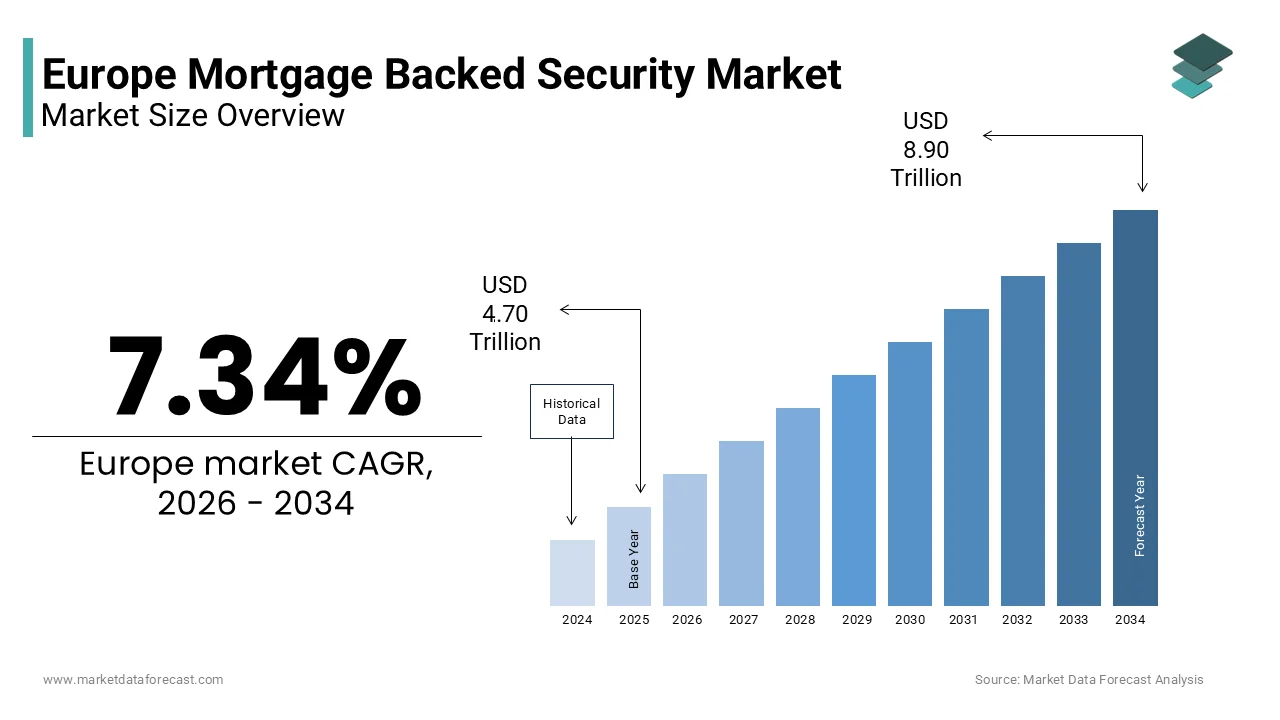
Market Size, 2025
$4.70 TnMarket Estimate, 2026
$5.05 TnMarket Forecast, 2034
$8.90 TnCAGR, 2026–2034
7.34%Europe Mortgage Backed Security Market Report Summary
The Europe mortgage backed security market was valued at USD 4.70 trillion in 2025, is estimated to reach USD 5.05 trillion in 2026, and is projected to reach USD 8.90 trillion by 2034, growing at a CAGR of 7.34% during the forecast period. The growth of the Europe mortgage backed security market is driven by increasing housing finance demand, expanding mortgage lending activities, and rising investor interest in structured financial instruments. Mortgage backed securities provide financial institutions with improved liquidity and risk distribution by converting mortgage loans into tradable assets. In addition, the strengthening of regulatory frameworks, growth in institutional investments, and the development of securitization markets are further supporting the expansion of the mortgage backed securities market across Europe.
Key Market Trends
- Growing demand for securitized mortgage assets among institutional investors seeking stable income generating investment opportunities.
- Increasing mortgage lending activities across European housing markets supporting the issuance of mortgage backed securities.
- Rising participation of private financial institutions in securitization activities to improve capital efficiency and liquidity management.
- Growing use of advanced risk assessment models and credit enhancement mechanisms to improve the stability of mortgage backed securities.
- Expansion of securitization frameworks and regulatory support aimed at strengthening the European capital markets ecosystem.
Segmental Insights
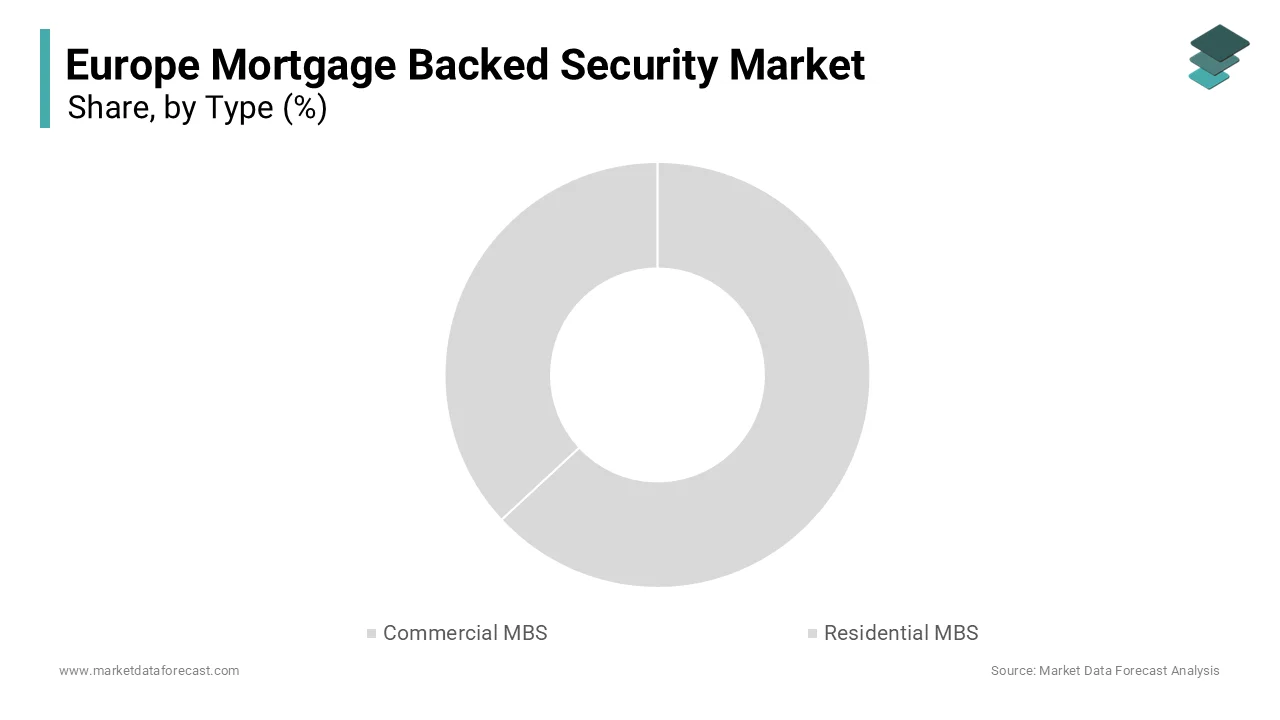
- Based on type, the residential mortgage backed securities segment held a significant share of the Europe mortgage backed security market in 2024. The dominance of this segment is attributed to the large volume of residential mortgage loans issued across European housing markets and the strong demand from investors for relatively stable and long term income generating securities.
- Based on issuer, the private financial institutions segment was the largest contributor to the Europe mortgage backed security market in 2024. Banks and financial institutions play a major role in originating mortgage loans and issuing securitized products to manage balance sheets, improve liquidity, and optimize capital allocation.
Regional Insights
- The Europe mortgage backed security market is experiencing steady growth across major economies due to the increasing demand for housing finance and expanding securitization activities within the financial sector.
- Germany accounted for the largest share of the Europe mortgage backed security market and held 29.3% of the regional market share in 2024. The country’s strong housing finance system, large banking sector, and well established securitization infrastructure are key factors supporting market growth.
- Other European countries are also witnessing increasing issuance of mortgage backed securities due to rising housing demand, expanding financial markets, and growing participation from institutional investors.
Competitive Landscape
The Europe mortgage backed security market is characterized by the presence of major banking institutions, investment firms, and asset management companies actively participating in securitization activities. Market players are focusing on expanding mortgage origination capabilities, strengthening risk management frameworks, and developing structured financial products to meet investor demand. Strategic collaborations, portfolio diversification, and technological advancements in financial analytics are helping institutions enhance their securitization strategies across the region. Prominent players in the Europe mortgage backed security market include BNP Paribas, Banco Santander, Crédit Agricole, Société Générale, UniCredit, Barclays, Deutsche Bank, HSBC, Cerberus Capital Management, and CQS.
Europe Mortgage Backed Security Market Size
The Europe mortgage backed security market size was valued at USD 4.70 trillion in 2025 and is projected to reach USD 8.90 trillion by 2034 from USD 5.05 trillion in 2026, growing at a CAGR of 7.34%.
The mortgage backed security is a structured financial instrument collateralized by pools of residential or commercial mortgage loans, issued primarily by banks and specialized originators to transfer credit risk and enhance liquidity. According to the study, outstanding residential mortgage backed securities in the euro area totaled 680 billion euros at the end of 2025, with significant concentration in Germany, France, and the Netherlands. As per the European Banking Authority, over 70% of newly issued RMBS transactions in 2025 achieved “Simple Transparent and Standardised” designation, a regulatory prerequisite for preferential capital treatment. This framework has gradually rebuilt investor confidence following the 2008 crisis, positioning European MBS as a cornerstone of sustainable housing finance rather than speculative leverage.
MARKET DRIVERS
European Central Bank’s Targeted Longer Term Refinancing Operations Stimulate Issuance
The continued use of Targeted Longer Term Refinancing Operations has created a powerful incentive for banks to issue mortgage backed securities by linking funding costs to credit performance. This factor is ascribed in fuelling the growth of Europe mortgage backed security market. Under TLTRO III which concluded in 2024 and its successor framework introduced in 2025, banks that demonstrate net lending growth, including through securitisation of performing mortgages and gain access to ECB funds at rates as low as minus 0.5%. Institutions like Credit Agricole and ING used TLTRO proceeds to originate prime mortgages and subsequently securitize them by recycling capital while maintaining client relationships. This aligns with the EU’s goal of promoting responsible lending while deepening capital markets.
Housing Shortages in Core Economies Drive Prime Mortgage Origination
The persistent housing deficits in major economies have fueled high quality mortgage origination, providing abundant collateral for prime mortgage backed securities, which is boosting the growth of Europe mortgage backed security market. According to Eurostat, the EU faces a shortfall of 6.5 million dwellings by 2030, with Germany alone requiring 400000 new units annually to meet demand a target it consistently undershoots by 100000 units. This imbalance sustains strong borrower demand and supports low delinquency rates on newly originated loans. Similarly, France’s National Housing Agency reports that 92% of new mortgages issued in 2025 featured fixed rates and amortizing structures, ideal for securitisation. These conditions enable banks like BNP Paribas and ABN AMRO to originate large volumes of standardized, low risk loans suitable for RMBS pooling.
MARKET RESTRAINTS
Fragmented Legal Frameworks Across Jurisdictions Increase Structuring Complexity
The absence of a harmonized pan European foreclosure and insolvency regime imposes significant legal and operational burdens on mortgage-backed security issuers, deterring cross border pooling and increasing transaction costs. In Germany, mortgage enforcement requires court approval and averages 18 months, whereas in Spain, extrajudicial sales can conclude in under six months, as per data from the European Judicial Network. This divergence complicates the creation of homogeneous collateral pools, forcing issuers to segment assets by country and apply jurisdiction specific credit enhancements. Furthermore, differences in consumer protection laws, such as France’s prohibition on variable rate mortgages for primary residences versus Italy’s flexible terms limit standardization of underlying loan contracts. The European Commission’s 2023 review of the Securitisation Regulation acknowledged these barriers but stopped short of proposing binding harmonization, citing subsidiarity principles.
Investor Base Remains Concentrated Among Domestic Banks and Insurance Firms
The limited investor diversification among domestic banks insurance companies and central banks is also hampering the growth of Europe mortgage backed security market. This narrow base reduces secondary market liquidity and increases vulnerability to regulatory or macroeconomic shocks affecting a single investor class. For example, when Solvency II capital charges were recalibrated in 2024, several German insurers reduced RMBS allocations by 12 to 15% within six months, triggering price volatility in peripheral tranches. Similarly, the ECB’s quantitative tightening program led to passive selling of RMBS from its portfolio, compressing spreads without broad private demand to absorb supply. In contrast, the US market benefits from deep participation by pension funds mutual funds and international accounts.
MARKET OPPORTUNITIES
Green Mortgage Backed Securities Unlock Sustainable Finance Flows
The emergence of green mortgage backed securities by aligning housing finance with the EU Taxonomy for sustainable activities is substantially to pose new opportunities for the growth of Europe mortgage backed security market. These instruments pool energy efficient mortgages, typically for properties rated A or B under national Energy Performance Certificate schemes and channel proceeds toward climate aligned housing. The EU’s Green Bond Standard, now explicitly includes energy efficient mortgages as eligible assets by enabling issuers to attract ESG mandated funds. Data from the Climate Bonds Initiative shows that certified green RMBS offer 15 to 25 basis points tighter pricing than conventional equivalents due to strong demand from asset managers like Amundi and Legal & General. Moreover, national governments are incentivizing origination, France’s MaPrimeRenov scheme provides subsidies for home retrofits by creating a pipeline of taxonomy aligned loans.
Integration with Covered Bond Frameworks Enhances Liquidity and Safety
The dual eligibility of mortgage assets for both covered bonds and securitisation offers a unique structural advantage by enabling issuers to optimize funding strategies and enhance investor confidence. The integration with covered bond frameworks enhances liquidity and safety, which is also a factor to escalate the growth of Europe mortgage back security market. Unlike other regions, European banks can place the same prime mortgage pool into either a covered bond program, which benefits from legislative protection and ECB repo eligibility or an RMBS structure offering greater capital relief. This flexibility was high during the 2023 liquidity crunch, when banks shifted issuance toward RMBS to meet capital requirements, while preserving covered bond buffers. Additionally, the overlap fosters a common due diligence standard, where rating agencies like Moody’s apply consistent collateral assessment methodologies across both instruments, reducing analytical friction.
MARKET CHALLENGES
Data Fragmentation Impedes Accurate Loan Level Disclosure
The inconsistent national data standards and legacy IT systems hinder timely and accurate disclosure, undermining investor trust and pricing efficiency. Each member state maintains separate mortgage registries with varying fields definitions and update frequencies, Germany’s Grundbuch records ownership but not loan terms, while Spain’s Catastro focuses on physical attributes. Consequently, RMBS trustees often rely on issuer provided data that may lack verification, leading to discrepancies in key metrics like loan to value or debt to income. Without interoperable digital infrastructure, the promise of transparent securitisation remains partially unfulfilled, deterring algorithmic investors who require clean structured datasets for portfolio integration.
Climate Physical Risk Exposure Threatens Collateral Valuation
The increasing frequency of climate related physical hazards are a systemic challenge to the collateral integrity of European mortgage backed securities in flood and wildfire prone regions. The climate physical risk exposure threatens collateral valuation is also to slow down the growth of Europe mortgage backed security market. According to the European Environment Agency, over 22% of EU residential properties face elevated flood risk, with hotspots in the Netherlands Rhine Valley and Northern Italy. Standard mortgage underwriting rarely incorporates granular climate risk scores, resulting in RMBS pools that may be overvalued relative to future insurability and habitability. The Network for Greening, the Financial System estimates that climate adjusted property values in high risk zones could decline by 15 to 30% by 2050, directly impacting loan to value ratios. Insurers are already responding, in France AXA discontinued coverage for new homes in high fire risk communes in 2024, potentially rendering associated mortgages ineligible for securitisation. Meanwhile, the ECB’s climate stress tests reveal that banks hold 180 billion euros in mortgage exposure to acute physical risks, much of which could migrate into RMBS structures.
REPORT COVERAGE
| REPORT METRIC | DETAILS |
| Market Size Available | 2025 to 2034 |
| Base Year | 2025 |
| Forecast Period | 2026 to 2034 |
| CAGR | 7.34% |
| Segments Covered | By Type, Issuer, and Region |
| Various Analyses Covered | Global, Regional, & Country Level Analysis; Segment-Level Analysis; DROC, PESTLE Analysis; Porter’s Five Forces Analysis; Competitive Landscape; Analyst Overview of Investment Opportunities |
| Regions Covered | UK, France, Spain, Germany, Italy, Russia, Sweden, Denmark, Switzerland, Netherlands, Turkey, and the Czech Republic |
| Market Leaders Profiled | BNP Paribas, Banco Santander, Crédit Agricole, Société Générale, UniCredit, Barclays, Deutsche Bank, HSBC, Cerberus Capital Management, and CQS. |
SEGMENTAL ANALYSIS
By Type Insights
The residential mortgage backed securities segment held a significant share of the Europe mortgage backed security market in 2024 owing to the sheer volume of prime residential lending, standardized underwriting practices, and preferential regulatory treatment under the EU’s Simple Transparent and Standardised framework. Unlike commercial mortgages which vary widely in structure and collateral quality, residential loans benefit from homogeneous documentation, amortizing schedules, and lower historical default rates. This stability makes RMBS highly attractive to insurance companies and pension funds seeking long duration assets with predictable cash flows. National housing policies reinforce this trend, where Germany’s KfW bank originated over 32 billion euros in energy efficient residential mortgages in 2025, much of which was securitized through its promotional programs. The convergence of data standardization, low credit risk, and policy alignment ensures residential MBS remains the structural backbone of Europe’s securitisation ecosystem.
The green residential mortgage backed securities segment is expected to register a fastest CAGR of 24.6% from 2025 to 2033. The EU Taxonomy for Sustainable Activities explicitly recognizes energy efficient residential mortgages, as environmentally sustainable when financing properties with Energy Performance Certificate ratings of A or B. La Banque Postale’s 2024 green RMBS deal pooled 1.2 billion euros of such mortgages by achieving pricing 22 basis points inside conventional equivalents due to strong ESG fund demand. With the EU requiring all new buildings to meet near zero energy standards by 2030, the stock of eligible collateral will expand exponentially, transforming green RMBS from niche product to mainstream issuance. Asset managers controlling trillions in assets under management, now operate under binding sustainability disclosure rules under SFDR Article 9, compelling them to allocate capital toward certified green instruments. As per the European Fund and Asset Management Association, Article 9 funds held in assets by end 2025, with fixed income allocations increasingly favoring green bonds and securitisations. Amundi and Legal & General have publicly committed to doubling green RMBS holdings annually through 2030.
By Issuer Insights
The private financial institutions segment was the largest by holding a prominent share of the Europe mortgage backed security market share in 2024 owing to the imperative to free up regulatory capital and enhance liquidity under Basel III and CRR II frameworks. Unlike the United States Europe lacks federal housing agencies with explicit government guarantees, placing securitisation squarely in the private domain as a risk transfer tool. Institutions like Credit Agricole BNP Paribas and ABN AMRO routinely securitize prime mortgage portfolios to reduce risk weighted assets and meet leverage ratio requirements. The European Central Bank’s TLTRO program further incentivized this behavior by linking cheap funding to net lending growth achievable through securitisation. Additionally, private issuers benefit from established servicing infrastructure and granular borrower data enabling precise structuring. This combination of regulatory necessity operational capability and monetary policy support ensures private institutions remain the engine of Europe’s MBS market.
The private financial institutions segment is deemed to witness a fastest CAGR of 28.3% from 2025 to 2033. New entrants like Germany’s GLS Bank Netherlands’ ASN Bank and France’s La Nef focus, exclusively on sustainable mortgages by creating high quality collateral pools ideal for green RMBS. These institutions partner with national energy agencies to verify retrofit compliance and embed EPC data into loan origination systems. Their lean digital infrastructure enables lower cost securitisation with full loan level transparency meeting both STS and EU Green Bond Standard criteria. Triodos Bank’s 2024 RMBS transaction achieved 100% allocation to Article 9 funds within hours of launch demonstrating strong investor appetite. This potential rule change creates powerful arbitrage for specialized lenders who can originate, securitize, and retain senior tranches at minimal capital cost. Even before formal adoption, supervisors like De Nederlandsche Bank encourage green securitisation through favorable Pillar II assessments. Combined with lower funding costs from ESG investors, this regulatory momentum enables rapid balance sheet turnover.
REGIONAL ANALYSIS
Germany Mortgage Backed Security Market Analysis
Germany was the largest contributor of the Europe mortgage backed security market by holding 29.3% of share in 2024 with its deep pool of prime residential mortgages, robust legal framework, and active participation of public promotional banks. The country’s Pfandbrief tradition provides a cultural and institutional foundation for secured lending, with investors viewing German RMBS as quasi covered bonds. The KfW, alone originated 32 billion euros in energy efficient mortgages, much of which fed into securitisation programs. The BaFin regulator enforces rigorous STS compliance, ensuring high data quality that attracts international investors. Additionally, Germany’s Energiewende policy mandates building retrofits, continuously expanding the stock of green eligible collateral. This blend of credit quality regulatory rigor and policy alignment makes Germany the undisputed core of Europe’s MBS ecosystem.
France Mortgage Backed Security Market Analysis
France mortgage backed security market held second position by holding 22.3% of the share in 2024 with the dominance in green mortgage backed securities and state supported origination infrastructure. The Caisse des Depots and La Banque Postale act as key conduits for national housing policy, channeling MaPrimeRenov subsidies into securitisable loan pools. According to France’s National Housing Agency, over 450000 energy retrofits were completed in 2025, creating abundant taxonomy aligned collateral. The French Prudential Supervision Authority actively encourages RMBS issuance through favorable capital treatment for STS deals. Moreover, France’s civil law system provides clear foreclosure procedures averaging nine months, faster than many peers enhancing investor confidence.
Netherlands Mortgage Backed Security Market Analysis
The Netherlands mortgage back security market growth is expected to have steady opportunities throughout the forecast period. The sophisticated institutional investor community and proactive integration of climate risk into mortgage underwriting is elevating the growth of mortgage backed security market in this country. Dutch pension funds like ABP and PGGM hold over 180 billion euros in fixed income assets and are early adopters of green RMBS to meet SFDR Article 9 mandates. According to recent study, all major Dutch banks now incorporate flood and heat stress scenarios into property valuations, ensuring RMBS collateral reflects physical climate risks. ING and ABN AMRO pioneered dynamic loan to value adjustments based on EPC ratings by creating differentiated risk pools suitable for structured finance.
Spain Mortgage Backed Security Market Analysis
Spain mortgage backed security market growth is driven with its post crisis recovery in mortgage lending and innovative use of digital platforms to originate securitisable loans. After years of deleveraging Spanish banks like Santander and CaixaBank resumed prime mortgage issuance in 2022, reaching 58 billion euros in new originations by 2025, according to the Bank of Spain. Digital lenders such as Housers and iAhorro accelerated this rebound by offering streamlined applications with automated valuation models compliant with ECB data standards.
Italy Mortgage Backed Security Market Analysis
Italy mortgage back security market growth is driven by the gradual deepening amid banking sector consolidation and EU funded housing initiatives. According to some study, new mortgage originations reached 42 billion euros in 2025, which was the highest since 2010 supported by the Superbonus 110 tax credit for energy retrofits. Though partially scaled back, the incentive generated over 200000 retrofit projects creating green collateral. Arrears remain elevated at 4.7% but are concentrated in non performing legacy portfolios excluded from securitisation. New STS compliant deals from Mediobanca and Banco BPM achieved strong placement with German insurers seeking yield pickup.
COMPETITIVE LANDSCAPE
Competition in the Europe mortgage backed security market is defined by institutional credibility regulatory compliance and access to high quality mortgage origination channels rather than pricing alone. Unlike the US market dominated by agency guarantees Europe’s landscape features commercial banks savings institutions and specialized lenders competing on collateral integrity transparency and sustainability alignment. Success hinges on achieving Simple Transparent and Standardised designation which requires rigorous data disclosure and homogeneous loan pools. Large universal banks like BNP Paribas and ING leverage their retail networks to source consistent collateral while smaller players such as Deutsche Pfandbriefbank differentiate through niche focus on energy efficient or social housing segments. Investor relationships are paramount as placements rely heavily on long term mandates from insurers and pension funds rather than speculative trading. Regulatory scrutiny from ESMA and national supervisors ensures only technically sound and well governed transactions gain market access creating high barriers to entry.
KEY MARKET PLAYERS
Some of the notable key players in the Europe mortgage backed security market are
- BNP Paribas
- Banco Santander
- Crédit Agricole
- Société Générale
- UniCredit
- Barclays
- Deutsche Bank
- HSBC
- Cerberus Capital Management
- CQS
Top Players in the Market
- BNP Paribas SA is a leading European financial institution with deep involvement in structuring and placing mortgage backed securities across the continent. The bank leverages its extensive retail mortgage origination network in France, Italy, and Belgium, to source high quality prime residential loans for securitisation. BNP Paribas acts as arranger underwriter and placement agent for both conventional and green RMBS transactions serving institutional investors globally.. The bank also enhanced its loan level reporting platform to meet ECB transparency mandates ensuring faster STS validation. These initiatives reinforce BNP Paribas’s role as a bridge between European housing finance and international capital seeking compliant fixed income exposure.
- Deutsche Pfandbriefbank AG specializes in real estate financing and has emerged as a key issuer of both residential and commercial mortgage backed securities in Germany and Central Europe. While rooted in the Pfandbrief tradition the bank actively structures RMBS to optimize regulatory capital and diversify funding sources beyond covered bonds. It focuses on energy efficient mortgages originating from its partnerships with KfW and regional housing associations. Deutsche Pfandbriefbank also invested in AI driven collateral monitoring systems to provide dynamic loan to value updates enhancing investor confidence in collateral integrity amid climate risk concerns.
- ING Groep NV plays a pivotal role in the Benelux mortgage backed security market through its integrated origination servicing and structuring capabilities. The bank originates prime Dutch and Belgian mortgages with full amortization and strict loan to value controls making them ideal for STS compliant securitisation. ING has pioneered climate adjusted underwriting by integrating flood and heat stress maps into property valuations ensuring future proof collateral pools. It completed a landmark RMBS transaction featuring dynamic tranching based on real time energy performance data from smart meters. ING also collaborates with Dutch pension funds to co-develop investor reporting templates that align with SFDR Article 9 requirements strengthening its position as a trusted partner in sustainable structured finance.
Top Strategies Used by the Key Market Participants
Key players in the Europe mortgage backed security market prioritize originating prime residential mortgages with low loan to value ratios and full amortization to meet STS criteria. They invest in digital underwriting platforms that embed energy performance and climate risk data into loan files enabling green securitisation. Institutions enhance transparency by adopting standardized loan level reporting aligned with ECB repository requirements. Strategic partnerships with national promotional banks and energy agencies ensure access to policy supported collateral pools. Additionally, firms develop dedicated ESG investor reporting frameworks to comply with SFDR and attract Article 9 fund allocations. Capital relief optimization through regulatory arbitrage between covered bonds and RMBS remains a core structuring objective driving issuance frequency and volume.
MARKET SEGMENTATION
This research report on the European mortgage backed security market has been segmented and sub-segmented based on categories.
By Type
- Commercial MBS
- Residential MBS
By Issuer
- Government Sponsored Enterprises (GSEs)
- Government Agencies
- Private Financial Institutions
By Country
- UK
- France
- Spain
- Germany
- Italy
- Russia
- Sweden
- Denmark
- Switzerland
- Netherlands
- Turkey
- Czech Republic
- Rest of Europe