- Product Description Description
- Table of Contents TOC
- List of Table & Figure LOT
- Get Free Sample PDF Sample PDF
Market Size, 2025
$1.91 BnMarket Estimate, 2026
$2.06 BnMarket Forecast, 2034
$3.70 BnCAGR, 2026–2034
7.63%Europe Motorsports Market Report Summary
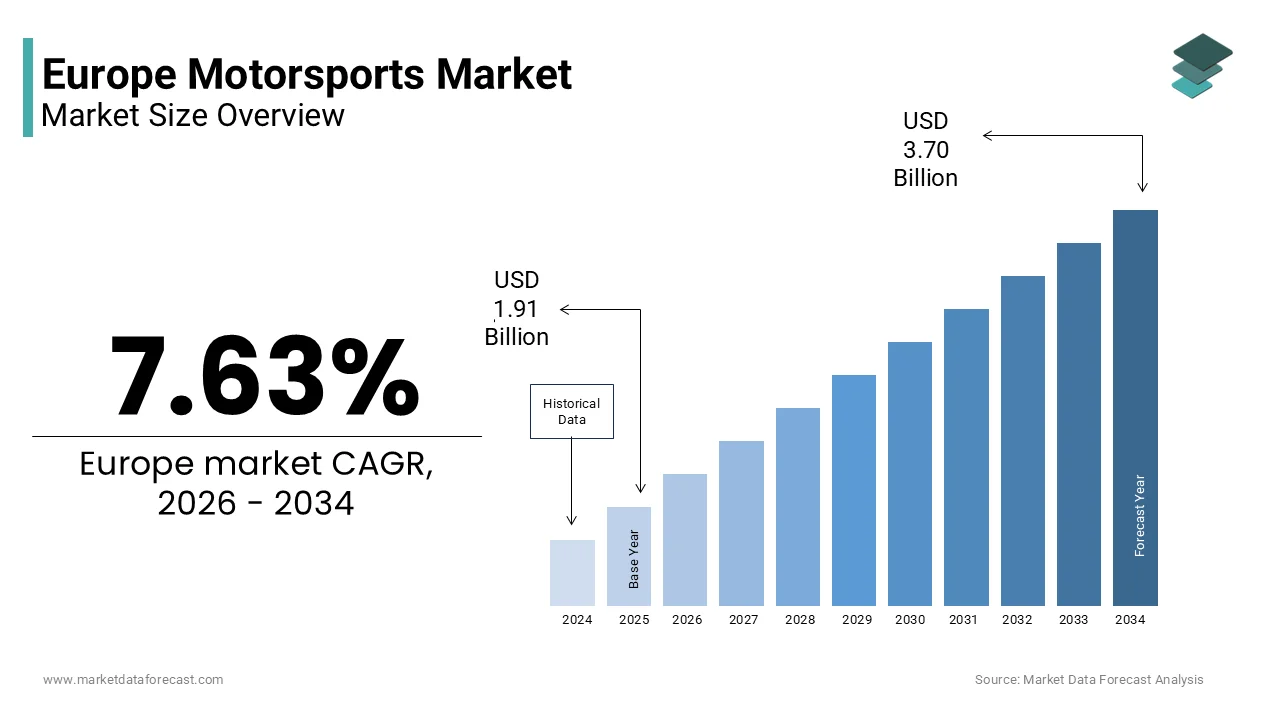
The Europe motorsports market was valued at USD 1.91 billion in 2025 and is projected to reach USD 3.70 billion by 2034 from USD 2.06 billion in 2026, growing at a CAGR of 7.63% during the forecast period. Market growth is driven by strong fan engagement, rising sponsorship investments, increasing media rights revenues, and expanding digital streaming platforms. The region’s deep rooted racing heritage, technological innovation in high performance vehicles, and growing interest in electric and hybrid racing formats are further accelerating the expansion of the Europe motorsports market.
Key Market Trends
- Rising commercial sponsorship and brand partnerships across major racing championships, enhancing revenue streams for teams and organizers.
- Increasing adoption of hybrid and electric racing series, supporting sustainability goals and attracting new audiences.
- Growth in digital broadcasting and direct to consumer streaming platforms, expanding global viewership and fan engagement.
- Advancements in automotive engineering, aerodynamics, and data analytics, strengthening competitive performance and technological innovation.
- Expansion of experiential fan events and motorsport tourism across key European racing circuits.
Segmental Insights
- Based on type, the race teams segment was the largest in the European motorsports market and accounted for a 48.6% share in 2025. The dominance of race teams is attributed to substantial investments in vehicle development, sponsorship deals, talent acquisition, and participation in multiple racing championships.
- Based on racing series, the GT racing segment captured a 35.1% share of the Europe motorsports market in 2025. The popularity of Grand Touring championships is driven by strong manufacturer participation, endurance racing appeal, and growing international audience interest.
- Based on discipline, the formula racing segment dominated the Europe motorsports market by holding a 42.7% share in 2025. Formula racing benefits from high media coverage, global fan base, advanced vehicle technology, and strong commercial backing.
Regional Insights
- The United Kingdom led the Europe motorsports market by accounting for a 32.5% share in 2025. The country’s leadership is supported by its concentration of leading racing teams, advanced engineering facilities, historic racing circuits, and a well established motorsport ecosystem.
- Other European countries also contribute significantly, supported by internationally recognized racing events, strong automotive manufacturing bases, and growing investments in electric racing championships.
Competitive Landscape
The Europe motorsports market is highly competitive and innovation driven, with leading teams and manufacturers investing heavily in research, aerodynamics, powertrain technology, and performance optimization. Strategic sponsorship agreements, global branding initiatives, and expansion into sustainable racing formats are key competitive strategies. Prominent players in the Europe motorsports market include Mercedes AMG, BMW Motorsport, McLaren Racing, Williams Racing, Red Bull Racing, Ferrari S.p.A, Aston Martin, Audi Sport, Porsche Motorsport, and Renault Sport.
Europe Motorsports Market Size
The Europe motorsports market size was valued at USD 1.91 billion in 2025 and is projected to reach USD 3.70 billion by 2034 from USD 2.06 billion in 2026, growing at a CAGR of 7.63%.
Motorsports refers to a global category of competitive sporting events that primarily involve the use of motorized vehicles for racing or non-racing competition. Unlike entertainment-driven markets, Europe’s motorsports sector functions as a high-performance engineering and innovation hub, where competition serves as a catalyst for automotive and materials technology advancement. The Fédération Internationale de l'Automobile oversees a Formula One calendar heavily reliant on traditional European venues, while the vast majority of competing teams maintain their primary design and manufacturing hubs within Europe, particularly in the United Kingdom. Similarly, as per the Fédération Internationale de Motocyclisme, European circuits host a substantial portion of the MotoGP calendar, while Italian and Spanish manufacturers, led by Ducati, dominate the technical development and success of the racing machines. Beyond elite categories, Europe sustains a dense network of national championships, karting academies, and historic racing events that feed talent and technology upward. Critically, the sector contributes significantly to regional economies. The UK's Motorsport Valley, a key area for high-performance engineering, generates immense annual economic value and provides substantial employment for engineers and technicians in the global racing industry, according to the Motorsport Industry Association. This blend of industrial relevance, cultural prestige, and technological spillover defines the European motorsports market as a strategic asset far beyond spectator sport.
MARKET DRIVERS
Europe as the Global Epicenter of Motorsport Engineering and Team Operations
The region’s unrivaled concentration of motorsport engineering expertise and team infrastructure serves as the primary driver of market activity, investment, and overall growth in the Europe motorsports market. The United Kingdom’s premier automotive corridor acts as a dense, self-sustaining ecosystem where specialized engineering firms collaborate to advance high-performance technologies. This industrial cluster serves as the primary international source for elite racing machinery and provides the foundational technical infrastructure for competitive motorsport worldwide. Similarly, Italy’s Emilia-Romagna region houses Ferrari Lamborghini and Ducati, integrating road car R&D with racing programs. This density enables rapid prototyping, knowledge exchange, and talent mobility that no other region matches. The presence of elite teams attracts OEMs seeking performance validation. BMW Porsche and Audi maintain factory programs specifically to leverage European technical ecosystems. This engineering gravity ensures continuous capital inflow, skilled employment, and technological leadership, making Europe not just a venue but the operational brain of global motorsport.
Deep Cultural Integration of Motorsport in National Identity and Media Consumption
Motorsport is deeply woven into the social and cultural fabric of several European nations, which fuels sustained public interest, media rights value, and youth participation, and the expansion of the Europe motorsports market. In Italy, Ferrari's legacy transcends sport, symbolizing national pride and engineering excellence; Scuderia Ferrari maintains a massive, predominantly European global fanbase, confirmed by team fan surveys. Similarly, Spain celebrates MotoGP champion Marc Márquez as a national icon, while Finland venerates its rally heritage through figures like Tommi Mäkinen. This cultural embedding translates into robust viewership. Formula One's Monaco Grand Prix continues to draw substantial live audiences, consistently ranking as one of the most-watched races of the season among European broadcasters and international viewers. National governments recognize this soft power. The French Ministry of Sports supports national karting academies, while the German Motorsport Federation licenses a vast number of active competitors, demonstrating strong, structured national commitment to motorsport development. This grassroots-to-glory pipeline ensures a loyal fan base, commercial sponsorship appeal, and political support for circuit infrastructure, creating a resilient demand foundation insulated from short-term economic shifts.
MARKET RESTRAINTS
Stringent Environmental Regulations and Urban Noise Restrictions
The tightening regulatory environment concerning emissions noise and land use directly threatens circuit viability and event scheduling, and it is a major restraint on the Europe motorsports market. The European Union’s Green Deal and national climate laws increasingly classify high decibel motorsport events as incompatible with urban sustainability goals. The European Environment Agency reports that a significant portion of Europeans are exposed to harmful transportation noise exceeding recommended thresholds, causing cities such as Paris and Zurich to adopt strict urban planning measures and noise abatement strategies, including restrictions on residential construction in noisy zones. Historic venues face existential pressure. The Nürburgring in Germany must adhere to strict curfews and sound barriers, limiting testing and event days. Additionally, proposed bans on internal combustion engines in several countries by 2035 cast uncertainty over traditional racing formats. These constraints increase operational costs, reduce revenue opportunities, and force organizers to invest heavily in mitigation technologies, thereby constraining market expansion despite strong fan interest.
High Operational Costs and Economic Volatility Impacting Team Sustainability
The escalating financial burden of competing at elite levels poses a significant barrier to team longevity and competitive diversity in the Europe motorsports market. The Formula One financial regulations introduced in 2021 set a performance-based spending ceiling that excludes driver salaries and power unit development, which allows top-tier teams to retain a competitive edge through higher spending in these areas, causing continued financial strain on independent teams. Analyses of Formula One team budgets suggest that reaching and maintaining competitiveness in the modern era requires total annual funding that far exceeds the base cost cap, making long-term sustainability challenging for teams lacking major manufacturer support or high-level sponsorship. Economic downturns exacerbate this fragility. The 2022 energy crisis forced several LMP2 endurance teams to withdraw due to surging logistics and material costs. Furthermore, reliance on sponsorships ties team solvency to corporate marketing budgets, which contract during recessions. This financial precarity discourages new entrants, reduces grid sizes, and concentrates success among well funded entities, undermining the sporting meritocracy that underpins fan engagement and long term market health.
MARKET OPPORTUNITIES
Electrification and Sustainable Fuels as Platforms for Technological Leadership
The region’s leadership in developing zero and low carbon racing technologies positions motorsport as a testbed for future mobility solutions, which is opening up new pathways augmenting the expansion of the Europe motorsports market. The FIA’s commitment to net zero by 2030 has accelerated adoption of sustainable fuels and electric powertrains across categories. Formula E, headquartered in London, showcases cutting edge battery and motor tech on city streets, with European manufacturers like Jaguar and Porsche using it for EV R&D. Simultaneously, the FIA-certified synthetic e-fuel, produced from captured CO2 and renewable energy, is being trialed in WRC and F1, with EU-based refineries like Aramco’s partnership in Germany scaling production. The European Commission’s Horizon Europe program has consistently directed substantial funding toward advanced green propulsion technologies within the mobility sector, supporting industry-led research projects aimed at reducing emissions and enhancing sustainable transportation solutions. Europe is flipping the script on regulation: by linking competition to climate policy, it has turned compliance into a global showcase for innovation that attracts investors and sets the gold standard for sustainable engineering.
Expansion of Digital Engagement and Esports Integration
The convergence of physical racing and digital platforms offers a major opportunity to broaden audience reach and create new revenue streams, which is likely to boost the growth of the Europe motorsports market. European motorsport bodies have aggressively embraced esports. Official Formula One virtual racing continues to serve as a vital platform for engaging a substantially younger demographic compared to conventional television, despite facing fluctuating viewership numbers following the pandemic-era peak. Teams like Mercedes and Alpine operate dedicated sim racing divisions that scout talent and engage fans through Twitch and YouTube. Motorsport gaming content has emerged as a significant segment of the digital entertainment landscape in Europe, drawing substantial engagement and consistent viewership across various online platforms. Additionally, NFT collectibles, metaverse experiences, and data-driven fan apps enhance interactivity. This digital layer not only mitimotorsports the impact of circuit access restrictions but also builds global communities around European teams and events, turning passive spectators into active participants and opening monetization avenues beyond ticketing and broadcasting.
MARKET CHALLENGES
Geopolitical Fragmentation and Divergent National Policies
The lack of harmonized regulations across member states regarding noise emissions land zoning and event permitting complicates cross border logistics and long term planning, which is a critical challenge facing the Europe motorsports market. The implementation of broad EU environmental directives is far from uniform, as demonstrated by a circuit expansion permitted in Spain that could be blocked under more stringent German local ordinances. Planned infrastructure upgrades for European motorsport venues often experience scheduling delays due to inconsistent and complex regional permitting processes. This fragmentation increases legal uncertainty and deters investment in pan European series. Moreover, post Brexit customs checks add days to freight transit for UK-based teams shipping equipment to continental races, raising costs and risking missed deadlines. Europe’s logistical edge is at risk of being surpassed by centralized markets in North America or the Middle East unless regulatory alignment increases.
Talent Drain to Non Motorsport High Tech Sectors
Retaining top engineering talent remains an obstacle within the Europe motorsports market. This is due to competition from higher-paying and more stable industries, such as aerospace, renewable energy, and software development. Engineers graduating from United Kingdom motorsport programs are increasingly pursuing roles in electric vehicle and battery startups, driven by career stability and alignment with sustainability trends. Research confirms that initiatives like Formula Student are shifting toward high-performance electric vehicle development. The seasonal nature of racing, with layoffs between championships, further discourages long term career commitment. Meanwhile, emerging economies offer lucrative packages to experienced European engineers, accelerating brain drain. This attrition weakens the technical depth of teams and suppliers, slowing innovation cycles and increasing reliance on automation. Europe’s motorsport sector faces losing its top competitive edge, its human capital, unless it improves career pathways, wages, and academic partnerships.
REPORT COVERAGE
| REPORT METRIC | DETAILS |
| Market Size Available | 2025 to 2034 |
| Base Year | 2025 |
| Forecast Period | 2026 to 2034 |
| CAGR | 7.63% |
| Segments Covered | By Type, Racing Series, Revenue Channel, and Region |
| Various Analyses Covered | Global, Regional, & Country Level Analysis; Segment-Level Analysis; DROC, PESTLE Analysis; Porter’s Five Forces Analysis; Competitive Landscape; Analyst Overview of Investment Opportunities |
| Regions Covered | UK, France, Spain, Germany, Italy, Russia, Sweden, Denmark, Switzerland, Netherlands, Turkey, and the Czech Republic |
| Market Leaders Profiled | Mercedes AMG (Germany), BMW Motorsport (Germany), McLaren (UK), Williams Racing (UK), Red Bull Racing (UK/Austria), Ferrari S.p.A (Italy), Aston Martin (UK), Audi Racing Team (Germany), Porsche Motorsport (Germany) and Renault Sport (France) |
SEGMENTAL ANALYSIS
By Type Insights
The race teams segment was the largest segment of the European motorsports market and accounted for a 48.6% share in 2025. The supremacy of the segment is attributed to its central role as technology integrators, brand ambassadors, and primary employers within the ecosystem. European-based teams, particularly in Formula One, Formula E, and MotoGP, operate as high-performance engineering firms that design, build, and race vehicles while managing complex logistics across global calendars. The Motorsport Industry Association highlights that a substantial majority of the world’s elite racing teams maintain their headquarters within Europe, with the United Kingdom hosting the vast majority of Formula One constructors and their supporting operations. These teams generate income not only from prize money but also from OEM partnerships, technical consulting, and component sales to customer racing programs. For instance, Mercedes-AMG Petronas supplies power units to three other F1 teams, creating a significant B2B revenue stream. The concentration of talent, infrastructure, and intellectual property within European race teams makes them the economic and innovative core of the continental motorsport landscape.
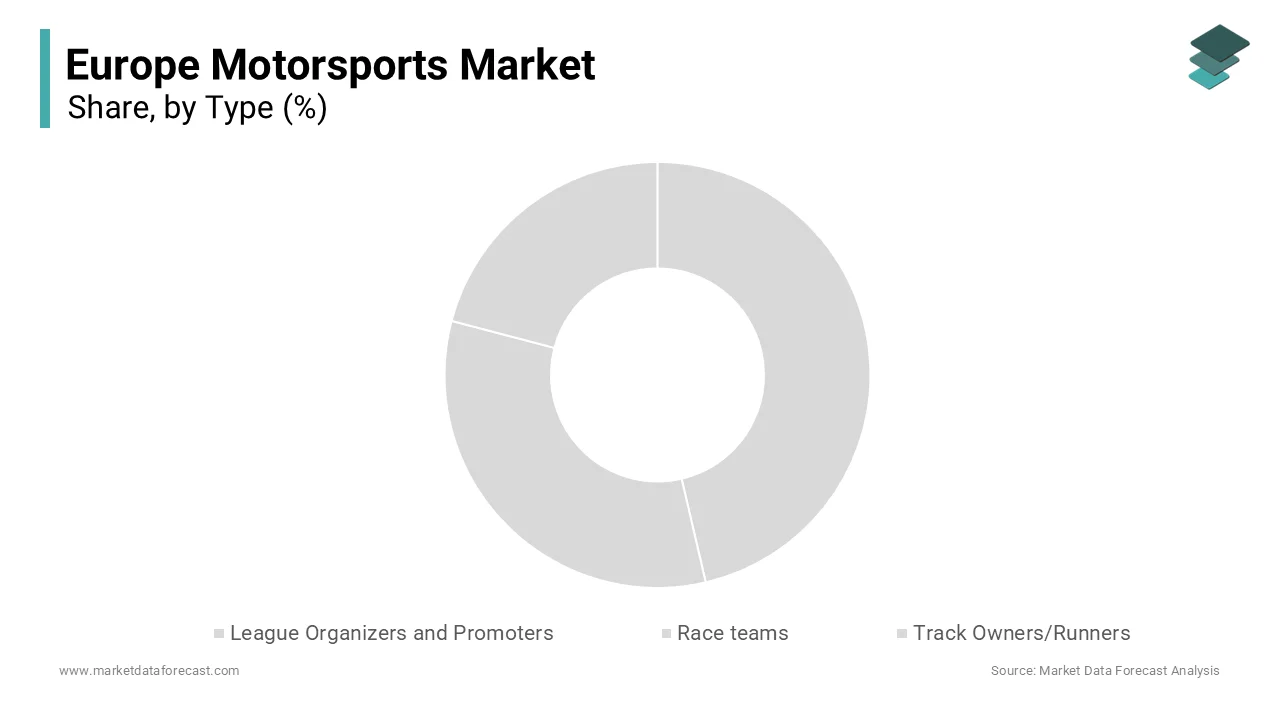
The track owners and operators segment is likely to experience the fastest CAGR of 6.9% from 2026 to 2034 due to the diversification of circuit usage beyond race weekends into year-round experiential and testing facilities. Historic venues like Silverstone and Circuit de Barcelona-Catalunya now host corporate driving experiences, EV manufacturer testing days, and sim racing events, generating stable off-season revenue. Following the pandemic, professional racing venues have shifted their business models, with income from non-race activities, such as corporate driving experiences, testing, and leisure events, now representing the majority of total revenue, marking a significant increase over pre-pandemic levels. Additionally, EU funding under the Connecting Europe Facility has supported upgrades to safety and sustainability standards, enabling tracks to qualify for international FIA Grade 1 certification. Municipalities also recognize circuits as tourism assets. The Nürburgring continues to attract a massive volume of tourists for public driving sessions, serving as a primary contributor to the regional economy through, hospitality, and tourism-related services. This shift from event-dependent to diversified business models ensures resilient growth even amid regulatory pressures on traditional racing.
By Racing Series Insights
The GT (Grand Touring) racing segment captured the majority share of 35.1% of the Europe motorsports market in 2025. The prominence of the segment is supported by direct manufacturer involvement, road-relevant technology, and accessible competition formats. Series like the Fanatec GT World Challenge Europe feature production-based cars from Porsche Ferrari Lamborghini and BMW, allowing brands to showcase performance derivatives while controlling costs through Balance of Performance regulations. The European GT3 racing landscape continues to expand, with premier endurance events regularly attracting large, diverse grids from numerous international manufacturers through a well-established customer competition framework. The format appeals to both professional works drivers and affluent amateur gentlemen racers, ensuring full grids and strong sponsorship appeal. Moreover, GT racing’s endurance elements, such as the 24 Hours of Spa, generate high media engagement. The marquee endurance event at Spa-Francorchamps has seen a significant rise in on-site attendance and continues to broaden its international reach through accessible global digital streaming platforms and multi-language broadcasts. This blend of manufacturer relevance, competitive depth, and spectator drama solidifies GT racing as the cornerstone of European sports car competition.
The one-make racing series segment is on the rise and is expected to be the fastest growing segment in the market by witnessing a CAGR of 8.3% during the forecast period owing to manufacturer strategies to engage customers, develop young talent, and promote new road models. These championships, such as the Porsche Carrera Cup, Ferrari Challenge, and Alpine Elf Cup, offer standardized vehicles that ensure close competition while minimizing team operating costs. According to Porsche Motorsport, European one-make series experienced significant, high-volume demand for grid spots in 2023, with a substantial majority of the field comprising privateer owners who leverage the competitive platform for networking, business, and personal branding opportunities. National motorsport federations also endorse these series as entry points into professional racing. The French FFSA integrates Alpine Cup results into its driver ranking system. Additionally, digital integration, live timing apps and onboard streaming, enhances fan engagement. One-make series are fast-tracking their way to the top, slashing entry costs and plugging directly into brand networks to become the ultimate launchpad for the continent's next generation of racers.
By Discipline Insights
The formula racing segment dominated the Europe motorsports market by holding a 42.7% share in 2025. Europe serves as the operational heart of this category, hosting the majority of teams, suppliers, and races. The Formula One calendar, overseen by the FIA, continues to feature a significant, albeit reduced, presence of traditional European races alongside a growing number of global events. The region’s concentration of aerodynamicists composite engineers and data scientists creates an unmatched innovation cluster. The high-performance engineering cluster known as the UK's Motorsport Valley serves as a major driver of economic growth and high-skilled employment, with a significant majority of Formula One teams based there. Formula racing’s strict technical regulations drive R&D spillovers into road car sectors, reinforcing OEM investment. Furthermore, its global broadcast reach makes it the most valuable promotional platform for sponsors, ensuring sustained financial inflow and media dominance across the European landscape.
The rally and off-road racing segment is expected to exhibit a noteworthy CAGR of 7.6% from 2026 to 2034. The swift expansion of the segment is fuelled by the FIA’s introduction of Rally1 hybrid regulations in 2022, which mandate 100-kilowatt electric motors alongside internal combustion engines, aligning the sport with EU sustainability goals. According to the FIA, the core group of manufacturer entries in the top category of the World Rally Championship remained stable, with Hyundai, Toyota, and M-Sport Ford continuing their participation from 2021 through 2023. National championships in Finland Sweden and Spain have also adopted hybrid or electric categories, attracting new teams and sponsors. The discipline’s cinematic appeal, broadcasts featuring dramatic landscapes and unpredictable conditions, resonates strongly with digital audiences. In 2023, the WRC+ All Live streaming service experienced continued growth in subscriptions across Europe, reflecting an increasing consumer preference for digital, on-demand motorsport coverage. Additionally, rally’s accessibility, requiring public roads rather than expensive circuits, lowers entry barriers for organizers and fans alike, fostering grassroots participation and regional tourism development across rural Europe.
REGIONAL ANALYSIS
United Kingdom Motorsports Market Analysis
The United Kingdom led the Europe motorsports market by accounting for a 32.5% share in 2025. The leading of the UK market is driven by “Motorsport Valley,” a high-density cluster of large number of specialized firms spanning Oxfordshire Northamptonshire and the West Midlands. This ecosystem supports Formula One teams either headquartered or operating major facilities in the UK including Mercedes Red Bull and McLaren. According to the Motorsport Industry Association, the United Kingdom's motorsport and high-performance engineering sector supports a vast network of specialized jobs and generates substantial annual turnover, driven by a high-skill workforce and strong export demand. The UK also hosts iconic events like the British Grand Prix and Silverstone-based championships, drawing millions in tourism revenue. Despite Brexit, the country maintains technical leadership through strong university partnerships and continued OEM investment, making it the undisputed engineering nucleus of global motorsport.
Italy Motorsports Market Analysis
Italy followed closely in the Europe motorsports market and occupied a share of 22.8% share in 2025. The growth of the Italian market is propelled by its deep integration of motorsport into national automotive identity. Home to Ferrari Lamborghini Ducati and Aprilia, Italy leverages racing as a proving ground for road car innovation and brand prestige. The racing division of the Italian luxury brand, through its extensive operations, global sponsorships, and merchandise sales, provides a substantial, consistent, and significant boost to the national economy, cementing its role as a premier industrial and cultural ambassador. The country hosts legendary events including the Italian Grand Prix at Monza and the San Marino MotoGP round, which attract hundreds of thousands of spectators. Moreover, Italian design houses like Pininfarina collaborate closely with race teams on aerodynamics and aesthetics. This fusion of engineering passion cultural heritage and industrial policy ensures Italy remains a strategic pillar of European motorsport.
Germany Motorsports Market Analysis
Germany is another key player in the European motorsports market due to its reputation for engineering rigor and OEM-backed competition. Mercedes-AMG Porsche and Audi maintain factory programs across Formula One Formula E and endurance racing, channeling motorsport R&D into high-performance road vehicles. The Deutscher Motor Sport Bund (DMSB) maintains extensive grassroots participation across national championships, highlighting a robust, widespread engagement in German motorsport. Moreover, the Nürburgring remains a premier, essential, and notoriously demanding proving ground for international automotive manufacturers while simultaneously operating as a major, popular destination for tourist drivers and enthusiasts. Germany’s dual education system also produces a steady pipeline of skilled technicians through vocational motorsport academies. This combination of industrial might technical discipline and public participation sustains Germany’s influential role in shaping European racing standards.
France Motorsports Market Analysis
France is moving ahead steadfastly in the Europe motorsports market owing to its institutional influence and structured talent development pathways. As the headquarters of the Fédération Internationale de l’Automobile, France shapes global motorsport regulations including sustainability mandates and safety protocols. The French Federation of Automobile Sport manages a comprehensive, nationally supported talent development system, mentoring drivers from competitive karting through to top-tier formula racing. Alpine’s return to Formula One and success in endurance racing revitalized domestic interest, while the 24 Hours of Le Mans serves as a major driver of regional economic activity in France, producing substantial annual income through tourism, hospitality, and local, specialized supplier expenditure. Additionally, France leads in promoting electric motorsport through Formula E and hydrogen rally pilots. This blend of regulatory authority systematic training and innovation advocacy positions France as a forward-looking architect of motorsport’s future.
Spain Motorsports Market Analysis
Spain is likely to expand in the Europe motorsports market over the forecast period by leveraging its favorable climate extensive circuit network and strategic location to become Europe’s premier motorsport event hub. The country hosts multiple top-tier races including the Spanish Formula One Grand Prix Catalan MotoGP and World Rally Championship rounds. Following the removal of track restrictions and increased popularity, major Spanish motorsport events during 2023 saw a surge in spectator numbers, resulting in significant economic benefits for the tourism sector. Circuits like Circuit de Barcelona-Catalunya and MotorLand Aragón offer year-round testing due to mild winters, attracting teams from across Europe. Spain also invests in youth development through the “Escuela Española de Pilotos” which has produced champions like Carlos Sainz Jr. This combination of geographic advantage infrastructure investment and talent cultivation establishes Spain as a dynamic and commercially vital node in the European motorsport ecosystem.
COMPETITIVE LANDSCAPE
The Europe motorsports market features intense rivalry among factory backed teams independent constructors and event promoters, all operating under tightening financial and environmental constraints. Competition is no longer solely about on track results but encompasses technological innovation sustainability credentials and digital audience engagement. Factory teams from Germany Italy and the UK dominate elite categories due to OEM funding yet face pressure from cost caps and regulatory shifts toward electrification. Independent teams survive through niche specialization in customer racing or historic events. Meanwhile circuit operators compete to host premier series by upgrading infrastructure to meet FIA safety and noise standards. The market is increasingly polarized between well capitalized entities that can afford hybrid R&D and smaller players reliant on grassroots participation. Success now depends on balancing sporting excellence with regulatory compliance brand storytelling and economic resilience in a rapidly transforming mobility landscape.
KEY MARKET PLAYERS
Some of the notable key players in the Europe motorsports market are
- Mercedes AMG
- BMW Motorsport
- McLaren Racing
- Williams Racing
- Red Bull Racing
- Ferrari S.p.A
- Aston Martin
- Audi Sport
- Porsche Motorsport
- Renault Sport
Top Players in the Market
- Mercedes AMG Petronas Formula One Team is a British based racing outfit headquartered in Brackley England and represents one of the most technologically advanced and successful entities in European motorsport. The team serves as a global showcase for Mercedes Benz’s engineering prowess, directly influencing road car development in hybrid powertrains aerodynamics and data analytics. To strengthen its position, the team has invested heavily in sustainable fuel research and digital twin simulation technologies to optimize performance within FIA cost cap constraints. It also expanded its esports division to engage younger audiences and launched a technical consultancy arm offering CFD and materials expertise to non automotive sectors. These initiatives reinforce Mercedes’ leadership while extending its influence beyond the racetrack into broader industrial innovation.
- Scuderia Ferrari S.p.A. is Italy’s iconic Formula One team and the oldest continuously competing constructor in the sport’s history. Beyond racing, Ferrari leverages its motorsport heritage to drive brand exclusivity and technological credibility for its road cars. The team has reinforced its market presence by accelerating development of its hybrid power unit under the FIA’s engine regulations and investing in a new wind tunnel facility in Maranello compliant with EU energy efficiency standards. Ferrari also deepened integration between its Corse Clienti customer racing programs and its luxury lifestyle ecosystem, offering track experiences to high net worth clients. These actions preserve its cultural prestige while ensuring technical relevance in an era of electrification and sustainability mandates.
- Porsche Motorsport GmbH is a German racing division renowned for its dominance in endurance and GT racing across Europe. The company plays a pivotal role in validating Porsche’s electric and hybrid technologies through competition in Formula E and the FIA World Endurance Championship. To strengthen its position, Porsche launched a fully factory backed LMDh prototype program targeting overall victories at Le Mans and expanded its one make Carrera Cup series into Eastern Europe. It also established a sustainability task force to achieve carbon neutral race operations using biofuels and renewable logistics. These efforts align motorsport with corporate environmental goals while reinforcing Porsche’s reputation for engineering excellence and accessibility in customer racing.
Top Strategies Used by the Key Market Participants
Key players in the Europe motorsports market are primarily focused on integrating sustainability through synthetic fuels electrification and carbon neutral operations while maintaining competitive performance. Teams are investing in digital engineering tools like AI driven simulation and real time telemetry to maximize efficiency under cost caps. Strategic expansion of customer racing and experiential offerings such as driving academies and esports creates diversified revenue streams. Collaboration with OEMs ensures technology transfer to road cars enhancing brand value. Additionally firms are leveraging their heritage to build emotional engagement through content creation and fan communities while complying with evolving EU environmental and labor regulations to secure long term operational licenses.
MARKET SEGMENTATION
This research report on the European motorsports market has been segmented and sub-segmented based on categories.
By Type
- League Organizers and Promoters
- Race teams
- Track Owners/Runners
By Racing Series
- One-Make Series
- Porsche Supercup
- Ferrari Challenge
- Lamborghini Super Trofeo
- Others
- Touring Car Racing
- World Touring Car Championship
- BTCC
- DTM
- Others
- Stock Car Racing
- NASCAR
- ARCA Menards Series
- Others
- GT Racing
- GT Series World Challenge (Blacpain GT Series)
- Super GT
- Intercontinental GT Challenge
- Others
- Endurance Racing
- World Endurance Championship (WEC)
- IMSA WeatherTech SportsCar Championship
- 24H Series
- Others
- Rally and Off-Road Racing
- World Rally Championship (WRC)
- European Rally Championship (ERC)
- Dakar Rally
- SCORE International Off-Road Racing
- Extreme E
- NHRA Drag Racing Series
- Others
- Formula Racing
- Formula 1
- Formula 2
- Formula E
- IndyCar
- Others
- Motorbike Racing
- MotoGP
- WorldSBK
- FIM EWC
- SuperMotoCross Championship (MX)
- British SuperBikes (BSB)
- MotoCross World Championship (MXGP)
- MotoAmerica Superbike Championship
- Others
By Revenue Channel
- Broadcasting
- Ticketing
- Sponsorship
- Merchandising
By Country
- UK
- France
- Spain
- Germany
- Italy
- Russia
- Sweden
- Denmark
- Switzerland
- Netherlands
- Turkey
- Czech Republic
- Rest of Europe