Europe Nanomaterials Market Size, Share, Trends, & Growth Forecast Report By Material (Gold (Au), Silver (Ag), Iron (Fe), Copper (Cu), Platinum (Pt), Titanium (Ti), Nickel (Ni), Other Nanomaterials), Application and Country (UK, France, Spain, Germany, Italy, Russia, Sweden, Denmark, Switzerland, Netherlands, Turkey, Czech Republic and Rest of Europe), Industry Analysis From 2025 to 2033
Europe Nanomaterials Market Size
The Europe Nanomaterials Market size was valued at USD 4.39 billion in 2024 and is anticipated to reach USD 5.05 billion in 2025 from USD 15.54 billion by 2033, growing at a CAGR of 15.09% during the forecast period from 2025 to 2033.
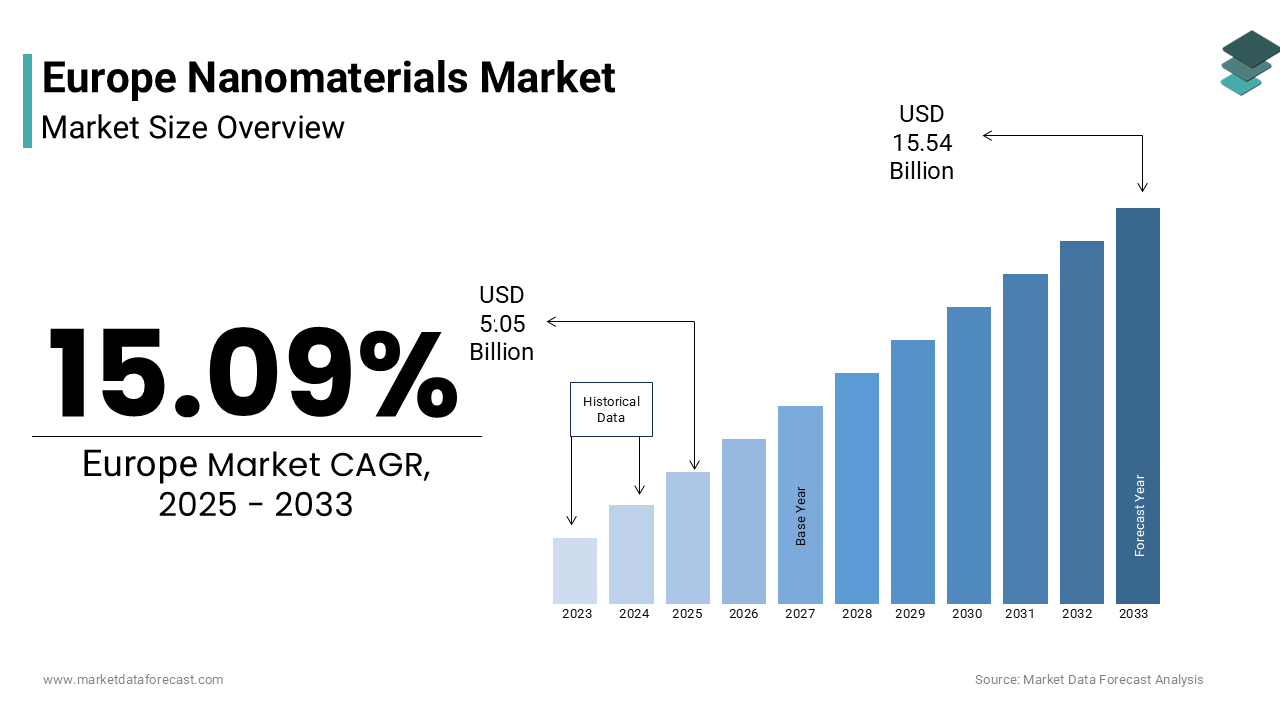
The nanomaterials is an engineered materials with at least one external dimension or internal structure measuring between one and one hundred nanometers, leveraging unique physicochemical properties for advanced applications. These materials are integral to sectors including electronics, automotive, healthcare, energy, and packaging, where performance enhancement and miniaturization are critical. Europe’s prominence in scientific research and industrial innovation positions it as a key region in nanomaterial development. Regulatory frameworks such as the European Chemicals Agency’s updated guidance on nanoforms under REACH further shape market dynamics by defining safety and registration protocols.
MARKET DRIVERS
Accelerated Adoption in Automotive Lightweighting Initiatives
The European automotive industry’s rigorous decarbonization mandates have intensified demand for nanomaterials that enable vehicle lightweighting without compromising structural integrity. This factor is solely attributed to accelerating the growth of the Europe nanomaterials market. Nanocomposites incorporating carbon nanotubes and nano clays reduce vehicle weight by up to twenty percent compared to conventional materials, which is directly lowers fuel consumption and emissions. As per recent studies, over 90% of new passenger vehicles produced in the European Union in 2024 integrated advanced materials, including nanomaterial based components, to meet the fleet wide average emissions target of 95 grams of carbon dioxide per kilometer. Moreover, the European Commission’s Fit for 55 package mandates a 55% reduction in car emissions by 2030 relative to 2021 levels, further accelerating material innovation. Companies, such as BMW and Renault have publicly committed to increasing nano reinforced polymer usage in chassis and interior systems. This regulatory and industrial convergence ensures sustained demand for high performance nanomaterials across the automotive value chain, which is positioning lightweighting not merely as a design preference but as a compliance imperative.
Expansion of Nanomedicine Applications in Oncology and Diagnostics
The aging population and rising cancer incidence are other factors prompting the growth of the European nanomaterials market. Nanoparticle based drug delivery systems enhance bioavailability, reduce systemic toxicity, and improve tumor targeting, addressing limitations of conventional chemotherapy. According to the World Health Organization, the regional office for Europe, cancer incidence is projected to increase by 33% by 2035, with over four million new cases annually across the continent. In response, the European Medicines Agency has approved over 15 nanomedicine formulations, since 2020, including liposomal doxorubicin and albumin bound paclitaxel. Additionally, Horizon Europe has allocated more than 300 million euros to nanomedicine research under its health cluster, which is emphasizing translational development. Academic medical centers in Germany, France, and the Netherlands are leading clinical trials involving gold nanoparticles for photothermal therapy and quantum dots for early stage imaging.
MARKET RESTRAINTS
Stringent and Evolving Regulatory Classification Under REACH
The European Union’s regulatory environment under the Registration Evaluation Authorisation and Restriction of Chemicals framework, which imposes significant compliance burdens on nanomaterial producers due to evolving definitions and data requirements for nanoforms. The stringent and evolving regulatory classification under REACH is restricting the growth of Europe nanomaterials market. Since 2020, the European Chemicals Agency has mandated separate registration dossiers for each nanoform of a substance, drastically increasing administrative and testing costs. According to the European Chemicals Agency, over 600 nanoforms were registered by the end of 2023, yet compliance gaps persist, with nearly 40% of dossiers requiring resubmission due to insufficient physicochemical characterization. Furthermore, the classification of certain nanomaterials as substances of very high concern under REACH triggers authorization requirements that can delay commercialization timelines by 18 to 24 months. The regulatory uncertainty remains the single largest barrier to nanomaterial innovation in Europe, with companies citing inconsistent interpretation of nanoform definitions across member states.
High Production Costs and Limited Scalability of Advanced Nanomaterials
The commercial viability is hindered by prohibitive manufacturing expenses and technical issues in achieving consistent large-scale synthesis is additionally limiting the growth of Europe nanomaterials market. Techniques, such as chemical vapor deposition for graphene or sol gel processes for silica nanoparticles require ultra-pure precursors, controlled atmospheres, and energy intensive protocols, resulting in production costs that can exceed those of conventional materials by three to five times. According to the Fraunhofer Institute for Manufacturing Engineering and Automation, the average cost to produce one kilogram of high quality multi walled carbon nanotubes in Europe ranges between two hundred and four hundred euros, compared to under one hundred euros for industrial grade carbon black. European manufacturers also face competition from Asian producers who benefit from state subsidized scale and lower energy costs.
MARKET OPPORTUNITIES
Integration of Nanomaterials in Green Hydrogen and Energy Storage Systems
Europe’s strategic pivot toward energy sovereignty and decarbonization has unlocked significant opportunities for nanomaterials in green hydrogen production and advanced battery technologies, which is creating new opportunities for the growth of Europe nanomaterials market. Nanostructured catalysts, particularly those based on platinum group metal free formulations incorporating iron nitrogen carbon frameworks, enhance the efficiency of proton exchange membrane electrolyzers by reducing overpotential losses by up to 30%. According to the European Clean Hydrogen Alliance, the European Union aims to install forty gigawatts of electrolyzer capacity by 2030, which is creating substantial demand for high performance electrode materials. Simultaneously, silicon nano anodes and solid state electrolytes incorporating lithium lanthanum zirconium oxide nanoparticles are poised to revolutionize electric vehicle batteries by increasing energy density beyond four hundred watt hours per kilogram. The European Battery Alliance reports that over 25 new gigafactories are under development across the continent, with projected annual output exceeding eight hundred gigawatt hours by 2030. Public funding mechanisms such as the Important Projects of Common European Interest have allocated over 6 billion euros to battery innovation, with nanomaterial integration as a core priority. These initiatives signal a structural shift wherein nanomaterials transition from performance enhancers to foundational enablers of Europe’s clean energy architecture by offering durable commercial pathways beyond traditional industrial applications.
Emergence of Circular Economy Mandates Driving Nano enabled Recycling Technologies
The European Union’s Circular Economy Action Plan has investment in nanotechnology based solutions for material recovery and waste stream valorization, opening a novel opportunity for functional nanomaterials. Nanostructured membranes and magnetic nanoparticles are increasingly deployed to separate raw materials from complex waste matrices, such as recovering rare earth elements from end-of-life electronics or lithium from spent batteries. According to the European Environment Agency, electronic waste generation in the European Union reached 12 million metric tons in 2023, with less than 40% formally recycled. Nanofiltration systems using titanium dioxide coated membranes have demonstrated recovery rates exceeding 90% for cobalt and nickel from battery leachates in pilot facilities operated by Umicore and Solvay. Startups across Belgium, Finland, and Sweden are commercializing nano adsorbents that selectively bind target metals at parts per billion concentrations, significantly outperforming conventional solvent extraction. This regulatory push toward resource autonomy transforms nanomaterials from passive components into active agents of circularity, which is positioning Europe at the forefront of sustainable materials engineering.
MARKET CHALLENGES
Persistent Knowledge Gaps in Long Term Environmental and Health Impacts
The absence of conclusive long term data on the ecotoxicological and human health effects of engineered nanomaterials continues to impede widespread acceptance and standardization is declining the growth of Europe nanomaterials market. The unique reactivity and bio persistence of nanoparticles raise concerns about accumulation in soil, water, and biological systems, yet chronic exposure studies remain limited in scope and duration. According to a 2024 assessment by the European Food Safety Authority, fewer than 10% of nanomaterials in commercial use have undergone comprehensive multi-generational toxicity testing in mammals. These knowledge gaps fuel public skepticism and complicate risk communication, particularly in sensitive applications like food packaging or agricultural inputs.
Fragmented Cross Border Collaboration in Nanomanufacturing Infrastructure
The lack of harmonized manufacturing infrastructure and standardized metrology across member states by hindering economies of scale and technology transfer, which is another factor degrading the growth of Europe nanomaterials market. While countries like Germany and France host advanced pilot lines for carbon nanotubes and quantum dots, many Southern and Eastern European nations lack access to clean room facilities or nanoparticle characterization tools. According to the European Commission’s 2024 Innovation Scoreboard, the disparity in nanotechnology infrastructure investment between leading and lagging regions exceeds a factor of five, creating bottlenecks in supply chain integration. This fragmentation increases costs for multinational companies that must validate materials separately for each market and discourages collaborative production networks.
REPORT COVERAGE
| REPORT METRIC | DETAILS |
| Market Size Available | 2024 to 2033 |
| Base Year | 2024 |
| Forecast Period | 2025 to 2033 |
| Segments Analysed | By Material, Application and region |
| Various Analyses Covered | Global, Regional & Country Level Analysis; Segment-Level Analysis, Drivers, Restraints, Opportunities, Challenges; PESTLE Analysis; Porter's Five Forces Analysis, Competitive Landscape, Analyst Overview of Investment Opportunities |
| Regions Analysed | United Kingdom, France, Spain, Germany, Italy, Russia, Sweden, Denmark, Switzerland, the Netherlands, Turkey, and the Czech Republic. |
| Key Market Players | Arkema S.A., Evonik Industries AG, BASF SE, Nanoco Group PLC, OCSiAl, Ahlstrom Corporation, American Elements, Nanophase Technologies Corporation, Nanografi Nano Technology, and SkySpring Nanomaterials, Inc. |
SEGMENTAL ANALYSIS
By Material Type Insights
The silver nanomaterials segment held 38.2% of the Europe nanomaterials market share in 2024 with unrivaled antimicrobial properties and widespread integration across medical devices, wound dressings, and consumer surfaces. As per the European Centre for Disease Prevention and Control, healthcare associated infections affect over 2.6 million patients annually across the European Union, which is driving demand for infection control solutions. Additionally, the European Commission’s Biocidal Products Regulation has approved silver nanoforms for use in high touch public infrastructure, including hospital railings and public transport surfaces by accelerating adoption beyond clinical settings.
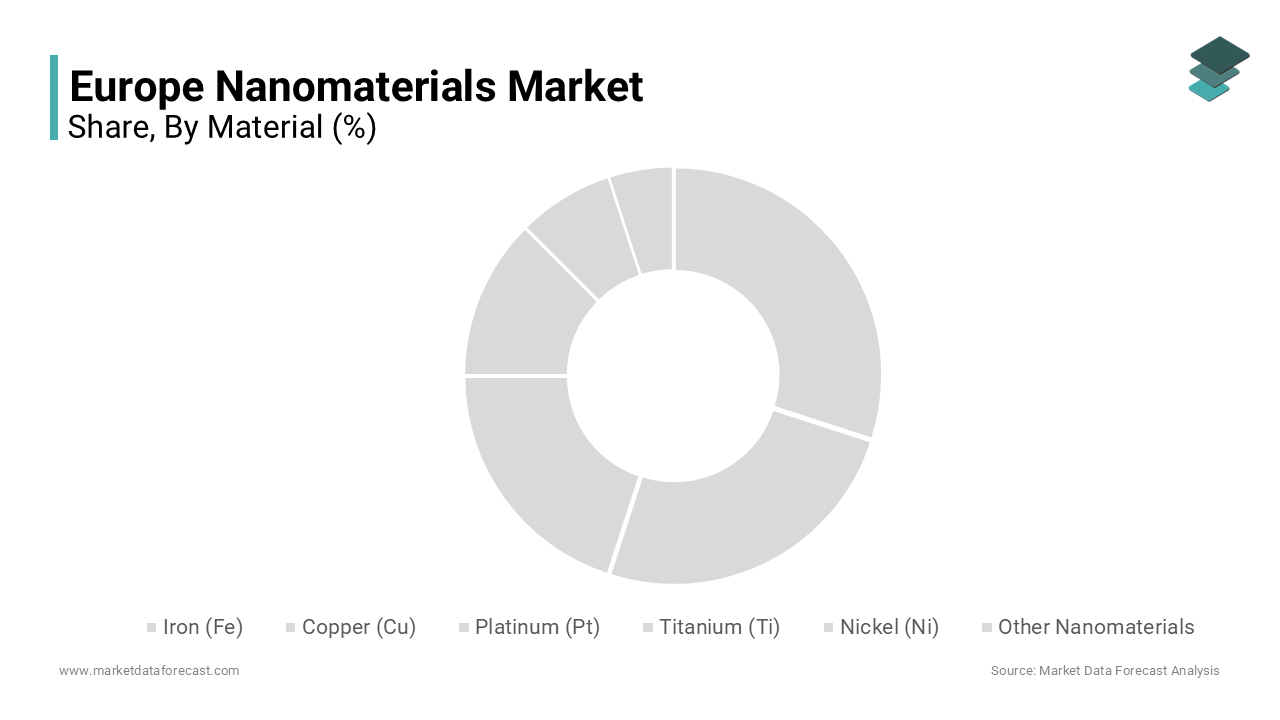
The copper segment is likely to witness a fastest CAGR of 18.3% from 2025 to 2033 owing to the rising demand for cost effective antimicrobial alternatives in food packaging and agricultural coatings, where copper’s lower price and comparable biocidal performance to silver offer strategic advantages. According to the European Food Safety Authority, foodborne illnesses affect nearly 130 million Europeans each year, prompting stricter hygiene standards under the EU Farm to Fork Strategy. Furthermore, the European Union’s 2023 directive on sustainable crop protection permits nano copper formulations as reduced risk fungicides, replacing conventional copper sulfate in vineyards across Italy and France.
By Application Insights
The medical segment was accounted in holding 44.2% of the Europe nanomaterials market share in 2024 owing to the advanced healthcare infrastructure, robust regulatory pathways for nanomedicines, and high public investment in precision medicine. The European Medicines Agency approved seven nano based therapeutics in 2023 alone, including lipid nanoparticle mRNA vaccines and albumin bound paclitaxel, reflecting institutional readiness to adopt nanotechnology. Leading academic hospitals in the Netherlands and Sweden now routinely use iron oxide nanoparticles for magnetic resonance imaging contrast enhancement, with over 1.2 million diagnostic procedures performed annually using nano contrast agents, as per the recent survey. Moreover, the Horizon Europe program allocated 420 million euros in 2024 specifically to nanotech enabled diagnostics and regenerative medicine, fostering public private partnerships.
The automotive segment is anticipated to witness a fastest CAGR of 16.7% throughout the forecast period with the stringent CO2 emission standards and the mass adoption of electric vehicles, which demand lighter, stronger, and thermally stable materials. BMW’s iVision circular concept vehicle, unveiled in 2024, uses graphene enhanced carbon fiber composites that reduce structural weight by 30% while maintaining crash resistance, as verified by TÜV Rheinland testing. Similarly, nano alumina coatings are now standard in power electronics to manage heat dissipation in inverters, which is a requirement for 800 volt architectures. The European Commission’s Net Zero Industry Act designates nanomaterials as essential for clean mobility, with 1.2 billion euros earmarked for supply chain resilience.
REGIONAL ANALYSIS
Germany Nanomaterials Market Analysis
Germany was the largest contributor in the Europe nanomaterials market by holding 26.3% of share in 2024 with its world class chemical manufacturing base, precision engineering heritage, and coordinated national nanotechnology strategy. BASF, Evonik, and Merck, are headquartered in Germany collectively supply over 40% of Europe’s engineered nanomaterials, particularly silica, silver, and quantum dots. As per the Fraunhofer Society, 12 dedicated nanomaterial pilot lines by enabling rapid scale up from lab to industry. In the automotive sector, German OEMs such as Volkswagen and BMW mandate nano reinforced composites in all new electric platforms to comply with EU emissions targets. Additionally, Germany hosts Europe’s largest nanotoxicology research hub at the Helmholtz Centre Munich, which collaborates with the European Chemicals Agency to refine safety assessments.
France Nanomaterials Market Analysis
France nanomaterials market was positioned second by holding 17.2% of share in 2024 with the integration of public health policy, aerospace innovation, and sustainable chemistry initiatives. The French National Research Agency allocated 185 million euros to nanotechnology projects in 2024, with a strong emphasis on medical diagnostics and green hydrogen catalysts. In healthcare, France’s national cancer plan promotes nanomedicine adoption by resulting in over 200 hospitals using liposomal doxorubicin formulations as standard care for metastatic breast cancer, as per the recent studies. The country also pioneered the world’s first mandatory nano declaration system in 2013, which now tracks over 20000 metric tons of nanomaterials annually via the R Nano registry administered by ANSM. This proactive regulatory transparency has built public trust and enabled industry compliance by creating a stable environment for long term investment.
The United Kingdom Nanomaterials Market Analysis
The United Kingdom nanomaterials market growth is likely to register a significant CAGR in next coming years with the strong influence despite Brexit through scientific excellence and venture capital activity. According to Innovate UK, nanotechnology grants totaled 92 million pounds in 2023, with 70% directed toward diagnostics and regenerative medicine. Although no longer part of EU regulatory bodies, the UK aligns its nano safety standards with ECHA through mutual recognition agreements by ensuring market continuity. The country’s emphasis on translational research, agile startup culture, and integration of nanomaterials into public health protocols sustains its position as a knowledge intensive hub within the European landscape.
Italy Nanomaterials Market Analysis
Italy nanomaterials market growth is likely to grow with its leadership in nano enabled textiles, food packaging, and agricultural technologies. Italy’s agricultural sector, particularly viticulture that drives demand for nano copper fungicides. Eni and Versalis have commercialized nano polymer masterbatches that improve barrier properties in flexible packaging, thereby extending shelf life of dairy and meat products by up to 21 days, as tested by the University of Bologna.
COMPETITIVE LANDSCAPE
Competition in the Europe nanomaterials market is characterized by a mix of large multinational chemical enterprises and specialized nanotechnology startups. Established players leverage their integrated manufacturing infrastructure and regulatory expertise to dominate high volume segments such as nano silica and nano silver. Meanwhile agile startups focus on niche applications in quantum dots nanomedicine and nano catalysts often supported by EU grants and incubator programs. Intense rivalry is evident in securing patents for novel synthesis methods and functionalized surfaces with enhanced performance characteristics. Geographic concentration in Germany France and Sweden creates regional innovation hubs that attract talent and investment.
KEY MARKET PLAYERS
Some of the companies that are playing a dominating role in the Europe Nanomaterials Market include
- Arkema S.A.
- Evonik Industries AG
- BASF SE
- Nanoco Group PLC
- OCSiAl
- Ahlstrom Corporation
- American Elements
- Nanophase Technologies Corporation
- Nanografi Nano Technology
- SkySpring Nanomaterials, Inc.
Top Players in the Market
BASF SE
BASF SE is a foundational contributor to the Europe nanomaterials market through its advanced chemical innovation and diversified nano product portfolio. The company develops engineered nanoparticles such as silica and alumina for applications in catalysis, coatings, and personal care. In recent years BASF has intensified its focus on sustainable nanomanufacturing, launching a series of bio based nanodispersions compatible with circular economy principles. It has also expanded its Verbund production model to integrate nano synthesis with renewable energy sources at its Ludwigshafen site. Collaborations with European research consortia under Horizon Europe have enabled BASF to co-develop next generation nano additives for battery electrolytes and hydrogen membranes with its technological leadership and global outreach in functional nanomaterials.
Evonik Industries AG
Evonik Industries AG plays a pivotal role in the Europe nanomaterials market by specializing in high performance nanostructured materials for healthcare, electronics, and additive manufacturing. The company’s Health Care division produces nano lipid carriers and nano silica for drug delivery and diagnostics, serving global pharmaceutical clients. Recently, Evonik inaugurated a dedicated nanomaterials pilot plant in Hanau Germany to accelerate scale up of proprietary nano formulations under Good Manufacturing Practice standards. It also partnered with leading European universities to advance nano toxicity screening protocols aligned with REACH. These initiatives underscore Evonik’s commitment to regulatory compliant innovation and position it as a key enabler of precision medicine and advanced manufacturing technologies worldwide.
Arkema SA
Arkema SA significantly influences the Europe nanomaterials market through its development of nano reinforced polymers and specialty nanocoatings. The company’s Graphene Solutions platform delivers graphene nanoplatelets for thermal management in electric vehicles and electronics, while its Kynar nanofluoropolymer technologies enhance durability in extreme environments. It also launched a new range of water based nano dispersions for eco-friendly industrial coatings compliant with EU Green Deal standards. These strategic moves reflect Arkema’s integration of nanotechnology into sustainable material solutions with global applicability across high growth sectors.
Top Strategies Used by the Key Market Participants
Key players in the Europe nanomaterials market primarily pursue vertical integration to secure raw material supply and control quality across the value chain. They invest heavily in research and development through public private partnerships under EU innovation frameworks. Strategic collaborations with academic institutions enable access to cutting edge nano characterization and safety assessment capabilities. Companies also prioritize sustainability by adopting green synthesis methods and bio-based precursors to align with regulatory and consumer expectations. Furthermore, they expand production capacities via dedicated pilot lines and clean room facilities to meet stringent industry specifications in medical and electronics applications. These strategies collectively enhance technological leadership, ensure regulatory compliance, and strengthen long term market positioning across high value segments.
MARKET SEGMENTATION
The research report on the Europe Nanomaterials Market has been segmented and sub-segmented based on categories.
By Material
- Gold (Au)
- Silver (Ag)
- Iron (Fe)
- Copper (Cu)
- Platinum (Pt)
- Titanium (Ti)
- Nickel (Ni)
- Other Nanomaterials
By Application
- Aerospace
- Automotive
- Medical
- Energy & Power
- Electronics
- Paints & Coatings
- Other Applications
By Country
- UK
- France
- Spain
- Germany
- Italy
- Russia
- Sweden
- Denmark
- Switzerland
- Netherlands
- Turkey
- Czech Republic
- Rest of Europ
Frequently Asked Questions
What are nanomaterials?
Nanomaterials are materials with at least one dimension sized between 1–100 nanometers, offering unique physical, chemical, and mechanical properties.
. What industries commonly use nanomaterials in Europe?
Key industries include electronics, automotive, aerospace, healthcare, energy, and packaging.
What is driving the growth of the Europe nanomaterials market?
Increasing demand for lightweight materials, growth in nanotechnology R&D, advancements in electronics, and rising applications in healthcare and renewable energy.
What are the major types of nanomaterials?
Carbon nanotubes, metal oxide nanoparticles, quantum dots, nanoclays, nanofibers, and dendrimers.
Which countries lead the nanomaterials market in Europe?
Germany, France, the U.K., and the Netherlands are the major contributors due to strong R&D and industrial manufacturing.
What are the challenges in the Europe nanomaterials market?
High production costs, safety concerns, strict environmental regulations, and limited large-scale manufacturing.
Who are the key players in the Europe nanomaterials market?
Arkema S.A., Evonik Industries AG, BASF SE, Nanoco Group PLC, OCSiAl, Ahlstrom Corporation, and others.
What applications are growing rapidly?
Electronics, energy storage, biomedical applications, coatings, catalysts, and construction materials.
Is the use of nanomaterials regulated in Europe?
Yes. The EU regulates nanomaterials under REACH and other safety guidelines to ensure environmental and human health protection.
What is the future outlook for the Europe nanomaterials market?
The market is expected to grow steadily due to increased R&D funding, expansion of sustainable materials, and adoption of nanotechnology in advanced manufacturing.
Access the study in MULTIPLE FORMATS
Purchase options starting from
$ 2000
Didn’t find what you’re looking for?
TALK TO OUR ANALYST TEAM
Need something within your budget?
NO WORRIES! WE GOT YOU COVERED!
Call us on: +1 888 702 9696 (U.S Toll Free)
Write to us: sales@marketdataforecast.com