- Product Description Description
- Table of Contents TOC
- List of Table & Figure LOT
- Get Free Sample PDF Sample PDF
Market Size, 2025
$7.20 BnMarket Estimate, 2026
$7.76 BnMarket Forecast, 2034
$13.13 BnCAGR, 2026–2034
6.79%Europe Natural Gas Liquids Market Report Summary
The Europe natural gas liquids (NGL) market was valued at USD 7.27 billion in 2025, is estimated to reach USD 7.76 billion in 2026, and is projected to reach USD 13.13 billion by 2034, growing at a CAGR of 6.79% during the forecast period from 2026 to 2034. The growth of the Europe natural gas liquids market is driven by Europe’s accelerated energy diversification strategy, rising dependence on imported LPG and ethane, and the sustained demand from petrochemical manufacturing and off-grid heating applications. Following the reduction of Russian pipeline gas supplies, NGLs such as propane, butane, and ethane have emerged as strategic energy carriers supporting energy security, industrial competitiveness, and transitional decarbonization objectives across the region.
Key Market Trends
- Sharp increase in NGL imports as co-products of LNG shipments from the U.S., Qatar, and North Africa
- Growing classification of propane and butane as strategic energy reserves under EU energy security policies
- Shift in petrochemical feedstocks from naphtha to lighter NGLs to reduce carbon intensity
- Expansion of LPG adoption in rural and off-grid heating to replace coal and biomass
- Rising investment in storage terminals and import infrastructure across Northern and Central Europe
Segmental Insights
- By type, the propane segment dominated the Europe natural gas liquids market by accounting for 42.4% of the market share in 2024. This dominance is driven by propane’s dual role as a clean residential heating fuel in off-grid regions and as a critical petrochemical feedstock for propylene production. Policy support for clean air, mandatory strategic reserves, and widespread residential use solidify propane as the backbone of Europe’s NGL consumption.
- The ethane segment is projected to register the fastest CAGR of 16.8% from 2025 to 2033, supported by Europe’s strategic transition toward low-carbon petrochemical feedstocks. Ethane cracking produces lower CO₂ emissions than naphtha-based processes, aligning with EU carbon pricing and CBAM policies. The commissioning of dedicated ethane import terminals and long-term supply contracts with U.S. producers has structurally anchored ethane within Europe’s industrial supply chain.
- By application, the petrochemical feedstock segment held the largest share of 55.5% in 2024, reflecting Europe’s reliance on NGLs for producing ethylene, propylene, and downstream polymers. The ongoing substitution of heavier feedstocks with propane and ethane supports emissions reduction targets while ensuring supply continuity for strategic materials.
- The residential and commercial fuel segment is expected to grow at the fastest rate, registering a CAGR of 13.2% from 2025 to 2033, driven by government-led programs to replace coal and wood heating systems with LPG in rural and air-pollution-sensitive regions.
Regional Insights
- Germany led the Europe natural gas liquids market with a 18.7% share in 2024, supported by its extensive chemical industry, strategic storage expansion, and policy recognition of NGLs as essential energy reserves.
- The Netherlands followed with a 15.3% market share, functioning as Europe’s primary NGL import and redistribution hub through Rotterdam and Amsterdam ports, combined with strong petrochemical demand.
- France remains a key market due to widespread residential LPG usage, national stockpiling mandates, and propane dehydrogenation capacity for industrial plastics.
- Poland is emerging as a high-growth market driven by aggressive coal-to-LPG residential heating conversion programs and expanding import infrastructure.
- Italy benefits from strong commercial LPG demand, Mediterranean import routes, and increasing use of propane in food service and petrochemical applications.
Competitive Landscape
The Europe natural gas liquids market is characterized by high capital intensity, vertical integration, and strategic infrastructure ownership, rather than pure price competition. Market leadership depends on secure long-term import contracts, storage capacity, regulatory compliance, and carbon-intensity transparency. Major energy and chemical companies dominate the market by controlling both supply and downstream consumption through integrated LNG, NGL, and petrochemical assets. The EU’s classification of NGLs as strategic energy reserves has further elevated the importance of storage, logistics resilience, and cross-border supply reliability. Key players operating in the Europe natural gas liquids market include Shell plc, BP plc, TotalEnergies SE, Equinor ASA, Eni S.p.A., OMV AG, INEOS Group, Repsol S.A., Gazprom, and Rosneft.
Europe Natural Gas Liquids Market Size
The europe natural gas liquids market size was valued at USD 7.27 billion in 2025 and is anticipated to reach USD 7.76 billion in 2026 from USD 13.13 billion by 2034, growing at a CAGR of 6.79% during the forecast period from 2026 to 2034.
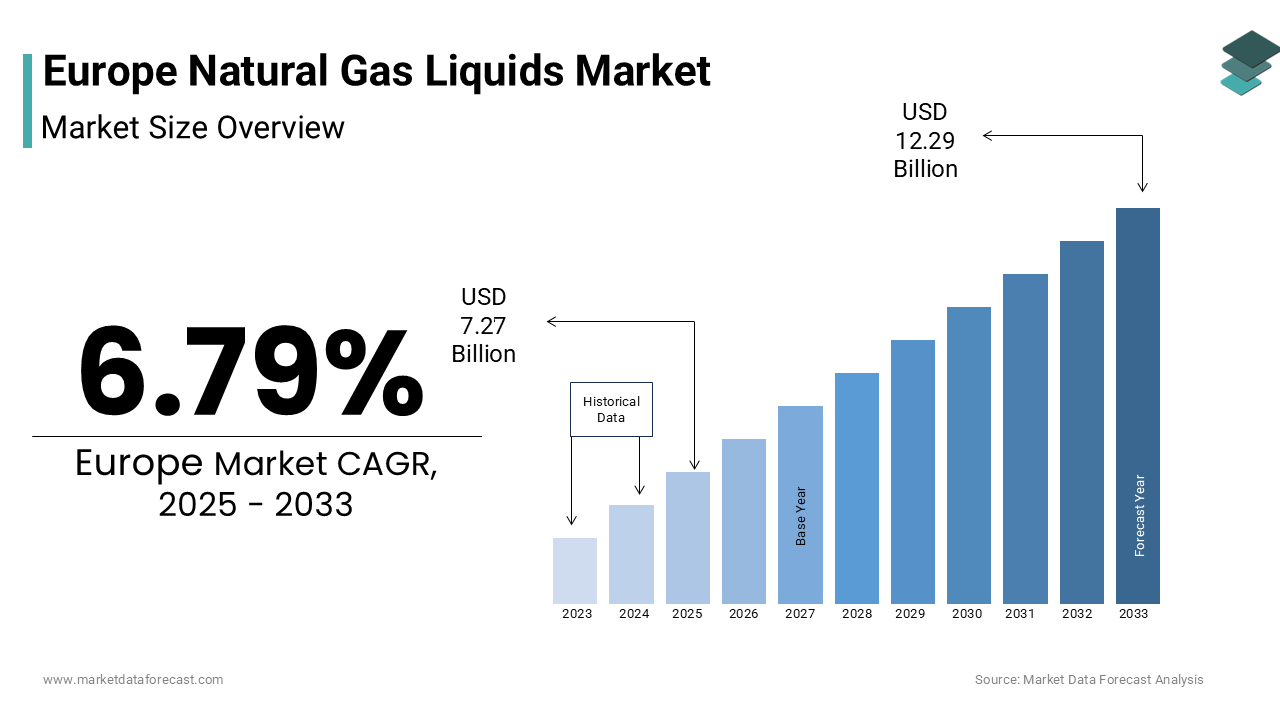
Natural gas liquids (NGLs) refer to hydrocarbon components, primarily ethane, propane, butane, and natural gasoline, separated from raw natural gas during processing and used as feedstocks for petrochemicals, heating fuels, and transportation blending agents. Unlike pipeline-quality dry gas, NGLs possess higher energy density and chemical versatility, making them critical to industrial value chains and energy security. Europe’s NGL landscape has been profoundly reshaped by geopolitical shifts and energy diversification imperatives following the 2022 reduction in Russian pipeline gas supplies. According to research, EU imports of liquefied petroleum gas (LPG), which are a natural gas liquids (NGL) derivative, have been on a significant upward trend in recent years, with a notable increase in volumes sourced as co-products of U.S. and Qatari liquefied natural gas (LNG) cargoes. As per multiple sources, a substantial majority of Europe’s propane demand is met via imports, with key volumes originating from sources including the United States, Norway, and Algeria. Natural gas liquids such as propane are commonly used in off-grid heating applications, particularly for households in rural areas where natural gas infrastructure is unavailable. In addition, The European chemical industry utilizes propane and butane as essential feedstocks for a notable portion of the EU’s total olefin production. These intersecting roles, in energy access, industrial manufacturing, and supply chain resilience, position NGLs as a strategic yet often overlooked pillar of Europe’s post fossil transition strategy.
MARKET DRIVERS
Geopolitical Diversification of Energy Supplies Boosts NGL Import Dependency
The region’s urgent decoupling from Russian hydrocarbons has dramatically increased reliance on imported natural gas liquids as co products of diversified LNG procurement, which acts as a major factor propelling the growth of the Europe natural gas liquids market. Following the 2022 energy crisis the European Commission’s REPowerEU plan prioritized alternative gas sources resulting in a surge of LNG imports from the United States Qatar and Nigeria. According to various studies, the composition of natural gas, including the percentage of NGLs, varies depending on its geological source, and these NGLs are typically extracted during the liquefaction process at export facilities. The specific processes and infrastructure at receiving terminals like Zeebrugge and Sines handle regasification of the processed LNG. In addition, following a period of significant growth in imports between 2021 and 2023, the European Union's reliance on seaborne liquefied natural gas increased substantially. Much of this propane and butane is directed to storage facilities in the Netherlands and Germany to secure winter heating supplies. European natural gas storage inventories reached very high levels well ahead of the winter season in 2023, surpassing previous pre-winter benchmarks in a decade due to strong injection policies and reduced demand. This strategic stockpiling reflects a deliberate policy shift where NGLs are no longer by products but intentional energy security assets in Europe’s post Russian supply architecture.
Petrochemical Industry Reliance on Light Feedstocks Sustains Ethane and Propane Demand
Chemical manufacturing sector in the region remains a structural anchor for NGLs demand due to its dependence on light hydrocarbons as cost effective and lower emission feedstocks. Consequently, this further contributes to the expansion of the Europe natural gas liquids market. Ethane and propane are utilized as primary feedstocks in Europe for producing chemical building blocks such as ethylene and propylene. Specialized processing units are operated by major chemical companies to convert propane into industrial precursors. Furthermore, a move towards lighter feedstocks has resulted in a measurable reduction in the carbon intensity of production, while regional carbon trade policies incentivize production methods based on natural gas liquids. Despite the green transition the European Commission’s Critical Raw Materials Act explicitly recognizes propane and butane as strategic inputs for circular polymers and battery binders. This industrial embeddedness ensures sustained NGL demand even as Europe decarbonizes its energy mix.
MARKET RESTRAINTS
Limited Domestic NGL Production Constrains Supply Autonomy
There is a fundamental structural constraint due to minimal indigenous NGL extraction from domestic gas fields, and this thereby inhibits the growth of the Europe natural gas liquids market. Unlike North America or the Middle East European natural gas reservoirs, primarily in the North Sea and Netherlands, are lean in condensate and NGL content. According to sources, the European Union's natural gas production, largely from conventional sources, generally yields a lower proportion of recoverable natural gas liquids (NGLs) compared to the NGL-rich natural gas extracted from U.S. shale formations. The Groningen field in the Netherlands, formerly Europe’s primary domestic natural gas source, has been permanently closed due to substantial seismic risks, significantly reducing the region's internal supply capacity. As per research, the European Union maintains a high dependency on total energy imports. However, its specific supply of propane and butane (LPG) is sourced from a diversified range of global suppliers, including the U.S., North Africa, and Norway. The EU is actively phasing out Russian LPG imports, which historically represented a variable, but relatively small, share of total EU LPG imports. This import reliance exposes the market to global price volatility geopolitical disruptions and shipping bottlenecks. The 2022 Red Sea crisis temporarily raised freight costs, which delays NGL deliveries to Rotterdam. Europe's energy sovereignty remains fragile unless significant investment occurs in alternative extraction or synthetic production, exposing it to supply shocks.
Stringent Environmental Regulations on Fugitive Emissions Increase Operational Costs
The European Union’s aggressive climate policy imposes significant compliance burdens on NGLs handling through strict limits on fugitive methane and volatile organic compound emissions, which further restricts the expansion of the Europe natural gas liquids market. The European Union's Methane Regulation (EU/2024/1787), formally adopted in 2024, mandates extensive monitoring and repair protocols for methane leaks across the oil and natural gas energy sectors to significantly reduce fugitive emissions. As per the data from European environmental authorities, a substantial volume of methane emissions originates from natural gas infrastructure, which has prompted calls for tighter regulatory oversight and improved monitoring to mitigate environmental impact. The implementation of stringent methane reduction requirements is generally expected to increase operational expenditures for midstream energy operators due to necessary investments in advanced leak detection and mitigation technologies. Besides, the EU's Industrial Emissions Directive requires relevant large-scale energy and chemical processing installations to operate using the Best Available Techniques (BAT), which encourages efficient processes and the minimization of flaring and venting. These measures while environmentally necessary reduce margin flexibility and deter new infrastructure development, particularly in Central and Eastern Europe where regulatory capacity is limited. The regulatory tightening thus acts as a structural brake on market expansion despite growing demand.
MARKET OPPORTUNITIES
Expansion of NGL Infrastructure for Energy Security Creates Strategic Opportunity
The region’s accelerated investment in NGL storage and distribution infrastructure paves the way to enhance energy resilience and market liquidity, which is anticipated to boost the growth of the European natural gas liquids market. In response to supply disruptions the European Commission designated propane and butane as strategic energy reserves under the Emergency Intervention Regulation. As per multiple sources, European Union regulations now require member states to maintain sufficient natural gas in storage facilities to meet specific capacity targets by the start of the heating season, ensuring enhanced regional energy security. This has triggered a wave of infrastructure development. The Netherlands continues to focus on developing its Eemshaven area as a major energy hub, with a focus on diversifying natural gas imports and exploring future hydrogen infrastructure. Moreover, Poland is significantly expanding its capacity to import liquefied natural gas via new infrastructure development in Gdańsk, complementing its existing import capabilities as part of a national strategy to diversify energy sources. Furthermore, European countries are actively investing in new energy infrastructure to enhance supply security and facilitate the energy transition, with significant focus on developing robust hydrogen networks and strengthening regional natural gas interconnections using EU funding mechanisms. These projects transform NGLs from passive by products into actively managed strategic reserves, which creates new roles for terminals traders and grid operators in Europe’s energy security architecture.
Growing Use of LPG in Rural Decarbonization and Clean Cooking Initiatives
Liquefied petroleum gas, a primary NGL derivative, is emerging as a transitional clean fuel in the region’s off grid decarbonization strategy, particularly in Central and Eastern Europe, to ultimately provide fresh prospects for the Europe natural gas liquids market. Across Europe, a notable number of households, particularly in Eastern Member States, still lack connection to the natural gas network and heavily rely on solid fuels (such as coal and biomass) for heating, which contributes significantly to residential air pollution. National policies are now promoting LPG as a cleaner alternative. The European Commission’s Clean Air Policy Package identifies LPG as a key measure to reduce black carbon in non-attainment zones. Furthemore, LPG is utilized as a lower-emission alternative fuel for certain specialized vehicle applications, such as forklifts, in cases where full electrification is not a feasible option. This dual role, as a clean heating fuel and low carbon mobility solution, positions NGLs as pragmatic enablers of just and inclusive energy transition in underserved regions.
MARKET CHALLENGES
Volatile Global Pricing and Freight Costs Undermine Market Stability
The high susceptibility to external price shocks and logistical disruptions, due to its dependence on transoceanic imports, continues to disrupt the growth of the Europe natural gas liquids market. Unlike pipeline gas NGLs like ethane and propane are traded in a globalized maritime market where prices are indexed to U.S. Mont Belvieu or Saudi Contract Prices, both subject to crude oil and petrochemical demand swings. Following the Ukraine invasion in early 2022, European propane and natural gas import prices experienced an extreme upward surge, leading to significant financial difficulties for distributors and consumers, as per research Freight costs add further volatility. The 2023 Red Sea shipping crisis caused very large gas carrier (VLGC) rates from the U.S. Gulf to Rotterdam to increase sharply due to rerouting and heightened risk, as reported by various market intelligence and energy information sources. These fluctuations directly impact end users. As per a study, persistent natural gas and LPG price volatility has led to considerable uncertainty, resulting in some European rural heating suppliers adjusting or delaying customer contracts. Without long term supply agreements or regional pricing benchmarks Europe’s NGL market will continue to experience destabilizing cost swings that hinder investment planning and consumer affordability.
Inadequate Interconnectivity Limits Cross Border NGL Distribution
The region’s NGLs infrastructure suffers from fragmented national systems and insufficient cross border pipeline connectivity, despite growing strategic importance, also hinders the expansion of the Europe natural gas liquids market. Only a minority of European Union member states maintain interconnected propane networks capable of providing mutual assistance during emergencies. Recent cold weather events highlighted regional supply shortages occurring simultaneously with surplus stocks in other areas. Insufficient pipeline infrastructure and limited transport capacity can prevent the movement of fuel from storage terminals to regions in need. Natural gas liquids are considered one of the least integrated components within the broader regional energy security framework. Unlike natural gas which benefits from the ENTSOG network NGLs rely heavily on road and rail transport, modes vulnerable to weather strikes and border delays. Logistical barriers increase distribution costs in landlocked countries. Divergent national safety standards and permitting regimes significantly slow progress, even with EU funding for initiatives like the Central European LPG Corridor. Regional imbalances will persist, undermining collective energy resilience, until a cohesive trans-European NGL infrastructure is developed
REPORT COVERAGE
| REPORT METRIC | DETAILS |
| Market Size Available | 2025 to 2034 |
| Base Year | 2025 |
| Forecast Period | 2026 to 2034 |
| CAGR | 7% |
| Segments Covered | By Type, Application, End-User and Region. |
| Various Analyses Covered | Global, Regional, and Country Level Analysis, Segment-Level Analysis, DROC, PESTLE Analysis, Porter’s Five Forces Analysis, Competitive Landscape, Analyst Overview of Investment Opportunities |
| Regions Covered | United Kingdom, France, Spain, Germany, Italy, Russia, Sweden, Denmark, Switzerland, the Netherlands, Turkey, and the Czech Republic. |
| Market Leaders Profiled | Shell plc, BP plc, TotalEnergies SE, Equinor ASA, Eni S.p.A., OMV AG, INEOS Group, Repsol S.A., Gazprom, and Rosneft |
SEGMENTAL ANALYSIS
By Type Insights
The propane segment continued to hold the majority share of 42.4% of the Europe natural gas liquids market in 2024. Its dual role as a clean heating fuel for off grid households and a versatile petrochemical feedstock drives the leading position of the propane segment. Many European households rely on propane for space and water heating in areas where natural gas pipelines are unavailable. Transitioning from coal to propane serves as a method for reducing particulate matter emissions within regional clean air strategies. Propane functions as a necessary feedstock in the production of propylene for industrial materials such as polypropylene and acrylonitrile. Moreover, propane is classified as a strategic reserve, necessitating the maintenance of national stockpiles to ensure energy security. This combination of residential necessity industrial utility and policy support solidifies propane as the cornerstone of Europe’s NGL landscape.
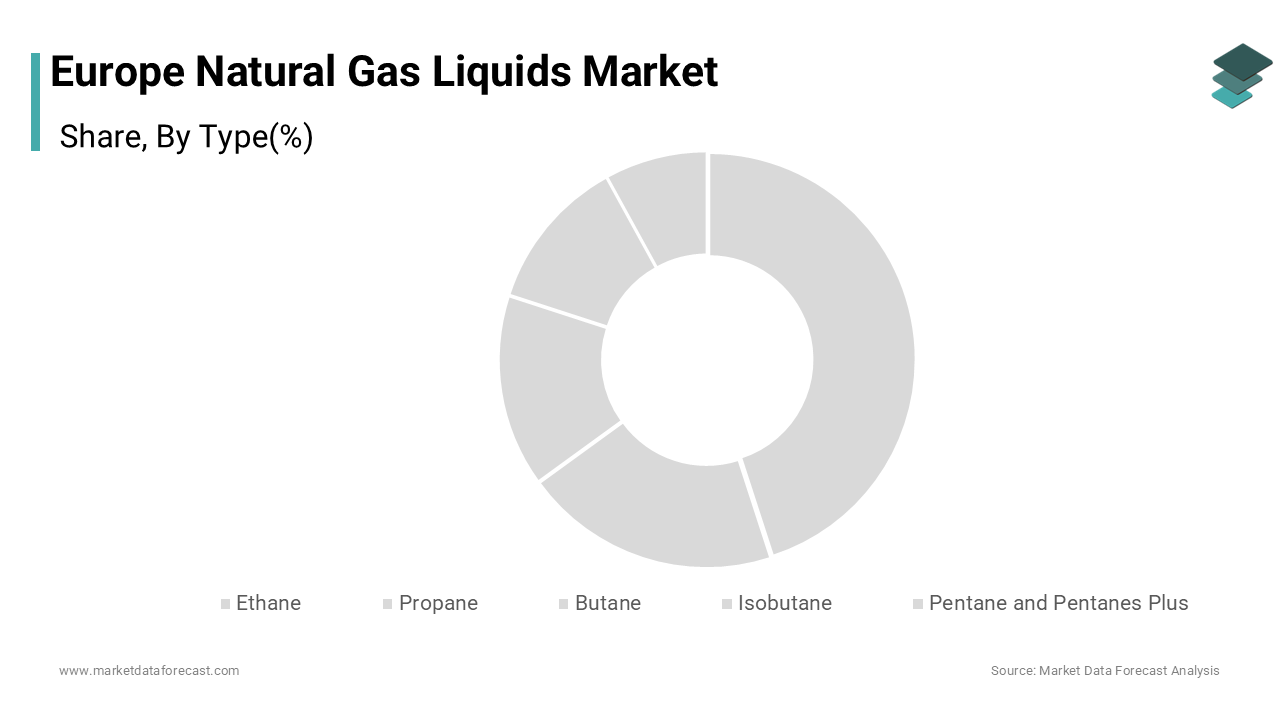
The ethane segment is anticipated to witness the fastest CAGR of 16.8% from 2026 to 2034 due to the strategic shift in European petrochemical manufacturing toward lighter and lower carbon feedstocks. Ethane cracking emits less CO2 per tonne of ethylene compared to naphtha, a critical advantage under the EU’s Carbon Border Adjustment Mechanism. Apart from these, the launch of a new, dedicated import terminal at a major European port has expanded the region's capacity to receive ethane from overseas. This facility supports a large-scale production unit that provides key materials for advanced polymer and battery applications. Furthermore, official regulations have highlighted the importance of a specific derivative of ethane for electric vehicle components, indicating sustained future demand. The recent increase in the volume of ethane imported into Europe, combined with the new infrastructure, demonstrates that ethane is becoming a foundational resource for industry, which evolves into a leading product in its market segment.
By Application Insights
The petrochemical feedstock segment remained the largest segment in the Europe natural gas liquids market by accounting for a 55.5% share in 2025. Factors such as the structural dependence of Europe’s chemical sector on light hydrocarbons like ethane, propane, and butane to produce base chemicals such as ethylene, propylene, and butadiene have contributed to the prominence of the petrochemical feedstock segment. Large quantities of natural gas liquids (NGLs) are consumed in European cracking facilities, with propane specifically utilized as a feedstock for major dehydrogenation operations. The transition from naphtha to natural gas liquids has lowered the carbon intensity of olefin manufacturing. The shift toward less carbon-intensive feedstocks supports regional climate objectives. Mandates for recycled or bio-based content in plastic production depend on a consistent supply of monomers derived from natural gas liquids. The concentration of chemical clusters in key logistics hubs serves as a primary economic and strategic driver for regional NGL demand.
The residential and commercial fuel segment is likely to experience the fastest CAGR of 13.2% from 2025 to 2033 owing to targeted policies to replace solid fuels in off grid heating and reduce urban air pollution. A significant number of European households do not have access to natural gas through pipeline infrastructure. Residential heating through coal and wood combustion contributes substantially to particulate matter emissions. In response national programs are accelerating LPG adoption. Liquefied petroleum gas is recognized as an economical alternative for improving air quality in areas failing to meet environmental standards. Urban centers have implemented requirements for public facilities to transition to liquefied petroleum gas systems. Besides, commercial kitchens in Spain and Italy are switching to propane for instant heat and zero indoor emissions. This convergence of health equity and decarbonization imperatives positions residential and commercial fuel as Europe’s most socially impactful NGL growth frontier.
By End-User Insights
The industrial segment led the Europe natural gas liquids market and captured a 61.7% share in 2024. The supremacy of the industrial segment is attributed to the chemical industry’s reliance on NGLs as primary feedstocks and in manufacturing’s use of propane and butane for high temperature process heat. Petrochemical production sites across the EU use natural gas liquids regularly, with a single major port complex processing a significant volume of material annually for making key chemical components. The industry has seen a decrease in direct emissions since implementing changes in the materials used for production, specifically by incorporating propane as a raw material. Beyond chemicals industries like glass metal casting and food processing use propane burners for precise thermal control where electrification is impractical. Regulations within the EU identify certain gaseous fuels, such as liquefied petroleum gas, as effective methods for decreasing specific air pollutants during high temperature industrial processes. This deep industrial embeddedness, spanning feedstock and fuel, ensures the sector remains the primary engine of Europe’s NGL consumption.
The residential segment is on the rise and is expected to be the fastest growing segment in the market by witnessing a CAGR of 14.1% from 2025 to 2033. The rapid growth of the residential segment is fuelled by state led initiatives to eliminate coal and wood heating in Central and Eastern Europe where millions of households still use solid fuels. National recovery funding has been directed toward replacing household heating units with propane-based systems. The transition to propane heating has resulted in a measurable increase in adoption among residential users. Governmental fiscal incentives, such as tax exemptions, have encouraged the use of residential liquefied petroleum gas. Financial policy adjustments have led to higher sales volumes for fuel cylinders. Propane systems significantly lower indoor particulate matter concentrations compared to traditional solid-fuel stoves. Switching to cleaner-burning fuels provides a substantial health advantage, particularly during colder seasons when indoor heating is most prevalent. Furthermore, the EU’s Social Climate Fund now includes LPG heating in its energy poverty alleviation grants. Europe's commitment to an equitable energy transition, which prioritizes all households, is expected to spur rapid growth in the demand for residential natural gas liquids (NGL) within historically neglected areas.
REGIONAL ANALYSIS
Germany Natural Gas Liquids Market Analysis
Germany dominance of the Europe natural gas liquids market and accounted for a 18.7% share in 2024. The dominance of the German market is driven by its massive chemical industry and expanding strategic storage infrastructure. The country is home to Europe’s largest chemical cluster in Ludwigshafen where BASF consumes significant tonnes of propane and butane annually as feedstock and fuel. Germany relies on significant imports of liquefied petroleum gas to maintain stability for its industrial sectors and heating requirements. The government has reclassified natural gas liquids as essential reserves to enhance national energy security protocols. Energy infrastructure firms are increasing their subterranean storage capacities to accommodate these larger strategic stockpiles. Additionally, Germany’s Energiewende policy promotes propane as a transitional fuel for off grid heating in rural Bavaria and Saxony. This blend of industrial scale policy foresight and infrastructure investment ensures Germany’s continued dominance in Europe’s NGL landscape.
The Netherlands Natural Gas Liquids Market Analysis
The Netherlands was the second-largest player in the Europe natural gas liquids market and held a 15.3% share in 2024. The growth of NGLs in the Netherlands is credited to its role as Europe’s primary NGL import and distribution hub. The Port of Rotterdam maintains a significant role in handling substantial volumes of specific energy product imports for the region. Also, the port features several terminals that manage these energy imports. The country hosts major crackers in Moerdijk and Geleen that rely on imported propane and ethane for olefin production. A new facility has begun operation in the Port of Amsterdam, designed to support industrial processes requiring ethane. Additionally, the national gas infrastructure operator Gasunie is repurposing depleted North Sea fields for NGL storage with notable cubic meters of capacity operational by 2025. The government’s National Energy and Climate Plan prioritizes LPG for rural decarbonization with tax incentives for residential conversions. This synergy of logistics petrochemicals and policy makes the Netherlands the indispensable gateway for NGLs entering Europe.
France Natural Gas Liquids Market Analysis
France maintains a noteworthy position in the Europe natural gas liquids market because of widespread residential LPG use and national energy security measures. A notable number of households, particularly in certain rural regions, depend on propane for heating because the natural gas pipeline infrastructure is not widespread. Authorities consider liquefied petroleum gas (LPG) to be a strategic national resource, requiring substantial national reserves to ensure continuous supply for essential use. The country fulfills its LPG demand through imports, which are stored at key coastal facilities to maintain supply. A government program has been initiated to assist low-income households with a portion of the costs associated with converting their home heating systems Additionally, TotalEnergies operates propane dehydrogenation units in Gonfreville supplying propylene for automotive plastics. France’s dual focus on social equity and industrial resilience ensures steady NGL demand across sectors.
Poland Natural Gas Liquids Market Analysis
Poland experienced a steady growth in the Europe natural gas liquids market due to an aggressive national program to replace household coal stoves with propane heating systems. Numerous households continue to utilize solid fuels for heating, which impacts urban air quality. Government subsidies for residential installations have led to a rise in propane consumption for home heating. Updated building regulations require new rural constructions to be compatible with liquefied petroleum gas infrastructure. The commissioning of a floating import facility has expanded the national capacity to receive energy shipments from international markets. PKN Orlen also expanded its LPG blending capacity at the Plock refinery to support transportation use. Poland’s health driven energy transition makes it a high growth and socially significant NGL market in Europe.
Italy Natural Gas Liquids Market Analysis
Italy is likely to expand in the Europe natural gas liquids market over the forecast period owing to strong commercial LPG demand and strategic Mediterranean import routes. Italy has a notable reliance on propane for cooking in a large number of commercial kitchens across various establishments, including restaurants, hotels, and schools, valuing it for its instant heating capability and lack of indoor emissions. The country imports a significant amount of Liquefied Petroleum Gas (LPG) each year, with key entry points located at the Livorno and Augusta ports [1]. These imports mainly come from several international sources. Distribution within the country has been enhanced by the completion of a major pipeline project connecting Sicily to Naples, which improves supply access to southern regions that were previously underserved. Additionally, ENI operates propane dehydrogenation units in Brindisi supplying propylene for packaging and medical plastics. The National Recovery Plan includes substantial amount for LPG heating conversions in rural Apulia and Calabria. Italy’s mix of commercial adoption infrastructure development and southern decarbonization creates a resilient and diversified NGL ecosystem.
COMPETITIVE LANDSCAPE
Competition in the Europe natural gas liquids market is characterized by vertical integration strategic infrastructure ownership and policy alignment rather than price competition alone. The market is dominated by global energy majors and industrial conglomerates that control both supply chains and end use demand through petrochemical assets. Success hinges on securing long term ethane and propane offtake agreements from the United States and North Africa while maintaining compliant import and storage infrastructure within the EU. Unlike commodity trading here reliability carbon intensity and logistical resilience are decisive factors as customers—ranging from crackers to rural households—require uninterrupted supply under tightening environmental rules. The European Commission’s classification of NGLs as strategic reserves has elevated the importance of storage capacity and cross border connectivity as competitive differentiators. Meanwhile new entrants face high barriers due to capital intensity regulatory complexity and the need for integrated logistics. As Europe balances industrial competitiveness with clean air and energy security only players with end to end capabilities and policy foresight can sustain leadership in this strategically vital market.
KEY MARKET PLAYERS
Some of the companies that are playing a dominating role in the europe natural gas liquids market include
- Shell plc
- BP plc
- TotalEnergies SE
- Equinor ASA
- Eni S.p.A.
- OMV AG
- INEOS Group
- Repsol S.A.
- Gazprom
- Rosneft
Top Players in the Europe Natural Gas Liquids Market
Shell plc Natural Gas Liquids Market Analysis
Shell plc is a global energy major with significant infrastructure and trading operations in the Europe natural gas liquids market. The company supplies propane, butane, and ethane to petrochemical clusters in the Netherlands, Germany, and Belgium through its integrated LNG and NGL import terminals at Rotterdam and Rheinberg. Shell contributes globally by pioneering very large ethane carrier logistics and long term NGL offtake agreements with U.S. producers. In recent years it has strengthened its European position by expanding its LPG storage capacity at the Gate Terminal and launching carbon intensity tracking for NGL deliveries aligned with EU sustainability reporting requirements. Shell also collaborates with Borealis on circular feedstock initiatives using bio based propane. These actions reinforce Shell’s role as a reliable and forward looking NGL supplier in Europe’s evolving energy landscape.
TotalEnergies SE
TotalEnergies SE is a French integrated energy company with deep involvement in the Europe natural gas liquids market through its refining, petrochemical, and retail LPG networks. The company operates propane dehydrogenation units in France and Germany that convert imported NGLs into propylene for automotive and packaging industries. TotalEnergies sources ethane and propane from its equity stakes in U.S. LNG projects and Algerian gas fields ensuring diversified supply. The company also participates in EU strategic stockpiling programs under national energy security mandates. These initiatives position TotalEnergies as a vertically integrated and policy aligned NGL provider across Europe.
INEOS Group
INEOS Group is a European chemical and energy conglomerate with strategic investments in NGL infrastructure and consumption. The company owns Europe’s first dedicated ethane import terminal at the Port of Antwerp and operates world scale crackers in Belgium, Norway, and the UK that rely on U.S. sourced ethane and propane. INEOS contributes globally by developing secure Atlantic NGL supply chains and advocating for light feedstock competitiveness under EU climate policy. In recent years it has strengthened its European footprint by commissioning the Forties LPG pipeline linking North Sea fields to Grangemouth and investing in circular propane projects for recycled polypropylene. INEOS also partners with national governments on LPG heating conversions in off grid regions. These actions underscore its dual role as both a major NGL consumer and infrastructure enabler in Europe.
Top Strategies Used by the Key Market Participants
Key players in the Europe natural gas liquids market secure long term supply agreements with U.S. and North African producers to ensure feedstock stability amid geopolitical volatility. They invest in dedicated import terminals storage caverns and pipeline connectivity to enhance distribution resilience and strategic stockpiling. Companies develop certified low carbon NGL products with verified emission tracking to comply with EU sustainability regulations and carbon pricing mechanisms. They also form strategic partnerships with petrochemical manufacturers and national governments to align infrastructure with industrial and social decarbonization goals. Additionally firms expand residential and commercial LPG distribution in off grid regions through subsidized conversion programs and bottling network upgrades to support Europe’s clean air and energy poverty objectives.
MARKET SEGMENTATION
This research report on the europe natural gas liquids market has been segmented and sub–segmented into the following categories.
By Type
- Ethane
- Propane
- Butane
- Isobutane
- Pentane and Pentanes Plus
By Application
- Petrochemical Feedstock
- Residential and Commercial Fuel
- Industrial Fuel
- Transportation Fuel
- Space Heating
- Electricity Generation
- Aerosol Propellants and Refrigerants
By End-use
- Industrial
- Residential
- Commercial
- Utilities
- Transportation
- Oil and Gas Sector
By Country
- UK
- France
- Spain
- Germany
- Italy
- Russia
- Sweden
- Denmark
- Switzerland
- Netherlands
- Turkey
- Czech Republic
- Rest of Europe