- Product Description Description
- Table of Contents TOC
- List of Table & Figure LOT
- Get Free Sample PDF Sample PDF
Market Size, 2025
$13.32 BnMarket Estimate, 2026
$19.66 BnMarket Forecast, 2034
$443.96 BnCAGR, 2026–2034
47.64%Europe Neobanking Market Report Summary
The Europe neobanking market was valued at USD 13.32 billion in 2025, is estimated to reach USD 19.66 billion in 2026, and is projected to reach USD 443.96 billion by 2034, growing at a CAGR of 47.64% during the forecast period from 2026 to 2034. The growth of the Europe neobanking market is driven by rising consumer dissatisfaction with traditional banking models, increasing preference for mobile-first financial services, and the steady decline of physical bank branches across Europe. The widespread adoption of smartphones, demand for real-time financial management tools, and growing acceptance of digital-only financial relationships are further accelerating market expansion. Moreover, supportive regulatory frameworks such as the EU Digital Finance Package, open banking regulations, and embedded finance integration are strengthening the foundation for scalable neobank adoption across the region.
Key Market Trends
-
Rapid shift toward mobile-only banking, with users prioritizing real-time notifications, spending analytics, and seamless user experience.
-
Growing adoption of business-focused neobank accounts among freelancers, startups, and SMEs due to automated invoicing, tax tools, and API integrations.
-
Expansion of embedded finance models, where banking services are integrated directly into e-commerce, gig platforms, and digital marketplaces.
-
Increasing focus on sustainable finance features such as carbon tracking, ethical investments, and green savings products within neobank platforms.
-
The rising importance of regulatory compliance, data transparency, and deposit protection as key trust-building factors for long-term user retention.
Segmental Insights
- Based on account type, the business accounts segment dominated the Europe neobanking market by holding a 64.1% share in 2025. The segment’s leadership is attributed to strong demand from SMEs, freelancers, and gig workers for fast onboarding, integrated financial tools, multi-currency support, and automated tax and expense management features that are largely absent in traditional banks.
- Based on application, the personal application segment held the largest share of the Europe neobanking market in 2025. This dominance is driven by the mass adoption of digital banking among younger consumers, closure of physical bank branches, and growing reliance on mobile platforms for everyday financial management, budgeting, and spending control.
- The enterprise application segment is projected to register the fastest CAGR of 31.2% during the forecast period. This growth is supported by increasing cross-border SME activity, demand for multi-currency accounts, lower FX costs, automated VAT compliance, and integration of banking services with accounting and invoicing software.
Regional Insights
The Europe neobanking market is experiencing strong growth across major economies, supported by advanced digital infrastructure, regulatory maturity, and evolving consumer behavior toward digital finance.
- The United Kingdom led the Europe neobanking market by capturing a 19.4% share in 2025, driven by its early fintech-friendly regulatory ecosystem, high consumer adoption of mobile banking, strong venture funding environment, and presence of leading players such as Revolut and Monzo.
- Germany accounted for 16.8% of the market share in 2025, supported by strong SME demand, high data privacy awareness, and regulatory trust under BaFin supervision, which has increased adoption of compliant digital banks such as N26 and Solaris.
- France holds a significant position due to proactive government support for fintech innovation, fast licensing processes, digital identity integration, and strong adoption of neobanking platforms among startups and SMEs.
- The Netherlands is emerging as a key innovation hub due to advanced open banking infrastructure, early PSD2 adoption, high cross-border usage, and strong demand for sustainable and multi-currency financial products.
- Sweden continues to demonstrate strong adoption supported by its cashless society, nationwide digital ID (BankID), high digital trust levels, and seamless integration of neobanks into everyday financial behavior.
Competitive Landscape
The Europe neobanking market is characterized by intense competition between pure-play neobanks, fintech platforms, and traditional banks launching digital subsidiaries. While early growth was driven by superior user experience and fee transparency, competition is now centered on ecosystem depth, regulatory maturity, trust, and feature sophistication. Leading players are differentiating through embedded finance partnerships, automated tax and compliance tools, sustainability-linked financial products, and AI-driven financial insights. Regulatory licenses, strong data protection practices, and diversified product ecosystems are becoming the primary long-term competitive advantages. Prominent players in the Europe neobanking market include Revolut Ltd, Atom Bank Plc, Vivid Money S.A., N26 Bank AG, Bnext Group, Holvi Payment Services Ltd, Lunar Bank A/S, Monzo Bank Limited, Orange Bank & Trust Company, and Ma French Bank S.A.
Europe Neobanking Market Size
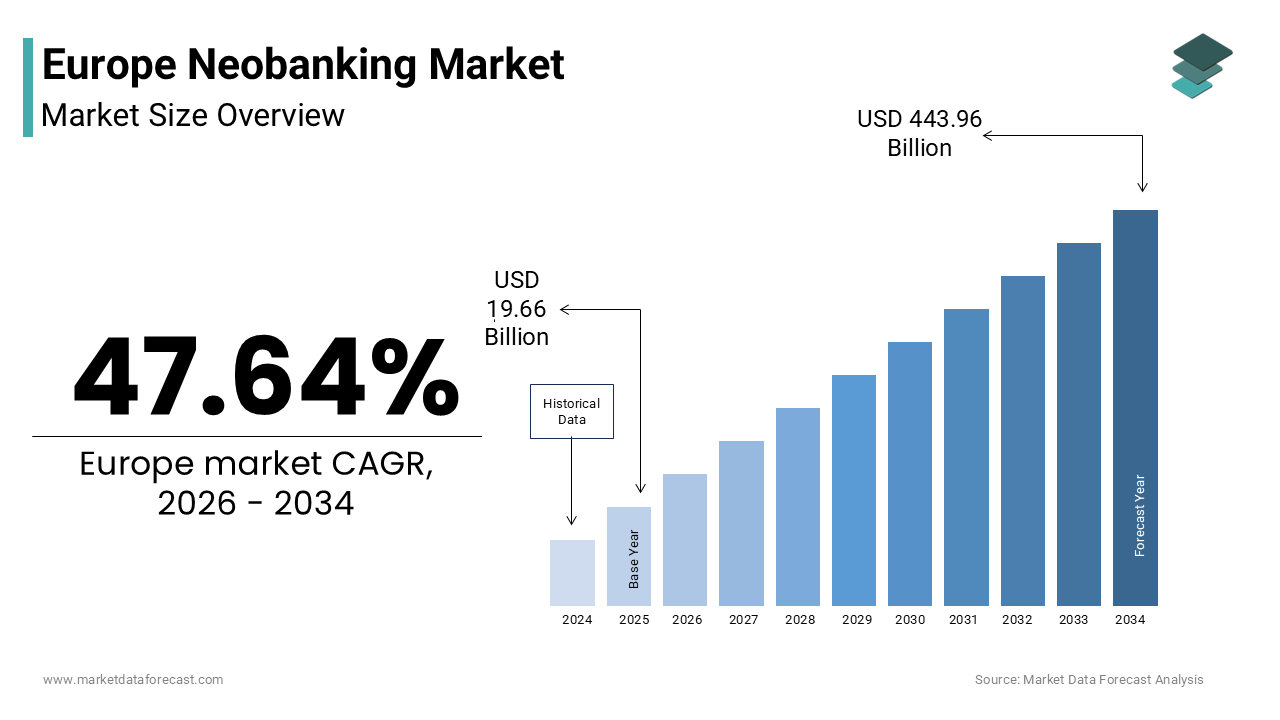
The europe neobanking market was valued at USD 13.32 billion in 2025, is estimated to reach USD 19.66 billion in 2026, and is projected to reach USD 443.96 billion by 2034, growing at a CAGR of 47.64% during the forecast period from 2026 to 2034.
Neobanking refers to digitally native financial institutions that deliver banking services exclusively through mobile applications without physical branches, operating under regulatory licenses such as electronic money institution or full banking charters issued by national authorities or the Central Bank. These entities leverage cloud infrastructure application programming interfaces and behavioral analytics to offer streamlined current accounts savings tools payment solutions and embedded financial products. A significant majority of adults within the European Union now utilize digital financial services, which highlights a clear transition in consumer preferences toward immediate, personalized, and mobile-focused interactions. New digital banking entities are appearing across the European Union, with a concentration of these institutions appearing in jurisdictions that provide flexible regulatory environments. The reduction in physical bank branches is a continuing trend, which is speeding up the movement of consumers toward completely digital, remote financial relationships. The decline in traditional, in-person banking infrastructure is establishing a favorable environment for the growth and adoption of neobanks.
MARKET DRIVERS
Persistent Consumer Dissatisfaction with Traditional Banking Service Models
Widespread disillusionment with legacy banks’ opaque fee structures slow digital transitions and perceived indifference to user experience is a primary driver of the Europe neobanking market. Many European consumers have expressed dissatisfaction regarding unforeseen fees associated with maintaining their bank accounts. Traditional financial institutions often face criticism concerning the functionality and efficiency of their mobile applications. The desire for intuitive and user-friendly digital interfaces is particularly pronounced among younger consumers when selecting a financial service provider. There is a notable pattern of younger demographics prioritizing user experience in digital banking, suggesting a shift in expectations for financial technology. Neobanks capitalize on this gap by offering zero monthly fees real time transaction notifications and instant card freezing, features now considered baseline expectations. Neobanks are outpacing established banks, which are stuck in years-long modernization projects, by offering the seamless, fast digital experiences that modern customers demand
Accelerated Regulatory Harmonization Through the Digital Finance Package
The European Union’s comprehensive Digital Finance Package has created a standardized yet innovation-friendly licensing and operational framework that significantly lowers entry barriers for neobanks. This framework is another accelerator of the Europe neobanking market. The European Commission has introduced harmonized regulatory frameworks (MiCA and DORA) designed to simplify cross-border scaling for fintechs and crypto-asset service providers by reducing reliance on individual national, fragmented regulations. Crucially the package includes the Financial Data Access regulation which mandates that licensed third parties can securely access customer financial data with consent, enabling neobanks to offer enriched personal finance management and credit scoring without holding all assets in house. The Bank of Lithuania, under increasing EU-wide regulatory scrutiny, is enhancing its supervision of digital financial services, resulting in a stricter licensing environment for new electronic money institutions seeking to passport services throughout the European Union. Furthermore, the European Banking Authority maintains centralized, publicly accessible registers of licensed entities, enabling stakeholders to verify the regulatory status of digital financial institutions in real time to increase market transparency and consumer trust. This regulatory cohesion not only reduces legal overhead but also encourages venture investment by providing predictable compliance milestones, a structural enabler absent in earlier fragmented stages of fintech development.
MARKET RESTRAINTS
Stringent Capital Requirements and Licensing Delays in Key Jurisdictions
Neobanks in the region continue to face significant hurdles in securing full banking licenses due to rigorous capital adequacy thresholds and protracted approval timelines, which acts as a major impediment to the Europe neobanking market. Seeking a full banking license can present considerable challenges for early-stage financial technology companies, often requiring significant capital and robust risk management governance. The licensing process can involve extended timelines, with many applications requiring major revisions, frequently due to inadequate anti-money laundering controls or insufficient capital planning. Regulatory oversight increasingly focuses on operational resilience and IT capabilities, with supervisory bodies intensifying scrutiny of internal governance and risk management frameworks for new applicants. These constraints force many entrants to operate under electronic money institution licenses which prohibit interest bearing deposits and lending, severely limiting revenue diversification. Consequently, neobanks remain dependent on interchange fees and premium subscriptions, creating fragile business models vulnerable to payment network policy changes and margin compression in saturated markets.
Consumer Skepticism Regarding Data Privacy and Long Term Viability
Public trust in neobanks’ ability to safeguard sensitive financial data and remain solvent during economic stress remains a persistent restraint to the Europe neobanking market. Many individuals express apprehension regarding the sharing of personal transaction information by digital-only banks with external partners. A significant portion of users questions the long-term stability and resilience of these institutions during economic downturns. Perceptions of risk are heightened by reported instances of data handling issues, and data protection authorities have initiated inquiries into certain digital banks regarding the transparency of their information sharing practices with marketing firms. Unlike established, traditional financial institutions, not all digital banks provide the same level of deposit insurance coverage, as protection is contingent on specific licensing requirements, and only a limited number of digital-only banks in Europe currently meet the criteria for deposit protection schemes, leaving users of other platforms without the same safeguards. This coverage gap fuels hesitation among risk averse customers particularly in Southern and Eastern Europe where financial literacy around fintech safeguards remains low. Neobanks must secure better deposit insurance and transparent data management to convert trial users into loyal, long-term clients.
MARKET OPPORTUNITIES
Embedded Finance Integration Across Non Financial Digital Platforms
Neobanks are increasingly leveraging embedded finance to expand beyond standalone banking apps by integrating financial services directly into e commerce gig economy and software platforms, which creates new opportunities for the Europe neobanking market. Many prominent online retailers in Europe have integrated credit options and immediate account setup directly into their payment platforms through partnerships with digital-only financial institutions. The integration of banking infrastructure into retail websites allows consumers to access financial services during the checkout process without being redirected to external applications. Collaborations between financial technology firms and service platforms have expanded to include specialized credit solutions for individuals working in the gig economy. This pattern suggests a shift toward embedded finance, where traditional banking functions are secondary to the immediate needs of the consumer at the point of purchase. Merchants aim to address consumer financial requirements more fluidly by reducing steps at checkout. Moreover, the EU’s revised Payment Services Directive facilitates secure third party initiation of payments allowing neobanks to embed services without handling sensitive card data. Neobanks are evolving into "invisible" digital layers, allowing them to dodge the high costs of customer acquisition while boosting engagement through real-time relevance.
Expansion into Sustainable and Ethical Finance Niches
Aligning with Europe’s accelerating demand for sustainable finance through transparent green investment options and carbon footprint tracking is a significant potential for the Europe neobanking market. According to sources, a portion of European millennials consider environmental impact a key factor in selecting financial products as of 2024. Neobanks such as Tomorrow in Germany and bunq in the Netherlands have pioneered real time CO2 calculators linked to card transactions enabling users to offset emissions directly within the app. Furthermore the EU Taxonomy for Sustainable Activities provides a regulated classification system that neobanks use to verify the environmental credentials of investment partners. Digital-first financial institutions are increasingly directing customer funds towards sustainability-focused assets, particularly those aligned with environmental standards. This approach is becoming a notable characteristic in sustainable finance, especially as regulations advance mandates for greater sustainability disclosures. Digital-native architectures facilitate the direct integration of sustainability metrics, offering a structural advantage in meeting transparency benchmarks compared to legacy systems. This positions them as authentic stewards of the continent’s green transition attracting ethically conscious consumers and institutional capital seeking ESG compliant channels.
MARKET CHALLENGES
Fragmented Cross Border Operational Compliance Despite Regulatory Harmonization
Neobanks confront persistent national level discrepancies in anti money laundering customer due diligence and consumer protection rules that complicate pan European scaling, and thereby challenge the growth of the Europe neobanking market. Digital banks operating across European jurisdictions often encounter fragmented regulatory interpretations regarding anti-money laundering requirements. Variations in national standards for identifying beneficial ownership, verifying user identities, and screening for politically exposed persons necessitate the creation of multiple onboarding processes by these institutions. Procedures for handling consumer complaints differ significantly, with timelines for resolution varying across different national authorities. Operating within these diverse regulatory frameworks frequently requires maintaining distinct compliance teams for specific jurisdictions, which can lead to higher operational overhead compared to a unified approach. These frictions delay product rollouts fragment user experiences and erode the cost advantages that digital models promise, which emphasizes that legal harmonization has not yet translated into operational uniformity.
Intensifying Competition from Traditional Banks’ Digital Subsidiaries
Neobanks now face aggressive counteroffensives from incumbent banks launching agile digital-only subsidiaries that combine fintech style interfaces with the trust and balance sheet strength of established institutions. This further slows down the expansion of the Europe neobanking market. The European Central Bank has noted that established financial institutions are increasingly securing digital licenses and launching specialized online-only entities to compete with pure-play digital banks. These spin offs inherit critical advantages: immediate access to deposit insurance networks pre existing regulatory goodwill and cross selling to millions of existing customers. A major banking group's digital subsidiary in Spain experienced rapid customer growth following a platform relaunch, significantly outpacing the annual acquisition rates commonly seen by challenger banks in the region. Furthermore incumbents leverage decades of transaction data to refine credit scoring and personalize offers without relying on third party data brokers. This convergence blurs the distinction between neobank and digital bank reducing the novelty appeal that once drove user migration. Neobanks risk becoming commoditized if they only offer UI improvements, as legacy players now
REPORT COVERAGE
| REPORT METRIC | DETAILS |
| Market Size Available | 2025 to 2034 |
| Base Year | 2025 |
| Forecast Period | 2026 to 2034 |
| CAGR | 47.64% |
| Segments Covered | By Account Type, Application and Country |
| Various Analyses Covered | Regional & Country Level Analysis, Segment-Level Analysis, DROC, PESTLE Analysis, Porter’s Five Forces Analysis, Competitive Landscape, Analyst Overview on Investment Opportunities |
| Countries Covered | UK, France, Spain, Germany, Italy, Russia, Sweden, Denmark, Switzerland, Netherlands, Turkey, Czech Republic, and Rest of Europe |
| Market Leaders Profiled | Revolut Ltd, Atom Bank Plc, Vivid Money S.A., N26 Bank AG, Holvi Payment Services Ltd, , Bnext Group, Lunar Bank A/S, Monzo Bank Limited, Orange Bank & Trust Company, and Ma French Bank S.A. |
SEGMENTAL ANALYSIS
By Account Type Insights
The business account segment dominated the Europe neobanking market by holding a 64.1% share in 2025. The dominance of the business account segment is attributed to the acute operational and financial needs of Europe’s vast small and medium enterprise ecosystem, which legacy banks have historically underserved with slow onboarding, rigid credit access, and poor digital tools. European regulators have actively streamlined digital business account opening to foster entrepreneurship. Policy initiatives have driven a shift toward digital company registration and banking across European member states. Neobanks have significantly reduced the time required for business onboarding compared to traditional financial institutions. The speed of account opening and specialized digital features are key factors influencing company banking choices. A substantial portion of new micro-enterprises are favoring digital-first financial providers over traditional banks. This regulatory tailwind has transformed neobanks into default financial partners for startups and freelancers across urban centers from Lisbon to Warsaw. Europe’s gig economy now employs millions of people, creating demand for accounts that sync with platforms like Uber Bolt and Fiverr. Neobanks respond with APIs that auto categorize income track VAT and enable instant payouts, features absent in conventional business accounts. Revolut Business’s integration with tax filing software in Germany and Italy further reduces administrative burden, allowing sole proprietors to file quarterly returns directly from their app. This seamless fusion of banking accounting and compliance turns neobanks into operational hubs rather than mere transactional tools.

The savings account segment is estimated to register the fastest CAGR of 29.4% from 2026 to 2034 due to rising inflation awareness and demand for automated, goal oriented financial planning. Neobanks leverage behavioral economics to convert incidental transactions into systematic savings. N26’s “Spaces” and bunq’s “Savings Goals” allow users to round up card purchases and allocate spare change to designated jars, automating micro savings without effort. Younger European consumers are frequently using automatic saving features as part of their financial routines. Users of digital banking services commonly employ automated saving tools like transaction round-ups. In certain European areas facing inflationary impacts on purchasing power, a large number of digital bank users implement automated savings rules soon after account creation. This frictionless approach transforms passive users into active savers, directly addressing the continent’s declining household savings rate. Unlike traditional banks offering near zero interest on standard accounts neobanks partner with regulated investment firms to provide yield bearing savings vaults compliant with the EU’s PRIIPs regulation. Digital banking platforms are increasingly designing specialized savings products, such as those linked to inflation indices, to help customers protect the value of their deposits. There is a growing trend among financial institutions to align savings offerings with specific environmental or sustainable investment frameworks. A significant shift in consumer behavior indicates that European savers are prioritizing protection against rising costs over immediate access to funds. Neobanks are leveraging these changing consumer preferences by engineering dynamic, tailored savings products. They convert a commoditized savings function into a differentiated offering by embedding yield transparency and sustainability into the core user experience.
By Application Insights
The personal application segment held the largest share of the Europe neobanking market in 2025. The leading position of the personal application segment is driven by mass consumer adoption among digitally native populations seeking control transparency and mobile centric financial experiences. The steady closure of bank branches across Europe has pushed consumers toward fully digital alternatives. Traditional financial institutions have significantly reduced their physical presence across multiple regions, leading to a noticeable decline in local service points. The reduction of brick-and-mortar locations is particularly evident in rural areas, where physical access to banking services has become increasingly limited. Digital-only banking platforms have emerged as an alternative, providing service access through mobile devices to users regardless of their physical location. In regions where physical infrastructure has become scarce, younger demographics have increasingly transitioned to using digital platforms as their main method for managing personal finances. There is an observable shift in consumer behavior where digital accessibility is being prioritized over traditional in-person banking interactions. This infrastructure gap transforms neobanks from convenience to necessity particularly for populations in underserved regions. Consumers increasingly demand proactive financial management tools that legacy banks fail to provide. Neobanks deliver real time spending categorization spending limits and subscription trackers within intuitive interfaces. Many European banking users demonstrate a preference for automated digital tools that categorize transactions over direct interaction with human financial advisors. Research suggests that automated analysis features can help consumers gain better oversight of their recurring expenses. The use of digital analytic dashboards appears to correlate with a reduction in overspending on subscriptions for some users. Behavioral insights from banking platforms indicate that users are actively engaging with tools designed to track and manage their spending habits. This shift reflects a broader cultural move toward self directed financial health, where transparency and immediacy outweigh traditional notions of banking reliability.
The enterprises application segment is estimated to register the fastest CAGR of 31.2% during the forecast period owing to the digitization of SME finance and cross border commerce. European SMEs increasingly operate across borders yet face exorbitant FX fees and settlement delays with traditional banks. Neobanks solve this with built in multi currency accounts and near real time international transfers. Many small and medium-sized enterprises operating across European borders have reported reduced foreign exchange costs when utilizing digital banking alternatives compared to traditional financial institutions. Strategic partnerships between fintech platforms and specialized transfer services are facilitating faster, direct currency payments, which reduces conversion needs for cross-border transactions. The ability to settle international transactions quickly and without unnecessary conversion is becoming increasingly important as micro-enterprises grow their revenue reliance on sales within other member states Neobanks integrate tax logic directly into transaction flows easing regulatory burdens. Digital receipt validation requirements, such as those in Poland, have coincided with improved accuracy in business expense reporting for companies utilizing automated financial tools. The adoption of neobank expense management platforms appears to be linked to a decrease in audit discrepancies identified by tax authorities. Financial technology firms, including Revolut Business, are increasingly offering automated, region-specific VAT compliance reporting to align with national regulations across the EU. The automation of expense categorization and reporting reduces the need for manual reconciliation processes. Freelancers and businesses in Europe are shifting away from manual, time-intensive expense management to automated digital solutions. Neobanks become vital infrastructure for millions of micro businesses by turning compliance from a burden into a quiet, automated process.
REGIONAL ANALYSIS
United Kingdom Neobanking Market Analysis
The United Kingdom led the Europe neobanking market by capturing a 19.4% share in 2025. The supremacy of the UK market is credited to an early and supportive regulatory environment alongside high smartphone penetration and consumer openness to fintech innovation. Regulatory frameworks have been established to facilitate the growth and expansion of digital banking services. A notable trend indicates that many users are increasingly utilizing digital banking accounts as their primary financial relationship. The fintech sector has sustained its development through targeted regulatory actions, including the creation of specialized testing environments and the streamlining of licensing processes. High levels of investment continue to support product development within this sector, particularly in areas like savings and lending. The advancements within this area appear to impact the wider financial technology landscape.
Germany Neobanking Market Analysis
Germany was the next prominent country in the Europe neobanking market by accounting for a 16.8% share in 2025. The expansion of the German market is fuelled by its strong SME base and demand for efficient digital finance. German consumers and businesses prioritize data privacy operational transparency and regulatory compliance, criteria that neobanks like N26 and Solaris meet through strict adherence to BaFin oversight. Freelancers in Germany are increasingly adopting digital business accounts, driven by a preference for integrated tools that manage invoicing and taxation. A notable shift away from traditional cash transactions toward digital payments at the point of sale has facilitated the faster adoption of neobanking solutions. Governmental support initiatives aimed at small and medium-sized enterprises are promoting the adoption of fintech tools and digital transformations. The combined impact of integrated functional tools, changing consumer payment habits, and institutional support has fostered greater acceptance of digital banking services.
France Neobanking Market Analysis
France holds anoteworthy position in the Europe neobanking market due to proactive state support for fintech and a vibrant startup culture. Regulatory authorities in France have increased the issuance of electronic money licenses, fostering a growing financial technology ecosystem with hubs in major cities. A prominent French fintech platform serves a significant portion of local small and medium-sized enterprises, indicating high adoption rates among new businesses. National initiatives actively support the fintech sector through accelerated licensing processes and favorable investment conditions. The integration of national digital identification systems has streamlined mandatory verification processes, substantially reducing customer onboarding times. Synergies between regulatory, technological, and governmental support have resulted in rapid expansion for digital banking services, with notable increases in user adoption. Cultural receptivity to innovation combined with regulatory agility positions France as a continental benchmark for scalable digital finance.
Netherlands Neobanking Market Analysis
The Netherlands witnessed a consistent growth in the Europe neobanking market owing to its advanced open banking infrastructure and high English proficiency enabling cross border scaling. Dutch neobanks like bunq and Mover operate as pan European platforms from day one thanks to the country’s early adoption of PSD2 and robust API standards. The use of third-party payment services by adults in the Netherlands suggests a high level of digital financial integration, creating an environment favorable for neobank solutions. The Dutch market shows a strong interest in sustainable finance, with a notable number of consumers opting for green savings and lending products. A substantial international workforce in Amsterdam contributes to the demand for multi-currency accounts and digital banking services that support non-domestic employment. This confluence of regulatory foresight environmental consciousness and global connectivity makes the Netherlands a high value innovation node rather than just a national market.
Sweden Neobanking Market Analysis
Sweden is anticipated to expand in the European neobanking market over the forecast period due to its cashless society and world leading digital public services. The Swedish economy's low reliance on physical cash has fostered widespread acceptance of digital payments and created readiness for app-based banking. Regulatory structures support digital-only banking services, balancing innovation with consumer protection. High consumer trust in digital financial platforms contributes to the adoption of neobanks, particularly among younger demographics. Moreover Sweden’s nationwide digital ID system BankID enables secure instant authentication across banking tax and healthcare platforms, a critical enabler for seamless neobank onboarding. Unlike markets where neobanks disrupt legacy systems Sweden’s digital maturity allows them to integrate as complementary layers in an already advanced ecosystem accelerating organic adoption without requiring behavioral retraining.
COMPETITIVE LANDSCAPE
The competition in the Europe neobanking market is intense and multifaceted involving not only pure play digital banks but also traditional financial institutions launching agile subsidiaries and global fintechs tailoring offerings for European compliance. While early movers gained traction through superior user experience and fee transparency the battlefield has shifted toward ecosystem depth regulatory maturity and niche specialization. New entrants face higher capital and compliance barriers yet incumbents struggle with legacy technology debt. Differentiation now hinges on advanced features such as AI driven cash flow insights automated ESG reporting and seamless integration with national tax systems. Simultaneously consumer trust remains fragile requiring demonstrable data stewardship and deposit protection. As a result leading players focus on building defensible moats through regulatory licenses proprietary data analytics and strategic alliances rather than price wars or marketing blitzes creating a mature yet dynamic competitive landscape defined by utility compliance and contextual relevance.
KEY MARKET PLAYERS
Some of the companies that are playing a dominating role in the Europe Neobanking Market include
- Revolut Ltd
- Atom Bank Plc
- Vivid Money S.A.
- N26 Bank AG
- Bnext Group
- Holvi Payment Services Ltd
- Lunar Bank A/S
- Monzo Bank Limited
- Orange Bank & Trust Company
- Ma French Bank S.A.
Top Players in the Market
Revolut
Revolut is a leading force in the Europe neobanking market offering a comprehensive suite of personal and business financial services through a mobile first platform. Headquartered in London the company holds a UK banking license and an electronic money institution license in Lithuania enabling pan European operations. Revolut has significantly influenced global neobanking by pioneering multi currency accounts stock trading and cryptocurrency features within a single app. In 2024 Revolut strengthened its position by launching localized business banking services in Italy and Spain featuring automated VAT reporting and SEPA payroll. It also enhanced its savings offerings with inflation linked yield accounts tied to Eurozone consumer price data. These innovations reinforce its role as a full service digital financial platform extending its model to markets in Asia and North America.
N26
N26 is a Berlin based neobank that has shaped the European digital banking landscape with its sleek user interface and German banking license. It serves both retail and freelance customers across 25 European markets emphasizing financial transparency and real time control. N26 contributes globally by demonstrating how regulated full service banking can operate entirely through mobile channels without physical branches. In 2024 the company deepened its product integration by launching Spaces Pro sub accounts for micro businesses and partnering with German tax software providers for automated filings. It also upgraded its security infrastructure to comply with the EU’s Digital Operational Resilience Act ahead of the 2025 deadline setting a benchmark for regulatory readiness. These moves solidify its reputation as a trusted and compliant digital bank.
Qonto
Qonto is a Paris headquartered neobank exclusively focused on serving freelancers small businesses and startups across Europe. It holds banking licenses in France and Germany and operates under electronic money licenses in several other EU countries. Qonto has redefined business banking by integrating invoicing expense management accounting and multi user controls into a single intuitive dashboard. Its global contribution lies in proving that verticalized neobanking—tailored to specific customer segments can achieve scale and profitability. In 2024 Qonto expanded its footprint into Portugal and Greece and introduced AI powered cash flow forecasting tools trained on anonymized transaction data from over 400000 European SMEs. It also launched a carbon accounting feature aligned with EU sustainability reporting standards further embedding environmental responsibility into business finance.
Top Strategies Used by the Key Market Participants
Key players in the Europe neobanking market employ three core strategies to sustain competitive advantage. First they pursue regulatory diversification by securing multiple licenses across jurisdictions such as Lithuania Germany and France to ensure operational continuity and market access despite national regulatory shifts. Second they invest in embedded finance partnerships with e commerce platforms gig economy apps and accounting software to deliver banking services at the point of need rather than as standalone products. Third they differentiate through value added features like real time carbon footprint tracking inflation adjusted savings and automated tax compliance that align with European consumer priorities around sustainability transparency and efficiency. These strategies enable neobanks to transcend basic payments and evolve into holistic financial operating systems for both individuals and businesses.
MARKET SEGMENTATION
This europe neobanking market research report is segmented and sub-segmented into the following categories.
By Account Type
- Business
- Savings
By Application
- Enterprises
- Personal
By Country
- UK
- France
- Spain
- Germany
- Italy
- Russia
- Sweden
- Denmark
- Switzerland
- Netherlands
- Turkey
- Czech Republic
- Rest of Europe