Europe Neuroscience Market Size, Share, Trends, & Growth Forecast Report By Component (Instruments, Consumables, Software & Services), Technology, End-User and Country (UK, France, Spain, Germany, Italy, Russia, Sweden, Denmark, Switzerland, Netherlands, Turkey, Czech Republic and Rest of Europe), Industry Analysis From 2026 to 2034
Market Size, 2025
$13,400.00 MnMarket Estimate, 2026
$14,124.94 MnMarket Forecast, 2034
$21,529.86 MnCAGR, 2026–2034
5.41%Europe Neuroscience Market Report Summary
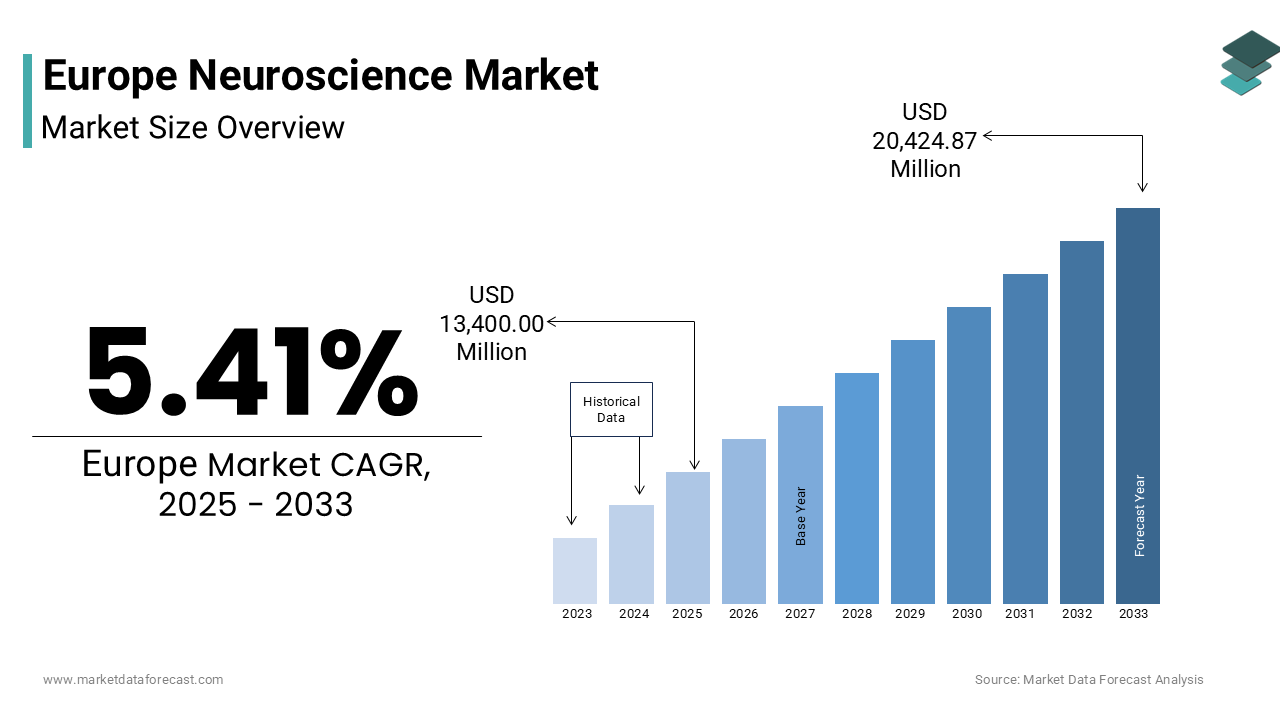
The Europe neuroscience market was valued at USD 13,400.00 million in 2025, is estimated to reach USD 14,124.94 million in 2026, and is projected to reach USD 21,529.86 million by 2034, growing at a CAGR of 5.41% during the forecast period from 2026 to 2034. The growth of the Europe neuroscience market is driven by the rising prevalence of neurodegenerative and psychiatric disorders, rapid aging of the European population, and expanding public investment in brain research and neurotechnology. Strong institutional support under Horizon Europe, increasing adoption of advanced neuroimaging and biomarker-guided clinical trials, and Europe’s leadership in ethical, evidence-based neuroscience research are further fueling market expansion. Moreover, the integration of digital health solutions, artificial intelligence enabled neurodiagnostics, and precision medicine approaches is broadening clinical applications across neurology and psychiatry.
Key Market Trends
- Rising adoption of advanced neuroimaging modalities such as MRI, PET, and functional imaging for early diagnosis of neurodegenerative diseases.
- Growing use of biomarker-guided and stratified clinical trials to improve therapeutic precision and trial success rates.
- Increasing integration of AI-driven neurodiagnostics and digital phenotyping tools in clinical and primary care settings.
- Expansion of publicly funded neuroscience research infrastructure through cross-border consortia and digital platforms like EBRAINS.
- Shift toward blood-based and proteomic biomarkers to complement or replace invasive and high-cost imaging techniques.
Segmental Insights
- Based on component, the instruments segment was the largest and held a significant share of the Europe neuroscience market in 2024. This dominance is attributed to the widespread deployment of MRI, PET, EEG, and other advanced neurodiagnostic instruments across public hospitals, academic medical centers, and clinical trial networks throughout Europe.
- Based on technology, the brain imaging segment accounted for the largest share of the market in 2024. The segment’s leadership is driven by the institutionalization of imaging-based diagnostics in Alzheimer’s, Parkinson’s, epilepsy, and stroke care, supported by standardized imaging protocols and reimbursement across multiple European health systems.
- Based on end user, research and academic institutes dominated the market, reflecting Europe’s strong emphasis on publicly funded neuroscience research, translational medicine, and multicenter clinical collaboration. However, diagnostic laboratories are expected to witness the fastest growth due to increasing reimbursement for blood-based neurodegenerative tests.
Regional Insights
- The Europe neuroscience market shows strong concentration across major healthcare and research-driven economies.
- Germany was the largest contributor, accounting for 25.3% of the Europe neuroscience market share in 2025, driven by its dense network of university hospitals, strong neurology workforce, and leadership in medical imaging and neuroscience research.
- France ranked second, supported by its integration of neuroscience into national public health strategy, nationwide reimbursement for Alzheimer’s diagnostics, and presence of major pharmaceutical R&D centers.
- The United Kingdom is expected to witness the fastest growth, fueled by its agile regulatory environment, rapid adoption of digital neuroscience tools, and strong funding for AI-driven neurotechnology.
- Sweden and the Netherlands continue to emerge as high-impact markets due to their advanced population health data systems, biobanks, and leadership in collaborative neuroscience research initiatives.
Competitive Landscape
The Europe neuroscience market is characterized by the presence of established medical device manufacturers, diagnostic leaders, and emerging digital health innovators operating within a highly regulated and ethically governed ecosystem. Competition is driven by scientific validation, regulatory compliance, biomarker integration, and alignment with public healthcare pathways, rather than price alone. Leading companies focus on expanding AI-enabled neuroimaging, minimally invasive neuromodulation technologies, and biomarker-based diagnostics, while actively participating in EU-funded research consortia. Prominent players in the Europe neuroscience market include Siemens Healthineers AG, GE HealthCare Technologies Inc., Koninklijke Philips N.V., Medtronic plc, Boston Scientific Corporation, Abbott Laboratories, Terumo Corporation, B. Braun Melsungen AG, Brainlab SE, and Natus Medical Incorporated.
Europe Neuroscience Market Size
The europe neuroscience market size was valued at USD 13,400.00 million in 2025 and is anticipated to reach USD 14124.94 million in 2025 from USD 21529.86 million by 2034, growing at a CAGR of 5.41% during the forecast period from 2026 to 2034.
The neuroscience is the research development and clinical deployment of diagnostic tools therapeutic interventions and digital health solutions targeting disorders of the central and peripheral nervous systems, including neurodegenerative diseases psychiatric conditions epilepsy stroke and chronic pain. The region’s approach prioritizes patient safety scientific rigor and equitable access often resulting in longer but more robust clinical validation pathways. According to the European Brain Council, over 165 million people in the European Union live with at least one neurological or mental health disorder representing nearly 40% of the total disease burden measured in disability adjusted life years. As per the World Health Organization Europe accounts for 31% of global multiple sclerosis cases and 28% of Parkinson’s disease prevalence despite having only 10% of the world’s population. This disproportionate burden combined with Europe’s leadership in neuroimaging infrastructure and cross border research consortia like the Human Brain Project positions the region as both a critical treatment market and a global epicenter for translational neuroscience innovation.
MARKET DRIVERS
Rising Prevalence of Neurodegenerative and Psychiatric Disorders Across Aging Populations
The shift toward an older population is intensifying the burden of neurological and mental health conditions creating sustained clinical and research demand. The rising prevalence of neurodegenerative and psychiatric disorders across aging populations is accelerating the growth of Europe neuroscience market. According to the European Commission, over 20% of the European Union’s population was aged 65 or older in 2024 with projections indicating this will rise to 29% by 2050. As per the European Brain Council Alzheimer’s, disease and other dementias affect more than 10 million Europeans with prevalence doubling every five years after age 65. Simultaneously, depression and anxiety disorders impact over 40 million adults annually making them the leading cause of disability in the region. National health systems in Germany, France, and Italy have expanded memory clinics and cognitive assessment networks with over 1,200 specialized centers now operational, across the European Union. This structural health burden ensures continuous demand for diagnostics therapeutics and caregiver support technologies irrespective of economic cycles.
Expansion of Publicly Funded Neuroscience Research Infrastructure Under Horizon Europe
The European Union’s strategic investment in neuroscience research through the Horizon Europe framework provides a stable foundation for innovation and clinical translation. The expansion of publicly funded neuroscience research infrastructure under horizon Europe is additionally elevating the growth of Europe neuroscience market. According to the European Commission, over 1.2 billion euros were allocated to brain health and neurotechnology projects between 2021 and 2024 under Pillar II of Horizon Europe. As per the Human Brain Project, consortium this funding enabled the creation of EBRAINS a digital research infrastructure offering access to high performance computing neuroimaging databases and brain simulation tools used by over 5,000 researchers, across 27 countries. Additionally, the Innovative Health Initiative co funds public private partnerships like the Alzheimer’s Drug Discovery Foundation Europe, which accelerates clinical validation of novel therapeutics. This sustained institutional backing de risks early-stage innovation and attracts global talent ensuring Europe remains a magnet for collaborative neuroscience advancement beyond commercial imperatives.
MARKET RESTRAINTS
Stringent Regulatory Pathways for Central Nervous System Therapeutics
The medicines agency imposes rigorous evidentiary standards for neuroscience therapies due to the complexity of the brain and historical safety concerns. The stringent regulatory pathways for centrl nervous system therapeutics is limiting the growth of Europe neuroscience market. According to the agency, central nervous system drug candidates that entered clinical trials between 2015 and 2023 received marketing authorization, significantly lower than the average for other therapeutic areas. As per the European Medicines Agency 2024 review, applications for psychiatric and neurodegenerative drugs require longer trial durations larger patient cohorts and more extensive cognitive and behavioral endpoints compared to other indications. The agency also mandates post authorization safety studies for all new antipsychotics and dementia therapies due to black box warnings on mortality and cardiovascular risk. While, essential for patient protection these barriers disproportionately affect small biotechs lacking capital to sustain prolonged trials delaying therapeutic innovation despite unmet medical need.
Fragmented Reimbursement and Access Policies Across Member States
Despite centralized drug approval, divergent national reimbursement decisions and health technology assessment criteria is hindering the growth of Europe neuroscience market. According to the European Observatory on Health Systems and Policies, only 12 of the 27 European Union member states provided universal reimbursement for recently approved disease modifying therapies for early Alzheimer’s in 2024. As per the German Institute for Quality and Efficiency in Health Care, the same therapy may be fully covered in Sweden but restricted to clinical trials in Greece due to differing cost effectiveness thresholds. The United Kingdom’s National Institute for Health and Care Excellence consistently applies a lower quality adjusted life year ceiling for neurological conditions for oncology reflecting conservative valuation of cognitive benefits. This fragmentation creates market access uncertainty that discourages investment particularly for high-cost gene and cell therapies requiring long term outcome data.
MARKET CHALLENGES
Integration of Artificial Intelligence in Neurodiagnostics and Digital Phenotyping
Artificial intelligence is new capabilities in early detection and personalized monitoring of neurological and psychiatric conditions through the analysis of multimodal data streams. The integration of artificial intelligence in neurodiagnostics and digital phenotyping is greatly influencing the growth of Europe neuroscience market. According to the European Institute of Innovation and Technology, over 35 AI-driven neurodiagnostic tools received CE marking in 2024, including algorithms that detect Parkinson’s from voice patterns Alzheimer’s from retinal scans and depression from smartphone typing dynamics. The European Commission’s Digital Europe Programme has funded pilot deployments of these tools in primary care settings across Portugal and Finland enabling earlier specialist referrals. These digital biomarkers are designed to comply with the EU Artificial Intelligence Act’s transparency requirements using explainable models and bias mitigation protocols.
Adoption of Advanced Neuroimaging and Biomarker Guided Clinical Trials
The dense network of academic medical centers and standardized imaging protocols is accelerating the use of objective biomarkers in neuroscience drug development. The adoption of advbaanced neuroimaging and biomarker guided clinical trials is another attribute to elevate the growth of Europe neuroscience market. According to the European Association of Neuroimaging, over 800 certified PET and MRI centers across the European Union participate in harmonized data acquisition protocols, under the European Prevention of Alzheimer’s Dementia initiative. The European Medicines Agency’s 2023 qualification opinion formally recognized these biomarkers as surrogate endpoints for early disease modification. Companies like Roche and Biogen leverage this infrastructure to run adaptive trials with real time biomarker feedback shortening development cycles. This biomarker enabled precision approach not only enhances trial efficiency but also aligns with the European Union’s push for stratified medicine under the Innovative Health Initiative.
MARKET CHALLENGES
Shortage of Specialized Neurology and Psychiatry Workforce
The deficit in trained neuroscience clinicians that constrains diagnosis treatment and trial recruitment is one of the challenges for the growth of Europe neuroscience market. According to the European Union of Medical Specialists, there is a shortfall of over 18,000 neurologists, across the European Union with Southern and Eastern member states experiencing the most acute gaps. This scarcity delays diagnosis with the European Brain Council reporting an average 14 month wait for a first neurology consultation in countries like Spain and Poland. The deficit also limits clinical trial capacity as specialized centers become bottlenecks for patient screening and follow up.
Ethical and Legal Constraints on Brain Data and Neurotechnology
The handling of sensitive neural data and invasive neurotechnologies is subject to overlapping ethical and legal frameworks that can impede innovation. The ethical and legal constraints in brain data and neurotechnology is additionally impeding the growth of Europe neuroscience market. According to the European Group on Ethics in Science and New Technologies, brain data derived from EEG fMRI or brain computer interfaces is classified as a special category of personal data under the General Data Protection Regulation requiring explicit consent and strict purpose limitation. As per the Council of Europe’s 2024 Recommendation on Neurotechnology, any implantable neural device must undergo prior ethical review by national bioethics committees a process that adds 6 to 12 months to market entry. While, these safeguards protect fundamental rights they create significant compliance burdens for startups developing next generation neurofeedback or closed loop neuromodulation systems.
REPORT COVERAGE
| REPORT METRIC | DETAILS |
| Market Size Available | 2025 to 2034 |
| Base Year | 2025 |
| Forecast Period | 2026 to 2034 |
| CAGR | 5.41% |
| Segments Covered | By Component, Technology, End-User and Region. |
| Various Analyses Covered | Global, Regional and Country Level Analysis, Segment-Level Analysis, DROC, PESTLE Analysis, Porter’s Five Forces Analysis, Competitive Landscape, Analyst Overview of Investment Opportunities |
| Regions Covered | United Kingdom, France, Spain, Germany, Italy, Russia, Sweden, Denmark, Switzerland, the Netherlands, Turkey, and the Czech Republic. |
| Market Leaders Profiled | Siemens Healthineers AG, GE HealthCare Technologies Inc., Koninklijke Philips N.V., Medtronic plc, Boston Scientific Corporation, Abbott Laboratories, Terumo Corporation, B. Braun Melsungen AG, Brainlab SE, and Natus Medical Incorporated |
SEGMENTAL ANALYSIS
By Component Insights
The instruments segment was the largest by holding 48.2% of the Europe neuroscience market share in 2024. European academic medical centers and public hospitals maintain extensive fleets of advanced neuroscience instruments, including MRI, PET, EEG and magnetoencephalography systems. According to the European Association of Neuroimaging, over 1,200 high field MRI scanners and 320 PET centers were operational across the European Union in 2024 supporting both patient care and multicenter trials. As per the German Center for Neurodegenerative Diseases, national initiatives like Germany’s 3 Tesla MRI expansion program added 85 new research grade scanners in 2024 alone. These instruments represent long term capital assets with lifespans of 10 to 15 years creating stable demand through upgrades and replacements. Neurological and psychiatric diagnosis in Europe increasingly relies on objective instrumental data rather than symptom reporting alone. According to the European Medicines Agency, amyloid PET and quantitative EEG are now required components of early Alzheimer’s and epilepsy diagnostic protocols in 19 member states. As per the UK’s National Institute for Health and Care Excellence, all suspected Parkinson’s cases must undergo DaTSCAN imaging to confirm dopaminergic deficit before treatment initiation. This clinical codification ensures consistent utilization of specialized instruments across public healthcare systems. This institutionalization transforms instruments from optional research tools into essential clinical utilities embedded in national care pathways.
The Software & Services segment is ascribed to witness a fastest CAGR of 14.8% from 2025 to 2033. The European Medicines Agency and the European Commission have established formal pathways for the validation and adoption of software as a medical device in neuroscience. According to the European Commission’s 2024 Digital Health Action Plan, over 45 AI based neurodiagnostic software tools received CE marking as Class IIa or IIb medical devices in 2024 including platforms that analyze speech patterns for depression or gait for Parkinson’s. Companies like BrainKey and Neuronostics leverage cloud based platforms to deliver standardized analysis of MRI EEG and wearable data across multicenter studies. This regulatory recognition transforms software from an ancillary tool into a core therapeutic and diagnostic asset with recurring revenue models. Post pandemic healthcare models in Europe increasingly rely on software platforms for longitudinal neurological assessment and therapy management. As per the German Federal Ministry of Health, the national telemedicine reimbursement framework now covers AI assisted seizure prediction and cognitive decline alerts enabling sustainable adoption. The European Commission’s Cross Border Healthcare Directive also facilitates data sharing between member states allowing patients to access second opinions via secure cloud platforms.
By Technology Insights
The brain Imaging segment was accounted in holding 42.3% of the Europe neuroscience market share in 2024. Europe has led global efforts to standardize brain imaging as an objective diagnostic criterion for Alzheimer’s and Parkinson’s diseases. According to the European Prevention of Alzheimer’s Dementia, consortium over 800 imaging centers across 22 countries adhere to harmonized MRI and PET acquisition protocols by enabling pooled data analysis. As per the European Medicines Agency, amyloid PET is now a required inclusion criterion in 70% of Phase III Alzheimer’s trials conducted in Europe ensuring patient homogeneity. The Joint Research Centre reports that national health systems in Germany France and Sweden reimburse amyloid PET for early diagnosis in patients with mild cognitive impairment, a policy that drives consistent scanner utilization. These facilities serve dual purposes supporting patient stratification in clinical trials, while enabling fundamental research on neural networks.
The neuro proteomic analysis segment is projected to register a fastest CAGR of 16.2% from 2025 to 2033. The identification of phosphorylated tau and neurofilament light chain, as reliable plasma biomarkers has revolutionized early detection of Alzheimer’s and ALS. According to the European Commission’s Innovative Health Initiative, some public private partnerships focused on neuro proteomics received funding in 2024 to validate these markers across diverse populations. National health agencies in Denmark and the Netherlands have already incorporated these assays into memory clinic workflows reducing reliance on invasive and expensive imaging. This shift toward accessible liquid biopsies is driving demand for high sensitivity mass spectrometry and immunoassay platforms across diagnostic laboratories. Neuro proteomics enables patient stratification based on molecular subtypes rather than clinical symptoms alone. As per the French National Institute of Health and Medical Research, proteomic subtyping revealed that patients clinically diagnosed with Alzheimer’s actually had non amyloid pathologies redirecting them to alternative trials. Companies like Biogen and Roche now co develop companion diagnostics using proteomic signatures to match patients with gene therapies or monoclonal antibodies.
By End User Insights
The Research & Academic Institutes segment held 45.3% of the Europe neuroscience market share in 2024. European universities and research hospitals serve as the operational hubs for large scale collaborative projects funded, under Horizon Europe and the Innovative Health Initiative. As per the Human Brain Project, the EBRAINS digital infrastructure hosted by academic centers in Germany, France, and Switzerland provides shared access to brain simulation tools neuroimaging databases and high performance computing used many researchers annually. These institutions not only conduct basic research but also validate diagnostics and run early phase trials creating continuous demand for instruments consumables and software. Europe’s academic medical centers uniquely blend patient care and research under single institutional umbrellas. According to the European Brain Council, many university hospitals across the European Union operate dedicated neuroscience research units that recruit patients directly into observational studies and clinical trials. This seamless pipeline from bedside to bench and back ensures consistent utilization of advanced technologies and creates a self-sustaining ecosystem where research funding directly supports clinical infrastructure.
The diagnostic laboratories segment is esteemed to witness a fastest CAGR of 13.5% from 2025 to 2033. National health systems are increasingly covering liquid biopsy tests for neurodegenerative diseases driving volume in private and public labs. According to the European Observatory on Health Systems and Policies, Sweden and Finland began reimbursing plasma p tau217 tests in 2024 for patients with cognitive complaints reducing wait times for specialist referrals by 50%. As per the German Federal Joint Committee, the national decision on amyloid blood test reimbursement is expected by mid-2025 following successful pilot programs in Hamburg and Munich. These tests require high sensitivity immunoassay platforms and mass spectrometers creating new capital and consumable demand in labs previously focused on general chemistry. The shift from imaging to blood based screening represents a structural transition that scales with aging populations. These reference labs invest heavily in automation AI driven result interpretation and secure data portals to serve hospitals and clinics across multiple countries. This centralization model ensures economies of scale and quality control while expanding access to advanced diagnostics in regions with limited specialist resources.
REGIONAL ANALAYSIS
Germany Neuroscience Market Analysis
Germany was the largest contributor of the Europe neuroscience market by occupying 25.3% of share in 2024 with its world class academic medical centers and dense neurology network. According to the German Federal Ministry of Education and Research, the country operates over 40 university hospitals with dedicated neuroscience departments and participates in 60% of EU funded brain health consortia. As per the German Society of Neurology, many neurologists practice in the country the highest in Europe by ensuring broad access to advanced diagnostics. Germany’s strong medical device industry also supplies imaging and electrophysiology systems globally. This fusion of public research funding clinical density and industrial capability makes Germany the structural core of Europe’s neuroscience ecosystem.
France Neuroscience Market Analysis
France neuroscience market held 18.3% of the share in 2024 with its integration of neuroscience into national public health strategy. As per the French Health Authority, amyloid PET and plasma tests are now reimbursed for early Alzheimer’s diagnosis nationwide. The country also hosts major pharmaceutical R and D centers for Sanofi and Ipsen focusing on neurodegeneration and rare diseases. This top down approach ensures that research innovation rapidly translates into accessible care reinforcing France’s position as a policy driven neuroscience leader.
UK Neuroscience Market Analysis
The UK neuroscience market growth is expected to witness a fastest CAGR during the forecast period with its agile regulatory environment and in digital neuroscience. According to the UK’s Medical Research Council, invested in brain research in 2024 with a focus on AI driven diagnostics and brain computer interfaces. The Medicines and Healthcare products Regulatory Agency has approved 12 digital biomarker tools for neurological conditions since 2023, more than any other European country using a streamlined innovation pathway. As per the National Institute for Health and Care Excellence, tele neurology and remote monitoring are fully reimbursed enabling rapid adoption of software platforms.
Sweden Neuroscience Market Analysis
Sweden neuroscience market growth is likely to grow with its unique population health infrastructure for neuroscience discovery. The Karolinska Institute’s Alzheimer’s biomarker program has tracked 15,000 individuals for over a decade identifying novel plasma signatures now validated across Europe. As per the Swedish Agency for Health Technology Assessment, blood based neurodegenerative tests are among the fastest adopted globally with nationwide reimbursement since 2023. Sweden’s universal healthcare system ensures equitable access to advanced diagnostics while its small size enables rapid policy implementation. This combination of data depth policy agility and ethical governance makes Sweden a disproportionate contributor to European neuroscience innovation.
The Netherlands Neuroscience Market Analysis
The Netherlands neuroscience market growth is likely to grow with its role as a hub for international neuroscience collaboration. According to the Dutch Research Council, the country hosts key nodes of the Human Brain Project and the European Prevention of Alzheimer’s Dementia initiative with the VU University Medical Center in Amsterdam serving as a central data coordination site. The Netherlands’ multilingual workforce and central location facilitate cross border clinical trials with Belgium Germany and France. Additionally, Dutch universities consistently rank among Europe’s top for neuroscience publications per capita.
COMPETITIVE LANDSCAPE
Competition in the Europe neuroscience market is defined by a convergence of medical device manufacturers diagnostic companies and digital health innovators operating within a uniquely rigorous regulatory and ethical framework. The landscape is moderately consolidated among multinational leaders yet dynamically challenged by academic spin offs and AI startups specializing in neurodiagnostics. Incumbents leverage decades of clinical validation imaging infrastructure and biomarker expertise to maintain dominance in instruments and consumables while newer entrants disrupt through software based digital phenotyping and remote monitoring. The European Medicines Agency’s stringent evidentiary standards for central nervous system therapies create high barriers to entry but also ensure that approved solutions carry global credibility. Competition is not primarily price driven but centers on scientific validation regulatory foresight and integration into public healthcare pathways. Cross border research consortia and national health technology assessment bodies further shape market access making collaboration often more valuable than confrontation. As a result, the most successful players combine technological excellence with deep engagement in Europe’s public health and research ecosystem.
KEY MARKET PLAYERS
Some of the companies that are playing a dominating role in the Europe Neuroscience Market include
- Siemens Healthineers AG
- GE HealthCare Technologies Inc.
- Koninklijke Philips N.V.
- Medtronic plc
- Boston Scientific Corporation
- Abbott Laboratories
- Terumo Corporation
- B. Braun Melsungen AG
- Brainlab SE
- Natus Medical Incorporated
Top Players in the Europe Neuroscience Market
Siemens Healthineers
Siemens Healthineers plays a pivotal role in the Europe neuroscience market through its advanced neuroimaging systems including high field MRI PET CT and molecular imaging platforms. The company’s European R and D centers in Germany and the UK focus on AI powered neuro quantification tools that support early diagnosis of Alzheimer’s Parkinson’s and epilepsy. Siemens actively contributes to EU funded initiatives like the Human Brain Project by providing standardized imaging protocols and cloud-based analytics via its syngo.via platform. In recent years, the company has expanded its digital neurology portfolio with CE marked AI applications for stroke detection and white matter lesion segmentation. Globally, Siemens leverages its European regulatory expertise to shape clinical validation standards for neuroimaging biomarkers ensuring its technologies remain integral to both research and routine care, across North America and Asia.
Roche Diagnostic
Roche Diagnostics maintains a strong neuroscience presence in Europe through its leadership in cerebrospinal fluid and blood based biomarker assays for neurodegenerative diseases. The company’s Elecsys platform offers fully automated tests for amyloid beta phosphorylated tau and neurofilament light chain widely adopted in memory clinics and clinical trials across Germany France and the Nordics. Roche co leads the European Prevention of Alzheimer’s Dementia consortium and supplies companion diagnostics for its investigational Alzheimer’s therapeutics. Recent efforts include validation of plasma biomarkers on routine clinical analyzers enabling broader lab access. Globally Roche exports its Europe developed assay protocols and reference materials setting international standards for precision neurology and reinforcing its position as a bridge between diagnostics and targeted therapeutics.
Elekta
Elekta is a key European innovator in neuroscience through its precision stereotactic radiosurgery and neuromodulation technologies. Headquartered in Sweden the company supplies advanced Gamma Knife and linear accelerator systems to over 400 neurosurgical centers across Europe for treating brain tumors functional disorders and epilepsy. Elekta integrates AI driven treatment planning and real time motion management to enhance targeting accuracy while minimizing cognitive side effects. The company actively participates in the European Federation of Neurosurgical Societies to standardize radiosurgery protocols and expand access in Eastern Europe. Globally Elekta’s European clinical data and regulatory clearances underpin its installations in North America and Asia where it promotes minimally invasive alternatives to open brain surgery supported by robust outcome registries.
Top Strategies Used by the Key Market Participants
Key players in the Europe neuroscience market pursue strategies centered on biomarker integration regulatory collaboration and digital transformation. Companies invest heavily in validating imaging and fluid biomarkers as objective endpoints aligned with European Medicines Agency qualification opinions. They form public private partnerships under Horizon Europe and the Innovative Health Initiative to de risk clinical development and access real world data. Strategic expansion into software as a medical device enables recurring revenue through AI driven analytics platforms for diagnosis and monitoring. Firms also localize manufacturing and clinical support to comply with national reimbursement requirements and data sovereignty laws. Additionally, they prioritize training for neurologists and radiologists to ensure proper adoption of complex technologies. These strategies collectively align innovation with Europe’s emphasis on evidence based equitable and ethically governed neuroscience advancement.
MARKET SEGMENTATION
This research report on the europe neuroscience market has been segmented and sub–segmented into the following categories.
By Component
- Instruments
- Consumables
- Software & Services
By Technology
- Brain Imaging
- Stereotaxic Surgeries
- Neuro-Microscopy
- Neuro-Proteomic Analysis
- Neuro-Cellular Manipulation
- Others
By End User
- Diagnostic Laboratories
- Hospitals
- Research & Academic Institute
By Country
- UK
- France
- Spain
- Germany
- Italy
- Russia
- Sweden
- Denmark
- Switzerland
- Netherlands
- Turkey
- Czech Republic
- Rest of Europe
Frequently Asked Questions
What is the Europe neuroscience market?
The Europe neuroscience market includes drugs, medical devices, diagnostics, and research tools used for the prevention, diagnosis, and treatment of neurological and psychiatric disorders.
Which conditions are covered under the neuroscience market in Europe?
Major conditions include Alzheimer’s disease, Parkinson’s disease, epilepsy, multiple sclerosis, stroke, depression, schizophrenia, migraine, and other central nervous system disorders.
Which segment dominates the Europe neuroscience market?
Pharmaceuticals dominate the market due to high demand for neurological therapies and continuous drug development activities.
What factors are driving the growth of the Europe neuroscience market?
Key drivers include an aging population, rising prevalence of neurological disorders, increased R&D investment, and technological advancements in neuroimaging and neuromodulation.
What role do medical devices play in the neuroscience market?
Medical devices such as neurostimulators, deep brain stimulation systems, EEG, and neuroimaging equipment support diagnosis, monitoring, and treatment of neurological disorders.
Which end users drive demand in the Europe neuroscience market?
Hospitals, specialty neurology clinics, diagnostic centers, research institutions, and academic organizations are the primary end users.
Which countries lead the Europe neuroscience market?
Germany, the United Kingdom, France, Italy, and Spain are key contributors due to strong healthcare infrastructure and research capabilities.
What challenges does the Europe neuroscience market face?
Challenges include high treatment costs, complex regulatory approvals, limited disease-modifying therapies, and reimbursement constraints.
What trends are shaping the Europe neuroscience market?
Key trends include personalized medicine, minimally invasive procedures, AI-driven diagnostics, and expansion of clinical trials.
What is the future outlook for the Europe neuroscience market?
The market is expected to grow steadily due to increasing disease burden, technological advancements, and expanding neuroscience research initiatives.
Access the study in MULTIPLE FORMATS
Purchase options starting from
$ 2000
Didn’t find what you’re looking for?
TALK TO OUR ANALYST TEAM
Need something within your budget?
NO WORRIES! WE GOT YOU COVERED!
Call us on: +1 888 702 9696 (U.S Toll Free)
Write to us: sales@marketdataforecast.com