- Product Description Description
- Table of Contents TOC
- List of Table & Figure LOT
- Get Free Sample PDF Sample PDF
Market Size, 2025
$232.52 BnMarket Estimate, 2026
$245.63 BnMarket Forecast, 2034
$380.99 BnCAGR, 2026–2034
5.64%Europe Oil & Gas Market Size, Growth, Trends & Forecast (2025–2034)
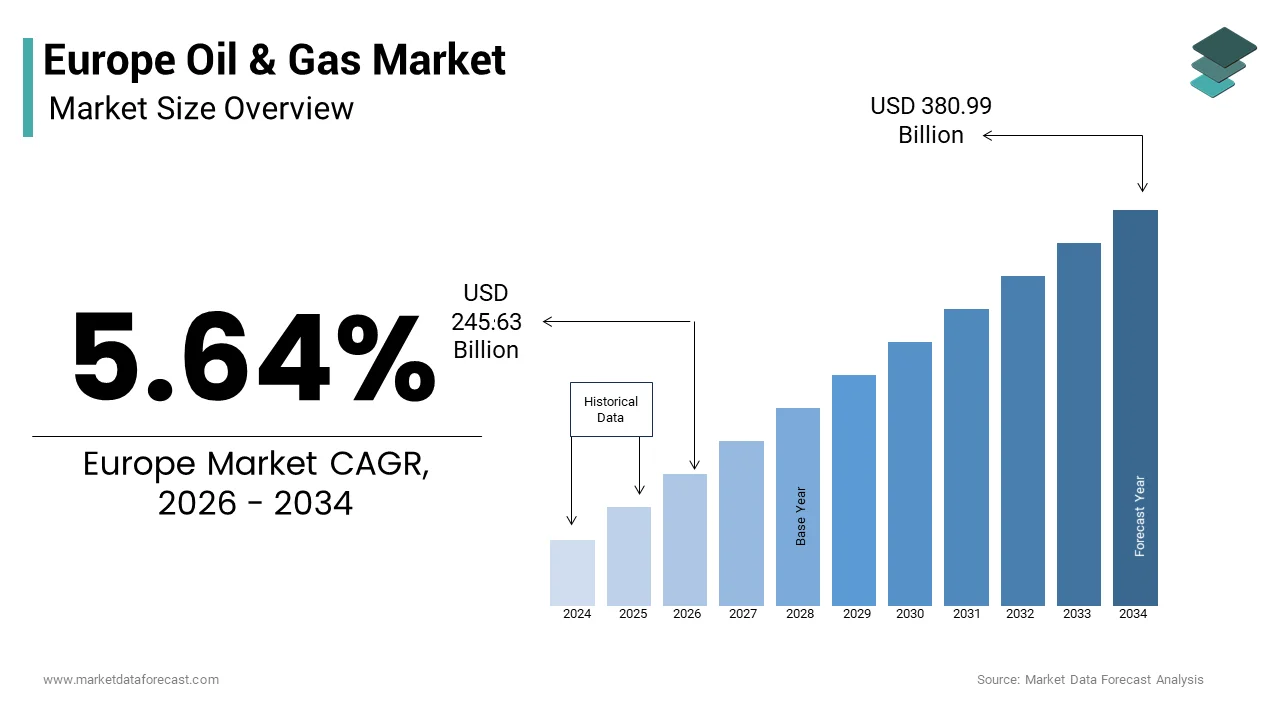
The Europe oil & gas market size was valued at USD 232.52 billion in 2025, is anticipated to reach USD 245.63 billion in 2026, and is expected to expand up to USD 380.99 billion by 2034, registering a compound annual growth rate (CAGR) of 5.64% during the forecast period. Driven by stringent regulatory compliance, energy security imperatives, LNG supply diversification, and decarbonization strategies like carbon capture and storage (CCS), the European market balances short-term fossil fuel reliability with long-term transition goals.
Key Executive Metrics (At-a-Glance)
- 2025 Base Valuation: USD 232.52 Billion
- 2026 Current Valuation: USD 245.63 Billion
- 2034 Forecast Valuation: USD 380.99 Billion
- Compound Annual Growth Rate (CAGR): 5.64% (2026–2034)
- Dominant Type Segment: Oil and Gas Storage Segment (commanding 29.2% market share in 2025, driven by mandatory 90% winter filling regulations)
- Fastest-Growing Type Segment: Export Terminals Segment (projected at a robust CAGR of 13.3% propelled by re-export capacity and LNG trade hubs)
- Dominant Drilling Segment: Offshore Drilling Segment (accounting for 60.5% market share in 2025 anchored by North Sea and Norwegian Continental Shelf reserves)
- Fastest-Growing Drilling Segment: Onshore Drilling Segment (expanding at a 9.4% CAGR fueled by unconventional tight gas exploration and depleted field CCS conversions)
- Dominant Country: Norway (market leader capturing 26.2% share backed by massive offshore production, sovereign wealth integration, and strict environmental governance)
Core Market Drivers
- Energy Security & Supply Diversification: Strategic shift away from Russian pipeline imports toward long-term LNG partnerships and mandatory storage levels.
- Industrial Process Heat Requirements: Continued reliance on natural gas for high-temperature manufacturing sectors (steel, cement, and chemicals) lacking immediate electrification alternatives.
Primary Market Restraints & Challenges
- Methane Emission Regulations & Public Opposition: High compliance costs under the EU Methane Regulation alongside prolonged legal and public resistance to fossil infrastructure.
- Fragmented National Policies & Price Volatility: Uncoordinated member-state climate targets and severe exposure to global hydrocarbon price fluctuations.
Europe Oil & Gas Market Segmentation Breakdown
| Segment Category | Leading Sub-Segment | Fastest-Growing Sub-Segment |
|---|---|---|
| By Type | Oil and Gas Storage (dominant sub-segment anchored by EU-mandated 90% winter reserve capacities) | Export Terminals (surging via excess regasification capacity and global LNG re-export demand) |
| By Drilling | Offshore (leading extraction method concentrated in the North Sea and Norwegian Continental Shelf) | Onshore (fastest growth driven by tight gas exploration and carbon capture storage basin conversions) |
| By Country | Norway & UK (Norway leads via vast North Sea assets and fiscal management; UK via mature basins and CCS clusters) | Germany & Netherlands (growth driven by rapid LNG import terminal deployment and critical gas transit hub infrastructure) |
Major Industry Players Profiled
Key multinational energy majors and national champions shaping the European oil and gas landscape include Equinor ASA, Shell plc, TotalEnergies SE, ExxonMobil, Chevron, BP plc, Eni S.p.A., ConocoPhillips, and Petrobras.
Europe Oil & Gas Market Size
The Europe oil & gas market size was valued at USD 232.52 billion in 2025 and is anticipated to reach USD 245.63 billion in 2026 to USD 380.99 billion by 2034, growing at a CAGR of 5.64% during the forecast period.
Current Introduction and Definition of the Europe Oil & Gas Market Report
Oil and gas are hydrocarbon resources across the continent’s diverse energy landscape. Unlike regions with abundant domestic reserves, Europe relies heavily on imports for its crude oil and natural gas as per the European Commission. The market operates under intense regulatory scrutiny shaped by the European Green Deal, Fit for 55 package, and REPowerEU Plan which collectively aim to phase out fossil fuel dependency while ensuring short term energy security. According to Eurostat, the EU consumed significant volumes of oil and natural gas in 2024, with transportation and industrial sectors accounting for a major share of total demand. As per the International Energy Agency, Europe added new liquefied natural gas import capacity in 2024 through floating regasification terminals in Germany and the Netherlands to replace Russian pipeline flows. The sector is now defined by a dual imperative of maintaining reliable supply during the energy transition while accelerating decarbonization through carbon capture, hydrogen blending, and methane emission controls. This tension between security and sustainability frames the strategic evolution of Europe’s oil and gas industry.
MARKET DRIVERS
Energy Security Imperatives Drive Diversification of Supply Sources
The urgent need of Europe to reduce dependence on single supplier nations has become a primary driver of oil and gas infrastructure investment and procurement strategy, which is primarily propelling the growth of the European oil and gas market. Following the 2022 disruption of Russian pipeline gas, the European Union mandated that all member states secure alternative supply routes to ensure winter resilience. According to the European Commission, the EU signed long term liquefied natural gas agreements with the United States, Qatar, and Norway by 2024. Germany commissioned its first floating storage and regasification unit in Wilhelmshaven in December 2023. Similarly, Poland expanded its Świnoujście terminal to handle additional capacity. As per the International Energy Agency, Europe’s LNG import capacity grew significantly between 2022 and 2024, which is making it the world’s largest LNG importer. National governments now treat hydrocarbon diversification as a matter of strategic sovereignty with emergency gas storage levels mandated at 90% by November each year. This geopolitical recalibration ensures sustained investment in terminals, pipelines, and storage despite long term decarbonization goals.
Industrial Process Heat Requirements Sustain Gas Demand
Natural gas remains indispensable for high temperature industrial processes that cannot be easily electrified, which is creating structural demand beyond power generation and further fuelling the expansion of the European oil and gas market. According to the European Environment Agency, industries such as steel, cement, glass, and chemicals account for a significant share of EU natural gas consumption with process temperatures often exceeding 1000 degrees Celsius. According to the European Steel Association, a majority of EU steel production still relies on natural gas fired reheating furnaces with hydrogen substitution not expected to scale before 2035. Similarly, as per the European Cement Association, most clinker kilns use gas as a primary fuel due to its clean combustion profile and precise temperature control. In 2024, the German Ministry for Economic Affairs allocated funding to support industrial gas users in switching to low carbon alternatives yet acknowledged full decarbonization would take decades. Until green hydrogen or electric arc technologies mature, natural gas serves as a necessary bridge fuel ensuring industrial competitiveness and supply chain stability in energy intensive sectors.
MARKET RESTRAINTS
Stringent Methane Emission Regulations Increase Operational Costs
The European Union’s aggressive methane reduction framework imposes significant compliance burdens on oil and gas operators across the value chain, which is impeding the growth of the European oil and gas market. Under the EU Methane Regulation adopted in 2023, companies must monitor, report, and mitigate methane leaks from extraction through distribution using advanced detection technologies. According to the European Environment Agency, methane has a much higher global warming potential than CO₂ over 20 years, making it a critical climate target. The regulation mandates quarterly aerial or satellite monitoring of all upstream sites and requires repair of leaks within five days. Operators like Eni and Equinor reported that compliance costs increased in 2024 due to investments in optical gas imaging drones and continuous emission monitoring systems. The European Commission estimates that full implementation will cost the sector billions of euros annually. While environmentally justified, these requirements strain margins particularly for small and mid-sized producers and may accelerate asset divestment in mature fields where abatement is technically challenging.
Public Opposition to Fossil Infrastructure Delays Critical Projects
Community resistance to new oil and gas infrastructure, particularly pipelines, LNG terminals, and storage facilities, has become a major restraint on supply security efforts, which is further hampering the expansion of the European oil and gas market. According to the European Environmental Bureau, many proposed energy projects faced legal challenges or public protests in 2024 including Germany’s Brunsbüttel LNG terminal and Italy’s Poseidon gas pipeline. In the Netherlands, local groups successfully blocked expansion of the Norg gas storage facility citing seismic risk despite national energy security concerns. The Aarhus Convention guarantees public participation in environmental decisions, enabling grassroots organizations to initiate lengthy judicial reviews. As per the European Network of Ombudsmen for the Environment, permitting timelines for new infrastructure now average several years compared to shorter timelines earlier. This social license deficit creates uncertainty for investors and complicates the EU’s strategy to diversify supply sources even when projects align with short term security needs. Without early community engagement and transparent benefit sharing plans, essential infrastructure risks indefinite delay undermining both energy resilience and transition planning.
MARKET OPPORTUNITIES
Integration of Carbon Capture and Storage in Mature Basins Creates New Revenue Streams
The repurposing of depleted North Sea and Mediterranean oil and gas fields for carbon capture and storage presents a strategic opportunity for the European oil and gas market. According to the Global CCS Institute, Europe has several operational or planned CCS projects with combined capacity to store CO₂ annually by 2030. Norway’s Northern Lights project, backed by Equinor, Shell, and TotalEnergies, will inject CO₂ into a saline aquifer beneath the North Sea starting in 2025. Similarly, the UK’s Acorn project in Scotland aims to store CO₂ per year by 2027 using existing pipeline infrastructure. The European Commission’s Innovation Fund allocated billions of euros in 2024 to support cross border CO₂ transport networks. For oil and gas companies, these initiatives offer a pathway to leverage subsurface expertise and existing assets in a decarbonizing economy. By transitioning from extraction to sequestration, firms can maintain skilled workforces, secure long-term contracts with industrial emitters, and align with EU climate targets, transforming legacy liabilities into climate solutions.
Development of Low Carbon Hydrogen Blending in Gas Grids Enables Transition Pathway
The gradual injection of renewable and blue hydrogen into existing natural gas transmission networks offers a pragmatic decarbonization opportunity for the European oil and gas market. According to the European Hydrogen Backbone initiative, many countries plan to repurpose thousands of kilometers of gas pipelines for hydrogen transport by 2030. In 2024, Germany launched pilot projects blending hydrogen into regional grids serving industrial clusters in the Ruhr Valley. The European Gas Regulatory Forum confirmed that most modern pipelines can safely handle hydrogen without material upgrades. Equinor’s H2H Saltend project in the UK will supply hydrogen to a grid by 2026. The European Commission’s Hydrogen and Decarbonized Gas Markets Package establish certification rules for low carbon gases ensuring traceability and additionality. This strategy allows gas TSOs to maintain asset utilization while reducing carbon intensity, providing a bridge between current infrastructure and a net zero future without premature stranding of capital.
MARKET CHALLENGES
Fragmented National Energy Policies Undermine Coordinated Market Response
Despite EU level frameworks, individual member states pursue divergent oil and gas strategies creating inefficiencies and investment uncertainty, which is a significant challenge to the expansion of the European oil and gas market. According to the European Court of Auditors, only part of the EU countries fully aligned their national energy and climate plans with REPowerEU targets in 2024. Germany accelerated LNG import capacity while France prioritized nuclear and restricted new gas connections. Poland continues coal reliance but invests in Baltic gas interconnectors, whereas Spain promotes green hydrogen but lacks storage infrastructure. This fragmentation leads to duplicated investments, underutilized assets, and price volatility across borders. The European Commission’s 2024 stress test revealed that uncoordinated national gas storage withdrawals could trigger regional shortages even when EU wide levels are adequate. Without binding coordination on infrastructure planning, emergency response, and phase out timelines, Europe’s oil and gas market remains vulnerable to both supply shocks and inefficient decarbonization, hindering a unified energy transition.
High Exposure to Global Price Volatility Threatens Economic Stability
Europe’s heavy reliance on imported oil and gas leaves its economy acutely vulnerable to international price swings and geopolitical disruptions, which is further challenging the growth of the European oil and gas market. According to the European Central Bank, energy price volatility contributed to inflation in 2024. The International Energy Agency documented that European natural gas prices fluctuated widely in 2024 due to weather events, LNG tanker congestion, and export restrictions from key suppliers. Unlike the United States with abundant shale production, Europe lacks price dampening domestic supply. Industrial consumers face particular risk with fertilizer and chemical plants idling during price spikes as seen in 2022. The EU’s joint purchasing platform reduced but did not eliminate exposure as contract structures remain fragmented. Without greater strategic reserves, coordinated demand response, or accelerated electrification of end uses, Europe’s macroeconomic stability will continue to hinge on volatile global hydrocarbon markets, contradicting the goal of resilient and predictable energy costs.
REPORT COVERAGE
| REPORT METRIC | DETAILS |
| Market Size Available | 2025 to 2034 |
| Base Year | 2025 |
| Forecast Period | 2026 to 2034 |
| CAGR | 5.64% |
| Segments Covered | By Type, Drilling, and By Country |
| Various Analyses Covered | Global, Regional & Country Level Analysis, Segment-Level Analysis, DROC, PESTLE Analysis, Porter’s Five Forces Analysis, Competitive Landscape, Analyst Overview on Investment Opportunities |
| Regions Covered | UK, France, Spain, Germany, Italy, Russia, Sweden, Denmark, Switzerland, Netherlands, Turkey, the Czech Republic, and the Rest of Europe |
| Market Leaders Profiled | ExxonMobil (US), Shell plc, Royal Dutch Shell (GB), Chevron (US), Total Energies (FR), BP (GB), Eni (IT), ConocoPhillips (US), Equinor (NO), Petrobras (BR) |
SEGMENTAL ANALYSIS
By Type Insights
The oil and gas storage segment dominated the market by commanding for 29.2% of the regional market share in 2025. The dominance of oil and gas storage segment in the European market is driven by the binding regulatory mandates and strategic security imperatives. Following the 2022 energy crisis, the European Union enacted legislation requiring all member states to maintain minimum gas storage levels of 90% by November 1 each year. According to the European Commission, the EU had significant underground storage capacity in 2024, with facilities in Germany, Italy, and the Netherlands accounting for a major portion of total volume. The Agency for the Cooperation of Energy Regulators reported that many member states expanded storage infrastructure in 2024, adding new capacity through salt caverns and depleted fields. Similarly, strategic petroleum reserves under the International Energy Agency mandate require 90 days of net oil imports to be held across the EU. Companies like Storengy and Uniper invested billions of euros in 2024 to repurpose aging gas fields for high cycling storage supporting both seasonal balancing and emergency response. This regulatory and geopolitical necessity ensures sustained investment in storage regardless of price volatility or long term decarbonization goals.

The export terminals segment the fastest growing segment in the Europe oil and gas market and is estimated to witness a CAGR of 13.3% over the forecast period. The Europe’s strategic pivot to become a global liquefied natural gas export hub, leveraging excess regasification capacity and surplus Norwegian and North Sea gas is primarily driving the growth of the export terminals segment in the regional market. According to the International Energy Agency, Europe added LNG import capacity between 2022 and 2024 but now faces declining domestic demand, creating an opportunity for re-export. Germany’s Deutsche ReGas commissioned the first floating export terminal in Lubmin in early 2025. Similarly, the Netherlands’ Gate Terminal in Rotterdam began offering reload services in 2024. The European Commission’s Hydrogen and Decarbonized Gas Markets Package permits blending of low carbon gases, enabling future exports of renewable methane. As global LNG demand grows, particularly in South Asia, Europe’s advanced port infrastructure and stable legal framework position it as a flexible trading node in the global gas market.
By Drilling Insights
The offshore drilling segment led the market by accounting for 60.5% of the European market share in 2025. The growth of the offshore segment in the European market can be credited to the concentration of remaining hydrocarbon reserves in the North Sea, Baltic Sea, and Norwegian Continental Shelf. According to the Norwegian Petroleum Directorate, Norway produced large volumes of oil equivalents in 2024, with most originating from offshore fields. According to the UK’s Oil and Gas Authority, a majority of its remaining recoverable reserves lie in the North Sea requiring subsea and platform-based extraction. Major projects like Equinor’s Martin Linge and TotalEnergies’ Tyra Redevelopment involve multibillion euro investments in subsea processing and floating production units designed to extend field life into the 2040s. The European Marine Board confirms that offshore operations benefit from fewer land use conflicts and higher per well yields compared to onshore. Additionally, existing offshore infrastructure, including pipelines and power-from-shore systems, enables cost efficient development of satellite fields. This geological and infrastructural reality ensures offshore remains the backbone of European upstream activity despite environmental scrutiny.
The onshore drilling segment is the fastest growing segment in the Europe oil and gas market with a CAGR of 9.4% over the forecast period owing to the targeted development of unconventional resources and repurposing of mature fields for carbon capture and storage. In Romania, Romgaz restarted exploration in the Transylvanian Basin in 2024 targeting tight gas deposits using modern hydraulic fracturing techniques approved under strict environmental safeguards. Similarly, Poland’s PGNiG launched pilot shale gas wells in the Lublin Basin following revised seismic monitoring protocols. More significantly, Germany and the Netherlands are converting depleted onshore gas fields into CO₂ storage sites under the EU Innovation Fund. The Ketzin pilot in Germany has already injected CO₂ into a saline aquifer with plans to scale further. As per the European Environment Agency, onshore sites offer lower monitoring costs and easier access for verification compared to offshore. As the focus shifts from extraction to emission management, onshore drilling is evolving into a climate service industry.
COUNTRY-LEVEL ANALYSIS
Norway Oil & Gas Market Analysis
Norway led the oil and gas market in Europe in 2025 by holding 26.2% of the regional market share. The dominance of Norway segment in the European market is attributed to its vast offshore reserves, sustainable management model, and sovereign wealth integration. According to the Norwegian Petroleum Directorate, the country produced large volumes of oil equivalents in 2024, with Equinor operating many fields on the Norwegian Continental Shelf. Unlike other producers, Norway channels all hydrocarbon revenues into its Government Pension Fund Global which exceeded trillions of US dollars in 2024, ensuring intergenerational equity. The state maintains strict environmental controls including mandatory carbon capture on all new developments and zero routine flaring since 1971. Recent projects like the Troll Phase 3 and Johan Sverdrup II incorporate electrification from shore reducing emissions significantly. Norway also supplies 25% of EU natural gas via pipelines and is expanding its role in hydrogen and CO₂ transport. This blend of resource stewardship, technological leadership, and fiscal responsibility solidifies Norway’s dominance.
United Kingdom Oil & Gas Market Analysis
The United Kingdom held the second largest share of the European oil and gas market in 2025. The growth of the UK in the European market is driven by its mature North Sea assets and strategic transition toward integrated energy hubs. According to the UK Oil and Gas Authority, the sector produced oil and gas in 2024 primarily from aging fields like Forties and Buzzard. The government’s Energy Security Strategy allocates billions of pounds to support late life asset management and decommissioning while incentivizing carbon capture clusters such as Acorn in Scotland. The Oil and Gas Authority reported that most new licenses issued in 2024 included CCS obligations ensuring alignment with net zero goals. The UK also hosts the world’s largest offshore wind capacity creating synergy for hybrid platforms that combine gas production with renewable power. With strong regulatory oversight, skilled workforce, and pipeline connectivity to Europe, the UK maintains relevance despite declining reserves.
Netherlands Oil & Gas Market Analysis
The Netherlands is estimated to occupy a prominent share of the European oil and gas market during the forecast period due to its critical role in gas transit, storage, and trading. Although domestic production from the Groningen field ceased in 2024, the country operates Europe’s largest gas infrastructure network including the Gate LNG terminal and significant storage capacity at Norg. According to Gasunie, the Dutch transmission system handles a major portion of all gas entering the EU serving as a key hub for Norwegian, Russian, and LNG flows. The Ministry of Economic Affairs allocated billions of euros in 2024 to convert pipelines for hydrogen and CO₂ transport under the National Climate Agreement. Rotterdam’s port serves as a reloading point for global LNG trade with many cargoes handled in 2024. Despite phasing out extraction, the Netherlands leverages its geographic and infrastructural advantages to remain central to Europe’s energy security and transition architecture.
Germany Oil & Gas Market Analysis
Germany is predicted to register a healthy CAGR in the European oil and gas market during the forecast period owing to its massive import dependency and rapid infrastructure build out following the 2022 energy crisis. According to the Federal Network Agency, the country imported large volumes of gas in 2024 with a significant share arriving as LNG through newly commissioned terminals in Wilhelmshaven, Brunsbüttel, and Lubmin. The government fast tracked permitting under the LNG Acceleration Act reducing approval timelines from years to months. Germany also holds substantial underground storage capacity primarily in salt caverns operated by Storengy and Uniper. The Ministry for Economic Affairs and Climate Action allocated billions of euros to secure long term supply contracts with the United States, Qatar, and Norway. While domestic production is negligible, Germany’s strategic investments in terminals, storage, and hydrogen blending ensure it remains a pivotal demand center and logistics node in the European energy landscape.
Italy Oil & Gas Market Analysis
Italy is expected to exhibit a steady CAGR in the European oil and gas market during the forecast period due to its reliance on imported gas and strategic pipeline interconnections. According to the Italian Ministry of Economic Development, the country consumed large volumes of gas in 2024 with a significant portion arriving via pipelines from Algeria, Azerbaijan, and Libya through the Trans Adriatic Pipeline. The government expanded the Panigaglia LNG terminal capacity and approved the Poseidon pipeline to enhance Greek connectivity. Eni operates small offshore fields in the Adriatic but focuses on international upstream and CCS development. The National Recovery and Resilience Plan allocate billions of euros to gas grid decarbonization including hydrogen ready infrastructure. Italy’s geographic position as a southern entry point for non-Russian gas and its large industrial base ensure continued significance in Europe’s diversified supply architecture despite limited domestic reserves.
COMPETITIVE LANDSCAPE
The Europe oil and gas market features intense competition among national champions international majors and state-owned enterprises operating under dual pressures of energy security and decarbonization. Incumbents like Equinor TotalEnergies and Shell dominate due to their control over critical infrastructure pipeline access and long-term supply contracts. However, they face growing scrutiny from regulators and investors demanding faster transition timelines. New entrants are limited by capital intensity and permitting barriers yet niche players in LNG trading and carbon management are gaining traction. Competition is increasingly defined by emission intensity portfolio flexibility and alignment with EU policy frameworks rather than volume alone. The absence of domestic reserves forces reliance on global markets creating vulnerability to geopolitical shifts. Simultaneously the push toward hydrogen and CCS is fostering collaboration even among rivals. This complex landscape rewards companies that balance short term reliability with credible long term decarbonization pathways while navigating fragmented national policies and public opposition.
KEY MARKET PLAYERS
A few of the dominating players in the Europe Oil & Gas market are
- ExxonMobil (US)
- Shell plc
- Royal Dutch Shell (GB)
- Chevron (US)
- Total Energies (FR)
- BP (GB)
- Eni (IT)
- ConocoPhillips (US)
- Equinor (NO)
- Petrobras (BR)
Top Players In The Market
- Equinor ASA is a Norwegian state majority owned energy company and a cornerstone of the European oil and gas market with extensive offshore operations in the North Sea and Barents Sea. The company supplies significant volumes of natural gas to Germany the UK and France through pipeline networks and contributes globally through its presence in over 30 countries including major LNG projects in the United States and Brazil. Equinor is recognized for its leadership in low carbon hydrocarbon production having achieved near zero routine flaring since 2020. Recently the company commissioned the electrified Martin Linge platform powered from shore reducing emissions by 90 percent and launched the Northern Lights carbon capture and storage project in partnership with Shell and TotalEnergies. These initiatives reinforce its dual role as a reliable energy supplier and a pioneer in the energy transition.
- Shell plc maintains a robust footprint in the Europe oil and gas market through its integrated upstream midstream and downstream operations spanning the North Sea LNG terminals and retail networks. The company is a key partner in critical infrastructure including the Gate Terminal in the Netherlands and the UK’s Acorn carbon capture project. Globally Shell operates one of the world’s largest LNG portfolios and leverages its trading expertise to enhance European supply security. In recent actions Shell accelerated its Powering Progress strategy by divesting non-core upstream assets in Italy and reinvesting in hydrogen blending pilots at its Rheinland refinery in Germany. It also expanded its renewable natural gas procurement agreements to support decarbonization of its gas portfolio. These moves position Shell as a transitional energy integrator balancing hydrocarbon reliability with net zero commitments.
- TotalEnergies SE is a French multinational energy company with deep integration across the European oil and gas value chain from Norwegian offshore production to German LNG import terminals and Italian refining. The company supplies over 20 billion cubic meters of gas annually to EU customers and operates the Tyra field redevelopment in Denmark—the largest offshore project in the region. Globally TotalEnergies ranks among the top five LNG traders and invests heavily in low carbon solutions including blue hydrogen and carbon capture. Recently the company launched the H2H Saltend hydrogen project in the UK and partnered with Equinor on the Northern Lights CO₂ transport and storage initiative. It also converted its Grandpuits refinery into a biorefinery producing sustainable aviation fuel. These strategic pivots strengthen its position as a multi energy provider aligned with European climate and security objectives.
Top Strategies Used By The Key Market Participants
Key players in the Europe oil and gas market prioritize decarbonization by electrifying offshore platforms integrating carbon capture and storage and blending renewable gases into existing infrastructure. They diversify supply sources through long term LNG contracts with non-Russian suppliers and investments in floating regasification terminals. Companies are repurposing mature assets for hydrogen transport and CO₂ sequestration to extend infrastructure life and align with EU climate mandates. Strategic partnerships with governments and industrial clusters secure funding under the Innovation Fund and REPowerEU initiatives. Additionally, firms are accelerating digitalization through AI driven predictive maintenance and methane detection systems to comply with stringent EU emission regulations and enhance operational efficiency.
MARKET SEGMENTATION
This research report on the Europe oil and gas market is segmented and sub-segmented into the following categories.
By Type
- Surface and Lease Equipment
- Gathering and Processing
- Oil and Gas Pipelines
- Oil and Gas Storage
- Refining and Oil Products
- Transport
- Export Terminals
By Drilling
- Offshore
- Onshore
By Country
- UK
- France
- Spain
- Germany
- Italy
- Russia
- Sweden
- Denmark
- Switzerland
- Netherlands
- Turkey
- Czech Republic
- Rest of Europe