- Product Description Description
- Table of Contents TOC
- List of Table & Figure LOT
- Get Free Sample PDF Sample PDF
Market Size, 2025
$40.13 BnMarket Estimate, 2026
$41.49 BnMarket Forecast, 2034
$54.22 BnCAGR, 2026–2034
3.40%Europe Oilfield Service Market Intelligence Summary
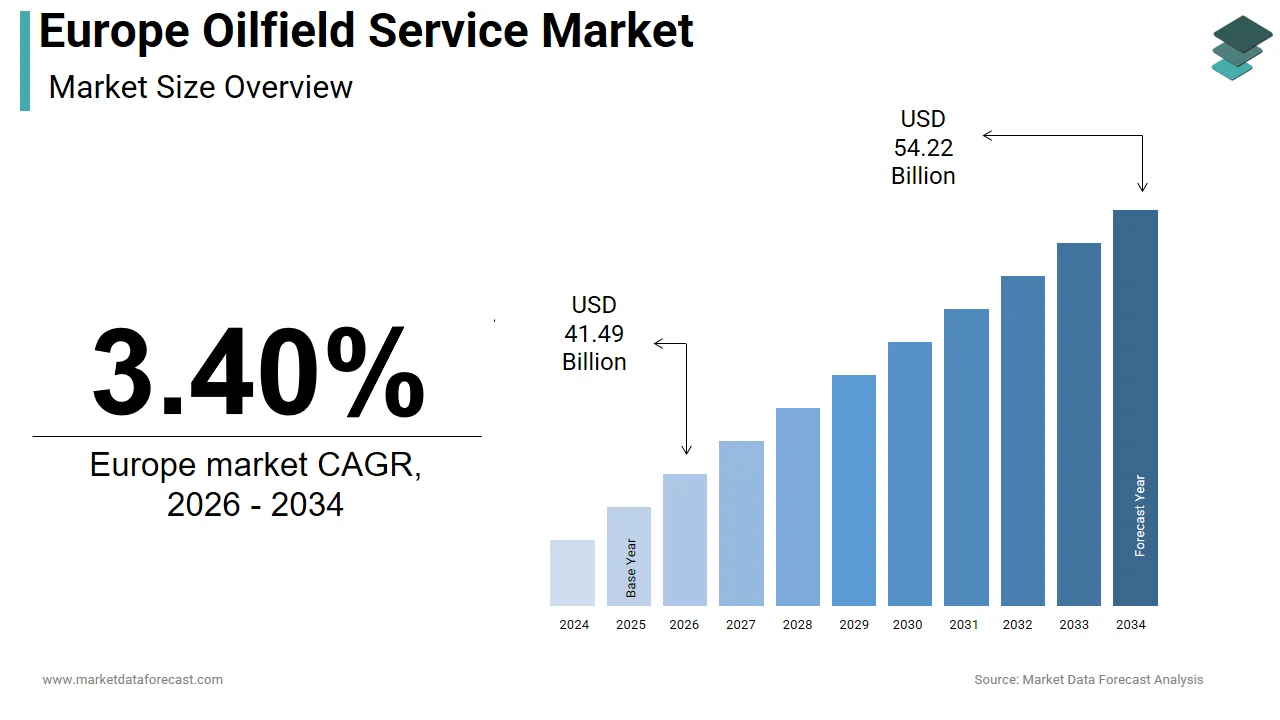
The Europe oilfield service (OFS) market is undergoing a strategic pivot toward mature field optimization and decarbonized operations. The market is projected to grow from $41.49 billion in 2026 to $54.22 billion by 2034, at a steady CAGR of 3.40%.
Market Snapshot (2026–2034)
- Offshore Dominance: Representing 78.4% of the market, offshore deployment remains the primary revenue generator, centered heavily in the North Sea.
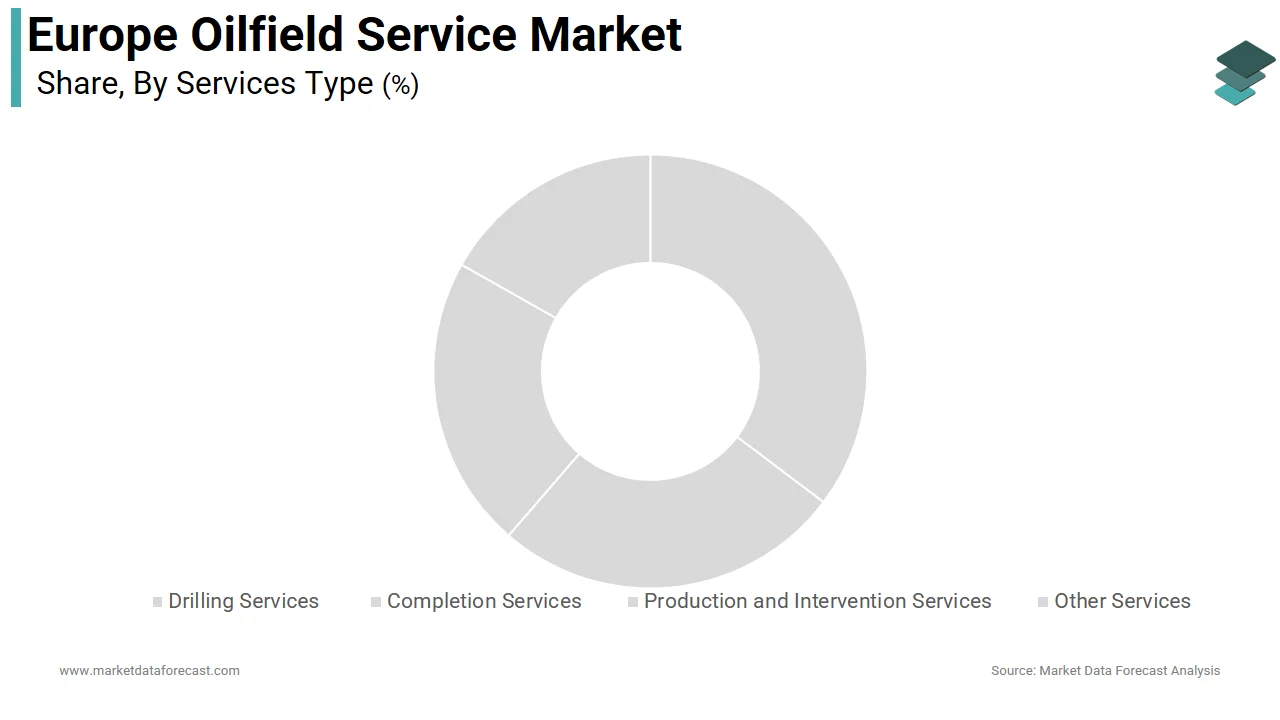
- Primary Revenue Pillar: Production and Intervention Services lead with a 46.4% share, as operators prioritize extending the life of existing reservoirs over new exploration.
- Regional Hubs:
- Norway: The top performer (32.3% share), fueled by record offshore investments and a state-supported innovation ecosystem.
- United Kingdom: Ranked second (24.3% share) with a dual focus on late-life production and large-scale decommissioning.
- Romania: Emerging onshore growth hub following new incentives for drilling in historical fields like the Prahova Valley.
Strategic Industry Trends
- The "Green Deal" Impact: Stringent EU environmental regulations, including the 2025 EU Methane Regulation, have increased compliance costs for North Sea operators by 18%–25% due to mandatory platform electrification and leak monitoring.
- Digital Transformation: The adoption of Digital Twins and AI is unlocking significant efficiencies. Real-time reservoir modeling is reducing unplanned downtime and optimizing injection strategies to extend the economic life of aging assets.
- Carbon Pricing: The integration of offshore production into the EU Emissions Trading System (ETS) has introduced carbon pricing, effectively raising the breakeven cost for marginal fields.
Critical Industry Challenges
- Labor Shortage: A severe shortage of skilled workforce in specialized offshore disciplines remains a primary bottleneck for market growth.
- Margin Compression: High compliance costs and fossil fuel phase-out policies are squeezing profit margins, requiring vendors to focus on lifecycle cost efficiency rather than price alone.
Key Industry Leaders & Competitive Landscape
Competition has shifted from "equipment rental" to "integrated technology partnerships." Leaders are now selected based on their ability to offer certified emissions tracking alongside technical services.
- Integrated Tech Giants: Schlumberger (SLB), Halliburton, and Baker Hughes.
- Offshore Specialists: Transocean Ltd and Weatherford International.
- Regional Powerhouses: Aibel, Aker Solutions, and specialized North Sea robotics firms.
Europe Oilfield Service Market Size
The Europe oilfield service market was worth USD 40.13 billion in 2025, is forecast to reach USD 41.49 billion in 2026, and is expected to hit USD 54.22 billion by 2034, growing at a CAGR of 3.40% from 2026 to 2034.
MARKET DRIVERS
Sustained Investment in Mature Field Life Extension and Enhanced Oil Recovery
Europe’s reliance on aging hydrocarbon fields in the North Sea drives continuous demand for advanced oilfield services focused on maximizing recovery and extending operational life. As per the UK Oil and Gas Authority, the UK Continental Shelf’s remaining reserves require enhanced oil recovery techniques, such as polymer flooding or low salinity water injection, to remain economically viable. The European Commission’s Energy Security Strategy explicitly supports such investments as a bridge during the transition, recognizing that domestic production reduces reliance on imported barrels. This focus on efficiency over expansion ensures steady demand for reservoir simulation, coiled tubing, and chemical injection services regardless of global oil price volatility.
Expansion of Offshore Decommissioning and Well Abandonment Activities
As Europe’s offshore fields reach economic limits, the expansion of offshore decommissioning and well abandonment activities is one of the major factors for the growth of Europe's oilfield service market. According to the Norwegian Petroleum Directorate, over 200 platforms and 6,000 wells are scheduled for abandonment on the Norwegian Continental Shelf by 2035. As per the study, the United Kingdom alone plans to decommission 145 installations and 3,500 wells between 2024 and 2030 at an estimated cost of 22 billion euros. This creates sustained demand for specialized services, including subsea cutting, well plugging, and environmental baseline surveys. Companies like Schlumberger and Halliburton have established dedicated decommissioning units in Aberdeen and Stavanger, offering integrated engineering and execution solutions. The OSPAR Convention, the regulatory framework for North Sea environmental protection, mandates rigorous post abandonment monitoring, further extending service contracts.
MARKET RESTRAINTS
Stringent Environmental and Emissions Regulations Under the EU Green Deal
The European Union’s climate policy framework imposes escalating operational constraints on oilfield activities through methane emission controls and carbon intensity requirements. The stringent environmental and emissions regulations under the EU green deal are restraining the growth of Europe oilfield service market. According to the European Environment Agency, the EU Methane Regulation adopted in 2024 mandates continuous monitoring of methane leaks from all upstream oil and gas infrastructure using optical gas imaging or satellite detection, with a reduction target by 2030. As per the International Energy Agency, compliance costs for North Sea operators increased by 18 to 25% in 2024 due to mandatory electrification of offshore platforms and installation of carbon capture readiness infrastructure. The European Commission’s Fit for 55-package also subjects offshore production to the EU Emissions Trading System, which is effectively imposing a carbon price in 2024. These measures raise the breakeven cost of marginal fields, accelerating shutdown decisions and reducing the economic window for service deployment. While essential for climate goals, these regulations compress margins and deter investment in long-term service contracts.
Geopolitical Pressure to Accelerate Fossil Fuel Phase Out
The energy policy is increasingly shaped by political commitments to end fossil fuel dependence, with regulatory uncertainty for oilfield service continuity restricting the growth of Europe oilfield service market. According to the European Parliament’s 2023 resolution on ending fossil fuel subsidies, all member states must cease licensing new oil and gas exploration in EU waters by 2030, with several, including Denmark and Ireland, already implementing bans. As per the International Energy Agency, the European Union’s long term strategy envisions a 90% reduction in domestic oil production by 2050, directly undermining the market horizon for service providers. National oil companies like Wintershall Dea have announced complete exits from exploration, shifting focus solely to managed decline. This political headwind discourages capital allocation to new service infrastructure, particularly in Southern and Central Europe, where onshore operations face heightened public opposition.
MARKET OPPORTUNITIES
Adoption of Digital Twins and AI for Reservoir Optimization
The digital transformation is unlocking new efficiency in Europe’s mature fields through real-time reservoir modeling and predictive maintenance. The adoption of digital twins and AI for reservoir optimization is likely to enhance the growth of Europe oilfield service market. According to the Norwegian Petroleum Directorate, active North Sea fields implemented digital twin technology in 2024, which is integrating seismic data, production logs, and downhole sensors into dynamic simulation models. As per Equinor, its digital twin of the Snorre field reduced unplanned downtime and increased recovery through optimized injection strategies. These platforms enable remote operation centers in Stavanger and Aberdeen to manage multiple fields simultaneously, thereby reducing offshore personnel and emissions. The digitalization offsets natural decline and extends the economic life of aging assets by aligning operational performance with Europe’s decarbonization imperatives.
Growth in Carbon Capture and Storage Enabled by Depleted Reservoirs
Europe’s extensive network of depleted oil and gas fields for carbon capture and storage is a new service frontier for oilfield expertise, which is setting up new opportunities for the growth of Europe's oilfield service market. According to the Global CCS Institute, over 12 carbon storage projects are under development in the North Sea by leveraging existing wellbores and subsurface knowledge from decades of hydrocarbon operations. As per the Norwegian Ministry of Petroleum and Energy, the Northern Lights project, Europe’s first open access CO2 transport and storage facility, will utilize the depleted Aurora reservoir in the North Sea with a capacity for 1.5 million tons annually from 2025. Oilfield service companies provide critical capabilities in well integrity assessment, reservoir characterization, and injection monitoring, repurposing legacy skills for climate solutions. The European Union’s Innovation Fund has committed over 2 billion euros to support these projects, recognizing that oilfield service providers are essential enablers of industrial decarbonization. This pivot transforms decommissioning liabilities into long-term carbon management assets.
MARKET CHALLENGES
Shortage of Skilled Workforce in Specialized Offshore Disciplines
The experienced personnel for complex oilfield operations, exacerbated by industry attrition and generational turnover, is certainly one of the challenges for the growth of Europe oilfield service market. According to the Society of Petroleum Engineers, in Europe, over 40% of offshore engineers and subsea technicians in the North Sea are aged 50 or older, with retirement rates exceeding new graduate recruitment by 3 to 1. As per the UK Offshore Energy Workforce Transfer Scheme, new entrants joined the sector in 2024 against an estimated need of 22,000 to maintain current activity levels. This shortfall delays well intervention platform maintenance and decommissioning campaigns, increasing operational risk and cost. Without targeted reskilling and retention programs, the expertise required for safe and efficient field management will erode just as demand for precision interventions peaks.
High Operational Costs and Logistical Complexity in Harsh Environments
Offshore operations in the North Sea and Arctic regions incur exceptional costs due to extreme weather and marine conditions, as well as regulatory compliance. The high operational costs and logistical complexity in harsh environments are significantly limiting the growth of Europe oilfield service market. According to the Norwegian Petroleum Directorate, the average daily operating cost for a North Sea jack-up rig exceeded in 2024, due to stringent safety and environmental standards. As per the UK Oil and Gas Authority, weather-related downtime accounts for 18 to 22 days annually per offshore installation, disrupting well intervention schedules and inflating project budgets. The OSPAR Convention prohibits the discharge of drilling muds and cuttings, requiring costly cuttings reinjection or onshore disposal. Additionally, crew transport via helicopter or vessel adds logistical layers absent in onshore basins. These structural cost drivers compress margins for service providers and make marginal field interventions economically unviable, accelerating field abandonment despite remaining reserves. The harsh environment, while technically manageable, imposes a financial premium that undermines competitiveness in a low-carbon policy landscape.
REPORT COVERAGE
| REPORT METRIC | DETAILS |
| Market Size Available | 2025 to 2034 |
| Base Year | 2025 |
| Forecast Period | 2026 to 2034 |
| Segments Covered | By Services Type, Location of Deployment, and Country. |
| Various Analyses Covered | Global, Regional, and Country-Level Analysis, Segment-Level Analysis, Drivers, Restraints, Opportunities, Challenges; PESTLE Analysis; Porter’s Five Forces Analysis, Competitive Landscape, Analyst Overview of Investment Opportunities |
| Countries Covered | UK, France, Spain, Germany, Italy, Russia, Sweden, Denmark, Switzerland, Netherlands, Turkey, Czech Republic, and the Rest of Europe. |
| Market Leaders Profiled | Halliburton Company, Transocean Ltd, Baker Hughes Company, Weatherford International PLC, Schlumberger Limited, and Others. |
SEGMENTAL ANALYSIS
By Service Type Insights
The production and intervention services segment accounted in holding 46.4% of the Europe oilfield service market share in 2024. Europe’s offshore basins, particularly the UK and Norwegian sectors of the North Sea, are characterized by advanced field maturity with average water cuts exceeding 75% and reservoir pressures often below bubble point. As per the UK Oil and Gas Authority, production wells in the UK sector underwent artificial lift upgrades or scale inhibition treatments in 2024 alone. These interventions, including coiled tubing cleanouts, chemical squeeze jobs, and electric submersible pump installations, are essential to counteract formation damage and sustain economic output. The shift from discovery to management has transformed intervention from a reactive activity into a scheduled operational necessity embedded in annual field development plans across major operators like Equinor and Shell. European governments and operators are jointly investing in advanced production techniques to maximize recovery from existing infrastructure by aligning with energy security objectives. According to the European Commission’s Energy Security Strategy, enhanced oil recovery projects qualify for accelerated depreciation and tax allowances in Norway and the UK to offset declining output. The UK Oil and Gas Authority mandates that all field development plans include recovery optimization measures, creating contractual obligations for service providers. This policy-driven demand ensures consistent utilization of chemical injection, reservoir monitoring, and intelligent completion services regardless of short-term oil price fluctuations, anchoring the segment’s dominance in a managed decline environment.
The production and intervention services segment is likely to witness the fastest CAGR of 5.8% from 2026 to 2034. The integration of remote and autonomous systems is reducing costs and expanding the scope of intervention in harsh environments. According to the Norwegian Petroleum Directorate, well interventions on the Norwegian Continental Shelf in 2024 utilized remotely operated vehicles or robotic wireline systems by reducing offshore personnel and cutting operational emissions. As per Aker BP, its fully electric subsea intervention system deployed on the Skogul field achieved a reduction in intervention time compared to conventional methods. This digital transformation not only improves safety and efficiency but also makes marginal interventions economically viable by extending the service envelope into previously uneconomic wells.
By Location of Deployment Insights
The offshore deployment segment was the largest by capturing 78.4% of Europe oilfield service market share in 2024. Europe’s largest and most economically viable oil and gas reserves are located offshore, with the North Sea alone accounting for regional production. According to the survey, Norway’s offshore fields produced 2.1 million barrels of oil equivalent per day in 2024, while onshore production across the entire European Union totaled less than 300,000 barrels per day. This geological reality concentrates investment, infrastructure, and service demand in marine environments. The high capital intensity of offshore platforms, averaging 2 to 5 billion euros per development, creates long-term service contracts spanning decades by ensuring stable demand for drilling completion and intervention even as onshore activity dwindles. Offshore operations in Europe are subject to some of the world’s most rigorous regulatory frameworks, including the EU Offshore Safety Directive and the OSPAR Convention, which mandate advanced engineering controls and continuous monitoring. According to the European Maritime Safety Agency, all offshore installations must implement real-time gas detection well control systems and emergency shutdown protocols certified to international standards. As per the Norwegian Ocean Industry Authority, operators must conduct annual well integrity audits using specialized downhole tools and robotics. These requirements necessitate highly trained personnel and purpose built vessels assets that only major service companies can deploy at scale. The regulatory complexity creates a high barrier to entry, locking in established players and ensuring that offshore work commands premium pricing despite declining production volumes.
The onshore deployment segment is expected to witness the fastest CAGR of 4.1% from 2026 to 2034. Geopolitical tensions have prompted a strategic reassessment of domestic onshore production, particularly in Romania and Poland. According to the Romanian Energy Ministry, onshore oil output increased in 2024, following new concessions in the Prahova Valley and state-backed incentives for Petrom and Romgaz to intensify drilling. These initiatives aim to reduce reliance on imported hydrocarbons and leverage existing pipeline infrastructure. Although modest in scale, this policy-driven resurgence creates new demand for land rig services, well completion, and hydraulic fracturing sectors that had been dormant for over a decade. Europe’s legacy onshore oilfields are being converted into hubs for low-carbon energy, generating new service contracts. As per the Global CCS Institute, the Ketzin pilot CO2 storage site in Germany, where the first onshore carbon storage project in Europe relies on oilfield service companies for well recompletion and monitoring. The European Commission’s Innovation Fund has allocated 85 million euros to support such repurposing under the “Brownfield to Greenfield” initiative. Service providers with onshore experience are thus positioned to capture emerging opportunities in the energy transition, driving modest but meaningful growth in a traditionally declining segment.
COUNTRY LEVEL ANALYSIS
Norway Oilfield Service Market Analysis
Norway was the top performer of the Europe oilfield service market by holding 32.3% of the share in 2024 with its world-class offshore sector and state-supported innovation ecosystem. According to the Norwegian Petroleum Directorate, the country produced 2.1 million barrels of oil equivalent per day in 2024, with mature fields requiring intensive intervention and enhanced recovery services. The government’s Long Term Perspective Plan for the Petroleum Sector explicitly links oil revenues to the sovereign wealth fund while mandating emissions reductions by creating a unique balance of production and sustainability. This combination of resource-based regulatory clarity and technological ambition ensures Norway remains the continent’s most dynamic and high-value oilfield service market.
United Kingdom Oilfield Service Market Analysis
The UK was ranked second by holding 24.3% of the share in 2024, with its dual focus on late-life production and large-scale decommissioning. Simultaneously, the UK Continental Shelf still holds 2.7 billion barrels of recoverable reserves, with majors like BP and Shell investing in digital twins and electrified platforms to extend field life. The Oil and Gas Authority’s Maximising Economic Recovery strategy ensures that even marginal fields receive support through tax allowances and infrastructure sharing. Aberdeen remains Europe’s leading oilfield service cluster with over 2,500 companies providing specialized offshore expertise.
Russia Oilfield Service Market Analysis
Russia oilfield service market growth is likely to grow with its integration increasingly limited to Eastern corridors and technical cooperation. Despite sanctions, Russian firms continue to source specialized equipment and expertise from European service companies for Arctic and tight oil projects under joint venture arrangements. The Yamal LNG and Vostok Oil initiatives, though primarily gas-focused, require extensive drilling and completion services with European engineering input. However, geopolitical isolation has reduced Western participation, shifting reliance to domestic and Asian providers.
Romania Oilfield Service Market Analysis
Romania oilfield service market growth is driven by its policy-driven onshore resurgence. According to the Romanian Energy Ministry, onshore oil production increased in 2024, following new incentives for Petrom and Romgaz to intensify drilling in the Prahova Valley, the historical heart of European oil production. Additionally, Romania is advancing the Buzău carbon storage project using depleted onshore fields with technical support from European Union-funded consortia. The country’s existing pipeline network and skilled workforce make it a strategic candidate for onshore service growth in Southeastern Europe.
Denmark Oilfield Service Market Analysis
Denmark oilfield service market growth is propelled by its orderly phase out of oil and gas, balanced with continued technological contribution. According to the Danish Energy Agency, the Tyra field redevelopment, the largest in Danish history, was completed in 2024 to extend production until 2032, while reducing emissions by 50% through electrification. Though Denmark has banned new exploration and plans full cessation by 2050, the Tyra complex remains a North Sea hub requiring ongoing intervention and maintenance services. Danish firms like Maersk Drilling (now part of Noble Corporation) continue to provide advanced offshore rigs and digital solutions across Europe.
COMPETITIVE LANDSCAPE
Competition in the Europe oilfield service market is characterized by a concentrated yet evolving landscape where global service giants coexist with specialized regional contractors and emerging digital startups. The sector is defined not by volume growth but by technical sophistication in managing mature assets under stringent environmental and safety regulations. Incumbents leverage decades of North Sea experience and integrated technology platforms to maintain dominance in high-value segments like reservoir modeling and decommissioning. Meanwhile, niche players differentiate through robotic intervention, subsea robotics, or methane monitoring tailored to European compliance needs. The market faces structural pressure from the EU’s fossil fuel phase-out, yet remains resilient due to legally binding decommissioning obligations and energy security imperatives. Competition is increasingly centered on sustainability credentials, digital integration, and lifecycle cost efficiency rather than price alone.
KEY MARKET PLAYERS
The leading companies operating in the Europe oilfield service market include:
- Halliburton Company
- Transocean Ltd
- Baker Hughes Company
- Weatherford International PLC
- Schlumberger Limited
TOP PLAYERS IN THE MARKET
- Schlumberger maintains a leading presence in the Europe oilfield service market through its comprehensive portfolio of digital and offshore solutions tailored for mature field management. The company operates major technology centers in the UK, Norway, and France, supporting reservoir characterization, well intervention, and production optimization across the North Sea. Schlumberger actively contributes to Europe’s energy transition by repurposing its subsurface expertise for carbon capture and storage projects, including the Northern Lights initiative in Norway. In recent years, the company has expanded its DELFI cognitive E&P platform with AI-driven decline curve analysis and well integrity monitoring specifically calibrated for North Sea geology. Globally, Schlumberger leverages its European regulatory experience and offshore track record to shape service standards in other mature basins such as the Gulf of Mexico and Southeast Asia, reinforcing its role as a technology integrator in complex environments.
- Halliburton plays a strategic role in the Europe oilfield service market with specialized capabilities in production enhancement and decommissioning services. The company’s operations in Aberdeen, Stavanger, and Rotterdam focus on coiled tubing chemical treatments and well plugging for aging North Sea infrastructure. Halliburton has intensified its collaboration with European operators on electrified intervention systems that reduce offshore emissions while maintaining operational efficiency. The company’s DecisionSpace 365 platform now includes modules for carbon storage site screening and monitoring developed in partnership with European energy firms. Globally, Halliburton exports its Europe proven decommissioning protocols and digital reservoir management tools to mature basins worldwide. Its European experience in navigating stringent environmental regulations and complex stakeholder landscapes provides a competitive template for sustainable service delivery in other high-compliance regions.
- Baker Hughes holds a significant position in the Europe oilfield service market through its leadership in rotating equipment electrification and emissions monitoring technologies. The company supplies advanced turbomachinery and digital twin solutions for offshore platform electrification projects led by Equinor and TotalEnergies. Baker Hughes has also deployed its BHC3 AI platform across European assets to predict equipment failures and optimize production in high water cut fields. The company actively participates in EU-funded initiatives like the North Sea Energy Collaboration to advance methane detection and carbon capture readiness. Globally, Baker Hughes leverages its European success in low-carbon oilfield services to support international clients transitioning their upstream operations.
TOP STRATEGIES USED BY THE KEY MARKET PARTICIPANTS
Key players in the Europe oilfield service market pursue integrated strategies focused on mature field optimization, digital transformation, and energy transition alignment. Companies are repurposing traditional intervention and monitoring expertise for carbon capture and storage, well integrity verification, and geothermal repurposing. They invest heavily in electrified offshore systems and AI-driven platforms to reduce emissions while extending field life. Strategic partnerships with national oil companies and EU-funded consortia for risk innovation and ensuring regulatory alignment. Geographic focus remains on the North Sea and Eastern Europe, where policy supports both production security and decarbonization. Additionally, firms are consolidating service lines to offer end-to-end solutions from reservoir simulation to decommissioning.
MARKET SEGMENTATION
This research report on the Europe oilfield service market has been segmented and sub-segmented into the following categories.
By Services Type
- Drilling Services
- Completion Services
- Production and Intervention Services
- Other Services
By Location of Deployment
- Onshore
- Offshore
By Country
- United Kingdom
- France
- Spain
- Germany
- Italy
- Russia
- Sweden
- Denmark
- Switzerland
- Netherlands
- Rest of Europe