- Product Description Description
- Table of Contents TOC
- List of Table & Figure LOT
- Get Free Sample PDF Sample PDF
Market Size, 2025
$7.50 BnMarket Estimate, 2026
$8.01 BnMarket Forecast, 2034
$13.59 BnCAGR, 2026–2034
6.83%Europe Oleochemicals Market Size
The Europe oleochemicals market size was valued at USD 7.50 billion in 2025 and is projected to reach USD 13.59 billion by 2034 from USD 8.01 billion in 2026, growing at a CAGR of 6.83%.
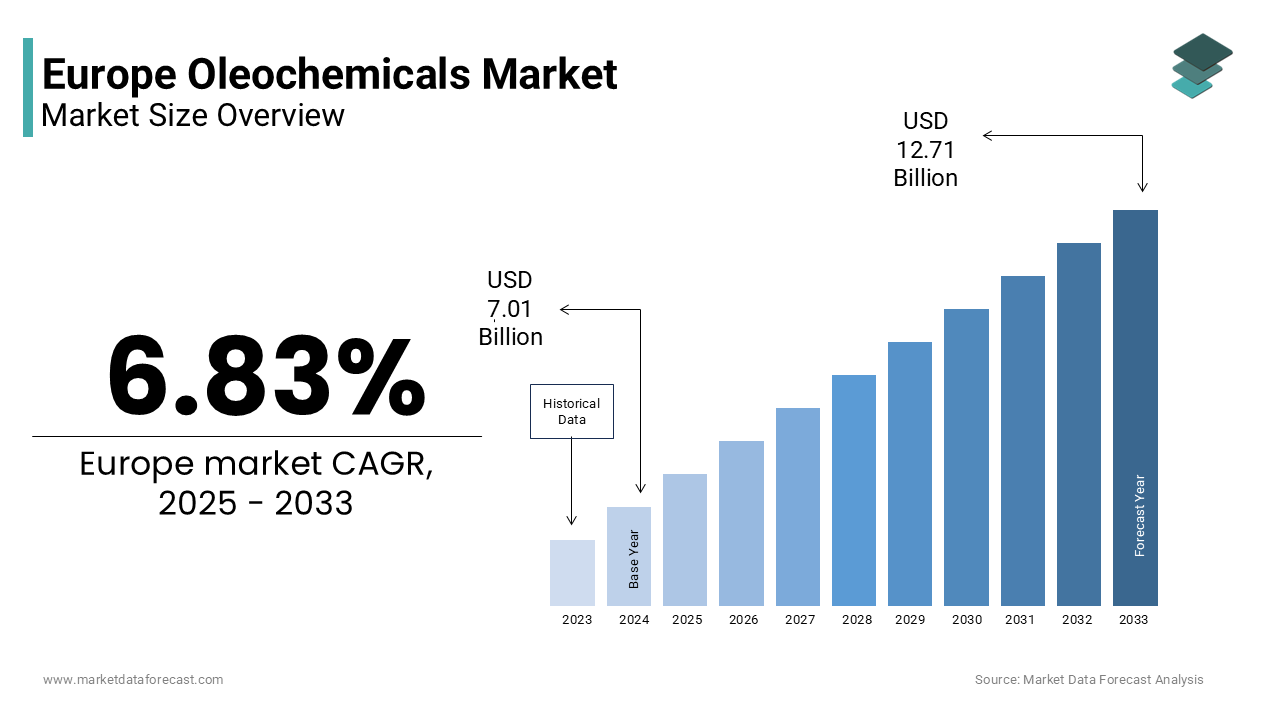
The oleochemicals are a suite of bio-based chemicals derived primarily from vegetable oils and animal fat, including fatty acids, fatty alcohols, methyl esters, and glycerol, which serve as renewable building blocks for surfactants, ts lubricants, polymers and personal care formulations. Unlike petrochemical analogues, oleochemicals offer biodegradability, lower ecotoxicity and carbon footprint advantages that align with the European Union’s circular economy and climate neutrality mandates. As per the European Environment Agency, over 73% of new cosmetic formulations launched in the EU in 2025 featured bio-based surfactants derived from oleochemica, ls, reflecting strong consumer and regulatory pull toward natural ingredients. Additionally, the EU Renewable Energy Directive II mandates that advanced biofuels from waste fats and used cooking oil contribute at least 3.5% of transport energy by 2030, further expanding demand for hydrotreated vegetable oil derivatives.
MARKET DRIVERS
Stringent EU RegulationsFavourr Bio-Based and Biodegradable Ingredients
European regulatory frameworks increasingly penalise persistent synthetic chemicals, while incentivising renewable and readily biodegradable alternatives, creating a structural advantage for oleochemicals across multiple sectors. The stringent EU regulations favour bio-based and biodegradable ingredients are majorly propelling the growth of the European oleochemicals market. In parallel, the EU Ecolabel criteria for detergents and cosmetics mandate a minimum of 85% ultimate biodegradability for all surfactants, a threshold that most oleochemical-derived molecules, such as sodium lauryl sulfate from coconut oil, easily meet. According to the European Commission’s 2025 Biobased Industries Consortium review, over 68% of new industrial cleaning formulations launched in Western Europe replaced linear alkylbenzene sulfonates with oleochemical-based alternatives to comply with wastewater discharge standards under the Urban Wastewater Treatment Directive. The EU Strategy for Plastics in a Circular Economy further promotes bio-based monomers like sebacic acid from castor oil for polyamides used in automotive and electronics. This regulatory tailwind not only drives volume but also commands price premiums for certified green ingredients, thereby reinforcing investment in oleochemical capacity across the region.
Rising Consumer Demand for Natural and Sustainable Personal Care Products
European consumers are exhibiting a pronounced preference for personal care and household products formulated with plant-derived ingredients, which directly amplifies demand for oleochemicals, such as fatty alcohols, glycerol and methyl esters. The rising consumer demand for natural and sustainable personal care products is additionally driving up the growth of the European oleochemicals market. According to the European Consumer Organisation, a 2025 pan-EU survey revealed that 79% of respondents actively check ingredient lists for natural or bio-based claims, with 64% willing to pay a 15% premium for certified sustainable formulations. This behavioural shift has compelled major brands, including L’Orea, Unilever and Beiersdorf, to reformulate core product lines using oleochemical surfactants and emollients. The European Natural and Organic Cosmetics certification body reported a 28% year-on-year increase in certified product registrations in 2025, further validating this trend. Retailers, such as E.Leclerc and DM Drogerie, have also introduced private label lines with strict bio-based content requirements sourced exclusively from European oleochemical refiners. This confluence of ethical consumption, brand accountability, ty and retail gatekeeping establishes a durable demand foundation for oleochemicals beyond industrial compliance into the heart of consumer choice.
MARKET RESTRAINTS
Volatility in Sustainable Feedstock Supply and Certification Complexity
The persistent constraints are due to inconsistent availability and evolving certification standards for key vegetable oil feedstocks, like palm kernel and coconut oils, which are primarily imported from Southeast Asia and the Pacific. The volatility in sustainable feedstock supply and certification complexity is restricting the growth of the European oleochemicals market. According to the European Commission’s Directorate General for Trade, imports of palm kernel oil declined by 14% in 2025 compared to 2022 due to stricter enforcement of the EU Deforestation Regulation, which requires full geolocation traceability for all consignments entering the bloc. Many smallholder producers lack the digital infrastructure to provide verifiable GPS coordinates, triggering shipment rejections and supply disruptions. Domestic alternatives, such as rapeseed, offer partial relief, but Europe’s rapeseed output remains vulnerable to weather shocks, as evidenced by the 9% yield drop in 2023 due to late spring frosts, per Eurostat. These supply chain vulnerabilities not only inflate raw material costs but also delay product launches tin ime-sensitive sectors like cosmetics and detergents.
Competition from Low-Cost Petrochemical Surfactants in Price-Sensitive Applications
Despite regulatory and sustainability advantages, oleochemicals continue to face intense price competition from petrochemical-derived surfactants and lubricants in cost-driven industrial and institutional applications across Southern and Eastern Europe. The growing competition between the key players is one of the factors hampering the growth of the European oleochemicals market. In contrast, the landed cost of RSPO segregated palm kernel oil in Rotterdam averaged 1180 euros per metric ton, as documented by the European Oilseed Alliance. This price differential enables petrochemical alternatives to dominate sectors, such as industrial laundry, institutional cleaning and metalworking fluids, where performance parity exists, and environmental mandates are less enforced. As per the European Cleaning Industry Association, approximately 57% of bulk detergent purchases by hospitals and municipalities in 2025 still specified linear alkylbenzene sulfonates due to budget constraints. Additionally, the EU’s carbon border adjustment mechanism does not yet cover base chemicals, thereby failing to internalise the environmental cost advantage of oleochemicals.
MARKET OPPORTUNITIES
Expansion of Bio-Based Polymers and Green Lubricants in Automotive and Engineering
Unlocking high-value opportunities through the integration of fatty acid derivatives into advanced bio-based polymers and synthetic lubricants for automotive and industrial machinery is expected to enhance the growth of the European oleochemicals market. As per the European Automobile Manufacturers Association, many new passenger vehicles produced in the EU in 2025 incorporated bio polyamides or polyols derived from castor or rapeseed oil in under-the-hood components, such as coolant hoses, connectors and interior foams. These materials offer comparable thermal stability to petroleum-based counterparts while reducing lifecycle carbon emissions by up to 40%, as validated by the Joint Research Centre’s 2025 lifecycle assessment database. Simultaneously, the European Lubricants Industry Association reported that bio lubricant consumption in industrial hydraulics and metal processing grew by 12.3% in 2025, driven by the EU Ecolabel’s stringent biodegradability requirements for equipment operating in sensitive environments, such as forestry, mining and marine applications. Companies like Evonik and BASF commercialised estolide-based lubricants from high oleic sunflower oil that meet ISO 15380 standards for high-performance machinery. This shift toward performance-oriented bio-based materials transforms oleochemicals from commodity intermediates into enablers of circular engineering solutions aligned with the EU’s net-zero industrial strategy.
Growing Adoption of Oleochemical-Derived Surfactants in Agrochemical Formulations
The European agrochemical sector is increasingly reformulating crop protection products with oleochemical-based adjuvants and emulsifiers to comply with stricter environmental and human health standards while enhancing field efficacy. This is another factor that contributes to leveraging new opportunities for the growth ofthe European oleochemicalss market. These oleochemical adjuvants improve rainfastness and leaf adhesion, thereby reducing active ingredient dosage and runoff into waterways. The EU Sustainable Use of Pesticides Regulation mandates that all professional pesticide applications minimise environmental contamination, which has accelerated the replacement of aromatic solvent-based carriers with rapeseed or sunflower-derived alternatives. According to the European Crop Protection Association, over 45000 metric tons of oleochemical surfactants were consumed in EU agrochemical formulations in 2025, with a 17% increase from 2022. Major agrochemical producers, including Bayer and Syngenta, have partnered with European oleochemical refiners to co-develop cold-flow stable emulsifiable concentrates suitable for northern European climates.
MARKET CHALLENGES
Technological Limitations in Upgrading Low-Grade Waste Fats for High-Purity Applications
Despite the abundant availability of used cooking oil and animal tallow, the European oleochemicals market struggles to consistently upgrade these low-cost circular feedstocks to the purity levels required for personal care and pharmaceutical applications. This factor is also hampering the growth of the European oleochemicals market. According to the European Waste Association, over 3.2 million metric tons of used cooking oil were collected across the EU in 2025, yet less than 28% met the acid value and peroxide thresholds necessary for cosmetically-grade acids due to inconsistent collection practices and contamination with food residues. Conventional refining processes, such as molecular distillation and bleaching, are aenergy-intensiveand yield losses of 15 to 20% when processing highly degraded feedstocks, as reported by the Fraunhofer Institute for Interfacial Engineering in 2025. Emerging technologies like enzymatic glycerolysis and supercritical extraction remain confined to pilot scale due to high capital costs and a lack of standardised protocols. Many refiners are forced to blend waste fats with virgin oils to achieve specification compliance, diluting the circularity benefit.
Fragmented Sustainability Certification Landscape Increases Compliance Burden
The complex and overlapping ecosystem of sustainability certification schemes, including RS, PO, ISCC, EU RED II, EU Organic and Nordic Swan, each with distinct traceability audit and documentation requirements that multiply administrative costs and supply chain friction. The fragmented sustainability certification landscape is likely to degrade the growth of the European oleochemicals market. According to the European Oleochemicals Producers Network, an average refiner must maintain compliance with 4.7 certification systems simultaneously to serve diverse end markets from detergents to cosmetics to biofuels. A 2025 audit by the European Court of Auditors found that certification costs for palm kernel oil suppliers increased by 32% between 2021 and 2025 due to redundant data entry and divergent interpretations of deforestation risk by different auditors. Moreover, the EU Deforestation Regulation mandates a digital due diligence statement for each shipment, which must be reconciled with pre-existing certification data, creating operational redundancy. Small and medium refiners in countries like Poland and Romania often lack the personnel or software to manage this compliance overhead, leading to market exclusion or reliance on third-party aggregators that extract margin. Until the European Commission harmonises these frameworks under a single digital registry, as proposed in the 2026 Sustainable Products Initiative, the certification burden will continue to act as a structural inefficiency that disadvantages agile and circular players in the oleochemicals value chain.
REPORT COVERAGE
| REPORT METRIC | DETAILS |
| Market Size Available | 2025 to 2034 |
| Base Year | 2025 |
| Forecast Period | 2026 to 2034 |
| CAGR | 6.83% |
| Segments Covered | By Product Type, Feedstock, Source, End User Industry, and Region |
| Various Analyses Covered | Global, Regional, & Country Level Analysis; Segment-Level Analysis; DROC, PESTLE Analysis; Porter’s Five Forces Analysis; Competitive Landscape; Analyst Overview of Investment Opportunities |
| Regions Covered | UK, France, Spain, Germany, Italy, Russia, Sweden, Denmark, Switzerland, Netherlands, Turkey, and the Czech Republic |
| Market Leaders Profiled | BASF SE, Evonik Industries AG, Emery Oleochemicals, KLK Oleo, Oleon NV, Wilmar International, Procter & Gamble Chemicals, Musim Mas Holdings, IOI Group, Croda International Plc, VVF Group, Zanyu Technology Group, Kao Corporation, Cargill, Incorporated, and Godrej Industries |
SEGMENTAL ANALYSIS
By End User Industry Insights
The personal care and cosmetics segment was the largest by holding 36.4% of the European oleochemicals market share in 2025, with the sector’s strong alignment with European consumer preferences for natural, biodegradable, skin-compatible ingredients derived from renewable sources. Oleochemicals, such as fatty alcohols, glycerol and methyl esters, serve as emollients, surfactants and emulsifiers in creams, lotions, shampoos and soaps, offering performance parity with petrochemicals, while meeting stringent safety and sustainability criteria. According to Cosmetics Europe, over 82% of new cosmetic formulations launched in the European Union in 2025 featured bio-based ingredients, with oleochemicals comprising the majority of the renewable content. The EU Ecolabel and COSMOS certification standards further mandate minimum thresholds for natural origin ingredients, which directly favour rapeseed, coconut and palm kernel-derived molecules. As per the European Consumer Organisation, a 2025 survey found that 79% of EU consumers actively avoid products containing synthetic surfactants like sodium laureth sulfate, opting instead for lauryl glucoside or sodium coco sulfate derived from oleochemical feedstocks. Major brands, including L’Oreal, Beiersdorf, and LVMH, have committed to 100% traceable and sustainable palm and palm kernel sourcing by 2026, accelerating demand for certified oleochemical intermediates.
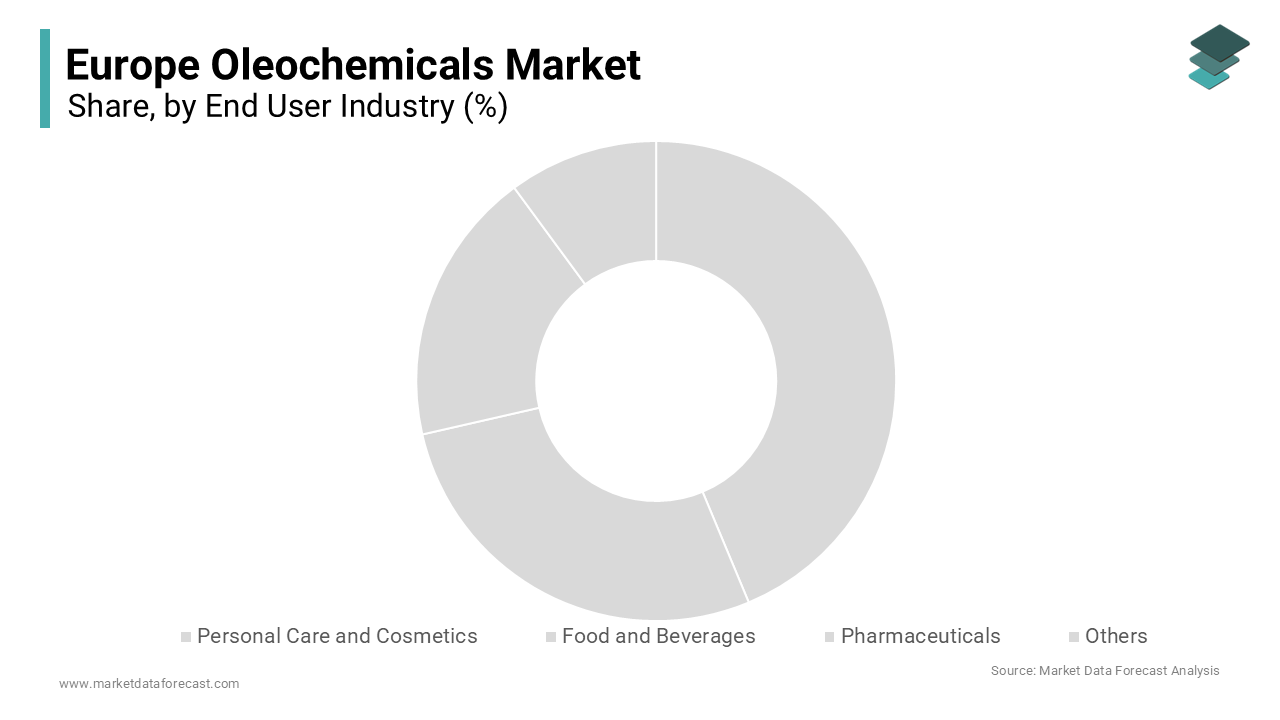
The pharmaceuticals segment is expected to grow at the fastest CAGR of 6.8% during the forecast period with the rising use of high-purity oleochemical derivatives, as excipients, solubilisers and controlled release matrices in advanced drug delivery systems. The shift toward biologics and oral peptide therapeutics further amplifies demand for sophisticated lipid excipients that maintain stability during digestion. Additionally, the European Pharmacopoeia updated its monographs in 2023 to include stricter limits on residual solvents and heavy metals in fatty acid derivatives, prompting pharmaceutical refiners to invest in advanced purification technologies such as short path distillation and ion exchange chromatography. Companies like Croda and IOI Pharma have established GMP-compliant oleochemical facilities in the UK and the Netherlands dedicated to serving European pharma clients.
REGIONAL ANALYSIS
Germany Oleochemicals Market Analysis
Germany was the largest by holding 21.2% of the European oleochemicals market share in 2025. As Europe’s largest chemical and personal care manufacturing hub, Germany drives demand through its dense network of industrial formulators, pharmaceutical producers and green technology innovators. According to the German Chemical Industry Association, over 240000 metric tons of oleochemicals were consumed domestically in 2025, with the personal care sector accounting for 44% of this volume. The country’s strong regulatory alignment with the EU Ecolabel and Blue Angel certification frameworks incentivises the use of RSPO and ISCC-certified feedstocks in consumer products. Additionally, Germany is home to leading oleochemical refiners such as KLK, Oleo Europe and Emery Oleochemicals, which operate integrated facilities producing fatty acids and alcohols from both rapeseed and imported sustainable palm kernel oil. The federal government’s National Bioeconomy Strategy has also allocated 180 million euros since 2023 to support circular feedstock innovation, including enzymatic upgrading of used cooking oil for fhigh-purityity applications. These industrial policies, regulatory and manufacturing synergies position Germany as the technical and commercial epicentre of Europe’s oleochemicals value chain.
France Oleochemicals Market Analysis
France was ranked second with 17.3% of the European oleochemicals market share in 2025, with its global leadership in luxury cosmetics, fragrance and pharmaceutical innovation. French personal care giants, such as L’Oreal, LVMH and Pierre Fabre, collectively sourced over 95000 metric tons of certified oleochemicals in 2025 for use in premium skincare and haircare formulations. This transparency mandate has accelerated the adoption of traceable rapeseed and sunflower-derived fatty alcohols produced by domestic refiners like Novastar and Oleon. Furthermore, France’s agricultural sector produced 4.3 million metric tons of rapeseed in 2025, as per FranceAgriMer, providing a strategic local feedstock base. The French National Research Agency also funds collaborative projects between CNRS and chemical firms to develop cold-processable oleochemical emulsifiers that reduce energy consumption in formulation.
United Kingdom Oleochemicals Market Analysis
The United Kingdom Europe oleochemicals market growth is anticipated to have significant growth opportunities throughout the forecast period, with its strength in speciality oleochemicals or pharmaceuticals, nutraceuticals and high-performance lubricants. The UK maintains close alignment with EU pharmacopoeial and cosmetic regulations, ensuring continued demand for certified ingredients. According to the UK’s Office for National Statistics, the pharmaceutical sector imported 28000 metric tons of high-purity glycerol and fatty acid esters in 2025, primarily for use in lipid nanoparticle formulations and oral drug delivery systems. Companies like Croda International, headquartered in East Yorkshire, operate GMP-certified oleochemical plants that supply over 60 global pharma clients from European bases. The UK’s Bioeconomy Strategy also promotes the use of waste animal fats and used cooking oil in industrial applications, with over 320000 metric tons of waste fats collected in 2025, per the Environment Agency. Additionally, the British Retail Consortium’s sustainable sourcing guidelines require all private label beauty products to use RSPO or ISCC-certified oleochemicals.
Netherlands Oleochemicals Market Analysis
The Netherlands' oleochemicals market growth is likely to grow with its strategic role as Europe’s primary import and refining hub for sustainable vegetable oils and oleochemical intermediates. The Port of Rotterdam handled over 5.8 million metric tons of palm kernel and coconut oil in 2025, according to Portbas,,e making it the continent’s largest entry point for certified feedstocks. Dutch refiners, such as IOI Europe and Vanta Speciality,,icals operate state-of-the-art facilities that convert these oils into fatty alcohols, methyl ester and glycerol for distribution across the EU. Additionally, the country’s advanced agri-food sector drives demand for food-grade oleochemicals as release agents and emulsifiers in confectionery and dairy processing. The Dutch National Growth Fund has committed 95 million euros to the BBio-BasedIndustries program supporting R&D in enzymatic glycerolysis and solvent-free esterification. This logistical certification and innovation infrastructure establishes the Netherlands as the logistical and technical backbone of Europe’s oleochemical supply chain.
Italy Oleochemicals Market Analysis
Italy's oleochemicals market growth is likely to grow with its vibrant personal care, home care, and food processing industries, which prioritise natural and Mediterranean-sourced ingredients. Italian cosmetic manufacturers, such as Intercos and Bormioli Luigi, increasingly use sunflower and olive oil-derived oleochemicals to appeal to domestic and export markets seeking regionally authentic formulations. According to the Italian National Institute of Statistics, the personal care sector consumed 62000 metric tons of oleochemicals in 2025, with 68% sourced from EU-grown oilseeds to comply with the national “Made Green in Italy” label. Italy’s food industry also utilises food-grade stearic acid and glycerol as anti-caking and humectant agents in pasta sauces, baked goods, and dairy analogues. Additionally, small and medium refiners in Emilia Romagna have developed cold-pressed oleochemical processes that preserve antioxidant content for premium cosmetic applications. These cultural, agronomic, and artisanal factors position Italy as a unique market where tradition and sustainability converge in oleochemical demand.
COMPETITIVE LANDSCAPE
The interplay of global refiners, regional specialists, and vertically integrated chemical conglomerates. Competition is less about price and more about sustainability credentials, feedstock traceability,y, regulatory compliance and technical service capability. Global players, such as Emery Croda and IOI Oleo, compete alongside European refiners like Oleon and KLK Oleo Europe, which leverage local oilseed supply chains and deep regional relationships. Regulatory complexity, around deforestation, palm oil sourcing and chemical safety, ty acts as both a barrier to entry and a differentiator for established players with robust compliance systems. Innovation is concentrated in green chemistry, including enzymatic processing, circular feedstock utilisation and carbon footprint reduction. This environment rewards companies that combine technical excellence with transparent and auditable sustainability practices, resulting in a high-trust, high-compliance, competitive ecosystem.
KEY MARKET PLAYERS
Some of the notable key players in the European oleochemicals market are
- BASF SE
- Evonik Industries AG
- Emery Oleochemicals
- KLK Oleo
- Oleon NV
- Wilmar International
- Procter & Gamble Chemicals
- Musim Mas Holdings
- IOI Group
- Croda International Plc
- VVF Group
- Zanyu Technology Group
- Kao Corporation
- Cargill, Incorporated
- Godrej Industries
Top Players in the Market
- Emery Oleochemicals is a globally integrated producer with a strong European footprint, operating a major manufacturing facility in Germany that supplies high-purity fatty acids and glycerol derivatives to personal alp phapharmaceuticaldustrial customers across the continent. The company leverages its dual sourcing strategy, combining certified palm kernel oil with European rapeseed to meet diverse sustainability requirements. Emery launched its EMECLEAR line of ultra-low colour fatty alcohols specifically designed for premium cosmetic formulations compliant with COSMOS and EU Ecolabel standards. It also enhanced its traceability platform using blockchain to provide real-time feedstock origin data to European brand owners. These initiatives reinforce Emery’s position as a reliable and innovative partner aligned with Europe’s green chemistry and transparency mandates.
- Croda International is a UK-based global leader in speciality oleochemicals with expertise in high-performance lipid systems for pharmaceuticals, cosmetics, and crop science. The company’s European operations focus on bio-based emulsifiers, solubilisers, and emollients derived from sustainable palm, coconut and rapeseed oils processed in GMP and ISO certified facilities. Croda expanded its pharmaceutical excipient portfolio with new glyceride-based delivery systems for oral peptide therapeutics and introduced a carbon footprint labelling initiative for all its oleochemical products sold in the EU. It also partnered with the University of York on enzymatic refining technologies to upgrade used cooking oil into cosmetic-grade materials.
- IOI Oleo is a major European oleochemical refiner with a state-of-the-art production site in the Netherlands that serves as a key hub for converting certified palm kernel and coconut oils into fatty alcohols, methyl ester, and glycerol for the EU market. The company is a pioneer in mass balance and segregated supply chains under the ISCC EU certification system, enabling transparent sourcing for demanding sectors such as cosmetics and food. IOI Oleo commissioned a new hydrogenation unit to produce high oleic fatty alcohols with improved oxidative stability for sensitive formulations. It also launched a digital sustainability dashboard that provides European customers with real-time data on water usage, carbon intensity, and deforestation risk across its supply chain. These investments solidify IOI Oleo’s role as a technologically advanced and responsibly integrated supplier in Europe’s bio-based chemical landscape.
Top Strategies Used by the Key Market Participants
Key players in the European oleochemicals market pursue strategies centred on feedstock diversification, sustainability certification application-specificvation. Companies are increasingly integrating European-grown oilseeds like rapeseed and sunflower with certified imported oils to balance supply security and deforestation risk. Vertical integration from refining to formulation enables tighter quality control and faster response to regulatory changes such as the EU Deforestation Regulation. Investment in advanced purification technologies like molecular distillation and enzymatic processing allows producers to meet the stringent purity requirements of pharmaceutical and cosmetic applications. Strategic partnerships with brand owners, universities, and certification bodies enhance traceability, ty credibility and product differentiation. Additionally, firms are adopting digital to, including blockchain and lifecycle assessment software, to provide transparent environmental metrics that align with corporate sustainability reporting mandates across Europe.
MARKET SEGMENTATION
This research report on the European oleochemicals market has been segmented and sub-segmented based on categories.
By Product Type
- Fatty Acids
- Fatty Alcohols
- Methyl Esters
- Glycerine
- Others
By Feedstock Source
- Vegetable Oils
- Animal Fats
By End User Industry
- Personal Care and Cosmetics
- Food and Beverages
- Pharmaceuticals
- Others
By Country
- UK
- France
- Spain
- Germany
- Italy
- Russia
- Sweden
- Denmark
- Switzerland
- Netherlands
- Turkey
- Czech Republic
- Rest of Europe