- Product Description Description
- Table of Contents TOC
- List of Table & Figure LOT
- Get Free Sample PDF Sample PDF
Europe Optical Coatings Market Report Summary
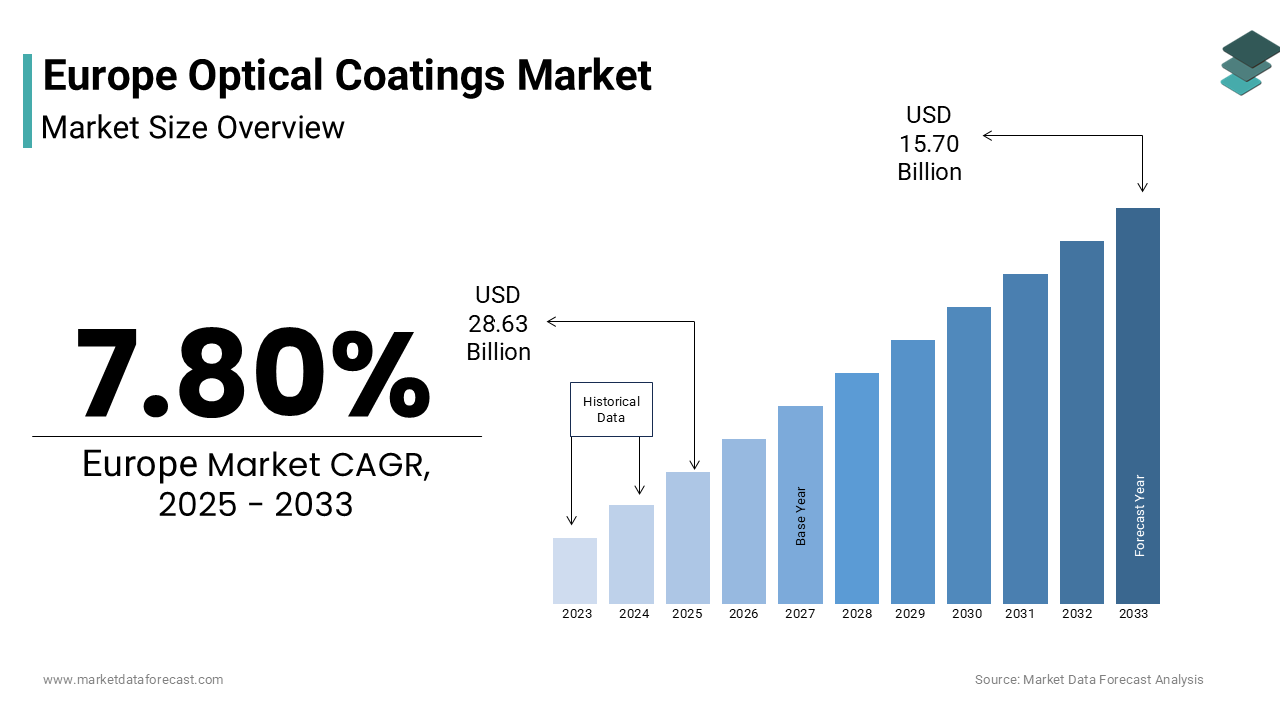
The Europe optical coatings market was valued at USD 14.70 billion in 2024, is estimated to reach USD 15.70 billion in 2025, and is projected to reach USD 28.63 billion by 2033, growing at a CAGR of 7.80% during the forecast period from 2025 to 2033. The growth of the Europe optical coatings market is driven by rising demand from semiconductor manufacturing, medical imaging, consumer electronics, aerospace, and renewable energy sectors. Optical coatings are a critical enabling technology across Europe’s photonics ecosystem, enhancing light transmission, reflection control, durability, and spectral selectivity in high-precision optical components. Strong EU investment in semiconductor self-sufficiency, space programs, and defense modernization, along with strict energy efficiency and sustainability regulations, continues to reinforce the strategic importance of advanced optical coating technologies across the region.
Key Market Trends
- Increasing demand for anti-reflective and filter coatings in semiconductor lithography and inspection systems
- Rising adoption of precision coatings in medical imaging, ophthalmic devices, and diagnostics
- Growing use of electrochromic and low-emissivity coatings in smart buildings and automotive glazing
- Expansion of optical coatings in defense, space, and satellite-based sensing systems
- Shift toward environmentally friendly and REACH-compliant coating chemistries
Segmental Insights
- Based on type, the anti-reflective coatings segment held the largest share of the Europe optical coatings market in 2024. The dominance of this segment is attributed to its widespread use in consumer electronics, medical optics, solar panels, and precision instruments to enhance light transmission and reduce glare.
- Based on end-use industry, the consumer electronics segment led the market in 2024 due to the high volume of smartphones, displays, cameras, and wearable devices requiring multilayer optical coatings for performance and durability. Meanwhile, the aerospace and defense segment is expected to register the fastest growth during the forecast period, driven by rising demand for ruggedized, high-performance optical systems in surveillance, targeting, and space applications.
Regional Insights
- Germany dominated the Europe optical coatings market in 2024, supported by its leadership in industrial optics, semiconductor equipment, and automotive photonics, along with the presence of major players such as ZEISS and SCHOTT.
- France holds a significant market share, driven by strong demand from aerospace, defense, and space programs, including satellite imaging and electro-optical systems.
- The United Kingdom is a key innovation hub, supported by growing investments in quantum technologies, medical diagnostics, and advanced optical research.
- The Netherlands plays a pivotal role in the market due to its central position in the global semiconductor value chain and demand for ultra-precision coatings used in EUV lithography systems.
- Switzerland contributes strongly through high-end optical coatings for scientific instrumentation, medical lasers, and luxury optical applications.
Competitive Landscape
The Europe optical coatings market is highly technology-driven and characterized by a limited number of specialized players capable of delivering nanometer-scale precision and application-specific performance. Competition is based on coating durability, spectral accuracy, environmental compliance, and long-term reliability rather than price. Large integrated optics companies dominate high-value segments such as semiconductors, defense, and space, while niche coating providers serve regional medical, scientific, and industrial clients. Regulatory pressures under REACH and rising capital requirements for advanced deposition technologies continue to shape market dynamics.
Key Market Players
Major companies operating in the Europe optical coatings market include Cutting Edge Coatings GmbH, Artemis Optical Ltd, OptoTech Optikmaschinen GmbH, Bühler Holding AG, Evatec AG, ZEISS Group, LEYBOLD GmbH, Satis Vacuum Technologie SA, Oerlikon Balzers Coating AG, Ionbond AG, Jenoptik AG, SCHOTT, NANEO Precision IBS Coatings GmbH, Umicore Coating Services Ltd, and OptoSigma Europe SAS.
Europe Optical Coatings Market Size
The europe optical coatings market size was valued at USD 14.70 billion in 2024 and is anticipated to reach USD 15.70 billion in 2025 from USD 28.63 billion by 2033, growing at a CAGR of 7.80% during the forecast period from 2025 to 2033.
Optical coatings are thin film layers applied to optical components such as lenses, mirrors, filters, and displays to modify their reflective, transmissive, or absorptive properties for specific wavelengths of light. In Europe, these coatings are indispensable across precision industries including semiconductor lithography, aerospace imaging, medical diagnostics, and renewable energy. The market operates at the intersection of advanced materials science and high tolerance manufacturing, where nanometer scale deposition accuracy directly influences device performance. According to sources, photonics-enabled technologies are a significant and growing component of the global economy, with the European photonics industry consistently demonstrating a high growth rate that surpasses the overall EU GDP growth. Simultaneously, as per research, the use of advanced multi-layer anti-reflective and durable protective coatings for space-borne optics is a critical and established practice in modern Earth observation and communication satellites to ensure optimal performance and mission longevity in harsh space environments. Europe’s leadership in scientific instrumentation, evidenced by facilities like CERN and the European Southern Observatory, further anchors demand for ultra low loss and high laser damage threshold coatings. These applications require compliance with stringent environmental and performance standards. Thus, the Europe optical coatings market is less a standalone segment and more a critical enabler of technological sovereignty in defense, healthcare, and clean energy.
MARKET DRIVERS
Expansion of EU Semiconductor Manufacturing Under the Chips Act
The European Union’s strategic push to achieve semiconductor self-sufficiency is a major accelerator of the Europe optical coatings market. This drives demand for advanced optical coatings used in photolithography and metrology systems. As per studies, the European Chips Act aims to significantly increase the EU's share of global semiconductor production by leveraging substantial public and private investment. Central to this effort are extreme ultraviolet (EUV) lithography machines. Extreme ultraviolet (EUV) lithography systems utilize numerous highly reflective multilayer mirrors, rather than lenses, to direct light within a vacuum environment. Companies like ASML, headquartered in the Netherlands, source these components from specialized European coating providers adhering to atomic level surface smoothness specifications. According to sources, the growing adoption of advanced semiconductor manufacturing processes within Europe is increasing demand for specialized optical components, such as multilayer molybdenum silicon coatings. Besides, new fabrication plants in Germany, France, and Italy, such as Infineon’s Dresden expansion and STMicroelectronics’ Agrate facility, require in line optical inspection systems that rely on anti-reflective and bandpass filter coatings. The European Investment Bank (EIB) has expanded its financing for semiconductor-related research, development, and manufacturing projects, with substantial loan agreements announced to support the industry. This policy driven industrial renaissance transforms optical coatings from niche inputs into strategic assets underpinning Europe’s technological resilience.
Growth in Medical Imaging and Diagnostic Device Innovation
The region’s robust medtech sector is causing demand for precision optical coatings in endoscopes, ophthalmic instruments, and in vitro diagnostic platforms, and thereby fuels the expansion of the Europe optical coatings market. According to research, the European medical technology industry continues to expand, driven by a large number of small and medium-sized enterprises (SMEs) and a significant market value. Modern endoscopic systems utilize gradient index lenses with anti reflective and hydrophobic coatings to enhance image clarity and reduce biofouling during procedures. In ophthalmology, devices like optical coherence tomography scanners employ broadband anti reflective coatings across 800 to 1300 nanometer ranges to maximize signal to noise ratios. German and Swiss medical technology firms are increasingly focusing on advanced materials and coating technologies to meet evolving performance and safety requirements. Furthermore, The full enforcement of the EU Medical Devices Regulation has prompted medical device manufacturers to implement more stringent validation processes for materials and coatings, especially those on reusable instruments subject to repeated sterilization. Europe’s significant role in the worldwide medtech export market, combined with internal demand from an aging populace seeking minimally invasive options, elevates the importance of optical coatings. These coatings are now central to ensuring devices comply with regulations and perform effectively in clinical settings.
MARKET RESTRAINTS
Stringent Restrictions on Hazardous Coating Precursors Under REACH
The European Union’s Registration Evaluation Authorisation and Restriction of Chemicals (REACH) regulation imposes constraints on the Europe optical coatings market. This is done by restricting or requiring authorization for key deposition precursors such as hexafluoroethane and certain organometallic compounds. The European Chemicals Agency is consistently adding substances to the Candidate List for Substances of Very High Concern, prompting industries to seek safer alternatives for various applications including some deposition processes. This forces coating manufacturers to reformulate processes or seek substitutes, often at the cost of performance or yield. For instance, research in material science indicates challenges in maintaining equivalent performance metrics, such as coating uniformity, when replacing conventional perfluorinated compounds with environmentally benign alternatives. Compliance also demands extensive documentation, with authorization dossiers costing upwards of per substance. Small and medium enterprises, which form the backbone of Europe’s specialty optics supply chain, struggle with these administrative and technical burdens. Consequently, some coating lines have been relocated outside the EU, while others face extended lead times due to precursor import delays. These regulatory hurdles, though environmentally justified, impede innovation velocity and increase production costs in a sector where nanometer scale precision is non-negotiable.
High Capital Intensity and Limited Access to Advanced Deposition Equipment
The high capital investment required for advanced optical coating systems and the limited availability of next-generation equipment create serious structural barriers in the Europe optical coatings market. The cost of specialized manufacturing equipment like ion beam sputtering and atomic layer deposition platforms is high and varies widely based on configuration and supplier, as noted by industry associations. Moreover, geopolitical export controls—particularly under the Wassenaar Arrangement restrict the sale of high precision coating systems to entities involved in dual use applications, affecting even civilian research institutes. The European defence industry has encountered general challenges and supply chain concerns regarding access to high-performance and specialized materials and components, including advanced optical coatings for critical applications. This scarcity forces smaller optical workshops to outsource coating services, compromising intellectual property and supply chain agility. Additionally, the energy demand of these systems is substantial. Large-scale, high-vacuum physical vapor deposition processes are generally known to be energy-intensive operations. Rising energy costs and the introduction of carbon pricing mechanisms across the European Union have generally increased the operational expenses for energy-intensive industrial processes such as advanced coating lines. Lack of coordinated EU funding and infrastructure bottlenecks the market, which favours large players and hinders innovation in quantum sensing and AR.
MARKET OPPORTUNTIES
Rise of Sustainable and Recyclable Optical Coating Technologies
The emergence of eco conscious optical coating technologies exhibits an opportunity for European manufacturers to align with circular economy principles while meeting performance demands, which in turn drives the growth of the Europe optical coatings market. Research in materials science consistently develops sol-gel antireflective coatings that improve optical transmission across the visible spectrum. European Union regulations under the Circular Economy Action Plan aim to increase the repairability and material recovery of electronic products. Companies like Meyer Burger in Switzerland are already integrating such low temperature, water based coatings into solar module production, where durability and cost efficiency are critical. Furthermore, the EU Horizon Europe program allocates substantial funding to research and innovation projects focused on sustainable materials and circular economy initiatives, including advancements in photonics. These innovations not only reduce environmental footprints but also open export pathways to jurisdictions with strict chemical regulations, such as California and Japan. Pioneering green photonics enables Europe to gain a competitive edge, leveraging regulatory demands to capture high-value markets such as consumer electronics, renewable energy systems, and wearable optics.
Integration of Optical Coatings in Defense and Space Applications
The region’s strategic autonomy agenda is creating potential expansion possibilities for the Europe optical coatings market. This opens a pathway for these coatings in defense, surveillance, and space systems that demand extreme environmental resilience and spectral precision. The European Defence Fund is continuously increasing funding for collaborative defence research and development to close key capability gaps within Europe. The European Union is developing the IRIS² secure connectivity system as a multi-orbital satellite constellation to ensure strategic autonomy and enhance secure governmental communication services. Similarly, Airbus Defence and Space requires durable anti reflective coatings for missile seeker domes that withstand Mach 3 aerothermal loads. These applications command premium pricing and long term supply contracts, insulating providers from consumer market volatility. Moreover, the EU’s commitment to Copernicus and Galileo programs ensures sustained demand. European Union space programs, particularly the Copernicus initiative, are consistently expanding the number and capabilities of Earth observation satellites to provide increasingly detailed data for environmental monitoring and climate change response. Defense industrial strategies in France, Germany, and Sweden are moving away from cost-minimization, instead emphasizing sovereign capabilities, which directly benefits optical coating specialists providing essential sensor components.
MARKET CHALLENGES
Supply Chain Vulnerability for Rare Earth and Specialty Target Materials
Dependence on imported rare earth elements and high purity sputtering targets, most of which originate from China, challenges the growth of the Europe optical coatings market. This leads to acute supply chain risks. Materials such as lanthanum, neodymium, and hafnium are essential for high refractive index layers in broadband anti reflective and laser line filters. According to 2024 data from Eurostat, the EU imported 95% of its total rare earth elements from the combined top three partners (China, Russia, and Malaysia). China alone accounted for approximately 46% of total rare earth element imports by weight in 2024, though it has a near monopoly on specific refined products like certain oxides and magnets. Following China's implementation of stricter export licensing procedures for hafnium in 2024, the available supply to Europe decreased significantly, causing market tensions and a substantial increase in prices for the material. Stockpiling is impractical due to limited shelf life and storage hazards, while recycling rates for coated optics remain low due to technical complexity. Consequently, European coating houses face unpredictable input costs and lead time volatility, undermining long term contracts with aerospace and semiconductor clients. Europe's photonics sovereignty faces a critical strategic vulnerability that will persist until alternative material systems or robust regional refining capabilities are established.
Talent Shortage in Precision Thin Film Engineering
A persistent shortage of specialized engineers and technicians skilled in optical thin film design and deposition is constraining the Europe optical coatings market. This hampers its capacity to scale and innovate. The European photonics industry is experiencing challenges in talent acquisition, with a persistent demand for skilled individuals in engineering and manufacturing roles. This gap stems from the decline of dedicated photonics curricula in technical universities. There is a limited number of specialized graduate-level educational programs focusing on specific areas like thin film optics within the European Union, which contributes to workforce challenges. The aging workforce compounds the issue. The vacuum coating sector, particularly in key regions like Germany, faces demographic shifts in its workforce, with concerns about an aging population of skilled technicians and the need for new talent pipelines. Consequently, companies face extended development cycles for new coating stacks and higher reliance on external consultants, increasing time to market for applications in quantum computing and lidar. However, despite broad initiatives like the EU Skills Agenda addressing general STEM shortages, the highly specialized nature of optical coatings necessitates focused academic-industry collaboration. Europe's opportunity to leverage its top-tier optical systems leadership is jeopardized by the imminent talent shortage, which requires immediate attention.
REGIONAL ANALYSIS
| REPORT METRIC | DETAILS |
| Market Size Available | 2024 to 2033 |
| Base Year | 2024 |
| Forecast Period | 2025 to 2033 |
| Segments Analysed | By Type, End-Use Industry and Region |
| Various Analyses Covered | Global, Regional & Country Level Analysis, Segment-Level Analysis, Drivers, Restraints, Opportunities, Challenges; PESTLE Analysis; Porter's Five Forces Analysis, Competitive Landscape, Analyst Overview of Investment Opportunities |
| Regions Analysed | United Kingdom, France, Spain, Germany, Italy, Russia, Sweden, Denmark, Switzerland, the Netherlands, Turkey, and the Czech Republic. |
| Market Leaders Profiled | Cutting Edge Coatings GmbH, Artemis Optical Ltd, OptoTech Optikmaschinen GmbH, Bühler Holding AG, Evatec AG, Zeiss Group, LEYBOLD GmbH, Satis Vacuum Technologie SA, Oerlikon Balzers Coating AG, Ionbond AG, Jenoptik AG, SCHOTT, NANEO Precision IBS Coatings GmbH, Umicore Coating Services Ltd, and OptoSigma Europe SAS. |
SEGMENTAL ANALYSIS
By Type Insights
The anti-reflective coatings segment was the top performing segment in the Europe optical coatings market and held a share of 34.3% in 2024. Factors such as its critical role in enhancing light transmission and reducing glare across consumer electronics, medical devices, and renewable energy systems have mainly contributed to the growth of the anti-reflective coatings segment. In the solar sector, anti-reflective layers on photovoltaic glass can increase energy conversion efficiency, a significant gain in an industry where marginal improvements drive competitiveness. Moreover, in ophthalmic lenses, premium eyewear brands like EssilorLuxottica specify multi layer anti reflective stacks to eliminate back surface reflections, improving visual acuity and reducing eye strain. Furthermore, EU energy labeling regulations for displays and lighting mandate minimum luminous efficacy thresholds, compelling manufacturers to adopt high performance coatings. This confluence of energy policy, visual ergonomics, and photonic efficiency ensures anti reflective coatings remain the foundational layer in Europe’s optical ecosystem.
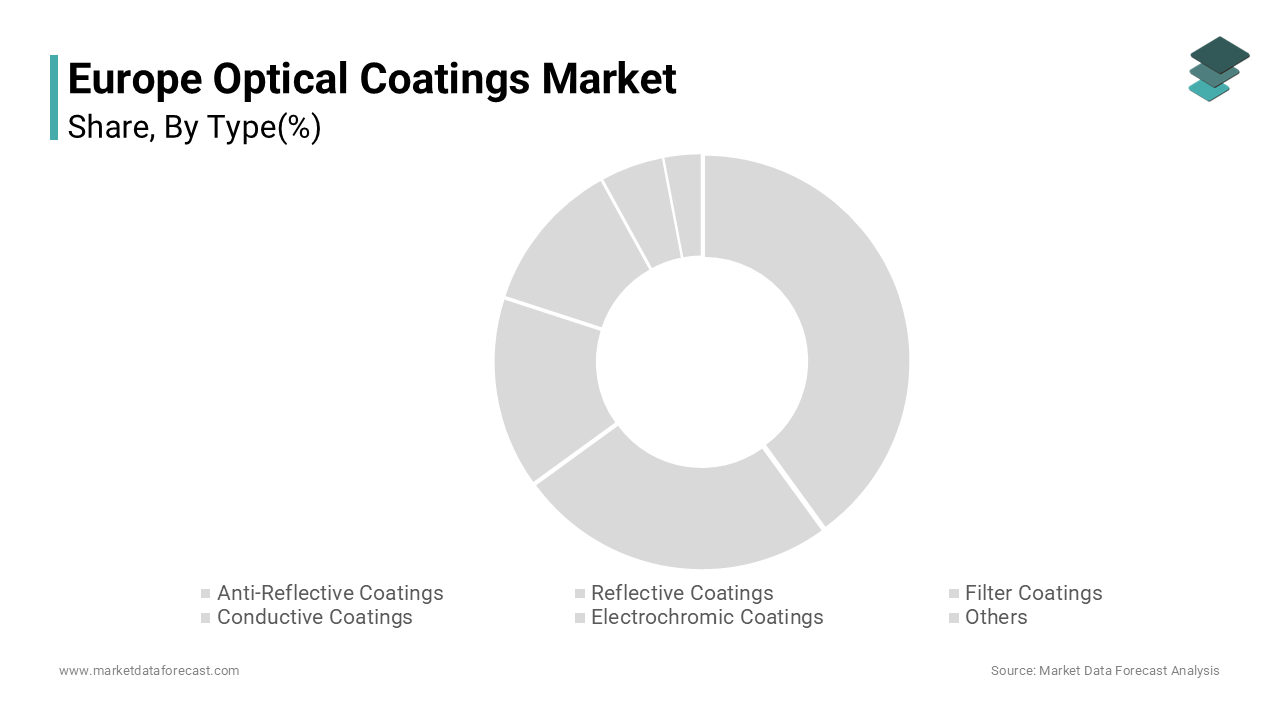
The electrochromic coatings segment is likely to experience the fastest CAGR of 9.4% from 2025 to 2033 due to rising demand for smart windows in commercial buildings and automotive glazing that dynamically modulate light and heat transmission to improve energy efficiency. According to sources, buildings account for a portion of the EU’s total energy consumption, prompting the Energy Performance of Buildings Directive to mandate nearly zero energy standards for all new public structures. Electrochromic glazing, capable of reducing solar heat gain, directly supports this goal. The automotive sector is equally pivotal. Reflecting stricter building efficiency rules in Europe, electrochromic coatings are evolving into essential tools for sustainable architecture and transport, rather than niche luxury items.
By End-Use Industry Insights
The consumer electronics segment led the Europe optical coatings market by accounting for a 28.5% share in 2024 because of the proliferation of high-resolution displays, smartphone cameras, and wearable devices requiring precision optical surfaces. Every modern smartphone contains many coated optical elements, from anti reflective cover glass to infrared cut filters for facial recognition sensors. According to research, the EU imported millions of smartphones in 2024, each demanding multi layer coatings for display clarity and camera performance. Premium brands like Apple and Samsung source European coated glass for European assembly due to stringent quality standards on surface roughness and spectral consistency. Additionally, the rise of augmented reality headsets from firms like Meta and Microsoft has intensified demand for conductive and anti reflective hybrid coatings that enable transparent electrodes and waveguide coupling. As per sources, a portion of consumers prioritize screen glare reduction when purchasing devices, directly influencing OEM coating specifications. So, this segment sustains consistent volume and technical evolution, anchoring Europe’s optical coatings industry in the global electronics supply chain.
The aerospace and defense segment is on the rise and is expected to be the fastest growing segment in the market by witnessing a CAGR of 10.8% during the forecast period owning to Europe’s strategic push for defense autonomy and next generation space capabilities, both requiring advanced optical systems with extreme environmental resilience. Funding supports programs in electro-optical surveillance and directed energy applications. These advanced systems require specialized coatings for effective performance in infrared and laser applications. A secure satellite constellation is being developed for sovereign communications. The satellites incorporate numerous optical components. Also, the component coatings must be resilient to conditions found in low Earth orbit, including atomic oxygen exposure and thermal variations. Similarly, Dassault’s Rafale F5 fighter upgrade includes multispectral targeting pods with diamond like carbon anti reflective coatings that survive Mach 2 flight conditions. Europe's defense industry increasingly relies on optical coatings to meet the growing need for indigenous sensing, spurred by global instability.
REGIONAL ANALYSIS
Germany Optical Coatings Market Analysis
Germany outperformed other countries in the Europe optical coatings market and occupied a 22.2% share in 2024. The growth of the optical coatings in Germany is attributed to its world leading position in industrial optics, semiconductor equipment, and automotive photonics. The country hosts global coating innovators like SCHOTT and Zeiss, which supply ultra low loss anti reflective and laser resistant coatings for EUV lithography, medical endoscopes, and autonomous vehicle sensors. The German photonics industry, represented by trade associations like SPECTARIS, is a major economic force in Europe and globally. Optical coatings represent a vital foundational technology within the broader photonics value chain. Germany's extensive applied research infrastructure, particularly within the Fraunhofer institutes, actively develops advanced manufacturing and deposition processes, supporting key applications like defense and quantum technologies. Government initiatives in Germany, such as "Photonik Forschung Deutschland," are designed to foster innovation and build robust domestic supply chains in strategically important areas like advanced optical components. Public and private investment in the German photonics sector aims to maintain technological leadership and support a highly innovative industry with a significant R&D ratio. Besides, stringent energy efficiency standards for building glazing under the German Energy Saving Ordinance drive the adoption of electrochromic and low emissivity coatings. This blend of industrial scale, R&D infrastructure, and regulatory foresight positions Germany as Europe’s optical coatings nucleus.
France Optical Coatings Market Analysis
France followed closely in the Europe optical coatings market and accounted for a 17.3% share in 2024. The expansion of the French market is driven by the Europe optical coatings market, distinguished by its vertically integrated defense and space industries that demand high reliability optical components. The French Aerospace Lab (ONERA) and companies like Thales and Safran rely on domestic coating facilities to produce infrared reflective and laser damage resistant layers for missile seekers, satellite imagers, and fighter jet HUDs. France’s leadership in space is equally significant. Hence, France sustains a high value, high precision coating ecosystem that serves both strategic and commercial missions.
United Kingdom Optical Coatings Market Analysis
The United Kingdom is moving ahead steadfastly in the Europe optical coatings market due to its command in quantum technologies and advanced medical diagnostics. A national focus on quantum technology has led to an increased interest in advanced coatings. This demand extends to quantum computing components and sensor systems. Specific coatings are sought to help manage light interaction within these systems. The goal of using these specialized materials is to maintain system performance and signal clarity. Companies have been acquiring a variety of anti-reflective and conductive coatings to meet these technological requirements In medtech, firms like Olympus Medical Europe and Smith & Nephew require biocompatible, autoclavable coatings for surgical endoscopes and ophthalmic devices. Besides, the UK’s departure from EU defense frameworks has accelerated sovereign development of electro optical systems, with BAE Systems investing in domestic coating lines for next generation targeting pods. This convergence of deep tech ambition and regulatory rigor ensures the UK remains a high innovation node in Europe’s optical landscape.
Netherlands Optical Coatings Market Analysis
The Netherlands experienced a consistent expansion in the Europe optical coatings market owing to its central role in the global semiconductor value chain and integrated photonics ecosystem. The production of EUV lithography machines relies on a substantial number of precisely coated mirrors per unit. These mirrors incorporate molybdenum silicon multilayers designed to achieve high reflectivity at the 13.5-nanometer wavelength. The ongoing shipment of EUV systems naturally drives a strong demand for high-precision optical coatings from the supply chain. There is a significant, coordinated investment to scale up integrated photonic chips, which are used in datacom and sensing applications. These photonic chips depend heavily on specific coatings, such as anti-reflective and waveguide coupling coatings, which are fabricated using advanced wafer-level deposition techniques. A notable concentration of pilot lines dedicated to manufacturing photonic integrated circuits exists within the region. The Netherlands functions as a pivotal coating gateway in the EU's push for semiconductor autonomy, seamlessly connecting atomic-scale deposition techniques with industrial-scale production requirements.
Switzerland Optical Coatings Market Analysis
Switzerland is predicted to grow in the Europe optical coatings market during the forecast period due to its ultra-high precision coatings used in scientific instrumentation, luxury watches, and medical lasers. Companies like Leica Microsystems and ZEISS Industrial Metrology specify sub angstrom surface roughness coatings for confocal microscopes and coordinate measuring machines, ensuring nanometer level measurement accuracy. Swiss watchmakers such as Rolex and Patek Philippe use proprietary anti reflective coatings on sapphire crystals to enhance dial legibility without compromising scratch resistance, a key differentiator in the luxury segment. Despite its small size, Switzerland’s reputation for micron level perfection and neutrality in defense supply chains ensures its outsized influence in high end optical coatings across Europe
COMPETITIVE LANDSCAPE
Competition in the Europe optical coatings market is highly specialized and technology driven with a limited number of players possessing the capability to deposit nanometer scale multilayer films for strategic applications. The landscape is segmented between large integrated firms like Zeiss and SCHOTT that control end to end value chains and smaller niche coating houses serving regional instrumentation or aerospace clients. Differentiation hinges on precision reproducibility environmental compliance and application specific durability rather than cost. Regulatory pressures under REACH restrict access to high performance precursors favoring companies with in house R&D for alternative chemistries. The defense and semiconductor sectors create high barrier segments where performance and security clearance outweigh price considerations. Meanwhile consumer electronics demand drives scale and speed in anti reflective and conductive coatings. Talent scarcity in thin film engineering and capital intensity of advanced deposition tools further concentrate capabilities. As a result competition is less about market share and more about securing long term partnerships in high value photonics domains.
KEY MARKET PLAYERES
Some of the companies that are playing a dominating role in the Europe optical coatings market include
- Cutting Edge Coatings GmbH
- Artemis Optical Ltd
- OptoTech Optikmaschinen GmbH
- Buhler Holding AG
- Evatec AG
- Zeiss Group
- LEYBOLD GmbH
- Satis Vacuum Technologie SA
- Oerlikon Balzers Coating AG
- Ionbond AG
- Jenoptik AG
- SCHOTT
- NANEO Precision IBS Coatings GmbH
- Umicore Coating Services Ltd
- OptoSigma Europe SAS
Top Players in the Europe Optical Coatings Market
Carl Zeiss AG
Carl Zeiss AG is a German multinational renowned for its precision optics and advanced optical coatings used in semiconductor lithography medical imaging and aerospace systems. The company develops ultra low loss anti reflective and high laser damage threshold coatings critical for EUV photolithography and ophthalmic diagnostics. It also partnered with European quantum computing startups to supply cavity mirrors with sub ppm scatter specifications. These initiatives reinforce Zeiss’s global leadership in high end optical systems while anchoring Europe’s sovereignty in strategic photonics technologies.
SCHOTT AG
SCHOTT AG is a leading German specialty glass and materials manufacturer with a strong footprint in optical coatings for consumer electronics automotive displays and solar applications. The company produces high durability anti reflective and conductive coatings on its Xensation and MEMpax glass substrates used in premium smartphones and electric vehicle touchscreens. It also collaborated with European building material firms to integrate electrochromic coated glass into smart façade systems. These actions strengthen SCHOTT’s role as a sustainable enabler of digital and energy efficient optical interfaces across global markets.
EssilorLuxottica SA
EssilorLuxottica SA is a Franco Italian eyewear giant that drives significant demand for optical coatings through its ophthalmic lens portfolio. The company applies multi layer anti reflective hydrophobic and scratch resistant coatings to millions of lenses annually in its European facilities. It also expanded its coating validation labs in France to comply with stricter EU biocompatibility standards for skin contact optics. By linking coating performance to visual health and consumer comfort EssilorLuxottica elevates functional coatings into premium differentiators within the global vision care market.
Top Strategies Used by the Key Market Participants
Key players in the Europe optical coatings market focus on developing eco friendly deposition processes that eliminate hazardous precursors while maintaining optical performance. They invest in atomic level precision equipment such as ion beam sputtering and atomic layer deposition to serve semiconductor and quantum applications. Companies form strategic partnerships with defense aerospace and medtech OEMs to co develop application specific coating stacks. Vertical integration of coating formulation coating application and end product assembly enhances quality control and intellectual property protection. Additionally firms leverage EU funding programs like Horizon Europe to pilot circular economy models for coated optic recovery and reuse. These strategies collectively reinforce technological leadership regulatory compliance and sovereign supply chain resilience across Europe’s advanced optics ecosystem.
MARKET SEGMENTATION
This research report on the europe optical coatings market has been segmented and sub–segmented into the following categories.
By Type
- Anti-Reflective Coatings
- Reflective Coatings
- Filter Coatings
- Conductive Coatings
- Electrochromic Coatings
- Others
By End-use Industry
- Consumer Electronics
- Telecommunication
- Medical
- Transportation
- Aerospace & Defense
- Others
By Country
- UK
- France
- Spain
- Germany
- Italy
- Russia
- Sweden
- Denmark
- Switzerland
- Netherlands
- Turkey
- Czech Republic
- Rest of Europe