Europe Organic Biogas Market Research Report By Application (Commercial, Residential, Industrial), By Feedstock (Sewage Waste, Organic Waste, Energy Crops, and Others), By Process (Sewage Sludge, Landfill, Anaerobic Digestion, Pyrolysis & Gasification), By Region (Spain, Italy, France, The UK, Germany, and the Rest of Europe) - Industry Analysis From 2026 to 2034
Market Size, 2025
$4.07 BnMarket Estimate, 2026
$4.29 BnMarket Forecast, 2034
$6.52 BnCAGR, 2026–2034
5.38%Europe Organic Biogas Market Report Summary
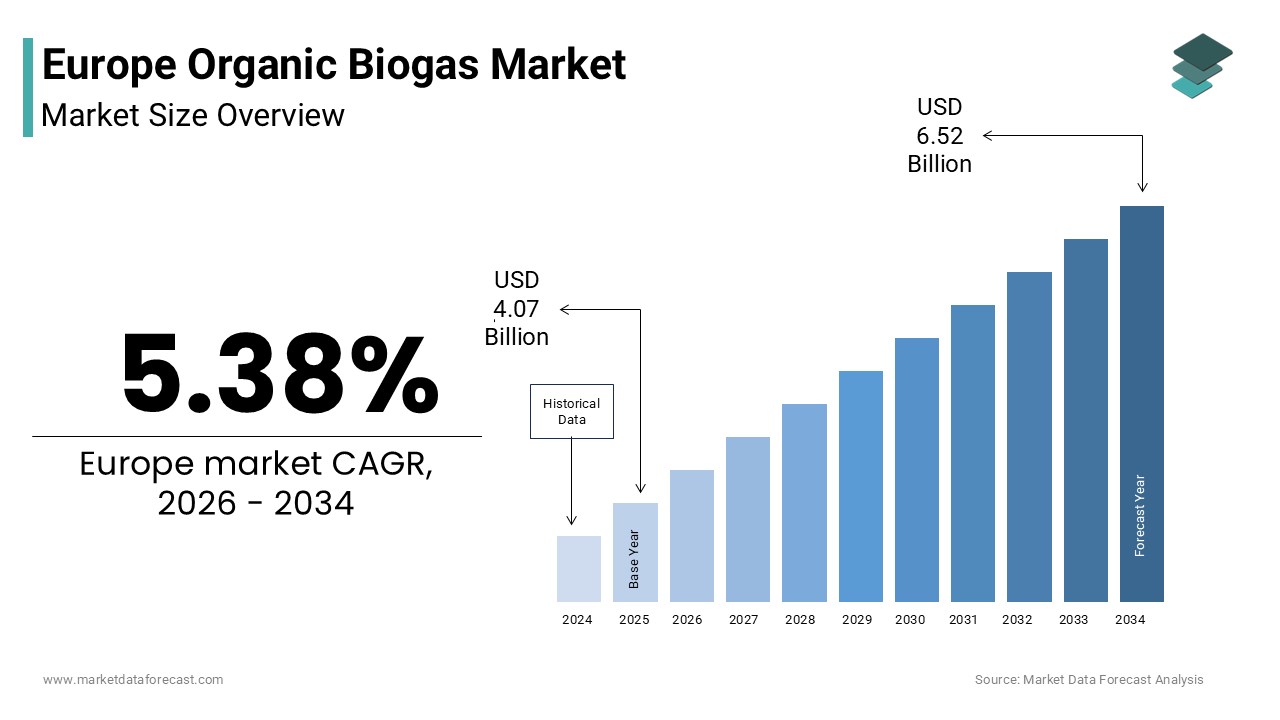
The Europe organic biogas market was valued at USD 4.07 billion in 2025 and is anticipated to reach USD 4.29 billion in 2026 from USD 6.52 billion by 2034, growing at a CAGR of 5.38% during the forecast period from 2026 to 2034. The growth of the Europe organic biogas market is driven by stringent climate policies, increasing adoption of renewable energy sources, and growing demand for sustainable waste management solutions. Expanding investments in anaerobic digestion facilities, rising biomethane production for natural gas grid injection, and increasing government incentives supporting renewable gas projects are further accelerating market growth. Moreover, advancements in digital monitoring technologies, process optimization, and expanding applications of biomethane across industrial, transportation, and residential sectors are supporting the expansion of the Europe organic biogas market.
Key Market Trends
-
Rising integration of biomethane into existing natural gas grids across Europe.
-
Increasing utilization of agricultural residues and organic waste for renewable biogas production.
-
Growing investments in digital monitoring and AI-based process optimization for biogas plants.
-
Rising adoption of biomethane as a low-carbon transportation fuel.
-
Increasing government support through renewable energy targets, subsidies, and feed-in tariff programs.
Segmental Insights
- Based on feedstock, the agricultural residues segment dominated the Europe organic biogas market and accounted for 43.5% of the market share in 2025. The dominance of the segment is attributed to the abundant availability of agricultural waste, well-established collection infrastructure, increasing government support for sustainable farming practices, and growing utilization of crop residues for anaerobic digestion. Technological improvements in feedstock pre-treatment continue to enhance biogas production efficiency.
- The food waste segment is projected to witness the fastest CAGR of 12.3% during the forecast period owing to mandatory bio-waste separation regulations, increasing municipal waste collection programs, growing adoption of circular economy initiatives, and the high biogas yield obtained from food waste digestion. Rising investments in centralized organic waste treatment facilities further support segment growth.
- Based on application, the industrial segment dominated the Europe organic biogas market and held 54.3% of the market share in 2025. The growth of the segment is driven by increasing industrial energy demand, rising decarbonization initiatives, expanding utilization of biomethane as a replacement for natural gas, and growing adoption of combined heat and power (CHP) systems across manufacturing industries. Government incentives promoting industrial renewable energy adoption continue to strengthen segment demand.
- The transportation segment is anticipated to register the fastest CAGR of 14.3% during the forecast period due to increasing renewable fuel mandates, expanding compressed biomethane vehicle fleets, growing investments in biomethane refueling infrastructure, and rising demand for low-carbon fuels across heavy-duty transportation and public transit applications.
Regional Insights
- Germany dominated the Europe organic biogas market and accounted for 56.4% of the regional market share in 2025. The country's leadership is driven by its extensive network of operational biogas plants, favorable Renewable Energy Sources Act (EEG) policies, strong agricultural sector, and continuous investments in biomethane upgrading technologies. Germany's leadership in engineering innovation and renewable energy development continues to strengthen market growth.
- The United Kingdom held 32.1% of the Europe organic biogas market share in 2025 owing to increasing utilization of food waste and sewage sludge as feedstocks, expanding biomethane production capacity, supportive Green Gas Certification Scheme, and growing investments in waste-to-energy infrastructure. Strong government initiatives promoting domestic renewable energy further support market expansion.
- Italy continues to maintain a significant position in the European market due to its large agricultural sector, expanding biomethane production initiatives, increasing livestock waste utilization, and favorable financial incentives supporting advanced anaerobic digestion technologies. Government support under the National Recovery and Resilience Plan continues to accelerate market growth.
- France is witnessing strong growth supported by ambitious national biomethane production targets, increasing farmer participation in cooperative biogas projects, expanding feed-in tariff programs, and rising investments in rural energy independence through methanization initiatives.
- Denmark is expected to experience notable growth during the forecast period owing to advanced biomethane grid integration infrastructure, strong agricultural cooperative participation, increasing renewable gas utilization, and continuous investments in improving digestion efficiency and nutrient recovery technologies.
Competitive Landscape
The Europe organic biogas market is highly competitive and characterized by the presence of specialized biogas technology providers, renewable energy companies, engineering firms, and utility operators competing through technological innovation, operational efficiency, and sustainable energy solutions. Leading companies are focusing on developing advanced anaerobic digestion systems, biomethane upgrading technologies, digital plant monitoring platforms, and nutrient recovery solutions. Strategic collaborations with agricultural cooperatives, waste management companies, and utility providers, along with investments in research and development, continue to strengthen competitive positioning across the Europe organic biogas market. The prominent players operating in the Europe organic biogas market include Scandinavian Biogas Fuels International, PlanET Biogas Global, Xergi, AB Holding, Engie, and Weltec Biopower.
Europe Organic Biogas Market Size
The europe organic biogas market is estimated to be worth USD 4.07 billion in 2025 and is projected to reach USD 6.52 billion by 2034 from USD 4.29 billion in 2026, at a CAGR of 5.38% from 2026 to 2034.
The organic biogas is renewable energy sector focusing on the anaerobic digestion of organic waste materials to produce methane rich biogas and nutrient dense digestate. This process transforms agricultural residues food waste sewage sludge and dedicated energy crops into clean energy while simultaneously addressing waste management challenges. The European Union has positioned biogas as a cornerstone of its circular economy strategy aiming to reduce dependence on fossil fuels and lower greenhouse gas emissions. The sector is integral to achieving the climate neutrality goals outlined in the European Green Deal, which targets a 55% reduction in net greenhouse gas emissions by 2030 compared to 1990 levels. According to the European Environment Agency, agriculture and waste sectors contribute significantly to methane emissions making their capture through biogas plants a vital mitigation strategy. The integration of biogas into existing natural gas grids allows for seamless distribution and utilization in heating power generation and transportation. Regulatory frameworks such as the Renewable Energy Directive II mandate specific shares of advanced biofuels and biogas in transport fuel mixes further stimulating investment.
MARKET DRIVERS
Stringent Climate Policy Frameworks Accelerate Adoption of Renewable Gas Solutions
The stringent climate policy frameworks by mandating significant reductions in carbon emissions and promoting renewable energy sources is driving the growth of the Europe organic biogas market. The European Green Deal and the Fit for 55 package establish legally binding targets that compel member states to increase the share of renewables in their energy mix. As per the European Commission the Renewable Energy Directive sets a binding target of at least 42.5% renewable energy by 2030 with an ambition to reach 45%. Biogas is recognized as a dispatchable renewable source that can balance intermittent solar and wind power ensuring grid stability. The EU Methane Strategy specifically targets methane emissions from the energy and agriculture sectors encouraging the capture and use of biogas instead of venting or flaring. According to the International Energy Agency replacing fossil natural gas with biomethane could reduce EU greenhouse gas emissions by up to 80 million tons of carbon dioxide equivalent annually. National governments have introduced subsidies feed in tariffs and tax incentives to support biogas plant construction and operation. For instance, Germany’s Renewable Energy Sources Act provides guaranteed payments for electricity generated from biomass including biogas. These regulatory mechanisms de risk investments and improve the financial viability of biogas projects. Furthermore, carbon pricing under the EU Emissions Trading System increases the cost of fossil fuels making biogas more competitive.
Growing Demand for Circular Waste Management Solutions Drives Feedstock Availability
The growing demand for circular waste management solutions by ensuring a steady and increasing supply of organic feedstocks while reducing landfill usage is additionally amplifying the growth of the Europe organic biogas market. The European Union Landfill Directive mandates a significant reduction in biodegradable municipal waste sent to landfills requiring member states to implement alternative treatment methods. Anaerobic digestion offers a dual benefit of generating energy and producing high quality digestate that can be used as organic fertilizer closing the nutrient loop. The Circular Economy Action Plan emphasizes the importance of bio waste separation at source which improves the quality and quantity of feedstock available for biogas plants. Municipalities are increasingly partnering with private operators to build centralized digestion facilities to meet waste treatment obligations. The separation of food waste from household collections has improved significantly with countries like France and Italy implementing mandatory sorting laws. This consistent flow of high energy content organic material enhances the efficiency and profitability of biogas production.
MARKET RESTRAINTS
High Initial Capital Investment and Complex Permitting Processes Restrain Expansion
The high initial capital investment and complex permitting processes by creating significant financial and administrative barriers to entry is declining the growth of the Europe organic biogas market. Constructing a commercial scale anaerobic digestion facility requires substantial upfront capital for technology engineering and infrastructure development. Small and medium sized enterprises often struggle to secure financing due to perceived risks and long payback periods. Additionally, the permitting process for new biogas plants involves multiple regulatory approvals including environmental impact assessments zoning permits and grid connection agreements. According to the European Biogas Association obtaining all necessary permits can take between 2 to 5 years in some member states delaying project commencement and increasing costs. Bureaucratic hurdles vary significantly across countries creating uncertainty for investors who seek standardized procedures. Public opposition known as NIMBY not in my backyard syndrome often arises due to concerns about odors traffic and visual impact further complicating approval processes. In regions with strict environmental regulations additional mitigation measures are required increasing capital expenditure.
Volatility in Feedstock Prices and Supply Chain Disruptions Impact Profitability
The volatility in feedstock prices and supply chain disruptions by creating uncertainty in operational costs and production consistency is another factor hindering the growth of the Europe organic biogas market. Biogas plants rely on a continuous supply of organic materials such as maize silage manure food waste and sewage sludge. Fluctuations in agricultural commodity prices directly affect the cost of energy crops which are a primary feedstock in many European countries. The global fertilizer price increases in recent years have raised the cost of growing energy crops reducing margins for biogas producers. Competition for organic waste streams from other industries such as animal feed and composting also drives up prices. Supply chain disruptions caused by extreme weather events logistical bottlenecks or geopolitical tensions can interrupt feedstock delivery leading to plant downtime. Plants designed for specific feedstocks may struggle to adapt to alternative materials without costly modifications. The seasonal nature of certain agricultural residues requires storage infrastructure which adds to capital and operating expenses. Dependence on imported feedstocks exposes producers to currency fluctuations and trade barriers.
MARKET OPPORTUNITIES
Integration of Biomethane into Natural Gas Grids Offers Scalable Distribution Channels
The integration of biomethane into natural gas grids by enabling large scale distribution and utilization of renewable gas is setting up new opportunities for the growth of the Europe organic biogas market. Upgrading biogas to biomethane removes carbon dioxide and impurities resulting in a product that is chemically identical to fossil natural gas and can be injected directly into existing infrastructure. This integration allows biomethane to reach end users in heating industry and transport sectors without requiring new dedicated pipelines. The REPowerEU plan aims to increase annual biomethane production to 35 billion cubic meters by 2030 to reduce reliance on Russian gas imports creating a strong policy push for grid injection. member states have established guarantee of origin schemes to certify and track renewable gas facilitating trade and consumer confidence. Utilities and gas suppliers are increasingly offering green gas tariffs attracting environmentally conscious consumers and corporate clients. The ability to store biomethane in underground gas storages provides energy security and flexibility to balance seasonal demand variations. This scalability transforms biogas from a localized energy source into a national and cross border commodity. Investments in upgrading technologies and grid connection points are accelerating unlocking the full potential of organic biogas to decarbonize the gas network.
Advancements in Digital Monitoring and Process Optimization Enhance Efficiency
Advancements in digital monitoring and process optimization by improving operational efficiency yield and reliability through data driven insights is another factor to enhance the growth of Europe organic biogas market. The adoption of Internet of Things sensors artificial intelligence and machine learning allows real time monitoring of key parameters, such as temperature pH levels and gas composition. Predictive maintenance algorithms identify potential equipment failures before they occur reducing downtime and repair costs. Digital platforms enable remote management of multiple plants allowing operators to benchmark performance and implement best practices across facilities. The integration of blockchain technology facilitates transparent tracking of feedstock origins and biomethane certificates building trust with regulators and consumers. Startups and tech companies are developing specialized software solutions tailored to the biogas industry fostering innovation and competition. These digital enhancements make biogas plants more attractive to investors by demonstrating higher reliability and lower operational risks.
MARKET CHALLENGES
Regulatory Uncertainty and Policy Fragmentation Across Member States Create Investment Risks
The regulatory uncertainty and policy fragmentation by hindering long term investment planning and cross border collaboration is significant challenge for the growth of the Europe organic biogas market. While the European Union sets overarching targets individual member states implement national support schemes that vary widely in design generosity and duration. The inconsistencies in national renewable energy policies have led to uneven development of biogas capacity across the EU with some countries lagging significantly behind. Changes in government priorities or budget constraints can lead to sudden reductions in subsidies or feed in tariffs leaving investors with stranded assets. According to the European Biogas Association, frequent regulatory changes create a volatile business environment where project viability can change overnight. Investors require stable and predictable regulatory frameworks to commit capital to long term infrastructure projects. Delays in transposing EU directives into national law further exacerbate uncertainty and slow down project approvals.
Technical Limitations in Digestate Management and Nutrient Recovery Pose Environmental Concerns
The technical limitations in digestate management and nutrient recovery pose environmental by creating disposal issues and potential pollution risks that is also to hinder the growth of the Europe organic biogas market. Anaerobic digestion produces large volumes of digestate which contains nutrients such as nitrogen and phosphorus that must be managed responsibly. As per the European Environment Agency excessive application of digestate to agricultural land can lead to nitrate leaching into groundwater and eutrophication of surface waters violating the Nitrates Directive. Many regions in Europe are already designated as nitrate vulnerable zones restricting the amount of organic fertilizer that can be applied. The lack of advanced nutrient recovery technologies means that much of the potential value in digestate is lost or becomes a liability. According to the Joint Research Centre only a small fraction of digestate is currently processed to extract concentrated fertilizers due to high costs and technological immaturity. Transporting wet digestate over long distances is economically and environmentally inefficient due to its high water content. Storage requirements for digestate are stringent to prevent ammonia emissions and odor complaints from local communities. Regulatory restrictions on heavy metal content and pathogens further limit the usability of digestate from certain feedstocks. Developing cost effective technologies for nutrient extraction and water reduction is essential to ensure sustainable digestate management and regulatory compliance.
REPORT COVERAGE
| REPORT METRIC | DETAILS |
| Market Size Available | 2025 to 2034 |
| Base Year | 2025 |
| Forecast Period | 2026 to 2034 |
| CAGR | 5.38% |
| Segments Covered | By Application, Feedstock, Process, Type, and Region. |
| Various Analyses Covered | Global, Regional & Country Level Analysis, Segment-Level Analysis, DROC, PESTLE Analysis, Porter’s Five Forces Analysis, Competitive Landscape, Analyst Overview of Investment Opportunities |
| Regions Covered | France, The UK, Spain, Germany, Italy, Rest of Europe. |
| Market Leaders Profiled | Scandinavian Biogas Fuels International, PlanET Biogas Global, Xergi, AB Holding and Engie, Weltec Biopower, and Others. |
SEGMENTAL ANALYSIS
By Feedstock Insights
The agricultural residues segment held 43.5% of the Europe organic biogas market share in 2025 due to their vast availability across the continent and well established collection infrastructure. Crop residues such as straw maize stover and sugar beet pulp are generated in massive quantities during harvest seasons providing a consistent and low-cost supply of organic material. The European Union produces approximately 250 million tons of agricultural residues annually with countries like France Germany and Poland being major contributors, as per research. The use of these residues does not compete with food production making them an environmentally and socially acceptable feedstock option. Farmers benefit from additional revenue streams by selling residues to biogas plants which helps offset farming costs. The European Commission supports the utilization of agricultural waste through the Common Agricultural Policy which encourages sustainable resource management practices. Technological advancements in pre treatment processes have improved the digestibility of lignocellulosic materials increasing biogas yields from residues. The seasonal nature of residue generation is managed through storage facilities ensuring year round plant operation. This abundance combined with policy support and economic incentives solidifies agricultural residues as the primary feedstock driving the European biogas sector forward.
The food waste segment is likely to grow at an anticipated to grow at an anticipated CAGR of 12.3% from 2026 to 2034. The European Union Waste Framework Directive requires member states to separate bio waste at source by 2023 significantly increasing the volume of collected food waste available for anaerobic digestion. As per the European Environment Agency the EU generates approximately 88 million tons of food waste annually with households and food service sectors being major contributors. Urban centers are increasingly implementing mandatory sorting schemes, which improve the purity and quality of collected food waste making it ideal for biogas production. The high energy content of food waste results in superior biogas yields compared to other feedstocks enhancing plant profitability. Municipalities are investing in centralized digestion facilities to manage organic waste efficiently while generating renewable energy. Consumer awareness campaigns have improved participation rates in waste separation programs ensuring a steady supply chain. The circular economy model promotes the conversion of food waste into energy and fertilizer aligning with sustainability goals.
By End Use Insights
The industrial sector segment was the largest by holding 54.3% of the Europe organic biogas market share in 2025 due to its high energy demand and urgent need to decarbonize operations. Industries such as chemical manufacturing food processing and paper production require substantial amounts of heat and power, which can be supplied by biogas. Biogas offers a reliable and dispatchable energy source that can replace fossil natural gas in industrial boilers and combined heat and power systems. The REPowerEU plan emphasizes the substitution of Russian gas imports with renewable alternatives including biomethane for industrial applications. Europe industrial consumers are increasingly signing long term supply contracts for green gas to meet corporate sustainability targets and comply with carbon pricing mechanisms. The ability of biogas to provide process heat at high temperatures makes it suitable for heavy industries that cannot easily electrify. Government incentives such as tax exemptions and grants further encourage industrial adoption of biogas. The sector’s commitment to reducing scope 1 and 2 emissions drives investment in on site biogas production or off take agreements.
The transportation segment is expected to witness a fastets CAGR of 14.3% during the forecast period with the renewable fuel mandates and increasing adoption of biomethane powered vehicles. The Renewable Energy Directive II sets specific targets for the share of advanced biofuels and renewable fuels of non biological origin in transport requiring member states to promote biomethane usage. Heavy duty transport and public bus fleets are transitioning to compressed biomethane due to its lower carbon intensity and comparable performance to diesel. The Fit for 55 package, includes stricter CO2 emission standards for cars and vans encouraging the use of clean fuels. Governments are expanding refueling infrastructure with hundreds of new biomethane stations planned across major highways. Logistics companies are incorporating biomethane into their fleets to meet environmental social and governance criteria. The availability of guarantee of origin certificates allows transport operators to prove the renewable nature of their fuel.
COUNTRY ANALYSIS
Germany Organic Biogas Market Analysis
Germany was the top performer of the Europe organic biogas market by holding 56.4% of share in 2025. The country has been a pioneer in biogas technology with thousands of operational plants contributing significantly to national renewable energy targets. The Renewable Energy Sources Act provides guaranteed feed in tariffs for electricity generated from biogas ensuring financial stability for operators. Recent amendments focus on upgrading biogas to biomethane for grid injection and transport use aligning with climate goals. The agricultural sector plays a crucial role with many farms operating co digestion facilities using manure and crop residues. Government initiatives promote the phase out of maize monocultures in favor of diverse feedstocks including waste materials. According to the Federal Ministry for Economic Affairs and Climate Action biomethane production is expected to double by 2030 supported by investment subsidies. The strong engineering base and research institutions drive continuous technological improvements in efficiency and emissions control. Germany’s leadership is reinforced by its active participation in European biogas associations and standard setting bodies.
United Kingdom Organic Biogas Market Analysis
The United Kingdom organic biogas market was ranked second by capturing 32.1% of share in 2025. The UK has shifted away from agricultural energy crops towards food waste and sewage sludge as primary feedstocks following policy changes. As per the Department for Energy Security and Net Zero the UK produces over 1.5 billion cubic meters of biomethane annually primarily from anaerobic digestion of organic waste. The Green Gas Certification Scheme allows producers to verify and trade renewable gas attributes encouraging investment in upgrading facilities. Local authorities are mandated to collect food waste separately ensuring a consistent supply for biogas plants. The sector supports thousands of jobs and contributes significantly to rural economies. Investment in large scale industrial digestion facilities is rising particularly near urban centers to minimize transport costs. The withdrawal from the EU has led to independent policy developments focusing on domestic energy security and waste reduction. Carbon pricing through the UK Emissions Trading System enhances the competitiveness of biomethane against fossil gas.
Italy Organic Biogas Market Analysis
Italy organic biogas market growth is likely to grow with the agricultural sector and attractive incentive schemes. The country has a long history of biogas production particularly in the northern regions where livestock farming is intensive. The government has introduced specific decrees to promote the upgrading of biogas to biomethane for injection into the natural gas grid. Financial incentives include feed in premiums and tax credits for investments in advanced digestion technologies. The use of animal manure and agricultural residues is widespread helping farmers manage waste while generating income. According to the Ministry of Ecological Transition, Italy aims to produce 2.3 billion cubic meters of biomethane by 2030 as part of its National Recovery and Resilience Plan. The automotive sector is also adopting biomethane with a growing network of refueling stations for natural gas vehicles. Regional policies support the development of small scale distributed plants to enhance local energy autonomy. The combination of agricultural tradition and modern policy support ensures Italy remains a key player in the European biogas market.
France Organic Biogas Market Analysis
France organic biogas market growth is eventually rising with the ambitious methanization plans and rural development initiatives aimed at energy independence. The French government has set a target to produce 8 billion cubic meters of biomethane by 2030 as outlined in the Multiannual Energy Program. As per the French Association of Methanization Professionals the number of biomethane injection sites has tripled in the last three years reaching over 150 facilities. Feed in tariffs and purchase obligations guarantee a market for injected biomethane encouraging farmer cooperatives to invest in collective digestion units. The focus is on utilizing local resources such as livestock manure crop residues and agro industrial waste to support rural economies. According to the Ministry of Ecological Transition financial aid packages are available for feasibility studies and construction of methanization units. The agricultural sector is actively involved with many farms transitioning to mixed energy and food production models. Public acceptance is generally high due to the perceived benefits of waste reduction and local energy creation. Regulatory simplification efforts are underway to speed up permitting processes for new projects.
Denmark Organic Biogas Market Analysis
Denmark organic biogas market growth is leveraging with the advanced grid integration and a strong focus on sustainability. The country has one of the highest shares of biogas in its energy mix with extensive infrastructure for upgrading and injecting biomethane. Denmark employs sophisticated monitoring and control systems to ensure the quality and stability of gas injected into the grid. The government supports the transition from natural gas to green gas through taxation policies and subsidies for upgrading facilities. Agricultural cooperatives play a central role in owning and operating large scale biogas plants that process manure and organic waste. Research and development efforts focus on improving digestion efficiency and nutrient recovery from digestate. The integration of biogas with wind power allows for flexible energy storage and distribution.
COMPETITIVE LANDSCAPE
The competition in the Europe organic biogas market is characterized by a mix of specialized technology providers large utility companies and agricultural cooperatives vying for dominance in a rapidly evolving sector. Technological innovation serves as the primary differentiator with firms investing in advanced digestion and upgrading solutions to improve efficiency and reduce costs. Geographic expansion is another key strategy as companies seek to establish presence in countries with supportive policies and abundant feedstock resources. Partnerships with waste management entities ensure secure supply chains for organic materials, which are for consistent production. Regulatory compliance and certification play significant roles in building trust and accessing premium markets such as green transport fuel. Price competition is moderate due to the specialized nature of the technology but cost efficiency determines long term viability. Mergers and acquisitions facilitate rapid growth and access to proprietary technologies enhancing market reach. Talent acquisition remains challenging as specialized skills in bioengineering and process optimization are in high demand.
KEY MARKET PLAYERS
Companies playing a promising role in the europe organic biogas market include
- Scandinavian Biogas Fuels International
- PlanET Biogas Global
- Xergi
- AB Holding
- Engie
- Weltec Biopower
- Others
Top Players in the Europe Organic Biogas Market
EnviTec Biogas
EnviTec Biogas stands as a leading technology provider in the European organic biogas sector specializing in comprehensive plant engineering and optimization services. The company designs and constructs anaerobic digestion facilities across Germany and neighboring countries focusing on high efficiency and reliability. EnviTec recently expanded its service portfolio to include digital monitoring solutions that enhance operational performance and reduce maintenance costs for plant operators. The firm actively participates in research projects aimed at improving substrate flexibility and biomethane upgrading technologies. Their commitment to sustainability is evident in their development of low emission digestate management systems. Strategic partnerships with local farmers ensure a steady supply chain expertise while strengthening community ties.
Weltec Biopower
Weltec Biopower is a prominent manufacturer of prefabricated biogas plants known for their modular design and rapid deployment capabilities across Europe. The company serves a diverse client base including municipalities agricultural cooperatives and industrial waste processors by providing scalable solutions. Weltec recently introduced advanced fermentation technologies that increase biogas yields from complex organic waste streams such as food residues and sewage sludge. The firm has strengthened its market position by expanding its service network to provide ongoing technical support and maintenance across multiple European countries. Their focus on quality control and standardized components reduces construction time and costs for clients. Weltec also engages in educational initiatives to promote best practices in biogas production among new entrants. This customer centric strategy drives consistent growth and brand loyalty in a competitive landscape.
DMT Environmental Technology
DMT Environmental Technology plays a crucial role in the Europe organic biogas market by providing specialized equipment for gas upgrading and purification processes. The company focuses on transforming raw biogas into high quality biomethane suitable for grid injection and vehicle fuel. DMT recently launched innovative membrane separation technologies that improve energy efficiency and reduce operational costs for upgrading facilities. The firm collaborates with major utility companies to integrate biomethane production into existing natural gas infrastructure ensuring seamless distribution. Their expertise in trace gas removal ensures compliance with stringent European quality standards for renewable gas. DMT also offers consulting services to help clients optimize plant performance and maximize revenue from biomethane certificates. This technological leadership enables wider adoption of biomethane and supports the decarbonization goals of the European transport and heating sectors.
Top Strategies Used by Key Market Participants
Key players in the Europe organic biogas market primarily focus on technological innovation to enhance efficiency and reduce operational costs. Companies invest heavily in research and development to improve anaerobic digestion processes and gas upgrading techniques. Strategic partnerships with agricultural cooperatives and waste management firms secure stable feedstock supplies and streamline logistics. Expansion into biomethane upgrading allows producers to access higher value markets such as transportation and grid injection. Digitalization through smart monitoring systems optimizes plant performance and predictive maintenance reducing downtime. Lobbying efforts aim to harmonize regulatory frameworks across member states facilitating cross border trade of renewable gas. Vertical integration enables companies to control the entire value chain from feedstock collection to final energy distribution. Sustainability certifications are pursued to build trust with consumers and comply with environmental standards.
MARKET SEGMENTATION
This research report on the europe organic biogas market has been segmented and sub-segmented based on application, feedstock, process and country.
By Application
- Commercial
- Residential
- Industrial
By Feedstock
- Sewage Waste
- Organic Waste
- Energy Crops
- Others
By Process
- Sewage Sludge
- Landfill
- Anaerobic Digestion
- Pyrolysis & Gasification
By Country
- France
- The UK
- Spain
- Germany
- Italy
- Rest of Europe
Frequently Asked Questions
Mention some key players in Europe Organic Biogas Market?
Scandinavian Biogas Fuels International, PlanET Biogas Global, Xergi, AB Holding and Engie, Weltec Biopower
Mention any of the Europe Organic Biogas Market Primary Drivers?
Awareness shit towards adopting clean energy resources, cheaper cost, and government regulations.
Which region holds the largest market share?
Germany in Europe Organic Biogas Market holds the largest market share.
What is the growth rate of the Europe Organic Biogas Market?
The growth rate of the Europe Organic Biogas Market is at a CAGR of around 5.38%.
Related Reports
Access the study in MULTIPLE FORMATS
Purchase options starting from
$ 2000
Didn’t find what you’re looking for?
TALK TO OUR ANALYST TEAM
Need something within your budget?
NO WORRIES! WE GOT YOU COVERED!
Call us on: +1 888 702 9696 (U.S Toll Free)
Write to us: sales@marketdataforecast.com