- Product Description Description
- Table of Contents TOC
- List of Table & Figure LOT
- Get Free Sample PDF Sample PDF
Market Size, 2025
$1.47 BnMarket Estimate, 2026
$1.55 BnMarket Forecast, 2034
$2.36 BnCAGR, 2026–2034
11.5%Europe Organic Seeds Market Size, Growth, Trends & Forecast (2026–2034)
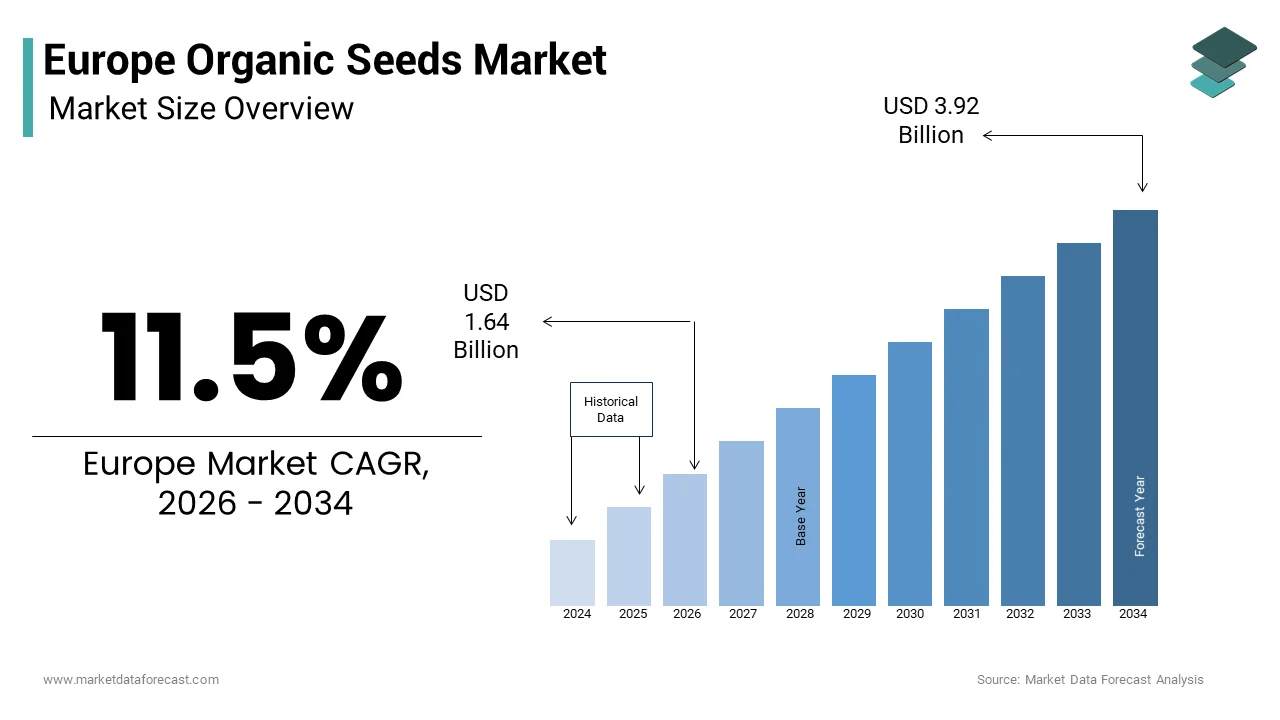
The Europe organic seeds market size was valued at USD 1.47 billion in 2025, is anticipated to reach USD 1.55 billion in 2026, and is projected to expand up to USD 2.36 billion by 2034, registering a compound annual growth rate (CAGR) of 11.5% during the forecast period from 2026 to 2034. Growth is driven by soaring consumer demand for organic food, institutional support through the European Union's Farm to Fork Strategy and Common Agricultural Policy (CAP), and increasing retail compliance mandates.
Key Executive Metrics (At-a-Glance)
- 2025 Base Valuation: USD 1.47 Billion
- 2026 Current Valuation: USD 1.55 Billion
- 2034 Forecast Valuation: USD 2.36 Billion
- Compound Annual Growth Rate (CAGR): 11.5% (2026–2034)
- Dominant Crop Segment: Vegetable Seeds (48.2% share in 2025)
- Fastest-Growing Crop Segment: Fruit and Nut Seeds (9.7% CAGR, 2026–2034)
- Dominant Application Segment: Agriculture (Field crops: cereals, oilseeds, and pulses across over 10.3 million hectares)
- Fastest-Growing Application Segment: Horticulture (8.9% CAGR, driven by urban gardening and peri-urban organic farming)
- Dominant Distribution Channel: Cooperatives (44.7% share)
- Fastest-Growing Distribution Channel: Retailers (10.3% CAGR, driven by specialized online platforms and e-commerce)
- Dominant Country Market: Germany (29.3% share in 2024)
Core Market Drivers
- Retail & Consumer Demand: EU organic retail sales surpassing €55 billion, forcing traceability and mandatory organic seed sourcing by major retail chains like Carrefour and Edeka.
- Policy and Institutional Support: Frameworks such as the EU Farm to Fork Strategy, France’s Ambition Bio 2032, and CAP 2023–2027 direct payments stimulating organic adoption.
Primary Market Restraints & Challenges
- Supply Scarcity & Costs: Limited availability of certified organic seed varieties leading to frequent derogations for conventional untreated seeds, alongside high production costs (30% to 50% higher than conventional seeds).
- Climate & Legal Constraints: Climate-induced yield volatility, IP restrictions on seed saving, and fragmented cross-border certification standards.
Europe Organic Seeds Market Segmentation Breakdown
| Segment Category | Largest (Dominant) Sub-Segment | Fastest-Growing Sub-Segment |
|---|---|---|
| By Crop Type | Vegetable Seeds (48.2% share, 2025) | Fruit and Nut Seeds (9.7% CAGR, 2026–2034) |
| By Application | Agriculture (Field-crop production) | Horticulture (8.9% CAGR) |
| By Distribution Channel | Cooperatives (44.7% share, 2024/2025) | Retailers (10.3% CAGR) |
| By Country | Germany (29.3% share, 2024) | Spain / Italy (High growth in orchard & agrobiodiversity sectors) |
Major Industry Players Profiled
Key corporations and specialized entities steering the European organic seeds market include Bingenheimer Saatgut AG (Germany), Rijk Zwaan Zaadteelt en Zaadhandel BV (Netherlands), Sativa Rheinau AG (Switzerland), Johnny’s Selected Seeds, Fedco Seeds, High Mowing Organic Seeds, Seed Savers Exchange, Wild Garden Seeds, HILD Samen, Fleuren, Vitalis Organic Seeds, Navdanya, De Bolster, Maas Plant, Southern Exposure Seed Exchange, and Arnica Kwekerij.
Europe Organic Seeds Market Size
The Europe organic seeds market size was valued at USD 1.47 billion in 2025 and is anticipated to reach USD 1.55 billion in 2026 to USD 2.36 billion by 2034, estimated to be growing at a CAGR of 11.5% during the forecast period from 2026 to 2034.
The Organic Seeds are certified in strict compliance with European organic agricultural regulations that prohibit synthetic fertilizers, pesticides, genetically modified organisms, and irradiation. These seeds form the biological foundation of organic crop systems, which emphasize soil fertility, ecological balance, and biodiversity. The organic land use by 2030 is growing with intensifying pressure on seed systems to scale supply. The structural gaps persist, with fewer than 30% of organic farms consistently sourcing fully certified organic seeds by relying on derogations for conventional untreated seeds.
MARKET DRIVERS
Rising Consumer Demand for Organic Food Fuels Seed Procurement
The consumer preference for organic seed adoption across Europe is prompting the growth of the Europe Organic Seeds Market. The retail sales of organic food in the European Union surpassed 55 billion euros, as per reports. This demand exerts direct pressure on supply chains to ensure traceability and compliance from farm to fork by compelling farmers to source certified organic seeds to maintain product integrity and certification status. The organic crops must be grown from organic seeds wherever such seeds are commercially available, with the linkage between end market demand and upstream seed procurement. According to the Organic Farmers and Growers Association, organic arable farmers in the United Kingdom prioritized organic seed sourcing specifically to meet retailer and consumer expectations for authenticity. Furthermore, the proliferation of private-label organic products by major retailers, such as Carrefour and Edeka, has intensified contractual requirements for documented organic seed use.
Policy Support Through the EU’s Farm to Fork Strategy
The European Union’s Farm to Fork Strategy provides a robust institutional framework that actively stimulates demand for organic seeds, which will additionally boost the growth of the Europe Organic Seeds Market. France’s Ambition Bio 2032 program is specifically to support organic seed multiplication and breeding initiatives. Similarly, the Common Agricultural Policy 2023–2027 channels direct payments to farmers who adopt organic practices, including the use of certified organic seeds, thereby reducing financial barriers to entry.
MARKET RESTRAINTS
Limited Availability of Certified Organic Seed Varieties
The persistent scarcity of certified organic seed varieties adapted to diverse agro-climatic conditions is hampering the growth of the Europe Organic Seeds Market. The European Commission acknowledged in 2024, only a few vegetable crop varieties and cereal varieties available in the EU Common Catalogue are certified for organic production. This mismatch forces many organic farmers to apply for derogations allowing the use of untreated conventional seeds, with the integrity of the organic chain. Breeding programs tailored to organic systems are further hampered by limited investment. The absence of high-yielding, disease-resistant organic varieties for key crops like wheat and potatoes constrains productivity and profitability by deterring new entrants from transitioning to organic farming despite favorable policy signals.
High Production Costs and Fragmented Supply Chains
The economic viability of organic seed production is significantly constrained by elevated costs and logistical inefficiencies, which are additionally hampering the growth of the Europe Organic Seeds Market. Organic seed multiplication requires dedicated isolation distances, organic soil preparation, and labor-intensive roguing to maintain genetic purity and certification standards, resulting in production costs that are 30 to 50% higher than conventional seed. Small-scale seed producers, who dominate the European organic seed landscape, lack economies of scale and access to integrated distribution networks by leading to fragmented and regionally siloed supply chains. Furthermore, inconsistent national certification protocols create administrative burdens, as a seed producer in Poland may face different documentation requirements when selling to Germany versus Italy, increasing compliance costs.
MARKET OPPORTUNITIES
Advancements in Participatory Plant Breeding Programs
The participatory plant breeding initiatives are co-developing resilient, locally adapted seed varieties through farmer breeder collaborations, which are posing new opportunities for the growth of the Europe Organic Seeds Market. The European Horizon 2020-funded project DIVERSIFOOD demonstrated that participatory breeding has increased the adoption rate of organic seeds among participating farms across eight countries. In Italy, organic farms engaged in on-site seed selection for tomatoes and leafy greens, resulting in 22 new locally adapted entries registered in the national organic seed database. The Organic Regulation explicitly encourages such decentralized breeding models by simplifying registration procedures for heterogeneous material by enabling faster market entry.
Integration of Digital Platforms for Seed Traceability and Matching
The digital innovation is unlocking new market efficiencies by connecting organic seed producers directly with end users through transparent, data-driven platforms, which also leverages the growth of the Europe Organic Seeds Market. This platform reduced search time for compliant seeds by an average of 60% in its first year of operation. Concurrently, blockchain-based traceability systems are being piloted in France and the Netherlands to provide immutable records of seed origin, breeding method, and certification history by addressing longstanding concerns about fraud and mislabeling. Moreover, machine learning algorithms are being deployed to match regional soil and climate profiles with optimal seed varieties by enhancing agronomic performance.
MARKET CHALLENGES
Climate-Induced Yield Instability in Organic Seed Crops
The organic seed production systems face heightened vulnerability to climate variability due to their exclusion of synthetic inputs that buffer against environmental stress is one of the challenging factors for the growth of the Europe Organic Seeds Market. Unlike conventional systems that can deploy chemical growth regulators or irrigation enhancers, organic seed growers rely solely on soil health and genetic resilience, which are often insufficient under acute climatic shocks. Seed crops are particularly sensitive during flowering and seed set phases, with a single heat wave during these stages can cause near total crop failure. This volatility deters investment in organic seed multiplication, as producers face unpredictable returns and limited crop insurance options tailored to organic standards.
Intellectual Property Constraints on Seed Saving and Exchange
The restrictive intellectual property of he organic seed ecosystem by limiting traditional farmer practices of seed saving and exchange is degrading the growth of the Europe Organic Seeds Market. Although the European Union permits seed saving for organic farmers under certain conditions, commercial vegetable varieties are protected under plant variety rights or patents. These protections often prohibit the resale or redistribution of harvested seed, even within organic networks. This concentration restricts genetic diversity and increases licensing costs for breeders developing organic lines.
REPORT COVERAGE
| REPORT METRIC | DETAILS |
| Market Size Available | 2025 to 2034 |
| Base Year | 2025 |
| Forecast Period | 2026 to 2034 |
| CAGR | 11.5% |
| Segments Covered | By Crop Type, Application, Distribution Channel, and Country |
| Various Analyses Covered | Regional and Country-Level Analysis, Segment-Level Analysis, DROC, PESTLE Analysis, Porter’s Five Forces Analysis, Competitive Landscape, Analyst Overview of Investment Opportunities |
| Regions Covered | Germany, the UK, France, Spain, Russia, Sweden, Denmark, Italy, Switzerland, the Netherlands, and the Rest of Europe. |
| Market Leaders Profiled | Diana group, BASF SE, Chr. Hansen A/S, Kemin Industries Inc., Nutraceutical International LLC, and Royal DSM N.V. |
SEGMENTAL ANALYSIS
By Crop Insights
The vegetable seeds segment was the largest with 48.2% of the Europe Organic Seeds Market share in 2025. The growth of the segment is primarily driven by surging urban consumption of fresh organic vegetables across Europe. In 2023, over 68 % of organic food sales in the EU consisted of fresh produce, with vegetables representing the largest share. Major cities such as Berlin, Paris, and Amsterdam have witnessed double-digit annual growth in organic vegetable consumption, driven by health-conscious demographics and expanded retail shelf space. Supermarkets like Edeka and Carrefour now dedicate entire sections to locally grown organic vegetables, creating direct procurement linkages with organic farms that require certified organic vegetable seeds.
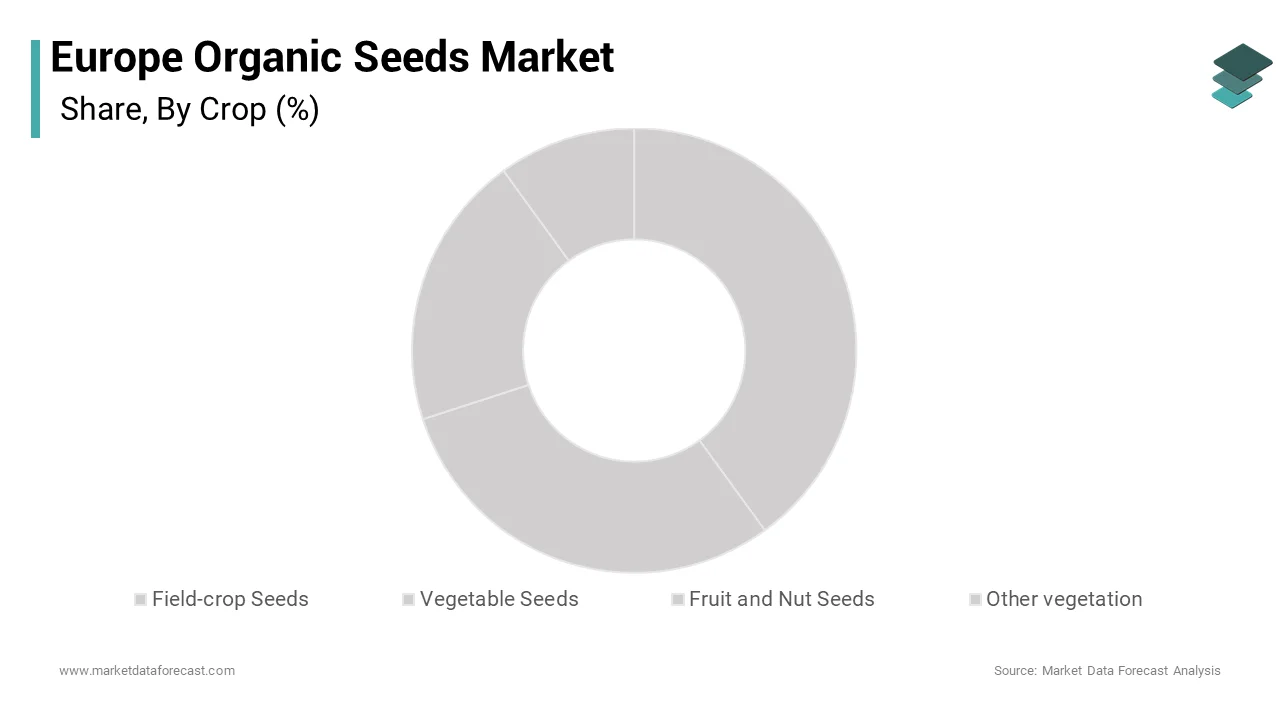
The fruit and nut seeds segment is lucratively growing with an expected CAGR of 9.7% from 2026 to 2034, with the long-term transition of European orchards to organic management in Southern Europe. The perennial systems require upfront investment in certified organic planting material, including rootstocks and grafted seedlings derived from organic seed sources. This shift is further supported by climate adaptation strategies, where organic fruit trees exhibit greater resilience to water stress with an advantage in drought-prone regions like Andalusia and Sicily.
By Application Insights
The agriculture segment accounted in holding a significant share of the Europe Organic Seeds Market in 2025. Agriculture is a certified organic arable land dedicated to cereals, oilseeds, and pulses across the EU. In 2024, over 10.3 million hectares of organic land were used for field crop production of the total organic farmland in Europe. Countries like Germany, France, and Sweden allocate significant acreage to organic wheat, barley, oats, and rapeseed crops that require large volumes of certified organic seeds per hectare. The European Commission’s Farm to Fork Strategy has intensified this trend by linking direct payments under the Common Agricultural Policy to organic seed usage for field crops. The organic cereal farms now use certified organic seeds with tightened enforcement.
The horticulture segment is projected to expand at a CAGR of 8.9% throughout the forecast period with the proliferation of urban gardening, community allotments, and peri-urban organic farms across European cities. Municipal policies are accelerating this trend; cities like Copenhagen and Barcelona now allocate public land for organic horticulture plots and subsidize organic seed kits for residents. These micro-scale systems prioritize seed purity and non-chemical treatment, aligning perfectly with organic certification.
By Distribution Channel Insights
In 2024, the cooperatives segment accounted in holding 44.7% of the share 2025. Cooperatives dominate distribution due to their integrated model of farmer-owned seed production, multiplication, and exchange, which ensures genetic adaptation and supply reliability. These entities prioritize regionally adapted landraces and open-pollinated varieties that perform well under local organic conditions, traits often absent in commercial hybrid seeds. This circular model reduces dependency on external suppliers and minimizes transportation costs. Moreover, cooperatives often reinvest profits into participatory breeding programs, accelerating the development of climate-resilient varieties.
The retailers segment is anticipated to register the fastest CAGR of 10.3% throughout the forecast period, with the rise of specialized online retailers offering curated organic seed collections directly to home gardeners and small-scale growers. Platforms like Bingenheimer Saatgut in Germany and Franchi Sementi in Italy have expanded their digital storefronts to include detailed variety descriptions, planting guides, and organic certification documentation, enhancing consumer trust. These platforms leverage data analytics to forecast regional demand and optimize inventory, reducing waste and stockouts.
COUNTRY LEVEL ANALYSIS
Germany Organic Seeds Market Analysis
Germany was the top performer of the Europe organic seeds market by occupying 29.3% of the share in 2024 with its robust organic farming infrastructure and consumer demand. The country hosts leading organic seed companies such as Bingenheimer Saatgut and Sativa Rheinau, which together supply over 30% of the EU’s organic vegetable seeds. The rising demand from the urban consumer with German households purchased organic food regularly in 2023.
France Organic Seeds Market Analysis
France was ranked second with a prominent share of the Europe Organic Seeds Market with its ambitious national organic strategy and diverse agricultural base. France excels in vegetable and legume seed production, with cooperatives like GNIS Bio and Semences Paysannes playing a pivotal role in conserving over 5,000 traditional varieties. Additionally, the French retail sector strongly promotes organic gardening with over 60% of garden centers stock certified organic seeds, and major chains like Botanic have eliminated conventional seed lines. The integration of organic seeds into school gardening programs and municipal green initiatives further broadens grassroots adoption.
Spain Organic Seeds Market Analysis
Spain's organic seed market is expected to grow with a prominent CAGR during the forecast period, with organic fruit, nut, and horticultural seed systems. Organic almond and olive orchards alone cover over 800,000 hectares, which is driving demand for certified organic rootstock and seed-derived propagation material. Export orientation further stimulates growth. International buyers increasingly require proof of organic seed origin by compelling growers to secure compliant inputs.
Italy Organic Seeds Market Analysis
Italy's Organic Seeds Market growth is likely to have prominent opportunities with its rich agrobiodiversity and artisanal organic farming traditions. The country cultivates 2.1 million hectares of organic land, with a notable emphasis on heirloom vegetables, grains, and wine grapes. Over 120 organic seed saver networks operate across rural Italy by preserving more than 3,000 local landraces, many of which are now formally registered in the national organic seed catalogue.
COMPETITIVE LANDSCAPE
The Europe Organic Seeds Market features a dynamic competitive landscape characterized by a mix of specialized organic seed companies, traditional seed giants expanding into organic lines, and farmer-led cooperatives. Competition centers on genetic innovation, regional adaptability, certification reliability, and supply chain transparency rather than price alone. Established players leverage decades of breeding expertise and distribution networks, while niche firms differentiate through biodiversity conservation and open-pollinated varieties. Regulatory complexity across EU member states creates both barriers and opportunities, favoring agile and compliant operators. The absence of dominant monopolies encourages collaboration, with many companies participating in joint breeding projects under EU-funded programs.
KEY MARKET PLAYERS
A few of the market players in the Europe organic seeds market include
- Johnny’s Selected Seeds
- Bingenheimer Saatgut AG
- Fedco Seeds
- Rijk Zwaan Zaadteelt en Zaadhandel BV
- High Mowing Organic Seeds
- Sativa Rheinau AG
- Seed Savers Exchange
- Wild Garden Seeds
- HILD Samen
- Fleuren
- Vitalis Organic Seeds
- Navdanya
- De Bolster
- Maas Plant
- Southern Exposure Seed Exchange
- Arnica Kwekerij.
Top Players In The Market
- Bingenheimer Saatgut AG is a pioneering German organic seed company dedicated exclusively to certified organic and biodynamic seed production. The company offers over 600 varieties of vegetables, cereals, and herbs, all bred and multiplied under strict organic standards. It actively participates in participatory plant breeding programs across Europe to develop climate-resilient and regionally adapted varieties. The company also launched a digital seed traceability platform in early 2024 by enabling farmers to verify the organic integrity of each seed batch. These initiatives reinforce its role as a trusted supplier in both European and global organic seed networks.
- Rijk Zwaan is a Netherlands-based global vegetable seed breeder with a robust organic seed portfolio spanning tomatoes, lettuce, peppers, and cucurbits. While historically focused on conventional hybrids, the company has significantly scaled its organic breeding division since 2020. It operates organic trial fields in Spain, Italy, and France to test variety performance under diverse European growing conditions. The company also partnered with organic certifiers to streamline seed documentation for EU and export markets. These actions demonstrate its strategic commitment to capturing growth in the expanding organic segment.
- Sativa Rheinau AG is a Swiss leader in organic and biodynamic seed production with a strong presence across Central and Northern Europe. The company specializes in open-pollinated vegetable, herb, and flower seeds, emphasizing biodiversity and on-farm adaptability. Sativa collaborates with over 150 organic farms for seed multiplication, ensuring genetic diversity and local resilience. In 2024, it inaugurated a new seed storage and viability testing laboratory compliant with EU organic seed regulations. Sativa also launched an educational initiative for young organic farmers on seed saving and variety selection.
Top Strategies Used by the Key Market Participants
Key players in the Europe Organic Seeds Market employ several strategic approaches to enhance competitiveness and market reach. They invest heavily in participatory and organic specific plant breeding to develop regionally adapted and climate resilient varieties. Companies are expanding digital infrastructure to provide seed traceability and streamline procurement for farmers. Strategic partnerships with cooperatives, certifiers, and research institutions accelerate innovation and regulatory compliance. Many firms are upgrading seed processing and storage facilities to meet rising demand while maintaining organic integrity. Additionally, they engage in consumer and farmer education initiatives to promote organic seed adoption and build brand trust across the value chain.
MARKET SEGMENTATION
This research report on the Europe organic seeds market is segmented and sub-segmented into the following categories.
By Crop Type
- Field-crop Seeds
- Vegetable Seeds
- Fruit and Nut Seeds
- Other vegetation
By Application
- Agriculture
- Horticulture
- Other Practices
By Distribution Channels
- Wholesalers
- Retailers
- Cooperatives
By Country
- United Kingdom
- France
- Spain
- Germany
- Italy
- Russia
- Sweden
- Denmark
- Switzerland
- Netherlands
- Rest of Europe