- Product Description Description
- Table of Contents TOC
- List of Table & Figure LOT
- Get Free Sample PDF Sample PDF
Market Size, 2025
$9.80 BnMarket Estimate, 2026
$10.22 BnMarket Forecast, 2034
$14.27 BnCAGR, 2026–2034
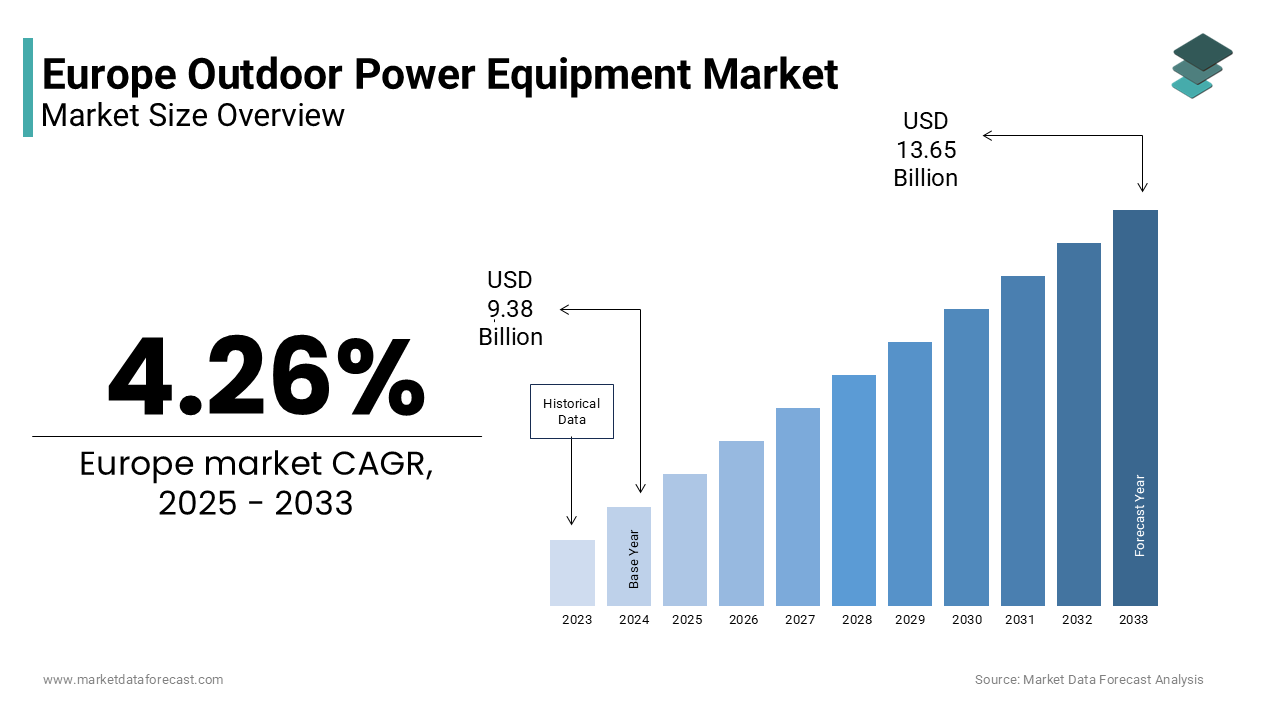
4.26%Europe Outdoor Power Equipment Market Size
The Europe outdoor power equipment market size was valued at USD 9.80 billion in 2025 and is projected to reach USD 14.27 billion by 2034 from USD 10.22 billion in 2026, growing at a CAGR of 4.26%.
Outdoor power equipment are motorized tools and machinery used for landscaping grounds maintenance and agricultural support, including lawn mowers, chainsaws, leaf blowers and brush cutters powered by internal combustion engines battery systems or hybrid configurations. This sector is undergoing a structural transformation driven by the European Green Deal’s decarbonization mandates and urbanization trends that intensify demand for efficient and low emission maintenance solutions. Unlike in other regions where commercial landscaping dominates Europe’s market is characterized by a high share of residential and municipal usage supported by strong gardening traditions and public green space policies. According to Eurostat, housing statistics show that a significant share of EU households has access to private outdoor spaces such as gardens or balconies. As per the European Environment Agency, urban green spaces account for an average of around 18% of city land across EU capitals, with cities such as Vienna and Oslo exceeding 30%. This cultural and spatial context creates consistent demand for user-friendly equipment, while stringent noise and emissions regulations, such as the EU’s Stage V engine standards for non-road mobile machinery accelerate the shift toward electrified and battery-powered alternatives and reshaping product design innovation and supply chain dynamics across the continent.
MARKET DRIVERS
Stringent Emission and Noise Regulations Under EU Stage V Standards
The European Union’s Stage V emission standards for nonroad mobile machinery, which is fully enforceable from 2025 have become a pivotal driver accelerating the adoption of batterypowered outdoor equipment across residential and municipal segments. These regulations impose strict limits on particulate matter and nitrogen oxide emissions, effectively phasing out many small twostroke gasoline engines commonly used in chainsaws and leaf blowers. According to the European Commission, hundreds of thousands of noncompliant units were removed from the EU market in 2025 through customs enforcement and retailer recalls. Municipalities have responded decisively. According to the European Green Cities Network, a majority of member cities including Paris, Berlin, and Helsinki have banned gasolinepowered equipment for public park maintenance by 2026. This regulatory pressure has compelled manufacturers to fasttrack electrification. STIHL introduced dozens of new batterypowered models in 2025, while Husqvarna expanded its EPOS fleet program for silent and zeroemission municipal operations. According to the projections of the European Environment Agency, compliance with Stage V will reduce urban particulate emissions from small engines significantly by 2027, which is making regulatory alignment not just a legal obligation but a competitive necessity. Stage V standards are accelerating electrification, embedding battery equipment into municipal and residential markets.
Rising Urban Green Space Maintenance Demands Amid Climate Adaptation Policies
European cities are expanding and intensifying green space maintenance as part of climate resilience strategies, which is leading to increased procurement of efficient outdoor power equipment and significantly contributing to the expansion of the European outdoor power equipment market. Urban forestry initiatives aimed at combating heat islands and improving air quality have significantly raised the workload for municipal landscaping teams. According to the European Urban Initiative, more than 200 cities committed in 2025 to plant millions of trees by 2030, requiring sustained use of brush cutters, stump grinders, and mulching equipment. Extreme weather events, such as the summer 2023 storms in Belgium and Germany, generated unprecedented volumes of fallen timber, which is demanding for rapid deployment of highcapacity chainsaws and chippers. As per the European Forest Fire Information System, a marked increase in urban forest debris removal operations in 2025 compared to the previous fiveyear average. This operational surge has driven demand for professionalgrade battery equipment that offers both emissions compliance and high torque performance. Companies like EGO and Greenworks responded with commercialgrade 56volt and 80volt platforms capable of matching gasoline equivalents in runtime and power. Climate adaptation policies are transforming outdoor power equipment from seasonal tools into yearround essential infrastructure.
MARKET RESTRAINTS
High Upfront Cost of Advanced BatteryPowered Equipment for Residential Users
Despite longterm savings, the initial purchase price of highperformance batterypowered outdoor equipment remains a significant barrier for European households, particularly in Southern and Eastern Europe where disposable income is lower. According to the European Consumer Organisation, premium batterypowered lawn mowers cost more than double comparable gasoline models. Similarly, professionalgrade battery chainsaws retail at significantly higher prices than gasoline alternatives. This price gap stems from expensive lithiumion battery packs, which account for a large share of total unit cost. Fraunhofer ISI notes that batteries typically represent 40–60% of equipment cost. While total cost of ownership over five years favors electric models due to lower maintenance and fuel expenses, most consumers make purchasing decisions based on upfront outlay. As per a 2025 survey by GfK across multiple EU countries, a majority of homeowners delayed upgrading to battery equipment due to cost concerns, with higher reluctance in Italy and Spain. Until battery costs decline through scale or subsidy programs, affordability will constrain mass residential adoption.
Limited Battery Runtime and Interchangeability Across Brands
The lack of standardized battery platforms and insufficient runtime for large property maintenance continues to hinder the full transition to batterypowered outdoor equipment in Europe, which is further hindering the outdoor power equipment market growth in Europe. Most manufacturers use proprietary battery systems, preventing crossbrand compatibility and forcing consumers to remain within a single ecosystem. According to the European Association of Garden Machinery, most battery tools sold in 2025 operated on brandspecific voltage architectures. This fragmentation increases longterm costs as users cannot share batteries across lawn mowers, hedge trimmers, and leaf blowers from different brands. Runtime limitations remain acute: the German Consumer Protection Agency found that only a minority of battery mowers tested in 2025 could cut lawns larger than 600 square meters on a single charge, which is below the European average garden size of 720 square meters (Eurostat). Although fastcharging and dualbattery systems help, these solutions add weight and complexity, deterring elderly or casual users. Without industrywide battery standardization or breakthroughs in solidstate energy density, functional constraints will sustain demand for gasoline models in large property and professional segments.
MARKET OPPORTUNITIES
Expansion of Municipal Equipment Leasing and Sharing Programs
European cities are pioneering public access models that overcome ownership barriers and accelerate clean equipment adoption through shared infrastructure, which is a promising opportunity in the European outdoor power equipment market. Instead of individual purchases, municipalities are deploying community tool libraries and commercial leasing fleets powered by zeroemission equipment. Amsterdam’s Green Tools program offers residents free weekly rentals of batterypowered hedge trimmers, leaf blowers, and lawn mowers from neighbourhood hubs to reduce private ownership needs while ensuring compliance with local noise ordinances. According to the Covenant of Mayors for Climate and Energy, more than 100 cities across the EU launched similar initiatives in 2025, serving millions of households. On the commercial side, Husqvarna’s EPOS program leases fully maintained batterypowered fleets to landscaping contractors with payperuse billing, reducing capital expenditure and simplifying compliance with municipal lowemission zone requirements. The European Federation of Public Service Unions notes that such models have increased municipal equipment utilization rates while cutting fleet CO₂ emissions significantly. Servicebased access models expand market reach, align with circular economy principles, and optimize resource use.
Integration of Smart Features and Connectivity for Precision Landscaping
A highgrowth opportunity lies in embedding digital intelligence into outdoor power equipment to enable precision maintenance and datadriven landscaping. Manufacturers are equipping mowers and trimmers with GPS mapping, obstacle detection, and usage analytics that optimize cutting patterns and reduce energy consumption. Bosch’s Indego S+ robotic mower, for instance, uses satelliteassisted navigation to cover complex gardens with high accuracy while generating soil health reports via its companion app. According to the European Smart Home Observatory, connected outdoor devices in European homes grew sharply in 2025, with hundreds of thousands activated, which is a doubledigit yearonyear increase. Municipalities are also adopting smart equipment. Copenhagen uses sensorequipped battery mowers that adjust cutting height based on grass growth data collected from municipal weather stations. The European Institute of Innovation and Technology has funded multiple projects under its Urban Green Tech initiative to develop AIpowered equipment that minimizes plant stress and water use. Intelligent systems transform outdoor power tools into environmental management platforms, which is creating new revenue streams through software and data services while supporting EU biodiversity and water conservation goals.
MARKET CHALLENGES
Fragmented National Safety Certification and Training Requirements
A persistent challenge arises from divergent national regulations governing the safe operation and certification of professional outdoor power equipment across EU member states. While the Machinery Regulation (EU) 2023/1230 establishes baseline safety requirements, individual countries impose additional operator training and certification mandates that complicate crossborder labor mobility and equipment deployment. According to the European Agency for Safety and Health at Work, Germany requires BGHM certification for chainsaw use, while France mandates the Certibruit license for equipment exceeding 80 decibels. These discrepancies force companies to maintain multiple training programs, increasing administrative costs. According to the estimations of the European Landscaping Association, fragmented requirements raise compliance costs significantly. Moreover, languagespecific safety labeling and manual requirements delay product launches. As per a 2025 study by CEMA, certification timelines varied widely across member states, from a few weeks in some countries to several months in others. Regulatory fragmentation undermines the EU’s single market principle and discourages SMEs from expanding services beyond national borders despite growing demand for transnational green space maintenance.
EndofLife Management and Battery Recycling Infrastructure Gaps
The rapid shift to batterypowered equipment has exposed critical deficiencies in Europe’s waste management systems for handling endoflife lithiumion batteries from outdoor tools, which is further challenging the expansion of the European market. Unlike consumer electronics, which benefit from established takeback schemes, outdoor power equipment often falls outside standard collection streams due to its size, weight, and classification as professional machinery. According to the European Recycling Platform, fewer than half of lithiumion batteries from garden tools were properly recycled in 2025, with many ending up in mixed waste or informal repair shops. The issue is exacerbated by complex battery pack designs that require manual disassembly before recycling, which is a process few facilities are equipped to handle. According to the research of the Fraunhofer Institute, only a limited number of specialized recycling centers in Europe could process outdoor equipment batteries at scale in 2025. Although the EU Battery Regulation mandates extended producer responsibility from 2026, most manufacturers lack reverse logistics networks for bulky tools. Until dedicated collection points and standardized battery designs are implemented, the environmental benefits of electrification will be partially offset by improper disposal and resource loss, contradicting circular economy objectives.
REPORT COVERAGE
| REPORT METRIC | DETAILS |
| Market Size Available | 2025 to 2034 |
| Base Year | 2025 |
| Forecast Period | 2026 to 2034 |
| CAGR | 4.26% |
| Segments Covered | By Type, Power Source, Sales Channel, Application, and Region |
| Various Analyses Covered | Global, Regional, & Country Level Analysis; Segment-Level Analysis; DROC, PESTLE Analysis; Porter’s Five Forces Analysis; Competitive Landscape; Analyst Overview of Investment Opportunities |
| Regions Covered | UK, France, Spain, Germany, Italy, Russia, Sweden, Denmark, Switzerland, Netherlands, Turkey, and the Czech Republic |
| Market Leaders Profiled | ANDREAS STIHL AG & Co. KG., Deere & Company, Honda Motor Co., Ltd., Husqvarna AB, Techtronic Industries Co. Ltd., MTD Products Inc., STIGA S.p.A., The Toro Company, Ariens Company, and YAMABIKO Corporation |
SEGMENTAL ANALYSIS
By Type Insight
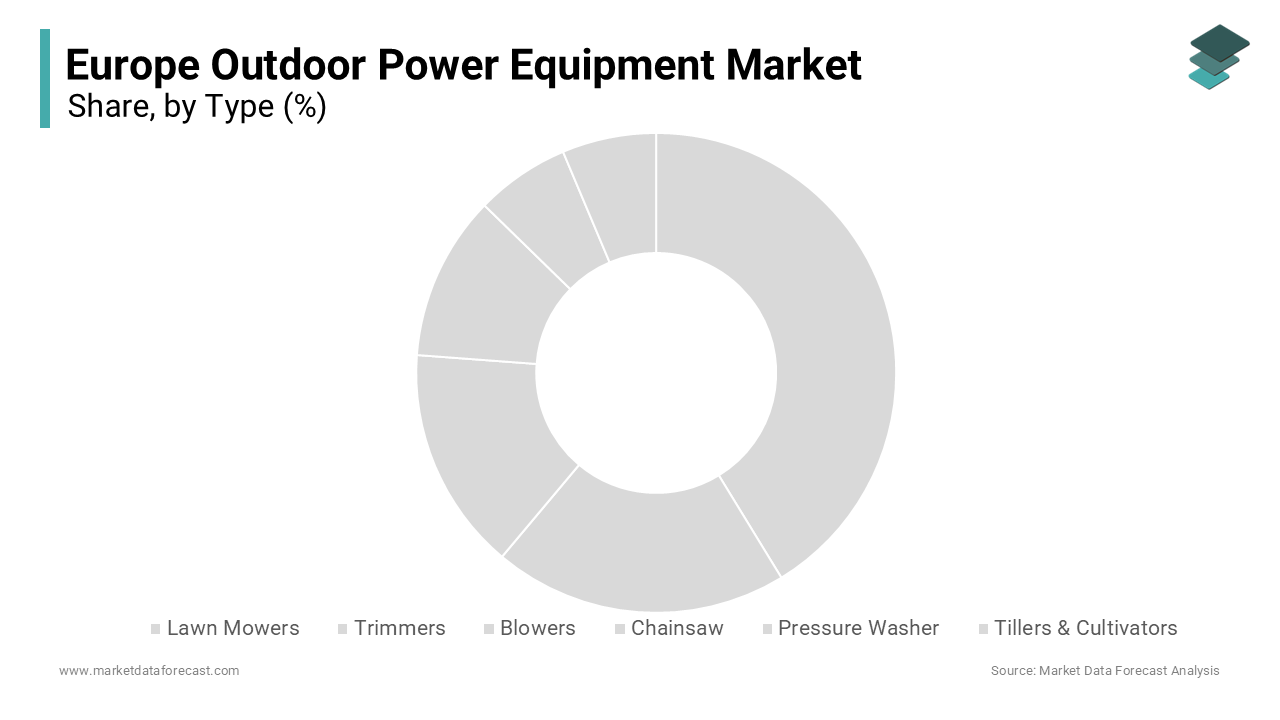
The lawn mowers segment accounted for 35.6% of the European outdoor power equipment market share in 2025. The dominance of lawn mowers segment in this regional market is majorly driven by the cultural and regulatory importance of private and public green space maintenance across the continent. Garden ownership is deeply embedded in European lifestyle, with over 92 million households tending private lawns or green balconies, as per Eurostat 2025 data. In countries like the United Kingdom and Germany, more than 55% of detached homes feature lawns exceeding five hundred square meters, which is requiring regular mowing. Simultaneously, municipal mandates reinforce demand: the European Environment Agency reports that 83% of EU cities enforce strict aesthetic or ecological standards for public park lawns, requiring weekly cutting during growing seasons. This dual residential and institutional need sustains consistent equipment utilization. Manufacturers like Husqvarna and STIHL have responded with segmented offerings to ensure product relevance across use cases. The result is a resilient demand base less susceptible to economic cycles due to the non-discretionary nature of lawn upkeep.
The robotic mowers segment is estimated to grow at a CAGR of 18.2% over the forecast period in this regional market owing to the aging demographics, urban noise restrictions, and smart home integration. Europe’s rapidly aging population creates strong demand for low effort lawn solutions. Manual mowing becomes physically challenging, while hiring services is costly and faces labor shortages. According to the European Federation of Landscaping Professionals, a 17% decline in available gardening labor between 2020 and 2025 due to demographic and migration trends. Robotic mowers address this gap by enabling autonomous maintenance with minimal user intervention. In Germany and Sweden over 40% of robotic mower buyers in 2025 were aged sixty or above, as confirmed by GfK consumer panels. Municipalities are also adopting them for small public plots. The City of Utrecht deployed fifty robotic units in neighbourhood parks in 2025 to reduce labor costs by 35% while maintaining consistent grass height. This demographic and operational push ensures sustained adoption beyond early tech adopters.
By Power Source Insight
The battery powered equipment segment led the market by holding 46.4% of the European market share in 2025. The dominance of battery powered equipment segment in this regional market is attributed to the regulatory phase outs of small gasoline engines and advances in lithium-ion technology. The European Union’s Stage V standards which fully applied to small non road engines from January 2025 effectively banned most two stroke gasoline models used in leaf blowers trimmers and chainsaws. According to the European Commission, over 750,000 non-compliant units were barred from import or sale in 2025. Municipalities responded by mandating battery equipment for all public green space work. According to the European Green Cities Network, 82% of member cities implemented such bans by mid-2025. This regulatory shift forced both consumers and professionals to transition. Battery platforms from EGO Greenworks and STIHL now offer runtime and torque parity with gasoline in most applications, removing performance objections. As per the estimations of the European Environment Agency, this transition will cut urban particulate matter from small engines by 45% by 2027 making battery power not optional but mandatory for market access.
The battery powered remains the fastest growing power source and is expected to witness a CAGR of 15.4% over the forecast period due to expanding voltage platforms and circular economy incentives. Manufacturers are launching eighty volt and 100-volt systems specifically for commercial landscapers who previously relied on gasoline for heavy duty tasks. In 2025, EGO introduced its Commercial Series with a 100-volt brush cutter delivering 65 newton meters of torque, which is comparable to fifty cc gasoline models. According to the European Landscaping Association over 35% of professional contractors purchased their first battery powered commercial tool in 2025, primarily driven by municipal zero emission procurement policies. Husqvarna’s T540i XP battery chainsaw achieved certification for professional forestry use in Sweden and Germany after demonstrating equivalent cut speed to 52cc gasoline equivalents. This performance parity removes the last barrier to professional adoption. With over two hundred thousand landscaping firms in the EU facing low emission zone restrictions, high voltage battery platforms are rapidly replacing gasoline across the commercial segment.
By Sales Channel Insight
The e-commerce segment is growing exponentially and is likely to expand at a CAGR of 15.04% over the forecast period owing to the growing digital adoption and specialized online retailers. While general marketplaces like Amazon offer outdoor tools dedicated online retailers such as ManoMano in France and GreenShop in the Netherlands provide superior product expertise logistics and after sales support. According to the European E Commerce Association, these specialized platforms grew their outdoor power equipment sales by 42% in 2025 compared to 28% for generalists. They offer features such as virtual garden planners battery compatibility checkers and live chat with horticulture experts to enhance purchase confidence for technical products. ManoMano’s “Click and Pick” service allows customers to order online and collect from local partner stores within two hours reducing delivery emissions and wait times. This hybrid model combines digital convenience with local presence addressing key barriers to online tool purchases. As broadband penetration reaches 98% across the EU and digital literacy improves among older demographics e commerce is poised to capture an increasing share of both residential and professional buyers.
By Application Insight
The residential DIY segment led the market and held 60.5% of the European market share in 2025 due to Europe’s strong gardening culture and high homeownership rates in suburban and rural areas. Gardening is deeply rooted in European identity with national traditions from English cottage gardens to French potagers. According to the European Garden Heritage Network, over 68% of European homeowners consider garden maintenance a weekly essential activity. In Germany and the Netherlands homeowner associations often enforce lawn standards, creating social pressure for regular upkeep. Eurostat data shows that 79% of single-family homes in the EU have private outdoor space requiring mowing trimming or blowing. This cultural norm drives consistent equipment purchases independent of economic fluctuations. Even in urban areas balcony gardening with small trimmers and mini mowers is rising. As per the European Urban Initiative, a 29% increase in micro green space tools sold in cities like Barcelona and Berlin in 2025. This grassroots demand ensures the residential segment remains the market’s backbone.
REGIONAL ANALYSIS
Germany Outdoor Power Equipment Market Analysis
Germany dominated the market in Europe in 2025 by occupying 22.8% of the regional market share. The dominance of Germany in the European outdoor power equipment market is attributed to the high homeownership rates, strict environmental regulations, and engineering excellence. According to the Federal Statistical Office (Destatis), 62% of German households own singlefamily homes with gardens, which directly sustains consistent residential demand for lawn and garden equipment. The Technical Inspection Association (TÜV) enforces Stage V emission standards and noise limits below 65 decibels, pushing manufacturers toward battery innovation and ensuring compliance drives product upgrades. The Federal Ministry for Economic Affairs allocated €95 million in 2025 to help landscaping SMEs transition to electric equipment, showing how subsidies accelerate adoption. Germany’s dual vocational system trains over 12,000 garden machinery technicians annually, ensuring strong aftersales service capacity that supports longterm market growth. Justification: Each of these statistics highlights how Germany’s regulatory rigor, consumer base, and skilled workforce reinforce its leadership in sustainable outdoor equipment.
United Kingdom Outdoor Power Equipment Market Analysis
The United Kingdom captured the second largest share of the European outdoor power equipment market in 2025. The growth of the UK in the European market is driven by its gardening heritage and extensive public green infrastructure. According to the Office for National Statistics (ONS), 85% of UK homes have private gardens, which underpins high household demand for garden tools. The Royal Horticultural Society (RHS) reported in 2025 that 73% of British adults engage in weekly garden maintenance, showing how cultural habits translate into equipment ownership. The UK government’s Levelling Up Parks Fund allocated £600 million in 2025 to restore urban green spaces, creating institutional demand for professionalgrade tools. London’s Ultra Low Emission Zone restrictions on gasoline tools in public parks further accelerate municipal adoption of battery models. Justification: These figures demonstrate how cultural passion for gardening, combined with policy investment, sustains the UK’s highvolume market.
France Outdoor Power Equipment Market Analysis
France is anticipated to command for a promising share of the European outdoor power equipment market over the forecast period owing to the aggressive public procurement and consumer incentives. The French Ministry of Ecological Transition mandated in 2023 that all municipal green space equipment must be zeroemission by 2026, leading cities like Lyon and Marseille to replace over 25,000 gasoline tools with battery alternatives in 2025. The Ma Prime Rénov’ Vert program offers households up to €250 for trading in polluting mowers, facilitating over 150,000 exchanges in 2025 according to ADEME, which shows how subsidies directly boost household adoption. France’s “jardin potager” tradition ensures strong residential demand, particularly in rural regions where property sizes exceed 1,000 square meters, creating larger maintenance needs. Justification: These statistics highlight how France’s subsidy programs and cultural gardening traditions combine to accelerate electrification and market expansion.
Sweden Outdoor Power Equipment Market Analysis
Sweden is predicted to grow at a prominent CAGR in the European outdoor power equipment market during the forecast period. Sweden is leading in professional and municipal adoption of battery tools. The Swedish Environmental Protection Agency reported that over 90% of landscaping contracts in 2025 required zeroemission tools, showing how procurement rules directly drive demand. Husqvarna’s battery snow blowers and STIHL’s coldweather chainsaws are engineered to operate at –20°C, proving how climate conditions shape product innovation. Statistics Sweden (SCB) confirms that landscaping labor costs average €42 per hour, making robotic mowers economically attractive for municipalities and private users. The Swedish Energy Agency provided €40 million in 2025 grants for charging infrastructure, ensuring operational feasibility for largescale adoption. Extended producer responsibility laws guarantee over 80% of outdoor tool batteries are recycled, reinforcing sustainability. Justification: Each statistic shows how Sweden’s climate, labor economics, and sustainability policies converge to create a highintegrity growth market.
Netherlands Outdoor Power Equipment Market Analysis
The Netherlands is projected to account for a noteworthy share of the European outdoor power equipment market during the forecast period owing to the excellence of Netherlands in urban gardening and digital retail innovation. According to Statistics Netherlands (CBS), over 70% of households maintain balcony or rooftop gardens, which drives demand for compact trimmers and robotic mowers suited to small spaces. Amsterdam’s 2023 noise ordinance restricting tool use to 9 AM–7 PM weekdays have accelerated adoption of sub60 decibel battery models, showing how urban regulation shapes product design. The Dutch Ecommerce Foundation reported 89% penetration for garden tools in 2025, with platforms offering sameday delivery and rental subscriptions, proving how digital retail expands accessibility. Additionally, over 60% of outdoor power equipment sold in Belgium and Luxembourg is distributed from Dutch warehouses, highlighting the Netherlands’ role as a logistics hub. Justification: These statistics illustrate how urban adaptation, ecommerce penetration, and logistics integration make the Netherlands a trendsetter in compact and smart outdoor equipment.
COMPETITIVE LANDSCAPE
Competition in the Europe outdoor power equipment market is defined by a race toward sustainable innovation rather than price competition alone. Leading manufacturers differentiate through battery performance noise reduction smart features and regulatory compliance with EU environmental directives. The market features a clear divide between premium engineering focused brands and value-oriented players yet even mid-tier companies are compelled to electrify due to legal mandates. Collaboration is increasingly common as OEMs partner with municipalities energy providers and recycling organizations to build end to end ecosystems encompassing sales charging infrastructure and battery take back. Professional and residential segments demand distinct solutions yet both prioritize ease of use low maintenance and environmental credentials. Unlike global markets where gasoline equipment remains dominant Europe’s regulatory foresight has created a high trust environment where technological leadership and ecological responsibility are the primary drivers of competitive advantage ensuring that only the most advanced and compliant players thrive.
KEY MARKET PLAYERS
Some of the notable key players in the Europe outdoor power equipment market are
- ANDREAS STIHL AG & Co. KG.
- Deere & Company
- Honda Motor Co., Ltd.
- Husqvarna AB
- Techtronic Industries Co. Ltd.
- MTD Products Inc.
- STIGA S.p.A.
- The Toro Company
- Ariens Company
- YAMABIKO Corporation
Top Players in the Market
- Husqvarna AB is a Swedish multinational and a global pioneer in outdoor power equipment with deep roots in the European market. The company offers a comprehensive portfolio spanning robotic mowers battery powered chainsaws and professional landscaping systems under brands such as Husqvarna Gardena and Kress. Husqvarna has been instrumental in advancing battery electrification through its EPOS fleet management platform which enables commercial landscaping contractors to lease and monitor zero emission equipment on a pay per use basis. In 2025 the company expanded its robotic mower production in Sweden and launched its T540i XP battery chainsaw certified for professional forestry use in Germany and Austria. Husqvarna’s global influence extends through its sustainability leadership aligning product development with the EU Green Deal and exporting European regulatory compliant solutions to North America and Asia.
- STIHL is a German manufacturer renowned for its high-performance outdoor power tools and a dominant force in both professional and residential segments across Europe. The company produces a full range of battery powered equipment including brush cutters chainsaws and lawn mowers under its AK AP and MGA platforms known for interchangeable batteries and rugged reliability. STIHL has accelerated its electrification strategy by investing over two hundred million euros in 2025 to expand battery pack assembly at its Waiblingen headquarters. The firm also launched 23 new battery models compliant with EU Stage V emission standards reinforcing its commitment to sustainable innovation. STIHL’s global distribution network spans more than one hundred sixty countries and its European engineered products set global benchmarks for durability safety and emissions compliance particularly in forestry and municipal applications.
- Robert Bosch GmbH contributes significantly to the Europe outdoor power equipment market through its Bosch and Gardena brands which specialize in smart connected garden solutions for residential users. The company integrates its expertise in sensors connectivity and battery technology to deliver robotic mowers smart irrigation systems and app-controlled trimmers that align with European smart home and noise reduction policies. In 2025 Bosch enhanced its Indego robotic mower series with satellite assisted navigation and weather adaptive mowing schedules improving precision on complex lawns. The firm also expanded its 36 volt and 40-volt battery platforms to ensure compatibility across garden tools. Bosch leverages its global R&D infrastructure to deploy Europe developed sustainable gardening technologies in markets worldwide promoting circular design and user centric automation as core pillars of modern outdoor equipment.
Top Strategies Used by the Key Market Participants
Key players in the Europe outdoor power equipment market prioritize full electrification of product portfolios to comply with EU Stage V emission standards and municipal zero emission procurement policies. They invest heavily in high voltage battery platforms that deliver gasoline comparable performance for professional users while maintaining quiet operation. Companies develop integrated ecosystems with interchangeable batteries and smart connectivity to increase customer loyalty and reduce total cost of ownership. Strategic expansion of robotic and autonomous solutions addresses labor shortages and aging demographics across European households. Additionally, firms collaborate with municipalities and landscaping associations to co design service-based models such as equipment leasing and shared tool libraries that align with circular economy principles and public sustainability goals.
MARKET SEGMENTATION
This research report on the Europe outdoor power equipment market has been segmented and sub-segmented based on categories.
By Type
- Lawn Mowers
- Walk-behind Mowers
- ZTR Mowers
- Riding Mower
- Robotic Mower
- Lawn & Garden Tractor
- Trimmers
- Hedge Trimmer
- Brush Cutter & Trimmer
- Edge Trimmer/Edger
- Others
- Blowers
- Snow Blower
- Leaf Blower
- Chainsaw
- Pressure Washer
- Tillers & Cultivators
- Others
By Power Source
- Gasoline Powered
- Battery Powered
- Electric Motor/Corded
By Sales Channel
- E-commerce
- Direct Purchase
By Application
- Residential/DIY
- Commercial
By Country
- UK
- France
- Spain
- Germany
- Italy
- Russia
- Sweden
- Denmark
- Switzerland
- Netherlands
- Turkey
- Czech Republic
- Rest of Europe