- Product Description Description
- Table of Contents TOC
- List of Table & Figure LOT
- Get Free Sample PDF Sample PDF
Market Size, 2025
$1.15 BnMarket Estimate, 2026
$1.25 BnMarket Forecast, 2034
$2.29 BnCAGR, 2026–2034
7.9%Executive Summary: Europe Pain Management Devices Market
- Market Scope: Comprehensive regional analysis of the European pain management devices market covering device types, clinical applications, purchase modes, regulatory compliance under the EU MDR, and country-level adoption frameworks.
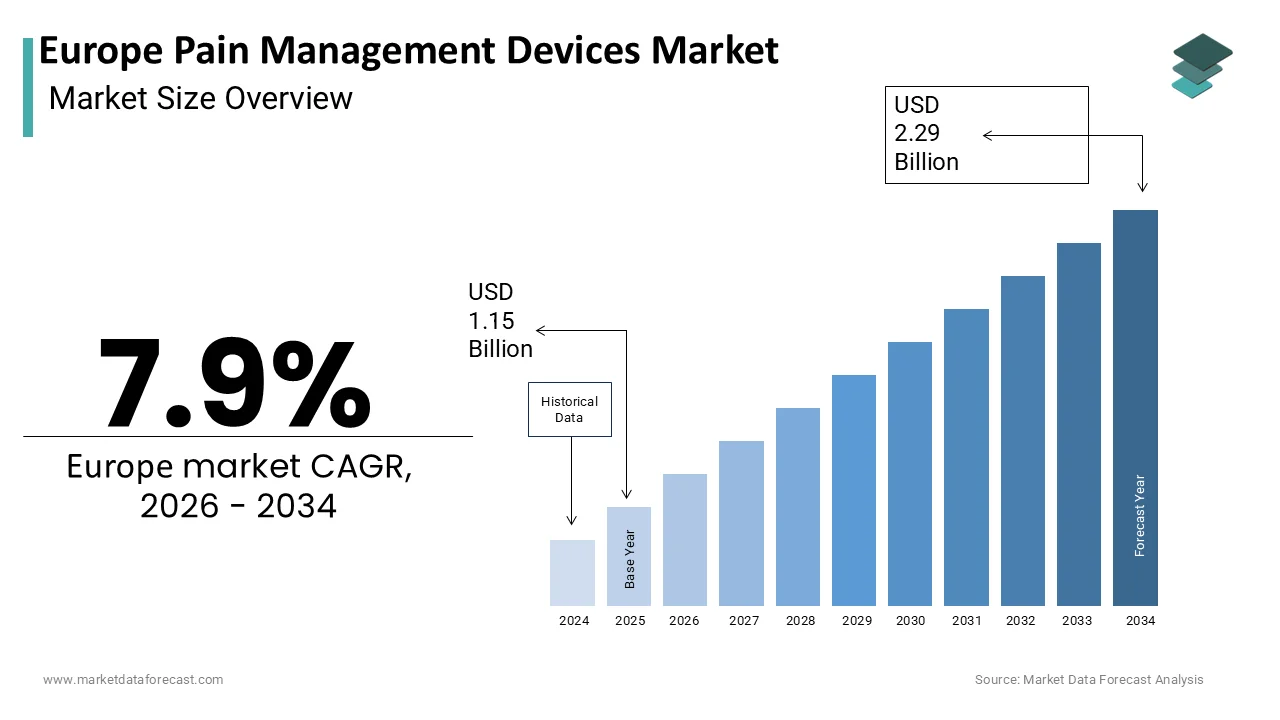
- Market Valuation & Forecast: Valued at USD 1.15 billion in 2025, estimated at USD 1.25 billion in 2026, and projected to reach USD 2.29 billion by 2034, registering a steady compound annual growth rate (CAGR) of 7.9% from 2026 to 2034.
- Primary Growth Drivers: High prevalence of chronic and neuropathic pain conditions among aging European populations, accelerated adoption of minimally invasive surgical procedures, and a strong clinical shift toward non-opioid, multimodal analgesia. Counterbalancing restraints include stringent EU MDR approval pathways and inconsistent reimbursement policies across member states.
Key Europe Pain Management Devices Market Segment Metrics (2026–2034)
| Category | Leading Segment (2025 Position) | Fastest-Growing Segment |
|---|---|---|
| By Device Type | Neurostimulation Devices (held a dominant 48.2% share in 2025 due to proven efficacy in managing refractory chronic and neuropathic pain) | Ablation Devices (projected to witness the fastest growth at a 9.2% CAGR driven by expanding radiofrequency applications in joint and musculoskeletal pain) |
| By Application | Neuropathic Pain (accounted for a leading 35.4% share in 2025 anchored by high clinical prevalence and limited systemic medication efficacy) | Cancer Pain (expected to exhibit an 8.7% CAGR owing to rising oncology caseloads and the adoption of implantable intrathecal infusion pumps) |
| By Mode of Purchase | Prescription-Based Purchase (captured the largest share in 2025 due to Class IIb/III device classifications requiring rigorous physician oversight) | Counter Purchase (predicted to grow at a 7.4% CAGR fueled by consumer demand for wearable TENS units and home-based self-care tech) |
| By Country / Region | Germany (dominated with a 22.5% share in 2025 backed by robust healthcare infrastructure, comprehensive statutory reimbursement, and certified pain clinics) | France & Spain (emerging as dynamic high-growth markets supported by centralized health policies, regional decentralization, and expanding non-opioid initiatives) |
Major Europe Pain Management Devices Market Players & Competitive Landscape
Market Structure: Highly competitive regional market dominated by multinational medical technology leaders and specialized firms competing intensely on closed-loop neurostimulation technology, waveform innovation, digital health telemetry integration, and rigorous EU MDR regulatory compliance.
Key Industry Companies: Medtronic plc, Boston Scientific Corporation, Abbott Laboratories, St. Jude Medical, Inc., Baxter International, Stryker Corporation, Pfizer, Codman and Shurtleff, B. Braun Melsungen AG, and DJO Global LLC.
Europe Pain Management Devices Market Size
The Europe Pain Management Devices Market is projected to grow from USD 1.15 billion in 2025 to USD 1.25 billion in 2026 and reach USD 2.29 billion by 2034, registering a CAGR of 7.9% during the forecast period from 2026 to 2034
Pain management devices refer to the medical technologies engineered to alleviate acute and chronic pain through non-pharmacological or minimally invasive interventions. These include neurostimulation systems, radiofrequency ablation devices, analgesic infusion pumps, and transcutaneous electrical nerve stimulation units. Pain affects a substantial segment of the European population, with chronic pain alone afflicting approximately one in five adults across the region, as per the European Federation of IASP Chapters. The burden is particularly severe among the elderly, who constitute a notable share of the total population in the European Union. Rising comorbidities such as osteoarthritis, cancer, and neuropathic disorders further amplify the clinical need for effective pain control solutions. National health systems across Europe increasingly recognize the socioeconomic toll of untreated pain, leading to lost productivity, disability claims, and diminished quality of life, prompting policy attention and reimbursement reviews. Demand is intensifying for devices that offer targeted therapy with fewer systemic side effects compared to traditional analgesics, as healthcare delivery shifts toward outpatient settings and patient-centric models. This evolving clinical and regulatory context defines the strategic landscape for pain management technologies in Europe.
MARKET DRIVERS
Accelerated Adoption of Minimally Invasive Surgical Techniques Fuels Device Utilization
The broad integration of minimally invasive surgical procedures across European hospitals has substantially expanded the clinical indications for advanced pain management devices. This accelerates the growth of the Europe pain management devices market. As per sources, Surgical procedures in Western Europe are increasingly being performed with laparoscopic or robotic assistance. These approaches, while reducing tissue trauma, still generate postoperative pain necessitating effective management protocols beyond opioids. Enhanced recovery after surgery pathways frequently integrate neurostimulation and local anesthetic infusion systems. The incorporation of peripheral nerve blocks or patient-controlled analgesia pumps results in reduced postoperative opioid consumption. Multimodal analgesia is endorsed by guidelines to minimize opioid-related adverse events, as per studies. This clinical prioritization of non-opioid alternatives directly drives procurement and utilization of device-based pain therapies across surgical specialties.
Rising Prevalence of Chronic Pain Conditions Across Age Groups
Rising prevalence of chronic pain conditions across age groups fuels the expansion of the European pain management devices market. Chronic pain has emerged as a pervasive public health issue in Europe millions of adults, according to research. This burden is disproportionately concentrated among older demographics, with a share of individuals aged 65 and above reporting persistent musculoskeletal or neuropathic pain. Degenerative spinal disorders account for a notable share of chronic pain cases in countries. Moreover, cancer-related pain remains a critical concern. Neuropathic pain syndromes linked to diabetes, a condition affecting millions of Europeans, further compound demand for neuromodulation therapies. National pain strategies in countries mandate access to multidisciplinary pain clinics where device-based interventions are routinely evaluated. This epidemiological reality, coupled with heightened patient expectations for functional restoration rather than mere symptom suppression, continues to catalyze investment in durable and implantable pain management solutions across European healthcare systems.
MARKET RESTRAINTS
Stringent Regulatory Approval Pathways Delay Market Entry
The European Union’s transition to the Medical Device Regulation framework has significantly extended the time required for novel pain management devices to achieve authorization, which in turn impedes the growth of the European pain management devices market. This extended timeline stems from heightened clinical evidence requirements, including post-market surveillance plans and comprehensive risk management documentation. Moreover, notified bodies remain limited in capacity. Only a few designated entities are authorized to evaluate high-risk devices across the entire EU. These constraints particularly hinder small and medium-sized enterprises, which lack the regulatory infrastructure to navigate complex submissions. The financial implications are substantial,with compliance costs increasing. As a result, market entry for next-generation technologies such as closed-loop neurostimulators or wearable analgesic delivery platforms is often delayed by two to three years relative to the United States. This regulatory friction suppresses innovation velocity and restricts patient access to clinically superior alternatives.
Inconsistent Reimbursement Policies Across Member States Limit Adoption
Reimbursement heterogeneity across European healthcare systems is a barrier to the uniform deployment of advanced devices for managing pain, which has negatively impacted the European pain management devices market. In Germany and France implantable neurostimulation systems benefit from well defined diagnosis related group codes enabling predictable hospital reimbursement yet in Southern and Eastern European countries such as Greece and Romania these technologies often lack dedicated funding pathways. According to a study, few EU member states provide national coverage for radiofrequency ablation in chronic low back pain despite its endorsement in clinical guidelines. This fragmentation forces manufacturers to undertake country-specific health technology assessments, which can cost a notable amount per jurisdiction. Consequently, hospitals in under resourced regions frequently defer adoption due to budgetary uncertainty. Even in nations with favorable policies, procedural volumes remain constrained by annual budget ceilings, which cap the number of implantations per facility. Such financial gatekeeping not only restricts patient access but also discourages clinical training and service line development necessary to sustain long term device integration.
MARKET OPPORTUNITIES
Integration of Digital Health Platforms Enables Remote Pain Monitoring
The convergence of connected health technologies is opening new care delivery models in the region, which offer fresh opportunities for the growth of the European pain management devices market. As per sources, most new neurostimulation systems in the European market include embedded telemetry for remote therapy adjustment by clinicians. These functions support a European initiative that prioritizes remote patient monitoring to help manage chronic disease and reduce hospital visits. The Netherlands uses integrated pain platforms connecting wearable sensors with medical records in many academic centers. Moreover, the European Network for Health Technology Assessment has recognized digitally enabled analgesic pumps as cost-effective interventions for home-based cancer pain management, reducing outpatient visits. These digital augmentations not only enhance clinical outcomes but also generate real-world evidence to support future regulatory and reimbursement submissions, thereby accelerating market maturation.
Expansion of Outpatient and Ambulatory Care Settings Drives Portable Device Innovation
The region’s strategic shift toward decentralized care delivery is causing demand for portable and user administered pain management solutions, which is setting up new prospects for the expansion of the Europe pain management devices market. As per research, a portion of all surgical procedures in the EU were conducted in ambulatory settings, which reflects national policies aimed at containing inpatient costs. This transition necessitates compact analgesic delivery systems that support rapid discharge without compromising pain control. Wearable elastomeric infusion pump, for instance, saw an increase in prescriptions across private surgical clinics. Similarly, transcutaneous electrical nerve stimulation units. National health agencies have updated coverage criteria to include these devices in post-discharge care bundles for orthopedic and oncologic procedures. This policy alignment, combined with patient preference home-based therapy, creates a fertile environment for next-generation ambulatory pain technologies. Manufacturers are responding with miniaturized form factors extended battery life and multilingual user interfaces tailored to Europe’s linguistic diversity.
MARKET CHALLENGES
Persistent Shortage of Specialized Pain Clinicians Constrains Device Utilization
A deficit in healthcare professionals trained in interventional pain management challenges the growth of the European pain management devices market. This scarcity is most acute in Eastern and Southern member states, where national training programs remain underdeveloped. Consequently, multidisciplinary pain clinics operate below capacity even when devices are available and reimbursed. The human capital gap directly impedes the adoption of complex technologies such as the dorsal root ganglion stimulator, which require precise anatomical targeting and post-implant programming expertise. Hospitals often delay procurement decisions, anticipating staffing limitations. The full therapeutic potential of advanced devices will remain unrealized across significant portions of the European market until national medical education frameworks prioritize pain as a distinct specialty.
High Upfront Costs and Limited Long-Term Budget Allocation Hinder Institutional Investment
The capital intensity associated with acquiring and maintaining advanced systems poses a persistent financial challenge for regional healthcare institutions, which constrains the expansion of the European pain management devices market. Spinal cord stimulators, for instance, carry y notable acquisition cost per unit. When factoring in surgical suite time, imaging guidance, and post-implant follow up the total episode cost. In publicly funded systems operating under fixed annual budgets, such expenditures compete directly with other capital priorities such as imaging equipment or robotic surgery platforms. According to a study, only a portion of district general hospitals in the EU maintain dedicated capital reserves for elective pain device implantation. This constraint is exacerbated by reimbursement models that fail to capture the full lifecycle value of these technologies. Consequently, many facilities adopt conservative procurement policies restricting device use to refractory cases only. This cost containment reflex ultimately delays earlier intervention when device therapy could yield superior functional outcomes and reduce downstream pharmaceutical expenditures, as demonstrated in longitudinal studies from Scandinavian registries.
REPORT COVERAGE
| REPORT METRIC | DETAILS |
| Market Size Available | 2025 to 2034 |
| Base Year | 2025 |
| Forecast Period | 2026 to 2034 |
| Segments Covered | By Device Type, Application, Mode of Purchase and Region. |
| Various Analyses Covered | Global, Regional and Country-Level Analysis, Segment-Level Analysis, Drivers, Restraints, Opportunities, Challenges; PESTLE Analysis; Porter’s Five Forces Analysis, Competitive Landscape, Analyst Overview of Investment Opportunities |
| Countries Covered | UK, France, Spain, Germany, Italy, Russia, Sweden, Denmark, Switzerland, Netherlands, Turkey, Czech Republic, Rest of Europe |
| Market Leaders Profiled | St. Jude Medical, Inc., Boston Scientific Corporation, Medtronic plc, Baxter International, Stryker Corporation, Pfizer, Codman and Shurtleff, B. Braun Melsungen AG, DJO Global LLC. |
SEGMENTAL ANALYSIS
By Device Type Insights
The neurostimulation devices segment dominated the European pain management devices market and held a 48.2% share in 2025. The prominence of the neurostimulation devices segment is driven by its proven efficacy in managing refractory chronic pain conditions and increasing clinical adoption across multidisciplinary pain centers. A further principal driver is the rising prevalence of neuropathic and failed back surgery syndrome cases, which frequently do not respond to pharmacological interventions. An additional growth aspect is the technological evolution of these systems, including the introduction of closed-loop spinal cord stimulators that adapt therapy in real time based on patient feedback. These next-generation devices demonstrate greater pain reduction over conventional models. Apart from these, favorable health technology assessment outcomes in countries like Sweden and Switzerland have accelerated reimbursement approvals, thereby supporting widespread institutional deployment.

The ablation devices segment is on the rise and is expected to be the fastest-growing segment in the market by witnessing a CAGR of 9.2% during the forecast period due to expanding indications beyond traditional oncology applications into chronic musculoskeletal and joint pain management. A key growth enabler is the increasing use of radiofrequency ablation for knee osteoarthritis, where clinical guidelines now recommend it as a second-line intervention after conservative therapy fails. A different key driver for this segment is procedural efficiency, with ablation sessions averaging under 45 minutes and requiring only local anesthesia, a same-day discharge. Moreover, national coverage policies are evolving. This policy shift, along with rising surgeon training initiatives supported by the European Pain Association, is expected to sustain double-digit growth for this segment across both Western and Central Europe.
By Application Insights
The neuropathic pain segment led the European pain management devices market and accounted for a 35.4% share in 2025, with its high prevalence and the limited effectiveness of systemic medications in achieving sustained relief. Another primary factor bolstering device-based interventions is the growing recognition of central and peripheral sensitization mechanisms which respond favorably to neuromodulation. The integration of neurostimulation into national pain management algorithms also fuels the growth of this segment. The policy endorsement has led to a fourfold increase in device referrals in NHS pain clinics.
The cancer pain segment is expected to exhibit a noteworthy CAGR of 8.7% from 2025 to 2033, owing to rising oncology caseloads and the shift toward palliative care integration in disease management pathways. Europe records over 3 million new cancer diagnoses annually, according to the European Cancer Information System, with 65 percent of patients in advanced stages experiencing moderate to severe pain. An important growth driver is the adoption of implantable analgesic infusion pumps for intrathecal drug delivery, which offer superior pain control with lower systemic toxicity compared to oral opioids. A further impetus is due to evolving reimbursement frameworks. This combination of clinical necessity, policy alignment, and cost-effectiveness evidence is accelerating device adoption in oncology settings across high and middle-income European nations.
By Mode of Purchase Insights
The prescription-based purchase segment was the largest in the European pain management devices market by occupying a substantial share in 2025. The supremacy of the prescription-based purchase segment is propelled by the classification of most pain management devices as Class IIb or Class III medical products requiring physician oversight under the EU Medical Device Regulation. A core factor is the clinical complexity associated with implantable and invasive systems such as spinal cord stimulators, which necessitate multidisciplinary evaluation and surgical implantation. An additional driver of this segment is national regulatory enforcement. Furthermore, reimbursement systems in countries like France and Sweden only process claims when devices are dispensed through physician-prescribed channels linked to hospital billing codes. This tight integration of clinical authorization procurement and payment ensures that the vast majority of high-value pain devices remain within the prescription-based purchase ecosystem.
The counter purchase segment is predicted to witness the highest CAGR of 7.4% over the forecast period, owing to surging consumer demand for over-the-counter wearable neuromodulation and electrotherapy units. The leading catalyst is the proliferation of Class IIa and Class I devices, such as transcutaneous electrical nerve stimulation units, which are permitted for direct consumer sale under EU regulations when used for mild musculoskeletal discomfort. Digital health enablement also fuels the expansion of this segment. Several manufacturers have launched smartphone-connected TENS devices with real-time biofeedback that comply with the EU’s in vitro Diagnostic Regulation for low-risk wellness products. This trend reflects broader shifts toward self-care and home-based symptom management, particularly among younger demographics managing sports-related or postural pain without seeking formal medical consultation.
COUNTRY LEVEL ANALYSIS
Germany Pain Management Devices Market Analysis
Germany outperformed other countries in the European pain management devices market and accounted for a 22.5% share in 2025. The demand for these systems in Germany is driven by its robust healthcare infrastructure, strong reimbursement mechanisms, and high prevalence of age-related chronic pain conditions. The country’s statutory health insurance system covers most of the population and provides comprehensive funding for neuromodulation and ablation therapies when clinically indicated. A key enabler is the early adoption of health technology assessment frameworks that validate cost-effectiveness. Additionally, Germany hosts the highest density of certified pain clinics in Europe, with multidisciplinary centers accredited by the German Pain Society driving consistent device utilization across public and private settings.
France Pain Management Devices Market Analysis
France was the next-biggest player in the European pain management devices market by capturing a 16.4% share in 2025. The prominence of the French market is fuelled by a centralized healthcare system that increasingly prioritizes non opioid pain strategies. The French National Authority for Health has progressively expanded reimbursement for device-based interventions, particularly for neuropathic and cancer pain. Furthermore, France has one of the highest rates of radiofrequency ablation adoption in Europe witha witha number of pain specialists trained annually. The country also leads in ambulatory pain management with a share of ablation procedures performed in outpatient settings. These structural and policy-level supports create a highly conducive environment for sustained market growth.
United Kingdom Pain Management Devices Market Analysis
The United Kingdom is another key region in Europe for the pain management device market, with evidence-based commissioning and national clinical guidelines. Despite resource constraints within the National Health Service, the UKmaintainss a long uptake of implantable therapies for refractory pain conditions. A critical factor underpinning market activity is the integration of device pathways into integrated care systems, which coordinate specialist referrals across primary and secondary care. Post-Brexit regulatory alignment with EU MDR standards has also ensured continued access to innovative technologies. These elements collectively sustain the UK’s position as a high-value market despite fiscal pressures on public health expenditure.
Italy Pain Management Devices Market Analysis
Italy is moving ahead steadfastly in the European pain management devices market due to an aging demographic and rising demand for minimally invasive pain interventions. The country’s population aged 65 and above constitutes a poriton of the total amplifying the burden of degenerative spinal and joint disorders. A key market enabler is the recent inclusion of radiofrequency ablation for knee osteoarthritis in the National Essential Levels of Care, which guarantees nationwide reimbursement. Another factor is regional innovation hubs. Lombardy and Emilia Romagna have established specialized pain technology networks supported by university hospitals that accelerate the adoption of next-generation neurostimulation platforms. Italy’s combination of demographic pressure,political modernizationi, and clinical specialization ensures its continued prominence in the European landscape.
Spain Pain Management Devices Market Analysis
Spain is likely to grow in the European pain management devices market between 2025 and 20,33 ow ing to healthcare decentralization and regional investment in chronic pain programs. The autonomous communities of CCataloniaMadrid, and Andalusia have independently expanded access to neuromodulation and infusion pump therapies through localized budget allocations. A pivotal driver is the national plan for chronic pain management. Spain also reports one of the highest patient satisfaction rates for device-based pain relief. Despite historical budget constraints, the convergence of epidemiological needs, regional polautonom t oy and clinical innovation is solidifying Spain’s role as a dynamic emerging market within Western Europe.
TOP LEADING PLAYERS IN THE MARKET
- Medtronic plc maintains a prominent role in the European pain management devices market through its comprehensive portfolio of neurostimulation systems, including spinal cord and dorsal root ganglion stimulators. The company actively collaborates with European pain societies to support clinical education and real-world evidence generation. In recent yearss Medtronic has launched next-generation closed-loop platforms across Germany, Francee and the United Kingdom, aligned with EU MDR requirements. These systems feature adaptive stimulation algorithms that respond to patient posture and activity, enhancing therapeutic precision. The company also expanded its digital health integration enabling remote programming through secure clinician portals which supports outpatient care models increasingly adopted across European healthcare systems.
- Boston Scientific Corporation has significantly deepened its footprint in Europe by advancing its radiofrequency ablation and neuromodulation offerings for chronic pain indications. The company received European CE Mark approval for its innovative WaveWriter Prime spinal cord stimulation system, which delivers high-definition targeting of pain pathways. Boston Scientific has also forged strategic partnerships with national pain registries in Sweden and Spain to collect longitudinal outcomes data supporting health technology assessments. Additionally, the company invested in localized training centers across Italy and the Netherlands to certify physicians on complex waveform programming techniques. These initiatives reinforce its commitment to clinical excellence and accelerate the adoption of evidence-based device therapies across diverse European healthcare environments.
- Abbott Laboratories plays a pivotal role in the European pain management landscape primarily through its portfolio of Burst and high-frequency spinal cord stimulation technologies. The company has prioritized patient-centric innovation by incorporating motion sensing and adaptive dosing features into its devices to maintain consistent pain relief during daily activities. Abbott recently completed a multicenter post-market study across France, Germany, and SSwitzerlandnd demonstrated ng reduction in opioid use among recipients of its neuromodulation systems. The company also enhanced its digital infrastructure by launching a clinician-facing mobile application compliant with EU data privacy standards, enabling secure therapy adjustments. These efforts underscore Abbott’s strategy to align technological advancement with evolving European regulatory and clinical expectations.
TOP STRATEGIES USED BY THE KEY MARKET PARTICIPANTS
Key players in the European pain management devices market consistently pursue regulatory compliance through rigorous conformity assessments under the EU Medical Device Regulation to ensure uninterrupted market access. They invest heavily in clinical evidence generation by conducting multicenter trials and real-world data studies to support health technology assessments and reimbursement approvals. Companies establish localized training academies to certify physicians on advanced device programming, thereby expanding the pool of qualified implanters. Strategic collaborations with national pain societies and hospital networks facilitate guideline integration and early adoption.Additionally our,y firms enhance digital capabilities by developing secure remote monitoring platforms that align with Europe’s digital health transformation and outpatient care models.
COMPETITIVE LANDSCAPThe Europeanpe pain management devices market features intense competition characterized by technological differentiation, clinical vavalidation and strategic market access initiatives. Leading multinational corporations dominate tthe high-endimplantable segment through continuous innovation in waveform delivery, closed-loop control,, and digital connectivity. Meanwhile, specialized mid-tier firms compete on procedural efficiency and cost effectiveness, particularly in ablation and wearable electrotherapy categories. Regulatory complexity under the EU Medical Device Regulation has raised entry barriers favoring established players with robust quality management systems. Reimbursement heterogeneity across member states forces companies to adopt adoptcountry-specificc commercial strategies, including health economics submissions and andvalue-basedd pricing models. Clinical collaboration is a key competitive lever with firms investing in physician training, real-world evidence, and guideline endorsement to drive adoption. The competitive landscape is further shaped by increasing demand for opioid sparing solutions and integration into multidisciplinary pain pathways across public and private care settings.
KEY MARKET PLAYERS
Companies playing a promising role in the European pain management devices market profiled in the report are
- St. Jude Medical, Inc.
- Boston Scientific Corporation
- Medtronic plc
- Baxter International
- Stryker Corporation
- Pfizer
- Codman and Shurtleff
- B Braun Melsungen AG
- DJO Global LLC
MARKET SEGMENTATION
This research report on the europe pain management devices market has been segmented and sub-segmented into the following categories.
By Device Type
-
Neurostimulation Devices
-
Transcutaneous Electrical Nerve Stimulation devices
-
Spinal Cord Stimulation devices
-
-
Ablation Devices
-
Radiofrequency Ablation Devices
-
Cryo Ablation Devices
-
-
Analgesia Infusion Pumps
-
Intrathecal Infusion Pumps
-
External Infusion Pumps
-
By Application
-
Neuropathic Pain
-
Facial Pain
-
Migraine
-
Musculoskeletal Pain
-
Cancer Pain
-
Others
By Mode of Purchase
-
Counter Purchase
-
Prescription-Based Purchase
By Country
-
UK
-
France
-
Spain
-
Germany
-
Italy
-
Russia
-
Sweden
-
Denmark
-
Switzerland
-
Netherlands
-
Turkey
-
Czech Republic
-
Rest of Europe