- Product Description Description
- Table of Contents TOC
- List of Table & Figure LOT
- Get Free Sample PDF Sample PDF
Market Size, 2025
$41.98 BnMarket Estimate, 2026
$42.95 BnMarket Forecast, 2034
$51.56 BnCAGR, 2026–2034
2.31%Europe Paint and Coatings Market Report Summary
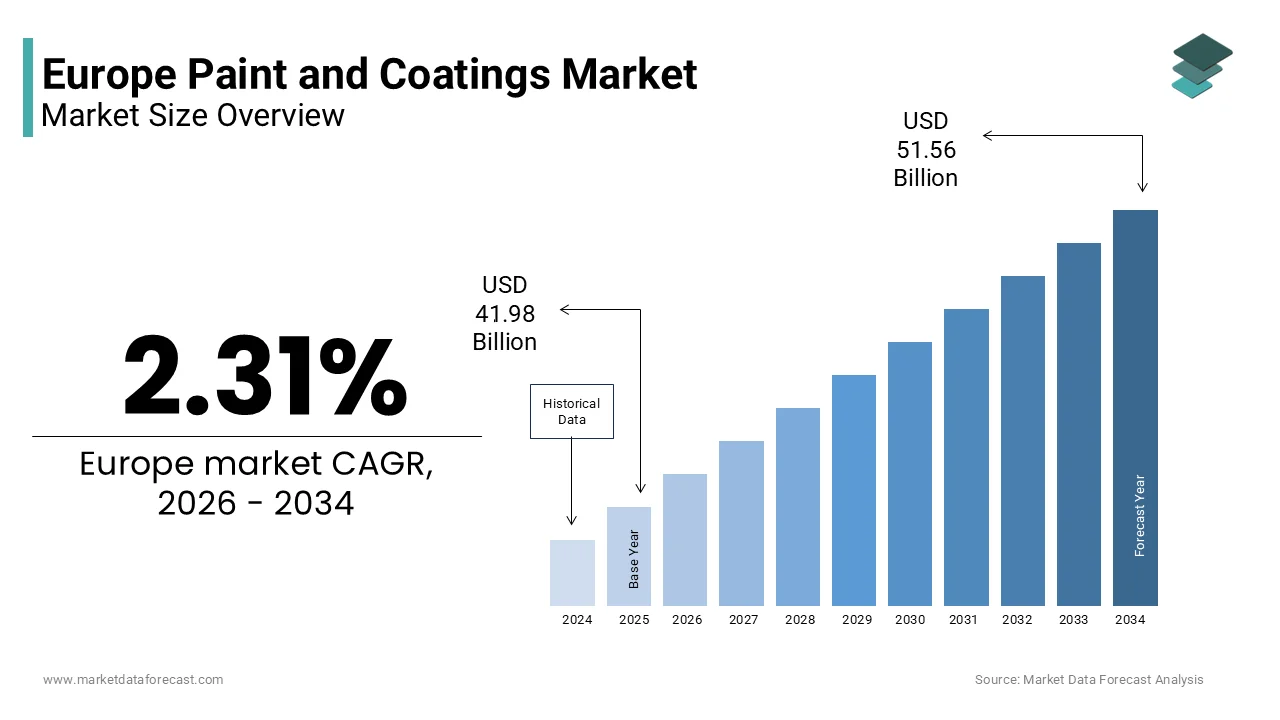
The Europe paint and coatings market was valued at USD 41.98 billion in 2025, is estimated to reach USD 42.95 billion in 2026, and is projected to reach USD 51.56 billion by 2034, growing at a CAGR of 2.31% during the forecast period. Market growth is driven by steady demand from construction, automotive, and industrial sectors, along with increasing renovation and maintenance activities across Europe. The rising focus on sustainable and low emission coatings, coupled with stringent environmental regulations, is encouraging the adoption of water based and eco friendly formulations. In addition, advancements in coating technologies and increasing demand for high performance and protective coatings are supporting market expansion.
Key Market Trends
- Rising demand for eco friendly and low emission coatings is driving the adoption of sustainable products.
- Increasing renovation and infrastructure maintenance activities are supporting market growth.
- Growing use of advanced coatings for corrosion protection and durability is boosting demand.
- Expansion of construction and automotive industries is contributing to steady market expansion.
- Technological advancements in coating formulations are improving performance and application efficiency.
Segmental Insights
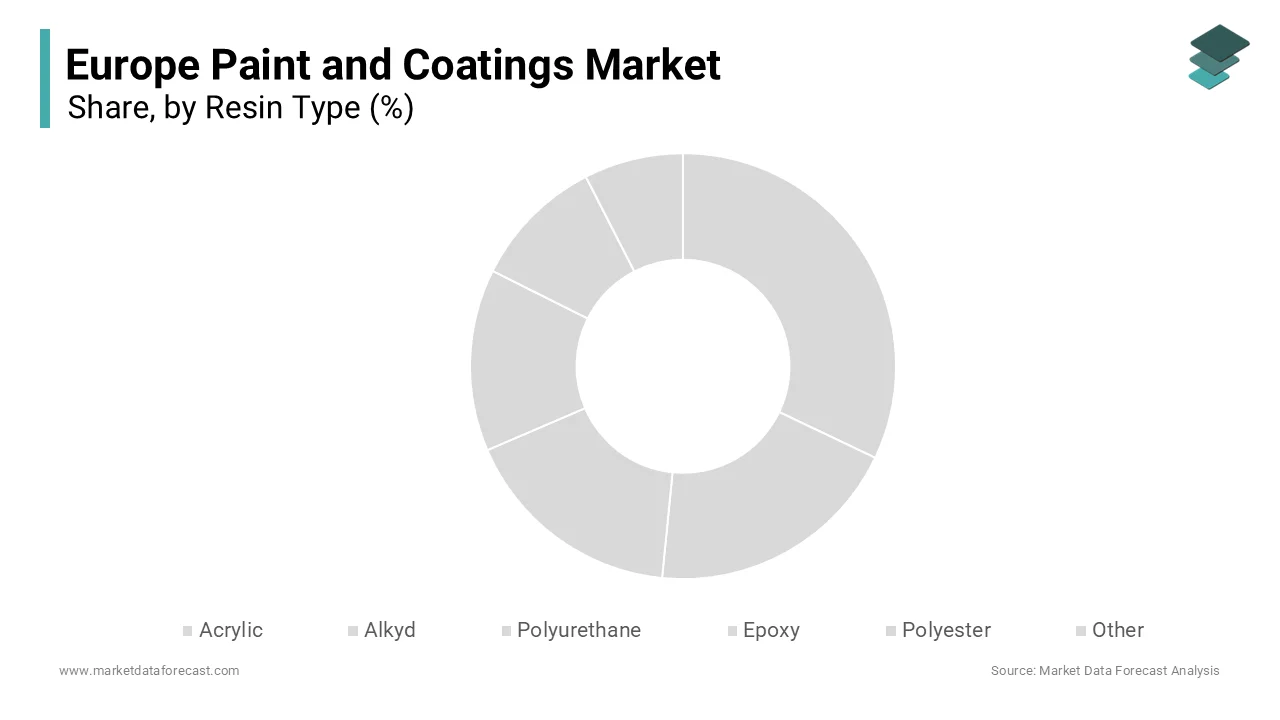
- Based on resin type, the acrylic resin segment was the largest and held 38.4% of the Europe paint and coatings market share in 2025. This dominance is attributed to its durability, weather resistance, and wide application across architectural and industrial coatings.
- Based on technology, the water borne segment accounted for 52.3% of the Europe paint and coatings market share in 2025. The segment’s growth is driven by environmental regulations, low volatile organic compound emissions, and increasing preference for sustainable solutions.
- Based on end user industry, the architectural segment dominated with 55.4% of the Europe paint and coatings market share in 2025, supported by strong demand from residential and commercial construction activities.
Regional Insights
- The Europe paint and coatings market is experiencing steady growth across key countries, supported by construction activities and industrial demand.
- Germany was the largest contributor, accounting for 20.3% of the Europe paint and coatings market share in 2024, driven by a strong construction sector, advanced manufacturing base, and high demand for architectural and industrial coatings.
Competitive Landscape
The Europe paint and coatings market is highly competitive, with major players focusing on sustainable product development, technological innovation, and expansion of production capacities to strengthen their market position. Companies are investing in eco friendly coatings, advanced materials, and strategic collaborations. Prominent players in the Europe paint and coatings market include AkzoNobel NL, PPG Industries US, Sherwin Williams US, BASF DE, Nippon Paint JP, RPM International US, Asian Paints IN, Kansai Paint JP, and Valspar US.
Europe Paint and Coatings Market Size
The Europe paint and coatings market size was valued at USD 41.98 billion in 2025 and is projected to reach USD 51.56 billion by 2034 from USD 42.95 billion in 2026, growing at a CAGR of 2.31%.
The paint and coatings is the formulation distribution and application of liquid or mastic materials that convert into a solid film after application to a substrate. These products serve functions including protection against corrosion weathering and chemical exposure, as well as providing aesthetic enhancement and specialized properties such as thermal insulation or antimicrobial resistance. The integrated with the construction automotive and industrial manufacturing sectors which dictate consumption patterns. The regulatory environment significantly influences product formulations with strict limits on volatile organic compound emissions. According to the European Environment Agency, transport and industrial processes remain significant sources of air pollution prompting tighter controls on solvent based products. The shift towards water borne and high solids coatings reflects this regulatory pressure. Furthermore, the European Chemicals Agency enforces rigorous standards under the Registration Evaluation Authorization and Restriction of Chemicals regulation ensuring that hazardous substances are managed safely. The automotive industry also contributes substantially to demand with vehicle production rates influencing original equipment manufacturer coating volumes. As per the European Automobile Manufacturers Association passenger car production in the EU reached 10.5 million units in 2023.
MARKET DRIVERS
Revitalization of the Construction Sector Through Renovation Initiatives
The extensive renovation of existing building stock is majorly propelling the growth of Europe paint and coatings maarket. Governments are implementing aggressive energy efficiency targets that require upgrading building envelopes which often involves repainting and recoating exterior and interior surfaces. According to the European Commission, the Renovation Wave strategy aims to double the annual energy renovation rate of residential and non-residential buildings by 2030. This initiative necessitates the use of high-performance coatings that provide thermal insulation and durability. As per study, over 75% of the building stock in the European Union is energy inefficient creating a vast addressable market for renovation related products. The demand for reflective and insulating paints has risen as property owners seek to reduce heating and cooling costs amidst rising energy prices. Additionally, the aesthetic refreshment of urban infrastructure and residential properties drives consistent consumption of decorative paints. The construction industry’s recovery post pandemic has further amplified this trend with increased investment in both public and private projects. Manufacturers are responding by developing eco-friendly latex and acrylic formulations that meet stringent environmental standards while offering superior coverage and longevity. The integration of smart coatings that can monitor structural health or adjust transparency also adds value to renovation projects. This sustained focus on improving building performance and aesthetics ensures a steady and growing demand for architectural paints and coatings across the continent.
Growth in Automotive Production and Electric Vehicle Adoption
The resurgence of automotive manufacturing and the rapid adoption of electric vehicles is additionally elevating the growth of the Europe paint and coatings market. Original equipment manufacturers require advanced coating systems to protect vehicle bodies from corrosion and enhance aesthetic appeal. According to the reports, car production in the EU increased by 13.9% in 2023 compared to the previous year reflecting a robust recovery in the sector. The shift towards electric vehicles introduces new requirements for coatings such as lightweight formulations and thermal management solutions for battery packs. As per the International Energy Agency, electric car sales in Europe surpassed 2 million units in 2023 accounting for more than 20% of total car sales. This transition drives innovation in coating technologies including powder coatings and water borne basecoats that reduce environmental impact during the manufacturing process. Automotive refinishing also contributes to market growth as the average age of vehicles on European roads increases leading to higher demand for repair and maintenance coatings. The emphasis on sustainability in the automotive supply chain encourages the use of low volatile organic compound coatings. Manufacturers are investing in research and development to create durable and visually appealing finishes that align with brand identities. The combination of increased production volumes and technological advancements in vehicle design sustains strong demand for high performance automotive coatings in the European market.
MARKET RESTRAINTS
Stringent Environmental Regulations on Volatile Organic Compounds
The strict environmental regulations are limiting the use of volatile organic compounds, which is limiting the growth of Europe paint and coatings market. Regulatory frameworks, such as the Industrial Emissions Directive and the National Emission Ceilings Directive impose tight restrictions on solvent based products which have traditionally been favored for their performance characteristics. According to the European Environment Agency emissions of volatile organic compounds from industrial processes must be reduced by 40% by 2030 compared to 2005 levels. This mandate forces manufacturers to reformulate products using water borne or high solids technologies which can be more expensive and technically challenging to produce. As per the European Chemicals Agency the registration and evaluation of new chemical substances under the Registration Evaluation Authorization and Restriction of Chemicals regulation add considerable time and cost to product development. Small and medium sized enterprises often struggle to comply with these complex regulatory requirements due to limited resources for research and testing. The transition away from solvents can also impact the performance of coatings in terms of drying time and durability leading to customer resistance. Additionally varying national implementations of European directives create a fragmented regulatory landscape that complicates cross border trade. Compliance costs are passed on to consumers potentially reducing demand in price sensitive segments. The continuous tightening of environmental standards requires ongoing investment in cleaner technologies which constrains profit margins and limits the availability of certain high performance solvent based products in the market.
Volatility in Raw Material Prices and Supply Chain Disruptions
The fluctuations in the prices of key raw materials, such as titanium dioxide resins and pigments is another factor hampering the growth of Europe paint and coatings market. These inputs are essential for producing high quality coatings and their prices are influenced by global supply dynamics energy costs and geopolitical tensions. According to the International Monetary Fund, global commodity prices experienced significant volatility in recent years affecting the cost structure of chemical manufacturers. The reliance on imported raw materials exposes European manufacturers to currency exchange rate risks and supply chain bottlenecks. Disruptions in logistics due to port congestion or labor strikes can lead to delays and inventory shortages impacting production schedules. The energy intensive nature of coating manufacturing further amplifies the impact of rising electricity and natural gas prices. Manufacturers face difficulties in passing on these increased costs to customers who are sensitive to price changes. This margin pressure discourages investment in new capacity and innovation. Additionally, the scarcity of certain specialty pigments and additives can limit product availability and hinder the development of new formulations. The unpredictability of input costs complicates long term planning and strategic decision making for industry participants. These economic pressures restrict market growth and competitiveness particularly for smaller players who lack the bargaining power to secure favorable supply contracts.
MARKET OPPORTUNITIES
Development of Bio Based and Sustainable Coating Solutions
The development of bio based and sustainable coating solutions is creating new opportunities for the growth of Europe paint and coatings market. Consumers and industries are increasingly seeking environmentally friendly alternatives to traditional petroleum-based products. According to the European Bioplastics Association, the production capacity for bio based plastics in Europe is expanding rapidly driven by demand for sustainable materials. This trend extends to coatings where bio based resins derived from renewable resources such as vegetable oils and plant sugars are gaining traction. As per the European Commission the Circular Economy Action Plan promotes the use of sustainable products and materials in construction and manufacturing. Companies that innovate in this space can differentiate themselves and capture market share among eco conscious buyers. Bio based coatings often offer comparable performance to conventional products while reducing carbon footprint and dependency on fossil fuels. Regulatory incentives for green products further support this transition. Partnerships with agricultural suppliers and biotechnology firms facilitate the sourcing of raw materials. The introduction of certifications for bio based content enhances consumer trust and market acceptance. Additionally, the development of self healing and anti microbial coatings using natural ingredients opens new application areas in healthcare and food processing.
Expansion into Smart and Functional Coatings
The expansion into smart and functional coatings is another attribute leveraging the growth of Europe paint and coatings market. These advanced coatings provide additional benefits beyond protection and aesthetics such as energy generation sensing or self cleaning capabilities. According to the Fraunhofer Institute for Solar Energy Systems, building integrated photovoltaics using transparent coatings are becoming increasingly viable for urban applications. Smart coatings can regulate temperature reduce noise or improve air quality adding value to construction and automotive projects. As per the European Innovation Partnership on Smart Cities and Communities the deployment of intelligent infrastructure is a priority for many European cities driving demand for innovative materials. Anti-graffiti and anti-microbial coatings are also gaining popularity in public spaces and healthcare facilities due to hygiene and maintenance concerns. The aerospace and marine sectors utilize functional coatings to reduce drag and improve fuel efficiency. Research and development investments in nanotechnology enable the creation of coatings with precise molecular structures for enhanced performance. Collaborations between material scientists and end users accelerate the commercialization of these technologies. The ability to offer customized solutions for specific challenges allows manufacturers to command premium prices.
MARKET CHALLENGES
Intense Competition from Low Cost Imports
The intense competition from low cost imports is one of the major challenges for the growth of Europe paint and coatings market. Manufacturers in Asia and other regions often benefit from lower labor and raw material costs allowing them to offer products at competitive prices. According to the World Trade Organization, global trade in chemical products has increased with emerging countries becoming significant exporters. As per Eurostat, imports of paints and varnishes into the European Union have risen steadily putting pressure on domestic producers. European manufacturers must contend with these price advantages while adhering to stricter environmental and safety regulations that increase production costs. The presence of counterfeit or substandard products in the market further exacerbates the challenge undermining brand reputation and consumer trust. Small and medium sized enterprises are particularly vulnerable to this competition as they lack the economies of scale to absorb cost disparities. The fragmentation of the European market with varying national preferences and standards complicates efforts to achieve uniform pricing and distribution strategies. Additionally, the appreciation of the euro against other currencies can make European exports less competitive and imports more attractive. However, this strategy requires continuous investment in research and development which may be constrained by margin pressures.
Complexity of Recycling and Waste Management
The complexity of recycling and waste management is also to inhibit the growth of Europe paint and coatings market. Paint waste is classified as hazardous in many jurisdictions due to the presence of heavy metals solvents and other toxic substances. According to the European Environment Agency, only a small fraction of paint waste is currently recycled in Europe with the majority being incinerated or landfilled. The lack of standardized collection and processing infrastructure makes it difficult to recover valuable materials from used paint containers and residual product. As per the European Commission the Waste Framework Directive, sets ambitious recycling targets but implementation varies across member states. Manufacturers face increasing pressure to take responsibility for the end-of-life management of their products under extended producer responsibility schemes. Developing effective recycling technologies for mixed paint waste is technically challenging and costly. Water based paints while less hazardous still require careful treatment to prevent water pollution. The logistical burden of collecting and transporting waste paint adds to operational costs. Consumer awareness about proper disposal methods remains low leading to improper handling and environmental contamination. Regulatory uncertainty regarding future waste management requirements creates risks for long term planning. Companies must invest in sustainable packaging and take back programs to mitigate these challenges.
REPORT COVERAGE
| REPORT METRIC | DETAILS |
| Market Size Available | 2025 to 2034 |
| Base Year | 2025 |
| Forecast Period | 2026 to 2034 |
| CAGR | 2.31% |
| Segments Covered | By Resin Type, Technology, End User Industry, and Region |
| Various Analyses Covered | Global, Regional, & Country Level Analysis; Segment-Level Analysis; DROC, PESTLE Analysis; Porter’s Five Forces Analysis; Competitive Landscape; Analyst Overview of Investment Opportunities |
| Regions Covered | UK, France, Spain, Germany, Italy, Russia, Sweden, Denmark, Switzerland, Netherlands, Turkey, and the Czech Republic |
| Market Leaders Profiled | AkzoNobel (NL), PPG Industries (US), Sherwin-Williams (US), BASF (DE), Nippon Paint (JP), RPM International (US), Asian Paints (IN), Kansai Paint (JP), Valspar (US) |
SEGMENTAL ANALYSIS
By Resin Type Insights
The acrylic resin segment was the largest by holding 38.4% of the Europe paint and coatings market share in 2025 owing to the versatility and superior performance characteristics of acrylic polymers in both architectural and industrial applications. The extensive use of acrylic emulsions in water based architectural paints, which are favored for their durability weather resistance and low volatile organic compound emissions is also elevating the growth of Europe paint and coatings market. According to the European Coatings Industry Federation, the shift towards environmentally friendly formulations has significantly boosted the demand for acrylic resins as they offer excellent adhesion and color retention without the need for harmful solvents. As per Eurostat the renovation of residential buildings across the European Union has increased by 12% in recent years driving the consumption of high quality interior and exterior paints that rely on acrylic binders. Furthermore, acrylic resins are cost effective compared to other high performance polymers making them accessible for large scale construction projects. The ability of acrylics to be modified for specific properties such as flexibility or hardness allows manufacturers to tailor products for diverse climatic conditions across Europe. The growing preference for low odor and quick drying paints in urban environments further supports the adoption of acrylic based formulations. Additionally, the compatibility of acrylics with various pigments and additives enhances their appeal in decorative coatings.
The polyurethane resin segment is projected to register a fastest CAGR of 5.6% from 2026 to 2034 with the exceptional durability and chemical resistance in industrial and automotive applications. The increasing demand for high performance coatings that can withstand harsh environmental conditions and mechanical stress is escalating the growth of the segment. The automotive sector in the production of electric vehicles, which require advanced coating solutions for battery protection and lightweight components will also boost the growth of the segment. According to the European Automobile Manufacturers Association the production of electric vehicles in Europe is expected to double by 2025 necessitating robust protective coatings that polyurethane resins provide. As per the German Chemical Industry Association the demand for polyurethane coatings in the aerospace and marine industries is also rising due to their ability to resist corrosion and abrasion. Polyurethane coatings are increasingly used in flooring systems for industrial facilities and commercial spaces where hygiene and durability are critical. The development of bio based polyurethane resins further accelerates growth by aligning with sustainability goals and regulatory requirements. These innovative formulations reduce dependency on fossil fuels while maintaining performance standards. The versatility of polyurethane in both solvent borne and water borne systems allows for broad application across various sectors. Additionally, the aesthetic appeal of polyurethane finishes including high gloss and matte options drives demand in the furniture and wood coating industries.
By Technology Insights
The water-borne technology segment was the largest by holding 52.3% of the Europe paint and coatings market share in 2025 with the stringent environmental regulations that limit the use of volatile organic compounds in solvent based products. The European Union’s Industrial Emissions Directive, which mandates significant reductions in solvent emissions from industrial processes is elevating the growth of the segment. According to the European Environment Agency, water borne coatings produce significantly lower levels of hazardous air pollutants making them the preferred choice for compliant manufacturing. As per the European Coatings Industry Federation, over 60% of architectural paints sold in Europe are now water borne reflecting a decisive shift in consumer and professional preferences. The improvement in the performance of water borne technologies has also contributed to their widespread adoption. Modern water borne coatings offer comparable durability and finish quality to solvent based alternatives while being safer to handle and apply. The construction sector’s emphasis on indoor air quality has further boosted demand for low odor water borne paints in residential and commercial buildings. Additionally, government incentives for green building certifications encourage the use of environmentally friendly materials. The availability of advanced acrylic and polyurethane dispersions has expanded the application range of water borne technologies to include industrial and automotive sectors.
The powder coatings segment is expected to exhibit a fastest CAGR of 6.2% from 2026 to 2034 with the zero volatile organic compound emissions and high material efficiency. The increasing adoption of powder coatings in industrial applications such as automotive parts appliances and architectural aluminum profiles is also bolstering the growth of the segment. The sustainability advantage of powder coatings, which produce negligible waste and can be recycled within the production process is also fuelling the growth of the segment. According to the European Powder Coating Association, the utilization rate of powder coatings in industrial finishing has increased by 15% in recent years due to their environmental benefits. As per the European Aluminium Association, the demand for powder coated aluminum facades in green buildings is rising as architects seek durable and eco friendly materials. Powder coatings offer superior corrosion resistance and mechanical strength making them ideal for outdoor structures and heavy duty equipment. The elimination of solvents reduces fire hazards and health risks for workers enhancing workplace safety. Technological advancements in low cure powder coatings have expanded their applicability to heat sensitive substrates such as wood and plastics. This innovation opens new market segments in furniture and automotive interior components. Additionally, the energy efficiency of modern curing ovens reduces operational costs for manufacturers.
By End User Industry Insights
The architectural segment was the largest by holding 55.4% of the Europe paint and coatings market share in 2025 owing to the extensive use of paints and coatings in residential and commercial construction for protection and aesthetic enhancement. The ongoing renovation wave across Europe aimed at improving energy efficiency and building aesthetics. According to the European Commission, the Renovation Wave strategy targets the renovation of 35 million buildings by 2030 creating substantial demand for architectural coatings. As per Eurostat, the construction sector represents a significant portion of the European economy with residential repairs and maintenance accounting for a large share of activity. Homeowners and property developers increasingly invest in high quality exterior and interior paints to enhance property value and comfort. The trend towards sustainable living has also boosted demand for eco-friendly and low volatile organic compound architectural paints. Water based latex and acrylic paints are preferred for their ease of application and minimal environmental impact. Additionally, the growth of urbanization leads to increased construction of multi-family housing units which require large volumes of coatings. The aesthetic diversity offered by modern architectural paints including textured and specialized finishes further drives consumption. The recurring nature of painting projects for maintenance and refreshment ensures steady demand.
The automotive segment is projected to register a fastest CAGR of 4.8% from 2026 to 2034 with the recovery of vehicle production and the transition to electric mobility. The need for advanced coating systems that provide corrosion protection aesthetic appeal and functional benefits for modern vehicles. The increasing production of electric vehicles, which require specialized coatings for battery enclosures and lightweight components. According to the European Automobile Manufacturers Association, electric vehicle sales in Europe are growing rapidly requiring new coating technologies to meet performance and safety standards. As per the International Energy Agency, the push for lighter vehicles to improve energy efficiency has increased the use of high performance primers and clear coats. Automotive original equipment manufacturers are adopting multi layer coating systems that offer superior durability and scratch resistance. The demand for customized colors and effects also drives innovation in automotive refinish coatings. The average age of vehicles on European roads is increasing leading to higher demand for repair and maintenance coatings in the aftermarket sector. Regulatory pressures to reduce emissions from coating processes have accelerated the adoption of water borne and powder coating technologies in automotive plants.
REGIONAL ANALYSIS
Germany Paints and Coatings Market Analysis
Germany was the largest contributor in the Europe paint and coatings market by holding 20.3% of the share in 2024 with its robust automotive and construction industries. The country’s market status is characterized by high demand for high performance industrial coatings and eco friendly architectural paints. The presence of major automotive manufacturers, who require advanced coating solutions for vehicle production. According to the German Federal Ministry for Economic Affairs and Climate Action, the automotive sector is investing heavily in electric vehicle production which increases demand for specialized protective coatings. As per the German Paint and Printing Ink Industry Association, the shift towards water borne and powder coatings is accelerating due to strict environmental regulations. The construction sector in Germany also contributes significantly to demand with ongoing renovation projects aimed at improving energy efficiency. The Energiewende policy promotes sustainable building practices encouraging the use of low volatile organic compound paints. Germany’s strong industrial base supports the production and consumption of high-quality coatings for machinery and infrastructure. The country’s focus on innovation drives the development of smart and functional coatings. Regulatory frameworks such as the Technical Instructions on Air Quality Control enforce stringent emission limits fostering the adoption of cleaner technologies. Germany’s strategic position as an industrial hub ensures steady demand for diverse coating types.
France Paints and Coatings Market Analysis
France paint and coatings market growth is likely to grow with an anticipated CAGR of 14.4% of hsare in 2025 with the strong construction sector and aesthetic preferences. The French government’s MaPrimeRenov scheme, which provides financial incentives for energy efficient home improvements including exterior insulation and painting. According to the French National Institute of Statistics and Economic Studies, the number of housing renovations has increased steadily supporting demand for architectural coatings. As per the French Paint Industry Federation, there is a growing preference for eco labeled paints that meet strict environmental and health standards. The luxury goods and automotive sectors in France also drive demand for high quality decorative and protective coatings. French consumers place high value on aesthetics leading to demand for premium finishes and custom colors. The tourism industry contributes to market growth through the maintenance and renovation of hotels and historic buildings. Regulatory initiatives such as the Anti Waste Law for a Circular Economy promote the use of sustainable packaging and recyclable materials in the paint industry. France’s commitment to reducing carbon emissions drives the adoption of low volatile organic compound formulations.
Italy Paints and Coatings Market Analysis
Italy paint and coatings market growth is likely to grow with its vibrant construction and furniture industries. The Superbonus tax credit scheme, which although modified has stimulated extensive renovation activities, including facade painting and insulation. As per the Italian Paint and Varnish Manufacturers Association, there is a high demand for high quality aesthetic finishes that reflect Italy’s design heritage. The furniture industry in Italy is a global leader driving demand for sophisticated wood coatings that enhance the natural beauty of timber. Italian manufacturers are known for their innovation in color trends and texture effects appealing to discerning consumers. The tourism sector also contributes to demand through the maintenance of hospitality facilities and historic sites. Regulatory efforts to improve energy efficiency in buildings support the use of reflective and insulating coatings. Italy’s focus on design and quality ensures a preference for premium coating products.
United Kingdom Paints and Coatings Market Analysis
The United Kingdom paint and coatings market growth is esteemed to grow with its housing and industrial base. The UK government’s commitment to improving energy efficiency in homes, which often involves exterior repainting and insulation upgrades is escalating the growth of Europe paint and coatings market. According to the Office for National Statistics, the housing sector remains active with significant spending on repairs and improvements. As per the British Coatings Federation, there is a growing trend towards sustainable and low odor paints among consumers concerned about indoor air quality. The DIY sector in the UK is robust with homeowners frequently undertaking painting projects. Regulatory standards such as the Control of Volatile Organic Compounds in Paints Regulations enforce limits on solvent content driving the adoption of water borne technologies. The UK’s focus on sustainability and home ownership ensures consistent demand for quality paint and coating products.
Spain Paints and Coatings Market Analysis
Spain paint and coatings market growth is esteemed to grow with the significant demand for exterior coatings due to the country’s warm climate and exposure to sunlight. The renovation of tourist accommodations and residential properties, which requires durable and weather resistant paints. According to the Spanish National Statistics Institute, the construction sector has recovered strongly with increased investment in housing and hospitality projects. As per the Spanish Paint Industry Association there is a high demand for anti-algae and UV resistant coatings that protect buildings from harsh environmental conditions. Spanish consumers prefer bright and vibrant colors influencing product development and marketing strategies. Government initiatives to improve energy efficiency in buildings support the use of thermal insulation coatings.
COMPETITIVE LANDSCAPE
The competition in the Europe paint and coatings market is characterized by the presence of established multinational corporations and specialized regional producers. Market leaders compete on the basis of product quality innovation and sustainability credentials. The high regulatory barriers related to environmental compliance create significant advantages for companies with advanced research and development capabilities. Competitive dynamics are influenced by raw material costs and energy prices which impact production expenses. Companies differentiate themselves through eco friendly formulations and digital customer services. Price competition is moderate as customers prioritize performance and environmental standards over lowest cost. Strategic alliances with construction and automotive industries strengthen market positions and ensure stable demand. The shift towards sustainable building and transportation drives innovation and collaboration among market participants. Regulatory frameworks play a crucial role in shaping competitive landscapes by setting standards for emissions and waste. Companies that adapt quickly to changing regulations and consumer preferences gain a competitive advantage.
KEY MARKET PLAYERS
Some of the notable key players in the Europe paint and coatings market are
- AkzoNobel (NL)
- PPG Industries (US)
- Sherwin-Williams (US)
- BASF (DE)
- Nippon Paint (JP)
- RPM International (US)
- Asian Paints (IN)
- Kansai Paint (JP)
- Valspar (US)
Top Players in the Market
- AkzoNobel is a global leader in paints and coatings with a strong presence in the European market through its decorative and performance coatings divisions. The company focuses on sustainability by developing low volatile organic compound products and energy efficient manufacturing processes. Recent actions include expanding its portfolio of bio based raw materials and enhancing digital customer experiences through online color tools. AkzoNobel invests heavily in research and development to create innovative solutions for architectural and industrial applications. Their commitment to circular economy principles drives the introduction of recyclable packaging and take back schemes. The company strengthens its market position by collaborating with architects and contractors to promote sustainable building practices. AkzoNobel’s strategic initiatives aim to reduce carbon emissions across its value chain while delivering high quality protective and decorative finishes. This approach ensures long term competitiveness and alignment with European environmental regulations.
- PPG Industries is a major player in the Europe paint and coatings market offering a diverse range of products for automotive aerospace and construction sectors. The company leverages its global expertise to provide advanced coating solutions that enhance durability and aesthetic appeal. Recent strategies involve increasing production capacity for water borne and powder coatings to meet stringent environmental standards. PPG invests in digital technologies to optimize supply chain efficiency and customer service. The company actively participates in sustainability initiatives by reducing waste and energy consumption in its operations. PPG collaborates with original equipment manufacturers to develop lightweight and corrosion resistant coatings for electric vehicles. Their focus on innovation and customer centric solutions strengthens their competitive edge.
- BASF SE is a leading chemical company that significantly influences the Europe paint and coatings market through its raw material supply and proprietary formulations. The company provides essential resins pigments and additives that enable the production of high performance coatings. Recent actions include expanding its portfolio of sustainable raw materials such as bio based solvents and recycled polymers. BASF invests in research and development to create innovative solutions that reduce environmental impact and improve coating efficiency. The company collaborates with formulators and manufacturers to develop next generation coatings for various applications. BASF’s commitment to sustainability drives the adoption of circular economy practices within the industry. Their strategic partnerships and technical expertise strengthen their market position.
Top Strategies Used by Key Market Participants
Key players in the Europe paint and coatings market primarily focus on sustainability and innovation to address environmental concerns and regulatory requirements. Companies invest in developing low volatile organic compound and bio based products to meet strict emission standards. Strategic acquisitions and partnerships expand product portfolios and geographic reach. Digitalization of supply chains enhances operational efficiency and customer engagement. Manufacturers prioritize research and development to create high performance coatings for emerging applications such as electric vehicles and smart buildings. Compliance with environmental regulations is maintained through continuous improvement in production processes. Companies also engage in consumer education to promote the benefits of sustainable coatings.
MARKET SEGMENTATION
This research report on the European paint and coatings market has been segmented and sub-segmented based on categories.
By Resin Type
- Acrylic
- Alkyd
- Polyurethane
- Epoxy
- Polyester
- Other
By Technology
- Water borne
- Solvent borne
- Powder Coatings
- UV Cured Coatings
By End User Industry
- Architectural
- Automotive
- Wood
- Protective Coatings
- General Industrial
- Transportation
- Packaging
By Country
- UK
- France
- Spain
- Germany
- Italy
- Russia
- Sweden
- Denmark
- Switzerland
- Netherlands
- Turkey
- Czech Republic
- Rest of Europe