- Product Description Description
- Table of Contents TOC
- List of Table & Figure LOT
- Get Free Sample PDF Sample PDF
Market Size, 2025
$2.47 BnMarket Estimate, 2026
$2.56 BnMarket Forecast, 2034
$3.39 BnCAGR, 2026–2034
3.57%Europe Pallet Market Size, Growth, Trends & Forecast (2026–2034)
The pallet market size in Europe was valued at USD 2.47 billion in 2025, reached USD 2.56 billion in 2026, and is projected to expand up to USD 3.39 billion by 2034, registering a compound annual growth rate (CAGR) of 3.57% during the forecast period from 2026 to 2034. Driven by robust logistics infrastructure, e-commerce expansion in the food & beverage sector, and circular economy sustainability initiatives, the market continues steady regional growth.
Key Executive Metrics (At-a-Glance)
- 2025 Base Valuation: USD 2.47 Billion
- 2026 Current Valuation: USD 2.56 Billion
- 2034 Forecast Valuation: USD 3.39 Billion
- Compound Annual Growth Rate (CAGR): 3.57% (2026–2034)
- Leading Country Market: Germany (Leading with a 28.3% market share in 2025, underpinned by a robust manufacturing base, export-driven economy, and strong emphasis on sustainability)
- Fastest-Growing Country Markets: France (Projected to witness a leading CAGR of 5.2% driven by thriving retail, agricultural logistics, and advanced pallet pooling) & Spain (Projected to exhibit a CAGR of 6.4% due to investments in food processing and smart e-commerce logistics)
- Leading Type Segment: Wooden Pallets (The largest segment occupying a prominent market share in 2025 due to affordability, strength, and widespread raw material availability)
- Fastest-Growing Type Segment: Plastic Pallets (Projected to grow at a CAGR of 6.5% fueled by durability, contamination resistance, and IoT tracking integration)
- Leading Application Segment: Food and Beverages (Accounted for 40.3% of the European market share in 2025 due to stringent hygiene standards and high supply chain volume)
- Fastest-Growing Application Segment: Pharmaceuticals (Estimated to grow at a CAGR of 7.2% driven by demand for contamination-free packaging solutions and safe drug transport regulations)
- Leading Structural Design Segment: Block Pallets (Largest segment occupying 60.4% market share in 2025 due to superior load-bearing capacity for heavy-duty tasks)
- Fastest-Growing Structural Design Segment: Stringer Pallets (Augmented to register a CAGR of 5.8% owing to cost-effectiveness, lightweight design, and automation compatibility)
Core Market Drivers
- E-Commerce & Logistics Surge: Rapid expansion of online retail and food distribution requiring robust warehousing and transportation solutions.
- Circular Economy & Sustainability: Government mandates and eco-friendly initiatives driving the widespread repair, reuse, and pooling of wooden and plastic pallets.
Primary Market Restraints & Challenges
- Raw Material Price Volatility: Fluctuations in timber and oil prices increasing production costs for wooden and plastic pallet manufacturers.
- Labor Shortages & Compliance: Skilled workforce deficits in manufacturing/repair sectors alongside strict biodiversity and environmental wood sourcing regulations.
Europe Pallet Market Segmentation Highlights
| Segment Category | Leading / Dominant Segment | Fastest-Growing / Prominent Segment |
|---|---|---|
| By Type | Wood Pallets (Prominent share in 2025) | Plastic Pallets (CAGR of 6.5%) |
| By Application | Food and Beverages (40.3% share in 2025) | Pharmaceuticals (CAGR of 7.2%) |
| By Structural Design | Block Pallets (60.4% share in 2025) | Stringer Pallets (CAGR of 5.8%) |
| By Country | Germany (28.3% share in 2025) | Spain (6.4% CAGR) & France (5.2% CAGR) |
Major Industry Players Profiled
Key operators leading the Europe pallet market include Brambles Limited, Tranpak Deliver Innovation, Smurfit Kappa Group, Craemer Holding GmbH, Menasha Corporation, KraftPal Technologies Ltd., DS Smith, Falkenhahn AG, Schoeller Allibert Services B.V., Conitex Sonoco, Elsons International, UFP Industries, Inc., and Cabka Group GmbH.
Europe Pallet Market Size
The pallet market size in Europe was valued at USD 2.47 billion in 2025. The European market is estimated to be worth USD 3.39 billion by 2034 from USD 2.56 billion in 2026. The market’s promising CAGR for the predicted period is 3.57%.
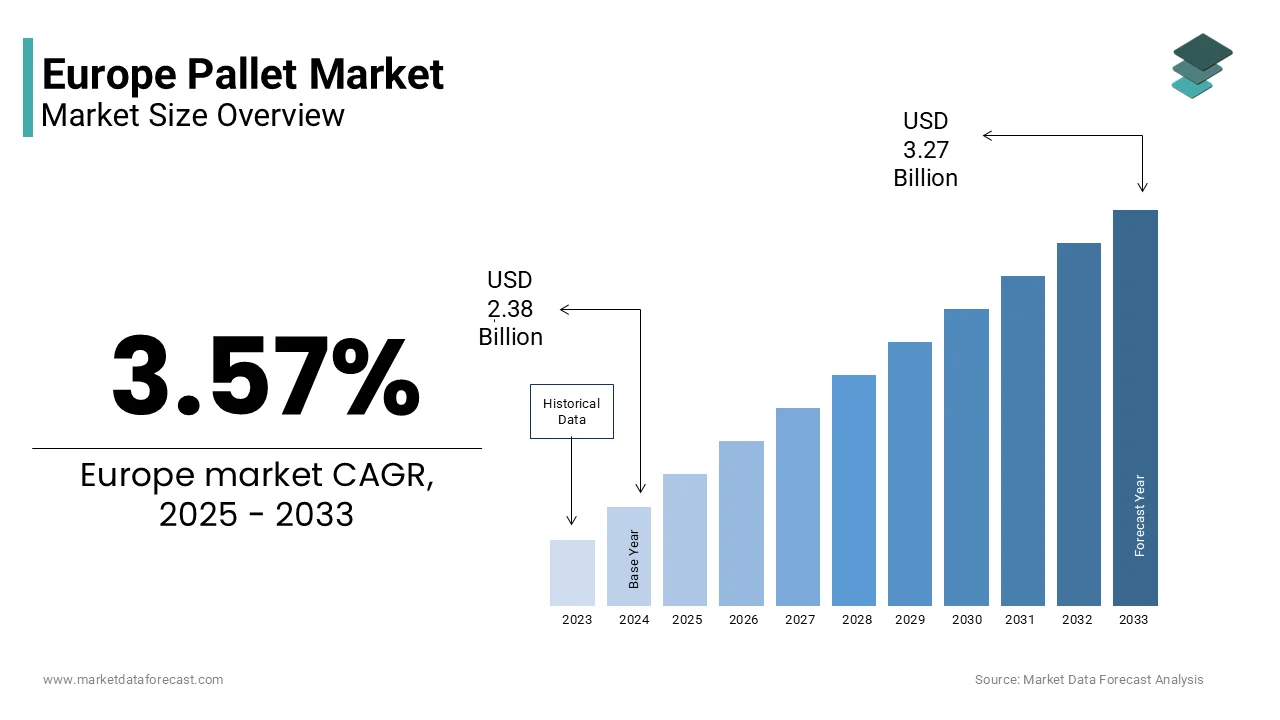
The Europe pallet market is a cornerstone of the region’s logistics and supply chain infrastructure. The surge in e-commerce in the food and beverage sector, has significantly increased demand for pallets to facilitate efficient transportation and storage. According to Eurostat, over 60% of European pallets are used in the food and beverage industry amplifying their role in maintaining supply chain continuity. Additionally, sustainability initiatives promoting reusable and recyclable pallets have gained traction is propelling market growth despite challenges like fluctuating raw material costs.
MARKET DRIVERS
Surge in E-Commerce and Logistics Demand
The rapid expansion of e-commerce has emerged as a key driver of the Europe pallet market. This growth necessitates robust logistics solutions, including pallets, to ensure seamless warehousing and transportation. Wooden pallets are particularly favored for their cost-effectiveness and load-bearing capacity. As per the European Logistics Association, pallet usage in the e-commerce sector grew by 18% in 2023 alone by reflecting their indispensability in handling high-volume shipments. Additionally, industries like food and beverages rely heavily on pallets to maintain hygiene standards during transit will further propels the growth of the market.
Sustainability Initiatives and Circular Economy Trends
Sustainability initiatives are reshaping the Europe pallet market, driving adoption of reusable and recyclable pallets. According to the European Commission, over 90% of wooden pallets are now repaired and reused by aligning with circular economy goals. This trend is supported by government regulations mandating eco-friendly packaging solutions. Plastic pallets, for instance, are gaining popularity due to their durability and recyclability. Industries like pharmaceuticals and chemicals favor plastic pallets for their resistance to contamination and ease of cleaning.
MARKET RESTRAINTS
Fluctuating Raw Material Costs
Fluctuations in raw material prices pose a significant challenge to the Europe pallet market. According to the European Timber Trade Federation, wood prices surged by 25% in 2023 due to supply chain disruptions and rising demand for construction materials. This volatility increases production costs for wooden pallet manufacturers by reducing profit margins. Similarly, plastic pallet producers face challenges from fluctuating oil prices, which directly impact the cost of raw materials like polyethylene. As per the European Chemical Industry Council, these price fluctuations create uncertainty by forcing manufacturers to pass on costs to end-users. This financial strain slows down adoption among SMEs operating on tight budgets.
Environmental Regulations on Wood Usage
Stringent environmental regulations governing wood sourcing and usage act as a restraint on the Europe pallet market. According to the European Forest Institute, over 30% of European forests are protected under biodiversity laws is limiting the availability of timber for pallet production. Additionally, certification requirements such as FSC (Forest Stewardship Council) compliance add to operational complexities and costs. As per the European Environmental Agency, non-compliance with these regulations can lead to penalties by deterring smaller manufacturers from entering the market.
MARKET OPPORTUNITIES
Expansion into Emerging Markets
Eastern European countries present untapped opportunities for the Europe pallet market. According to the European Bank for Reconstruction and Development, nations like Poland, Romania, and Hungary are witnessing rapid industrialization, with manufacturing output growing at an average annual rate of 8%. These regions are investing heavily in food processing and chemical industries, driving demand for wooden and plastic pallets. As per the Central European Economic Review, collaborations with local distributors and government incentives make these markets highly attractive for pallet manufacturers seeking to expand their footprint.
Integration with Smart Logistics Technologies
The integration of pallets with smart logistics technologies offers immense growth potential. According to the European Digital Innovation Hub, over 50% of European logistics providers are adopting IoT-enabled pallets equipped with RFID tags and sensors. These innovations enable real-time tracking and monitoring, reducing losses and improving supply chain efficiency. As per the European Technology Observatory, smart pallets can reduce inventory management costs by 30% by making them indispensable for industries like pharmaceuticals and e-commerce. The manufacturers can unlock new revenue streams while addressing evolving customer demands for transparency and efficiency by leveraging AI and machine learning.
MARKET CHALLENGES
Shortage of Skilled Labor for Pallet Manufacturing and Repair
A significant challenge in the European pallet market is the shortage of skilled labor required for manufacturing and repair processes. According to the European Labour Market Monitor, the manufacturing sector across Europe has faced a workforce deficit, with over 30% of companies reporting difficulties in finding skilled workers as of 2022. This shortage affects the production and maintenance of pallets in regions with high demand, such as Germany and France. The lack of trained technicians for repairing reusable pallets further hampers the efficiency of circular economy practices. This labor gap increases operational costs and limits the scalability of pallet production.
Limited Recycling Infrastructure in Emerging Markets
While recycling initiatives are well-established in many European countries, emerging markets within the region face challenges due to limited recycling infrastructure. The European Environment Agency notes that countries in Eastern Europe, such as Romania and Bulgaria, have recycling rates below the EU average of 49%, which impacts the effective reuse of pallet materials. This inadequacy hinders the region’s ability to comply with the EU Packaging and Packaging Waste Directive, which emphasizes the circular economy. Developing advanced recycling systems requires substantial investments and government support is creating barriers for manufacturers operating in these regions and slowing the adoption of sustainable pallet practices.
REPORT COVERAGE
| REPORT METRIC | DETAILS |
| Market Size Available | 2025 to 2034 |
| Base Year | 2025 |
| Forecast Period | 2026 to 2034 |
| CAGR | 3.57% |
| Segments Covered | By Type, Application, Structural Design, and Region |
| Various Analyses Covered | Global, Regional, & Country Level Analysis; Segment-Level Analysis; DROC; PESTLE Analysis; Porter’s Five Forces Analysis; Competitive Landscape; Analyst Overview of Investment Opportunities |
| Regions Covered | UK, France, Spain, Germany, Italy, Russia, Sweden, Denmark, Switzerland, Netherlands, Turkey, Czech Republic, Rest of Europe |
| Market Leaders Profiled | Tranpak Deliver Innovation, Brambles Limited, Smurfit Kappa Group, Craemer Holding GmbH, Menasha Corporation, KraftPal Technologies Ltd., DS Smith, Falkenhahn AG, Schoeller Allibert Services B.V., Conitex Sonoco, Elsons International, UFP Industries, Inc., Cabka Group GmbH, and others. |
SEGMENTAL ANALYSIS
By Type Insights
The wooden pallets segment was the largest by occupying a prominent share of the Europe pallet market in 2025 with their affordability, strength, and widespread availability of raw materials. According to Eurostat, wooden pallets accounted for €8.4 billion in revenues in 2023, driven by their Additionally, repair and reuse programs have enhanced their sustainability appeal by making them a preferred choice for environmentally conscious organizations.
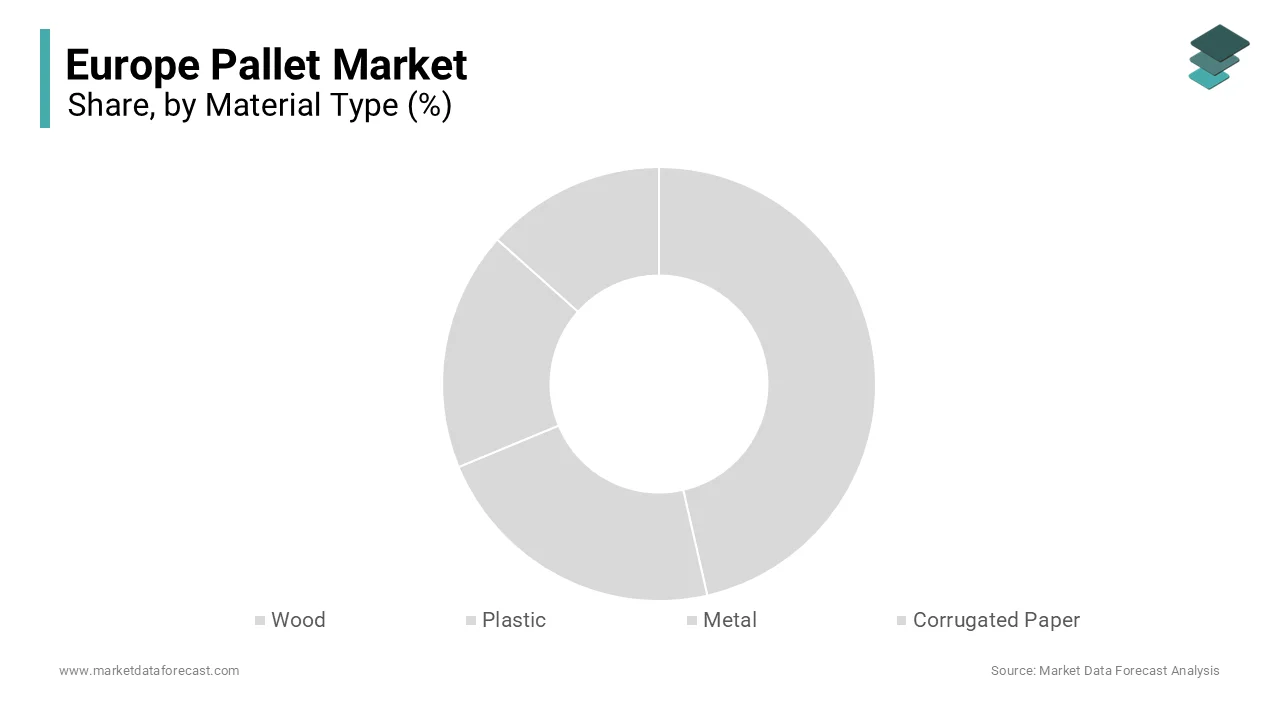
The plastic pallets segment is projected to grow at a CAGR of 6.5% in the next coming years due to their durability and recyclability. According to the European Plastics Federation, plastic pallets are increasingly adopted in pharmaceutical and chemical industries, where hygiene and contamination resistance are critical. Their integration with IoT systems allows for real-time tracking is reducing operational costs by 25%. As per the European Machinery Directive, this segment’s growth is further fueled by rising demand for lightweight yet robust solutions in logistics and warehousing.
By Application Insights
The food and beverage industry was accounted in holding 40.3% of the Europe pallet market share in 2025 due to the stringent hygiene standards and the need for efficient supply chain management. According to Eurostat, pallet usage in this sector grew by 18% in 2023, reflecting its critical role in maintaining product quality during transit. Additionally, the rise of e-commerce has further boosted demand for wooden and plastic pallets.
The pharmaceutical sector is estimated to grow with a CAGR of 7.2% during the forecast period with the increasing demand for contamination-free packaging solutions. According to the European Pharmaceutical Market Research Association, plastic pallets are increasingly adopted for their resistance to bacteria and ease of cleaning. As per the European Healthcare Distribution Association, government regulations promoting safe drug transportation further accelerate adoption by making it the fastest-growing application segment.
By Structural Design Insights
The block pallets segment was the largest by occupying 60.4% of the Europe pallet market share in 2025 with their superior load-bearing capacity and versatility, making them ideal for heavy-duty applications.
The stringer pallets segment is augmented in registering a CAGR of 5.8% in the next coming years with their cost-effectiveness and lightweight design. According to the European Logistics Association, stringer pallets are increasingly adopted in the food and beverage sector, where affordability and hygiene are paramount. Their compatibility with automated systems further enhances their appeal.
REGIONAL ANALYSIS
Germany led the Europe pallet market with a 28.3% of share in 2025 with its robust manufacturing base and export-driven economy, which relies heavily on efficient logistics solutions. The country’s strong emphasis on sustainability, supported by government initiatives promoting reusable pallets.
Spain is deemed to exhibit a CAGR of 6.4% in the foreseen years with the investments in food processing and e-commerce logistics. The rise of smart logistics technologies, such as IoT-enabled pallets, has accelerated adoption in urban distribution hubs. As per the European Logistics Association, Spain’s focus on lightweight yet durable pallet solutions aligns with evolving customer demands.
France pallet market is estimated to witness a fastets CAGR of 5.2% during the forecast period due to its thriving retail and agricultural sectors. According to the French Ministry of Agriculture, the extensive use of wooden pallets in food and beverage logistics, which are critical for transporting perishable goods. France’s commitment to eco-friendly practices, supported by government incentives for recycling and reuse has boosted the adoption of sustainable pallet solutions. Its advanced pallet pooling systems also contribute to reducing waste and optimizing supply chain operations.
The Netherlands is attributed to have significant growth in the pallet market due to its strategic location as a logistics hub for Europe. The Port of Rotterdam, the largest port in Europe, plays a central role in driving demand for pallets in import and export activities. According to the Dutch Ministry of Infrastructure, the Netherlands is a leader in pallet pooling services by enhancing supply chain efficiency and sustainability. This focus on innovative logistics practices strengthens its position in the European market.
COMPETITIVE LANDSCAPE
The Europe pallet market is highly competitive, characterized by the dominance of established players like CHEP Europe, Brambles Limited, and PECO Pallet, alongside emerging firms focusing on niche segments. Brambles differentiates itself through its circular economy initiatives, while PECO’s affordability strategy appeals to budget-conscious clients, particularly SMEs. Regional fragmentation allows smaller innovators to carve out niches by fostering innovation. Pricing wars occasionally arise, particularly in cost-sensitive markets like Eastern Europe. Regulatory frameworks further intensify rivalry, as manufacturers must continuously adapt to evolving compliance requirements. Despite challenges, collaboration opportunities exist, especially in integrating green technologies and IoT-driven solutions. Overall, the competitive landscape reflects a balance between innovation-driven growth and strategic positioning by ensuring dynamic evolution over the forecast period.
KEY MARKET PLAYERS
The major key players in Europe pallet market are
- Tranpak Deliver Innovation
- Brambles Limited
- Smurfit Kappa Group
- Craemer Holding GmbH
- Menasha Corporation
- KraftPal Technologies Ltd.
- DS Smith
- Falkenhahn AG
- Schoeller Allibert Services B.V.
- Conitex Sonoco
- Elsons International
- UFP Industries, Inc.
- Cabka Group GmbH
TOP PLAYERS IN THIS MARKET
- CHEP Europe reusable wooden pallet pooling system caters to industries like food and beverages by ensuring supply chain efficiency. CHEP’s commitment to sustainability, including its zero-waste initiatives, has strengthened its dominant position. According to Eurostat, CHEP’s pool-based model reduces carbon emissions by 20% by making it a preferred choice for environmentally conscious organizations.
- Brambles is specializing in sustainable pallet solutions. According to the European Environmental Agency, Brambles’ focus on circular economy practices, such as repair and reuse programs, aligns with EU regulations. Its partnerships with global retailers and manufacturers ensure widespread adoption of its eco-friendly pallets by enhancing its market presence.
- PECO Pallet is focusing on heavy-duty wooden pallets for industrial applications. As per the European Federation of Wooden Pallet & Packaging Manufacturers, PECO’s strong distribution network ensures accessibility across Europe in emerging markets like Eastern Europe. Its cost-effective offerings appeal to SMEs.
TOP STRATEGIES USED BY THE KEY PLAYERS
Key players employ strategies like sustainability initiatives, technological integration, and strategic partnerships. CHEP focuses on expanding its reusable pallet pools, reducing environmental impact while enhancing supply chain efficiency. Brambles emphasizes eco-friendly solutions are leveraging IoT-enabled tracking systems to improve transparency and reduce losses. PECO prioritizes affordability, targeting SMEs through cost-effective offerings and localized distribution networks. Additionally, all three companies align with EU sustainability goals by ensuring compliance with environmental regulations while meeting evolving customer needs.
RECENT HAPPENINGS IN THE MARKET
- In March 2025, CHEP Europe launched its next-generation reusable wooden pallets. This initiative aims to enhance sustainability and reduce carbon footprints.
- In May 2025, Brambles partnered with Siemens AG. This collaboration seeks to integrate IoT-enabled tracking systems into pallets by improving supply chain transparency.
- In July 2025, PECO Pallet announced a distribution agreement with TechData in Italy. This move enhances accessibility to affordable wooden pallets, particularly for SMEs in underserved regions.
- In September 2025, CHEP expanded its Leipzig recycling center. This development ensures localized repair and reuse programs thereby reducing transportation costs and environmental impact.
- In November 2025, Brambles initiated a training program for logistics operators in France. This action addresses the talent gap in pallet management by fostering long-term industry growth
MARKET SEGMENTATION
This research report on the Europe pallet market is segmented and sub-segmented into the following categories.
By Type
- Wood
- Plastic
- Metal
- Corrugated Paper
By Application
- Food and Beverages
- Chemicals and Pharmaceuticals
- Machinery and Metal
- Construction
- Others
By Structural Design
- Block
- Stringer
- Others
By Country
- UK
- France
- Spain
- Germany
- Italy
- Russia
- Sweden
- Denmark
- Switzerland
- Netherlands
- Turkey
- Czech Republic
- Rest of Europe