Europe Patient Engagement Solutions Market Size, Share, Trends & Growth Forecast Report By Component (Software, Hardware, Services), Delivery Mode (Web-Based, Cloud-Based, On-Premise), Functionality (Communication, Health Tracking & Insights, Billing & Payments, Administrative, Patient Education, Predictive Analytics, Streamlined Operations), Application, Therapeutic Area, End-User, and Country (UK, France, Spain, Germany, Italy, Russia, Sweden, Denmark, Switzerland, Netherlands, Turkey, Czech Republic, Rest of Europe) – Industry Analysis, 2026 to 2034
Market Size, 2025
$7.61 BnMarket Estimate, 2026
$9.11 BnMarket Forecast, 2034
$38.48 BnCAGR, 2026–2034
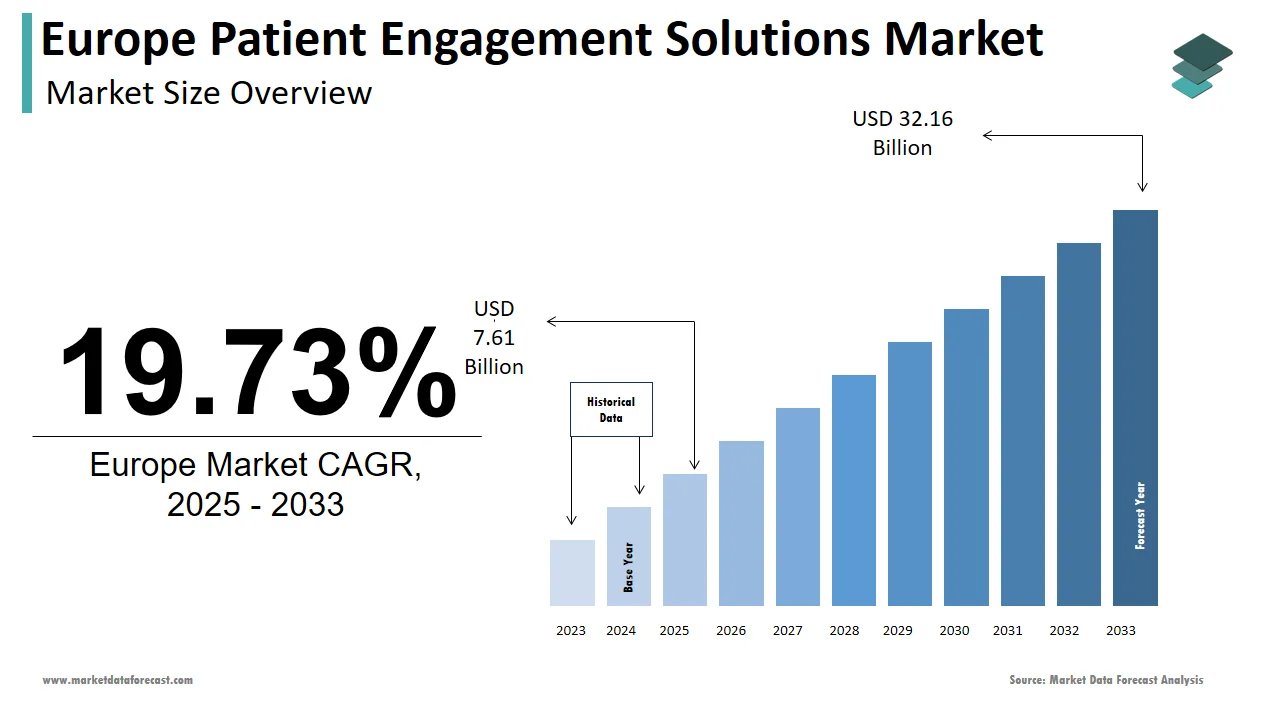
19.73%Europe Patient Engagement Solutions Market Size
The size of the Europe patient engagement solutions market was valued at USD 7.61 billion in 2025. This market is expected to grow at a CAGR of 19.73% from 2026 to 2034 and be worth USD 38.48 billion by 2034, up from USD 9.11 billion in 2026
The patient engagement solutions are integrated digital platforms and communication tools designed to actively involve individuals in their healthcare journey, from appointment scheduling and remote monitoring to treatment adherence and shared decision making. As per Eurostat, 64% of European adults aged 16 to 74 used the internet to seek health information in 2023, signaling strong digital readiness. The European Health Data Space Regulation further strengthens this ecosystem by standardizing patient data portability across borders while enforcing strict GDPR compliance.
MARKET DRIVERS
Mandatory Implementation of Electronic Health Records and Patient Access Rights
The EU’s legal framework mandating patient access to health data is a primary driver for the growth of the Europe patient engagement solutions market. According to the European Commission’s Directive on Patients’ Rights in Cross-Border Healthcare, all EU citizens have the right to access their electronic health records in a timely and secure manner. National compliance is accelerating implementation; Germany’s Electronic Patient Record Ordinance mandated that all statutory health insurers provide interoperable portals to 74 million insured individuals by January 2024. Countries with mature patient portals saw a 28% reduction in missed appointments and a 19% increase in chronic disease medication adherence. These legal imperatives transform patient engagement from an optional innovation into a statutory healthcare function.
Rising Burden of Chronic Diseases and Aging Populations
Europe’s shift and escalating prevalence of chronic conditions for continuous care models enabled by engagement solutions is additionally escalating the growth of Europe patient engagement solutions market. According to Eurostat, 21.5% of the EU population was aged 65 or older in 2023, a figure projected to reach 29.4% by 2050. Concurrently, the European Burden of Disease Study reported that non-communicable diseases account for 87% of all disability adjusted life years in the EU, with cardiovascular disease, diabetes, and chronic respiratory conditions leading in prevalence. The European Centre for Disease Prevention and Control confirmed that 54 million Europeans live with multimorbidity, requiring coordinated self-management. In response, the European Innovation Partnership on Active and Healthy Ageing documented that remote monitoring and medication reminder systems reduced hospital readmissions by 33% in heart failure patients across pilot sites in Italy and the Netherlands.
MARKET RESTRAINTS
Fragmented Interoperability Standards Across National Health Systems
The lack of unified technical standards for data exchange between national electronic health record systems is restricting the growth of the Europe patient engagement solutions market. According to the European Commission’s 2023 eHealth Network Report, only eleven member states fully implement the European Patient Summary and ePrescription exchange frameworks, limiting cross-border continuity of care. This fragmentation forces vendors to develop country-specific solutions, inflating development costs and delaying market entry. The European Health Management Association documented that average integration timelines for engagement platforms exceed fourteen months in multi-vendor hospital environments compared to five months in standardized settings.
Digital Literacy and Socioeconomic Disparities in Technology Access
The persistent gaps in digital literacy and internet access create inequitable adoption of patient engagement solutions among elderly and low-income populations is limiting the growth of the Europe patient engagement solutions market. According to Eurostat, only 41% of Europeans aged 65 to 74 possess basic digital skills, and 28% have never used the internet. The European Social Survey confirmed that 37% of low-income households cite the cost of devices and data as barriers to digital health participation. These disparities contradict the EU’s principle of health equity and risk widening care gaps unless accompanied by inclusive design and analog alternatives.
MARKET OPPORTUNITIES
Integration of AI-Powered Personalized Health Coaching
Europe’s push toward predictive and preventive care to deliver individualized health guidance is also prominently elevating the growth of Europe patient engagement solutions market. According to the European Commission’s Artificial Intelligence in Health Action Plan, over 45 million euros were allocated in 2023 to pilot AI coaching platforms for diabetes and hypertension management. National health systems are scaling adoption; the UK’s National Health Service integrated an AI lifestyle coach into its NHS App in early 2024 by reaching 28 million users with tailored nutrition and exercise plans. Additionally, the European Data Protection Board issued specific guidelines in 2023 for transparent AI decision-making, ensuring these tools comply with GDPR while delivering clinical value. These regulatory and clinical synergies position AI coaching as a transformative frontier in patient engagement.
Expansion of Engagement Solutions in Mental Health and Well-being Services
The growing recognition of mental health as integral to overall care is additionally to further increase the growth of the Europe patient engagement solutions market. According to the European Mental Health Coalition, 38% of EU adults reported symptoms of anxiety or depression in 2023, yet only 29% accessed professional help due to stigma and access barriers. National initiatives reinforce this shift, where Denmark’s Sundhed.dk portal now offers integrated cognitive behavioral therapy modules with 120000 monthly active users. As per a report, digital mental health engagement reduced wait times for specialist care by 34 days on average in pilot regions. Additionally, the European Medicines Agency is developing evaluation frameworks for regulated mental health apps as medical devices. These policies and public health imperatives position mental well-being as a high-growth domain for next-generation engagement solutions.
MARKET CHALLENGES
Inconsistent Reimbursement and Value Assessment Frameworks
The absence of harmonized reimbursement models for patient engagement solutions suppresses sustainable adoption, which is a challenge for the growth of the Europe patient engagement solutions market. According to the European Network for Health Technology Assessment, only five EU countries, such as Germany, France, Italy, the Netherlands, and Sweden, have formal health technology assessment pathways for digital therapeutics and engagement platforms as of early 2024. The European Health Insurance Consortium reported that in most member states, hospitals must fund these solutions from operational budgets without dedicated payment codes. A 2023 study found that reimbursement approval timelines for digital engagement tools averaged 17 months post regulatory clearance, with prices varying by over 250% between countries.
Regulatory Ambiguity in Classifying Engagement Tools as Medical Devices
The evolving and inconsistent classification of patient engagement solutions under the EU Medical Devices Regulation creates legal uncertainty for developers and healthcare providers is also degrading the growth of the Europe patient engagement solutions market. According to the European Commission’s MDR Implementation Group, tools that provide diagnostic suggestions or treatment recommendations may be classified as Class IIa or higher medical devices requiring rigorous clinical evaluation. However, the boundary remains unclear; the European Court of Justice has not issued binding jurisprudence on whether medication reminder apps or symptom checkers constitute medical devices. National competent authorities interpret rules differently; Germany’s BfArM classified a diabetes coaching app as a medical device in 2023, while France’s ANSM deemed a similar tool non-regulated.
REPORT COVERAGE
| REPORT METRIC | DETAILS |
| Market Size Available | 2025 to 2034 |
| Base Year | 2025 |
| Forecast Period | 2026 to 2034 |
| Segments Covered | By Component, Delivery Mode, Functionality, Application, Therapeutic Area, End-User, and Country. |
| Various Analyses Covered | Global, Regional, and Country-Level Analysis, Segment-Level Analysis, Drivers, Restraints, Opportunities, Challenges; PESTLE Analysis; Porter’s Five Forces Analysis, Competitive Landscape, Analyst Overview of Investment Opportunities |
| Countries Covered | UK, France, Spain, Germany, Italy, Russia, Sweden, Denmark, Switzerland, Netherlands, Turkey, Czech Republic, and the Rest of Europe. |
| Market Leaders Profiled | Allscripts Healthcare Solutions, Inc., Athenahealth, Inc., Cerner Corporation, Philips Healthcare, IBM, Lincor Solutions, McKesson Corporation, Medecision, Inc., Orion Health Ltd., Yourcareuniverse, Inc., Siemens, and Welvu. |
SEGMENTAL ANALYSIS
By Component Insights
The software segment was the largest and held a prominent share of the Europe patient engagement solutions market in 2024, with the EU’s regulatory push for digital health records and patient portals as mandated under the European Health Data Space Regulation. As per the European Commission, all member states must implement interoperable electronic health record systems with patient access modules by 2025, driving demand for secure, scalable software platforms. Additionally, the European Institute for Health Records documented that 74% of hospitals across the EU now integrate third-party patient engagement software with their core clinical systems to support appointment scheduling, prescription refills, and telehealth. These regulatory and operational imperatives make software the foundational layer of patient engagement in Europe.

The services segment is expected to register the fastest CAGR of 14.3% throughout the forecast period, with the increasing complexity of implementation, integration, and user support required for compliant engagement platforms. According to the European Commission’s Digital Europe Programme, investments are required for digital health transformation projects that include mandatory vendor-provided training, change management, and data migration services. Additionally, the European Centre for Disease Prevention and Control documented that ongoing patient onboarding and digital literacy coaching increased portal adoption rates by 47% in elderly populations.
By Delivery Mode Insights
The cloud-based delivery segment was the largest and held 59.3% of the Europe patient engagement solutions market share in 2024, with the scalability, security, and compliance advantages offered by EU-certified cloud infrastructures. As per the European Data Protection Board, over 76% of new patient engagement platforms launched in 2023 leveraged GAIA-X-aligned or EU Cloud Rulebook-compliant providers to ensure data residency and auditability. The European Commission’s Digital Health and Care Strategy mandates that all publicly funded digital health tools use cloud environments with built-in cybersecurity certifications, a condition met by providers like OVHcloud and Deutsche Telekom. Additionally, the European Health Telematics Observatory found that cloud deployments achieved full functionality in 4.8 months on average compared to 13 months for on-premises alternatives due to pre-integrated compliance modules. These technical and regulatory synergies solidify cloud as the dominant delivery model.
The cloud-based delivery segment is expected to showcase the fastest CAGR of 15.2% during the forecast period, owing to the integration of AI and real-time analytics native to cloud platforms. The European Telecommunications Standards Institute confirmed that 5G-enabled remote monitoring devices now stream patient data directly to cloud platforms for dynamic care pathway adjustments.
By Functionality Insights
The communication functionality segment accounted in holding 32.4% of the Europe patient engagement solutions market share in 2024, owing to the EU’s emphasis on continuity of care and reduced administrative burden through secure messaging, appointment coordination,n and telehealth integration. As per the European Commission’s Digital Health and Care Strategy, all national eHealth roadmaps prioritize bidirectional communication between patients and providers as a core service. National platforms exemplify this focus, where France’s Mon Espace Santé and the UK’s NHS App both feature integrated video consultation and message threads used by over 45 million citizens annually. Additionally, the European Health Data Space Regulation mandates standardized communication APIs to ensure interoperability across borders. These policy, operational, and user experience factors solidify communication as the central functionality segment.
The predictive analytics segment is likely to grow with an anticipated CAGR of 12.5% throughout the forecast period. This momentum is driven by the EU’s strategic shift toward preventive and personalized care. According to the European Commission’s Artificial Intelligence in Health Action Plan, over 52 million euros were allocated in 2023 to pilot AI-driven risk stratification tools for diabetes, cardiovascular disease, and mental health integrated into national patient portals. The European Centre for Disease Prevention and Control documented that predictive alerts for medication non-adherence reduced hospital readmissions in heart failure patients across trials in the Netherlands and Sweden. National health systems are scaling adoption; Germany’s Digital Health Applications Ordinance now includes predictive analytics as a reimbursable feature for certified digital therapeutics. Additionally, the European Data Protection Board issued specific transparency guidelines in 2024, ensuring algorithmic accountability while enabling clinical utility. These regulatory and clinical synergies position predictive analytics as the innovation frontier.
COUNTRY LEVEL ANALYSIS
Germany Patient Engagement Solutions Market Analysis
Germany was the top performer of the Europe patient engagement solutions market by occupying 23.4% of share in 2024, with its legally mandated Electronic Patient Record system, which enrolled 58 million citizens by early 2024 under the Digital Healthcare Act. As per the Federal Ministry of Health, all statutory health insurers must provide interoperable portals with functionalities for appointment booking, ePrescriptions, and telehealth. Additionally, the Federal Office for Information Security enforces strict cybersecurity requirements, ensuring high user trust.

United Kingdom Patient Engagement Solutions Market Analysis
The United Kingdom patient engagement solutions market was ranked second by holding 18.2% of share in 2024. The National Health Service Long Term Plan mandates digital-first primary care, driving the adoption of engagement tools across general practices. The UK’s Digital Technology Assessment Criteria require all publicly funded health apps to undergo rigorous clinical and data security reviews, ensuring high quality. Additionally, the National Institute for Health and Care Research funded 24 patient engagement trials in 2023, focusing on diabetes and mental health using AI-driven coaching.
France Patient Engagement Solutions Market Analysis
France patient engagement solutions market growth is attributed to holding significant growth opportunities throughout the forecast period with its centralized Mon Espace Santé platform, which serves over 52 million citizens with unified access to records, vaccination tracking, and secure messaging. France’s Digital Health Strategy 2025 mandates that all healthcare professionals connect to the national system by 202,6 with penalties for non-compliance. Additionally, the French National Authority for Health issued guidelines in early 2024 for integrating predictive analytics into patient portals for chronic disease management.
COMPETITIVE LANDSCAPE
The Europe patient engagement solutions market features intense rivalry among global health IT leaders, European health tech specialists, and public sector digital agencies, all operating within a highly regulated and ethically conscious environment. Unlike markets driven by feature proliferation, competition in Europe centers on compliance, interoperability, and trust. Global vendors like Philips, Siemens Healthineers, and Oracle Health leverage scale but must adapt to country-specific eHealth roadmaps and data sovereignty expectations. Public procurement dominance means relationships with national health services often outweigh pure technology advantages. Success increasingly depends on demonstrating measurable improvements in patient outcomes while adhering to Europe’s stringent privacy and equity standards.
KEY MARKET PLAYERS
Some of the companies that are playing a dominating role in the Europe patient engagement solutions market include
- Allscripts Healthcare Solutions, Inc.
- Athenahealth, Inc.
- Cerner Corporation
- Philips Healthcare
- IBM
- Lincor Solutions
- McKesson Corporation
- Medecision, Inc.
- Orion Health Ltd.
- YourCareUniverse, Inc.
- Siemens
- Welvu
TOP PLAYERS IN THE MARKET
- Philips Healthcare is a leading force in the Europe patient engagement solutions market, offering integrated platforms that connect patients with care teams across hospital, home, and community settings. The company’s HealthSuite Digital Platform powers national programs in Germany, the Netherlands, and the UK, enabling secure messaging, remote monitoring, and personalized care pathways. Globally, Philips contributes by embedding European privacy and interoperability standards into its worldwide health technology portfolio, ensuring consistent ethical design across markets while advancing value-based care models through longitudinal engagement analytics.
- Siemens Healthineers plays a strategic role in the Europe patient engagement solutions market through its teamplay digital health ecosystem, which integrates imaging, diagnostics, and patient communication tools. The company supports public health systems in Spain, Italy, and Sweden with cloud-based portals that allow patients to access radiology reports, schedule follow ups and receive AI-powered insights. It also partnered with the German Electronic Patient Record authority to ensure seamless data exchange between its platforms and the national infrastructure. Globally, Siemens extends its influence by harmonizing European data governance principles with its international digital health offerings, promoting cross-border research and care continuity.
- Cerner Corporation, now operating as Oracle Health, is a key contributor to the Europe patient engagement solutions market through its Millennium EHR integrated patient portal used by major hospitals in the UK, France, and the Nordics. The platform supports multilingual communication, medication management, and telehealth aligned with national digital health strategies. It also collaborated with the NHS England to enhance patient access to mental health resources within the Cerner portal. Globally, Oracle Health strengthens its position by aligning European regulatory expectations on data portability and AI transparency with its global cloud infrastructure, enabling scalable, compliant deployment across continents.
TOP STRATEGIES USED BY THE KEY MARKET PARTICIPANTS
Key players in the Europe patient engagement solutions market prioritize regulatory alignment by embedding European Health Data Space, GDPR, and Medical Devices Regulation requirements directly into their platforms. They invest in sovereign cloud infrastructure through GAIA-X and national partnerships to ensure data residency and cybersecurity compliance. Strategic collaborations with public health authorities and hospital networks accelerate integration with national eHealth ecosystems. Companies develop AI-driven predictive analytics and personalized coaching tools validated through real-world evidence to support value-based care. Additionally, they offer multilingual and accessibility compliant interfaces to address digital inclusion and reduce health disparities across diverse European populations.
MARKET SEGMENTATION
This Europe patient engagement solutions market research report is segmented and sub-segmented into the following categories.
By Component
-
Software
-
Standalone Software
-
Integrated Software
-
-
Hardware
-
Integrated Bedside Terminals / Assisted Devices
-
In-room Televisions
-
Tablets
-
-
Services
-
Consulting Services
-
Implementation & Training
-
Support & Maintenance
-
Data Analytics & Reporting Services
-
By Delivery Mode
-
Web-Based
-
Cloud-Based
-
On-Premise
By Functionality
-
Communication
-
Health Tracking & Insights
-
Billing & Payments
-
Administrative
-
Patient Education
-
Predictive Analytics
-
Streamlined Operations
By Application
-
Population Health Management
-
Outpatient Health Management
-
Inpatient Health Management
-
Home Health Management
-
Social & Behavioral Management
-
Financial Health Management
By Therapeutic Area
-
Chronic Disease Management
-
Women's Health
-
Mental Health
-
Fitness
-
Health & Wellness
By End-User
-
Healthcare Providers
-
Outpatient Facilities
-
Inpatient Facilities
-
-
Healthcare Payers
-
Private
-
Public
-
-
Pharmaceutical Companies
-
Pharmacies
-
Independent Pharmacies
-
Community Pharmacies
-
Mail-Order Pharmacies
-
Retail Pharmacies
-
Digital Pharmacies
-
Specialty Pharmacies
-
Central Fill Pharmacies
-
Compounding Pharmacies
-
Others
-
-
Individual Users
By Country
- UK
- France
- Spain
- Germany
- Italy
- Russia
- Sweden
- Denmark
- Switzerland
- Netherlands
- Turkey
- Czech Republic
- Rest of Europe
Frequently Asked Questions
1. What is the europe patient engagement solutions market?
The europe patient engagement solutions market provides digital platforms and services to enhance patient participation and self-management in healthcare
2. Which countries lead the europe patient engagement solutions market?
Germany, France, and the UK lead the europe patient engagement solutions market thanks to advanced healthcare infrastructure and rapid digital innovation
3. What drives growth in the europe patient engagement solutions market?
Growth in the europe patient engagement solutions market is driven by chronic disease burden, digital health adoption, and regulatory support for value-based care
4. What are the top solutions in the europe patient engagement solutions market?
Top solutions in the europe patient engagement solutions market are patient portals, telehealth systems, mobile health apps, and remote monitoring platforms
5. How does artificial intelligence transform the europe patient engagement solutions market?
AI enables predictive analytics, risk stratification, and tailored care plans in the europe patient engagement solutions market, boosting proactive engagement
6. What impact does remote monitoring have on the europe patient engagement solutions market?
Remote monitoring allows providers in the europe patient engagement solutions market to track health data, enabling early intervention and better outcomes
7. Who are key players in the europe patient engagement solutions market?
Key players in the europe patient engagement solutions market include Cerner, Siemens Healthineers, Philips, and Orion Health, among others
8. How does telehealth shape the europe patient engagement solutions market?
Telehealth expands access to care, streamlines communication, and enhances convenience in the europe patient engagement solutions market
9. What challenges face the europe patient engagement solutions market?
Major challenges for the europe patient engagement solutions market include data privacy, cybersecurity, system interoperability, and user adoption
10. How do patient portals benefit the europe patient engagement solutions market?
Patient portals help patients access records, schedule appointments, and communicate securely within the europe patient engagement solutions market
Related Reports
Access the study in MULTIPLE FORMATS
Purchase options starting from
$ 2000
Didn’t find what you’re looking for?
TALK TO OUR ANALYST TEAM
Need something within your budget?
NO WORRIES! WE GOT YOU COVERED!
Call us on: +1 888 702 9696 (U.S Toll Free)
Write to us: sales@marketdataforecast.com