- Product Description Description
- Table of Contents TOC
- List of Table & Figure LOT
- Get Free Sample PDF Sample PDF
Market Size, 2025
$42.84 BnMarket Estimate, 2026
$44.81 BnMarket Forecast, 2034
$64.21 BnCAGR, 2026–2034
4.60%Executive Summary: Europe Penoxsulam Market
- Market Scope: Comprehensive market evaluation of the European penoxsulam herbicide ecosystem, analyzing crop-specific applications, aquatic weed management, and country-level adoption dynamics in Southern Europe.
- Market Valuation: Valued at USD 42.84 billion in 2025, estimated at USD 44.81 billion in 2026, and projected to reach USD 64.21 billion by 2034, registering a steady CAGR of 4.60% (2026–2034).
- Primary Growth Drivers: Concentrated and intensive rice cultivation in Southern Europe, favorable regulatory approvals under the EU pesticide framework, rising resistance to traditional ALS inhibitors, and specialized demand for targeted aquatic weed control.
Key Market Segment Metrics (2026–2034)
| Category | Leading Segment (Base Position) | Fastest-Growing Segment (2026–2034) |
|---|---|---|
| By Crop / Application Type | Rice Cultivation (captures the dominant market share due to critical weed management needs in flooded paddy systems across Southern Europe) | Aquatics (projected at a noteworthy 6.8% CAGR, driven by rising demand for selective weed control in irrigation canals and managed water bodies) |
| By Country / Region | Italy (dominated the European market with a 52.4% share in 2025, anchored by extensive Po Valley rice farming) | Spain, Portugal, and Greece (expanding steadily through specialized rice regimes and aquatic invasive species management) |
Major Market Players & Market Structure
Market Structure: A highly specialized and tightly regulated niche marketplace characterized by a quasi-monopolistic structure, where innovators and licensed distribution partners focus on regulatory stewardship, resistance management, and agronomic support rather than volume expansion.
Key Companies: Corteva Agriscience, Dow Chemical Co., ADAMA Agricultural Solutions Ltd, Nufarm Ltd., Bayer CropScience AG, Syngenta International AG, Chemtura Corp., Monsanto Co., Shijiazhuang Xingbai Bioengineering Co., and BASF SE.
Europe Penoxsulam Market Size
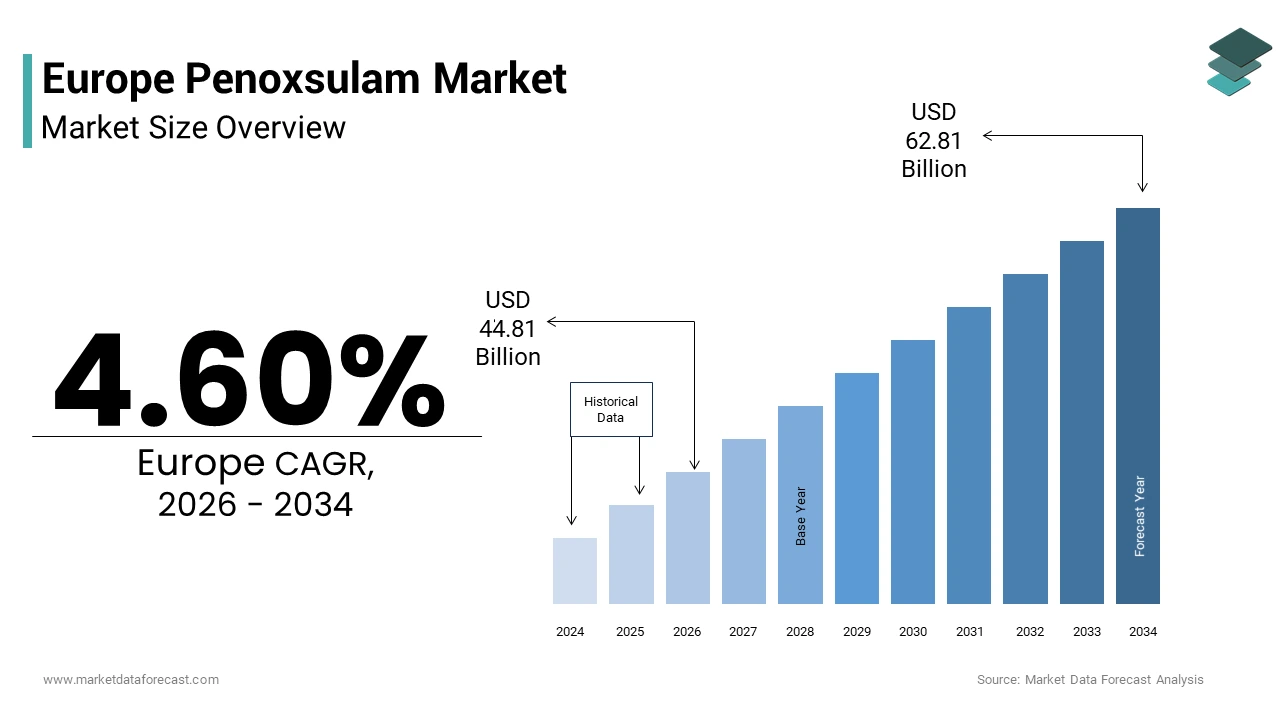
The European penoxsulam market was valued at USD 42.84 billion in 2025 and is anticipated to reach USD 44.81 billion in 2026 from USD 64.21 billion by 2034, growing at a CAGR of 4.60% from 2026 to 2034.
Current Introduction of the European Penoxsulam Market
Penoxsulam is a selective systemic post emergence herbicide belonging to the triazolopyrimidine sulfonamide chemical class, primarily used for controlling broadleaf and grassy weeds in rice paddies and certain non-crop aquatic environments. In the European context, its application is highly specialized and geographically limited due to the continent’s minimal rice cultivation, which accounts for less than 1 percent of global production. As per sources, the majority of the European Union's rice cultivation is concentrated in Italy, Spain, and Portugal, where penoxsulam is approved for use under regulated conditions to control weeds. The compound functions by inhibiting acetolactate synthase ALS, a key enzyme in bbranched-chainamino acid synthesis, leading to cessation of weed growth within days of application. The European Food Safety Authority (EFSA) classifies penoxsulam as an herbicide with low toxicity to mammals and birds, and a relatively short life in soil, but notes that it requires strict management in aquatic ecosystems due to its potential to affect aquatic life. Its market in Europe is not driven by volume but by precision, serving a niche agricultural segment where alternative weed control options are limited due to water management constraints and resistance issues. This tightly regulated, low-volume, high-specificity profile defines the unique operational landscape of the European penoxsulam market.
MARKET DRIVERS
Concentrated Rice Cultivation in Southern Europe Driving Targeted Demand
Rice farming in Southern Europe is limited but intensive, which fuels the growth of the European penoxsulam market. This intensity creates a focused and consistent demand for penoxsulam as a critical weed management tool in flooded paddy systems. Italy and Spain dominate EU rice production, operating irrigation systems that create high-risk environments for persistent aquatic weeds, including red rice and barnyard grass. These conditions render many conventional herbicides ineffective or environmentally risky, making penoxsulam’s selective action and water compatibility essential. Field research in Italy has demonstrated that targeted application of penoxsulam is highly effective in managing infestations of barnyard grass (Echinochloa crus-galli) in rice paddies. Furthermore, the rise of herbicide-resistant biotypes in the Po Valley has accelerated adoption. Italian rice growers widely incorporate penoxsulam into their integrated management strategies to address herbicide-resistant weed species. Given the limited, scalable non-chemical alternatives and its recent EU approval renewal, penoxsulam is considered a critical tool for managing weeds in Europe’s primary rice-producing region.
Regulatory Acceptance Under the EU Pesticide Framework: Ensuring Continued Use
Penoxsulam’s continued availability in the region hinges on its favorable toxicological and environmental profile, which has secured repeated approval under the stringent EU pesticide regulation framework, and thereby contributes to the expansion of the European penoxsulam market. The regulatory authorization for the herbicide penoxsulam has been extended based on a review of its risk profile. Evaluations indicated that the substance presents a low risk to users and environmental organisms when applied according to specific instructions. The compound is noted for rapid degradation in soil under aerobic conditions. This regulatory stability provides growers with long-term planning certainty, unlike other ALS inhibitors that face increasing restrictions. Additionally, penoxsulam is not classified as a candidate for substitution under EU criteria, meaning it is not slated for phase-out despite being a synthetic active substance. For rice farmers in Italy and Spain who have few effective alternatives, this regulatory endorsement is indispensable. The EU's crackdown on older herbicides like propanil makes penoxsulam the reliable, compliant choice for effective paddy weed protection.
MARKET RESTRAINTS
Stringent Environmental Restrictions Limiting Application Scope
Penoxsulam faces significant use constraints in the region, despite its approval, due to protective measures for aquatic ecosystems and drinking water sources, which in turn restrain the growth of the European penoxsulam market. A significant portion of rice cultivation in key European agricultural areas now coincides with protected water zones. Mitigation measures, such as buffer strips and application restrictions, are increasingly enforced to address potential runoff risks into surface water networks. Specific regulatory updates for herbicide use in rice paddies require mandatory distance restrictions from surface waters unless specialized drift-reducing technology is used. The implementation of stricter environmental stewardship requirements, including enhanced runoff management, has resulted in a measurable reduction in the active farming area per production unit. Furthermore, member states can impose additional restrictions. These limitations fragment the market, confining penoxsulam to specific sub-regions within Italy and Spain and preventing expansion into other potential uses such as turf or non-crop areas. Consequently, even though agronomically effective, its environmental risk mitigation requirements cap both volume and geographic reach, reinforcing its niche status.
Low Awareness and Limited Adoption Outside Core Rice Regions
Penoxsulam’s utility remains largely unrecognized beyond Southern Europe’s rice belt because of minimal extension services, lack of registration in Northern and Eastern member states, and absence of relevant cropping systems. This limits the expansion of the European penoxsulam market. The authorized use of this herbicide is primarily concentrated in specific Mediterranean regions where rice cultivation is prevalent. In northern European areas, the absence of corresponding rice cultivation means this herbicide is not introduced into the agricultural landscape. Agronomic professionals operating outside of the authorized southern regions have limited exposure to the herbicide, resulting in a lack of practical experience with it. A survey indicated that many agronomists in non-Mediterranean areas have not recommended or encountered this herbicide in their professional practice. Moreover, potential non-rice applications, such as in cranberry bogs or managed wetlands, are economically insignificant in Europe compared to North America, offering no commercial incentive for registration expansion. Penoxsulam will not gain traction in European agriculture without demonstration trials, educational campaigns, and regulatory harmonization. This isolation restricts market development to a narrow corridor of traditional use, leaving untapped potential in emerging aquatic weed scenarios unaddressed due to systemic disengagement.
MARKET OPPORTUNITIES
Integration into Herbicide Resistance Management Programs
The escalating threat of ALS inhibitor-resistant weeds in European rice fields provides a major opportunity for the European penoxsulam market. It acts as a rotational partner in resistance management strategies. Weed species have developed resistance to commonly used ALS inhibitors like imazamox and bispyribac-sodium, impacting control. Certain ALS inhibitors, such as penoxsulam, possess distinct characteristics that can manage populations resistant to other similar herbicides. Field trials indicate that rotating herbicides, specifically using penoxsulam with non-ALS herbicides, reduces selection pressure for resistance and maintains higher weed control over seasons compared to continuous use of single-mode herbicides. Consequently, management strategies are incorporating rotation and specific herbicide choices to address resistance. Beyond just weed control, penoxsulam acts as a sustainability enabler in high-intensity rice systems by serving as a tactical diversification tool, which is increasingly important under the EU’s anti-resistance Sustainable Use Regulation.
Development of Co-Formulations with Complementary Actives
The creation of premixed formulations combining penoxsulam with herbicides of different modes of action offers a potential prospect to enhance efficacy, broaden the weed spectrum, and simplify application. This development is anticipated to boost the expansion of the European penoxulam market. Combining active ingredients within a single product formulation can decrease the necessary number of field applications, reduce the overall volume of active components used, and support efforts to manage resistance. A recent product introduction in specific European markets blends an herbicide with a safener, which improves the crop's tolerance and allows for increased application rates during periods of lower temperatures. Field evaluations indicated that this specific combination enhances the management of difficult-to-control weeds, such as certain sedge species, when compared to using the herbicide component alone. Regulatory pathways support this innovation. The EU permits co-formulation registration if toxicological profiles are compatible, which they are in this case. Such products appeal to growers seeking simplicity and reliability, especially as labor shortages make multiple spray operations less feasible. Integrating penoxsulam into multi-component solutions maximizes its efficacy and market reach, securing its role as a vital tool within its specialized geographic zones.
MARKET CHALLENGES
Geographic Concentration Creating Supply Chain Vulnerability
Regional over-dependence breeds supply chain risks, which are among the serious challenges to theEuropeane penoxsulam market. The European penoxsulam market’s extreme dependence on just two countries, Italy and Spain, for nearly all demand creates significant supply and policy vulnerability. Rice production in the European Union is concentrated in a few nations, making the market vulnerable to regional disruptions. Weather events like flooding can delay planting schedules. Reduced planting activity is associated with lower demand for crop protection products. Water shortages in major growing areas can lead to uncultivated land, further reducing market demand. Because manufacturers cannot economically justify dedicated European production lines for such a small market, penoxsulam is imported in bulk from global facilities, exposing it to shipping delays and customs bottlenecks. The 2024 Red Sea crisis extended delivery times, forcing distributors to ration stock. The market's lack of diversification leaves it vulnerable to shocks, aggravating risks already posed by water scarcity and land competition.
Lack of Investment in New Application Technologies and Delivery Systems
The niche status of penoxsulam in the region discourages innovation in precision application methods, which impedes the expansion of the European penoxsulam market. This could reduce environmental impact and improve efficiency. Rice farming in some European areas often employs traditional broadcast spraying for herbicides instead of newer precision systems. Conventional methods in these regions may lead to greater chemical use and more drift compared to targeted application techniques. Agrochemical companies often concentrate R&D on high-volume molecules, potentially leaving specialized herbicides with older application protocols. Newer methods, like drone-based spot spraying, could potentially decrease the amount of certain herbicides needed for weed control while keeping their effectiveness. Currently, limited manufacturer backing is hindering the widespread use of advanced, localized spraying programs. The failure to adopt digital agronomy tools and smart spraying technologies leaves penoxsulam reliant on inefficient, broad-spectrum applications, which directly conflict with EU Farm to Fork sustainability goals. This technological stagnation risks future regulatory scrutiny and limits the molecule’s potential to contribute meaningfully to sustainable rice production in an era demanding precision and accountability.
REPORT COVERAGE
| REPORT METRIC | DETAILS |
| Market Size Available | 2025 to 2034 |
| Base Year | 2025 |
| Forecast Period | 2026 to 2034 |
| CAGR | 4.60% |
| Segments Covered | By Crop Type, And By Region |
| Various Analyses Covered | Global, Regional Country-Level Analysis; Segment-Level Analysis; DROC; PESTLE Analysis; Porter’s Five Forces Analysis; Competitive Landscape; Analyst Overview of Investment Opportunities |
| Regions Covered | UK, France, Spain, Germany, Italy, Russia, Sweden, Denmark, Switzerland, Netherlands, Turkey, the Czech Republic, and the Rest of Europe |
| Market Leaders Profiled | Dow Chemical Co., Bayer CropScience AG, Syngenta International AG, Chemtura Corp., Monsanto Co., Nufarm Ltd., Shijiazhuang Xingbai Bioengineering Co., and BASF SE. |
SEGMENTAL ANALYSIS
By Crop Insights
The rice segment led the European penoxsulam market by capturing a substantial share in 2025. The leading position of the rice segment is attributed to the herbicide’s unique efficacy in flooded paddy systems, where few alternatives offer comparable selectivity and residual control. Penoxsulam targets problematic grasses like Echinochloa crus-galli and broadleaf weeds such as Monochoria vaginalis that thrive in anaerobic conditions, without injuring rice plants due to its metabolic selectivity. A further driver is the concentration of EU rice production in Southern Europe. Rice cultivation within the European Union is significantly concentrated in particular areas. In these regions, conventional herbicides used for managing weeds are facing difficulties with both effectiveness and regulatory restrictions. Mechanized approaches to weed control are not practical for widespread implementation. Newer, specialized herbicide treatments appear effective against persistent weeds like barnyard grass when compared to older treatments. Regulatory bodies have extended the approval for specific modern herbicides, ensuring their availability for rice farming in the foreseeable future. Penoxsulam is an irreplaceable tool for Europe's intensive, small-scale rice industry, driven by the lack of viable non-chemical alternatives and rising resistant weed biotypes.

The aquatics segment is expected to exhibit a noteworthy CAGR of 6.8% between 2026 and 2034 due to increasing demand for selective weed control in managed aquatic environments such as irrigation canal,s drainage ditch,es and recreational water bod,ies where invasive species like water hyacinth and alligator weed threaten water flow and biodiversity. Unlike broad-spectrum herbicides, penoxsulam offers targeted control of emergent and floating broadleaf weeds with minimal impact on submerged vegetation and aquatic fauna when applied according to label guidelines. Observations from a wetlands trial indicate that a specific herbicide, penoxsulam, effectively reduced Pontederia crassipes coverage within several weeks while leaving native macrophytes largely unaffected. Regulatory frameworks, such as the EU Water Framework Directive, encourage the use of targeted treatments that maintain good ecological status in surface waters, which supports the application of precise interventions. The findings suggest a shift towards using selective, reduced-risk herbicides to manage invasive aquatic vegetation without compromising the surrounding ecosystem. The aquatics market is growing in Southern Europe, specifically Portugal, Greece, and France, driven by increased weed growth stemming from climate change. The shift toward policy-driven integrated water management ensures a growing, consistent niche for penoxsulam in sustainable, aquatic vegetation management.
COUNTRY LEVEL ANALYSIS
Italy Penoxsulam Market Analysis
Italy dominated the European penoxsulam market by accounting for a 52.4% share in 2025. The dominance of the Italian market is driven by the EU’s top rice producer, cultivating substantial hectares primarily in the Po Valley, a region characterized by intensive flooded agriculture and high weed pressure. The widespread adoption of penoxsulam is driven by the prevalence of herbicide-resistant Echinochloa biotypes. Many rice producers in Italy have shifted toward utilizing penoxsulam to manage weeds that have developed resistance to previously common herbicides. The adoption of this management strategy is largely supported by existing regulatory frameworks. Current authorization for the use of penoxsulam in Italian rice farming is maintained under standard regulatory compliance, without further limitations beyond typical buffer zones. Additionally, cooperative structures like Ente Nazionale Risi facilitate bulk procurement and technical training, ensuring consistent application quality. Italy stands as the undisputed center of European penoxsulam demand, driven by robust agronomic services and few alternative options for weed control in rice cultivation.
Spain Penoxsulam Market Analysis
Spain was the next prominent player in the European penoxsulam market by holding a 38.7% share in 2025. The growth of the Spanish market is propelled by the Ebro Delta and Guadalquivir regions, which together account for a significant number of hectares of rice cultivation under strict water management regimes. Penoxsulam is favored for its compatibility with continuous flooding systems where contact herbicides fail, and soil residual activity is critical. A key driver is the rise of red rice infestations. Rising populations of weedy rice are creating increased pressure on cultivators, leading to a shift toward systemic early-season weed management solutions. National agricultural strategies promoting herbicide rotation have contributed to the increased adoption of specific chemical controls for resistance management. While water scarcity occasionally limits total acreage, specific herbicides remain a critical tool during normal water availability seasons to manage weed competition. A combination of organized grower groups and agricultural funding mechanisms supports the continued high adoption rate of specialized, effective weed control techniques in the primary rice-producing regions.
Portugal Penoxsulam Market Analysis
Portugal occupies a significant position in theEuropeane penoxsulam market. Its market is centered in the Tejo and Sado river valleys, where thousands of hectares of rice are cultivated under traditional flooded methods. Penoxsulam adoption has grown steadily since its national authorization, driven by increasing infestations of Cyperus difformis and Echinochloa oryzicola that reduce yields if uncontrolled. The Portuguese Rice Producers Association actively promotes penoxsulam as part of integrated weed management to comply with the EU’s Sustainable Use Directive. Younger farmers in Portugal are driving a notable shift toward precision chemistry rather than legacy herbicides, despite the market's relatively small scale. Adhering strictly to EU regulatory standards and partnering with Spain in cross-border resistance monitoring, Portugal functions as a reliable, secondary hub for penoxsulam application in Southern Europe.
Greece Penoxsulam Market Analysis
Greece grew steadily in the European penoxsulam market. Its limited but growing use is concentrated in the Thessaly and Macedonia regions. In Italy, rice cultivation spans notable hectares along the Aliakmon and Axios rivers. Penoxsulam was authorized in Greece following local trials that confirmed its efficacy against Ludwigia peploides and Echinochloa crus-galli—, pecies increasingly problematic due to warmer springs and extended growing seasons. As per a study, penoxsulam reduced weed biomass compared to untreated controls, with no observed phytotoxicity. The Greek Ministry of Rural Development includes penoxsulam in its recommended herbicide rotation schemes to delay resistance development in smallholder farms. Despite current low adoption rates, Greece's unique geography and high susceptibility to invasive aquatic weeds suggest significant growth potential for management solutions in both rice cultivation and non-crop aquatic areas over the next ten years.
France Penoxsulam Market Analysis
France is likely to expand in the European penoxsulam market. Despite having minimal rice production, France maintains a small but regulated presence of penoxsulam primarily for experimental and emergency use in aquatic weed control. The herbicide is not approved for routine rice farming due to the country’s precautionary stance on ALS inhibitors in sensitive wetland ecosystems. Regulatory bodies have permitted the temporary use of penoxsulam for managing invasive Ludwigia species in specific aquatic environments, marking an expansion beyond conventional agricultural applications. This action highlights a trend of exploring the use of penoxsulam for targeted aquatic weed control within the scope of European environmental directives. While agricultural use in rice crops remains limited, specialized applications in these areas are being evaluated. The continued scientific assessment and regulatory review of these applications make this region a key case study for potential future approvals in other areas dealing with aquatic invasive species.
COMPETITIVE LANDSCAPE
Competition in the EEuropeanPenoxsulam Market is highly constrained due to intellectual property protection and limited geographic applicability, resulting in a quasi-monopolistic structure dominated by the innovator and a few licensed partners. The market is not characterized by price rivalry but by regulatory stewardship, technical support, and stewardship credibility. With penoxsulam approved in only four EU countries and used almost exclusively in rice paddies, competition focuses on service differentiation rather than product substitution. Generic entry remains blocked by patent and data exclusivity, while alternative herbicides face resistance or environmental limitations. Distributors compete on logistics reliability, agronomic advisory quality, and compliance assistance rather than formulation innovation. The absence of significant volume discourages new entrants, and end users have minimal bargaining power due to the lack of alternatives. As a result, the market operates as a tightly managed specialty segment where success depends on maintaining regulatory goodwill, supporting sustainable use, and ensuring uninterrupted supply to a small but critical user base in Southern Europe.
KEY MARKET PLAYERS
This market is extremely disjointed, with numerous big and developing players operating in the business. The major companies dominating the European Penoxsulam market are
- Dow Chemical Co.
- Bayer CropScience AG
- ADAMA Agricultural Solutions Ltd
- Corteva Agriscience
- Syngenta International AG
- Chemtura Corp.
- Monsanto Co.
- Nufarm Ltd.
- Shijiazhuang Xingbai Bioengineering CoCo
- BASF SE.
Top Players In The Market
- Corteva Agriscience is the originator and primary global developer of penoxsulam, holding key patents and regulatory registrations across major agricultural markets. In Europe, the company supplies penoxsulam exclusively for rice and aquatic weed control through authorized distributors in Italy, Spain, Portugal, and Greece. Corteva supports growers with agronomic guidance on resistance management and integrated weed control strategies tailored to Southern European paddy systems. It also collaborated with national rice associations to update herbicide rotation guidelines, incorporating penoxsulam as a core ALS inhibitor alternative. These initiatives reinforce Corteva’s role as the scientific and regulatory steward of penoxsula,m not only in Europe but global,ly where it remains the sole commercial supplier of the active ingredient.
- ADAMA plays a strategic role in tEuropeanope penoxsulam market as a licensed formulator and distributor under agreement with the patent holder, offering branded and generic versions to rice farmers in Southern Europe. The company leverages its extensive distribution network in Italy and Spain to ensure timely product availability during critical application windows. It also enhanced its digital agronomy platform to include penoxsulam-specific weed identification tools and resistance risk maps for regional advisors. By combining supply reliability with localized technical support, ADAMA strengthens access to this essential herbicide formid-sizedd farms that rely on cost-effective yet compliant solutions in an increasingly regulated environment.
- Nufarm contributes to the European penoxsulam market through strategic partnerships and regulatory expertise, facilitating product registration and distribution in niche geographies like Portugal and Greece. Although not a primary manufacturer, the company acts as a regional service provide,r ensuring compliance with EU pesticide regulations and national labeling requirements. It also developed multilingual stewardship materials for applicato,rs emphasizing buffer zone adherence and water protection protocols. Through its focus on regulatory navigation and environmental responsibil,ity Nufarm enables sustainable access to penoxsulam in emerging application zones beyond traditional rice cultivation.
Top Strategies Used By The Key Market Participants
Key players in Europeanrope Penoxsulam Market maintain exclusive or licensed rights to the active ingredient, ensuring supply control and regulatory compliance. They invest in localized agronomic education and resistance management programs to promote responsible use among rice growers. Companies developco-formulationss with safeners or complementary actives to enhance crop safety and broaden the weed spectrum. Strategic partnerships with national rice associations and water authorities facilitate adoption in both agricultural and aquatic settings. Additionally, they provide digital decision support tools and multilingual stewardship resources to align with EU Sustainable Use Directive requirements and protect water resources.
MARKET SEGMENTATION
This research report on the European penoxsulam market is segmented and sub-segmented into the following categories.
By Crop Type
- Rice
- Aquatics
- other types of crops
By Country
- UK
- France
- Spain
- Germany
- Italy
- Russia
- Sweden
- Denmark
- Switzerland
- Netherlands
- Turkey
- Czech Republic
- Rest of Europe