- Product Description Description
- Table of Contents TOC
- List of Table & Figure LOT
- Get Free Sample PDF Sample PDF
Europe Perovskite Solar Cell Market Report Summary
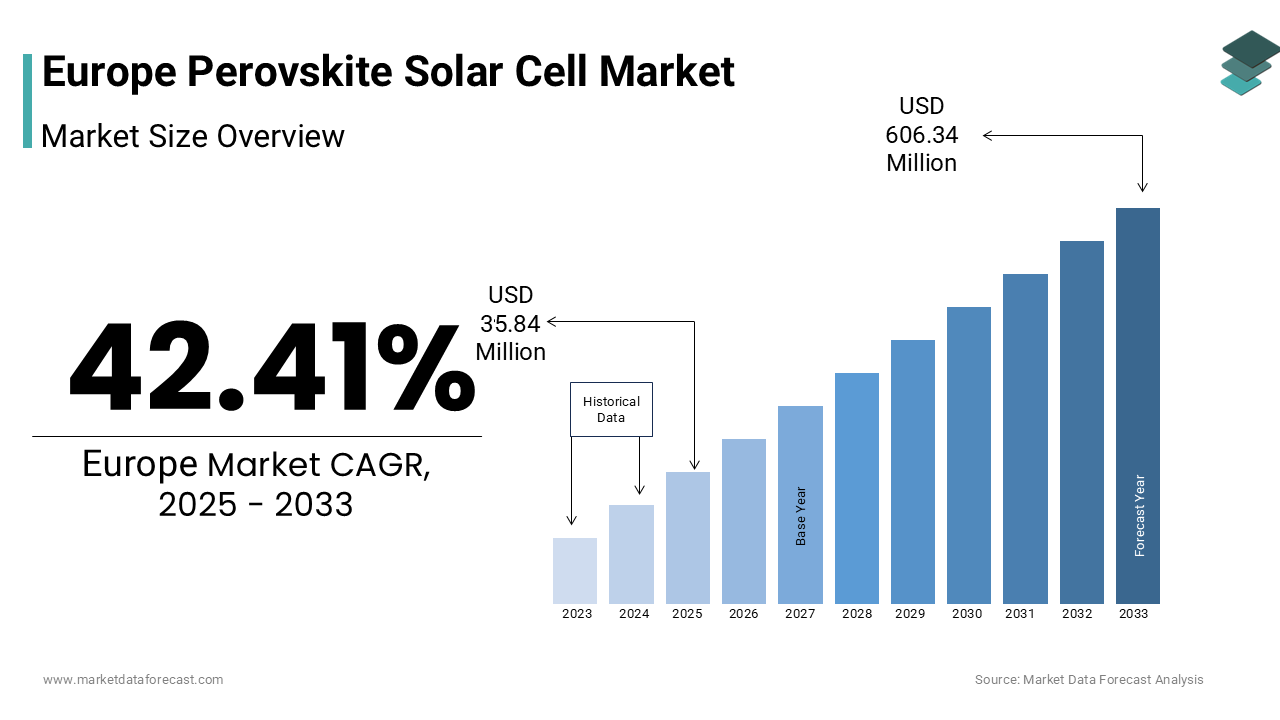
The Europe Perovskite Solar Cell Market Report was valued at USD 25.17 million in 2024, is projected to reach USD 35.84 million in 2025, and is expected to grow substantially to USD 606.34 million by 2033, expanding at an impressive CAGR of 42.41% from 2025 to 2033. The market growth is driven by rapid technological advancements in perovskite material efficiency, rising demand for affordable renewable energy systems, and increasing adoption of solar-integrated infrastructure across Europe. Supportive EU sustainability goals, strong government funding for clean energy, and active R&D collaborations among European innovators are accelerating perovskite commercialization.
Key Market Trends
- Advancements in high-efficiency perovskite materials are improving energy conversion rates.
- Growing adoption of flexible, lightweight solar modules for portable and building applications.
- Increasing integration of BIPV (Building Integrated Photovoltaics) in sustainable construction.
- Rising innovation in perovskite-silicon tandem solar cells for enhanced performance.
- Focus on durability and scalable mass production for commercial deployment.
Segmental Insights
- Based on type, the rigid perovskite segment dominated the market in 2024, driven by superior mechanical strength, higher efficiency, and suitability for traditional solar panels.
- Based on Application, the Building Integrated Photovoltaics (BIPV) segment accounted for a significant market share in 2024, supported by the increasing use of solar-integrated construction materials in smart and energy-efficient buildings.
Regional Insights
- Germany led the market with a 26.3% share in 2024, driven by strong policy support, advanced R&D facilities, and early adoption of next-generation solar technologies.
- The United Kingdom is expanding its renewable infrastructure and integrating perovskite solar tech into urban projects.
- France continues to invest in sustainable energy innovations and solar research programs.
- Switzerland and Poland are emerging as technology hubs with growing startup ecosystems focused on solar innovation.
Competitive Landscape
The Europe Perovskite Solar Cell Market is moderately consolidated, featuring a mix of established energy technology companies and emerging solar innovators. Market participants are emphasizing research collaboration, scalable production, and hybrid technology integration to strengthen competitiveness. Strategic partnerships between universities, research institutions, and manufacturers are enabling faster product commercialization and industrial adoption across the region.
Prominent players operating in the market include Oxford Photovoltaics (UK), Saule Technologies (Poland), Greatcell Energy, G24 Power Ltd., Meyer Burger Technology AG, Dyenamo AB, Fraunhofer ISE, Solaronix SA, Swift Solar, Hunt Perovskite Technologies, Panasonic Europe, and Toshiba Europe GmbH.
Europe Perovskite Solar Cell Market Size
The europe perovskite solar cell market size was valued at USD 25.17 million in 2024 and is anticipated to reach USD 35.84 million in 2025 from USD 606.34 million by 2033, growing at a CAGR of 42.41% during the forecast period from 2025 to 2033
Perovskite solar cells are a class of next generation photovoltaic devices that utilize light absorbing materials with a crystal structure analogous to calcium titanium oxide by offering high power conversion efficiency potential combined with low temperature solution processability. In Europe, this technology is emerging as a strategic enabler for lightweight, flexible, and building integrated photovoltaics that complement conventional silicon panels. The European Union’s installed solar photovoltaic capacity reached 280 gigawatts by the end of 2024. Perovskite technology addresses this gap by allowing semi-transparent and tinted solar glazing that maintains aesthetic functionality while generating power.
MARKET DRIVERS
EU Solar Energy Strategy Mandates Innovation in Next Generation Photovoltaics
The European Union’s institutional commitment to solar energy as a energy sovereignty has created a targeted policy environment that actively favors perovskite solar cell development. The EU solar energy strategy mandates innovation in next generation photovoltaics is majorly bolstering the growth of Europe Perovskite Solar Cell Market. This policy framework is not merely aspirational; it includes concrete mechanisms such as the European Solar PV Industry Alliance, which brings together over 300 companies and research organizations to accelerate commercialization. The REPowerEU Plan further mandates that all new public and commercial buildings with suitable roofs must install solar panels by 2026 with a requirement that creates demand for lightweight and aesthetically adaptable solutions like perovskite modules.
Superior Performance Metrics Enable Novel Deployment Scenarios
Perovskite solar cells unlock deployment opportunities inaccessible to conventional silicon due to their unique combination of high efficiency under low light, tunable transparency, and mechanical flexibility, which is additionally levelling up the growth of Europe perovskite solar cell market. Laboratory scale perovskite silicon tandem cells have achieved certified power conversion efficiencies exceeding 33 %, as validated by the European Solar Test Installation in 2024, compared to the practical ceiling of 26 to 27 % for standalone silicon. This spectral adaptability makes perovskites ideal for urban environments with frequent cloud cover and shading from surrounding structures. Additionally, their ability to be manufactured as semi-transparent modules with visible light transmission ranging from 10 to 50 % that enables integration into building facades and windows without compromising design. Companies like Saule Technologies in Poland have already deployed perovskite solar windows in commercial buildings in Warsaw and Wrocław.
MARKET RESTRAINTS
Material Instability Under Real World Environmental Stressors
The perovskite solar cells remain vulnerable to degradation when exposed to moisture, oxygen, ultraviolet radiation, and thermal cycling that conditions routinely encountered across Europe’s diverse climates is degrading the growth of Europe perovskite solar cells market. Most high efficiency perovskite formulations contain methylammonium lead iodide, a compound that decomposes within days under ambient humidity levels above 50 % in 2024, as per recent survey. Even with advanced encapsulation, field trials in Germany and the Netherlands recorded a 20 to 25 % drop in power output after just 12 months of outdoor exposure, according to a study.
Scalability Gaps Between Lab Prototypes and Industrial Manufacturing
The transition from laboratory scale champion cells to commercially viable modules are significant engineering and process control hurdles is also limiting the growth of Europe perovskite solar cells market. While small area perovskite cells under 1 square centimeter routinely exceed 25 % efficiency, module efficiencies drop precipitously to 16 to 19% at areas above 800 square centimeters due to non-uniform film formation and interconnection losses. Current deposition methods such as spin coating are incompatible with high throughput roll to roll production, and scalable alternatives like slot die coating struggle to achieve the nanometer scale thickness control required for optimal light absorption. Moreover, the use of toxic solvents such as dimethylformamide in perovskite ink formulations poses regulatory and occupational health challenges under the EU’s REACH chemical framework.
MARKET OPPORTUNITIES
Building Integrated Photovoltaics Offer High Value Niche Applications
The integration of perovskite solar cells into building envelopes presents a high margin commercial pathway that bypasses direct competition with utility scale silicon. This factor is ascribed to create new opportunities for the growth of Europe perovskite solar cells market. Europe’s building stock accounts for 40% of total energy consumption and 36% of CO₂ emissions, which is driving stringent mandates for on site renewable generation. Perovskite’s ability to be fabricated as lightweight, semi transparent, and color tunable modules makes it uniquely suited for windows, skylights, and curved facades where traditional panels are impractical. Saule Technologies in Poland has already commercialized perovskite solar windows with 10% efficiency and 30% visible light transmission, installed in logistics centers and office complexes across Warsaw.
Tandem Cell Roadmap Aligns with EU Industrial Policy and Efficiency Targets
Perovskite silicon tandem solar cells represent the most credible near-term commercialization route in Europe, which is directly aligning with the continent’s industrial and climate strategy. The European Solar Initiative has set a target of achieving 30 % module efficiency in mass production by 2030 with a threshold unattainable with silicon alone but readily achievable with perovskite top cells. Major European photovoltaic manufacturers including Meyer Burger in Switzerland and Enel Green Power in Italy are actively developing tandem production lines, with pilot modules already undergoing certification at TÜV Rheinland. The technology also addresses Europe’s strategic vulnerability in solar supply chains by boosting the output of domestically produced silicon wafers, and tandem cells improve the economics of European gigafactories competing against low cost Asian imports.
MARKET CHALLENGES
Lead Content Triggers Regulatory and Public Acceptance Concerns
The presence of soluble lead in high efficiency perovskite formulations poses a significant environmental and reputational risk is likely to slow down the growth of Europe perovskite solar cells market. Although the amount per module is small typically 0.4 to 0.8 grams per square meter, which lead is classified as a substance of very high concern under the EU’s REACH regulation by triggering stringent handling, recycling, and end of life requirements. Public perception is equally critical with a 2024 Eurobarometer survey on emerging energy technologies found that 61% of respondents expressed discomfort with lead based solar panels installed near homes or schools, even when assured of encapsulation safety.
Intellectual Property Fragmentation Hinders Collaborative Scale Up
The highly fragmented intellectual property landscape that impedes standardization, manufacturing scale up, and cross border collaboration is also to decline the growth of Europe perovskite solar cells market. Over 2,500 patents related to perovskite photovoltaics were filed globally between 2020 and 2024, with more than 40% originating from European universities and startups. However, these patents cover overlapping domains including composition architecture deposition methods and encapsulation by creating a dense thicket that increases licensing complexity and litigation risk. Companies like Oxford PV hold foundational patents on tandem cell structures, while others such as Saule Technologies control key ink formulation and printing process IP. This fragmentation discourages large industrial players from committing capital to perovskite manufacturing due to uncertainty over freedom to operate.
REPORT COVERAGE
| REPORT METRIC | DETAILS |
| Market Size Available | 2024 to 2033 |
| Base Year | 2024 |
| Forecast Period | 2025 to 2033 |
| Segments Covered | By Type, End-User, and Region |
| Various Analyses Covered | Global, Regional & Country Level Analysis, Segment-Level Analysis; DROC, PESTLE Analysis, Porter's Five Forces Analysis, Competitive Landscape, Analyst Overview of Investment Opportunities |
| Regions Covered | United Kingdom, France, Spain, Germany, Italy, Russia, Sweden, Denmark, Switzerland, the Netherlands, Turkey, and the Czech Republic, |
| Market Leader Profiled | Oxford Photovoltaics (UK), Saule Technologies (Poland), Greatcell Energy, G24 Power Ltd., Meyer Burger Technology AG, Dyenamo AB, Fraunhofer ISE, Solaronix SA, Swift Solar, Hunt Perovskite Technologies, Panasonic Europe, Toshiba Europe GmbH. |
SEGMENTAL ANALYSIS
By Type Insights
The rigid perovskite segment was the largest and held a dominant share of the European perovskite photovoltaic market in 2024. The growth of segment is largely driven by their compatibility with established glass based manufacturing infrastructure and higher stability performance under outdoor conditions. The immediate applicability of rigid perovskite cells in building integrated photovoltaics (BIPV), where flat or slightly curved glass facades and skylights dominate architectural design. Furthermore, rigid formats align with existing certification protocols such as IEC 61215, enabling faster market entry. Companies like Oxford PV in the UK and Saule Technologies in Poland have prioritized rigid tandem and single junction modules for pilot BIPV projects.
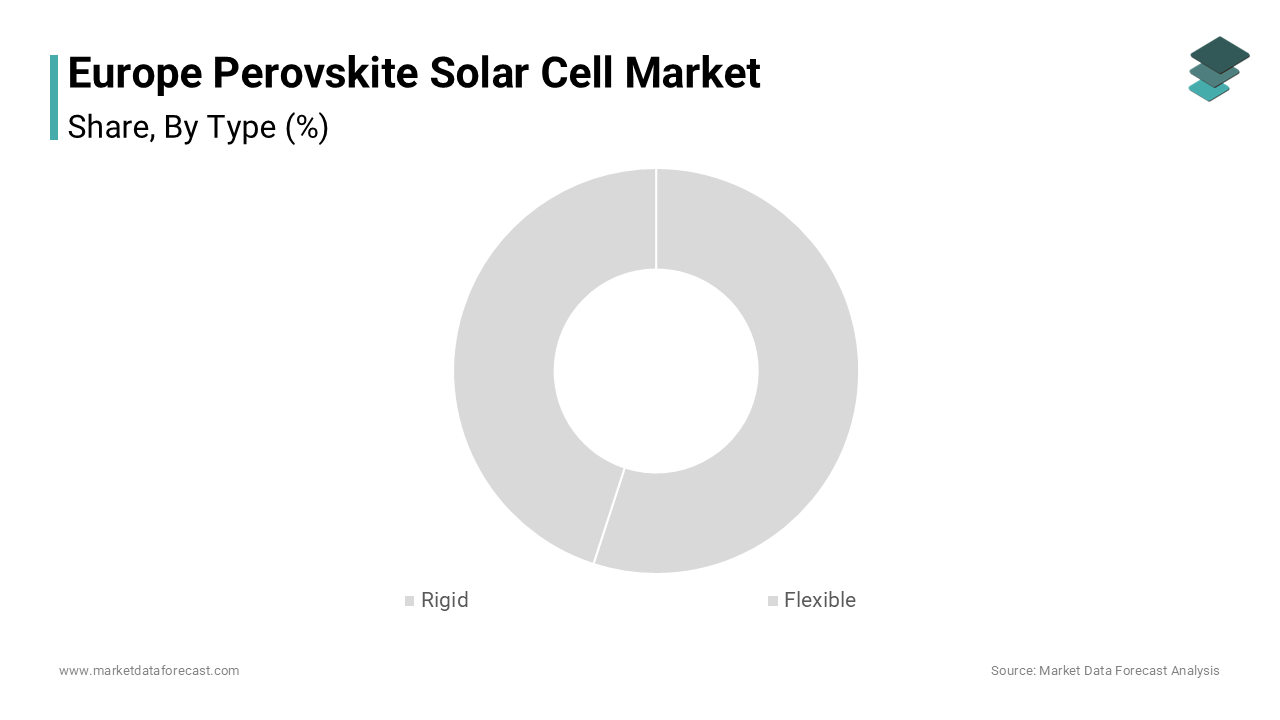
The flexible segment is likely to register a CAGR of 38.6% from 2025 to 2033 with their unique suitability for non-planar and weight sensitive applications that rigid panels cannot serve. A primary driver is the rise of mobile and transport integrated photovoltaics. Flexible perovskite modules weigh less than 0.5 kilograms per square meter are compared to over 12 kilograms for standard silicon panels by making them viable for vehicle integration. Roll to roll manufacturing advances at Sweden’s Epishine and Germany’s Heliatek are further reducing production costs, enabling scalable deployment across defense, logistics, and consumer sectors.
By Application Insights
The Building integrated photovoltaics (BIPV) segment held a significant share of the European perovskite solar cell market in 2024 with the perfect alignment between perovskite’s optical versatility and Europe’s stringent urban sustainability mandates. The Energy Performance of Buildings Directive requires all new public buildings to achieve nearly zero energy status by 2026 by driving demand for power generating façades, windows, and roofing materials that maintain architectural integrity. In France alone, the government’s “Solar Facades” program approved 82 BIPV projects in 2024, with 19 specifically using perovskite technology, according to the French Environment and Energy Management Agency.
The transportation and mobility segment is projected to grow at a CAGR of 42.1% throughout the forecast period with the automotive and aerospace industries’ urgent need for ultra lightweight, high power density solar solutions to extend vehicle range and reduce grid dependence. The expansion of electric aviation, where the European Union Aviation Safety Agency forecasts that over 200 electric air taxi prototypes will undergo certification by 2027, many of which require conformal solar skins to offset battery weight.
REGIONAL ANALYSIS
Germany
Germany was the top performer of the European perovskite solar cell market by capturing 26.3% of share in 2024 with its robust industrial base and proactive public research funding. The German Federal Ministry for Economic Affairs and Climate Action allocated 180 million euros in 2024 to next generation photovoltaics under its “Photovoltaics Strategy 2030,” with perovskite projects receiving priority for BIPV and tandem cell development. Additionally, the country’s strong chemical and machinery sectors provide a domestic supply chain for perovskite ink formulation and roll to roll coating equipment.
United Kingdom
The United Kingdom perovskite solar market was positioned second by holding 22.3% of share in 2024 with its global leadership in perovskite silicon tandem cell technology. Oxford PV, based in Oxfordshire, operates the world’s first commercial tandem cell production line, achieving certified module efficiencies of 28.6 % in 2024 with a record validated by the European Solar Test Installation. The UK’s strength stems from decades of materials science research at institutions like the University of Oxford and Imperial College London, which have produced over 600 high impact perovskite publications since 2020, as indexed by Scopus. According to the UK Department for Energy Security and Net Zero, the country aims to deploy 70 gigawatts of solar by 2035, with tandem cells expected to supply 30 % of new installations due to land use efficiency.
COMPETITIVE LANDSCAPE
Competition in the Europe perovskite solar cell market is defined by a small yet highly specialized group of technology developers vying for leadership in niche applications rather than volume. The competitive landscape is bifurcated between firms pursuing rigid high efficiency tandem modules for building integration and those developing flexible ultra lightweight films for mobility and portable electronics. Differentiation hinges on efficiency stability manufacturing scalability and application specific design rather than cost alone. Most companies remain in the pilot or early commercial phase with limited production capacity yet they actively shape market rules through participation in EU certification bodies and industry alliances. The absence of standardized reliability metrics and the high cost of outdoor testing create significant barriers to entry favoring incumbents with strong academic ties and public funding access.
KEY MARKET PLAYERS
Some of the companies that are playing a dominating role in the Europe Perovskite Solar Cell Market include
- Oxford Photovoltaics (UK)
- Saule Technologies (Poland)
- Greatcell Energy
- G24 Power Ltd.
- Meyer Burger Technology AG
- Dyenamo AB
- Fraunhofer ISE
- Solaronix SA
- Swift Sola
- Hunt Perovskite Technologies
- Panasonic Europe
- Toshiba Europe GmbH
Top Players in the Europe Perovskite Solar Cell Market
Oxford PV
Oxford PV is a UK based technology leader specializing in perovskite silicon tandem solar cells and holds a pivotal role in advancing high efficiency photovoltaics globally. The company operates the world’s first commercial production line for tandem cells in Brandenburg Germany achieving certified module efficiencies exceeding 28 %. In 2024 Oxford PV completed validation of its tandem modules under IEC 61215 standards marking a critical milestone for bankability. The firm supplies its cells to European and Asian module manufacturers enabling gigawatt scale deployment of next generation panels. s
Saule Technologies
Saule Technologies is a Polish innovator renowned for developing inkjet printed flexible perovskite solar cells tailored for building integrated applications. The company has deployed functional perovskite solar windows and façade elements in commercial buildings across Warsaw Wrocław and Brussels demonstrating real world viability in urban environments. These integrations position Saule as a pioneer in aesthetic and functional solar solutions that align with Europe’s sustainable urban development mandates.
Heliatek
Heliatek is a German developer of organic and perovskite based lightweight solar films with a strong focus on industrial and transport applications. The company produces ultra thin flexible solar modules that weigh less than 0.5 kilograms per square meter making them ideal for curved surfaces and weight sensitive installations. The firm has partnered with automotive and building materials manufacturers to integrate its films into vehicle roofs and composite panels. These collaborations extend perovskite functionality beyond traditional rooftops into mobility and infrastructure domains driving adoption across diverse sectors.s
Top Strategies Used by the Key Market Participants
Key players in the Europe perovskite solar cell market primarily pursue technology specialization application niche targeting strategic partnerships with established industrial actors and active engagement in public funded innovation programs. Companies focus on either rigid tandem cells for utility and BIPV use or flexible films for mobility and portable power creating distinct value propositions. They leverage national and EU level grants from Horizon Europe and the Innovation Fund to de risk pilot production and certification. Simultaneously they form alliances with glass manufacturers automotive OEMs and construction firms to co develop integrated products that meet sector specific requirements. Intellectual property protection and standardization participation are also critical as firms work to shape testing protocols and safety guidelines that facilitate market entry and investor confidence across the European Union.
MARKET SEGMENTATION
The research report on the europe perovskite solar cell market has been segmented and sub-segmented based on categories.
By Type
- Rigid
- Flexible
By End-user
- BIPV
- Power Station
- Transportation & Mobility
- Consumer Electronics
- Others
By Country
- UK
- France
- Spain
- Germany
- Italy
- Russia
- Sweden
- Denmark
- Switzerland
- Netherlands
- Turkey
- Czech Republic
- Rest of Europe