Europe Phase Transfer Catalysts Market Size, Share, Trends & Growth Forecast Report – Segmented By Type (Ammonium Salts, Potassium Salts), End Use, and Country (UK, France, Spain, Germany, Italy, Russia, Sweden, Denmark, Switzerland, Netherlands, Turkey, Czech Republic & Rest of Europe), Industry Analysis From 2026 to 2034
Market Size, 2025
$433 MnMarket Estimate, 2026
$460 MnMarket Forecast, 2034
$743 MnCAGR, 2026–2034
6.18%Executive Summary: Europe Phase Transfer Catalysts Market
- Market Scope: European regional market analysis covering catalyst type segments, end-user industry verticals, manufacturing efficiencies, and country-level leadership frameworks.
- Market Valuation: Valued at USD 433.41 million (2025), estimated at USD 460.19 million (2026), and projected to reach USD 743.50 million by 2034, growing at a CAGR of 6.18% (2026–2034).
- Primary Growth Drivers: High regional reliance on catalytic steps (>70% of EU fine chemical manufacturing processes incorporate them) and complex organic synthesis volumes (>5,000 tonnes annually). Process innovation is also expanding demand, with continuous-flow systems using supported tetrabutylammonium catalysts demonstrating a 40% reduction in solvent use and 30% faster cycle times, alongside regulatory approvals (EU approving 94 new active substances in 2023, the highest level in a decade).
Key Market Segment Metrics (2026–2034)
| Category | Leading Segment (2025 Position) | Fastest-Growing Segment |
|---|---|---|
| By Type | Ammonium Salts (held dominant type share in 2025, backed by >15 specialty chemical producers capable of manufacturing high-purity ammonium salts in Europe) | Potassium-Based Segment (projected to grow at a 9.4% CAGR) |
| By End Use | Pharmaceuticals (dominated end use with 58.2% market share in 2025; >75% of new EU molecular entities contain chiral centres/heterocyclic scaffolds, with average drugs undergoing 12–15 synthetic steps) | Agriculture (projected to register the fastest 10.2% CAGR) |
| By Region / Country | Germany (led Europe with 32.1% market share in 2025, supported by more than 400 chemical manufacturing sites) | — |
Major Market Players & Market Structure
Market Structure: Specialized fine chemical and specialty catalyst manufacturing landscape featuring nine notable market leaders competing on high-purity synthesis, continuous-flow process compatibility, green chemistry metrics, and custom supply agreements for pharmaceutical and agricultural applications.
Key Companies: Tokyo Chemical Industry, Nippon Chemical Industrial, Dishman Group, PAT IMPEX, Tatva Chintan Pharma Chem, Central Drug House, Pacific Organics, Otto Chemie, and Volant-Chem.
Europe Phase Transfer Catalysts Market Size
The Europe phase transfer catalysts market size was valued at USD 433.41 million in 2025 and is projected to reach USD 743.50 million by 2034 from USD 460.19 million in 2026, growing at a CAGR of 6.18%.
The Phase transfer catalysts are specialised chemical agents that facilitate reactions between reagents located in immiscible phases, typically aqueous and organic, by shuttling ionic species across the interface. The region’s stringent regulatory environment under REACH and its commitment to green chemistry principles have intensified demand for catalytic systems to minimise waste and energy consumption. According to the European Chemicals Agency, over 70% of fine chemical manufacturing processes in the EU now incorporate catalytic steps to comply with the Industrial Emissions Directive’s best available techniques framework. Furthermore, as per the European Federation of Pharmaceutical Industries and Associations, the continent produces more than 5000 tonnes annually of complex organic molecules requiring multi-step syntheses, many of which rely on quaternary ammonium or phosphonium-based phase transfer catalysts to achieve high yields under mild conditions.
MARKET DRIVERS
Expansion of Pharmaceutical Manufacturing Drives Catalyst Demand
The growing need for efficient synthetic methodologies with proportionally increasing pharmaceutical manufacturing drives is escalating the growth of the European phase transfer catalyst market. Complex drug molecules often require alkylation, esterification, or oxidation steps under biphasic conditions where traditional methods yield poor conversion or require hazardous reagents. Phase transfer catalysts enable these transformations at ambient temperatures with higher selectivity and reduced byproduct formation. According to the European Medicines Agency, the EU approved 94 new active substances in 2023, the highest number in a decade, reflecting robust pipeline activity. The European Federation of Pharmaceutical Industries and Associations confirmed that most of the API synthesis routes in EU-based facilities employ phase transfer catalysts for key carbon-carbon or carbon-heteroatom bond formations. Companies such as Novartis in Switzerland and Bayer in Germany routinely use tetrabutylammonium bromide and related compounds in kilo lab and pilot plant operations.
Growth in Agrochemical Innovation Heightens Need for Selective Synthesis Routes
The European agrochemical sector, while constrained by regulatory restrictions, continues to invest in next-generation crop protection molecules that demand high precision synthesis, that often enabled by phase transfer catalysts. This is eventually to boost the growth of he Europe phase transfer catalyst market. Modern pesticides and herbicides frequently contain chiral centres or heterocyclic structures that require regioselective alkylation or nucleophilic substitution under mild conditions. Phase transfer catalysis offers a solvent-efficient pathway to achieve these transformations without transition metal residues that could contaminate final products. Syngenta’s research centre in Stein, Switzerland and BASF’s facility in Limburgerhof, Germany, utilise phase transfer protocols for synthesising sulfonylurea and pyridine derivatives. The European Food Safety Authority’s 2025 renewal assessments mandated stricter purity thresholds for agrochemical actives, compelling manufacturers to replace classical Williamson ether synthesis with catalyst-mediated routes that reduce halogenated waste. This regulatory and technical shift elevates the role of phase transfer catalysts as enablers of compliant and environmentally conscious agrochemical manufacturing across the region.
MARKET RESTRAINTS
Stringent Environmental Regulations Limit Use of Conventional Quaternary Ammonium Salts
Many widely used phase transfer catalysts, particularly quaternary ammonium compounds such as benzyltriethylammonium chloride, are limiting the growth of he European phase transfer catalyst market. According to the European Chemicals Agency, several common ammonium-based catalysts were flagged in the 2023 Community Rolling Action Plan for potential inclusion in the REACH Candidate List of substances of very high concern. These compounds exhibit poor biodegradability and have been detected in wastewater effluents from pharmaceutical and fine chemical plants. Consequently, manufacturers are compelled to implement costly end-of-pipe treatments or redesign synthetic routes entirely. This regulatory pressure discourages the adoption of traditional catalysts and slows process validation timelines for small and medium enterprises lacking resources for alternative catalyst screening.
Volatility in Raw Material Supply Chains Disrupts Catalyst Production Stability
The highly dependent speciality amines, alkyl halides, and phosphine derivatives, for many of which face supply chain instability due to geopolitical tensions and energy market fluctuations, are also hampering the growth of the Europe phase transfer catalyst market. According to the European Chemical Industry Council, the EU imports over 60% of its tertiary amines and chloromethane precursors from the United States and Asia, exposing domestic catalyst manufacturers to shipping delays and price spikes. Similarly, the European Commission’s 2025 Critical Raw Materials Act identified phosphorus as a strategic element, with refined phosphine availability tightening amid export restrictions from major producers. These input uncertainties force catalyst producers to maintain elevated safety stocks or reformulate products, increasing working capital requirements and delaying customer deliveries.
MARKET OPPORTUNITIES
Rise of Continuous Flow Chemistry Creates New Application Avenues
The adoption of continuous flow reactors in European fine chemical and pharmaceutical manufacturing is opening novel pathways for phase transfer catalyst integration, which is expected to provide new opportunities for the growth of the European phase transfer catalyst market. Unlike batch processes, flow systems require catalysts that are stable, non-leaching, and compatible with long-duration operation, where conditions are increasingly met by immobilised or polymeric phase transfer catalysts. These systems benefit from phase transfer catalysts grafted onto silica or polystyrene supports, which enable efficient anion transfer without catalyst contamination of the product stream. Companies such as Roche in Switzerland and GSK in the UK have demonstrated a 40% reduction in solvent use and 30% faster cycle times using flow reactors with supported tetrabutylammonium catalysts for nucleophilic substitutions. The European Process Intensification Platform further noted that EU-funded projects like CHEM21 have validated over 15 continuous phase transfer protocols for API intermediates. This technological shift positions advanced catalyst formats as enablers of next-generation manufacturing paradigms aligned with Europe’s green and digital industrial strategy.
Growing Emphasis on Bio-based Catalyst Development Aligns with Circular Economy Goals
The circular and bio-based economy is stimulating research into renewable sources that reduce reliance on petrochemical feedstocks is greatly influencing the growth of the European phase transfer catalyst market. Scientists across EU institutions are engineering catalysts from choline, amino acids, and lignin derivatives that offer comparable performance with enhanced biodegradability. The Technical University of Denmark recently demonstrated a choline bicarbonate catalyst that achieved 92% yield in a model alkylation reaction while fully degrading within 28 days in standard OECD biodegradation tests.
MARKET CHALLENGES
Difficulty in Catalyst Recovery and Reuse Increases Operational Costs
The persistent technical hurdle is the challenge of efficiently recovering and reusing homogeneous catalysts in batch synthesis is a new challenge for the growth of the European phase transfer catalyst market. Most conventional quaternary ammonium salts dissolve in the organic phase post-reaction, requiring energy-intensive distillation or extraction for separation, which processes often degrade the catalyst or contaminate the product. While immobilised catalysts offer a solution, their synthesis is complex, and they often suffer from reduced activity due to diffusion limitations. The economic penalty discourages smaller manufacturers from adopting phase transfer methods despite their synthetic advantages by limiting market penetration in incocost-sensitivements such as generic agrochemical intermediates and commodity speciality chemicals.
Lack of Standardised Performance Metrics Hinders Technology Adoption
The absence of universally accepted testing protocols to evaluate catalyst efficiency, stability, and environmental impact across different reaction systems is also hampering the growth of the European phase transfer catalyst market. Unlike heterogeneous catalysts governed by ISO standards for surface area or pore volume, phase transfer catalysts are assessed through disparate lab-scale metrics, such as yield improvement or reaction time reduction, that lack comparability. As per the European Committee for Standardisation, efforts to develop a unified methodology under CEN/TS 17980 have stalled due to disagreements among industry stakeholders on key parameters like leaching thresholds and recyclability benchmarks.
REPORT COVERAGE
| REPORT METRIC | DETAILS |
| Market Size Available | 2025 to 2034 |
| Base Year | 2025 |
| Forecast Period | 2026 to 2034 |
| CAGR | 6.18% |
| Segments Covered | By Type, End Use, and Region |
| Various Analyses Covered | Global, Regional, & Country Level Analysis; Segment-Level Analysis; DROC, PESTLE Analysis; Porter’s Five Forces Analysis; Competitive Landscape; Analyst Overview of Investment Opportunities |
| Regions Covered | UK, France, Spain, Germany, Italy, Russia, Sweden, Denmark, Switzerland, Netherlands, Turkey, and the Czech Republic |
| Market Leaders Profiled | Tokyo Chemical Industry Co., Ltd. (Japan), Nippon Chemical Industrial Co., Ltd. (Japan), Dishman Group (India), PAT IMPEX (India), Tatva Chintan Pharma Chem Pvt. Ltd. (India), Central Drug House (P) Ltd. (India), Pacific Organics Private Limited (India), Otto Chemie Pvt. Ltd. (India), and Volant-Chem Corp. (China) |
SEGMENTAL ANALYSIS
By Type Insights
The ammonium salts segment held a dominant share of the European phase transfer catalyst market in 2025, with their entrenched use in pharmaceutical synthesis across Western Europe. The mature supply infrastructure is also enhancing the growth of the Europe phase transfer catalyst market. Europe hosts over 15 speciality chemical producers capable of manufacturing high-purity ammonium salts at scale, including Evonik in Germany and Solvay in Belgium. As per the European Chemicals Agency, these compounds benefit from well-established REACH registration dossiers by reducing regulatory uncertainty compared to newer alternatives. This combination of technical familiarity, supply chain resilience, and regulatory clarity ensures continued preference for ammonium salts across fine chemical and life science applications.
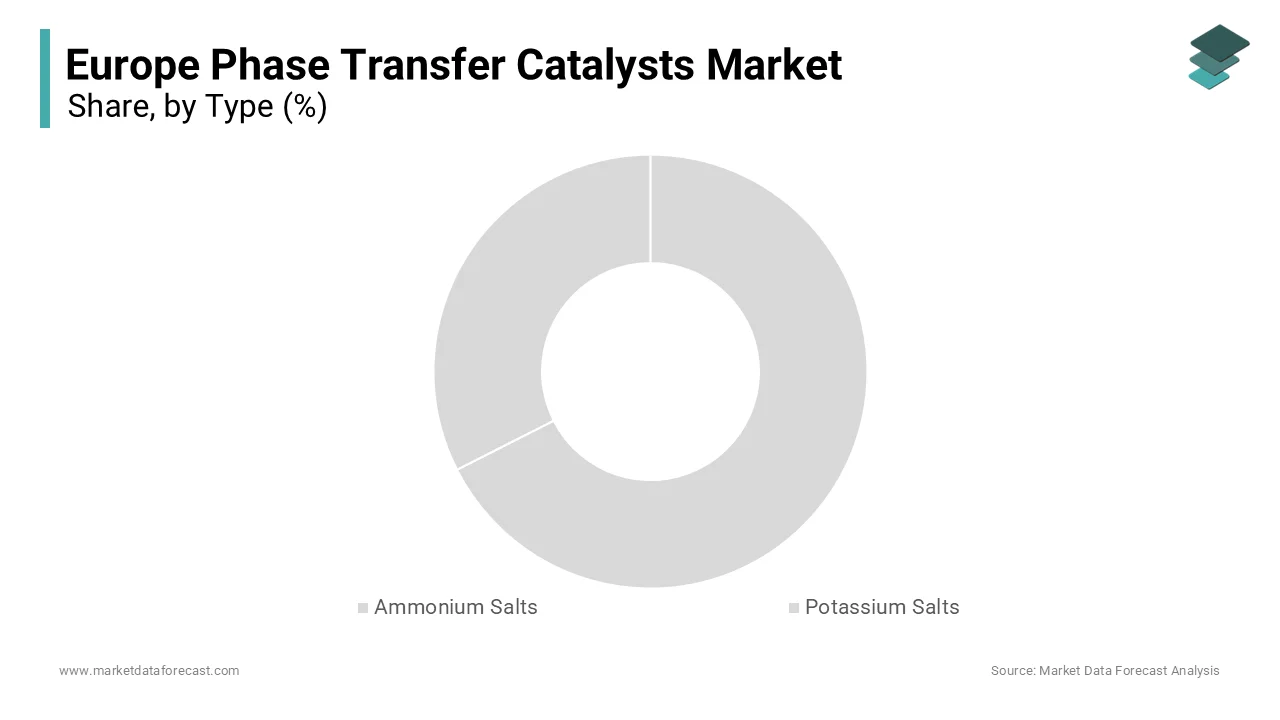
The potassium-based segment is expected to grow at a CAGR of 9.4% throughout the forecast period, with the demand for metal-mediated fluorination and carboxylation reactions in next-generation drug development. The rise of fluorine-containing pharmaceuticals is greatly influencing the growth of the segment. Potassium fluoride, when activated by 18-crown-6 or similar ligands that enables efficient nucleophilic fluorination under anhydrous conditions, a reaction difficult to achieve with ammonium systems due to competing decomposition. Companies like Novartis in Switzerland and Bayer in Germany have integrated potassium crown ether catalysts into fluorination steps for oncology and CNS drug candidates.
By End Use Insights
The pharmaceutical segment was the largest by occupying 58.2% of the European phase transfer catalysts market in 2025, with the industry’s reliance on complex multi-step syntheses that demand high selectivity, mild conditions, and minimal metal contamination, on which requirements are perfectly met by phase transfer catalysis. Over 75% of new molecular entities approved in the EU since 2020 contain chiral centres or heterocyclic scaffolds that require regioselective alkylation or ether formation, where reactions are efficiently catalysed by tetrabutylammonium salts in biphasic media. According to the European Medicines Agency, the average new drug now undergoes 12 to 15 synthetic steps, with phase transfer methods featured in at least three of them to avoid high temperature or strong base conditions that could racemize sensitive intermediates.
The agriculture segment is projected to grow at the fastest CAGR of 10.2% throughout the forecast period, with the development of novel, low-dose herbicides and fungicides that require precise synthetic routes enabled by phase transfer systems. Molecules like sulfonylureas and pyridine carboxylates are central to next-generation weed controldemand withh lkylation under controlled pH to avoid overreaction. This efficiency aligns with the EU’s Sustainable Use of Pesticides Regulation, which mandates reduced environmental impact per unit of active ingredient. The shift toward bio-based intermediates is additionally prompting the growth of the segment.
REGIONAL ANALYSIS
Germany Market Analysis
Germany was the largest contributor in the Europe phase transfer catalyst market by holding 32.1% of the share in 2025, with its world-class pharmaceutical and fine chemical industry. The country hosts over 400 chemical manufacturing sites registered with the European Chemicals Agency, many engaged in API and intermediate production requiring catalytic biphasic reactions. Companies like Merck KGaA and Bayer routinely employ ammonium salts in kilo lab and commercial scale syntheses for oncology and anti-infective drugs.
France Market Analysis
France phase transfer catalyst market is growing with its dual strength in pharmaceutical manufacturing and agrochemical innovation. Simultaneously, France is home to major crop protection developers such as Bayer Crop Science’s Lyon facility and Syngenta’s research centre in Saint Aubin. According to the French Ministry of Ecological Transition, the nation invested in support of the development of reduced-risk pesticides, many of which feature molecular architectures requiring phase transfer-mediated etherification. The country’s strong public research ecosystem, including CNRS and CEA, has pioneered bio-based phase transfer systems using choline derivatives by aligning with the national circular economy roadmap.
United Kingdom Market Analysis
The United Kingdom phase transfer catalyst market growth is driven by its legacy in pharmaceutical R&D and academic excellence in organic synthesis. The UK’s Medicines and Healthcare products Regulatory Agency continues to align with EU scientific guidelines by ensuring process compatibility across the region. The University of Cambridge and Imperial College London have published over 40 peer-reviewed studies since 2022 on novel ammonium and phosphonium catalysts, many licensed to domestic SMEs. Furthermore, the UK’s Industrial Decarbonisation Strategy includes catalysis as a priority area, with Innovate UK allocating 85 million pounds in 2023 to green synthesis projects. This blend of industrial scale, academic innovation, and policy support sustains the UK’s competitive position in high-value catalytic chemistry.
Italy Market Analysis
Italy's phase transfer catalyst market growth is likely to be propelled by its vibrant fine chemical and generic pharmaceutical sector. The country hosts over 120 medium-sized chemical enterprises specialising in custom synthesis, many clustered in the Lombardy and Emilia Romagna regions. Companies like Olon and Dipharma frequently employ tetrabutylammonium bromide in water-dichloromethane systems to produce hormone derivatives and antiviral precursors.
COMPETITIVE LANDSCAPE
KEY MARKET PLAYERS
Some of the notable key players in the Europe phase transfer catalysts market are
- Tokyo Chemical Industry Co., Ltd. (Japan)
- Nippon Chemical Industrial Co., Ltd. (Japan)
- Dishman Group (India)
- PAT IMPEX (India)
- Tatva Chintan Pharma Chem Pvt. Ltd. (India)
- Central Drug House (P) Ltd. (India)
- Pacific Organics Private Limited (India)
- Otto Chemie Pvt. Ltd. (India)
- Volant-Chem Corp. (China)
TOP STRATEGIES USED BY THE KEY MARKET PLAYERS
Key players in the Europe phase transfer catalyst market prioritise the development of greener and more recoverable catalyst formulations to align with EU environmental regulations. They invest in R&D collaborations with academic and industrial partners to co-innovate application-specific solutions. Companies enhance their technical service capabilities to support customers in process validation and regulatory compliance. Many integrate catalyst design with broader green chemistry platforms, including solvent reduction and energy efficiency. Additionally, they expand production capacities for high-purity grades to meet the stringent quality demands of pharmaceutical and electronic material manufacturers across Western and Central Europe.
COMPETITION OVERVIEW
Competition in the Europe phase transfer catalyst market is characterised by a mix of global chemical giants and specialised fine chemical producers. The industry features high technical expertise requirements due to the need for precise control over reaction selectivity, purity, and regulatory compliance. Leading players differentiate themselves through catalyst purity, ty consistency, custom synthesis capabilities and support for green chemistry goals. While price remains a factor in commodity applications, the pharmaceutical and advanced materials segments prioritise performance, reliability and documentation. Innovation focuses on immobilised catalysts, bio-based alternatives and systems compatible with continuous flow manufacturing. Regulatory alignment under REACH and participation in EU sustainability programs further shape competitive dynamics. The market remains moderately consolidated, with technology and trust serving as key barriers to entry for new participants.
TOP PLAYERS IN THE MARKET
- Evonik Industries is a leading global speciality chemicals company with a strong presence in the European phase transfer catalyst market. The company supplies high-purity quaternary ammonium salts and custom-formulated catalysts for pharmaceutical and fine chemical applications. Evonik leverages its polymer and surfactant expertise to develop immobilised phase transfer systems that enable catalyst reuse and simplify downstream purification. In recent years, the company has expanded its catalyst portfolio through R&D initiatives at its facility in Hanau, Germany, focusing on greener alternatives with improved biodegradability. Evonik also collaborates with European universities on projects funded by Horizon Europe to advance sustainable synthesis methodologies, reinforcing its role as an innovation enabler in catalytic chemistry.
- Solvay S.A. is a major European chemical producer deeply involved in the phase transfer catalyst space through its speciality intermediates and formulation technologies. The company offers a range of ammonium and phosphonium-based catalysts tailored for regulated industries, including pharmaceuticals and electronics. Solvay integrates catalyst design with its broader green chemistry strategy, emphasising reduced solvent use and waste generation. Recently, the company enhanced its production capabilities at its site in Brussels, Belgium, to meet growing demand for high-purity catalysts compliant with EU REACH standards. Solvay also participates in cross-industry consortia such as the European Chemistry Partnering Initiative to align its catalytic solutions with circular economy objectives and strengthen its technical leadership across the continent.
- Merck KGaA is a science and technology company with significant activity in the Europe phase transfer catalyst market through its Life Science and Electronics divisions. The company provides research-grade and GMP-compliant phase transfer catalysts used in drug discovery and API manufacturing across academic and industrial laboratories. Merck’s catalogue includes both standard and novel catalyst structures optimised for specific reaction types such as fluorination and etherification. Merck also invests in digital tools that help chemists select optimal catalysts based on reaction parameters, reinforcing its position as a trusted partner in high-value chemistry across Europe.
MARKET SEGMENTATION
This research report on the Europe phase transfer catalysts market has been segmented and sub-segmented based on categories.
By Type
- Ammonium Salts
- Potassium Salts
By End Use
- Pharmaceuticals
- Agriculture
- Chemical
By Country
- UK
- France
- Spain
- Germany
- Italy
- Russia
- Sweden
- Denmark
- Switzerland
- Netherlands
- Turkey
- Czech Republic
- Rest of Europe
Frequently Asked Questions
1. What is driving the Europe phase transfer catalysts market?
Growth is driven by increasing demand for efficient and scalable chemical processes. Expanding pharmaceutical and agrochemical production also boosts the market.
2. What are phase transfer catalysts used for?
They enable reactions between immiscible phases, improving reaction speed. They are widely used to enhance yields and reduce costs.
3. Which industries use phase transfer catalysts the most in Europe?
Pharmaceuticals, agrochemicals, and specialty chemicals are major users. These industries rely on PTCs for synthesis and formulation.
4. What types of phase transfer catalysts are commonly used?
Common types include ammonium salts and potassium salts. Each type supports different reaction conditions and chemistries.
5. Why are pharmaceuticals a major end-use sector?
PTCs help optimize drug synthesis and reduce processing time. They support greener and more efficient manufacturing methods.
6. Are phase transfer catalysts environmentally friendly?
Yes, PTCs support green chemistry by reducing solvent use and energy consumption. They help make reactions cleaner and more sustainable.
7. Which European countries lead the PTC market?
Germany, the U.K., and France lead due to strong chemical and pharma industries. These countries have high adoption of advanced catalysts.
8. What challenges does the market face?
Availability of substitutes and strict regulations pose challenges. High purity requirements also increase production costs.
9. How does PTC improve reaction efficiency?
PTCs transfer ions between phases, reducing activation energy. This improves reaction rates and enhances overall yield.
10. What future trends are expected in Europe’s PTC market?
Growth in pharma manufacturing and green chemistry adoption will shape demand. Advanced catalyst formulations are expected to gain traction.
Related Reports
Access the study in MULTIPLE FORMATS
Purchase options starting from
$ 2000
Didn’t find what you’re looking for?
TALK TO OUR ANALYST TEAM
Need something within your budget?
NO WORRIES! WE GOT YOU COVERED!
Call us on: +1 888 702 9696 (U.S Toll Free)
Write to us: sales@marketdataforecast.com