- Product Description Description
- Table of Contents TOC
- List of Table & Figure LOT
- Get Free Sample PDF Sample PDF
Market Size, 2025
$11.63 BnMarket Estimate, 2026
$12.11 BnMarket Forecast, 2034
$16.78 BnCAGR, 2026–2034
4.16%Executive Summary: Europe Phosphoric Acid Market
- Market Scope: Comprehensive European phosphoric acid market analysis covering industrial applications, agricultural and food sector demands, national leadership shares, soil nutrient metrics, and circular-economy trends.
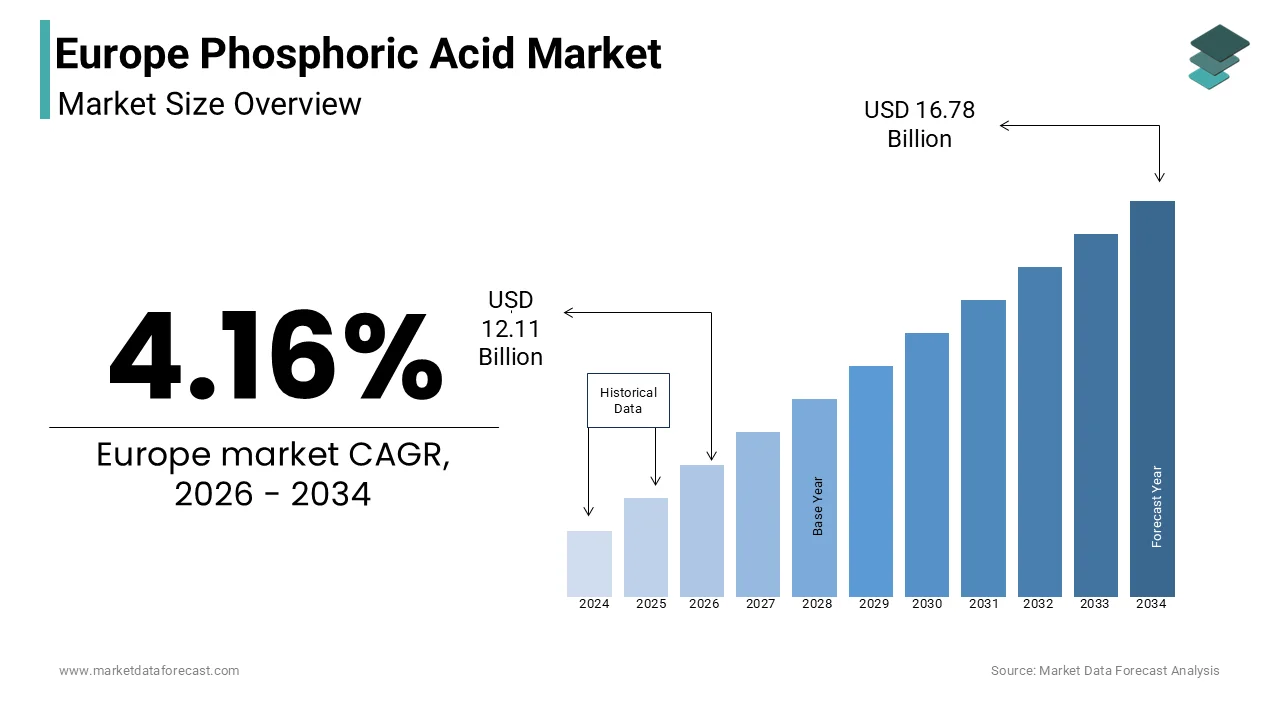
- Market Valuation: Valued at USD 11.63 billion (2025), estimated at USD 12.11 billion (2026), and projected to reach USD 16.78 billion by 2034, registering a steady CAGR of 4.16% (2026–2034).
- Primary Growth Drivers: High agricultural demand for fertilizer intermediates, extensive use in food and beverage formulation, industrial chemical synthesis, and regulatory drives toward phosphorus recycling and decarbonization. Key structural and agricultural benchmarks include ~75% of consumed phosphorus ending up in agricultural soils, European consumption of ~5.4 million metric tons of phosphate fertilizers in 2023 (with over 80% requiring phosphoric acid), European soft drink sales exceeding 59 billion liters in 2023 (colas accounting for nearly 30%), more than 42% of EU arable land facing suboptimal phosphorus availability, and Spain processing 2.8 million metric tons of imported phosphate rock in 2023 to supply over 65% of EU merchant acid demand.
Key Market Segment Metrics (2026–2034)
| Category | Leading Segment (2025 Position) | Fastest-Growing Segment |
|---|---|---|
| By Application | Fertilizers (held a prominent market share in 2025 as a fundamental intermediate for phosphate crop nutrition) | Food additives (identified as the fastest-growing application segment at a 5.8% CAGR) |
| By Grade / Purity | Fertilizer-grade and technical-grade phosphoric acid variants | High-purity merchant-grade and food-grade phosphoric acid |
| By Industrial End-Use | Agricultural fertilizers and chemical manufacturing sectors | Food, beverage, and specialized industrial applications |
| By Country / Region | Germany (led the European market with a 22.1% share in 2025, supported by heavy industrial manufacturing) | Spain (serving as a crucial processing hub supplying over 65% of EU merchant acid demand) |
Major Market Players & Market Structure
Market Structure: Highly consolidated and strategic European phosphoric acid marketplace featuring major global chemical producers, fertilizer conglomerates, and mining leaders competing intensely on feedstock security, industrial decarbonization, phosphorus recycling initiatives, high-purity acid production capabilities, and advanced circular-economy technologies.
Key Companies: Nutrien, ICL Group, Fertiberia, The Mosaic Company, OCP, Ma’aden, EuroChem Group AG, Solvay S.A., and Arkema.
Europe Phosphoric Acid Market Size
The Europe phosphoric acid market size was valued at USD 11.63 billion in 2025 and is anticipated to reach a valuation of USD 12.11 billion in 2026 and USD 16.78 billion by 2034, growing at a CAGR of 4.16% during the forecast period from 2026 to 2034.
Phosphoric acid is a colorless and odorless inorganic acid with the chemical formula H₃PO₄, serving as a foundational chemical in Europe’s agrochemical, food and beverage, and industrial sectors. In the European context, its strategic importance stems from its role in fertilizer production for phosphate-based compounds essential to modern agriculture. As per the European Environment Agency, approximately 75% of phosphorus consumed in the region ends up in agricultural soils, with limited circularity in recovery systems. Additionally, food-grade phosphoric acid finds regulated application in cola beverages and processed dairy, governed by stringent EFSA safety thresholds. This structural dependency, combined with evolving environmental legislation and nutrient management strategies under the EU Green Deal, defines the contemporary landscape of the Europe phosphoric acid market.
MARKET DRIVERS
Expanding Demand for High-Efficiency Fertilizers in EU Agriculture
The growing adoption of high-efficiency fertilizers, driven by both agronomic necessity and policy mandates, is fuelling the growth of the Europe phosphoric acid market. As the EU seeks to reconcile food security with environmental sustainability, phosphorus-based fertilizers derived from phosphoric acid remain indispensable. According to the European Commission’s Farm to Fork Strategy, the bloc aims to reduce overall fertilizer use by 20% by 2030 while simultaneously increasing organic farming to 25% of agricultural land. This paradoxical directive accelerates demand for precision nutrient delivery systems, where water-soluble phosphates such as monoammonium phosphate and diammonium phosphate are derived directly from purified phosphoric acid. The European Fertilising Products Regulation, fully applicable since 2022 that enables the commercialization of novel fertilizers containing recycled phosphorus, further embedding phosphoric acid in circular nutrient loops. Data from the International Fertilizer Association indicates that Europe consumed approximately 5.4 million metric tons of phosphate fertilizers in 2023, with over 80% requiring phosphoric acid as an intermediate. Germany, France, and Poland together account for nearly half of this demand, reflecting intensive arable farming systems. Moreover, declining soil phosphorus levels in regions like the Baltic states, as documented by the Joint Research Centre, compel targeted replenishment through acid-derived phosphates. This strategic pivot toward nutrient use efficiency sustains steady demand for phosphoric acid despite regulatory pressures.
Rising Use of Food Grade Phosphoric Acid in Processed Beverages and Dairy
The food-grade phosphoric acid in carbonated soft drinks and processed dairy products, where it functions as an acidulant preservative and flavor enhancer. The rising use of food-grade phosphoric acid in processed beverages and dairy is leveraging the growth of the Europe phosphoric acid market. The European Food Safety Authority permits its use under strict purity criteria defined in Regulation EC No 1333 2008, with E number E338 designating its food safe status. According to the European Soft Drinks Association, European consumers purchased over 59 billion liters of soft drinks in 2023, with colas representing nearly 30% of this volume, all of which rely on phosphoric acid for tartness and microbial stability. As per the European Dairy Association, over 18 million metric tons of processed cheese products were manufactured in the EU in 2023, many utilizing phosphoric acid derivatives like sodium phosphates to control meltability and texture. Furthermore, the expansion of plant-based dairy alternatives has introduced new applications, as phosphoric acid aids in mineral fortification and pH stabilization in soy and oat-based products. The European Commission’s 2022 review of food additives reaffirmed the safety of phosphoric acid at current usage levels, providing regulatory continuity. Consequently, the food sector acts as a resilient non-agricultural pillar of phosphoric acid consumption, insulated from fertilizer market volatility yet responsive to consumer trends toward convenience and shelf-stable products.
MARKET RESTRAINTS
Stringent Environmental Regulations Governing Phosphate Discharge and Waste Management
The significant headwinds from tightening environmental regulations targeting phosphate pollution and industrial effluent are restraining the growth of the Europe phosphoric acid market. Phosphoric acid production generates phosphogypsum, a radioactive byproduct containing trace uranium and radium, posing long-term storage and leaching risks. According to the European Environment Agency, over 30 million metric tons of phosphogypsum accumulate annually in EU waste facilities, with less than 5% repurposed due to radioactivity concerns under the Euratom Basic Safety Standards Directive. The EU’s Urban Wastewater Treatment Directive and the Water Framework Directive impose strict limits on phosphate discharge into waterways to combat eutrophication, indirectly pressuring downstream users of phosphoric acid, such as detergent manufacturers and fertilizer blenders. This policy discourages reliance on virgin phosphoric acid derived from imported rock. Additionally, the Industrial Emissions Directive subjects phosphoric acid plants to Best Available Techniques reference documents, requiring costly upgrades for emission control. Spain and Portugal, home to Europe’s few remaining acid production facilities, have faced repeated compliance deadlines from the European Court of Justice over nitrate pollution. These layered regulatory constraints increase operational costs, deter new investments, and accelerate the shift toward alternative phosphorus sources, thereby restraining conventional phosphoric acid market expansion.
Geopolitical Vulnerability in Phosphate Rock Supply Chains
Europe’s near-total dependence on imported phosphate rock renders the phosphoric acid market acutely vulnerable to geopolitical disruptions and trade policy shifts. The geopolitical vulnerability in phosphate rock supply chains is additionally hampering the growth of the Europe phosphoric acid market. According to the United States Geological Survey, the European Union sourced over 88% of its phosphate rock imports in 2023 from Morocco and the disputed territory of Western Sahara, regions where mining operations face increasing scrutiny over human rights and environmental practices. The European Parliament’s 2022 resolution on Western Sahara explicitly questioned the legality of trade in resources from occupied territories, introducing potential legal and reputational risks for European acid producers. Algeria and Jordan contribute marginally, but combined they supplied less than 7% of EU imports in 2023. Moreover, shipping routes through the Strait of Gibraltar and the Suez Canal expose supply chains to maritime disruptions, as witnessed during the 2021 Ever Given incident, which delayed fertilizer shipments by weeks. The European Commission’s Critical Raw Materials Act, adopted in 2023, notably omitted phosphorus from its list of strategic materials, signaling a policy gap in securing long-term acid feedstock. The supply insecurity acts as a structural restraint on phosphoric acid production scalability and pricing stability.
MARKET OPPORTUNITIES
Recovery and Recycling of Phosphorus from Wastewater and Organic Waste Streams
The emergence of urban mining and phosphorus recovery technologies by enabling secondary sourcing from waste is creating new opportunities for the growth of the Europe phosphoric acid market. Under the EU Sewage Sludge Directive and the revised Fertilising Products Regulation, recovered phosphorus from municipal wastewater, sewage sludge ash, and food waste can be legally marketed as fertilizer inputs. As per the German Federal Environment Agency, over 50 large-scale phosphorus recovery plants are operational across Germany, recovering more than 20000 metric tons of elemental phosphorus annually, equivalent to 13% of the country’s fertilizer phosphorus demand. Technologies such as struvite precipitation and thermal oxidation of sludge ash yield high-purity phosphate salts compatible with phosphoric acid production pathways. The city of Amsterdam’s Waste4Phosphorus initiative recovers phosphorus at a rate of 1.4 kilograms per capita per year, which is contributing to national circularity targets. The European Innovation Partnership on Agricultural Productivity and Sustainability supports pilot projects in France and Sweden that integrate recovered phosphates into acid neutralization processes. As per the Joint Research Centre, Europe discharges an estimated 1.6 million metric tons of phosphorus into wastewater annually, representing a vast untapped reservoir.
Growth of Battery Grade Phosphoric Acid in Lithium Iron Phosphate Cathode Production
The production of lithium iron phosphate cathodes for electric vehicle batteries for high-purity battery-grade acid is also enhancing the growth of the Europe phosphoric acid market. Unlike traditional fertilizer or food-grade variants, battery-grade phosphoric acid requires impurity levels below 10 parts per million for metals such as iron and aluminum, necessitating specialized refining processes. The European Battery Alliance projects that EU battery manufacturing capacity will exceed 800 gigawatt hours by 2030, with lithium iron phosphate chemistries capturing a growing share due to their thermal stability and cobalt-free composition. According to Benchmark Mineral Intelligence, lithium iron phosphate battery production in Europe is expected to scale from less than 10 gigawatt hours in 2023 to over 150 gigawatt hours by 2030, demanding approximately 300000 metric tons of battery-grade phosphoric acid annually. Companies such as BASF and Umicore are investing in cathode precursor plants in Germany and Belgium, integrating vertically with acid refiners. The European Commission’s Net Zero Industry Act designates battery materials as strategic, offering state aid for localized supply chains. Furthermore, the Inflation Reduction Act in the United States has spurred European automakers like Stellantis and Volkswagen to accelerate domestic battery production to avoid supply chain bifurcation. This electrification-driven pivot creates a premium segment within the phosphoric acid market, insulated from agricultural cyclicality and aligned with industrial policy.
MARKET CHALLENGES
Volatility in Energy Prices Affects Production Economics
The production of phosphoric acid via the wet process is highly energy-intensive, requiring substantial thermal and electrical inputs for acidulation, filtration, and concentration. The volatility in energy prices affecting production economics is acting as a barrier for the growth of the Europe phosphoric acid market. In Europe, where natural gas historically powered much of the chemical industry, the energy crisis triggered by the Russia-Ukraine conflict severely disrupted production economics. According to the European Chemicals Agency, average natural gas prices for industrial consumers in the EU rose by over 300% between 2021 and 2022, forcing several phosphoric acid facilities to operate below capacity or halt production entirely. Spain’s Fertiberia reduced its acid output by 25% in 2022 due to unviable energy costs, as reported by the Spanish Ministry for Ecological Transition. The EU Emissions Trading System further compounds costs, as phosphoric acid plants fall under combustion installation thresholds, incurring carbon allowances priced at over 80 euros per metric ton in 2023. These compounding energy and compliance expenses compress margins, discourage reinvestment, and elevate the risk of offshoring acid-dependent industries such as detergent and feed additive manufacturing.
Limited Domestic Phosphate Rock Reserves and Depleted Mining Infrastructure
The historical phosphate mining operations have largely ceased due to resource exhaustion and environmental opposition, leaving the continent without viable domestic feedstock is another attribute posing a challenge for the growth of the Europe phosphoric acid market. The last major phosphate mine in Estonia closed in 2002 after depleting its K-beds deposit, which once supplied over 500000 metric tons of ore annually. Unlike in the United States, where the Bone Valley formation supports integrated acid production, Europe lacks geologically accessible sedimentary phosphate deposits. Attempts to revive mining, such as the controversial plans in the Spanish region of Extremadura, have been blocked by regional courts citing groundwater contamination risks. This domestic void forces complete reliance on imports, but port and rail infrastructure for bulk phosphate rock remains underdeveloped.
REPORT COVERAGE
| REPORT METRIC | DETAILS |
| Market Size Available | 2025 to 2034 |
| Base Year | 2025 |
| Forecast Period | 2026 to 2034 |
| CAGR | 4.16% |
| Segments Covered | By Application, and By Country |
| Various Analyses Covered | Global, Regional & Country Level Analysis, Segment-Level Analysis, DROC, PESTLE Analysis, Porter’s Five Forces Analysis, Competitive Landscape, Analyst Overview on Investment Opportunities |
| Regions Covered | UK, France, Spain, Germany, Italy, Russia, Sweden, Denmark, Switzerland, Netherlands, Turkey, the Czech Republic, and the Rest of Europe |
| Market Leaders Profiled | Nutrien (Canada), ICL Group, Fertiberia, The Mosaic Company (U.S.), OCP (Morocco), Ma’aden (Saudi Arabia), EuroChem Group AG (Switzerland), Solvay S.A. (Belgium), Arkema (France) |
SEGMENTAL ANALYSIS
By Application Insights
The fertilizers segment accounted in holding a prominent share of the Europe phosphoric acid market in 2025 due to the indispensable role of phosphoric acid as the primary feedstock for phosphate fertilizers, which are critical to sustaining crop yields across the continent’s intensive agricultural zones. European agricultural policy increasingly emphasizes balanced nutrient application to maintain long-term soil health while curbing environmental degradation. The EU Common Agricultural Policy mandates nutrient management plans for farms receiving subsidies, pushing farmers toward scientifically calibrated phosphate inputs. As per the Joint Research Centre, over 42% of arable land in the EU exhibits suboptimal phosphorus availability in Central and Eastern Europe. In Germany and France, Europe’s top two fertilizer consumers, phosphate application rates remain above 25 kilograms per hectare annually to offset decades of phosphorus mining from soils. The European Commission’s 2023 Nutrient Management Plan reinforces the need for targeted phosphorus replenishment by ensuring sustained demand for diammonium phosphate and monoammonium phosphate derived from phosphoric acid.
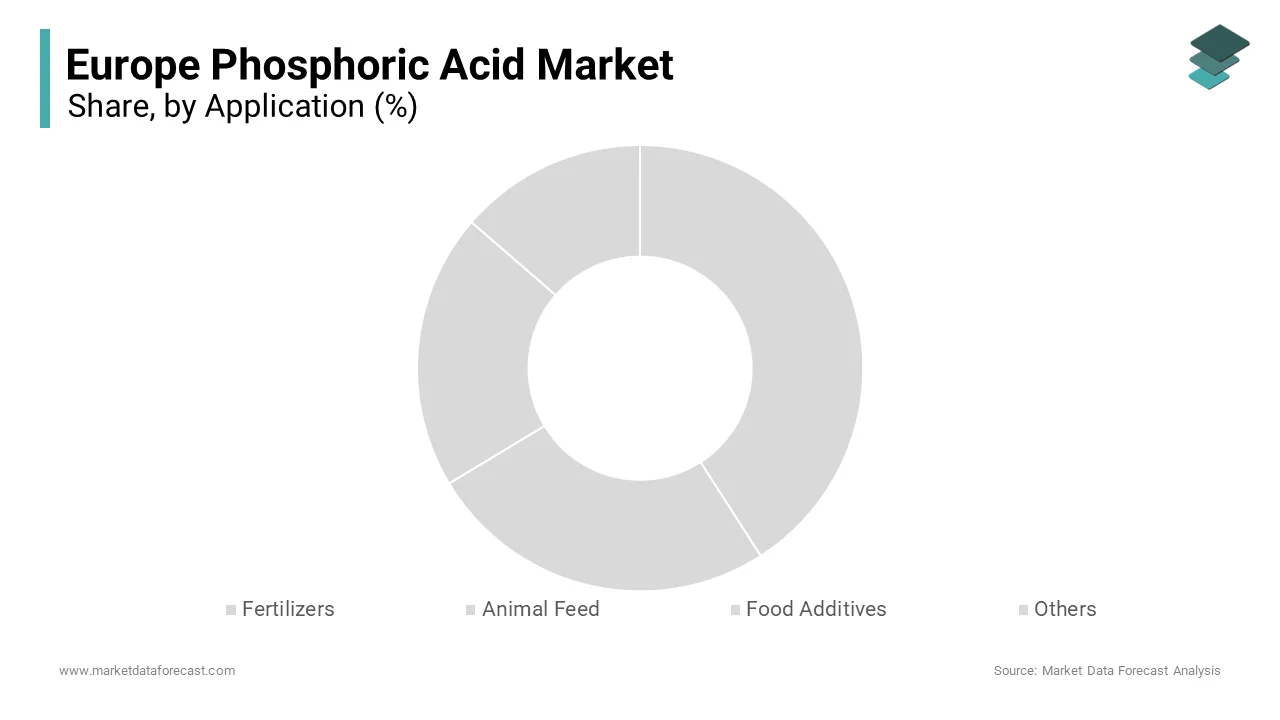
The food additives segment is projected to grow at the fastest CAGR of 5.8% from 2025 to 2033. Phosphoric acid remains irreplaceable in cola-type beverages due to its sharp taste profile and antimicrobial properties. The European Soft Drinks Association reports that per capita consumption of carbonated soft drinks in Western Europe stabilized at 87 liters in 2023 after a post-pandemic rebound, with colas representing 28% of total volume. The European Dairy Association notes that sales of high-protein dairy products grew by 9.2% year on year in 2023 by reaching 4.3 million metric tons across the EU. Germany and the Netherlands lead in dairy innovation, with over 60 new phosphate-stabilized products launched in 2023 alone.
COUNTRY LEVEL ANALYSIS
Germany Phosphoric Acid Market Analysis
Germany outperformed in the Europe phosphoric acid market by holding at 22.1% of share in 2025, driven by its dual role as Europe’s most industrialized agricultural economy and a hub for food and chemical manufacturing. Germany’s robust food processing sector ranked first in the EU by output, which relies heavily on phosphoric acid derivatives for cheese processing, meat curing, and beverage acidulation. The nation hosts key production facilities, including BASF’s integrated nutrient complex in Ludwigshafen, which supplies high-purity acid to both fertilizer and food customers. Additionally, Germany’s leadership in the battery value chain under the European Battery Alliance has spurred pilot projects for battery-grade phosphoric acid, though this remains nascent. Regulatory frameworks like the National Fertilizer Ordinance enforce precise phosphorus application, paradoxically increasing demand for high-analysis MAP and DAP over raw rock phosphate.
France Phosphoric Acid Market Analysis
France's phosphoric acid market growth is likely to grow with its position as the EU’s top agricultural producer and a sophisticated food and beverage industry. The country’s dairy sector alone processes over 25 billion liters of milk each year, generating substantial demand for sodium phosphates in melting cheeses and protein drinks. The French government’s Ecophyto plan is aiming to reduce pesticide use but not fertilizer dependency that indirectly supports phosphate consumption by promoting balanced crop nutrition. Furthermore, France’s leadership in the EU’s circular phosphorus initiatives, such as the national recovery target of 30% of phosphorus from wastewater by 2035 that creates a hybrid demand for both virgin and recycled acid streams.
Spain Phosphoric Acid Market Analysis
Spain's phosphoric acid market growth is likely to grow with its unique role as the continent’s primary production base and a major agricultural user. According to Spain’s Ministry for Ecological Transition, these facilities processed 2.8 million metric tons of imported phosphate rock in 2023, supplying over 65% of the EU’s merchant acid demand. The government’s Strategic Fertilizer Plan 2023–2030 prioritizes acid plant decarbonization through green hydrogen integration, positioning Spain as a future low-carbon supplier.
Italy Phosphoric Acid Market Analysis
Italy's phosphoric acid market growth is likely to grow with its extensive agricultural output and world-renowned food manufacturing sector. Italy’s food industry is globally recognized for cheese, cured meats, and ready meals, all of which require phosphates for texture stabilization and shelf-life extension. The Italian Dairy Association reports that over 500 types of cheese are produced nationally, with processed varieties like mozzarella and provolone using sodium phosphates derived from food-grade phosphoric acid. Regulatory frameworks like the National Recovery and Resilience Plan allocate funding for nutrient efficiency technologies, indirectly supporting high-analysis phosphate use.
COMPETITIVE LANDSCAPE
The Europe phosphoric acid market features moderate concentration with competition centered on integrated producers and import-dependent blenders. Major players differentiate through sustainability credentials, technological innovation,n and service depth rather than price alone. The absence of domestic phosphate rock reserves creates a level playing field where logistics efficiency feedstock security, and regulatory compliance determine competitive advantage. Companies like Fertiberia and ICL leverage localized production to reduce carbon footprints while global suppliers such as OCP gain influence through strategic stockholding and agronomic support programs. New entrants face high barriers due to environmental permitting costs and the capital intensity of acid plants. Meanwhile food food-grade acid suppliers compete on purity, consistency, and certification adherence. The market is shifting from commodity trading to integrated nutrient solutionss making technical partnerships and circular phosphorus capabilities critical success factors. This evolving dynamic fosters collaboration alongsidecompetitionton particularly in meeting EU circular economy and net zero mandates.
KEY MARKET PLAYERS
- Nutrien (Canada)
- ICL Group
- Fertiberia
- The Mosaic Company (U.S.)
- OCP (Morocco)
- Ma’aden (Saudi Arabia)
- EuroChem Group AG (Switzerland)
- Solvay S.A. (Belgium)
- Arkema (France)
Top Players In The Market
- OCP Group is a Morocco-owned entity and the world’s largest producer of phosphate rock and phosphoric acid. It plays a critical role in the Europe phosphoric acid market by supplying over 30% of the European Union’s phosphate rock imports primarily through long-term contracts with fertilizer producers in Spain, Germany, and the Netherlands. In recent years, OCP has intensified its European engagement by establishing technical service centers in Hamburg and Lyon to support precision agriculture solutions. The company also signed a strategic partnership with Yara in 2023 to co-develop low-carbon phosphate fertilizers aligned with EU Green Deal objectives. These initiatives reinforce OCP’s position as an integrated solutions provider rather than a mere commodity supplier.
- Fertiberia is Spain’s leading producer of fertilizers and phosphoric acid and operates Europe’s largest integrated phosphate complex in Huelva. The company produces both merchant and captive phosphoric acid for downstream fertilizer and industrial applications. In 2023, Fertiberia announced a 1.2 billion euro investment to decarbonize its operations by 203,0 ,including the deployment of green hydrogen in acid production and the integration of carbon capture technologies. It also launched a new line of bio-based phosphate fertilizers incorporating recovered phosphorus from urban waste streams. These actions demonstrate Fertiberia’s commitment to aligning its phosphoric acid business with European circular economy and climate neutrality mandates while strengthening its industrial leadership on the continent.
- ICL Group is a global specialty minerals and chemicals company with significant phosphoric acid operations in the Netherlands and Spain under its ICL Fertilizers Europe division. The company supplies high-purity phosphoric acid for both agricultural and food-grade applications across Western and Central Europe. In 2025, ICL inaugurated a new phosphorus recovery plant in the Netherlands capable of producing 15000 metric tons of recycled phosphates annually from wastewater ash. This facility supports the EU’s phosphorus circularity targets and diversifies ICL’s acid feedstock base. Additionally, ICL expanded its portfolio of ofcontrolled-releasee phosphate fertilizers tailored for European soil conditions. These innovations position ICL as a technology-driven player advancing sustainable phosphoric acid use in Europe.
Top Strategies Used By The Key Market Participants
Key players in the Europe phosphoric acid market focus on vertical integration to secure feedstock and downstream distribution channels. They invest heavily in decarbonization technologies, including green hydrogen substitution and carbon capturee to comply with EU climate regulations. Companies are increasingly adopting circular economy models by recovering phosphorus from wastewater and organic waste streams to produce secondary phosphoric acid derivatives. Strategic partnerships with agrochemical distributors and food manufacturers ensure stable offtake agreements and market access. Additionally, firms are expanding their technical service capabilities to offer precision nutrient management solutions that align with the European Commission’s Farm to Fork Strategy. These approaches collectively enhance competitiveness while addressing environmental and regulatory pressures unique to the European operating landscape.
RECENT MARKET NEWS
In March 2023, Fertiberia announced a strategic investment of 1.2 billion euros to decarbonize its Huelva phosphoric acid complex using green hydrogen and carbon capture technologies. This initiative is anticipated to reduce emissions by 80% by 2030 and strengthen the Europe phosphoric acid market presence.
MARKET SEGMENTATION
This research report on the Europhosphoric acid market is segmented and sub-segmented into the following categories.
By Application
- Fertilizers
- Animal Feed
- Food Additives
- Others
By Country
- UK
- France
- Spain
- Germany
- Italy
- Russia
- Sweden
- Denmark
- Switzerland
- Netherlands
- Turkey
- Czech Republic
- Rest of Europe