- Product Description Description
- Table of Contents TOC
- List of Table & Figure LOT
- Get Free Sample PDF Sample PDF
Market Size, 2025
$0.67 BnMarket Estimate, 2026
$0.70 BnMarket Forecast, 2034
$0.95 BnCAGR, 2026–2034
4%Europe Plant Antifreeze Market Size
The Europe plant antifreeze market size was valued at USD 0.67 billion in 2025 and is anticipated to reach a valuation of USD 0.70 billion in 2026 and USD 0.95 billion by 2034, growing at a CAGR of 4% from 2026 to 2034.
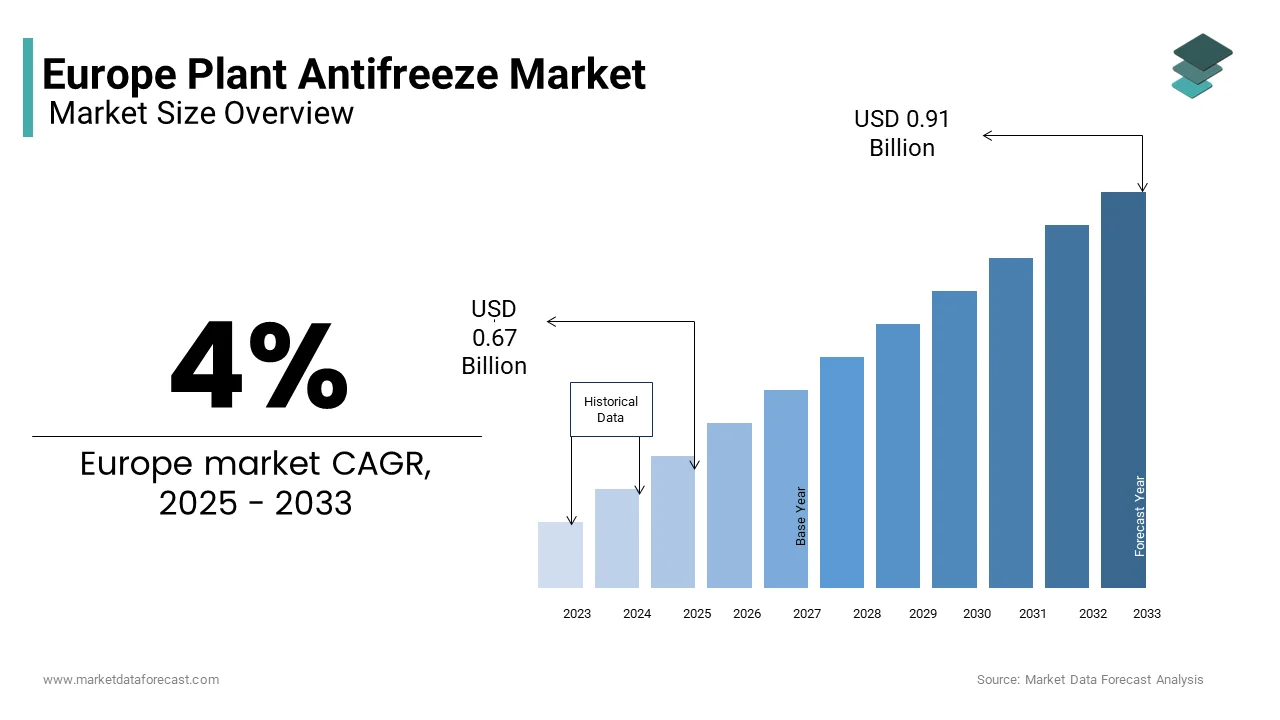
Plant Antifreeze is are compound used in agriculture, horticulture, and plant-based industrial processes to protect plants from frost damage and freezing temperatures. These plant antifreeze agents—often extracted from cold-tolerant species or synthesized based on natural antifreeze proteins—are designed to inhibit ice crystal formation within plant tissues, thereby preserving cellular integrity during extreme weather conditions. With climate change causing unpredictable temperature fluctuations across Europe, the demand for effective crop protection solutions has surged.
Additionally, the growing emphasis on organic farming practices across the EU, supported by regulatory bodies such as the European Commission’s Directorate-General for Agriculture and Rural Development, is encouraging the adoption of eco-friendly agro-inputs. These trends underscore the increasing importance of plant antifreeze products in safeguarding agricultural productivity across the region.
MARKET DRIVERS
Increasing Frequency of Unseasonal Frost Events Across Europe
The rising incidence of unseasonal frost events due to climate variability is one of the primary drivers of the Europe Plant Antifreeze Market. Traditionally temperate regions like France, Germany, and Poland are experiencing late spring frosts that severely impact early blooming crops such as cherries, apples, and grapevines.
These climatic disruptions have prompted farmers and agribusinesses to seek proactive measures to mitigate yield losses. Plant antifreeze proteins (AFPs) and their analogs, which prevent intracellular ice formation and stabilize cell membranes, are increasingly being adopted as a reliable defense mechanism. Notably, research conducted by Wageningen University & Research has demonstrated that foliar application of AFP-based sprays can reduce frost-induced cellular damage by up to 40%, significantly improving crop survival rates. Furthermore, governments and agricultural cooperatives across Europe are promoting the use of these biologically inspired solutions through subsidies and awareness programs.
Rising Adoption of Sustainable and Biobased Agricultural Inputs
The widespread shift toward sustainable and biobased agricultural inputs is another key driver propelling the Europe Plant Antifreeze Market. The European Union's Green Deal and Farm to Fork Strategy emphasize reducing synthetic chemical usage in farming, prompting the agricultural sector to explore environmentally friendly alternatives.
Plant-derived antifreeze compounds align with this sustainability agenda by offering non-toxic, biodegradable, and residue-free protection against freezing conditions. Unlike conventional frost protection chemicals, which may persist in soil and water systems, plant antifreeze agents break down naturally without harming ecosystems. This attribute has made them an attractive option for organic growers and eco-conscious food producers.
Moreover, agricultural input manufacturers are actively developing formulations that combine antifreeze proteins with other biostimulants to enhance overall plant resilience. Companies such as Koppert Biological Systems and Syngenta are investing in R&D to integrate plant antifreeze technology into broader crop protection portfolios. Apart from these, consumer preference for sustainably grown produce is influencing retailers to source from farms using green technologies.
MARKET RESTRAINTS
High Production Costs and Limited Commercial Availability
The high production costs and limited commercial availability of plant-derived antifreeze proteins are significant restraints affecting the Europe Plant Antifreeze Market. Unlike synthetic cryoprotectants, which can be manufactured at scale using cost-effective chemical processes, natural antifreeze agents require complex extraction techniques, specialized cultivation conditions, and extensive purification steps.
For instance, isolating antifreeze proteins from cold-adapted organisms such as winter flounder fish or Arctic yeast involves intricate biotechnological methods that increase manufacturing expenses. Even plant-based sources like cold-hardy grasses or algae necessitate controlled growth environments and post-harvest processing to maintain protein functionality.
This economic disparity limits accessibility for small-scale farmers who rely on affordable crop protection options. Additionally, the scarcity of dedicated production facilities in Europe further restricts supply chain efficiency.
Regulatory Complexity and Approval Delays for Novel Bio-Based Inputs
The complex regulatory landscape governing novel bio-based agricultural inputs is another major constraint limiting the growth of the Europe Plant Antifreeze Market. The European Food Safety Authority (EFSA) and the European Chemicals Agency (ECHA) enforce stringent approval procedures for any new agricultural biostimulant or protective agent, including plant antifreeze compounds.
Unlike well-established synthetic frost protectants, which have existing regulatory frameworks, plant-derived antifreeze proteins often face prolonged evaluation periods due to their biological nature. For example, the EFSA requires extensive toxicity and environmental impact assessments before approving any new active ingredient for field application. According to a 2024 report by the European Crop Protection Association, the average time required for regulatory clearance of a novel bio-based agro-input exceeds four years, compared to less than two years for conventional chemical products.
This delay discourages smaller biotech firms and startups from entering the market, as they lack the financial resources to sustain lengthy approval cycles. Moreover, inconsistent regulations across EU member states create additional compliance hurdles, especially when seeking multi-country authorizations.
MARKET OPPORTUNITY
Expansion of Controlled Environment Agriculture and Vertical Farming
The rapid expansion of controlled environment agriculture (CEA) and vertical farming systems is one of the most promising opportunities driving the Europe Plant Antifreeze Market. As urban populations grow and arable land diminishes, European countries are increasingly adopting indoor and greenhouse-based farming models to ensure year-round food production.
In these highly managed environments, maintaining optimal plant physiology under fluctuating temperature conditions is crucial. Plant antifreeze compounds offer a strategic advantage by enhancing cold tolerance in crops cultivated in climate-controlled settings, especially during system failures or seasonal transitions.
Additionally, CEA operators prioritize non-chemical, residue-free crop protection solutions to meet organic certification standards and consumer demand for clean-label produce. Startups and agritech firms are collaborating with biotech laboratories to develop tailored plant antifreeze formulations compatible with precision irrigation and automated farming systems.
Integration of Plant Antifreeze Technology in Seed Coatings and Biostimulant Formulations
The integration of antifreeze technology into seed coatings and biostimulant formulations is an emerging opportunity in the Europe Plant Antifreeze Market. Seed treatment technologies have gained traction as a means to enhance germination rates, stress tolerance, and early plant development. By incorporating plant-derived antifreeze proteins into seed coatings, manufacturers can provide young plants with enhanced resistance to early-season frost, thereby improving crop establishment and yield potential. Furthermore, combining antifreeze agents with microbial biostimulants and humic acid-based enhancers is proving to be an effective strategy for boosting plant resilience beyond just cold stress. Agrochemical companies are actively developing multifunctional seed treatments that integrate frost protection with drought tolerance and nutrient uptake efficiency.
MARKET CHALLENGES
Technical Limitations in Protein Stability and Delivery Mechanisms
The technical difficulty in ensuring protein stability and efficient delivery mechanisms for antifreeze compounds is a critical challenge confronting the Europe Plant Antifreeze Market. Unlike synthetic cryoprotectants, which remain stable under a wide range of environmental conditions, natural antifreeze proteins are sensitive to heat, pH variations, and enzymatic degradation, limiting their effectiveness in real-world agricultural applications.
As per research from the University of Copenhagen, many plant-derived antifreeze proteins lose up to 50% of their activity when exposed to temperatures above 30°C, which is common during spray applications in open fields. Besides, their solubility and dispersibility in aqueous solutions—used for foliar spraying—can be inconsistent, leading to uneven distribution and reduced efficacy.
To overcome these limitations, scientists are exploring formulation strategies such as microencapsulation, polymer conjugation, and fusion protein engineering to enhance thermal stability and prolong activity. However, these approaches are still in experimental phases and require further optimization before commercial deployment.
Limited Awareness and Adoption Among Traditional Farmers
The limited awareness and adoption among traditional farmers, particularly in rural and less technologically integrated regions, is another formidable challenge facing the Europe Plant Antifreeze Market. Despite growing scientific validation and regulatory support, many farmers remain unfamiliar with the benefits of plant-derived antifreeze proteins compared to conventional frost protection methods such as sprinkler irrigation, wind machines, or chemical sprays. Moreover, skepticism regarding product efficacy and cost-benefit analysis plays a role in slow adoption rates. Many farmers perceive plant antifreeze agents as expensive and unproven compared to established frost mitigation techniques.
REPORT COVERAGE
| REPORT METRIC | DETAILS |
| Market Size Available | 2025 to 2034 |
| Base Year | 2025 |
| Forecast Period | 2026 to 2034 |
| CAGR | 4% |
| Segments Covered | By Product, Application, And By Country |
| Various Analyses Covered | Global, Regional & Country Level Analysis, Segment-Level Analysis, DROC, PESTLE Analysis, Porter’s Five Forces Analysis, Competitive Landscape, Analyst Overview of Investment Opportunities |
| Regions Covered | UK, France, Spain, Germany, Italy, Russia, Sweden, Denmark, Switzerland, Netherlands, Turkey, Czech Republicc and Rest of Europe |
| Market Leaders Profiled | Syngenta, Dow AgroSciences, BASF SE, Bayer CropScience, Monsanto, DuPont de Nemours, Exxon Mobill and Adama |
SEGMENTAL ANALYSIS
By Product Insights
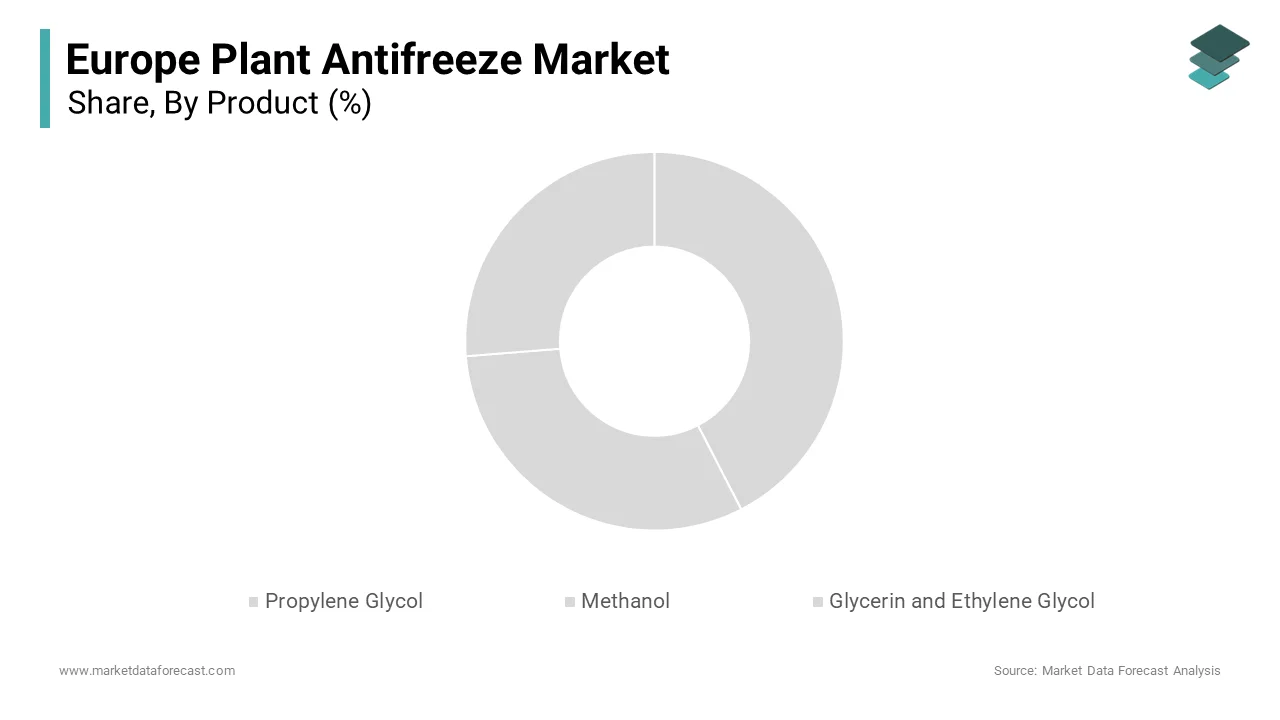
The Propylene Glycol segment dominated the market by accounting for 35.6% of total demand in 2025. Its widespread use in agricultural frost protection due to its non-toxic nature and superior thermal stability compared to other antifreeze agents is propelling the dominance of the Propylene Glycol segment. Also, its safety profile, making it suitable for application in organic farming systems where synthetic or hazardous chemicals are restricted, is a key driver behind the leading position of propylene glycol.
Its compatibility with existing irrigation and spraying systems used across European greenhouses and open-field agriculture is another major factor. Unlike ethylene glycol, which poses environmental risks, propylene glycol can be safely applied without requiring specialized equipment or extensive worker training. Additionally, increasing investments in controlled environment agriculture (CEA) and vertical farming facilities, especially in urban centers like Amsterdam and Copenhagen, have further reinforced the demand for safe and efficient plant antifreeze alternatives, ensuring continued growth for this segment.
Glycerin
The Glycerin segment is projected to grow at the fastest CAGR of 9.8% between 2025 and 2033. Increasing utilization of glycerin as a natural cryoprotectant in seed treatments and biostimulant formulations is propelling the rapid expansion of the Glycerin segment. Derived as a byproduct of biodiesel production, glycerin offers an eco-friendly and cost-effective alternative to conventional antifreeze compounds. As per the European Biodiesel Board, the surplus availability of glycerin from renewable energy plants has significantly reduced its procurement cost, making it more accessible for agricultural applications.
Furthermore, research conducted by Wageningen University & Research has demonstrated that glycerin-based formulations enhance cellular membrane stability during cold stress, improving germination rates and early plant development. Additionally, regulatory support for bio-based inputs under the EU Green Deal has encouraged agrochemical companies to integrate glycerin into sustainable crop protection strategies.
By Application Insights
The Fruits and Vegetables segment led the market by representing 40.5% of overall demand in 20245 High economic value and frost sensitivity of fruit and vegetable crops, particularly in Southern and Central Europe, is primarily driving the lead position of Fruits and Vegetables segment. Countries like Italy, France, and Spain rely heavily on orchard fruits such as peaches, plums, and apples, all of which are vulnerable to unseasonal frosts.
Moreover, the expansion of protected cultivation systems such as greenhouses and net houses has increased the adoption of plant antifreeze products tailored for delicate leafy greens, berries, and exotic vegetables. In addition, consumer demand for pesticide-free and sustainably grown produce has prompted farmers to shift away from chemical frost protectants toward biologically derived alternatives.
Cereals and Grains
The Cereals and Grains segment is anticipated to exhibit the highest growth in the Europe Plant Antifreeze Market and is recording a CAGR of 10.4% from 2025 to 2033. This accelerated growth is primarily fueled by the increasing vulnerability of cereal crops to early-season frost damage, especially in Northern and Eastern Europe. Wheat, barley, and oats—key staples in countries like Poland, Russia, and Ukraine—are frequently exposed to freezing temperatures during critical growth stages, affecting germination and tillering. In addition, agronomists and researchers are exploring plant antifreeze protein-based treatments to enhance cold tolerance in young seedlings. Additionally, government-backed initiatives promoting climate-resilient agriculture are accelerating the adoption of these technologies.
COUNTRY-LEVEL ANALYSIS
Germany occupied the leading position in the European plant antifreeze market by contributing 23.5% of the regional revenue in 2025. The country’s strong agricultural infrastructure, coupled with proactive government policies supporting sustainable farming practices, has positioned it as a key adopter of advanced frost protection technologies. German farmers are increasingly integrating plant antifreeze agents into their crop management strategies, particularly in high-value horticulture and greenhouse operations. Moreover, Germany's emphasis on innovation in controlled environment agriculture and precision farming has fostered the development of new plant antifreeze formulations tailored for automated application systems.
France is another key player in the regional market. The French agricultural sector, particularly its viticulture and orchard industries, is highly susceptible to late spring frosts, making plant antifreeze solutions increasingly essential. According to the French Ministry of Agriculture, unseasonal frost events in 2021 and 2022 caused over EUR 2 billion in losses to wine producers and fruit growers. In addition, the government has introduced financial incentives for farmers adopting environmentally friendly frost protection measures, including plant-derived antifreeze proteins. Additionally, France’s robust network of agricultural cooperatives and research institutions has facilitated the testing and adoption of novel frost mitigation technologies. Institutions such as INRAE (National Research Institute for Agriculture, Food and Environment) are conducting field trials to assess the performance of antifreeze-enhanced seed coatings in cereal crops. The country’s commitment to reducing synthetic chemical usage in line with the European Green Deal has further boosted demand for sustainable plant antifreeze products, reinforcing France’s strategic role in shaping the regional market.
United Kingdom remains a significant player due to its growing focus on climate-resilient farming techniques. To counteract risks, British agritech startups and universities are developing localized plant antifreeze solutions tailored for domestic crops. The UK government’s Environmental Land Management Scheme (ELMS) encourages farmers to adopt eco-friendly frost protection methods, indirectly boosting the demand for plant antifreeze agents. Additionally, the expansion of vertical farming enterprises in urban areas such as London and Manchester has created a niche market for biobased antifreeze applications in controlled growing environments.
Netherlands commands a notable portion of the European market. As a global leader in greenhouse horticulture and precision agriculture, the Netherlands serves as a hub for innovative plant protection technologies. Dutch greenhouse operators are early adopters of plant antifreeze solutions, particularly in tomato, pepper, and cucumber cultivation, where maintaining optimal physiological conditions is crucial. The country’s well-developed logistics and export-oriented agriculture industry also facilitate the distribution of plant antifreeze products to neighboring European markets. Additionally, Dutch agribusinesses are investing in formulation research to enhance the efficacy and stability of natural cryoprotectants under fluctuating climatic conditions.
Italy cisa significant player in the European market share. The Italian agricultural landscape, particularly its vast vineyards and orchards, faces frequent frost threats, making plant antifreeze solutions increasingly relevant. According to Coldiretti, Italy’s largest agricultural association, frost damage to olive groves and fruit orchards resulted in over EUR 900 million in losses in 2022 alone. In response, both public and private stakeholders have been promoting the use of biologically derived frost protection agents. Italian research institutions, including the Council for Agricultural Research and Economics (CREA), are actively evaluating the effectiveness of plant antifreeze proteins in protecting grapevines and citrus crops. Moreover, the country’s strong organic farming movement aligns well with the principles of using non-toxic, eco-friendly frost mitigants.
KEY MARKET PLAYERS
Syngenta, Dow AgroSciences, BASF SE, Bayer CropScience, Monsanto, DuPont de Nemours, Exxon Mobil, and Adama. Are the market players that are dominating the Europe plant antifreeze market?
Top Players In The Market
One of the leading players in the Europe Plant Antifreeze Market is BASF SE, a global chemical manufacturing giant with a strong presence in agricultural solutions. The company has been actively developing and commercializing plant protection technologies that integrate antifreeze properties into biostimulant formulations. BASF’s focus on sustainable agrochemicals aligns with European regulatory trends, making its products increasingly relevant for frost-sensitive crops.
Another key player is Koppert Biological Systems, a Dutch company renowned for its commitment to biological crop protection and climate-resilient farming solutions. Koppert has been pioneering the integration of natural cryoprotectants into greenhouse and open-field applications, offering farmers eco-friendly alternatives to synthetic frost inhibitors. Their work bridges traditional horticulture with modern biotechnology, reinforcing their leadership in the European market.
Syngenta Group also plays a major role in shaping the plant antifreeze landscape. With a strong R&D foundation and extensive partnerships across agritech, Syngenta develops seed treatment solutions that enhance cold tolerance in cereals and high-value crops. Their innovation in combining antifreeze agents with growth stimulants supports the broader adoption of these technologies among European growers seeking both productivity and sustainability.
Top Strategies Used By Key Market Participants
A primary strategy adopted by leading players in the Europe Plant Antifreeze Market is integrated product development through biotechnological innovation. Companies are investing heavily in research to engineer advanced plant antifreeze proteins and synthetic analogs that offer enhanced stability and effectiveness under varying environmental conditions.
Another crucial approach involves strategic collaborations with academic institutions and agricultural cooperatives. By partnering with universities and research bodies, companies gain access to cutting-edge discoveries in plant physiology and cold resistance mechanisms, which can be translated into practical field applications.
Lastly, market expansion through targeted education and farmer engagement programs is being widely pursued. Industry leaders are launching demonstration projects, training workshops, and advisory services to build awareness and trust in plant antifreeze technology among conventional and organic growers across Europe.
COMPETITION OVERVIEW
The competition in the Europe Plant Antifreeze Market is shaped by a blend of innovation-driven strategies, regulatory alignment, and growing demand for climate-resilient agricultural inputs. As unseasonal frost events become more frequent due to climate change, the need for effective, non-toxic frost protection methods has intensified, prompting both established agrochemical firms and emerging biotech startups to enter the space. Incumbent players leverage their existing distribution networks and R&D capabilities to integrate plant antifreeze technologies into broader crop protection portfolios, while new entrants focus on niche innovations such as protein engineering and seed coating enhancements. The market is witnessing increased collaboration between industry stakeholders and research institutions to accelerate the development and validation of novel cryoprotectant formulations. Additionally, the emphasis on sustainability and bio-based inputs, supported by EU policy frameworks, is driving differentiation based on environmental impact and application safety. This evolving competitive environment fosters continuous technological advancement and market expansion, particularly in high-value crop sectors and controlled-environment agriculture.
RECENT HAPPENINGS IN THE MARKET
- In January 2024, BASF launched a new line of biostimulant formulations incorporating plant antifreeze peptides designed specifically for vineyard and orchard applications, aiming to enhance frost resilience in premium crops across Southern Europe.
- In March 2024, Koppert Biological Systems announced a strategic partnership with Wageningen University to develop next-generation plant antifreeze proteins tailored for greenhouse vegetable production, strengthening their foothold in controlled-environment agriculture.
- In June 2024, Syngenta introduced an antifreeze-enhanced seed coating solution for cereal crops, targeting Northern and Eastern European markets where early-season frost poses a significant threat to wheat and barley yields.
- In September 2024, UPL Limited expanded its European portfolio by introducing a glycerin-based plant antifreeze formulation derived from renewable sources, aligning with circular economy principles and supporting organic farming practices.
- In November 2024, Biobest launched a field demonstration initiative across France, Germany, and Italy to showcase the efficacy of its plant antifreeze treatments in reducing frost damage in soft fruit and berry cultivation, directly engaging with growers and cooperatives.
MARKT SEGMENTATION
This research report on the Europe plant antifreeze market is segmented and sub-segmented into the following categories.
By Product
- Propylene Glycol
- Methanol
- Glycerin
- Ethylene Glycol
By Application
- Fruits and Vegetables
- Cereals and Grains
- Oil Crops
- Others
By Country
- UK
- France
- Spain
- Germany
- Italy
- Russia
- Sweden
- Denmark
- Switzerland
- Netherlands
- Turkey
- Czech Republic
- Rest of Europe