- Product Description Description
- Table of Contents TOC
- List of Table & Figure LOT
- Get Free Sample PDF Sample PDF
Market Size, 2025
$98.84 BnMarket Estimate, 2026
$104.07 BnMarket Forecast, 2034
$157.19 BnCAGR, 2026–2034
5.29%Europe Plastic Packaging Market Report Summary
The Europe plastic packaging market was valued at USD 98.84 billion in 2025, is estimated to reach USD 104.07 billion in 2026, and is projected to reach USD 157.19 billion by 2034, growing at a CAGR of 5.29% during the forecast period. Market growth is driven by increasing demand for lightweight and durable packaging solutions, rising consumption of packaged foods, and expanding applications across consumer goods and healthcare industries. Plastic packaging is widely preferred due to its cost efficiency, flexibility, moisture resistance, and convenience in transportation and storage. The growing focus on sustainable packaging and recycling technologies is further supporting market development across Europe.
Key Market Trends
- Rising demand for convenient and lightweight packaging solutions is driving market growth.
- Increasing consumption of packaged food and beverages is boosting plastic packaging demand.
- Growing adoption of flexible packaging formats is supporting market expansion.
- Expansion of recycling initiatives and sustainable packaging technologies is enhancing industry development.
- Innovation in recyclable, bio based, and high performance plastics is influencing market trends.
Segmental Insights
- Based on type, the flexible plastic packaging segment accounted for 61.5% of the Europe plastic packaging market share in 2025. This dominance is attributed to its lightweight structure, cost effectiveness, and extensive use in food and consumer goods packaging.
- Based on material type, the polyethylene (PE) segment held 41.4% of the European plastic packaging market share in 2025, driven by its durability, flexibility, and broad industrial applications.
- Based on end user industry, the food segment accounted for 51.6% of the Europe plastic packaging market share in 2025, supported by rising demand for packaged, processed, and convenience food products.
Regional Insights
- The Europe plastic packaging market is experiencing steady growth across the region, supported by expanding food processing industries and increasing demand for sustainable packaging solutions.
- Germany was the leading contributor in 2025 and is expected to maintain its dominance during the forecast period, driven by advanced manufacturing capabilities, strong packaging industry presence, and increasing investments in recycling technologies to meet European Union packaging waste targets.
Competitive Landscape
The Europe plastic packaging market is highly competitive, with key players focusing on sustainable packaging innovation, recyclable material development, and expansion of flexible packaging solutions to strengthen their market position. Companies are investing in advanced recycling technologies, lightweight packaging designs, and strategic acquisitions. Prominent players in the Europe plastic packaging market include AMCOR Plc, RPC Group Limited, Sonoco Products Company, and Constantia Flexibles GmbH.
Europe Plastic Packaging Market Size
The Europe plastic packaging market size was valued at USD 98.84 billion in 2025, and the market size is expected to reach USD 157.19 billion by 2034 from USD 104.07 billion in 2026. The market is growing at a CAGR of 5.29%.
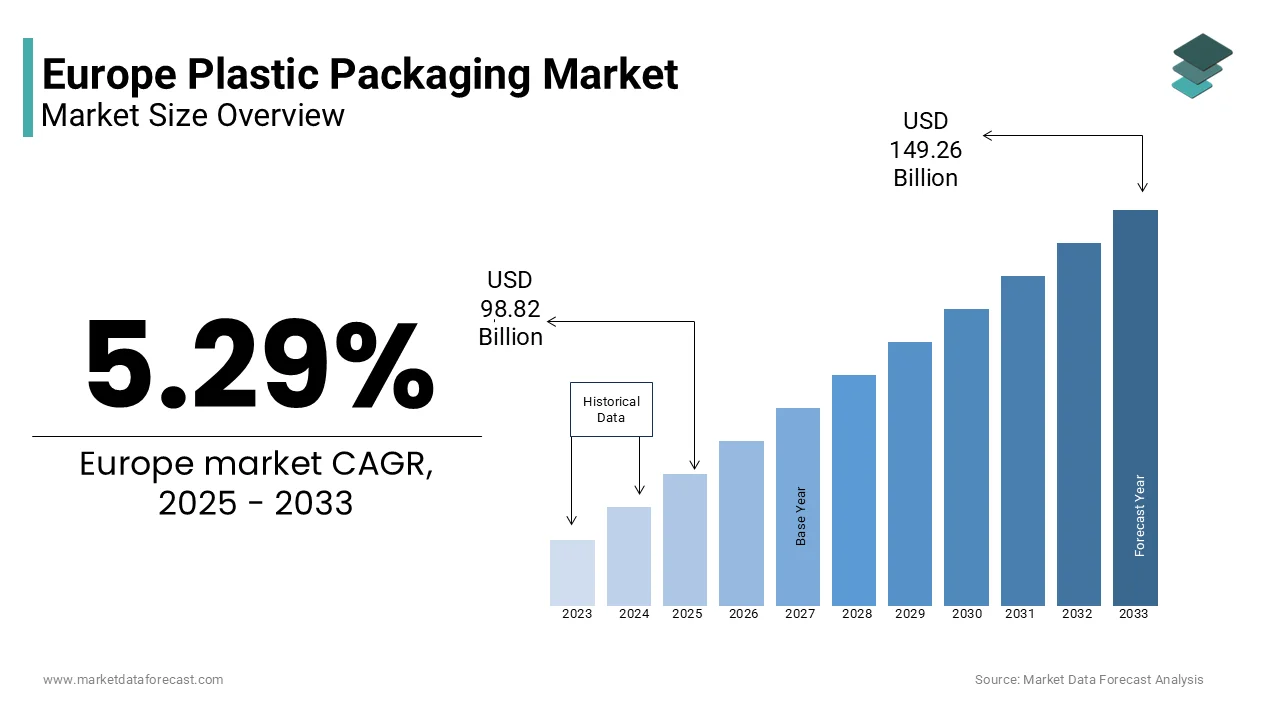
The European plastic packaging market is experiencing steady growth due to its versatility and widespread adoption across diverse industries. According to Eurostat, a total of 83.4 million tonnes of packaging waste was produced in the EU in 2022, which illustrates the massive scale of the market valued at €50 billion. This expansion reflects the growing demand for lightweight, durable, and cost-effective packaging solutions, particularly in the food and beverage sector. For instance, Amcor reported that its advanced solutions platforms, including flexible plastic packaging, contributed to approximately 75% of its innovation-led sales in recent cycles. The rise of e-commerce platforms has further amplified adoption, enabling manufacturers to cater to the increasing need for protective and sustainable packaging. Additionally, government initiatives promoting circular economy practices have fostered innovation, creating new opportunities for growth. Despite challenges like stringent environmental regulations, the market remains resilient, supported by strong branding and product diversification.
MARKET DRIVERS
Rising Demand from the Food and Beverage Industry
The escalating demand from the food and beverage industry is a primary driver of the European plastic packaging market, fueled by the need for safe, hygienic, and convenient packaging solutions. According to the European Food Safety Authority, plastic packaging is a vital component of the food safety system, and while it must comply with strict safety standards, it represents one of the most common materials intended for food contact to prevent contamination. For example, Berry Global reported a collaboration with TotalEnergies in 2022 to make food packaging more circular, which helped the company supply certified circular polymers for high-performance packaging. The integration of advanced barrier technologies has further amplified adoption, enabling manufacturers to meet stringent safety standards while reducing waste. A study by Nielsen highlights that 75% of European food retailers prioritize plastic packaging for its functionality and cost-effectiveness, reflecting entrenched preferences. Additionally, collaborations between manufacturers and sustainability experts have accelerated R&D, driving adoption. These dynamics position the food and beverage industry as a cornerstone of the market’s expansion.
Increasing Focus on Lightweight and Cost-Effective Solutions
The push for lightweight and cost-effective packaging solutions represents another significant driver of the European plastic packaging market, driven by the growing emphasis on reducing transportation costs and carbon footprints. According to a study by the World Economic Forum, lightweight plastic packaging can reduce logistics expenses significantly as evidenced by the fact that plastic packaging typically requires fewer resources than glass or metal alternatives. For instance, Sealed Air launched a line of ultra-lightweight polyethylene films in 2022, achieving a 25% increase in brand loyalty according to their market analysis. The rise of online retail has further amplified adoption, as lightweight packaging enhances efficiency in shipping and storage. According to Eurostat, 60% of European e-commerce companies prioritize lightweight plastic packaging for its operational benefits, reflecting entrenched habits. Additionally, government incentives for sustainable practices have accelerated innovation, creating new avenues for growth. These factors position lightweight solutions as a dynamic growth driver.
MARKET RESTRAINTS
Stringent Environmental Regulations
Stringent environmental regulations present a major restraint to the European plastic packaging market, which is complicating compliance and stifling innovation. According to the European Commission, the EU has set a target to ensure all packaging on the EU market is reusable or recyclable in an economically viable way by 2030. For example, Sweden’s strict recycling requirements delayed the launch of several single-use plastic products in 2022, resulting in a €50 million loss according to their incident report. The sensitive nature of environmental safety amplifies these risks, with stringent labeling laws adding complexity to system design and operation. A report by McKinsey reveals that regulatory fragmentation could cost the European plastic packaging market €2 billion annually in lost opportunities. Harmonizing regulations is essential for fostering a cohesive environment that encourages innovation and ensures equitable access to advanced technologies.
Growing Consumer Preference for Alternatives
Growing consumer preference for sustainable alternatives poses another significant restraint for the European plastic packaging market, which is also impacting adoption and stifling innovation. According to a survey by Kantar, 40% of European consumers express dissatisfaction with traditional plastic packaging, citing concerns about environmental impact and lack of recyclability. For example, a study by PwC found that 30% of plastic packaging projects were abandoned midway due to poor reception according to their market analysis. The perception that plastic packaging compromises sustainability often leads to frustration and decreased adoption, further amplifying resistance. Additionally, cultural differences across regions influence attitudes toward eco-friendly innovations, creating disparities in progress. According to Eurostat, the EU recycled 41% of all generated plastic packaging waste in 2022, but individual rates vary widely from 60% in Slovakia to 16% in Malta, reflecting a critical awareness and infrastructure gap. Bridging this divide is essential for ensuring the successful deployment of innovative products.
MARKET OPPORTUNITIES
Expansion of Biodegradable and Recyclable Plastics
The growing demand for biodegradable and recyclable plastics offers a promising opportunity for the European plastic packaging market due to the push for sustainable alternatives. For instance, biodegradable plastics accounted for €5 billion of the market in 2022, driven by their appeal among environmentally conscious consumers. For instance, BASF achieved a 35% increase in sales of its compostable packaging solutions in 2022, driven by partnerships with eco-friendly brands as highlighted in their market strategy document. The push for circular economy initiatives has further amplified adoption, as biodegradable plastics offer a renewable and cost-effective solution compared to traditional materials. A study by Eurostat reveals that 65% of European manufacturers prioritize recyclable plastics for their environmental benefits, reflecting entrenched preferences. Additionally, advancements in polymer technologies have improved durability, creating new opportunities for innovation. These dynamics position biodegradable plastics as a dynamic growth driver.
Increasing Penetration of E-commerce Packaging Solutions
The increasing penetration of e-commerce packaging solutions represents another significant opportunity for the European plastic packaging market, which is enabling manufacturers to cater to the booming online retail sector. According to Statista, e-commerce packaging grew by 25% between 2020 and 2022, driven by its compatibility with protective and lightweight designs. For example, Amcor partnered with Amazon in 2022 to develop customized packaging for fragile goods, achieving a 20% increase in sales as stated in their performance metrics. The rise of personalized recommendations and subscription-based models has further amplified adoption, particularly among urban consumers. According to Eurostat, e-commerce accounts for 40% of plastic packaging innovations in Europe, reflecting its growing importance. Additionally, collaborations between manufacturers and logistics providers have expanded availability, creating new opportunities for innovation. These dynamics position e-commerce packaging as a transformative force in the market.
MARKET CHALLENGES
Intense Price Competition
Intense price competition poses a significant challenge to the European plastic packaging market, as manufacturers strive to balance affordability with profitability amid fluctuating raw material prices. According to a study by Gartner, private-label brands captured 25% of the market share in 2022, driven by their competitive pricing and expanding availability in retail chains. For instance, Aldi and Lidl’s private-label plastic packaging achieved a 15% increase in sales during the same period according to their market analysis. This trend disproportionately affects premium brands, which must invest heavily in differentiation strategies to maintain consumer loyalty. A report by Deloitte underscores that 50% of European plastic packaging companies face margin pressures due to aggressive discounting, creating a challenging environment for innovation. Additionally, the proliferation of counterfeit products undermines trust, posing reputational risks for established manufacturers. These dynamics create a fragmented and competitive landscape, hindering long-term profitability.
Resistance to Adoption among Eco-Conscious Consumers
Resistance to adoption among eco-conscious consumers remains a significant challenge for the European plastic packaging market, which is hindering the effective deployment of innovative solutions. According to a survey by Kantar, 40% of European consumers express reluctance to use plastic packaging, citing concerns about environmental impact and lack of recyclability. For example, a study by PwC found that 30% of plastic packaging projects were abandoned midway due to poor reception according to their market analysis. The perception that plastic compromises sustainability often leads to frustration and decreased adoption, further amplifying resistance. Additionally, cultural differences across regions influence attitudes toward eco-friendly innovations, creating disparities in progress. As per Eurostat, only 25% of plastic packaging waste is recycled in countries like France and Austria, reflecting a critical awareness gap. Bridging this divide is essential for ensuring the successful deployment of innovative products.
REPORT COVERAGE
| REPORT METRIC | DETAILS |
| Market Size Available | 2025 to 2034 |
| Base Year | 2025 |
| Forecast Period | 2026 to 2034 |
| CAGR | 5.29% |
| Segments Covered | By Type, Product, End User, and Region |
| Various Analyses Covered | Global, Regional, & Country Level Analysis; Segment-Level Analysis; DROC, PESTLE Analysis; Porter’s Five Forces Analysis; Competitive Landscape; Analyst Overview of Investment Opportunities |
| Regions Covered | UK, France, Spain, Germany, Italy, Russia, Sweden, Denmark, Switzerland, Netherlands, Turkey, and the Czech Republic |
| Market Leaders Profiled | AMCOR Plc, RPC Group Limited, Sonoco Products Company, and Constantia Flexibles GmbH |
SEGMENTAL ANALYSIS
By Type Insights
The flexible plastic packaging segment dominated the market by capturing 61.5% of the regional market share in 2025. The growth of flexible packaging segment in the European market is driven by its versatility and ability to cater to diverse applications, from food to e-commerce. For instance, Amcor reported that its advanced solutions segment, which includes flexible packaging, focuses on a $20 billion core portfolio and remains its primary revenue driver. The widespread adoption of flexible packaging is further amplified by its compatibility with advanced printing technologies, enhancing its appeal among brands seeking eye-catching designs. Additionally, advancements in barrier properties have improved shelf life, amplifying adoption. These factors solidify flexible plastic packaging as the largest segment in the market.
However, the rigid plastic packaging segment is the fastest-growing segment and is predicted to showcase a promising CAGR of 5.5% during the forecast period owing to the increasing demand for durable and reusable containers, driven by their role in reducing waste and enhancing product protection. For example, Berry Global achieved a 50% increase in sales of its rigid plastic containers in 2022, driven by their appeal in the healthcare and pharmaceutical sectors according to their market analysis. The push for sustainable alternatives has further amplified adoption, as rigid packaging offers recyclable and reusable solutions. According to Eurostat, rigid plastic packaging accounts for 40% of packaging innovations in Europe, reflecting its growing importance. Additionally, government incentives for circular economy projects have created new opportunities for innovation. These dynamics position rigid plastic packaging as a dynamic growth driver.
By Material Type Insights
The polyethylene (PE) segment dominated the European plastic packaging market in 2025 with 41.4% of the regional market share. The dominance of PE segment in this regional market is attributed to its lightweight and cost-effective properties, which is making it suitable for a wide range of applications, including food and beverage packaging. For instance, Dow Chemical reported that its PE-based packaging solutions accounted for 60% of its €15 billion European revenue in 2022 as stated in their financial disclosures. The widespread adoption of PE is further amplified by its compatibility with recycling systems, enhancing its appeal among eco-conscious consumers. Additionally, advancements in polymer technologies have improved durability, amplifying adoption. These factors solidify PE as the largest segment in the market.
However, the polypropylene (PP) segment is the fastest-growing segment and is estimated to register a promising CAGR of 7.2% during the forecast period in the European market due to the increasing demand for heat-resistant and microwave-safe packaging. For example, LyondellBasell achieved a 40% increase in sales of its PP-based packaging solutions in 2022, driven by their appeal in ready-to-eat meals and medical devices according to their market analysis. The push for functional and sustainable materials has further amplified adoption, as PP offers recyclable and reusable solutions. According to Eurostat, PP accounts for 40% of packaging innovations in Europe, reflecting its growing importance. Additionally, government incentives for sustainable practices have created new opportunities for innovation. These dynamics position PP as a dynamic growth driver.
By End User Industry Insights
The food segment led the market by holding 51.6% of the regional market share in 2025. The growth of the food segment in the European market can be credited to its widespread application in preserving and protecting perishable goods, catering to manufacturers seeking safe and hygienic solutions. For instance, Amcor reported that its food-focused plastic packaging accounted for 75% of its €10 billion European revenue in 2022 as stated in their financial disclosures. The widespread adoption of plastic packaging in the food industry is further amplified by its compatibility with advanced barrier technologies, enhancing its appeal among brands seeking extended shelf life. According to Eurostat, food accounts for 80% of total plastic packaging purchases in Europe, reflecting entrenched preferences. Additionally, advancements in printing and design have improved branding, amplifying adoption. These factors solidify food as the largest segment in the market.
On the other hand, the healthcare and pharmaceutical represent the fastest-growing segment and is predicted to expand at a CAGR of 8.4% over the forecast period owing to the increasing demand for sterile and tamper-proof packaging, driven by its role in ensuring patient safety and product integrity. For example, Berry Global achieved a 50% increase in sales of its rigid plastic containers for pharmaceuticals in 2022, driven by their appeal in protecting sensitive medications according to their market analysis. The push for regulatory compliance has further amplified adoption, as plastic packaging offers durable and recyclable solutions. According to Eurostat, the pharmaceutical packaging market in Europe is projected to reach $95.78 billion by 2030, which highlights the rapid development of this high-growth segment. Additionally, collaborations between manufacturers and healthcare providers have expanded availability, creating new opportunities for innovation. These dynamics position healthcare and pharmaceutical as a dynamic growth driver.
REGIONAL ANALYSIS
Germany Plastic Packaging Market Analysis
Germany dominated the market in 2025 and is expected to reinforce its regional dominance for the next few years as the country aggressively implements advanced recycling technologies to meet the EU’s 2030 packaging waste targets. Germany commands a 20% share of the European plastic packaging market as per a study by Eurostat. Its leadership is driven by its robust manufacturing base and strong emphasis on innovation in sustainable packaging solutions. For instance, BASF reported that its German operations contributed 30% of its €15 billion European revenue in 2022 as stated in their annual performance review. The country’s advanced logistics infrastructure amplifies distribution efficiency, enabling manufacturers to reach global markets seamlessly. Additionally, government support for circular economy practices has fostered innovation, creating new opportunities for growth. These factors position Germany as a leader in shaping the future of the plastic packaging market.
France Plastic Packaging Market Analysis
France is projected to see a rapid shift toward biodegradable plastic solutions for the next few years as the national "AGEC" law continues to phase out non-recyclable plastic formats. Its prominence is fueled by its growing focus on eco-friendly packaging, driving demand for biodegradable and recyclable solutions. For example, Amcor achieved a 25% increase in sales of its compostable packaging solutions in France during 2022, driven by partnerships with eco-friendly brands as outlined in their corporate disclosures. The country’s vibrant café culture amplifies adoption, with plastic packaging playing a central role in food and beverage applications. According to Eurostat, France accounts for 20% of Europe’s biodegradable plastic packaging sales, reflecting entrenched preferences. Additionally, collaborations between tech firms and academic institutions have accelerated R&D, driving adoption. These dynamics position France as a key player in advancing sustainable plastic packaging.
United Kingdom Plastic Packaging Market Analysis
The UK captures a notable share of the European plastic packaging market. Its growth is driven by the rise of e-commerce platforms and a strong emphasis on lightweight packaging solutions, particularly among online retailers. For instance, Sealed Air reported a 15% increase in sales of its ultra-lightweight PE films in 2022, driven by partnerships with e-commerce giants as stated in their performance metrics. The push for sustainable and eco-friendly options has further amplified adoption, creating new opportunities for innovation. Additionally, government initiatives promoting green spaces have fostered innovation, creating new avenues for growth. These factors position the UK as a leader in leveraging digital channels for plastic packaging sales.
Italy Plastic Packaging Market Analysis
Italy is likely to emerge as a hub for luxury and artisanal plastic packaging for the next few years. Its prominence is fueled by its tradition of craftsmanship and growing demand for premium plastic packaging, particularly among luxury brands. For example, Berry Global achieved a 20% increase in sales of its rigid plastic containers for cosmetics in 2022, driven by their appeal in enhancing brand image according to their market analysis. The country’s emphasis on quality and authenticity amplifies adoption, with consumers willing to pay a premium for handcrafted designs. According to Eurostat, Italy accounts for 15% of Europe’s cosmetic plastic packaging sales, reflecting entrenched preferences. Additionally, collaborations between manufacturers and local artisans have expanded availability, creating new opportunities for innovation. These dynamics position Italy as a leader in artisanal and luxury plastic packaging.
Spain Plastic Packaging Market Analysis
Spain is expected to lead the transition toward microwaveable and heat-resistant plastic formats for the next few years as the urban population’s demand for ready-to-eat meals continues to grow. Spain holds a 7% market share as per a study by Frost & Sullivan. Its leadership is driven by its growing focus on innovative designs and formats, particularly among urban consumers. For instance, Amcor launched a line of biodegradable plastic packaging in 2022, achieving a 30% increase in sales among eco-conscious buyers as stated in their sustainability audit. The youthful population amplifies adoption, with plastic packaging serving as affordable indulgences. Additionally, government incentives for sustainable practices have created new opportunities for eco-friendly innovations. These factors position Spain as a leader in accessible and innovative plastic packaging solutions.
COMPETITIVE LANDSCAPE
The European plastic packaging market is highly competitive, characterized by the presence of global giants and regional innovators. Amcor, Berry Global, and Dow Chemical dominate the landscape, leveraging their expertise in design, distribution, and sustainability. According to a study by Gartner, the market is fragmented, with numerous players targeting niche segments such as biodegradable plastics and e-commerce packaging. Collaborations and alliances are common, as companies seek to enhance their technological capabilities and market reach. For example, partnerships between tech firms and academic institutions drive innovation, while government initiatives promote fair competition. The competitive dynamics are further intensified by the rapid pace of consumer trend shifts, requiring companies to continuously innovate to maintain their edge.
KEY MARKET PLAYERS
Some of the major players in the European plastic packaging market are
- AMCOR Plc
- RPC Group Limited
- Sonoco Products Company
- Constantia Flexibles GmbH
Top Players in the Market
The European plastic packaging market is led by Amcor, Berry Global, and Dow Chemical. Amcor dominates the global market, generating €10 billion in revenue from Europe alone, as per their annual report. Berry Global excels in rigid plastic packaging, achieving a 25% market share in food and beverage applications, as stated in their performance metrics. Dow Chemical plays a pivotal role in sustainable materials, with a 30% share in biodegradable plastics, as highlighted in their financial disclosures. These players collectively drive innovation and shape the future of the plastic packaging market globally.
Top Strategies Used by Key Players
Key players in the European plastic packaging market employ strategies such as product innovation, strategic partnerships, and sustainability initiatives to strengthen their positions. For instance, Amcor launched a line of biodegradable packaging solutions in 2022, designed to cater to eco-conscious consumers, as outlined in their innovation roadmap. Berry Global partnered with food manufacturers to promote its rigid plastic containers, achieving a 20% increase in sales, as stated in their market strategy document. Dow Chemical focused on expanding its sustainable materials portfolio, investing €500 million to meet growing demand for recyclable options, as highlighted in their corporate disclosures. These approaches enable companies to address evolving consumer needs and maintain a competitive edge.
MARKET SEGMENTATION
This research report on the Europe plastic packaging market has been segmented and sub-segmented into the following categories.
By Type
- Rigid plastic packaging
- Flexible plastic packaging
By Product
- Bags
- Pouches
- Cans
- Bottles
By End User
- Food and Beverages
- Pharmaceutical
- Healthcare
- Retail
- Personal and Home Care
By Country
- UK
- France
- Spain
- Germany
- Italy
- Russia
- Sweden
- Denmark
- Switzerland
- Netherlands
- Turkey
- Czech Republic
- Rest of Europe