Europe Plastics Recycling Market Size, Share, Trends, & Growth Forecast Report By Source (Residential, Commercial), Material, Application and Country (UK, France, Spain, Germany, Italy, Russia, Sweden, Denmark, Switzerland, Netherlands, Turkey, Czech Republic and Rest of Europe), Industry Analysis From 2026 to 2034
Market Size, 2025
$17.86 BnMarket Estimate, 2026
$19.36 BnMarket Forecast, 2034
$36.81 BnCAGR, 2026–2034
8.37%Europe Plastics Recycling Market Report Summary
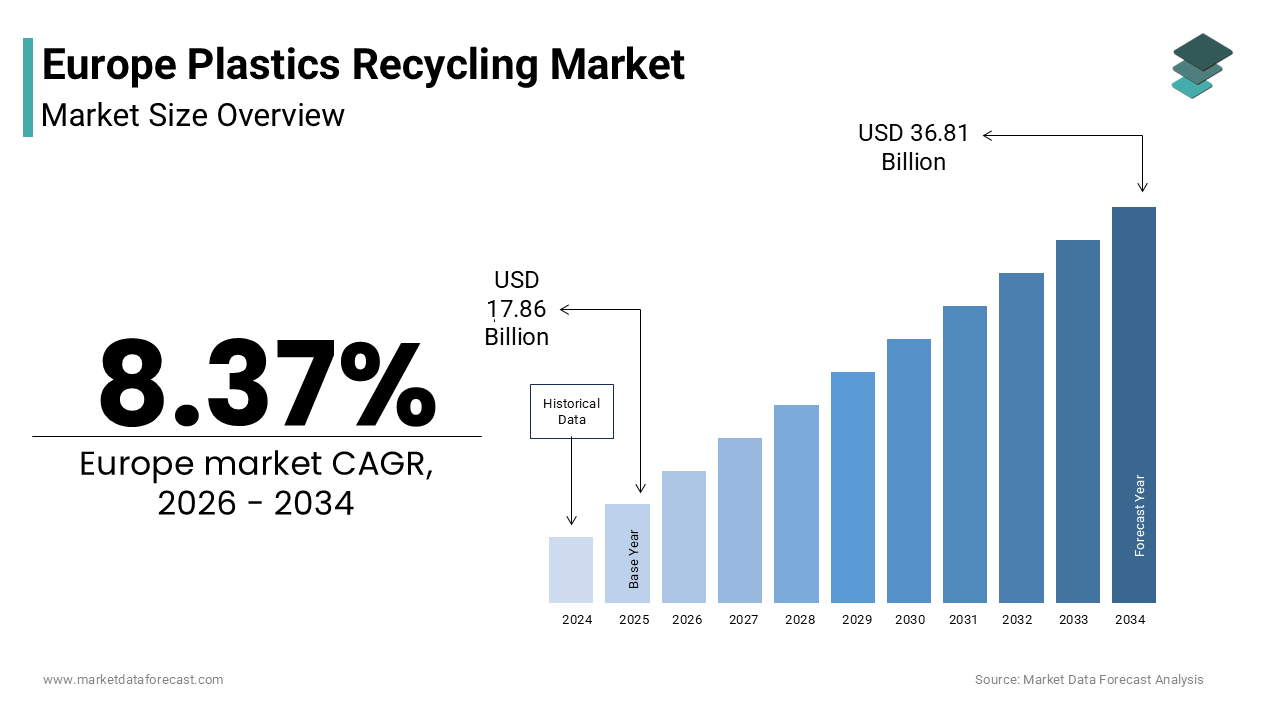
The Europe plastics recycling market was valued at USD 17.86 billion in 2025, is estimated to reach USD 19.36 billion in 2026, and is projected to reach USD 36.81 billion by 2034, growing at a CAGR of 8.37% during the forecast period from 2026 to 2034. The growth of the Europe plastics recycling market is driven by stringent regulatory mandates on recycled content, increasing corporate sustainability commitments, and the rising adoption of circular economy practices across industries. The expansion of packaging recycling, growing demand for recycled polymers from automotive and consumer goods sectors, and advancements in chemical recycling technologies are further fueling market growth. Moreover, the integration of digital sorting technologies and traceability systems is enhancing recycling efficiency and improving material quality across the European value chain.
Key Market Trends
-
Rising demand for recycled plastics driven by EU regulations mandating recycled content in packaging.
-
Increasing investments in chemical recycling technologies to process complex plastic waste streams.
-
Growing adoption of AI-based sorting and digital traceability systems to improve recycling efficiency.
-
Strong corporate commitments toward sustainable packaging and circular material usage.
-
Expansion of recycled plastic usage in automotive, construction, and industrial applications.
Segmental Insights
- Based on source, the residential segment was the largest and held a significant share of the Europe plastics recycling market in 2025. The segment’s dominance is attributed to the widespread implementation of municipal waste collection systems and strong participation from households in recycling programs across European countries.
- Based on material, the polyethylene terephthalate (PET) segment accounted for 33.5% of the Europe plastics recycling market share in 2025. The dominance of PET is driven by its high recyclability, well-established deposit return systems, and regulatory mandates requiring recycled content in beverage bottles.
- Based on application, the packaging segment was the largest, occupying a prominent share of the Europe plastics recycling market in 2025. The dominance of this segment stems from stringent EU regulations on packaging waste, high generation of plastic packaging materials, and increasing demand from FMCG and beverage industries for sustainable packaging solutions.
Regional Insights
The Europe plastics recycling market is witnessing strong growth across major countries, supported by advanced waste management infrastructure and strict environmental regulations.
- Germany was the largest contributor, driven by its highly developed recycling systems, strong regulatory framework, and high recycling rates across plastic packaging waste streams.
- The United Kingdom holds a significant position in the market, supported by rising consumer awareness, government initiatives, and increasing investments in recycling infrastructure.
- France is experiencing steady growth due to strong government policies promoting circular economy practices and increasing investments in advanced recycling technologies.
- The Netherlands is emerging as a key growth market, driven by its leadership in circular economy initiatives, advanced logistics infrastructure, and adoption of AI-based sorting and chemical recycling technologies.
Competitive Landscape
The Europe plastics recycling market is characterized by the presence of large waste management companies, specialized recyclers, and emerging chemical recycling firms competing to enhance processing capacity and material quality. Leading players are focusing on technological advancements, strategic partnerships, and vertical integration to strengthen their market position. Investments in advanced sorting technologies, chemical recycling, and long-term supply agreements with brand owners are shaping the competitive landscape. Prominent players in the Europe plastics recycling market include Veolia, SUEZ SA, Müller-Guttenbrunn Group, Paprec Group, Morssinkhof Rymoplast, Biffa plc, Viridor, Remondis SE & Co. KG, Plastipak Holdings Europe, and ALPLA Group.
Europe Plastics Recycling Market Size
The Europe plastics recycling market size was valued at USD 17.86 billion in 2025 and is anticipated to reach USD 19.36 billion in 2026 from USD 36.81 billion by 2034, growing at a CAGR of 8.37% during the forecast period from 2026 to 2034.
Plastics recycling constitutes the industrial ecosystem dedicated to collecting, sorting, and reprocessing post-consumer and post-industrial plastic waste into secondary raw materials for manufacturing. This sector operates as a critical pillar within the European Union circular economy strategy, aiming to decouple economic growth from resource consumption while mitigating environmental degradation. According to Eurostat, each inhabitant in the European Union generated a considerable amount of plastic packaging waste in 2023, which is indicating the scale of material requiring management. Despite robust collection frameworks, as per the European Commission, recycling rates for plastic packaging remain well below total generation, which is indicating a persistent gap between waste creation and effective recovery. The industry encompasses both mechanical recycling facilities, which currently hold significant installed capacity, and emerging chemical recycling plants designed to handle complex polymer streams. According to the European Environment Agency, recycled materials now account for a growing share of inputs across the EU economy, reflecting gradual progress toward circularity goals. However, the sector faces structural volatility, with projections suggesting a decline in recycling capacity by 2025 due to economic pressures and facility closures. This definition encapsulates a market in transition, balancing regulatory mandates for higher recycling rates against the realities of operational profitability and feedstock quality.
MARKET DRIVERS
Stringent Regulatory Mandates Driving Mandatory Recycled Content
The implementation of rigorous legislative frameworks that mandate minimum recycled content levels in new plastic products is majorly driving the expansion of the Europe plastics recycling market. According to the European Union, binding targets require plastic bottles to contain recycled polyethylene terephthalate, creating an immediate and non-negotiable demand for high-quality recyclates. As per EU regulations, member states are required to recycle plastic packaging waste, which forces producers to secure reliable supply chains of secondary materials. These regulations effectively shift the market dynamic from voluntary sustainability initiatives to compulsory compliance to ensure that manufacturers must source recycled polymers regardless of current price differentials with virgin plastics. As per recent industry analysis, these policy instruments are essential because without such legal obligations, the economic incentive to use recycled material often vanishes when oil prices drop. According to EU directives, collection targets for single-use plastic bottles guarantee a steady inflow of feedstock for recyclers to process into compliant materials. Consequently, this regulatory pressure acts as a guaranteed off-take mechanism, de-risking investments in sorting and washing infrastructure while compelling brand owners to integrate circular materials into their product designs to avoid penalties.
Corporate Sustainability Commitments and Brand Owner Demand
The growth of the Europe plastics recycling market is also attributed to the surge in voluntary yet commercially critical commitments made by multinational corporations and brand owners to integrate post-consumer recycled plastics into their packaging portfolios. Major consumer goods companies have pledged to make all of their packaging reusable, recyclable, or compostable, with specific targets often exceeding regulatory minimums to satisfy environmentally conscious consumers and investors. According to the Circular Plastics Alliance, industry initiatives aim to boost the EU market for recycled plastics, reflecting a coordinated effort to align supply with escalating corporate demand. This demand is not merely rhetorical but translates into long-term supply agreements that provide financial stability for recycling operators amidst market fluctuations. According to Plastics Europe, manufacturers are increasingly viewing access to high-quality recycled feedstock as a strategic asset necessary for maintaining market share and brand reputation in a green economy. The drive is further amplified by the fact that marine litter consists largely of plastics, prompting brands to proactively address ocean pollution perceptions by sourcing verified recycled content. As consumer preference shifts decisively toward sustainable products, companies face direct commercial risks if they fail to demonstrate tangible progress in circularity, thereby sustaining a premium demand for certified recycled polymers that outpaces the current available supply in the region.
MARKET RESTRAINTS
Severe Economic Instability and Rising Operational Costs
The most significant restraint hindering the Europe plastics recycling market is the profound economic instability caused by soaring energy prices and operational costs that erode profit margins for recyclers. The sector is highly energy-intensive, requiring substantial electricity and heat for sorting, washing, and extruding plastic waste, making it exceptionally vulnerable to volatile energy markets. For instance, the European plastics recycling industry has faced a deepening crisis, with facility closures increasing due to unsustainable cost structures. As per industry data, recycling capacity remains well below the annual growth required to meet EU targets, largely because existing plants are operating below capacity or shutting down entirely. When the cost of processing waste exceeds the market value of the resulting recycled granules, especially when virgin plastic prices remain low due to cheap fossil fuel feedstocks, recycling operations become financially insolvent. This economic disconnect creates a paradox where waste exists and demand exists, but the middle link of processing collapses under financial pressure, threatening to reverse years of infrastructure development and undermining the region's circular economy ambitions.
High Contamination Rates and Feedstock Quality Issues
The persistent issue of high contamination rates in collected plastic waste streams that severely limits the quality and quantity of usable recyclates is further impeding the expansion of the Europe plastics recycling market. A significant portion of plastic waste collected in Europe enters the mixed municipal waste stream rather than dedicated recycling bins, leading to cross-contamination with food residue, non-recyclable polymers, and other materials that degrade the final output. According to EU research, only a fraction of total plastic waste produced is effectively collected for recycling, with the remainder lost to incineration, landfill, or leakage into the environment. Even within dedicated collection streams, the presence of complex multi-layer films, additives, and incorrect polymer types complicates the sorting process and reduces the yield of high-grade recycled material. According to studies on plastic flows, contaminants in input waste considerably hamper recovery rates, forcing recyclers to downgrade materials to lower-value applications or reject batches entirely. The technical difficulty of separating black plastics or distinguishing between similar polymer families further exacerbates the problem, resulting in a supply of recycled plastic that often fails to meet the strict purity standards required by food-contact regulators. This quality deficit means that despite high collection targets, the actual volume of plastic suitable for high-value recycling remains insufficient to satisfy the growing demand from brand owners, which is creating a bottleneck that stifles market expansion.
MARKET OPPORTUNITIES
Expansion of Chemical Recycling Technologies for Complex Streams
The rapid scaling of chemical recycling technologies capable of processing complex and contaminated plastic waste that mechanical methods cannot handle is a significant opportunity in the Europe plastics recycling market. Unlike traditional mechanical recycling, which degrades polymer chains over time, chemical recycling breaks plastics down to their molecular building blocks, allowing for the production of virgin-quality plastics from difficult-to-recycle streams like flexible films and multi-layer packaging. According to the European plastics industry, significant investments are planned in chemical recycling infrastructure, which is signalling a capital shift toward this advanced processing capability. For instance, chemical recycling capacity in Europe represents a nascent but rapidly expanding segment with immense potential to absorb waste volumes previously destined for incineration. This technological pivot offers a solution to the quality constraints of mechanical recycling, enabling the creation of food-grade recycled content from post-consumer waste that was historically deemed unrecyclable. According to Plastics Europe, members aim to scale up chemically recycled plastics production, which would significantly diversify the region's feedstock base. By unlocking these hard-to-recycle fractions, chemical recycling can bridge the gap between waste generation and the high-purity demands of the circular economy, opening new revenue streams and reducing reliance on fossil-based virgin materials.
Digitalization and Advanced Sorting Infrastructure Integration
The integration of digitalization and advanced sorting technologies presents a substantial opportunity to enhance the efficiency, transparency, and yield of the European plastics recycling value chain. The deployment of artificial intelligence, near-infrared spectroscopy, and robotic sorting systems allows facilities to identify and separate polymer types with unprecedented precision, thereby increasing the purity and market value of the output. Digital product passports and blockchain tracking systems are emerging as tools to verify the origin and composition of recycled materials, addressing the traceability requirements increasingly demanded by regulators and brand owners. According to EU data, large volumes of packaging waste are generated annually, and optimizing the sorting of this massive stream through automation can drastically reduce contamination and improve overall recovery rates. Investments in modernizing legacy sorting centers are expected to yield higher throughput and lower operational costs, making recycling economically more attractive compared to disposal methods. As per industry observations, the adoption of these smart technologies is crucial for meeting stringent recycling targets, as manual sorting alone cannot achieve the necessary speed or accuracy. This digital transformation not only improves operational metrics but also builds trust in the recycled supply chain, encouraging greater uptake of secondary materials by manufacturers who require certified and consistent quality.
MARKET CHALLENGES
Fragmented Regulatory Landscape and Policy Uncertainty
A formidable challenge facing the Europe plastics recycling market is the fragmented regulatory landscape across member states, which creates inconsistency in waste collection standards and hampers the development of a unified continental market. While EU-wide directives set overarching goals, the transposition and enforcement of these rules vary significantly between countries, leading to disparities in collection rates, sorting criteria, and definitions of what constitutes recyclable waste. According to EU data, recycling rates differ widely among member states, creating an uneven playing field for recyclers operating across borders. This lack of harmonization complicates the logistics of trading waste and recyclates, as materials accepted in one jurisdiction may be classified as waste or rejected in another, increasing administrative burdens and costs. Additionally, ongoing debates regarding the classification of chemical recycling outputs and mass balancing rules introduce policy uncertainty that delays investment decisions. As per recent EU feedback periods, the industry remains in a state of flux regarding the final legal status of many recycled materials. Until a fully harmonized framework is established that standardizes collection infrastructures and regulatory definitions across all twenty-seven member states, the market will struggle to achieve the economies of scale necessary for robust growth and efficiency.
Competition from Low-Cost Virgin Plastics and Global Market Dynamics
The Europe plastics recycling market faces an enduring challenge from the intense price competition posed by low-cost virgin plastics derived from fossil fuels, which often undercut recycled alternatives on a cost basis. The economics of recycling are intrinsically linked to global oil prices, and when crude oil costs decline, the production of virgin polymers becomes cheaper, rendering recycled plastics less attractive to price-sensitive manufacturers without regulatory mandates. For instance, major players have shelved investments in European chemical recycling projects due to restrictive rules and unfavourable economic conditions compared to virgin production. Furthermore, global trade dynamics and restrictions on waste exports limit the ability of European nations to divert excess or low-quality waste to external markets, forcing domestic systems to absorb volumes they may not be equipped to process efficiently. The sector recorded a turnover of over 9.1 billion euros, yet this financial performance is constantly threatened by the volatility of virgin plastic pricing which dictates the ceiling for recycled material values. Without mechanisms such as carbon taxes on virgin plastics or stronger subsidies for recycled content, the market remains vulnerable to swings in the petrochemical sector, making long-term planning difficult for recyclers who operate on thin margins and require stable price premiums to justify their higher operational costs.
REPORT COVERAGE
| REPORT METRIC | DETAILS |
| Market Size Available | 2025 to 2034 |
| Base Year | 2025 |
| Forecast Period | 2026 to 2034 |
| CAGR | 8.37% |
| Segments Covered | By Source, Material, Application, Recycling Process, End-Use and Region. |
| Various Analyses Covered | Global, Regional & Country Level Analysis, Segment-Level Analysis, DROC, PESTLE Analysis, Porter’s Five Forces Analysis, Competitive Landscape, Analyst Overview of Investment Opportunities |
| Country Covered | UK, France, Spain, Germany, Italy, Russia, Sweden, Denmark, Switzerland, the Netherlands, Turkey, the Czech Republic, and the Rest of Europe. |
| Market Leaders Profiled | Veolia, SUEZ SA, Müller-Guttenbrunn Group, Paprec Group, Morssinkhof Rymoplast, Biffa plc, Viridor, Remondis SE & Co. KG, Plastipak Holdings Europe, and ALPLA Group. |
SEGMENTAL ANALYSIS
By Source Insights
The residential segment dominated the market with 54.4% of the European plastics recycling market share in 2025. The growth of the residential segment in the European market is majorly driven by the extensive implementation of municipal separate collection schemes across European Union member states, which target household packaging waste as the primary feedstock. The European Union Packaging and Packaging Waste Regulation mandates that all member states establish separate collection systems for plastic packaging, which is directly channelling residential waste into the recycling stream. According to Eurostat, households generate the majority of post-consumer plastic packaging waste, with collection rates in leading nations supported by deposit return schemes and curbside sorting. The sheer volume of single-use packaging items such as bottles, films, and containers discarded by consumers creates a consistent and high-volume supply chain that industrial sources cannot match in terms of diversity and quantity. Furthermore, public awareness campaigns funded by national governments have significantly increased participation rates in home recycling programs, ensuring a steady inflow of materials. The regulatory focus on Extended Producer Responsibility schemes places the financial burden of collection on producers but relies heavily on the residential infrastructure to gather the materials, cementing this segment as the foundational pillar of the European recycling ecosystem.
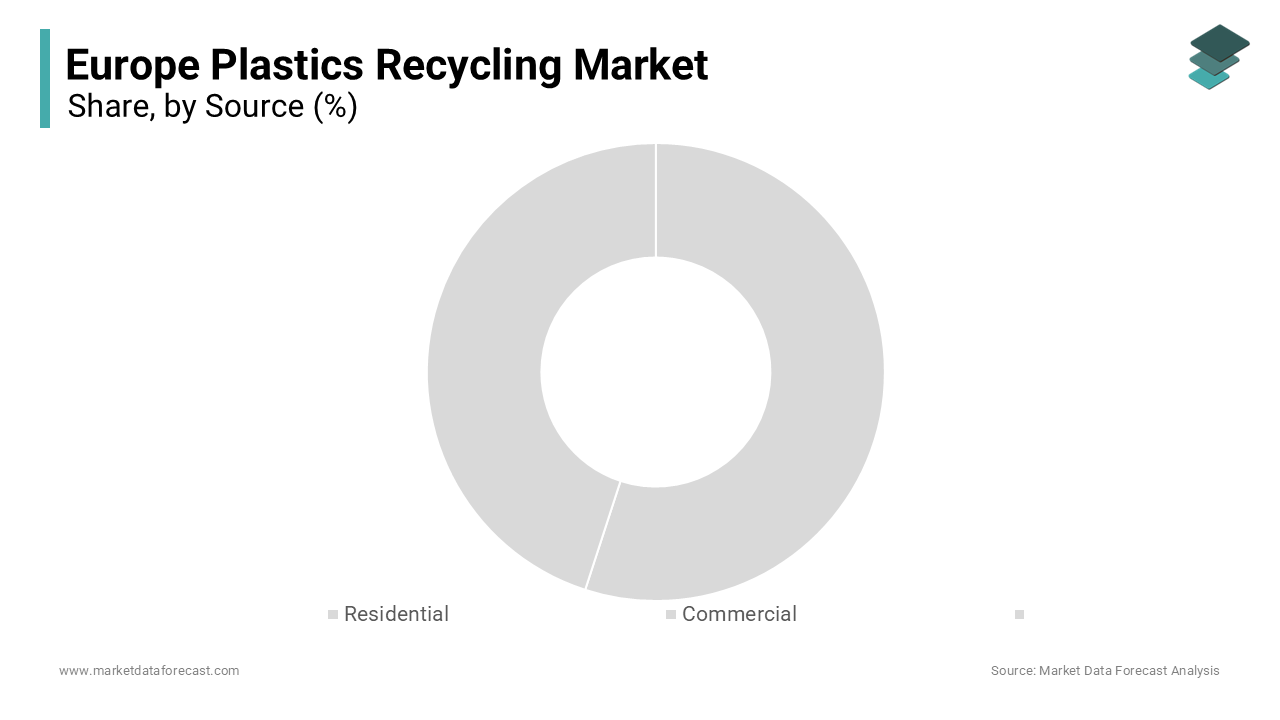
On the other hand, the commercial segment is emerging as the fastest-growing source within the Europe plastics recycling market and is expected to register a CAGR of 8.5% over the forecast period owing to the rapid proliferation of zero-waste initiatives within the hospitality, retail, and office sectors, which are increasingly mandated to separate waste streams under stricter local ordinances. Unlike residential waste which is often mixed, commercial waste from supermarkets and distribution centers offers higher purity levels of specific polymers like polyethylene and polypropylene, which is making it highly attractive for recyclers seeking quality feedstock. For instance, the rise of e-commerce has generated a surge in commercial plastic packaging waste, including shrink wraps and protective films, which businesses are now legally required to manage through dedicated recycling channels. The European Green Deal pushes for circular business models, compelling large corporations to audit and optimize their waste outputs, thereby diverting significant volumes from general waste to specialized recycling streams. Additionally, the expansion of bulk buying clubs and wholesale retailers has centralized plastic waste generation, allowing for more efficient collection logistics compared to dispersed household sources. As per sustainability audits, commercial entities are adopting advanced compaction and sorting technologies on-site to reduce contamination, further enhancing the economic viability of recycling this specific waste stream and driving its superior growth trajectory relative to other sources.
By Material Insights
The polyethylene terephthalate segment led the market by capturing 33.5% of the European market share in 2025 due to its widespread use in beverage bottles and food packaging. The supremacy of this material is also driven by the highly efficient and mature collection infrastructure specifically designed for PET bottles, including Deposit Return Systems that are operational in numerous European countries. According to Plastics Europe, PET bottles achieve high collection rates in nations with established deposit schemes, ensuring a consistent and high-quality supply of recyclable feedstock. The material possesses unique chemical properties that allow it to be recycled repeatedly without significant degradation of its polymer chain, making it ideal for closed-loop recycling where old bottles become new bottles. Regulatory mandates such as the Single Use Plastics Directive require a minimum of 25% recycled content in PET bottles by 2025, creating an insatiable demand from beverage manufacturers for food-grade recycled PET. This regulatory pull, combined with the technical ease of sorting PET using near-infrared technology, makes it the most economically viable polymer to recycle. Furthermore, the high market value of recycled PET granules compared to other polymers incentivizes collectors and sorters to prioritize this stream, reinforcing its market leadership. The established ecosystem of washers and flakers across the continent is optimized for PET processing, creating a self-reinforcing cycle of collection and reprocessing that other materials struggle to match.
The polypropylene segment is witnessing the fastest growth in the Europe plastics recycling market and is estimated to register a CAGR of 9.4% over the forecast period owing to the expanding application of PP in automotive components, rigid packaging, and consumer goods, coupled with recent technological breakthroughs in sorting and cleaning processes that now allow for higher quality recovery. Historically, PP was difficult to recycle due to contamination and diverse additive packages, but advancements in solvent-based purification and AI-driven sorting have unlocked its potential for high-value applications. According to industry analysis, the automotive sector in Europe is increasingly mandating the use of recycled PP in interior trim and under-the-hood components to meet circular economy targets, driving a sharp increase in demand. The material's versatility and resistance to fatigue make it a preferred choice for manufacturers seeking to replace virgin plastics with sustainable alternatives without compromising performance. As per market studies, the development of food-contact approved recycled PP is opening new avenues in packaging, a segment previously dominated by PET and HDPE. The European Commission's push for broader material coverage in recycling targets has also spurred investment in PP-specific recycling facilities, addressing the previous bottleneck of limited processing capacity. This combination of technological enablement and cross-sectoral demand is propelling PP to become the most dynamic segment in the material landscape.
By Application Insights
The packaging segment overwhelmingly dominated the Europe plastics recycling market with 66.1% of the European market share in 2025. The dominance of packaging segment in the European market is attributed to the intense regulatory pressure and consumer demand for sustainable packaging solutions within the fast-moving consumer goods and beverage industries. The European Union Packaging and Packaging Waste Regulation sets binding targets for recycled content in plastic packaging, forcing manufacturers to integrate secondary materials into bottles, films, and containers at an unprecedented scale. According to the European Environment Agency, plastic packaging constitutes the largest fraction of plastic waste generated in Europe, creating a natural loop where the waste stream directly feeds the application demand. Major brand owners have committed to making all of their packaging reusable, recyclable, or compostable, with specific goals to incorporate recycled content by 2025. The economic model for packaging recycling is further supported by Extended Producer Responsibility schemes that internalize the cost of waste management, making the use of recycled materials financially prudent. Additionally, the technical suitability of recycled polymers for non-food and increasingly food-contact packaging applications ensures a stable off-take market. The sheer volume of single-use items entering the waste stream ensures that packaging remains the primary driver for recycling infrastructure investment and material recovery efforts across the continent.
On the other side, the automotive segment is emerging as the fastest-growing application for recycled plastics in Europe and is anticipated to record a CAGR of 10.4% over the forecast period. The stringent vehicle end-of-life regulations and the industry's aggressive pursuit of lightweighting strategies to meet carbon emission standards is propelling the expansion of the automotive segment in the European market. European automakers are increasingly integrating recycled polypropylene, polyamide, and ABS into interior components, underbody shields, and battery housings for electric vehicles to reduce overall vehicle weight and environmental footprint. According to the European Automobile Manufacturers Association, plastics make up a significant portion of modern vehicles, and manufacturers are targeting increased shares of recycled content in new models by the end of the decade. The shift toward electric mobility has intensified this trend, as battery production and vehicle lifecycle assessments place a premium on circular materials to lower the embedded carbon of the final product. Regulatory frameworks like the End of Life Vehicles Directive mandate high recovery and recycling rates for automobiles, creating a closed-loop system where old cars feed materials into new ones. Furthermore, collaborations between chemical companies and car manufacturers are developing high-performance recycled grades that meet the rigorous safety and durability standards of the automotive industry. This convergence of regulatory compliance, sustainability goals, and performance requirements is accelerating the adoption of recycled plastics in the automotive sector faster than any other application.
REGIONAL ANALYSIS
Germany Plastics Recycling Market Analysis
Germany led the plastics recycling market in Europe in 2025 with the highest share of the regional market in 2025 due to its advanced waste management infrastructure and strict regulatory frameworks. According to Eurostat, Germany recycles over 46% of plastic packaging waste, one of the highest rates in Europe. The country operates more than 1,400 sorting and recycling facilities, with strong participation from chemical giants like BASF and Covestro in advanced recycling technologies. The Packaging Act mandates recycling quotas of 63% for plastics by 2025, driving innovation in mechanical and chemical recycling. Municipal systems are highly efficient, with over 90% household participation in separate collection schemes. Germany also invests in chemical depolymerization and pyrolysis to handle mixed plastics, positioning itself as a leader in next‑generation recycling. With its combination of regulatory rigor, industrial scale, and technological leadership, Germany remains the anchor of Europe’s plastics recycling market.
UK Plastics Recycling Market Analysis
The UK represented the second largest plastics recycling market in Europe and is driven by strong policy commitments and consumer awareness. According to WRAP, over 44% of plastic packaging was recycled in 2023, though the government aims to raise this to 55% by 2030 under the Resources and Waste Strategy. The UK operates more than 300 material recovery facilities, with London and Manchester serving as key hubs. Post‑Brexit, the UK introduced its own Extended Producer Responsibility (EPR) scheme, requiring producers to cover the full cost of recycling. Private investment has accelerated, with chemical recycling plants expanding capacity to process hard‑to‑recycle plastics. Consumer participation is high, with over 80% of households engaged in curbside collection. With its blend of regulatory autonomy, private investment, and consumer engagement, the UK remains a dynamic and evolving plastics recycling market.
France Plastics Recycling Market Analysis
France accounts for a prominent share of the European plastics recycling market over the forecast period due to the strong government initiatives and industrial participation. According to ADEME, France recycled 27% of plastic packaging waste in 2023, below the EU average, but reforms are accelerating progress. The Anti‑Waste and Circular Economy Law mandates 100% recyclable plastics by 2025, pushing companies to redesign packaging. France operates more than 500 recycling facilities, with Paris and Lyon leading in advanced sorting technologies. Major firms such as Veolia and Suez are investing in chemical recycling, with pilot plants targeting mixed and multilayer plastics. Consumer awareness campaigns have increased participation, with over 75% of households now separating plastics. With its combination of policy ambition, industrial investment, and consumer engagement, France is expected to close the recycling gap and strengthen its role in Europe’s circular plastics economy.
Netherlands Plastics Recycling Market Analysis
The Netherlands is estimated to register a promising CAGR in the European plastics recycling market during the forecast period. The circular economy leadership and advanced logistics are propelling the market growth in Netherlands. According to Eurostat, the Netherlands recycles 38% of plastic packaging waste, supported by efficient municipal systems. Amsterdam and Rotterdam serve as hubs for recycling innovation, with facilities integrating AI‑driven sorting and chemical recycling. The Dutch government’s Circular Economy 2050 strategy mandates a 50% reduction in raw material use by 2030, accelerating plastics recycling adoption. The Netherlands also leads in resource recovery, with facilities extracting phosphates and bioplastics from mixed waste streams. Consumer participation is strong, with over 80% of households engaged in separate collection. With its combination of policy innovation, logistics infrastructure, and advanced recycling technologies, the Netherlands remains a high‑influence market in Europe’s plastics recycling landscape.
COMPETITIVE LANDSCAPE
The competition in the Europe plastics recycling market is intensifying as established waste management giants compete with specialized recycling innovators and new chemical technology entrants. Large multinational corporations leverage their extensive collection networks and capital resources to dominate the mechanical recycling space while simultaneously acquiring startups to gain access to advanced chemical processing technologies. Smaller niche players differentiate themselves by focusing on specific polymer streams or developing proprietary sorting solutions that yield higher purity grades. The competitive landscape is further shaped by regulatory pressures that force all participants to upgrade facilities and improve transparency in their supply chains. Price volatility of virgin plastics creates a challenging environment where recyclers must constantly optimize costs to remain viable against fossil-based alternatives. Strategic collaborations between competitors are becoming more common to share risks associated with large-scale infrastructure investments. This dynamic environment drives continuous innovation as companies strive to secure limited high-quality feedstock and meet the escalating demand from brand owners committed to sustainability goals.
KEY MARKET PLAYERS
Some of the companies that are playing a dominating role in the Europe Plastics Recycling Market include
- Veolia
- SUEZ SA
- Müller-Guttenbrunn Group
- Paprec Group
- Morssinkhof Rymoplast
- Biffa plc
- Viridor
- Remondis SE & Co. KG
- Plastipak Holdings Europe
- ALPLA Group
Top Players in the Europe Plastics Recycling Market
Veolia
Veolia stands as a global leader in environmental services with a massive footprint in the European plastics recycling sector. The company operates numerous specialized facilities across France, Germany, and the Netherlands dedicated to sorting and washing post-consumer plastic waste. Veolia contributes significantly to the global market by developing advanced chemical recycling technologies that complement traditional mechanical methods. Recently, the firm has strengthened its position by forming strategic partnerships with major consumer goods companies to secure long-term supply agreements for high-quality recycled polymers. They have also invested heavily in upgrading their sorting infrastructure with artificial intelligence to improve purity levels. These actions ensure Veolia remains at the forefront of the circular economy transition while expanding its capacity to process complex plastic streams that were previously deemed unrecyclable in various regions.
Suez
Suez is a pivotal player in the Europe plastics recycling market, leveraging its extensive waste collection network to feed its growing portfolio of recycling plants. The company plays a crucial role globally by pioneering innovative solutions for hard-to-recycle plastics and promoting circular economy principles through its industrial symbiosis projects. In recent moves to solidify its market standing, Suez has focused on integrating digital tracking systems to enhance transparency and traceability within its supply chains. They have also expanded their chemical recycling capabilities through joint ventures aimed at converting plastic waste back into virgin-quality feedstock. By collaborating with automotive and packaging manufacturers, Suez ensures a steady demand for its recycled outputs. Their commitment to research and development allows them to tackle contamination challenges effectively, positioning the company as a key enabler of sustainable material loops across the continent and beyond.
Plastic Energy
Plastic Energy distinguishes itself as a pioneer in chemical recycling technology within the European market, offering a unique solution for mixed and contaminated plastic waste. Their contribution to the global market lies in their ability to produce certified circular polymers that meet food-grade standards, bridging the gap between waste management and high-value manufacturing. To strengthen their position, Plastic Energy has recently secured significant funding to scale up their commercial plants in Spain and the Netherlands. They have also entered into exclusive off-take agreements with global chemical giants to supply pyrolysis oil derived from plastic waste. These strategic moves allow them to bypass the limitations of mechanical recycling and address the growing demand for sustainable raw materials. By continuously refining their thermal conversion process, Plastic Energy is setting new benchmarks for quality and efficiency in the advanced recycling sector.
Top Strategies Used by Key Market Participants
Key players in the Europe plastics recycling market primarily employ vertical integration strategies to secure consistent feedstock supplies and control quality from collection to final granule production. Companies are increasingly investing in advanced sorting technologies utilizing artificial intelligence and robotics to enhance purity levels and operational efficiency. Another dominant strategy involves forming long-term strategic partnerships with brand owners and chemical producers to guarantee off-take agreements for recycled materials. Many firms are also diversifying their portfolios by incorporating chemical recycling capabilities alongside traditional mechanical processes to handle complex waste streams. Furthermore, participants are actively engaging in mergers and acquisitions to expand their geographical footprint and increase total processing capacity. These collective efforts aim to build resilient supply chains that can withstand market volatility while meeting stringent regulatory requirements for recycled content across various industries.
MARKET SEGMENTATION
This research report on the Europe plastics recycling market has been segmented and sub-segmented based on the following categories.
By Source
- Residential
- Commercial
By Material
- Polyethylene Terephthalate (PET)
- Polypropylene (PP)
- High-Density Polyethylene (HDPE)
- Low-Density Polyethylene (LDPE)
- Polyvinyl Chloride (PVC)
- Polystyrene (PS)
- Others
By Application
- Packaging
- Construction
- Automotive
- Textiles
- Electronics
By Recycling Process
- Mechanical Recycling
- Chemical Recycling
- Energy Recovery
- Biological Recycling
By End Use
- Consumer Goods
- Industrial Products
- Building Materials
- Agricultural Products
By Country
- UK
- France
- Spain
- Germany
- Italy
- Russia
- Sweden
- Denmark
- Switzerland
- Netherlands
- Turkey
- Czech Republic
- Rest of Europe
Access the study in MULTIPLE FORMATS
Purchase options starting from
$ 2000
Didn’t find what you’re looking for?
TALK TO OUR ANALYST TEAM
Need something within your budget?
NO WORRIES! WE GOT YOU COVERED!
Call us on: +1 888 702 9696 (U.S Toll Free)
Write to us: sales@marketdataforecast.com