- Product Description Description
- Table of Contents TOC
- List of Table & Figure LOT
- Get Free Sample PDF Sample PDF
Market Size, 2025
$2.26 BnMarket Estimate, 2026
$2.36 BnMarket Forecast, 2034
$3.31 BnCAGR, 2026–2034
4.33%Europe Platinum Market Report Summary
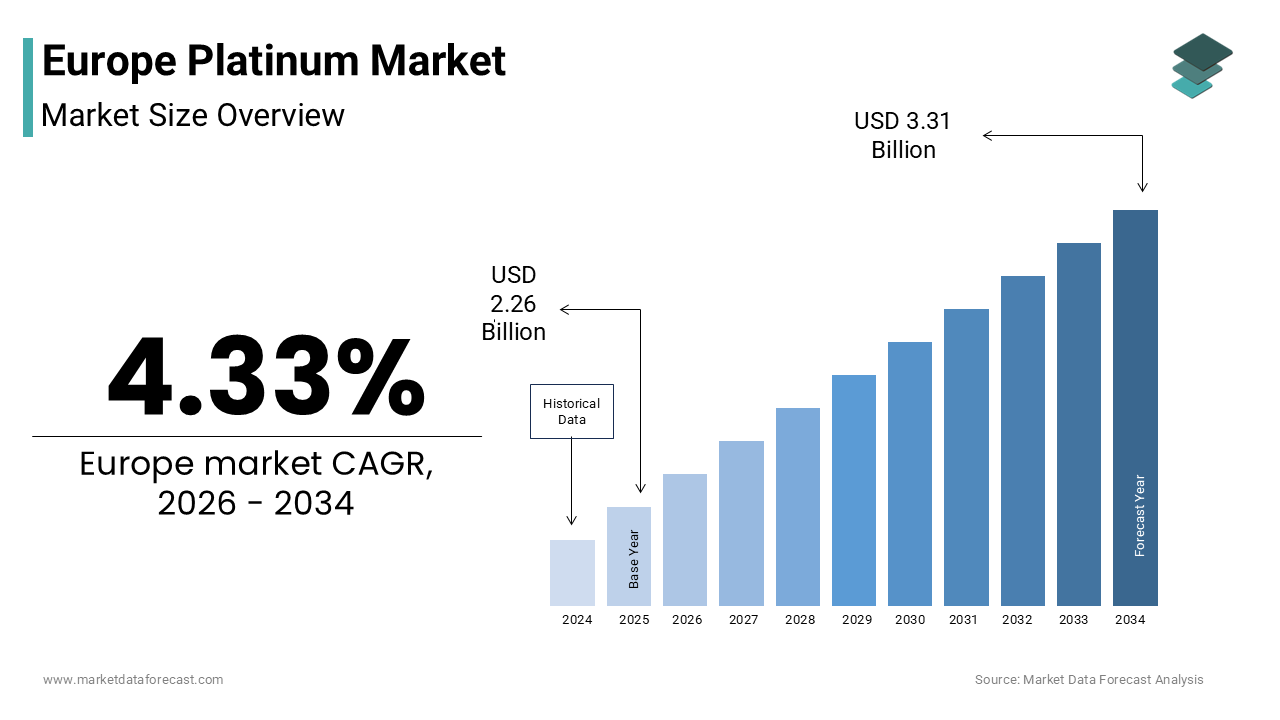
The Europe platinum market was valued at USD 2.26 billion in 2025, is estimated to reach USD 2.36 billion in 2026, and is projected to reach USD 3.31 billion by 2034, growing at a CAGR of 4.33% during the forecast period from 2026 to 2034. The growth of the Europe platinum market is driven by stringent emission regulations for heavy-duty vehicles, expanding adoption of platinum-based catalytic converters, and the rising role of platinum in green hydrogen technologies. Increasing deployment of proton exchange membrane (PEM) electrolyzers, growth in fuel cell electric vehicles, and strong demand from chemical processing industries are further fueling market expansion. Moreover, advancements in recycling technologies and the increasing importance of platinum as a critical raw material for Europe’s clean energy transition are strengthening the long-term market outlook.
Key Market Trends
-
Rising demand for platinum in heavy-duty diesel emission control systems due to stricter Euro 7 standards.
-
Growing adoption of platinum catalysts in green hydrogen production through PEM electrolyzers and fuel cell technologies.
-
Increasing focus on urban mining and recycling of end-of-life autocatalysts to secure regional supply chains.
-
Expanding use of platinum in chemical processing, including nitric acid production and pharmaceutical synthesis.
-
Shift in market dynamics as electrification reduces reliance on traditional automotive catalyst demand while hydrogen applications gain momentum.
Segmental Insights
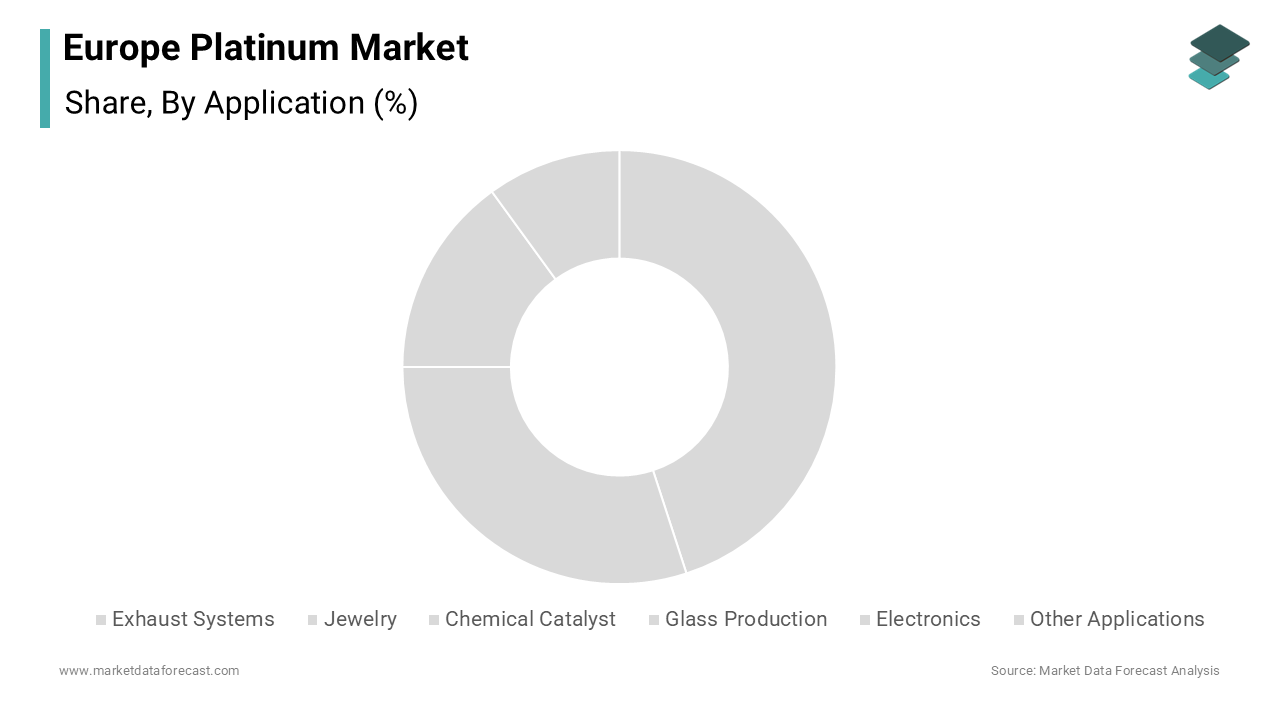
- Based on application, the exhaust systems segment held the largest share of 65.4% of the Europe platinum market in 2025. The dominance of this segment is attributed to strict emission regulations and sustained demand for platinum in heavy-duty diesel after-treatment systems where thermal stability and catalytic efficiency are essential.
- The chemical catalysts segment is projected to witness the fastest growth during the forecast period, supported by platinum’s critical role in nitric acid production, fine chemical synthesis, and emerging hydrogen-related applications.
Regional Insights
The Europe platinum market is experiencing stable growth across major industrial economies, supported by automotive manufacturing, chemical processing, and increasing investments in hydrogen infrastructure.
-
Germany was the largest contributor, accounting for 28.7% of the Europe platinum market share in 2025, driven by strong automotive production, advanced chemical manufacturing, and expanding hydrogen initiatives.
-
The United Kingdom continues to perform strongly due to its role as a global precious metals trading hub and growing hydrogen economy projects.
-
France maintains steady growth supported by aerospace manufacturing, luxury jewelry demand, and chemical catalyst applications.
-
Switzerland and the Netherlands are emerging as important markets, driven by high-end watchmaking, refining expertise, recycling infrastructure, and strong circular economy initiatives.
Competitive Landscape
The Europe platinum market is characterized by a concentrated competitive environment dominated by global mining companies, specialty catalyst manufacturers, and advanced recycling firms focusing on sustainability and material efficiency. Leading companies are investing in hydrogen-related technologies, low-platinum catalyst development, and high-recovery recycling processes to secure supply chains and align with EU decarbonization goals. Strategic collaborations with automotive OEMs, hydrogen consortia, and chemical producers are strengthening market positioning. Prominent players in the Europe platinum market include Anglo American Platinum Limited, Impala Platinum Holdings Limited, Sibanye-Stillwater, Norilsk Nickel, Northam Platinum Limited, Johnson Matthey Plc, Heraeus Precious Metals, Glencore plc, Royal Bafokeng Platinum, and Jubilee Metals Group plc.
Europe Platinum Market Size
The Europe platinum market size was valued at USD 2.26 billion in 2025 and is anticipated to reach USD 2.36 billion in 2026 from USD 3.31 billion by 2034, growing at a CAGR of 4.33% during the forecast period from 2026 to 2034.
Platinum (Pt) is a heavy, silver-white chemical element with the atomic number 78. It is one of the rarest and most stable metals on Earth, belonging to the Platinum Group Metals (PGMs) alongside palladium, rhodium, ruthenium, iridium, and osmium. Unlike investment-driven markets, Europe’s platinum demand is fundamentally industrial, anchored in automotive catalysts, chemical processing, hydrogen technologies, and jewelry. The European Union maintains a heavy reliance on foreign imports for its platinum needs, with supply chains heavily concentrated in South Africa, Russia, and Zimbabwe. Despite its high consumption for industrial and environmental technology, domestic production within the EU remains negligible. The European Chemicals Agency classifies platinum salts as substances of very high concern under REACH, necessitating strict handling protocols, while the London Platinum and Palladium Market provides price benchmarking for institutional transactions. Crucially, platinum is designated a critical raw material under the EU Raw Materials Initiative due to its irreplaceable role in emission control and clean energy. The European platinum market is undergoing a structural shift, moving away from its reliance on internal combustion engine catalysts. Driven by the energy transition, demand is progressively transitioning toward green hydrogen applications, specifically for fuel cells and electrolyzers. This dual identity, as both a legacy emission-control enabler and a future clean-energy catalyst, positions platinum at the nexus of Europe’s environmental transition and strategic material security.
MARKET DRIVERS
Stringent Emission Regulations and Heavy-Duty Vehicle Catalyst Demand
The region’s aggressive air quality policies propel the growth of the Europe platinum market. This continues to drive platinum demand through heavy-duty diesel and gasoline particulate filter applications, where platinum’s thermal stability outperforms palladium. Following adoption in 2024, the updated European emission regulations introduce stricter pollutant limits specifically for heavy-duty vehicles, alongside new requirements for non-exhaust emissions and improved battery durability for all new vehicles. Analyses indicate that the stricter Euro 7 exhaust standards for heavy-duty diesel engines necessitate more advanced aftertreatment technologies, driving an increase in precious metal usage per unit compared to previous generations. Research indicates high volumes of new commercial vehicles in the European market are subject to the new standards, requiring significantly higher amounts of catalytic platinum to meet stringent pollutant thresholds. Unlike light-duty vehicles, which have shifted toward palladium, diesel engines rely on platinum due to its superior performance under high-temperature exhaust conditions. This regulatory tailwind ensures stable, non-discretionary demand despite the rise of electric mobility, as the EU’s freight sector remains heavily dependent on internal combustion engines through at least 2035.
Expansion of Green Hydrogen Infrastructure and Electrolyzer Deployment
Platinum is emerging as a critical enabler of the region’s hydrogen economy, particularly in proton exchange membrane (PEM) electrolyzers used to produce green hydrogen from renewable electricity, which is among the key factors contributing to the expansion of the Europe platinum market. The European Union is advancing a major expansion of green hydrogen production with significant plans for electrolyzer deployment by the end of the decade, where proton exchange membrane technology is favored for its capability to operate efficiently with variable renewable energy sources. Proton exchange membrane electrolyzers rely on precious metals as catalysts to facilitate efficient, rapid, and high-purity hydrogen production, with ongoing industry efforts focused on reducing material loading to enhance sustainability and lower manufacturing costs. Through its Important Projects of Common European Interest (IPCEI), the European Commission is authorizing significant public funding for industrial-scale hydrogen initiatives, with a substantial portion of these projects focusing on the deployment of advanced electrolysis technologies like PEM. Companies are scaling manufacturing of multi-megawatt stacks, directly increasing platinum offtake. Despite ongoing research into platinum-free or low-platinum alternatives, current commercial systems still rely on the metal for optimal performance and durability. Platinum is shedding its image as a pollution filter and becoming a critical building block for clean energy as Europe pushes the REPowerEU agenda to end fossil dependency.
MARKET RESTRAINTS
Extreme Import Dependency and Geopolitical Supply Concentration
The region’s near-total reliance on imported platinum, a significant share sourced from South Africa and Russia, poses a severe structural vulnerability to supply chain disruptions, which restrains the growth of the Europe platinum market. The European Commission emphasizes that the global supply of critical platinum group metals is heavily concentrated, with the vast majority of extraction dominated by a very small number of nations, creating significant supply chain vulnerability. Following the Russian invasion of Ukraine in 2022, fears regarding the security of supply for critical raw materials heightened, exposing the risks of European reliance on concentrated foreign sources for essential industrial metals. Unlike gold or silver, platinum lacks strategic stockpiles in the EU, leaving industries exposed to geopolitical instability, labor strikes in South African mines, and logistical bottlenecks. The EU’s Carbon Border Adjustment Mechanism does not cover platinum, offering no protection against trade distortions. This dependency undermines Europe’s ambition for technological sovereignty in hydrogen and automotive sectors, as any disruption in primary supply could delay clean energy deployment and increase costs for manufacturers already operating on thin margins.
High Price Volatility and Substitution Pressures
Significant price volatility slows down the growth of the Europe platinum market. This is due to its dual exposure to industrial demand and investment speculation, creating budgeting uncertainty for end users. Between 2020 and 2024, platinum experienced volatile pricing driven by supply constraints, shifting macroeconomic factors, and changes in industrial demand. The World Platinum Investment Council points out that, due to the high price of palladium, automakers actively increased the use of platinum in gasoline catalyst applications, a trend that bolstered platinum demand. In chemical processing, researchers are developing non-platinum catalysts for nitric acid production, a major industrial use, though none match platinum’s longevity. This volatility discourages long-term contracts and incentivizes R&D into alternatives, eroding platinum’s market position in marginal applications. In the absence of pricing mechanisms or demonstrated indispensability in hydrogen-related applications, the metal is susceptible to substitution in areas lacking a clear performance-to-cost advantage.
MARKET OPPORTUNITIES
Integration of Platinum in Fuel Cell Electric Vehicles and Stationary Power
The deployment of fuel cell electric vehicles (FCEVs) and stationary power systems offers a high-growth opportunity for the Europe platinum market. Fuel cell electric vehicles rely on platinum-group metals to facilitate the chemical reaction that generates power, whereas battery-powered alternatives do not require these specific precious metal catalysts. European Union initiatives focus on scaling the hydrogen economy for heavy transport and industry, supported by regional roadmaps that envision a significant rollout of fuel-cell-powered commercial fleets by the end of the decade. Heavy-duty logistics and rail networks in Western Europe have successfully transitioned from prototype to active service, utilizing hydrogen technology to power long-haul freight and passenger trains. Beyond transport, stationary fuel cells for backup power in data centers and hospitals are gaining traction. Large-scale technology firms are successfully piloting hydrogen fuel cell systems as a viable, emission-free alternative for providing backup power to data center infrastructure. New European legislative frameworks require the establishment of a standardized network of hydrogen refueling points along primary transit arteries to ensure cross-border connectivity for hydrogen-powered transport. Platinum is shifting from specialized application to a primary driver of zero-emission mobility and secure energy, fueled by market scaling.
Development of Urban Mining and End-of-Life Catalyst Recycling
The region’s advanced recycling infrastructure serves as a prime development area to mitigate primary supply risks through urban mining of spent autocatalysts, which is anticipated to boost the expansion of the Europe platinum market. A significant volume of end-of-life vehicles is processed annually in the EU, representing a vital source of platinum group metals, with catalytic converters yielding valuable platinum, palladium, and rhodium. Major refineries in Belgium and Germany, such as Umicore and Heraeus, utilize high-efficiency, advanced technologies to recover the vast majority of platinum from scrap, achieving high-purity levels. The EU Battery and End-of-Life Vehicle Directives mandate high recovery rates, creating a steady feedstock stream. Recycled platinum has increasingly become a critical component of Europe's total supply, with the automotive sector playing a major role in closing the loop on precious metals, despite fluctuations in supply volumes due to shifting vehicle usage. The European Institute of Innovation and Technology funds projects like PLATIRUS to develop hydrometallurgical processes that reduce energy use compared to smelting. Recycled platinum is evolving from a secondary option into a top-tier resource as regulatory and investor interest in the circular economy grows, offering a smaller carbon footprint and freedom from mining-related geopolitical risks.
MARKET CHALLENGES
Declining Automotive Demand Due to Electrification and Policy Shifts
The long-term structural decline in internal combustion engine (ICE) vehicle sales is a fundamental challenge to the Europe platinum market. The European Union’s long-term environmental regulations, which are shifting toward a, strict, but slightly relaxed,, phase-out of conventional combustion engines, will significantly reduce the primary market for platinum-based autocatalysts, forcing a shift in demand for precious metals. Battery electric vehicle registrations in Europe are growing significantly, with plug-in vehicles now forming a substantial, rising portion of new car sales, putting the region on track for a majority-electric new car market by the end of the decade. Despite a slower transition to electric in heavy-duty vehicles, their extended lifespans mean that by 2035, platinum demand will begin to contract. Automakers are also optimizing catalyst designs to use less platinum per unit. BMW is successfully lowering the usage of precious metals in its emission-control systems through advanced manufacturing and coating technologies. Failure to swiftly scale hydrogen-based mobility could result in a significant demand imbalance following the contraction of the traditional automotive sector, thereby depressing prices and hindering investment in necessary supply chains.
Technological Barriers to Platinum Reduction in Electrolyzers
Fundamental electrochemical limitations hinder rapid reduction in PEM electrolyzer catalyst loadings, despite efforts to minimize platinum use, which in turn constrains the expansion of the Europe platinum market. The oxygen evolution reaction at the anode requires platinum or iridium to achieve commercially viable efficiency and durability. Research from the Fraunhofer Institute for Solar Energy Systems confirms that reducing precious metal catalyst loadings below established thresholds in PEM electrolyzers, while aimed at cost reduction, can significantly limit stack lifespan and increase overall hydrogen production costs. This trade-off between material savings and durability remains a central challenge in the industry. The development of nanostructured supports and alloying holds potential, yet no commercial system has successfully transitioned to mass production at ultra-low platinum loadings. The European Hydrogen Bank’s auction mechanism favors low-cost green hydrogen, pressuring manufacturers to maintain performance, even at higher material costs. Platinum remains a critical component in AEM electrolysis until advancements in non-precious catalysts and membrane stability reach maturity. This dependency creates a bottleneck: scaling electrolysis to meet EU targets requires thousands of kilograms of platinum annually, straining supply and potentially delaying decarbonization if material constraints are not addressed through recycling or substitution
REPORT COVERAGE
| REPORT METRIC | DETAILS |
| Market Size Available | 2025 to 2034 |
| Base Year | 2025 |
| Forecast Period | 2026 to 2034 |
| CAGR | 4.33% |
| Segments Covered | By Application and Region |
| Various Analyses Covered | Regional & Country Level Analysis, Segment-Level Analysis, DROC, PESTLE Analysis, Porter’s Five Forces Analysis, Competitive Landscape, Analyst Overview on Investment Opportunities |
| Countries Covered | UK, France, Spain, Germany, Italy, Russia, Sweden, Denmark, Switzerland, Netherlands, Turkey, Czech Republic and Rest of Europe |
| Market Leaders Profiled | Anglo American Platinum Limited, Impala Platinum Holdings Limited, Sibanye-Stillwater, Norilsk Nickel, Northam Platinum Limited, Johnson Matthey Plc, Heraeus Precious Metals, Glencore plc, Royal Bafokeng Platinum, and Jubilee Metals Group plc |
SEGMENTAL ANALYSIS
By Application Insights
In 2025, the exhaust systems segment led the Europe platinum market by capturing a 65.4% share. The leading position of the exhaust systems segment is driven by stringent emission regulations for heavy-duty diesel and gasoline vehicles. Platinum’s superior thermal stability and catalytic efficiency in oxidizing carbon monoxide and hydrocarbons make it irreplaceable in diesel oxidation catalysts and gasoline particulate filters. The upcoming Euro 7 standards, recently adopted by the EU, are expected to significantly raise platinum loadings in heavy-duty exhaust after-treatment systems, increasing demand for PGM materials compared to the current Euro VI requirements. A high volume of new commercial vehicles continues to be registered in the EU, and the continued prevalence of advanced internal combustion engines in these trucks and buses sustains significant demand for platinum in their emission control systems. Unlike light-duty vehicles, which have shifted toward palladium, diesel engines rely on platinum due to its resilience under high-temperature exhaust conditions. Data from the European Automobile Manufacturers Association indicates that freight transport is still heavily reliant on diesel engines, with the transition to zero-emission technology for long-haul vehicles expected to continue beyond the next decade. This regulatory and operational reality ensures that exhaust systems remain the bedrock of platinum demand in Europe, despite the broader transition to electric mobility.
The chemical catalysts segment is predicted to witness the highest CAGR of 7.8% from 2026 to 2034 due to platinum’s irreplaceable role in nitric acid production, a key input for fertilizers and explosives, and emerging applications in green hydrogen and pharmaceutical synthesis. Platinum-rhodium gauzes are the predominant catalyst technology for ammonia oxidation in European fertilizer production, necessitating regular, significant replacement to maintain operational efficiency. The European Commission’s Farm to Fork Strategy mandates increased fertilizer efficiency, indirectly supporting stable nitric acid output. More significantly, platinum is critical in PEM electrolyzers for green hydrogen. The European Commission's Hy2Use hydrogen initiative, approved in 2022, supports numerous large-scale electrolysis projects, with PEM electrolyzer technology for these projects requiring substantial platinum loading per megawatt for manufacturing. Additionally, fine chemical producers like BASF and Solvay use platinum catalysts in selective hydrogenation reactions for active pharmaceutical ingredients. Europe’s pursuit of sustainability and resilient food systems is transforming chemical catalysts from a legacy utility into a strategic vector for technological advancement.
REGIONAL ANALYSIS
Germany Platinum Market Analysis
Germany dominated the European platinum market by accounting for a 28.7% share in 2025. The supremacy of the German market is attributed to its advanced automotive, chemical, and hydrogen industries. The country’s market status reflects deep integration of platinum into emission control systems for commercial vehicles produced by Daimler Truck and MAN, which together account for a significant share of EU heavy-duty truck output. According to the German Federal Motor Transport Authority, the total stock of commercial vehicles on German roads continued to increase in 2024, with diesel-powered, heavy-duty trucks dominating new registrations, which are subject to rigorous Euro VI emission standards rather than Euro 7, which is scheduled for future implementation. Simultaneously, Germany hosts Europe’s largest chemical cluster in Ludwigshafen, where BASF uses platinum gauzes in nitric acid production. The nation is also a pioneer in hydrogen: Siemens Energy’s PEM electrolyzer factory in Berlin and the H2Global initiative are scaling platinum demand for clean energy. Strict enforcement of the Circular Economy Act promotes urban mining, with Umicore operating a major PGM refinery in Hanau. This blend of industrial scale, regulatory rigor, and technological leadership solidifies Germany’s position as the continent’s platinum powerhouse.
United Kingdom Platinum Market Analysis
The United Kingdom was the next prominent country in the Europe platinum market by holding a 16.3% share in 2025. The growth of the UK market is fuelled by jewelry, investment, and emerging hydrogen applications. The market status is defined by London’s role as a global precious metals hub, home to the London Platinum and Palladium Market which sets benchmark prices for institutional transactions. Driven by significantly higher gold prices that spurred a shift towards more accessible precious metal alternatives, global platinum jewellery demand saw a strong, sustained rise throughout 2024, with significant growth in Asian markets and record-high consumption in North America, heavily supported by targeted marketing campaigns for bridal and men's collections. Simultaneously, the UK is advancing hydrogen infrastructure: the Gigastack project in Hull and ITM Power’s electrolyzer plant in Sheffield are increasing industrial platinum uptake. The Royal Mint also produces platinum bullion coins, reinforcing its investment appeal. Despite Brexit, the UK maintains alignment with EU REACH regulations for platinum salts, ensuring seamless trade in chemical and automotive sectors. This dual identity, as both a financial and industrial center, ensures the UK remains a high-value, diversified node in the European platinum ecosystem.
France Platinum Market Analysis
France maintains a significant share of the European platinum market due to strong demand from chemical processing, aerospace, and jewelry. The market status reflects the presence of Arkema and TotalEnergies, which use platinum catalysts in nitric acid and fine chemical synthesis. France’s industrial fertilizer sector continues to rely on platinum-based catalysts for ammonia processing in nitric acid production, sustaining consistent demand for Platinum Group Metals (PGMs) within the chemical industry. In aerospace, Safran employs platinum alloys in jet engine components for high-temperature resistance. The luxury jewelry sector, led by Cartier and Van Cleef & Arpels, drives premium demand for high-purity platinum, with sales rising amid growing interest in sustainable luxury. The French Geological Survey notes that national stockpiles include strategic PGM reserves for defense and energy security. France’s National Hydrogen Strategy directs significant public funding towards developing domestic electrolyzer capacity, driving increased demand for platinum as a key catalytic material in PEM electrolyzer technology. This fusion of industry, luxury, and state strategy sustains France’s resilient and multifaceted platinum economy.
Switzerland Platinum Market Analysis
Switzerland occupies a distinctive niche position in the European platinum market owing to its world-leading jewelry and watchmaking sectors. The market status is defined by the use of platinum in high-end timepieces and luxury goods, where its density, luster, and hypoallergenic properties command premium pricing. According to research, while overall export volumes declined in 2024, the high-end luxury segment, led by manufacturers such as Rolex and Patek Philippe, maintained a focus on utilizing high-purity platinum alloys for their top-tier timepieces, despite the sector facing a contraction in total unit volume and a shift towards lower production numbers. Switzerland also hosts major precious metals refineries like Metalor and Valcambi, which process global PGM scrap into investment-grade bars and industrial powders. The Swiss National Bank maintains platinum reserves as part of its commodity portfolio, reinforcing its financial role. The country leverages its high-purity refining expertise to support EU chemical and electronics industries, even with limited local demand. This concentration on quality, craftsmanship, and financial integrity positions Switzerland as a premium and trusted segment in the European platinum landscape.
Netherlands Platinum Market Analysis
The Netherlands is anticipated to grow in the European platinum market over the forecast period due to recycling, chemical manufacturing, and logistics. The market status is supported by the fact that Umicore operates a major precious metal refinery in Hoboken, Belgium, which is recognized as a leader in recycling complex, high-value materials like automotive catalysts, achieving high purity levels. The Netherlands demonstrates a leading role in European circular economy initiatives by bolstering national recycling rates and, as reported, actively increasing the use of recycled materials, including those in the precious metal sector, to support sustainable, domestic supply chains. The Port of Rotterdam facilitates efficient import of primary metal and export of refined products, enhancing continental reach. Companies like Nouryon use platinum catalysts in specialty chemical production, while the national hydrogen strategy funds PEM electrolyzer pilots in Groningen. This forward-looking approach, prioritizing urban mining, clean technology, and logistical excellence, positions the Netherlands as a sustainability and innovation benchmark in Europe’s evolving platinum market.
COMPETITIVE LANDSCAPE
The Europe platinum market features intense competition among a few integrated players with capabilities spanning refining recycling and advanced materials fabrication. Companies like Umicore Heraeus and Johnson Matthey dominate through technological superiority regulatory compliance and long standing relationships with automotive chemical and hydrogen sectors. New entrants face prohibitive barriers including capital intensity hazardous material handling certifications and access to end-of-life feedstock streams. The market is bifurcated between bulk recycling where scale matters and high value applications like fuel cells where purity and innovation drive differentiation. Competition is not price based but centers on sustainability credentials material efficiency and technical service. Collaboration is common in EU funded hydrogen and circular economy initiatives yet commercial deployment remains competitive due to strategic material scarcity. This environment rewards operational excellence regulatory foresight and strategic alignment with Europe’s decarbonization goals over marketing or volume tactics.
KEY MARKET PLAYERS
Some of the companies that are playing a dominating role in the Europe Platinum Market include
- Anglo American Platinum Limited
- Impala Platinum Holdings Limited
- Sibanye-Stillwater
- Norilsk Nickel
- Northam Platinum Limited
- Johnson Matthey Plc
- Heraeus Precious Metals
- Glencore plc
- Royal Bafokeng Platinum
Top Players in the Europe Platinum Market
Umicore SA
Umicore SA is a Belgian multinational and a global leader in materials technology and recycling, with a dominant presence in the European platinum market. The company specializes in refining platinum group metals from spent autocatalysts and manufacturing advanced catalysts for automotive and hydrogen applications. Umicore contributes to the worldwide market through its proprietary hydrometallurgical recycling processes that recover a significant share of platinum with minimal environmental impact. Recently, the company expanded its Hoboken refinery near Antwerp to increase capacity for processing end-of-life fuel cells and electrolyzer components, aligning with EU green hydrogen initiatives. It also launched a certified low-carbon platinum product line for jewelry and investment, verified through blockchain-based chain-of-custody tracking, reinforcing its leadership in sustainable precious metals across Europe.
Heraeus Precious Metals GmbH & Co KG
Heraeus Precious Metals is a German specialty materials company and one of the world’s largest refiners and fabricators of platinum group metals. The company supplies high-purity platinum for chemical catalysts, glass manufacturing, and electronics across Europe and globally. Heraeus contributes to the international market through its advanced powder metallurgy and catalyst gauze technologies used in nitric acid production and PEM electrolyzers. The company also partnered with a European hydrogen consortium to develop ultra-low-loading platinum catalysts for next-generation electrolyzers, strengthening its role in clean energy innovation and circular economy practices.
Johnson Matthey PLC
Johnson Matthey is a UK-based specialty chemicals and sustainable technologies company with deep expertise in platinum-based catalysis. The company is a key supplier of autocatalysts, fuel cell components, and chemical process catalysts across Europe and globally. Johnson Matthey contributes to the worldwide market through its pioneering work in low-platinum fuel cell membranes and emission control systems. Its actions position Johnson Matthey as a critical enabler of both legacy emission reduction and future hydrogen economies in Europe.
Top Strategies Used by the Key Market Participants
Key players in the Europe platinum market are investing in advanced urban mining technologies to recover platinum from end-of-life autocatalysts fuel cells and electronic waste with recovery rates exceeding 95 percent. They are developing low-platinum and ultra-low-loading catalyst formulations for PEM electrolyzers and fuel cells to reduce material dependency while maintaining performance. Companies are launching certified low-carbon platinum products with blockchain based traceability to meet ESG and investment demand. Strategic partnerships with hydrogen consortia and automotive OEMs enable co development of next generation emission control and clean energy systems. Geographic expansion of refining and recycling capacity in Belgium Germany and the UK enhances supply security and reduces logistics emissions. Innovation in hydrometallurgical and electrochemical refining processes lowers energy use and environmental impact compared to traditional smelting. Compliance with EU REACH and Conflict Minerals Regulation ensures ethical sourcing and regulatory alignment. Participation in IPCEI and Horizon Europe funded projects accelerates R&D in green hydrogen and circular economy applications. Diversification into high purity platinum powders and gauzes supports chemical and glass manufacturing sectors. Digital platforms for real time material tracking enhance transparency and support Environmental Product Declarations for industrial clients.
MARKET SEGMENTATION
This research report on the Europe Platinum Market has been segmented and sub-segmented based on the following categories.
By Application
- Exhaust Systems
- Jewelry
- Chemical Catalyst
- Glass Production
- Electronics
- Other Applications
By Country
- UK
- France
- Spain
- Germany
- Italy
- Russia
- Sweden
- Denmark
- Switzerland
- Netherlands
- Turkey
- Czech Republic
- Rest of Europe