- Product Description Description
- Table of Contents TOC
- List of Table & Figure LOT
- Get Free Sample PDF Sample PDF
Market Size, 2025
$72.32 BnMarket Estimate, 2026
$76.01 BnMarket Forecast, 2034
$113.12 BnCAGR, 2026–2034
5.10%Europe Plus Size Clothing Market Report Summary
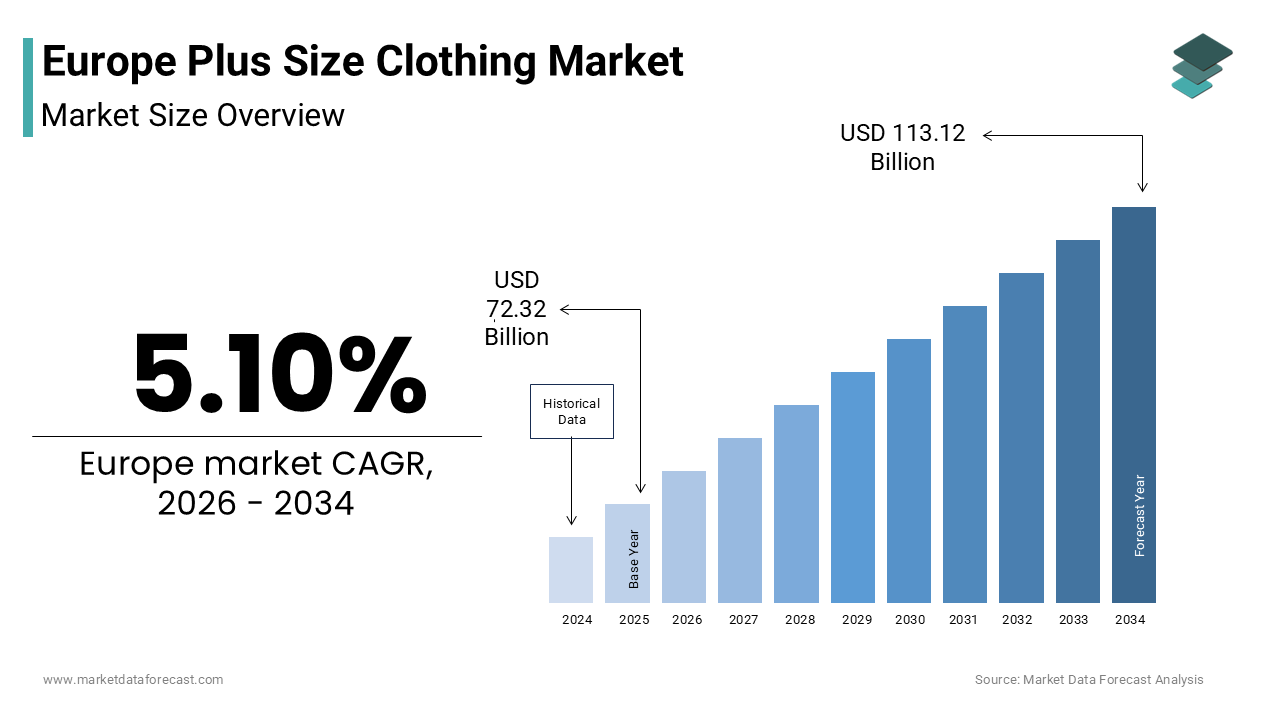
The Europe plus size clothing market was valued at USD 72.32 billion in 2025, is estimated to reach USD 76.01 billion in 2026, and is projected to reach USD 113.12 billion by 2034, growing at a CAGR of 5.10% during the forecast period from 2026 to 2034. The growth of the Europe plus size clothing market is driven by the rising prevalence of overweight and obese populations, increasing demand for inclusive fashion, and shifting societal attitudes toward body positivity and diversity. Expanding product offerings across stylish and trend-forward apparel, along with the integration of plus size ranges into mainstream retail collections, is further fueling market growth. Moreover, the rapid growth of e-commerce platforms, advancements in virtual fitting technologies, and strong influence of social media and body-positive movements are accelerating market expansion across Europe.
Key Market Trends
- Rising consumer demand for body positivity and inclusive fashion driving brands to expand size ranges and representation.
- Increasing adoption of online shopping platforms offering wider variety, privacy, and improved sizing technologies.
- The growing popularity of athleisure and comfort-driven clothing among plus size consumers aligned with lifestyle changes.
- Expansion of influencer-led marketing and collaborations promoting authentic engagement with plus size audiences.
- Integration of advanced technologies such as AI-driven virtual fitting tools to enhance customer experience and reduce returns.
Segmental Insights
- Based on end user, The women segment was the largest and held a significant share of the Europe plus size clothing market in 2025.
- Based on design style, The modern/contemporary segment accounted for 42.8% of the Europe plus size clothing market share in 2025.
- Based on distribution channel, The online channels segment was the largest, occupying a prominent share of the Europe plus size clothing market in 2025.
Regional Insights
The Europe plus size clothing market is witnessing strong growth across major economies, supported by rising consumer awareness, increasing inclusivity in fashion, and expanding retail and e-commerce infrastructure.
- The United Kingdom was the largest contributor, accounting for 24.5% of the Europe plus size clothing market share in 2025, driven by progressive cultural attitudes, strong presence of inclusive fashion brands, and high adoption of extended size ranges across major retailers.
- Germany remains a key market, supported by its large population base, increasing obesity rates, and growing demand for high-quality plus size apparel.
- France continues to perform steadily, fueled by evolving fashion norms, rising acceptance of inclusive clothing, and increasing presence of plus size collections in premium and mainstream retail.
- Italy and Spain are emerging markets, supported by changing consumer preferences, strong domestic fashion brands, and increasing adoption of plus size apparel across urban populations.
Competitive Landscape
The Europe plus size clothing market is characterized by intense competition among established fashion retailers, online platforms, and niche plus size brands focusing on inclusivity, fit innovation, and trend-driven designs. Leading companies are emphasizing expansion of size ranges, integration of plus size collections into core offerings, and leveraging digital technologies to enhance customer experience. Strategic collaborations with influencers, adoption of sustainable practices, and investments in AI-driven fit solutions are strengthening competitive positioning. Prominent players in the Europe plus size clothing market include Hennes & Mauritz AB (H&M), Inditex Group (ZARA), ASOS Plc, Boohoo Group Plc, Marks & Spencer Group plc, Mango (Punto Fa SL), Next plc, N Brown Group plc, Marina Rinaldi (Max Mara Group), Ulla Popken, Zizzi, MS Mode, Paprika, Yours Clothing, and Almé Paris.
Europe Plus Size Clothing Market Size
The Europe plus size clothing market size was valued at USD 72.32 billion in 2025 and is anticipated to reach USD 76.01 billion in 2026 from USD 113.12 billion by 2034, growing at a CAGR of 5.10% during the forecast period from 2026 to 2034.
Plus-size clothing refers to apparel designed specifically for body types that fall outside the "standard" or "straight" size range offered by most retailers. This market has transitioned from a marginalized niche into a pivotal component of the broader fashion industry, driven by a profound societal shift toward body inclusivity and the recognition of diverse consumer demographics. The demographic landscape in Europe provides a substantial foundation for this market, as obesity rates have risen significantly across the continent over recent decades. According to the World Health Organization Regional Office for Europe, more than 59 percent of adults in the WHO European Region were living with overweight or obesity in 2022, indicating a vast potential customer base that requires specialized apparel solutions. Furthermore, Eurostat data reveals that the average Body Mass Index for adults in many European Union member states has crossed the threshold of 26, signaling a permanent shift in population physiology rather than a temporary trend. This physiological reality contrasts sharply with historical fashion standards that prioritized slender silhouettes. The modern definition of plus size fashion now includes not only functional garments but also stylish, trend forward options that cater to the aesthetic desires of consumers who previously faced limited choices. Shifting societal norms are reducing the stigma attached to larger body types. Consequently, brands are expanding their size ranges to tap into a financially potent, underserved market across the UK, Germany, and France.
MARKET DRIVERS
Rising Prevalence of Obesity and Overweight Population
Demographic Expansion Creating Inherent Demand
The escalating prevalence of obesity and overweight conditions across European nations encourages the growth of the Europe plus size clothing market. This biological reality creates an inherent and expanding demand for apparel that accommodates larger body frames, transforming what was once a marginalized niche into a mainstream necessity. In specific markets such as the United Kingdom, studies indicate that a portion of adults are obese, while in Germany, sources suggest that a percentage of the adult population falls into the obese category. These statistics translate directly into millions of consumers who cannot fit into standard sizing charts offered by traditional fast fashion retailers. The correlation between rising Body Mass Index averages and clothing consumption is direct, as individuals require garments that offer both comfort and durability without compromising on style. As the average waist circumference of European consumers increases, the addressable market for sizes ranging from XL to 5XL expands proportionally. This demographic shift forces retailers to reconsider their inventory strategies, as ignoring this segment means alienating a significant portion of the population. The sustained upward trajectory of weight related health metrics ensures that the customer base for plus size fashion will continue to grow organically, independent of marketing trends, thereby providing a stable foundation for market expansion.
Intensified Consumer Demand for Body Positivity and Inclusivity
Cultural Shifts Reshaping Brand Loyalty
A profound cultural transformation centered on body positivity and inclusivity has emerged as a powerful demand driver for the Europe plus size clothing market. This reshapes the purchasing behaviors and brand expectations within the European fashion landscape. Modern consumers increasingly reject narrow beauty standards and demand representation in advertising campaigns and product offerings, compelling brands to expand their size ranges to maintain relevance and loyalty. According to a study, a notable share of consumers state that they are more likely to purchase from brands that demonstrate diversity and inclusion in their marketing and product lines. This sentiment is particularly strong among Generation Z and Millennial shoppers in Europe, who view inclusive sizing as a moral imperative rather than a mere business strategy. Social media platforms have amplified this movement, with influencers and activists calling out brands that fail to cater to diverse body types, leading to immediate reputational damage for non compliant companies. Moreover, major retailers are rushing to introduce extended size collections to capture this loyal demographic. The psychological impact of feeling represented drives higher conversion rates and repeat purchases, as customers who find brands that respect their bodies tend to exhibit greater brand advocacy. This cultural shift ensures that inclusivity remains a central pillar of market growth, forcing legacy brands to adapt or risk obsolescence in an increasingly conscious marketplace.
MARKET RESTRAINTS
Persistent Stigma and Limited Style Availability in Mainstream Retail
Social Exclusion Limiting Market Penetration
Persistent stigma surrounding larger body types continues to hinder the European plus-size clothing market. Consequently, there is a distinct lack of stylish options available in mainstream retail environments. Many established fashion brands still relegate plus size garments to separate sections or online exclusive categories, implicitly signaling that these consumers are secondary to their core business. This segregation fosters a sense of exclusion and limits the visibility of plus size fashion in physical stores, where tactile experience is crucial for purchase decisions. Furthermore, the variety of styles available often lags behind current trends, with many retailers offering basic, shapeless garments rather than fashionable pieces that mirror runway trends. This lack of stylistic parity discourages consumers from engaging with the market, as they seek clothing that expresses their individuality rather than merely covering their bodies. The psychological barrier created by this exclusionary practice reduces overall market penetration, as potential customers opt out of shopping entirely rather than settling for inferior options. Mainstream retailers must fully integrate plus-size lines into their core offerings with equal style and prominence. Until that happens, this social and operational restraint will continue to cap market potential.
Higher Production Costs and Complex Sizing Logistics
Economic Barriers to Profitability
The economic structure of manufacturing plus-size apparel is a formidable restraint to the Europe plus size clothing market. This is due to higher production costs and the logistical complexities associated with managing an expanded size matrix. Creating garments for larger bodies requires significantly more fabric, often more material per unit compared to standard sizes, which directly increases the cost of goods sold and compresses profit margins for retailers. Additionally, the grading process for plus size clothing is technically more demanding, requiring specialized pattern making to ensure proper fit and drape across diverse body shapes, which necessitates skilled labor and advanced technology. Higher price points can deter price sensitive consumers, limiting the volume of sales. Furthermore, inventory management becomes exponentially more difficult as the number of Stock Keeping Units multiplies. The logistical burden often leads retailers to limit their plus size offerings to a few safe styles, thereby restricting consumer choice and stifling market dynamism. So, the financial disincentive to produce fashionable plus size clothing at competitive price points remains a critical barrier preventing widespread market saturation and innovation.
MARKET OPPORTUNITIES
Expansion of Digital Commerce and Virtual Fitting Technologies
Technological Innovation Enhancing Customer Experience
The rapid advancement of digital commerce and virtual fitting technologies offers a major opening for the growth of the European plus-size market. This evolution allows the industry to overcome traditional limitations of physical retail. Online platforms eliminate the spatial constraints of brick and mortar stores, allowing brands to offer extensive size ranges and diverse styles without the fear of unsold inventory cluttering shop floors. This digital shift is particularly beneficial for plus size consumers who often face embarrassment or limited options in physical stores. Moreover, the adoption of artificial intelligence driven virtual try on tools is revolutionizing the customer experience by reducing return rates, which have historically been high in the plus size sector due to fit uncertainty. These technologies utilize precise body scanning data to recommend accurate sizes, thereby increasing consumer confidence and conversion rates. Brands that leverage these digital innovations can gather valuable data on plus size body shapes to refine their patterns and improve fit accuracy over time. This technological synergy not only enhances the shopping journey but also enables niche plus size brands to reach a pan European audience without the prohibitive costs of establishing physical presence, unlocking significant revenue potential in the digital realm.
Strategic Collaborations with Body Positive Influencers and Designers
Authentic Partnerships Driving Brand Advocacy
Forging strategic collaborations with body-positive influencers and specialized designers is a potent opportunity for brands within the Europe plus size clothing market. This approach allows them to authentically connect with the plus-size demographic and drive market growth. Traditional advertising often fails to resonate with this segment due to a lack of genuine representation, whereas partnerships with trusted voices in the body positivity movement can build immediate credibility and loyalty. The collaborations allow brands to co create collections that address specific fit issues and style preferences identified by the community, ensuring product market fit. For instance, partnerships between high street retailers and prominent plus size designers in France and Italy have led to capsule collections that sell out within days, demonstrating the immense purchasing power of this engaged audience. Such alliances also provide brands with direct feedback loops for product development, enabling them to iterate quickly and stay ahead of trends. By aligning with figures who champion inclusivity, companies can transcend transactional relationships and foster emotional connections, turning customers into brand advocates. This approach not only drives immediate sales but also positions brands as leaders in the inclusivity space, securing long term market share in an increasingly competitive landscape.
MARKET CHALLENGES
Inconsistent Sizing Standards Across European Regions
Fragmentation Hindering Cross Border Trade
The lack of standardized sizing regulations across different countries is one of the serious limitations for the Europe plus size clothing market. This creates significant confusion and frustration for consumers. Unlike some other regions, Europe does not enforce a unified sizing system, leading to drastic variations in what constitutes a specific size between nations and even between brands within the same country. A size 44 in Germany may differ substantially in cut and measurement from a size 44 in France or Italy, making cross border shopping and online purchasing fraught with uncertainty. This inconsistency forces consumers to engage in a trial and error process, ordering multiple sizes of the same item to find the right fit, which inflates logistics costs for retailers and increases the carbon footprint of the fashion industry. The absence of a harmonized standard also complicates supply chain management for international brands, which must maintain distinct inventory pools for different markets to accommodate local sizing idiosyncrasies. This fragmentation erodes consumer trust and hampers the scalability of plus size brands, as the inability to guarantee a consistent fit discourages repeat purchases and limits the potential for seamless pan European expansion.
High Return Rates and Reverse Logistics Burdens
Operational Efficiency and Sustainability Concerns
Exceptionally high return rates slow down the expansion of the Europe plus-size clothing market. These returns impose a severe financial and operational burden on retailers through costly reverse logistics processes. Due to the complexities of fitting larger and more varied body shapes, combined with the aforementioned sizing inconsistencies, plus size garments are returned at a significantly higher frequency than standard size items. Each return incurs substantial costs related to shipping, inspection, restocking, and potential markdowns if the item cannot be resold as new. For many retailers, these costs can erase the profit margin on multiple successful transactions, making the plus size segment less financially attractive despite its high demand. Furthermore, the environmental impact of these returns is increasingly scrutinized by conscious consumers, adding a reputational risk to the operational challenge. The difficulty in predicting accurate fit without physical trials exacerbates this issue, as even detailed size charts often fail to capture the nuances of plus size body proportions. High return volumes in the plus-size sector are caused by inconsistent sizing and poor fitting technology. Until this is resolved, it will remain a critical bottleneck for profitability and sustainability.
REPORT COVERAGE
| REPORT METRIC | DETAILS |
| Market Size Available | 2025 to 2034 |
| Base Year | 2025 |
| Forecast Period | 2026 to 2034 |
| CAGR | 5.20% |
| Segments Covered | By End-user, Design Style, Distribution Channel and Region. |
| Various Analyses Covered | Global, Regional & Country Level Analysis, Segment-Level Analysis, DROC, PESTLE Analysis, Porter’s Five Forces Analysis, Competitive Landscape, Analyst Overview of Investment Opportunities |
| Country Covered | UK, France, Spain, Germany, Italy, Russia, Sweden, Denmark, Switzerland, the Netherlands, Turkey, the Czech Republic, and the Rest of Europe. |
| Market Leaders Profiled | Hennes & Mauritz AB (H&M), Inditex Group (ZARA), ASOS Plc, Boohoo Group Plc, Marks & Spencer Group plc, Mango (Punto Fa SL), Next plc, N Brown Group plc, Marina Rinaldi (Max Mara Group), Ulla Popken, Zizzi, MS Mode, Paprika, Yours Clothing, and Almé Paris. |
SEGMENTAL ANALYSIS
By End User Insights
The women segment led the Europe plus size clothing market and held a substantial share in 2025. This prominence of the segment is credited to the historical exclusion of larger female bodies from mainstream fashion, which has created a massive pent up demand that specialized brands are now aggressively addressing. The sheer volume of the target demographic drives this leadership position, as women constitute the primary decision makers for household apparel purchases and exhibit higher frequency in fashion consumption compared to other genders. A key force behind the women segment dominance is the disproportionately high rate of obesity and overweight conditions among the female population across Europe. Statistical evidence underscores the magnitude of this demographic reality, creating a vast and non negotiable customer base for plus size apparel. The physiological shift means that standard sizing charts, which typically cap at size 12 or 14, exclude nearly half of the adult female population. Consequently, women are forced to seek out specialized retailers who offer extended sizes, driving volume sales in this segment. The correlation between rising Body Mass Index averages and clothing expenditure is direct, as women require complete wardrobes ranging from daily wear to formal attire that accommodates their changing body shapes. Unlike men, who may prioritize function over fashion, women in this demographic increasingly demand stylish options, further fueling market depth. The persistent rise in these health metrics ensures that the women segment will remain the cornerstone of the plus size industry for the foreseeable future. Also, a key reason for the segment’s leadership is the women segment is the intense intersection of societal pressure regarding appearance and a heightened desire for fashionable expression among plus size women. Historically, the fashion industry ignored larger female bodies, but the modern consumer refuses to compromise on style, driving brands to expand their offerings rapidly. Social media platforms have amplified this drive, with movements like #BodyPositivity and #PlusSizeFashion garnering billions of views, encouraging women to demand better representation and variety. This consciousness is not merely about coverage but about identity, as women seek garments that reflect current runway trends rather than outdated, shapeless designs. Furthermore, the rise of plus size influencers in France, Italy, and the UK has normalized the idea that larger women can and should participate in high fashion. This cultural shift transforms the segment from a necessity based market into a desire driven one, where consumers actively seek out new collections, thereby sustaining high sales volumes and encouraging continuous product innovation tailored specifically to the female form.
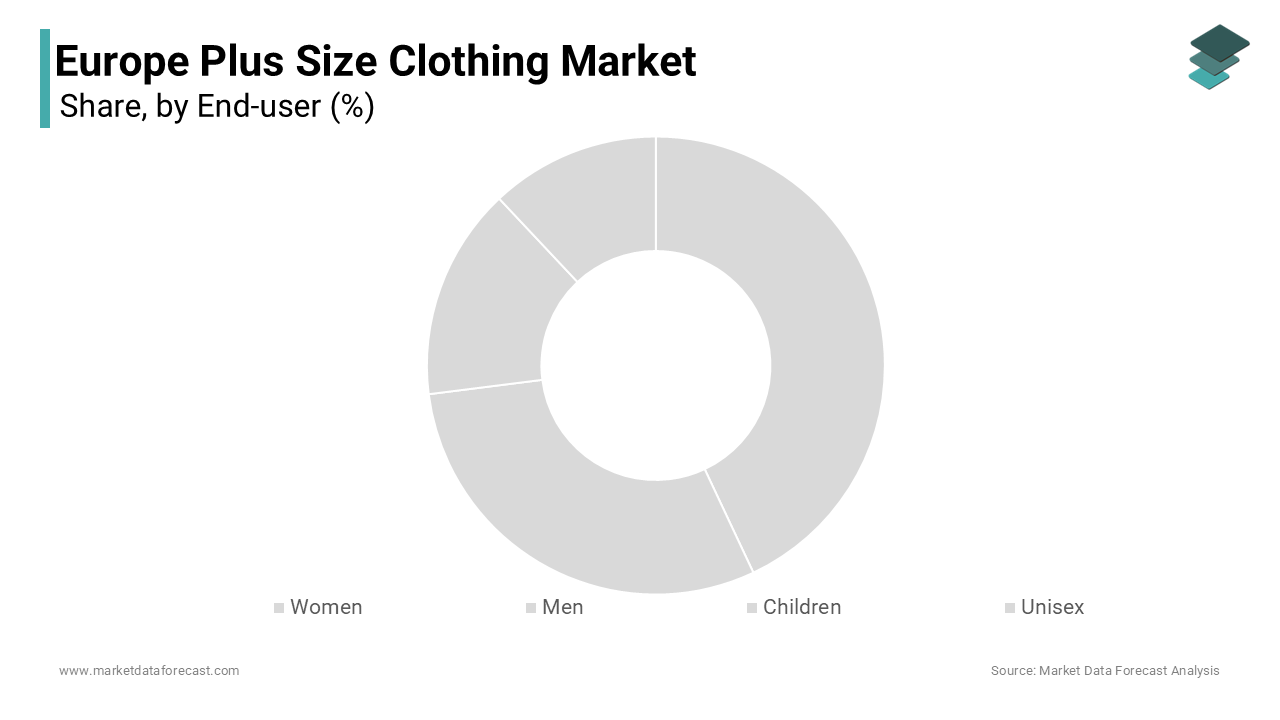
The men segment is predicted to witness the highest CAGR of 7.8% during the forecast period. Moreover, the rate of acceleration is superior due to the previously neglected nature of this demographic and the rapid awakening of brands to its potential. Also, the growth is fueled by a combination of rising obesity rates among men and a shifting cultural landscape where male grooming and fashion consciousness are no longer taboo. The fundamental engine driving the rapid expansion of the men plus size segment is the alarming increase in obesity prevalence among European men, which has created an urgent and underserved need for appropriate apparel. For decades, the market assumed men were less concerned with fit or style, but the sheer scale of the demographic shift has made this segment impossible to ignore. Unlike previous generations who might have settled for ill fitting garments, modern men are increasingly unwilling to compromise on comfort or professional appearance. The rise in average waistlines has specifically impacted the demand for trousers, suits, and casual wear, categories that require precise tailoring. As the average Body Mass Index for men continues to climb across Southern and Eastern Europe, the addressable market expands organically. This biological reality acts as a guaranteed growth vector, as every percentage point increase in obesity rates translates directly into new customers entering the plus size ecosystem, ensuring sustained double digit growth for manufacturers who cater to this expanding male population. A transformative cultural shift regarding male grooming and fashion awareness is acting as a potent accelerator for the men plus size segment, distinguishing it from historical norms. The modern European man is increasingly viewing clothing as a vital component of his personal brand and professional success, leading to higher expenditure on apparel that fits well and looks stylish. Social media platforms like TikTok and Instagram have played a pivotal role, with male plus size influencers gaining millions of followers by showcasing how to style larger frames, thereby destigmatizing the need for specialized clothing. The heightened awareness drives demand beyond basic necessities into areas like athleisure, smart casual, and formal wear, categories that were previously dominated by standard sizes. Brands are responding by launching dedicated plus size lines for men, moving away from the "big and tall" label which often carried negative connotations, towards inclusive marketing that celebrates diverse masculinities. The willingness of men to invest in quality garments that enhance their silhouette is driving higher average order values. The stigma around male vanity is dissipating, causing the plus-size men's market to transition from a functional afterthought to a dynamic fashion frontier. Consequently, this shift is fueling its status as the fastest-growing segment in the region.
By Design Style Insights
The modern or contemporary design style segment was the largest segment in the Europe plus size clothing market and accounted for a 42.8% share in 2025 because of the alignment of this style with the fast paced lifestyle of the urban European consumer and the aggressive push by major retailers to democratize trends. Besides, the Modern segment encompasses versatile, trend forward pieces that bridge the gap between casual and formal wear, making it the default choice for daily consumption. The main force behind the supremacy of the Modern Contemporary segment is its seamless integration with the rapid cycles of fast fashion and the dynamic lifestyles of urban Europeans. Consumers in major metropolitan hubs like London, Paris, and Berlin demand clothing that reflects current runway trends but is adapted for everyday wear, a niche that Modern design fills perfectly. According to sources, the turnover of fashion collections in Europe has accelerated, with new styles introduced every three to four weeks, a pace that Modern plus size brands have successfully matched. This agility allows retailers to capture the impulse buying behavior of consumers who wish to stay updated without waiting for seasonal releases. Furthermore, the urban workforce in Europe increasingly favors a "smart casual" dress code, which blurs the lines between office wear and leisure, a aesthetic core to the Modern style. The ability of this segment to offer trendy cuts, bold prints, and modern silhouettes at accessible price points makes it the most attractive option for the mass market. Unlike Traditional styles which may feel dated, or Ethnic styles which are occasion specific, Modern clothing addresses the immediate, recurring needs of the consumer. The fast fashion giants have heavily invested in plus size Modern lines, leveraging their supply chain efficiency to flood the market with affordable options, thereby cementing this segment's leadership through volume and accessibility. The pervasive influence of digital media and the instantaneous dissemination of global fashion trends serve as a critical driver for the Modern Contemporary segment. In the digital age, trends emerge and spread globally within days, and plus size consumers expect immediate access to these styles regardless of their size. Influencers and content creators predominantly showcase Modern outfits, setting a standard that consumers strive to emulate. This digital exposure creates a "see now buy now" culture, where the demand for the latest cut or color is immediate. Brands that fail to update their Modern collections risk losing relevance, as the digital native consumer equates style currency with brand value. The Modern segment benefits from this by constantly iterating designs based on real time data analytics, allowing them to produce exactly what is trending. This responsiveness creates a feedback loop where digital visibility drives sales, which in turn funds further rapid production. The psychological desire to belong to the current cultural moment drives consumers toward Modern designs, making this segment the natural leader in a market increasingly dictated by online visibility and viral trends.
The Athleisure design style segment is estimated to register the fastest CAGR of 9.2% between 2026 and 2034. This explosive growth of the segment is fuelled by the convergence of health consciousness, the normalization of remote work, and the specific comfort requirements of plus size individuals who prioritize flexibility and ease of movement in their daily attire. The structural shift in work patterns following the global pandemic has fundamentally altered clothing preferences, propelling the Athleisure segment to the forefront of growth. With a significant portion of the European workforce adopting hybrid or fully remote models, the demand for formal wear has declined while the need for comfortable yet presentable clothing has surged. For plus size individuals, comfort is not just a preference but a necessity, as restrictive clothing can cause physical discomfort. Athleisure wear, characterized by stretchable fabrics and relaxed fits, addresses this need perfectly. The blurring of boundaries between workout gear and daily wear means consumers can wear leggings, joggers, and oversized hoodies for grocery runs, virtual meetings, and leisure activities without feeling underdressed. This versatility has made Athleisure the uniform of the new normal. Furthermore, the psychological association of athleisure with wellness and self care resonates strongly with plus size consumers who are often on fitness journeys. The segment's growth is underpinned by this permanent behavioral change, ensuring that comfort remains a top priority for the foreseeable future. A robust increase in health consciousness and active participation in fitness activities among the plus size demographic is a powerful engine driving the Athleisure segment. There is a growing recognition that exercise should be accessible to all body types, leading to a surge in gym memberships and outdoor activities among larger individuals. The demographic requires specialized athletic wear that offers support, moisture wicking properties, and durability, which standard activewear often fails to provide. Brands have responded by launching high performance plus size lines, validating the fitness aspirations of these consumers. The motivation to engage in physical activity is closely linked to the availability of appropriate gear; when individuals feel supported by their clothing, they are more likely to exercise. This creates a virtuous cycle where increased fitness participation drives apparel sales. Additionally, the "wellness" trend has permeated mainstream culture, with athleisure becoming a symbol of a healthy lifestyle regardless of size. The segment benefits from this cultural validation, as wearing athleisure signals a commitment to health, driving adoption beyond the gym and into everyday life, thus fueling its rapid expansion.
By Distribution Channel Insights
The online channels segment dominated the Europe plus size clothing market and captured a 48.9% share in 2025. This dominance of the segment is credited to the unique advantages e commerce offers to plus size shoppers, including privacy, extensive variety, and detailed sizing information that physical stores often fail to provide. The digital realm has become the primary destination for this demographic due to the limitations inherent in brick and mortar retail. In addition, the paramount driver for the dominance of online channels is the profound desire for privacy and the avoidance of the stigma often experienced in physical retail environments. Plus size shoppers frequently report feelings of embarrassment, judgment, or frustration when navigating crowded high street stores with limited stock or poorly designed fitting rooms. Online shopping eliminates this psychological barrier, offering a safe and private space where consumers can browse and purchase without fear of scrutiny. The anonymity of the digital interface empowers customers to explore their style preferences freely. Furthermore, the ability to read reviews from other plus size customers provides a sense of community and reassurance that is absent in physical retail. This emotional safety net is a critical factor in channel selection, as it transforms shopping from a stressful ordeal into a convenient and enjoyable activity. As long as the in store experience remains fraught with potential for negative social interaction, the online channel will retain its position as the preferred sanctuary for the plus size community. A further key factor propelling the online segment is the capability of digital platforms to offer an unlimited assortment of styles and sizes, coupled with advanced sizing technologies that mitigate fit uncertainty. Physical stores are constrained by floor space, often limiting their plus size inventory to a few basic items, whereas online retailers can display thousands of Stock Keeping Units without spatial restrictions. This breadth of choice allows shoppers to find specific cuts, colors, and trends that are rarely stocked locally. Moreover, the integration of artificial intelligence and virtual fitting rooms has significantly reduced the hesitation associated with buying clothes unseen. Brands are leveraging data analytics to understand plus size body shapes better, offering detailed size guides and model measurements that empower informed decisions. The logistical advantage of home delivery further enhances this appeal, removing the physical burden of carrying heavy bags. The synergy of infinite choice and technological assurance makes the online channel not just an alternative, but the superior option for the plus size demographic, securing its market leadership.
The specialty stores segment is anticipated to witness the fastest CAGR of 8.5% from 2026 to 2034. This segment is swift growth as consumers crave tactile experiences and expert guidance that generalist retailers cannot provide. The resurgence of Specialty Stores is primarily driven by the intense consumer demand for personalized styling services and expert fitting assistance, which are crucial for the complex needs of plus size bodies. Unlike general department stores where staff may lack specific training, specialty boutiques employ stylists who understand the nuances of plus size proportions and can offer tailored advice. The expertise builds trust and loyalty, encouraging repeat visits. Moreover, the tactile nature of clothing shopping remains vital, as many consumers need to feel the fabric and try on garments to ensure comfort and drape, something online channels cannot fully replicate. These stores often host events, fitting sessions, and community gatherings, fostering a sense of belonging that transcends transactional retail. The ability to provide immediate alterations or custom adjustments further enhances the value proposition. As the market matures, consumers are willing to pay a premium for this level of service, driving revenue growth. The human element of specialty retail addresses the emotional and practical gaps left by digital channels, fueling its rapid expansion or prioritize Specialty Stores is a key accelerator for this segment's growth. These brands often reject the mass market approach of general retailers in favor of dedicated spaces that reflect their brand ethos and cater specifically to their community. These stores act as community hubs, hosting workshops, body positive events, and local influencer meetups, which drive organic footfall and brand advocacy. The curation offered by these stores ensures that every item on the rack is relevant and stylish, eliminating the "digging" experience common in larger stores. The exclusivity of certain collections available only in these boutiques creates a pull factor, drawing customers from wider geographic areas. Specialty stores are carving out a lucrative and rapidly expanding niche by focusing on quality over quantity and experience over volume. This approach appeals to the discerning plus-size consumer seeking validation and high-quality merchandise.
REGIONAL ANALYSIS
United Kingdom Plus Size Clothing Market Analysis
The United Kingdom outperformed other countries in the Europe plus size clothing market and accounted for a 24.5% share in 2025. This position of the UK is driven by its progressive cultural attitude toward body diversity and the early adoption of inclusive sizing by major retailers. The nation serves as the epicenter of plus size fashion innovation, boasting a mature ecosystem of dedicated brands, inclusive high street retailers, and a vibrant cultural discourse surrounding body positivity. Moreover, the country has been the birthplace of numerous global plus size brands and movements, creating a highly receptive consumer base. The demographic reality is matched by a retail landscape that has aggressively embraced inclusivity; for instance, major chains like Marks and Spencer and ASOS have pioneered extensive plus size ranges that are integrated into their main lines rather than segregated. Furthermore, the strong regulatory environment and consumer activism in the UK have pressured brands to be transparent about sizing and representation. The presence of influential plus size advocates and a robust media landscape dedicated to body positivity further fuels market dynamism. The convergence of high obesity prevalence, progressive retail strategies, and a supportive cultural narrative ensures that the UK remains the primary revenue generator and trendsetter for the European plus size sector.
Germany Plus Size Clothing Market Analysis
Germany was the next prominent country in the European plus size clothing market and occupied a 19.8% share in 2025. This expansion of the German market is supported by its large population base combined with rising obesity rates and a retail sector that is rapidly adapting to inclusivity demands. The German market is characterized by a strong preference for quality, functionality, and durability, with a growing openness to fashion forward plus size options driven by demographic shifts and evolving consumer expectations. Historically known for conservative sizing, German retailers like Otto and C&A have recently expanded their plus size portfolios significantly in response to consumer pressure. The German consumer's emphasis on value for money and high quality materials aligns well with the plus size segment, where durability is paramount. Furthermore, the rise of online shopping in Germany, which boasts one of the highest e commerce penetration rates in Europe, has facilitated access to a wider range of plus size brands, including international players. The government's health initiatives addressing obesity have also inadvertently raised awareness about the needs of larger individuals, including clothing. The combination of a large, affluent population, increasing health metrics, and a retail sector pivoting toward inclusivity positions Germany as a critical growth engine for the regional market.
France Plus Size Clothing Market Analysis
France holds a notable share of the Europe plus size clothing market owing to a cultural renaissance that is slowly dismantling the country's reputation for exclusivity in fashion. While historically resistant to plus size fashion due to its rigid adherence to haute couture standards, the French market is undergoing a transformative shift, driven by a new generation of designers and consumers who are challenging traditional beauty norms. The emergence of French plus size influencers and designers has been instrumental in shifting perceptions, proving that luxury and size inclusivity are not mutually exclusive. Major French retailers like La Redoute and Galeries Lafayette have responded by curating dedicated plus size sections and collaborating with inclusive brands. The "body positive" movement has gained traction in Paris, a global fashion capital, forcing legacy houses to reconsider their sizing policies. The French market's potential lies in its high spending power and appreciation for aesthetics; as soon as brands offer stylish, high quality plus size options, French consumers respond with strong loyalty. This transition from exclusion to cautious inclusion marks a pivotal phase for the French market, driving steady growth.
Italy Plus Size Clothing Market Analysis
Italy expanded steadily in the European plus size clothing market due to the intersection of its world class manufacturing capabilities and a gradual shift in consumer attitudes toward body image. Known globally for its craftsmanship and design heritage, Italy's plus size sector is evolving from a niche focus on comfort to a more style conscious segment, leveraging the country's manufacturing prowess to produce high quality extended size garments. Italian manufacturers are uniquely positioned to capitalize on this by producing high quality, well tailored plus size clothing that rivals standard sizes in elegance. The Italian consumer places a high premium on fabric quality and fit, and as brands begin to offer plus size options that meet these standards, adoption rates are climbing. Furthermore, the tourism sector in Italy exposes the market to diverse international body types, encouraging local retailers to broaden their offerings. The slow but steady acceptance of plus size fashion in Milan, a key fashion week venue, is also trickling down to the mass market. As Italian brands leverage their reputation for style to enter the plus size arena, they are unlocking significant value in a previously underserved demographic.
Spain Plus Size Clothing Market Analysis
Spain is anticipated to grow significantly in the Europe plus size clothing market during the forecast period. Its position as a top market is largely attributable to the proactive stance of its indigenous retail giants, particularly Inditex, which has integrated plus size ranges into its core brands like Zara and Mango. The Spanish market is characterized by a vibrant fashion culture and a rapidly growing acceptance of diverse body types, propelled by the aggressive expansion strategies of its domestic fast fashion giants. The strategy of Spanish retailers to treat plus size as a standard part of their collection rather than a separate entity has resonated strongly with consumers, driving high volume sales. The Mediterranean lifestyle, which emphasizes social visibility and appearance, encourages consumers to seek fashionable options regardless of size. Moreover, the rapid adoption of e commerce in Spain has further accelerated access to these new ranges, allowing brands to reach consumers in rural areas who previously had limited options. The combination of strong domestic brands, rising health metrics, and a culture that values social presentation ensures that Spain remains a dynamic and growing market for plus size fashion in Southern Europe.
COMPETITIVE LANDSCAPE
The competition in the Europe plus size clothing market is characterized by intense rivalry between established high street giants agile online pure plays and emerging niche brands vying for dominance. Traditional retailers are aggressively expanding their size ranges to prevent losing market share to digital natives who have long championed inclusivity as a core value proposition. The landscape is shifting from a scarcity model where options were limited to an abundance model where variety and style parity with straight sizes are the new battlegrounds. Competitors are differentiating themselves through superior fit technology personalized styling services and community building initiatives that foster deep brand loyalty. Price wars are evident in the mass market segment while premium players compete on fabric quality and exclusive designs. The entry of luxury brands into the plus size space is adding a new layer of complexity forcing mid market players to elevate their offerings. Overall the market is dynamic with constant innovation in sizing standards marketing narratives and distribution channels as companies strive to capture the spending power of the increasingly confident plus size consumer.
KEY MARKET PLAYERS
Some of the companies that are playing a dominating role in the Europe Plus Size Clothing Market include
- Hennes & Mauritz AB (H&M)
- Inditex Group (ZARA)
- ASOS Plc
- Boohoo Group Plc
- Marks & Spencer Group plc
- Mango (Punto Fa SL)
- Next plc
- N Brown Group plc
- Marina Rinaldi (Max Mara Group)
- Ulla Popken
- Zizzi
- MS Mode
- Paprika
- Yours Clothing
- Almé Paris
Top Players in the Europe Plus Size Clothing Market
ASOS Design
ASOS Design operates as a pivotal force in the Europe plus size clothing landscape through its dedicated ASOS Curve line which caters specifically to sizes 18 and above. The brand has revolutionized online retail by integrating trend led fashion with inclusive sizing making style accessible to a broader demographic across the continent. Their contribution to the global market involves setting digital standards for fit technology and diverse model representation which competitors worldwide now emulate. Recent actions to strengthen their position include the launch of virtual catwalk features that allow customers to see garments on models of varying body types before purchase. The company also expanded its edit to include occasion wear and bridal collections ensuring that plus size consumers have options for every life event. ASOS Design continues to lead the sector in innovation and customer engagement by leveraging data analytics to predict trends specific to larger bodies. This success is achieved independently of a physical store network.
Marks and Spencer
Marks and Spencer maintains a formidable presence in the Europe plus size clothing market by leveraging its heritage of quality and trust alongside its extensive Per Una and Autograph ranges designed for fuller figures. The company contributes globally by demonstrating how traditional high street retailers can successfully pivot toward inclusivity while maintaining rigorous quality standards for fabrics and construction. Their recent strategic moves involve a comprehensive overhaul of their fitting rooms to be more welcoming and the introduction of adaptive clothing lines that cater to diverse mobility needs within the plus size community. Marks and Spencer has also intensified its marketing campaigns to feature real customers of all sizes rather than professional models only fostering a deeper emotional connection with their audience. The retailer recently invested in supply chain agility to ensure that popular plus size items remain in stock reducing frustration for loyal customers. This commitment to consistency and quality solidifies their reputation as a reliable destination for everyday plus size fashion across the United Kingdom and beyond.
Hennes and Mauritz
Hennes and Mauritz known globally as H and M plays a critical role in the Europe plus size clothing market through its H and M Plus collection which offers affordable and contemporary styles for sizes 18 to 24. The Swedish giant contributes to the global ecosystem by proving that fast fashion can be inclusive without compromising on price accessibility thereby democratizing trends for millions of consumers. Recent actions to bolster their market position include the integration of plus size mannequins in physical stores across major European cities to normalize diverse body shapes in the retail environment. The company has also launched sustainability focused plus size lines using recycled materials appealing to the environmentally conscious segment of the demographic. H and M frequently collaborates with plus size influencers and designers to create limited edition capsules that generate buzz and drive traffic to both online and offline channels. Their aggressive expansion of size ranges in core categories like denim and activewear ensures they remain a top choice for budget conscious yet style aware shoppers throughout Europe.
Top Strategies Used by Key Market Participants
Key players in the Europe plus size clothing market primarily employ strategies centered on digital innovation and inclusive marketing to capture consumer loyalty. Companies are heavily investing in artificial intelligence driven virtual fitting tools to reduce return rates and enhance the online shopping experience for customers who cannot try items on physically. Another dominant strategy involves the integration of plus size ranges into main collections rather than segregating them which fosters a sense of equality and normalizes diverse body types. Brands are increasingly partnering with body positive influencers and content creators to build authentic connections and drive engagement among target demographics. Expansion of size matrices to include extreme sizes beyond the standard plus range is also a common tactic to address underserved niches. Furthermore, retailers are focusing on sustainable production methods specifically for plus size garments to appeal to ethically minded consumers. These approaches collectively aim to dismantle historical barriers and create a more accessible and welcoming fashion ecosystem for all.
MARKET SEGMENTATION
This research report on the Europe Plus Size Clothing Market has been segmented and sub-segmented based on the following categories.
By End User
- Women
- Men
- Children
- Unisex
By Design Style
- Modern/Contemporary
- Traditional/Classic
- Ethnic/Cultural
- Athleisure
By Distribution Channel
- Hypermarkets & Supermarkets
- Specialty Stores
- Online channels
- Others
By Country
- UK
- France
- Spain
- Germany
- Italy
- Russia
- Sweden
- Denmark
- Switzerland
- Netherlands
- Turkey
- Czech Republic
- Rest of Europe