Europe Plywood Market Size, Share, Trends, & Growth Forecast Report By Grade (Structural Grade, Fire-Resistant Grade, Marine Grade, Exterior Grade, Interior Grade, Decorative Grade), Type, Application, User Type and Country (UK, France, Spain, Germany, Italy, Russia, Sweden, Denmark, Switzerland, Netherlands, Turkey, Czech Republic and Rest of Europe), Industry Analysis From 2026 to 2034
Market Size, 2025
$14.70 BnMarket Estimate, 2026
$15.27 BnMarket Forecast, 2034
$20.72 BnCAGR, 2026–2034
3.89%Europe Plywood Market Report Summary
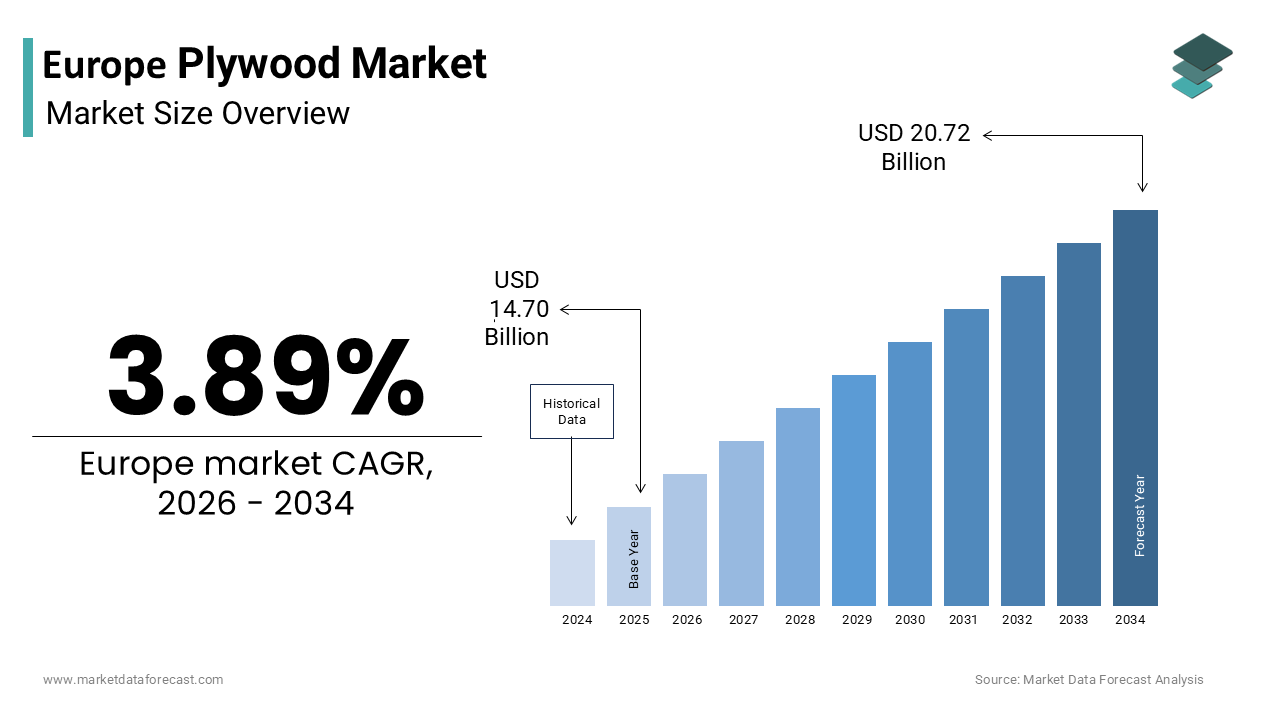
The Europe plywood market was valued at USD 14.70 billion in 2025, is estimated to reach USD 15.27 billion in 2026, and is projected to reach USD 20.72 billion by 2034, growing at a CAGR of 3.89% during the forecast period from 2026 to 2034. The growth of the Europe plywood market is driven by increasing demand for engineered wood products in residential renovation, rising adoption of modular and prefabricated construction methods, and expanding use of plywood across furniture, flooring, and industrial packaging applications. Additionally, supportive regulations promoting sustainable building materials and the use of certified timber resources are encouraging plywood adoption. The market is also benefiting from innovation in fire-resistant panels, moisture-resistant grades, and low-emission adhesives that comply with strict European environmental standards.
Key Market Trends
-
Increasing demand for engineered wood materials in renovation and retrofitting projects across Europe due to aging housing infrastructure.
-
Growing adoption of prefabricated and modular construction systems, which require dimensionally stable plywood panels for structural assemblies.
-
Rising focus on sustainable forestry and certified wood sourcing under FSC and PEFC standards across European countries.
-
Expanding use of fire-resistant and low-emission plywood panels to comply with stringent building safety and indoor air quality regulations.
-
Increasing development of lightweight plywood materials for automotive interiors and industrial applications.
Segmental Insights
- Based on grade, the structural grade segment was the largest and held a significant share of the Europe plywood market in 2024. The segment’s dominance is attributed to its extensive use in load-bearing construction applications such as wall sheathing, roofing systems, and floor decking in residential and commercial buildings.
- Based on wood type, the softwood plywood segment accounted for a major share of the Europe plywood market in 2024. The growth of this segment is supported by the abundant availability of coniferous forests in Northern Europe and its strong demand in construction, packaging, and industrial applications due to its high strength-to-weight ratio.
- Based on application, the flooring and construction segment occupied the largest share of the Europe plywood market in 2024. The growth of this segment is driven by the extensive use of plywood in subflooring, wall structures, and formwork in infrastructure and residential construction projects across Europe.
Regional Insights
The Europe plywood market is experiencing stable growth across major countries due to strong construction activity, growing renovation projects, and increasing demand for sustainable building materials.
-
Germany was the largest contributor, accounting for 22.6% of the Europe plywood market share in 2024, supported by strong construction activity and significant imports from neighboring plywood-producing countries.
-
Finland plays a major role in the regional market due to its vertically integrated forest industry and large-scale production of high-quality birch and softwood plywood.
-
Poland has emerged as an important production hub supplying plywood to furniture and construction industries across Western Europe.
-
France is witnessing increasing demand for plywood driven by government renovation programs and growth in the furniture and interior design industries.
-
Sweden is recognized for its advanced plywood manufacturing technologies and strong export-oriented production.
Competitive Landscape
The Europe plywood market is characterized by the presence of large integrated wood-product manufacturers and specialized regional producers competing through product innovation, sustainability initiatives, and technological advancements in veneer processing. Companies are increasingly investing in low-emission adhesives, digital traceability systems, and environmentally sustainable forestry practices to comply with stringent European regulations. Strategic partnerships with construction companies, furniture manufacturers, and industrial users are also strengthening market presence. In addition, product innovation in fire-resistant plywood, lightweight panels, and moisture-resistant grades is helping companies expand into new applications. Prominent players in the Europe plywood market include UPM Plywood, Metsä Wood, Latvijas Finieris, Koskisen Corporation, Stora Enso, Garnica, Panguaneta S.p.A., Thebault Group, Paged Group, and Kronospan.
Europe Plywood Market Size
The Europe plywood market size was valued at USD 14.70 billion in 2025 and is anticipated to reach USD 15.27 billion in 2026 from USD 20.72 billion by 2034, growing at a CAGR of 3.89% during the forecast period from 2026 to 2034.
The plywood is a strategically vital segment within the continent’s engineered wood products sector, defined by its reliance on layered wood veneers bonded with adhesives to form panels of enhanced strength and dimensional stability. In 2024, the European Union alone produced approximately 6.9 million cubic meters of plywood, which marked a significant 42% increase from the previous year, as per data published by IndexBox. The structural softwood variants for construction and high-grade hardwood types for interior applications. These production dynamics underscore a market in transition, balancing post-pandemic recovery, regulatory pressures, and evolving end-user demands across both residential and non-residential sectors.
MARKET DRIVERS
Resurgence in Residential Renovation Activities
The sustained momentum in residential renovation for plywood demand, where aging housing stocks necessitate modernization is one of the major factors propelling the growth of Europe plywood market. In Germany, France, Italy, and the United Kingdom, with the core consumption bloc, renovation expenditures have consistently outpaced new construction starts over the past five years. This trend directly benefits the plywood sector, as renovation projects favor engineered wood products for their ease of installation, dimensional stability, and compatibility with dry construction methods. Plywood is extensively used in flooring underlays, wall paneling, ceiling systems, and custom cabinetry, applications that dominate retrofitting workflows. Furthermore, national energy efficiency mandates, such as those embedded in the EU’s Energy Performance of Buildings Directive, compel homeowners to upgrade insulation and internal structures that often requiring the removal and replacement of existing substrates with higher-performance alternatives like moisture-resistant or fire-retardant plywood grades.
Expansion of Prefabricated and Modular Construction
The accelerating adoption of prefabricated and modular construction techniques is additionally propelling the growth of Europe plywood market. This methodology relies heavily on precision-engineered components assembled in controlled factory environments, where plywood’s consistent thickness, flatness, and screw-holding capacity for jig-based assembly lines. Moreover, public infrastructure programs increasingly mandate faster project delivery timelines, pushing contractors toward modular solutions that reduce on-site labor and weather-related delays. Countries like Sweden and the Netherlands have institutionalized modular approaches in social housing, where standardized plywood panels are pre-fitted with electrical conduits and insulation. This systemic integration not only increases per-project plywood intensity but also creates long-term contractual relationships between panel producers and module fabricators, stabilizing order flows.
MARKET RESTRAINTS
Stringent Environmental and Chemical Emission Regulations
The world’s most rigorous regulatory frameworks concerning chemical emissions and sustainable sourcing, which is impeding the growth of Europe plywood market. The EU’s REACH regulation and the E1 formaldehyde emission standard, thereby mandating levels below 0.1 parts per million that require manufacturers to reformulate adhesives and implement continuous air-quality monitoring, adding 8% to 12% to production costs, according to the survey. Additionally, the EU Timber Regulation (EUTR) and the newer Deforestation Regulation (EUDR), effective from December 2024, impose stringent due diligence obligations on all wood-based products by compelling plywood producers to trace every log back to its geolocation of harvest. Compliance necessitates investment in digital tracking systems and third-party audits, disproportionately affecting small and medium enterprises lacking capital reserves. The cumulative effect is increasingly bifurcated between large, vertically integrated players, who can absorb compliance overheads and smaller mills forced into niche segments or exit.
Volatility in Raw Material Availability and Log Supply Chains
The persistent instability in the availability and pricing of quality hardwood and softwood logs presents a formidable operational challenge for European plywood manufacturers, directly impacting production continuity and margin integrity. The volatility in raw material availability and log supply chains is degrading the growth of Europe plywood market. Unlike sawmills that can process a wide range of log diameters, plywood production requires large-diameter, defect-free logs to yield viable veneer sheets by making it highly sensitive to shifts in forest management practices and export policies. Compounding this, geopolitical tensions have disrupted traditional log import corridors for instance, sanctions on Russian timber, where a key source of birch veneer logs have forced EU producers to seek alternatives from North America or Southeast Asia, increasing lead times by 30% to 45% and raising input costs by an estimated 18% according to industry analyses. Domestic sources offer limited relief, as many EU member states prioritize logs for higher-value solid wood products or bioenergy. This chronic scarcity of suitable raw material not only constrains output capacity but also incentivizes substitution toward alternative panels like OSB or MDF in cost-sensitive applications, thereby eroding plywood’s market share in non-structural uses.
MARKET OPPORTUNITIES
Circular Economy Integration and Recycled Content Innovation
The pioneering circular economy models that incorporate post-consumer wood waste and recycled veneer streams into new panel production by aligning with the EU’s Green Deal and Circular Economy Action Plan. The circular economy integration and recycle content innovation is substantially to showcase new opportunities for the growth of Europe plywood market. Currently, less than 5% of plywood feedstock originates from recycled sources, yet technological advances in sorting, de-lamination, and adhesive separation are rapidly improving feasibility. The European Commission’s target of tripling resource productivity by 2030 creates a policy tailwind for such innovations, with potential access to Horizon Europe funding for pilot plants demonstrating closed-loop systems. Companies like UPM and Metsa Wood have already initiated R&D into hybrid panels blending virgin and reclaimed veneers without compromising structural integrity. Moreover, B2B customers in retail and logistics are increasingly demanding certified circular materials for shelving and pallets by creating a premium segment.
Growth in Cross-Sectoral Applications Beyond Traditional Construction
The diversification of plywood into non-traditional, high-value industrial applications for expansion, decoupling growth from cyclical construction trends. The growth in cross sectoral applications is additionally to leverage the growth of Europe plywood market. The European Wind Energy Association forecasts that installed offshore capacity will reach 95 GW by 2030 by requiring over 12,000 turbines, each utilizing an average of 120 square meters of specialized plywood for component protection during transit and assembly. Similarly, the electric vehicle manufacturing ecosystem is adopting lightweight, high-strength plywood composites for battery module housings and interior trim in commercial EVs, driven by weight-reduction imperatives. Automotive suppliers in Germany and Sweden have begun qualifying plywood variants that meet ISO 11843 standards for vibration resistance and thermal stability. Another emerging domain is acoustic engineering, where perforated plywood panels are integral to noise-abatement systems in urban infrastructure; the EU’s Environmental Noise Directive mandates mitigation measures in cities with populations exceeding 100,000, creating a recurring demand stream.
MARKET CHALLENGES
Geopolitical Trade Distortions and Anti-Dumping Measures
The distorted international trade flows exacerbated by geopolitical realignments and circumvention tactics, undermining fair competition and price stability, which is one of the challenges for the growth of the Europe plywood market. In October 2025, the European Commission imposed provisional anti-dumping duties of up to 86.8% on certain hardwood plywood imports, targeting practices that artificially depress prices and displace domestic production. However, enforcement remains complex, as exporters reroute shipments through third countries like Vietnam or Serbia to obscure origin, a phenomenon described by industry representatives as “structurally distorting” the market. Such unpredictability deters long-term investment in European production capacity and complicates procurement planning for downstream industries. Furthermore, retaliatory measures from exporting nations risk triggering trade wars that could restrict access to complementary materials or machinery. The administrative burden of verifying country-of-origin documentation also diverts resources from innovation to compliance. Until a coordinated, intelligence-led customs framework is implemented across the EU, these trade distortions will continue to fragment the single market, penalize compliant producers, and introduce systemic inefficiencies that impede the sector’s strategic coherence.
Technological Lag Among Small and Medium Enterprises
The pronounced technological gap between large integrated producers and small and medium-sized enterprises (SMEs) is additionally to limit the growth of Europe plywood market. Many SMEs operate legacy rotary lathes and drying systems that lack real-time moisture control or precision calibration, resulting in veneer yield losses of 15% to 20% compared to modern automated lines. Consequently, these firms struggle to meet the tight tolerances demanded by modular construction or automotive clients, confining them to low-margin commodity segments. This technological stratification not only stifles overall sector productivity but also impedes the EU’s broader industrial strategy, which aims for a 30% increase in manufacturing digitization by 2030.
REPORT COVERAGE
| REPORT METRIC | DETAILS |
| Market Size Available | 2025 to 2034 |
| Base Year | 2025 |
| Forecast Period | 2026 to 2034 |
| CAGR | 3.89% |
| Segments Covered | By Grade, Type, Application, User Type and Region. |
| Various Analyses Covered | Global, Regional & Country Level Analysis, Segment-Level Analysis, DROC, PESTLE Analysis, Porter’s Five Forces Analysis, Competitive Landscape, Analyst Overview of Investment Opportunities |
| Country Covered | UK, France, Spain, Germany, Italy, Russia, Sweden, Denmark, Switzerland, the Netherlands, Turkey, the Czech Republic, and the Rest of Europe. |
| Market Leaders Profiled | UPM Plywood, Metsä Wood, Latvijas Finieris, Koskisen Corporation, Stora Enso, Garnica, Panguaneta S.p.A., Thebault Group, Paged Group, and Kronospan. |
SEGMENTAL ANALYSIS
By Grade Insights
The structural grade segment was the largest by holding 38.2% of the European plywood market share in 2024 owing to its indispensable role in load-bearing applications within residential and commercial construction in roof sheathing, wall bracing, and floor decking systems that comply with Eurocode 5 standards for timber structures. Finland and Sweden lead production of structural softwood plywood, leveraging their vast boreal forests and advanced rotary peeling technologies to supply high-strength panels with consistent density and low moisture absorption. Additionally, the rise of cross-laminated timber (CLT) hybrid systems in mid-rise buildings has increased reliance on structural plywood as a complementary component for diaphragm action and shear resistance.
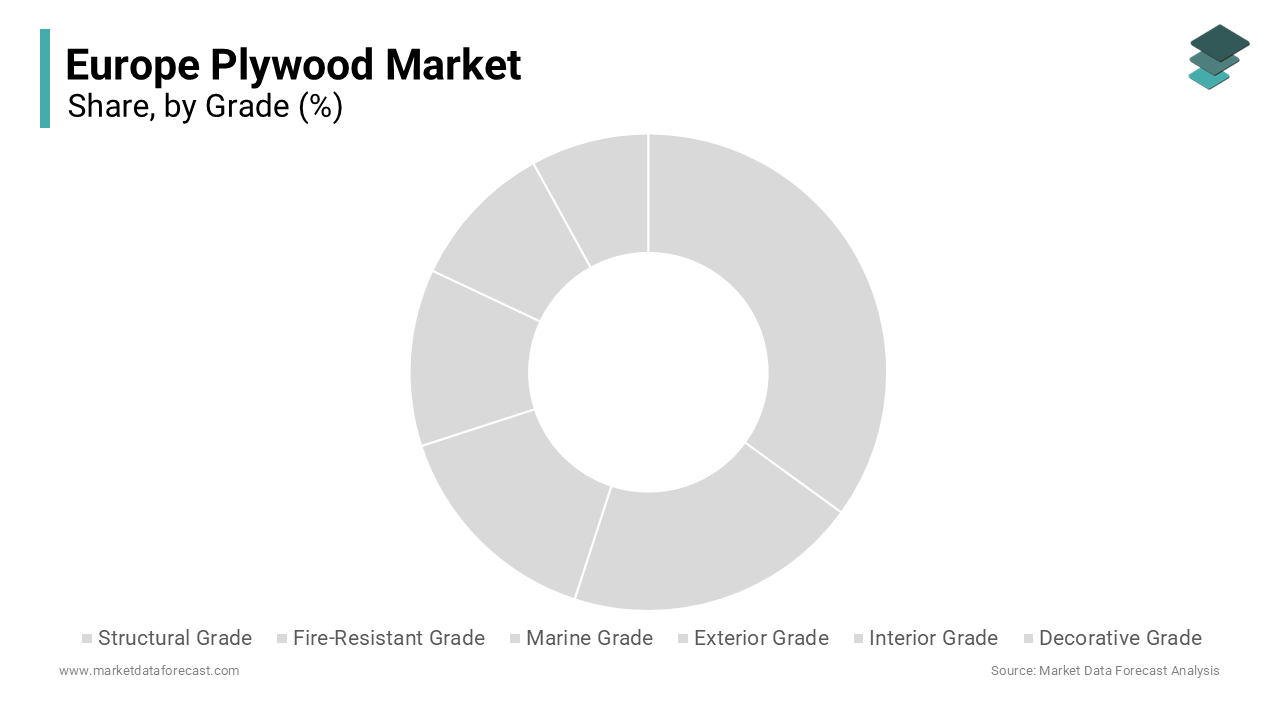
The Fire-Resistant Grade segment is projected to grow at a CAGR of 9.2% from 2025 to 2033 owing to the tightening fire safety regulations across urban construction zones, particularly following the EU’s updated Construction Products Regulation which mandates enhanced reaction-to-fire classifications for interior materials in multi-occupancy buildings. France enacted stricter fire codes requiring all new residential buildings over three stories to use Class B-s1, d0 or higher fire-rated panels, directly boosting demand for intumescent-coated or phenolic-resin-bonded plywood. Similarly, the UK’s post-Grenfell regulatory overhaul has made fire-resistant substrates non-negotiable in social housing retrofits, with over 120,000 units slated for cladding remediation by 2026, according to the Ministry of Housing Communities and Local Government. Manufacturers like Sonae Arauco and Kronospan have responded by scaling production of fire-retardant plywood treated with ammonium polyphosphate systems that achieve Euroclass B certification without compromising workability.
By Wood Type Insights
The softwood plywood segment was accounted in holding a significant share of the Europe plywood market in 2024 with the abundance of sustainably managed coniferous forests in Northern and Eastern Europe in Finland, Sweden, and the Baltic states, which supply consistent volumes of spruce pine and fir logs ideal for structural veneer production. Softwood’s favorable strength-to-weight ratio and dimensional stability make it the material of choice for construction formwork, roofing, and industrial packaging applications that collectively absorb over 75% of softwood plywood output. The European Forest Institute confirms that certified softwood harvests from FSC and PEFC sources exceeded 450 million cubic meters in 2023 by ensuring long-term feedstock security. Moreover, softwood plywood aligns with circular economy principles; its homogeneous fiber structure allows for efficient recycling into particleboard or biomass energy, satisfying end-of-life requirements under the EU Waste Framework Directive. Large-scale producers such as Stora Enso and UPM have optimized their mills for high-yield softwood conversion, achieving veneer recovery rates above 85%, which further cements cost and supply advantages over hardwood alternatives.
The hardwood plywood segment is deemed to grow at a fastest CAGR of 7.8% from 2025 to 2033. The growth of the segment is driven by the rising demand for premium interior finishes in luxury furniture, yacht interiors, and high-end retail fixtures, where aesthetics surface smoothness and screw-holding capacity are important. European birch is sourced predominantly from Finland and the Baltics, due to its fine grain uniform texture and excellent bonding properties. Additionally, the marine sector’s recovery post-pandemic has revived demand for BS1088-certified okoume and meranti plywood, with European boatbuilders constructing over 18,000 recreational vessels in 2024, as per the research. Innovations in formaldehyde-free adhesives have also enabled hardwood plywood to meet stringent indoor air quality standards like EMICODE EC1 Plus, which is opening access to green building certifications such as BREEAM and DGNB.
By Application Insights
The flooring & construction application segment was accounted in holding 45.3% of the Europe plywood market share in 2024 from plywood’s irreplaceable function as a subfloor underlayment, wall sheathing, and temporary formwork in both residential and civil engineering projects. The EU’s Renovation Wave Strategy, which targets the retrofitting of 35 million buildings by 2030 has intensified demand for moisture-resistant and dimensionally stable panels that support dry construction methodologies. Furthermore, infrastructure megaprojects like the Lyon-Turin rail tunnel and the Fehmarn Belt Fixed Link rely heavily on film-faced plywood for concrete casting by consuming an estimated 1.2 million square meters annually.
The automotive interior application segment is likely to expand at a CAGR of 11.4% during the forecast period with the electrification of commercial vehicles and the premiumization of cabin environments in electric vans and light trucks, where lightweight natural materials are favored over synthetic composites for acoustic comfort and sustainability branding. Companies like Mercedes-Benz and Renault have introduced birch plywood trim in their electric delivery van lines, citing a 30% reduction in interior VOC emissions compared to ABS plastics, according to internal lifecycle assessments. The shift aligns with the EU’s End-of-Life Vehicles Directive, which encourages bio-based interior components to improve recyclability. Additionally, specialty plywood suppliers such as Metsä Wood have developed ultra-thin 1.5-millimeter veneered panels that meet ISO 11452-2 electromagnetic compatibility standards by enabling integration near battery management systems without signal interference.
REGIONAL ANALYSIS
Germany Plywood Market Analysis
Germany was the top performer of the Europe plywood market by occupying 22.6% of share in 2024 with the defined by high-value downstream integration, where domestic production meets only 40% of demand, necessitating significant imports from Poland and the Baltics. Stringent energy efficiency laws under the Building Energy Act require thermal bridging mitigation, increasing use of plywood in insulated wall cassettes. The presence of global panel processors like Egger and Pfleiderer ensures continuous innovation in resin technology and surface finishing, Germany’s role as a quality benchmark setter rather than a volume producer.
Finland Plywood Market Analysis
Finland plywood market growth is likely to have significant growth opportunities throughout the forecast period with the anchored in vertically integrated forest-industrial clusters that convert sustainably harvested birch and spruce into high-specification panels for structural and marine applications. Furthermore, Finland’s adherence to strict environmental protocols, where 98% of its forests are PEFC certified that enhances market access under the EU Deforestation Regulation. The government’s Bioeconomy Strategy has also incentivized R&D in bio-based adhesives, with VTT Technical Research Centre developing lignin-reinforced binders that reduce fossil resin dependency by 30%.
Poland Plywood Market Analysis
Poland plywood market growth is likely to grow steadily with the cost-efficient production and strategic geographic positioning, serving as a key supplier to Germany’s construction and furniture sectors. Additionally, the rise of Polish furniture exporters, now the EU’s second-largest after Italy with €8.9 billion in sales has created captive demand for interior-grade panels. However, the sector faces pressure from EUDR compliance, as logs previously sourced from Belarus are now restricted, prompting accelerated diversification into domestic and Scandinavian supplies.
France Plywood Market Analysis
France plywood market growth is expected to grow with its balanced mix of domestic production and specialized import reliance. The MaPrimeRenov scheme, which subsidized over 1.1 million home upgrades in 2024, directly boosted consumption of moisture-resistant and fire-rated plywood for bathroom and kitchen refits. France also maintains a niche in high-end furniture and luxury yachting, where okoume plywood imports from Gabon though declining due to EUDR are being replaced by certified birch from the Baltics.
Sweden Plywood Market Analysis
Sweden plywood market growth is likely to grow with the technological dominance and export orientation, with over 90% of its 780,000 cubic meter annual output shipped abroad, to the UK and Benelux countries. The country’s focus on carbon-negative manufacturing aligns with EU Green Deal objectives; Swedish plywood carries an average embodied carbon of -1.4 kg CO2e per square meter due to biogenic storage and biomass-powered drying, as verified by IVL Swedish Environmental Research Institute. Additionally, Sweden is pioneering digital product passports for wood panels, enabling full traceability from stump to site under EUDR. This regulatory foresight, combined with participation in Nordic modular housing consortia, positions Sweden not just as a supplier but as a sustainability standard-bearer in the evolving European plywood ecosystem.
COMPETITIVE LANDSCAPE
The Europe plywood market features intense competition characterized by a mix of large integrated producers and specialized regional mills. Leading companies differentiate through technological sophistication sustainability credentials and application specific product development rather than price alone. Regulatory compliance particularly under EUDR REACH and CE marking frameworks acts as a significant barrier to entry favoring established players with robust compliance infrastructure. Innovation in resin chemistry veneer yield optimization and digital product passports defines the new competitive frontier. While Northern European firms dominate structural and birch segments Southern producers focus on decorative and interior grades creating regional specialization. The market is witnessing consolidation as smaller mills struggle with capital requirements for automation and emission control. Customer relationships are increasingly shaped by technical support capabilities and integration into downstream design workflows.
KEY MARKET PLAYERS
Some of the companies that are playing a dominating role in the Europe plywood market include
- UPM Plywood
- Metsä Wood
- Latvijas Finieris
- Koskisen Corporation
- Stora Enso
- Garnica
- Panguaneta S.p.A.
- Thebault Group
- Paged Group
- Kronospan
Top Players in the Europe Plywood Market
UPM-Kymmene Corporation
UPM is a Finnish forest industry leader with deep integration across the plywood value chain, operating advanced mills in Finland and Estonia that specialize in high grade birch and structural softwood panels. The company supplies premium products to construction furniture and marine sectors across Europe and Asia. In recent years UPM has intensified its focus on sustainability by launching plywood lines bonded with bio-based adhesives derived from tall oil. It also implemented digital traceability systems compliant with the EU Deforestation Regulation ensuring full log origin transparency. These initiatives reinforce its reputation as an innovator in eco engineered wood solutions while strengthening long term customer partnerships in regulated markets.
Stora Enso Oyj
Stora Enso headquartered in Finland maintains a significant footprint in the European plywood market through its network of technologically advanced mills producing structural and interior grade panels. The company leverages sustainably managed Nordic forests to supply consistent quality veneers for load bearing applications in modular construction and infrastructure. Recently Stora Enso expanded its product portfolio with fire resistant and moisture stable plywood variants certified under EN 13986 and Euroclass B standards. It also partnered with construction tech firms to integrate plywood data into BIM platforms enhancing specification accuracy. These moves position the company at the intersection of digitalization regulatory compliance and circular material design.
Sonae Arauco
Sonae Arauco a Portugal based panel manufacturer plays a strategic role in Southern Europe’s plywood landscape with production facilities focused on interior decorative and moisture resistant grades. The company serves furniture makers renovators and retail fixture designers across Iberia France and North Africa. To bolster its market position Sonae Arauco recently upgraded its resin formulation to eliminate formaldehyde emissions achieving EMICODE EC1 Plus certification. It also launched a lightweight plywood series tailored for prefabricated interior partitions aligning with dry construction trends.
Top Strategies Used by the Key Market Participants
Key players in the Europe plywood market are prioritizing vertical integration to secure raw material access and reduce supply chain volatility. They are investing heavily in digital traceability systems to comply with the EU Deforestation Regulation and enhance brand credibility. Product innovation focuses on developing fire resistant moisture stable and low emission plywood variants aligned with green building standards. Strategic partnerships with construction firms and furniture OEMs enable co development of application specific solutions. Additionally, companies are expanding lightweight and ultra-thin plywood offerings to penetrate automotive and acoustic engineering niches. Sustainability driven differentiation through bio-based adhesives carbon footprint labeling and circular design principles is central to their competitive positioning. Geographic diversification within Europe mitigates regional demand fluctuations while maintaining proximity to core customers.
MARKET SEGMENTATION
This research report on the Europe Plywood Market has been segmented and sub-segmented based on the following categories.
By Grade
- Structural Grade
- Fire-Resistant Grade
- Marine Grade
- Exterior Grade
- Interior Grade
- Decorative Grade
By Type
- Softwood Plywood
- Hardwood Plywood
By Application
- Construction
- Industrial
By Use Type
- New Construction
- Rehabilitation
By Country
- UK
- France
- Spain
- Germany
- Italy
- Russia
- Sweden
- Denmark
- Switzerland
- Netherlands
- Turkey
- Czech Republic
- Rest of Europe
Frequently Asked Questions
What is the Europe Plywood Market?
The Europe plywood market refers to the production, distribution, and consumption of plywood used across construction, furniture, packaging, and industrial applications in European countries.
What are the major applications of plywood in Europe?
Plywood in Europe is widely used in construction, furniture manufacturing, flooring, wall panels, packaging, and interior decoration.
What factors are driving the growth of the Europe Plywood Market?
The market growth is driven by increasing construction activities, rising demand for sustainable wood products, and growth in the furniture and interior design industries.
Which countries are major contributors to the Europe Plywood Market?
Germany, France, Italy, the United Kingdom, and Spain are among the key contributors due to strong construction and furniture manufacturing sectors
What types of plywood are commonly used in Europe?
Common types include softwood plywood, hardwood plywood, marine plywood, decorative plywood, and structural plywood.
How is plywood used in the construction industry in Europe?
Plywood is used for roofing, flooring, wall sheathing, formwork, and structural panels in construction projects.
Why is plywood preferred in furniture manufacturing?
Plywood is preferred because of its strength, durability, dimensional stability, and resistance to cracking and warping.
What are the key raw materials used in plywood production?
Plywood is mainly produced using wood veneers from trees such as pine, birch, spruce, and poplar.
What are the challenges faced by the Europe Plywood Market?
Challenges include fluctuating raw material prices, environmental regulations, and competition from alternative materials such as MDF and particle board.
What is the future outlook for the Europe Plywood Market?
The market is expected to grow steadily due to increasing construction activities, rising demand for eco-friendly building materials, and expansion of the furniture industry in Europe.
Access the study in MULTIPLE FORMATS
Purchase options starting from
$ 2000
Didn’t find what you’re looking for?
TALK TO OUR ANALYST TEAM
Need something within your budget?
NO WORRIES! WE GOT YOU COVERED!
Call us on: +1 888 702 9696 (U.S Toll Free)
Write to us: sales@marketdataforecast.com