- Product Description Description
- Table of Contents TOC
- List of Table & Figure LOT
- Get Free Sample PDF Sample PDF
Europe Podcast Market Report Summary
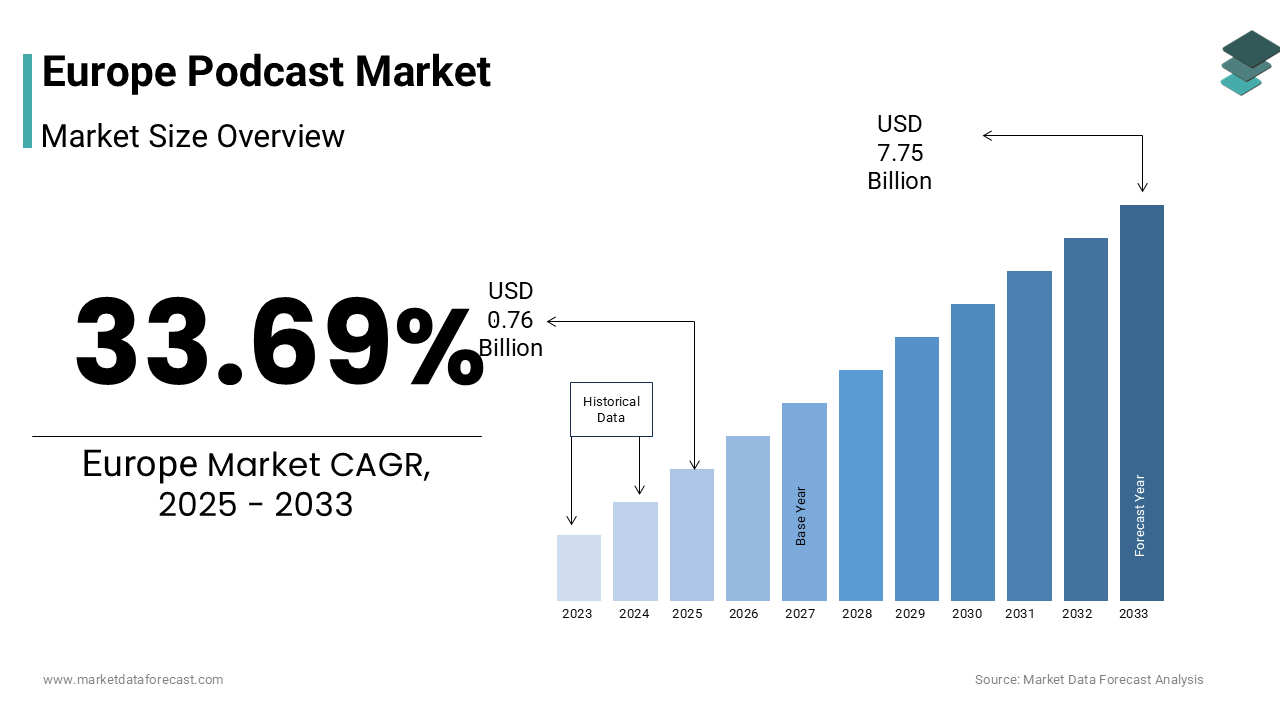
The Europe podcast market was valued at USD 0.57 billion in 2024, is anticipated to reach USD 0.76 billion in 2025, and is projected to grow significantly to USD 7.75 billion by 2033, expanding at a remarkable CAGR of 33.69% during the forecast period (2025–2033). The growth of the European podcast market is driven by the rising adoption of on-demand audio entertainment, increasing smartphone penetration, the popularity of digital streaming platforms, and growing consumer preference for personalized and niche audio content. Additionally, advancements in AI-driven content recommendations, integration with smart speakers, and the expansion of ad-supported and subscription-based podcast models are further fueling market expansion across the region.
Key Market Trends
- Rapid digital transformation and increasing mobile data usage are driving podcast consumption across Europe.
- Integration of AI and analytics enhances podcast discovery, personalized content recommendations, and listener engagement.
- Growing advertising investment in podcasting, with brands leveraging audio storytelling for targeted marketing.
- Rising popularity of multilingual and localized podcasts, catering to diverse European audiences.
- Expansion of podcast monetization models, including paid subscriptions, brand sponsorships, and programmatic ads.
- Increasing collaborations between media houses, streaming platforms, and independent creators to broaden listener reach.
- The growing influence of video podcasts on platforms like YouTube and Spotify, blurring the line between audio and visual content.
Segmental Insights
- Based on OS compatibility, the iOS segment occupied the major share of the Europe podcast market in 2024, driven by Apple’s long-standing dominance in podcast distribution and user loyalty within the iPhone ecosystem.
- Based on Deployment, the cloud-based deployment segment held the largest share in 2024 due to its scalability, ease of content management, and ability to support high-quality streaming across platforms.
- Based on End-User, the individual and professional users segment led the market in 2024, as podcasts became a preferred medium for entertainment, education, and business communications among content creators and professionals alike.
Regional Insights
- United Kingdom Held the largest share of 22.7% in 2024, driven by strong podcast penetration, mature digital infrastructure, and a robust creator ecosystem.
- Germany is witnessing rapid adoption due to high smartphone usage and interest in informative and news-based podcasts.
- France is experiencing strong growth through expanding music streaming services integrating podcasts into their offerings.
- Nordic countries are leading in subscription-based podcast models and multilingual content innovation.
- Southern Europe (Italy & Spain) is showing an increasing listener base due to emerging local creators and rising digital audio consumption.
Competitive Landscape
The Europe podcast market is highly dynamic, with major players focusing on platform expansion, exclusive content production, and AI-driven listener engagement. Companies are investing in partnerships, localized content strategies, and innovative ad models to enhance reach and monetization. Prominent players in the Europe podcast market include Spotify, Apple Podcasts, YouTube, Amazon Music, Audible, Deezer, Acast, Audioboom, Podimo, SoundCloud, BBC, Guardian Media Group, Bauer Media, Global, iHeartMedia, Sirius XM, Wondery, Podbean, Libsyn, Transistor, Podtrac, Chartable, and Mixcloud.
Europe Podcast Market Size
The europe podcast market size was valued at USD 0.57 billion in 2024 and is anticipated to reach USD 0.76 billion in 2025 from USD 7.75 billion by 2033, growing at a CAGR of 33.69% during the forecast period from 2025 to 2033.
Podcast is a rapidly maturing audio ecosystem shaped by digital connectivity linguistic diversity and evolving media consumption habits. Unlike video centric platforms podcasts thrive on intimacy accessibility and on demand engagement making them particularly suited to commuter culture and multilingual societies of Europe. Podcast includes a wide spectrum of content including news analysis true crime educational series and narrative storytelling often produced in local languages to resonate with national audiences. According to Eurostat, about 93% of households in the EU had internet access in 2023. Public service broadcasters such as BBC Radio, Radio France Inter and Deutschlandfunk have been instrumental in legitimising the audio-medium through high-quality investigative journalism and cultural programming. Simultaneously, independent creators use low-barrier-entry tools to explore niche topics from Nordic folklore to Mediterranean culinary heritage. This dual dynamic of institutional support and grassroots innovation defines the structural uniqueness of European podcast market.
MARKET DRIVERS
Proliferation of Smartphones and On Demand Audio Consumption
The widespread adoption of smartphones across Europe has fundamentally enabled the growth of podcast listening by providing portable always available access to on demand audio content, which is one of the key factors driving the growth of the European podcast market. According to the European Commission’s Digital Economy and Society Index, 92% of individuals aged 16 to 74 owned a smartphone in 2023 with daily usage exceeding three hours on average. This device ubiquity allows commuters, students, and remote workers to integrate podcasts into daily routines such as commuting, exercising, or household chores. According to Eurostat, public transport usage exceeds 60% of the working population in major European urban centers like Berlin, Paris, and Stockholm, which is making podcasts a preferred alternative to music or silence during transit. Audio streaming apps such as Spotify, Apple Podcasts, and Deezer have optimized mobile interfaces for discovery, playback, and offline listening, which is further lowering friction. According to the Reuters Institute for the Study of Journalism (2023), 57% of regular podcast listeners in Europe access content primarily via mobile devices, with 38% listening during daily commutes. This behavioral integration transforms podcasts from occasional entertainment into a habitual information and leisure medium deeply embedded in contemporary European digital life.
Strong Public Service Broadcasting Tradition and Investigative Journalism
The European legacy of robust public service media has significantly elevated podcast quality and credibility fostering audience trust and sustained engagement, which is further boosting the expansion of the podcast market in Europe. Institutions such as the BBC in the United Kingdom Radio France in France and SVT in Sweden allocate dedicated resources to produce high fidelity narrative journalism podcasts that rival global standards. The BBC’s “The Inquiry” and France Inter’s “Affaires Sensibles” exemplify how public broadcasters leverage archival access expert networks and editorial rigor to deliver compelling long form content. According to the European Broadcasting Union (EBU), over 70% of national public service broadcasters now operate dedicated podcast divisions, with annual production budgets exceeding one million euros in larger markets. These entities adhere to strict editorial guidelines ensuring factual accuracy and balanced reporting, which contrasts with the unregulated nature of much user-generated content. According to the Reuters Institute for the Study of Journalism (2023), 63% of European podcast listeners consider public service podcasts more trustworthy than commercial or independent alternatives. This institutional credibility not only attracts loyal audiences but also sets benchmarks for production values and ethical standards across the broader podcasting landscape.
MARKET RESTRAINTS
Fragmented Language Markets Limiting Cross Border Scalability
The linguistic fragmentation of Europe that impedes content scalability and monetization across national borders is one of the major restraints to the growth of the European podcast market. With over 24 official languages and numerous regional dialects, podcast creators must produce separate versions or accept limited audience reach. According to Eurostat, only 44% of Europeans report being able to hold a conversation in a language other than their mother tongue, which restricts the viability of single-language content beyond domestic markets. For instance, a German-language true crime series may achieve high engagement in Germany, Austria, and parts of Switzerland but remains inaccessible to audiences in Spain or Poland. This fragmentation increases production costs for localization and reduces advertising appeal for pan-European brands seeking unified campaigns. According to the European Audiovisual Observatory (2023), less than 12% of European podcasts are available in more than two languages. Consequently, creators often operate in siloed national ecosystems with limited access to broader revenue pools or collaborative opportunities. Until machine translation or multilingual voice synthesis reaches broadcast quality, this linguistic barrier will continue to constrain market consolidation and economies of scale.
Underdeveloped Monetization Infrastructure for Independent Creators
Independent podcasters across Europe face persistent challenges in generating sustainable revenue due to an underdeveloped monetization infrastructure compared to the United States, which is further impeding the growth of the podcast market in Europe. While programmatic advertising and dynamic ad insertion are common in North America European podcast networks often rely on static host read ads with limited targeting capabilities. According to sources, the podcast market in Europe has been growing rapidly from the last few years, which is reflecting the growing commercial potential of the medium across the continent. The absence of standardized audience measurement systems across the EU further deters brand investment, as advertisers lack reliable cross-platform metrics. Unlike the Interactive Advertising Bureau’s podcast measurement guidelines in the U.S., Europe lacks a harmonized framework endorsed by major platforms and agencies. Additionally, public funding for audio storytelling remains scarce outside public broadcasters with national arts councils in countries like Italy and Greece offering minimal support for digital audio projects. This financial precarity forces many creators to treat podcasting as a side activity, which is limiting production quality and consistency. Without coordinated industry efforts to establish transparent measurement standards and diversified revenue models such as listener subscriptions or EU cultural grants, the independent sector will struggle to professionalize.
MARKET OPPORTUNITIES
Rise of Local Language Educational and Language Learning Podcasts
The surging demand for educational content particularly language learning and academic enrichment delivered in local languages is one of the promising opportunities in the European podcast market. As digital education expands beyond formal institutions podcasts offer flexible accessible and engaging alternatives for lifelong learning. According to Eurostat (2023), around 65% of European adults participated in some form of informal learning with digital audio emerging as a preferred medium for skill acquisition. Platforms like LingQ and Coffee Break Languages have seen exponential growth by offering structured lessons in French, German, Spanish, and other European languages through conversational podcast formats. National initiatives further amplify this trend, such as Sweden’s “Studiefrämjandet,” that promotes adult education through publicly funded audio resources. According to the European Centre for the Development of Vocational Training (2023), 42% of young professionals use podcasts to improve workplace competencies, including communication and digital literacy. Universities in the Netherlands and Finland have also launched open-access lecture series as podcasts, reaching global audiences while reinforcing local educational identity. This convergence of pedagogy, technology, and linguistic pride positions educational podcasts as a high-impact growth vector.
Integration of Podcasts into Public Health and Civic Engagement Campaigns
European governments and NGOs are increasingly leveraging podcasts as strategic tools for public health communication and civic education creating new institutional demand for high quality audio content, which is likely to be another promising opportunity in the European podcast market. During the pandemic, national health agencies in Germany and Portugal disseminated vaccine information through serialized podcasts featuring epidemiologists and community leaders. Building on this precedent the European Centre for Disease Prevention and Control now produces “EU Health Talks” to address antimicrobial resistance mental health and nutrition across member states. Similarly civic organizations use narrative podcasts to explain complex policy issues such as the European Green Deal or digital rights with formats designed to engage younger demographics. According to the World Health Organization (WHO) and the European Commission (2023), several European public health agencies have increasingly adopted digital media formats, including podcasts to combat misinformation and promote preventive care. These initiatives provide stable funding for producers while enhancing the medium’s societal relevance. As trust in traditional media fluctuates, audio storytelling’s intimate and conversational nature offers a credible channel for evidence-based public messaging. This institutional adoption not only diversifies revenue streams but also elevates podcasting as a legitimate platform for democratic discourse and social well-being.
MARKET CHALLENGES
Inconsistent Copyright and Intellectual Property Frameworks Across Member States
The form of inconsistent copyright and intellectual property regulations across European Union member states that create legal uncertainty for creators and distributors is one of the key challenges to the European podcast market. While the EU Copyright Directive of 2019 aimed to harmonize digital rights, it left significant room for national interpretation, particularly regarding the use of third-party audio clips, music samples, and archival material. According to the European Audiovisual Observatory (2023), podcast producers in France must obtain separate licenses for even short musical excerpts. Whereas in the Netherlands, limited fair use provisions allow more flexible incorporation under certain conditions. This regulatory patchwork complicates cross-border distribution and increases compliance costs, especially for independent creators lacking legal resources. According to a 2023 survey by the European Podcast Association, 52% of producers have abandoned episodes due to copyright clearance difficulties. Furthermore, the absence of a centralized EU licensing body for sound recordings forces creators to navigate multiple collecting societies such as GEMA in Germany and SACEM in France. Until a unified and creator-friendly copyright framework is implemented, this legal fragmentation will continue to stifle creative expression and market integration.
Limited Accessibility Features for Hearing Impaired and Neurodiverse Audiences
The widespread lack of accessibility features such as transcripts captions and sensory friendly audio design for hearing impaired and neurodiverse listeners is further challenging the expansion of the European podcast market.
Despite the European Accessibility Act that mandates accessible digital services by 2025, most podcasts remain audio-only with no accompanying text. According to the European Union Agency for Fundamental Rights (2023), over 80 million Europeans live with some form of disability, yet less than 15% of top-ranked European podcasts provide full transcripts, as reported by the European Disability Forum (2023). This exclusion contradicts both ethical imperatives and legal obligations under the UN Convention on the Rights of Persons with Disabilities, which the EU has ratified. Moreover, neurodiverse audiences, including those with autism or ADHD often require adjustable playback speeds, content warnings, and reduced background noise, which are rarely standardized. Public service broadcasters lead in accessibility with the BBC providing transcripts for 90% of its podcasts yet commercial and independent creators lag due to cost and technical barriers. Without industry-wide adoption of accessible production standards, the podcast medium will fail to serve a significant portion of the European population, limiting its social impact and audience potential.
REPORT COVERAGE
| REPORT METRIC | DETAILS |
| Market Size Available | 2024 to 2033 |
| Base Year | 2024 |
| Forecast Period | 2025 to 2033 |
| Segments Covered | By OS Compatibility, Deployment, End-User, and Region. |
| Various Analyses Covered | Global, Regional, and Country Level Analysis, Segment-Level Analysis, DROC, PESTLE Analysis, Porter’s Five Forces Analysis, Competitive Landscape, Analyst Overview of Investment Opportunities |
| Regions Covered | North America, Europe, APAC, Latin America, Middle East & Africa |
| Market Leaders Profiled | Spotify, Apple Podcasts, YouTube, Amazon Music, Audible, Deezer, Acast, Audioboom, Podimo, SoundCloud, BBC, Guardian Media Group, Bauer Media, Global, iHeartMedia, Sirius XM, Wondery, Podbean, Libsyn, Transistor, Podtrac, Chartable, and Mixcloud. |
SEGMENTAL ANALYSIS
By OS Compatibility Insights
The iOS segment occupied the major share of the European podcast market in 2024. The dominance of iOS segment in the European market is primarily driven by the deep integration of Apple Podcasts into the iOS ecosystem which offers seamless discovery playback and subscription management without requiring third party apps. According to StatCounter (2023), iPhones maintain strong market penetration across Western and Northern Europe with countries like Sweden, the United Kingdom, and Ireland reporting iOS smartphone shares exceeding 55%. Apple’s early investment in podcast infrastructure, including the 2021 launch of Apple Podcasts Subscriptions and enhanced analytics for creators, has further solidified its position. Additionally, the demographic profile of iOS users aligns closely with core podcast audiences who value curated content and ad-free experiences. Public service broadcasters such as BBC and France Inter prioritize iOS optimization to ensure high-quality audio delivery and metadata consistency. This combination of hardware ubiquity, software integration, and audience alignment are primarily contributing to the domination of the iOS segment in the European podcast market.
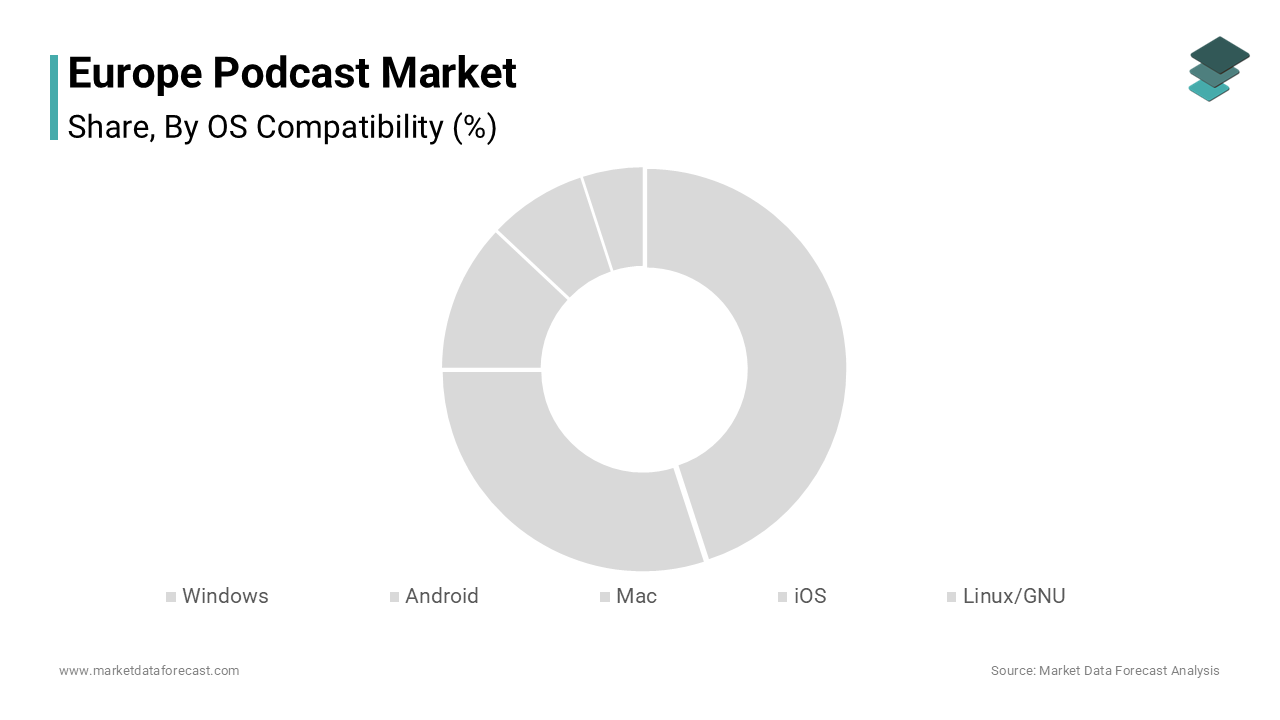
The android segment is expected to grow exponentially and is estimated to register a CAGR of 12.2% over the forecast period in the European market. The expanding footprint of android in Southern and Eastern Europe where affordability and device diversity drive adoption is one of the major factors propelling the growth of the android segment in the European market. According to StatCounter (2023), Android smartphones account for over 70% of the mobile market in countries like Spain, Italy, and Poland. The proliferation of Google Podcasts, Spotify, and third-party apps such as AntennaPod on Android has democratized access to global and local content. Google’s 2022 integration of podcast indexing into Search and Assistant enables voice-activated discovery without opening dedicated apps, which is a feature particularly valued by multitasking users. According to a 2023 study by the Reuters Institute for the Study of Journalism, Android users in Europe are 30% more likely to discover new podcasts through search or smart speakers than iOS counterparts. As 5G rollout improves streaming quality and emerging markets increase digital literacy, Android’s open ecosystem and price accessibility will continue to fuel its rapid expansion in podcast engagement.
By Deployment Insights
The cloud based deployment segment held the largest share of the European podcast market in 2024. The dominating position of cloud-based deployment segment is attributed to the operational advantages of scalability cost efficiency and global content delivery that cloud platforms provide to both individual creators and media organizations. Services such as Buzzsprout Captivate and Amazon S3 allow instant publishing to all major directories with automatic RSS feed updates and real time analytics. According to the European Broadcasting Union (EBU, 2023), more than 90% of public service podcast producers rely on cloud infrastructure to manage multilingual episodes and distribute content across 27 countries without latency. The shift away from on-premises servers has been accelerated by EU data sovereignty regulations, which is supported by GDPR-compliant hosting options offered by European cloud providers such as OVHcloud and Deutsche Telekom. According to a 2023 survey by the European Podcast Association, independent creators using cloud platforms reduced their average upload-to-publish time from 48 hours to under 10 minutes. This technical democratization enables consistent publishing schedules and professional reliability even for micro-budget operations and drive the growth of the cloud-based deployment segment in the European market.
The on-premises segment is anticipated to witness a CAGR of 6.9% over the forecast period in the European podcast market. The institutional users such as national broadcasters universities and government agencies that prioritize data control security and archival integrity over convenience is majorly driving the expansion of the on-premises segment in the regional market. Entities like Deutschlandfunk in Germany and RAI in Italy maintain internal servers to comply with national broadcasting archives laws which mandate long term preservation of original audio masters in uncompressed formats. Similarly, academic institutions including the University of Copenhagen and Sorbonne University host lecture podcasts on campus servers to ensure compliance with research data governance policies. According to Eurostat (2023), around 45.2% of EU enterprises reported using cloud computing services, which is primarily for hosting databases and email systems, reflecting a growing preference for secure and compliant digital infrastructure. While cloud dominates overall, this niche segment is expanding as regulatory scrutiny intensifies and organizations seek to retain full ownership of intellectual property and listener metadata in alignment with EU digital sovereignty principles.
By End User Insights
The individual and professional segment held the leading share of the European podcast market in 2024. This category includes independent journalists academics activists and subject matter experts who produce non-commercial or semi commercial content driven by passion expertise or community service. The low barrier to entry that require only a microphone and internet connection has enabled a surge in grassroots audio storytelling across diverse topics from Baltic folklore to Mediterranean climate activism. Platforms like Anchor and Podbean offer free hosting and distribution lowering technical hurdles. According to Spotify for Podcasters (2023), Europe is one of the fastest-growing regions for podcast creation, with the number of active shows increasing by over 30% year-on-year. Public funding through national arts councils in countries like Denmark and Finland further supports this ecosystem. These creators form the cultural backbone of the European podcast landscape, enriching it with authenticity, linguistic diversity, and civic engagement that commercial entities often cannot replicate.
The commercial and business segment is growing rapidly and is expected to register a CAGR of 13.9% over the forecast period owing to the corporations, NGOs and political organizations adopting podcasts as strategic tools for brand building internal communication and stakeholder engagement. Companies such as Siemens Allianz and L’Oréal now produce regular branded podcasts covering sustainability innovation and industry insights to position themselves as thought leaders. According to Spotify Advertising (2023), over 80% of marketers in Europe consider podcasts an effective channel for brand storytelling and audience engagement. Political parties in Germany and Sweden use narrative audio series to explain policy platforms to younger voters. Additionally, internal corporate podcasts are rising, with firms like Novartis and Philips using them for employee onboarding and culture reinforcement. As audio becomes integral to integrated marketing and organizational strategy, the commercial and business segment is expected to experience significant growth.
REGIONAL ANALYSIS
United Kingdom Podcast Market Analysis
The United Kingdom occupied the leading share of 22.7% of the regional market in 2024. The leading position of the UK in the European podcast market is primarily attributed to the BBC’s pioneering role in audio innovation public service investment and a vibrant independent creator scene centered in London and Manchester. The BBC alone produces over 500 podcast series annually with flagship shows like “The Daily” and “Global News Podcast” achieving global reach. Commercial radio groups such as Global and Bauer have aggressively expanded into on-demand audio with dedicated studios and talent development programs. According to the Reuters Institute for the Study of Journalism (2023), 61% of UK adults listen to podcasts monthly with true crime and current affairs being dominant genres. According to the Interactive Advertising Bureau UK (IAB UK, 2023), podcast advertising spends in the UK grew by 25% year on year, which is supported by the Advertising Standards Authority’s clear guidelines on branded content that have fostered advertiser confidence. Strong copyright protections and a mature digital advertising ecosystem further support professional production. The UK’s blend of institutional scale, creative freedom, and commercial viability are majorly propelling the domination of the UK in the European podcast market.
Germany Podcast Market Analysis
Germany stood as the second largest regional market for podcast in Europe in 2024. The emphasis of Germany on high quality journalism educational content and multilingual offerings is majorly driving the German podcast market growth. Public broadcasters ARD and Deutschlandfunk invest heavily in investigative podcast series with teams of reporters and sound designers producing cinematic audio documentaries. According to the Reuters Institute for the Study of Journalism (2023), around 73% of German podcast listeners prioritize factual accuracy and trustworthy information, which is reflecting a national preference for substantive content. Independent creators benefit from state-funded media labs in Berlin and Hamburg that provide studio access and legal advice. The rise of “Hörspiel” or audio drama has also fueled narrative innovation. With over 40% of podcasts produced in German and strong listener loyalty driven by trust in public media, Germany is anticipated to continue to account for a notable share of the European market throughout the forecast period.
France Podcast Market Analysis
France captured a substantial share of the European podcast market in 2024. The French podcast market thrives on a rich tradition of spoken word culture philosophical debate and literary storytelling which translates naturally into long form audio formats. Public service radio France Inter and France Culture lead with critically acclaimed series such as “Affaires Sensibles” and “La Fabrique de l Histoire” that blend historical research with dramatic narration. According to Harris Media (2023), France ranks among Europe’s top three podcast markets with over 20 million monthly listeners consuming audio content across various genres. The government supports the sector through the Centre National du Cinéma et de l’Image Animée (CNC) audio creation fund, which allocated €12 million in 2022 to independent producers. Paris serves as a hub for audio startups with companies like Ausha providing French-language-focused hosting and monetization tools. The cultural prestige of podcasting as a legitimate art form in France are fuelling investment and audience engagement across generations and driving the French podcast market expansion.
Sweden Podcast Market Analysis
Sweden is predicted to showcase a prominent CAGR in the European podcast market during the forecast period. Sweden stands out for its early adoption of digital audio public service innovation and strong support for independent creators through cultural policy. Swedish Radio’s “P3 Dokumentär” has set international benchmarks for investigative audio journalism winning multiple global awards. According to Statista (2023), around 69% of Swedes aged 18 to 34 listen to podcasts weekly with true crime and social issues ranking among the top genres. The government’s Kulturrådet provides annual grants to audio producers focusing on gender equality, sustainability, and minority voices. Stockholm hosts Europe’s largest podcast festival, Podstock that attracts over 10,000 attendees and fosters industry networking. High English proficiency also enables Swedish creators to reach global audiences while maintaining local relevance. This combination of institutional excellence, public funding, and cultural openness are supporting the growth of the podcast market in Sweden.
Spain Podcast Market Analysis
Spain is projected to register a healthy CAGR in the European podcast market over the forecast period owing to the high smartphone penetration youthful demographics and a resurgence of narrative audio rooted in the country’s oral storytelling heritage. Public broadcasters like RNE and regional networks such as Catalunya Ràdio produce award winning investigative series on topics ranging from political corruption to environmental justice. According to Spotify for Podcasters (2023), Spain ranks among the top five European countries for podcast consumption with a rapidly growing listener base driven by social media discovery and youth engagement. Independent platforms like iVoox, which isheadquartered in Madrid serve as vital hubs for Iberian and Latin American content and foster cross-cultural exchange. The rise of bilingual podcasts in Spanish and Catalan also reflects the nation’s linguistic diversity. With mobile data costs among the lowest in Europe and strong youth engagement, the Spanish podcast market continues to expand with authentic local voices gaining regional and global traction.
COMPETETIVE LANDSCAPE
The Europe podcast market features a multifaceted competitive landscape where global streaming giants public service broadcasters and agile local platforms vie for audience attention and creator loyalty. Unlike the United States where advertising dominates revenue models European competition is shaped by a hybrid ecosystem of public funding commercial subscriptions and brand partnerships. Global players like Spotify and Apple leverage scale and technology but face challenges in linguistic and cultural localization. Public broadcasters such as BBC ARD and France Inter command trust through editorial rigor yet must modernize distribution to retain younger listeners. Meanwhile regional platforms like Deezer and iVoox thrive by curating local voices and respecting data privacy norms. The absence of a unified measurement standard fragments advertiser confidence while regulatory pressures around copyright and digital sovereignty influence content strategy. Innovation in narrative form accessibility and multilingual production defines competitive advantage in this diverse and values driven audio environment.
KEY MARKET PLAYERS
Some of the companies that are playing a dominating role in the Europe podcast market include
- Spotify
- Apple Podcasts
- YouTube
- Amazon Music
- Audible
- Deezer
- Acast
- Audioboom
- Podimo
- SoundCloud
- BBC
- Guardian Media Group
- Bauer Media
- Global
- iHeartMedia
- Sirius XM
- Wondery
- Podbean
- Libsyn
- Transistor
- Podtrac
- Chartable
- Mixcloud
Top Players in the Market
Spotify is a transformative force in the Europe podcast market having redefined audio consumption through strategic acquisitions exclusive content and integrated listening experiences. The company has invested billions to secure global and regional exclusives including partnerships with major European creators and media houses such as Der Spiegel in Germany and Le Monde in France. Recent initiatives include the rollout of Spotify AI Transcripts for European languages enhancing accessibility and discoverability and the expansion of its Anchor platform with localized monetization tools for independent podcasters across the continent. Spotify’s integration of podcasts into its core music app has normalized audio storytelling for millions of European users while its ad targeting infrastructure attracts premium brand investment. By blending global scale with regional relevance Spotify continues to shape the future of on demand audio in Europe.
BBC is a cornerstone of the Europe podcast market renowned for its journalistic integrity narrative depth and public service mission. As a pioneer in audio storytelling the BBC produces hundreds of original podcast series annually spanning news documentaries drama and cultural commentary that resonate far beyond the United Kingdom. Recent efforts include the launch of BBC Sounds as a unified audio platform with personalized recommendations and offline listening optimized for European audiences. The corporation has also expanded multilingual content through collaborations with European public broadcasters and introduced enhanced metadata standards to improve cross border discoverability. Its commitment to training independent audio journalists across Europe through the BBC Academy further strengthens the regional ecosystem. The BBC’s blend of editorial excellence and public funding ensures it remains a trusted and influential voice in European podcasting.
Deezer has established a distinctive presence in the Europe podcast market by prioritizing local language content seamless music podcast integration and privacy conscious personalization. Headquartered in Paris the company offers a curated podcast experience across French German Spanish and Italian markets with dedicated editorial teams that spotlight regional creators and emerging voices. Recent actions include the introduction of Flow for Podcasts an AI driven recommendation engine trained on European listening habits and the launch of Deezer Originals featuring exclusive series on European history true crime and social issues. The platform also champions accessibility by providing transcripts for top shows and supporting independent producers through its Creator Fund. By leveraging its deep roots in European digital culture and resisting algorithmic homogenization Deezer offers a compelling alternative to US dominated platforms.
Top Strategies Used by the Key Market Participants
Key players in the Europe podcast market focus on local language content creation to resonate with national audiences and comply with cultural preferences. They invest in AI powered recommendation engines trained on regional listening behaviors to enhance discovery without compromising privacy. Strategic partnerships with public broadcasters journalists and academic institutions ensure high quality credible programming. Companies develop exclusive original series to differentiate their catalogues and attract subscriber revenue. They implement GDPR compliant data practices and transparent ad targeting to build user trust. Platforms integrate podcasts with music and audiobooks to create unified audio ecosystems. Accessibility features such as transcripts and adjustable playback are prioritized to meet EU inclusivity standards. Monetization tools including dynamic ad insertion and listener donations are localized to support independent creators across diverse European markets.
MARKET SEGMENTATION
The research report on the Europe podcast market has been segmented and sub-segmented based on categories.
By OS Compatibility
- Windows
- Android
- Mac
- iOS
- Linux/GNU
By Deployment
- On-Premises
- Cloud
By End-user
- Individual/Professional
- Commercial/Business
By Country
- UK
- France
- Spain
- Germany
- Italy
- Russia
- Sweden
- Denmark
- Switzerland
- Netherlands
- Turkey
- Czech Republic
- Rest of Europe