- Product Description Description
- Table of Contents TOC
- List of Table & Figure LOT
- Get Free Sample PDF Sample PDF
Market Size, 2025
$1.32 MnMarket Estimate, 2026
$1.37 MnMarket Forecast, 2034
$1.81 MnCAGR, 2026–2034
3.58%Europe Polyamide Market Report Summary
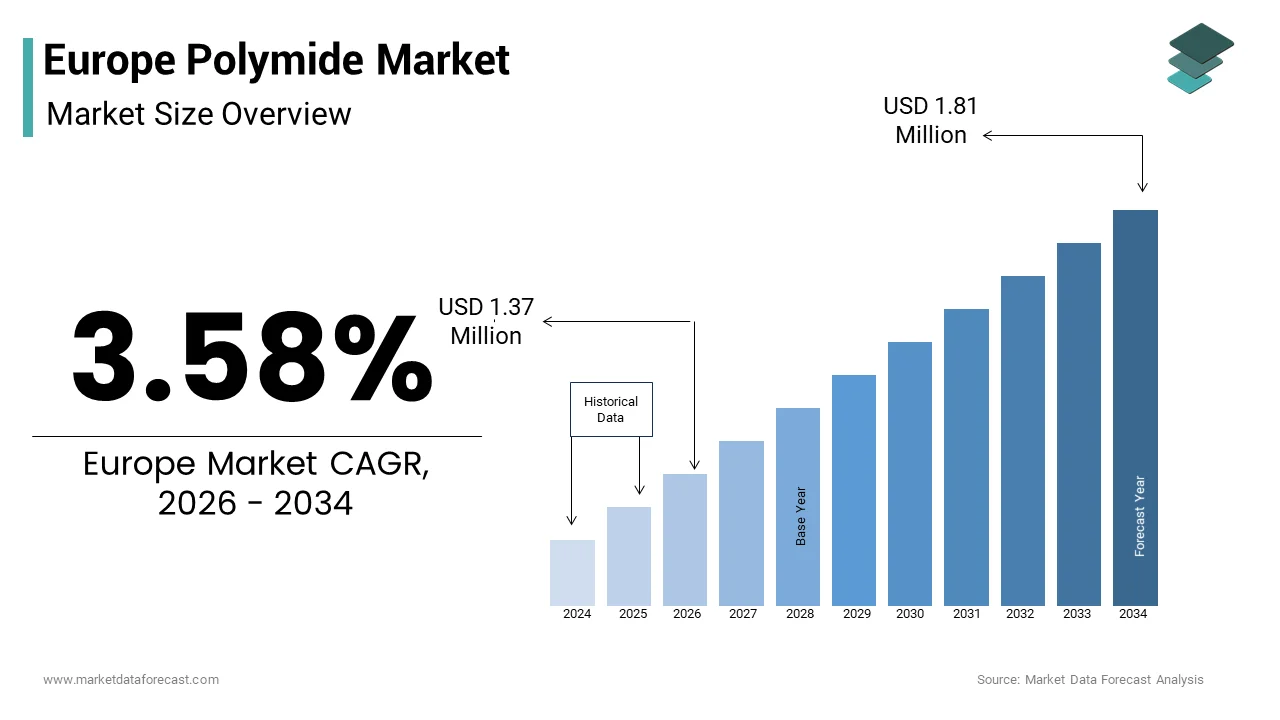
The Europe polyamide market was valued at 1.32 million tons in 2025, is estimated to reach 1.37 million tons in 2026, and is projected to expand to 1.81 million tons by 2034, growing at a CAGR of 3.58% during 2026–2034. Market growth is driven by the rising adoption of lightweight and high-performance engineering plastics across automotive, industrial machinery, aerospace, textiles, and electrical & electronics sectors. Increasing regulatory pressure to reduce vehicle emissions, along with the substitution of metals with durable polymers, continues to support polyamide demand across Europe.
Key Market Trends
- Strong demand from the automotive sector for lightweight, heat-resistant, and durable materials.
- Increasing use of polyamides in industrial machinery, textiles, and agricultural equipment.
- Growing applications in aerospace and defense, particularly in high-strength and specialty grades.
- Rising focus on material efficiency, recyclability, and compliance with EU sustainability standards.
- Continuous innovation in polyamide formulations to enhance thermal and mechanical performance.
Segmental Insights
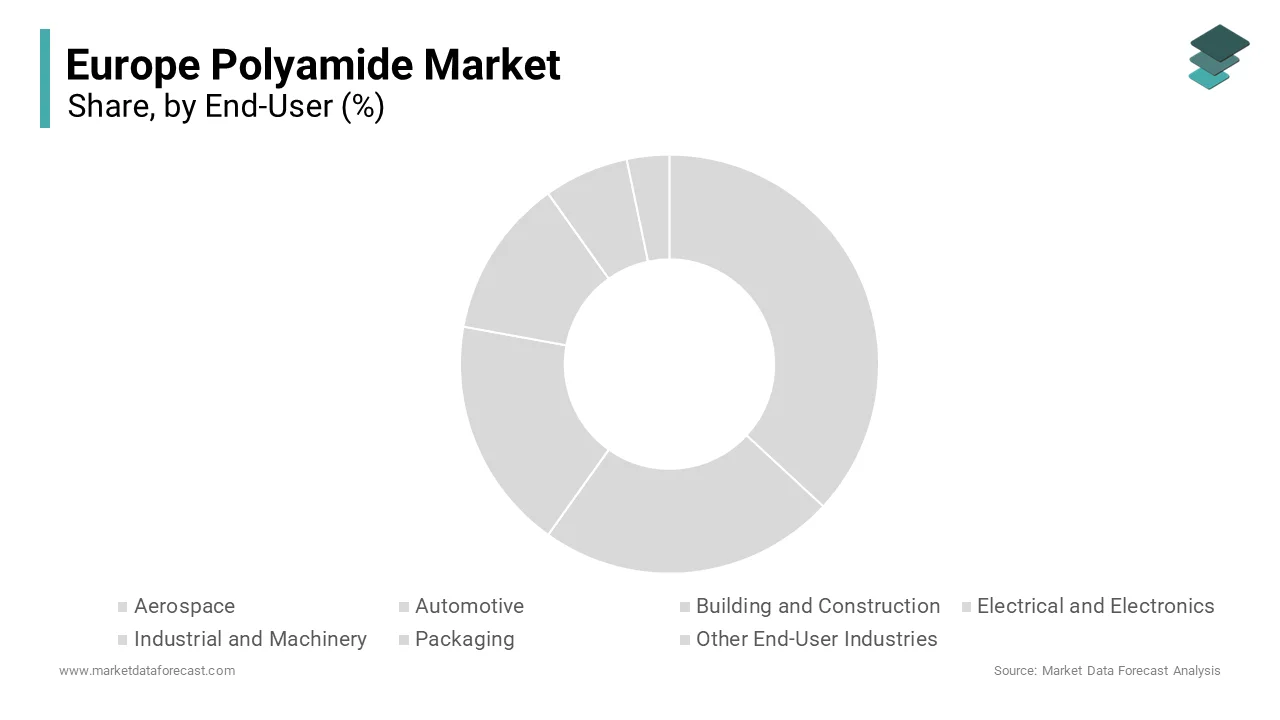
- By end-user industry, the automotive segment dominated the Europe polyamide market with a 38.4% share in 2025, driven by applications in under-the-hood components, structural parts, and interior systems.
- By sub-resin type, polyamide 6 (PA6) held the leading position, accounting for 49.5% of the Europe polyamide resin market share in 2025, due to its balanced strength, flexibility, and cost efficiency across multiple applications.
Country-Level Insights
- Germany emerged as the leading market, capturing 21.3% of the Europe polyamide market share in 2025, supported by its strong automotive and engineering plastics ecosystem.
- France followed with a 16.8% share, driven by diversified industrial and automotive demand.
- Italy’s market growth is primarily supported by industrial machinery, textile engineering, and agricultural equipment applications.
- The United Kingdom is witnessing growth due to its concentration of aerospace and defense manufacturing.
- Spain is expected to register steady expansion throughout the forecast period.
Competitive Landscape
The Europe polyamide market is moderately consolidated, with leading players focusing on capacity expansion, specialty resin development, and sustainable material solutions. Key companies operating in the market include Arkema, BASF, LANXESS, Celanese Corporation, DSM-Firmenich, Evonik Industries AG, Radici Partecipazioni SpA, Toray Industries Inc., and UBE Corporation.
Europe Polyamide Market Size
The Europe polyamide market size was valued at USD 1.32 million tons in 2025 and is anticipated to reach USD 1.37 million tons in 2026 and USD 1.81 million tons by 2034, growing at a CAGR of 3.58% from 2026 to 2034.
Introduction to the Europe Polyamide Market
Polyamides are commonly known as nylons represent a class of high performance thermoplastics characterized by exceptional mechanical strength thermal resilience and chemical resistance. In Europe, they serve as enablers across automotive electrical engineering consumer goods and industrial manufacturing sectors, where lightweight durability and dimensional stability are paramount. According to Eurostat, over 58% of Europe’s transport related carbon emissions originate from passenger vehicles prompting stringent lightweighting requirements under the European Commission’s Fit for 55 package. Polyamides have become indispensable in this context replacing metal components in engine systems and structural modules. Furthermore, the European Chemicals Agency classifies certain bio-based polyamides, as low concern substances under its 2023 substance evaluation program facilitating their adoption in sensitive applications. As per the report, approximately 43% of the EU’s industrial energy consumption is linked to material processing and conversion a metric driving demand for engineering plastics that reduce part count and assembly energy.
MARKET DRIVERS
Automotive Lightweighting Mandates Under EU Emissions Regulation
The most potent demand from binding automotive emissions targets that necessitate aggressive vehicle weight reduction is boosting the growth of Europe polyamide market. Under Regulation EU 2019, 631 the European Union requires new passenger cars to achieve an average fleet-wide CO2 emission of 95 grams per kilometer with a standard that effectively mandates a 12 to 15% reduction in vehicle mass compared to 2015 baselines. According to the European Automobile Manufacturers Association, each 10% reduction in vehicle weight yields a 6 to 8% improvement in fuel efficiency making lightweight polymers essential. Polyamides particularly glass filled variants, such as PA6 and PA66 are now standard in intake manifolds engine covers radiator end tanks and transmission components where they replace aluminum and steel. Similarly, Stellantis disclosed that its new electric vehicle platforms utilize over forty kilograms of polyamide per unit primarily in battery housings and connectors requiring high heat resistance and flame retardancy.
Expansion of Electrification Infrastructure Requiring High Performance Insulation
The continent-wide rollout of electrification infrastructure is another factor bolstering the growth of Europe polyamide market. As per the European Commission, many public and private electric vehicle charging points must be installed across the EU by 2025, under the Alternative Fuels Infrastructure Regulation. Each charging station requires connectors housings and circuit breakers capable of withstanding continuous high current loads elevated temperatures and arc resistance properties inherent to halogen free flame-retardant polyamides. Additionally, the EU’s Grid Expansion Acceleration Act of 2023 mandates the modernization of distribution networks to accommodate renewable integration necessitating new switchgear and transformer components that resist tracking and deformation. Siemens Energy verified in its 2024 materials specification guide that polyamide 66 with phosphinate based flame retardants is now the default insulating material in low voltage switchgear rated up to one thousand volts. Furthermore, the International Electrotechnical Commission’s updated IEC 60695 standard for glow wire ignition testing has effectively excluded many commodity plastics from electrical applications reinforcing polyamide dominance.
MARKET RESTRAINTS
Stringent Restrictions on Adipic Acid Emissions Under Industrial Emissions Directive
The regulatory curbs on nitrous oxide emissions generated during adipic acid synthesis, which is a key precursor for PA66. This factor is restricting the growth of Europe polyamide market. The Industrial Emissions Directive requires integrated pollution prevention and control for large combustion and chemical plants with strict limits on N2O a greenhouse gas 300 times more potent than CO2. In response, the EU mandated abatement technologies, such as thermal or catalytic decomposition leading to average compliance costs of 35 million euros per plant, as reported by the European Chemical Industry Council. BASF and Lanxess both idled portions of their PA66 precursor capacity in 2022 and 2023, respectively citing uneconomic retrofitting expenses. Consequently, Europe’s adipic acid output fell between 2020 and 2023, limiting domestic PA66 availability and increasing reliance on imported resins which face scrutiny under the EU’s Carbon Border Adjustment Mechanism.
Limited Scalability of Bio Based Polyamide Feedstock Infrastructure
Despite strong policy support for renewable polymers, the commercial scalability of bio-based polyamides remains hampered by fragmented and underdeveloped feedstock ecosystems. The limited scalability of bio-based polyamide feedstock infrastructure is also hampering the growth of Europe polyamide market. While polyamides, such as PA11 derived from castor oil and PA510 from sebacic acid offer reduced carbon footprints their raw material supply is geographically concentrated and agriculturally constrained. According to the European Commission castor cultivation is not permitted within EU territory due to invasiveness concerns forcing complete reliance on imports from India and Brazil. The International Trade Centre reported in 2023 that geopolitical disruptions and export restrictions in key producing regions caused castor oil prices to surge in a single year. Similarly, bio sebacic acid derived from sugar fermentation lacks dedicated European production facilities with only one pilot plant operational in the Netherlands as of 2024. This supply fragility discourages large scale adoption even among sustainability focused manufacturers like BMW and Schneider Electric, who require long term volume guarantees.
MARKET OPPORTUNITIES
Integration of Recycled Polyamide in Textile Circular Economy Frameworks
The EU Strategy for Sustainable and Circular Textiles has unlocked a high potential avenue for chemically recycled polyamide, particularly in apparel and technical fabrics. The integration of recycled polyamide in textile circular economy frameworks is significantly to boost the growth of the Europe polyamide market. As per the European Commission, over 5.8 million tons of textile waste are generated annually in the EU with synthetic fibers constituting 62% of that volume. The 2023 Eco Design for Sustainable Products Regulation mandates that by 2030 all textile products placed on the EU market must contain a minimum share of recycled content and be designed for disassembly. This directly benefits polyamide recycling technologies, such as depolymerization which can regenerate virgin equivalent PA6 from post-consumer fishing nets and carpet waste. Aquafil’s ECONYL regeneration system operating in Slovenia has already processed over 15000 tons of nylon waste annually converting it into filament yarn for brands like Gucci and IKEA. Similarly, the French government’s 2024 Extended Producer Responsibility scheme imposes escalating fees on virgin synthetic textiles incentivizing substitution with certified recycled polyamide. This regulatory and financial alignment positions chemically recycled polyamide as a cornerstone of Europe’s textile decarbonization roadmap.
Adoption of High Temperature Polyamides in Hydrogen Economy Applications
The emerging hydrogen infrastructure for high performance polyamides, such as PA46 and semi aromatic variants is greatly influencing the growth of Europe polyamide market. Hydrogen refueling stations compress gas to seven hundred bar requiring tubing seals and sensor housings that resist hydrogen embrittlement high pressure creep and thermal cycling. According to the European Clean Hydrogen Partnership, over 1000 hydrogen refueling stations must be operational across the EU by 2030 under the Hydrogen Backbone Initiative. DSM Engineering Materials confirmed in 2024 that its Stanyl ForTii PA46 meets SAE J2579 standards for hydrogen compatibility exhibiting zero permeation leakage over ten thousand pressure cycles. Similarly, BASF’s Ultramid Advanced N has been selected for bipolar plates in electrolyzers due to its conductivity stability and corrosion resistance in alkaline environments. Germany’s National Hydrogen Strategy allocated two point nine billion euros in 2023 for component standardization accelerating material qualification timelines.
MARKET CHALLENGES
Volatility in Caprolactam Pricing Driven by Energy Intensive Production
The persistent cost instability due to the energy intensive nature of caprolactam production is one of the major challenges for the growth of Europe polyamide market. According to the International Energy Agency, the average European caprolactam plant consumes 3.2 megawatt hours of electricity per metric ton of output making it acutely vulnerable to power price swings. During the 2022 energy crisis European electricity prices peaked at over three hundred euros per megawatt hour causing caprolactam production costs to surge, as verified by the European Chemical Industry Council. Although prices moderated in 2023 the structural dependency on natural gas for hydrogen and ammonia co feedstocks maintains exposure to geopolitical supply risks. In early 2024, unplanned outages at two major German crackers reduced regional caprolactam availability triggering allocation protocols among compounders. Unlike in Asia, where coal-based routes offer cost buffers Europe’s reliance on refinery integrated naphtha cracking leaves it uniquely susceptible to energy market turbulence.
Fragmented Regulatory Classification of Flame Retardant Additives
The technical and compliance from inconsistent regulatory treatment of brominated and halogen free flame retardants used in electrical grade polyamides is additionally to hamper the growth of Europe polyamide market. Although the EU Restriction of Hazardous Substances Directive permits certain brominated compounds in specific applications individual member states impose divergent restrictions. According to the European Chemicals Agency, Sweden and Germany classify decabromodiphenyl ether as a substance of very high concern while France permits its use in sealed electrical enclosures. Moreover, the European Commission’s 2023, proposal to restrict all brominated flame retardants under REACH if adopted would eliminate a key cost-effective solution for PA66 in circuit breakers and connectors. The transition to phosphinate or melamine-based alternatives requires extensive retesting under IEC 60695 and UL 94 standards delaying product approvals by 6 to 9 months.
REPORT COVERAGE
| REPORT METRIC | DETAILS |
| Market Size Available | 2025 to 2034 |
| Base Year | 2025 |
| Forecast Period | 2026 to 2034 |
| CAGR | 3.58% |
| Segments Covered | By End-user, Sub-Resin, and Country. |
| Various Analyses Covered | Global, Regional, and Country Analysis, Segment-Level Analysis, DROC, PESTLE Analysis, Porter’s Five Forces Analysis, Competitive Landscape, Analyst Overview of Investment Opportunities |
| Regions Covered | U.K., France, Germany, Spain, Italy, Sweden, Russia, Denmark, Switzerland, the Netherlands, Turkey, the Czech Republic, and the rest of Europe |
| Market Leaders Profiled | Arkema, Ascend Performance Materials, BASF, Celanese Corporation, Domo Chemicals, DSM-Firmenich, Evonik Industries AG, Grodno Azot, Grupa Azoty S.A., Koch IP Holdings, LLC, KuibyshevAzot, LANXESS, Radici Partecipazioni SpA, Toray Industries Inc., UBE Corporation |
SEGMENTAL ANALYSIS
By End User Industry Insights
The automotive industry segment held 38.4% of Europe polyamide market share in 2025. The EU’s legally binding CO2 fleet targets require passenger vehicles to average 95 grams of CO2 per kilometer by 2025 with a standard that necessitates extensive lightweighting. Polyamides, such as glass fiber reinforced PA6 and PA66 replace metal in engine covers intake manifolds transmission housings and under bonnet brackets reducing component weight by 30 to 50%, while maintaining thermal and mechanical integrity. The rapid electrification of mobility has intensified demand for high performance polymers in battery electric vehicles. Unlike internal combustion engines, electric drivetrains require polyamides with superior arc resistance and dimensional stability for battery modules connectors and DC/DC converters. As per the International Council on Clean Transportation, battery electric vehicles use more engineering plastics than conventional cars with polyamides constituting the largest share due to their flame-retardant grades meeting UL 94 V0 standards. This dual pressure of decarbonization and electrification ensures the automotive sector remains the undisputed anchor of Europe’s polyamide demand.
The electrical and electronics segment is projected to grow at a CAGR of 9.4% from 2026 to 2034 owing to the converging regulatory and infrastructural trends. The EU’s Ecodesign for Sustainable Products Regulation mandates that all electrical equipment placed after 2027 must incorporate a minimum of 25% recycled content and demonstrate reparability that favor high performance thermoplastics like polyamide which can be reprocessed without significant property loss. The continent-wide deployment of smart grid and electric vehicle charging infrastructure is creating unprecedented demand for components requiring high comparative tracking index and glow wire ignition resistance. According to the European Commission, over 2 million public EV charging points must be installed by 2025 with each connector system consuming approximately 180 grams of high heat polyamide. Germany’s Federal Network Agency verified that polyamide-based switchgear, now constitutes 82% of new low voltage distribution installations due to compliance with IEC 60947 standards. These dual drivers circularity mandates and infrastructure modernization are transforming the electrical segment from a stable niche into Europe’s most dynamic polyamide growth vector.
By Sub Resin Insights
The polyamide 6 segment was the largest by holding 49.5% of the Europe polyamide resin market share in 2025 with its balanced combination of processability mechanical robustness and cost efficiency across diverse applications. The extensive use in monofilament and multifilament yarns for technical textiles including tire cord airbags and seat belts is also gearing up the growth of segment. The European Tyre and Rubber Manufacturers’ Federation reported that in 2025, many passenger car tire cords in Europe utilized PA6 due to its superior adhesion to rubber and fatigue resistance under dynamic loading. According to the study, Europe’s caprolactam capacity stood at 1.8 million metric tons in 2025 with over 70% integrated into polyamide compounding. This vertical alignment reduces logistics complexity and ensures consistent feedstock availability even during adipic acid shortages that periodically disrupt PA66 output. Consequently, PA6 remains the default engineering nylon for mid performance applications where extreme heat resistance is not required.
The polyphthalamide segment is anticipated to witness a fastest CAGR of 12.7% throughout the forecast period with its unique ability to bridge the performance gap between standard polyamides and high cost thermoplastics like PEEK in demanding thermal environments. The adoption in electric vehicle power electronics, where operating temperatures routinely exceed 150 degrees Celsius. As per the source, PPA based connectors in 800 volt architectures exhibit 50% lower creep deformation than PA66 after one thousand hours at one hundred seventy degrees Celsius. The regulatory pressure to eliminate metal in fluid handling systems is also elevating the growth of Europe polyamide market. The European Food Safety Authority’s 2025 update to Regulation EC 1935/2004 now permits PPA for hot water and coolant lines in appliances due to its hydrolysis resistance and low extractables. Electrolux and Bosch have integrated PPA into dishwasher circulation pumps and washing machine valves.
COUNTRY LEVEL ANALYSIS
Germany Polyamide Market Analysis
Germany was the top performer of the Europe polyamide market by holding 21.3% of share in 2025. The market growth in this country is driven by its dense cluster of automotive OEMs tier one suppliers and chemical producers that form an integrated value chain. Volkswagen, BMW, and Mercedes Benz, collectively consume over several metric tons of polyamide annually for engine and electrification components, as confirmed by VDA’s 2025 material flow report. Simultaneously, Germany hosts major polyamide producers including BASF and Evonik, whose Ludwigshafen and Marl sites supply high performance grades. The Federal Ministry for Economic Affairs allocated 1.8 billion euros in 2025, under the High Tech Strategy 2025 to develop bio based and chemically recycled polyamides further cementing the nation’s R and D edge. Additionally, Germany’s stringent quality standards under DIN EN ISO norms ensure polyamide specifications are tightly aligned with functional safety requirements in automotive and electrical sectors.
France Polyamide Market Analysis
France polyamide market growth held 16.8% of share in 2025. Its distinct profile is shaped by strong state led industrial policy focused on electrification and circularity. ACC a joint venture between Stellantis TotalEnergies and Mercedes installed its Douvrin gigafactory in 2025 consuming over fifteen thousand metric tons of flame retardant PA66 annually. Simultaneously, France enforces the strictest extended producer responsibility rules in Europe under the AGEC Law, which mandates that by 2025 all plastic components in electronics must be marked for recyclability. Arkema’s Rilsan PA11 derived from castor oil has gained traction in electrical connectors due to its compatibility with mechanical recycling streams. According to ADEME, the French Environment and Energy Management Agency bio-based polyamides engineering plastic usage in French electronics a threefold increase since 2020. This policy driven convergence of electrification and bio circularity makes France a unique growth pole for advanced polyamide formulations.
Italy Polyamide Market Analysis
Italy polyamide market growth is likely to grow with the heavily oriented toward industrial machinery textile engineering and agricultural equipment rather than automotive. The Italian Mechanical Engineering Association, many of domestic polyamide consumption serves the production of gears bearings and conveyor components requiring high wear resistance and low friction. Companies like Biesse and Saccardo utilize self-lubricating PA6 grades in woodworking and packaging machinery exported, across Asia and North America.
The United Kingdom Polyamide Market Analysis
The United Kingdom polyamide market growth is likely to grow with a high concentration of aerospace and defense applications where specialty polyamides such as aramid and high temperature PPA are critical. The UK’s departure from the EU has intensified focus on sovereign supply chains leading to increased investment in domestic compounding. In 2025, Victrex and Solvay expanded their high temperature polymer blending facilities in Lancashire to support Tempest next generation fighter jet programs.
Spain Polyamide Market Analysis
Spain polyamide market growth is likely to grow steadily throughout the forecast period. Its polyamide demand is primarily driven by a dense network of automotive tier two and tier three suppliers producing cost optimized components for European and North African assembly plants. Companies like CIE Automotive and Gestamp utilize unfilled and short glass PA6 for fluid reservoirs cable ties and interior brackets, where mechanical performance requirements are moderate but price sensitivity is high. According to the Spanish Association of Automotive Suppliers, Spain’s polyamide consumption serves the automotive sector with annual volumes exceeding. The expansion of white goods manufacturing by firms, such as Fagor and Teka, which integrate PA6 into washing machine drums and dishwasher racks.
COMPETITIVE LANDSCAPE
The Europe polyamide market exhibits sophisticated competition driven by technical capability regulatory alignment and sustainability integration rather than pricing alone. Leading multinational chemical firms dominate through vertically integrated production formulation expertise and global application development centers. However, they face increasing pressure from specialty polymer innovators offering bio based or chemically recycled alternatives tailored to EU green mandates. Competition is further intensified by stringent regulatory frameworks such as REACH and the Ecodesign for Sustainable Products Regulation which raise barriers to entry and favor companies with robust compliance infrastructure. Differentiation occurs through performance under extreme conditions flame retardancy without halogens and certified circular content. Automotive and electrical sectors act as key battlegrounds where material approval cycles are long and switching costs high. The competitive landscape rewards deep technical collaboration lifecycle transparency and proactive regulatory engagement over broad product portfolios. Innovation in high temperature and hydrolysis resistant grades is becoming the new frontier as electrification and hydrogen infrastructure reshape end user requirements across the continent.
KEY MARKET PLAYERS
A Key playing role market players are in the Europe polyamide market are
- Arkema
- Ascend Performance Materials
- BASF
- Solvay SA
- Celanese Corporation
- Domo Chemicals
- DSM-Firmenich
- Evonik Industries AG
- Grodno Azot
- Grupa Azoty S.A.
- Koch IP Holdings, LLC
- KuibyshevAzot
- LANXESS
- Radici Partecipazioni SpA
- Toray Industries Inc.
- UBE Corporation
Top Players In The Market
- BASF SE is a global chemical leader with a commanding presence in the Europe polyamide market through its Ultramid portfolio of PA6 PA66 and specialty polyamides. The company supplies high performance engineering plastics to automotive electrical and industrial sectors across more than ninety countries. In 2023, BASF launched its Ultramid Ccycled line featuring chemically recycled content certified under ISCC Plus to meet EU circular economy mandates. The company also expanded its Verbund site in Ludwigshafen to increase production of halogen free flame-retardant grades for electric vehicle components. Its integration of digital twin technology for predictive quality control has enhanced consistency in high temperature polyamide batches.
- DSM Engineering Materials headquartered in the Netherlands is a key global innovator in high performance polyamides with strong penetration in Europe’s electrical automotive and consumer electronics markets. The company’s Akulon and Stanyl product lines are widely specified for their thermal stability chemical resistance and sustainability credentials. DSM introduced Akulon RePurposed a PA6 grade made from post-consumer fishing nets collected in partnership with coastal communities across Southern Europe.
- Solvay SA a Belgium based multinational is renowned for its advanced polyamide solutions including high temperature semi aromatic polyamides like Amodel and Ryton PPS. The company serves demanding aerospace automotive and energy applications across Europe and globally with a focus on extreme environment performance. The material has been adopted by major white goods manufacturers for dishwasher components requiring hydrolysis resistance. Solvay commissioned a new compounding line at its Bologna facility dedicated to flame retardant grades for 800 volt electric vehicle architectures. Its proactive engagement with REACH and EU green procurement policies ensures its formulations remain compliant and future proof.
Top Strategies Used by the Key Market Participants
Key players in the Europe polyamide market primarily focus on developing chemically and bio based recycled grades to comply with circular economy regulations expanding compounding capacity for electric vehicle applications and integrating digital quality systems to ensure batch consistency. They actively collaborate with OEMs and regulatory bodies to pre certify materials under evolving safety and environmental standards. Additionally, these companies invest in regional feedstock partnerships to secure renewable monomers and reduce reliance on volatile fossil based precursors. Their strategies consistently prioritize performance sustainability and supply chain resilience over price competition.
MARKET SEGMENTATION
This research report on the Europe polyamide market is segmented and sub-segmented into the following categories.
By End-user Industry
- Aerospace
- Automotive
- Building and Construction
- Electrical and Electronics
- Industrial and Machinery
- Packaging
- Other End-User Industries
By Sub-Resin Type
- Aramid
- Polyamide 6
- Polyamide 66
- Polyphthalamide
By Country
- UK
- France
- Spain
- Germany
- Italy
- Russia
- Sweden
- Denmark
- Switzerland
- Netherlands
- Turkey
- Czech Republic
- Rest of Europe