- Product Description Description
- Table of Contents TOC
- List of Table & Figure LOT
- Get Free Sample PDF Sample PDF
Market Size, 2025
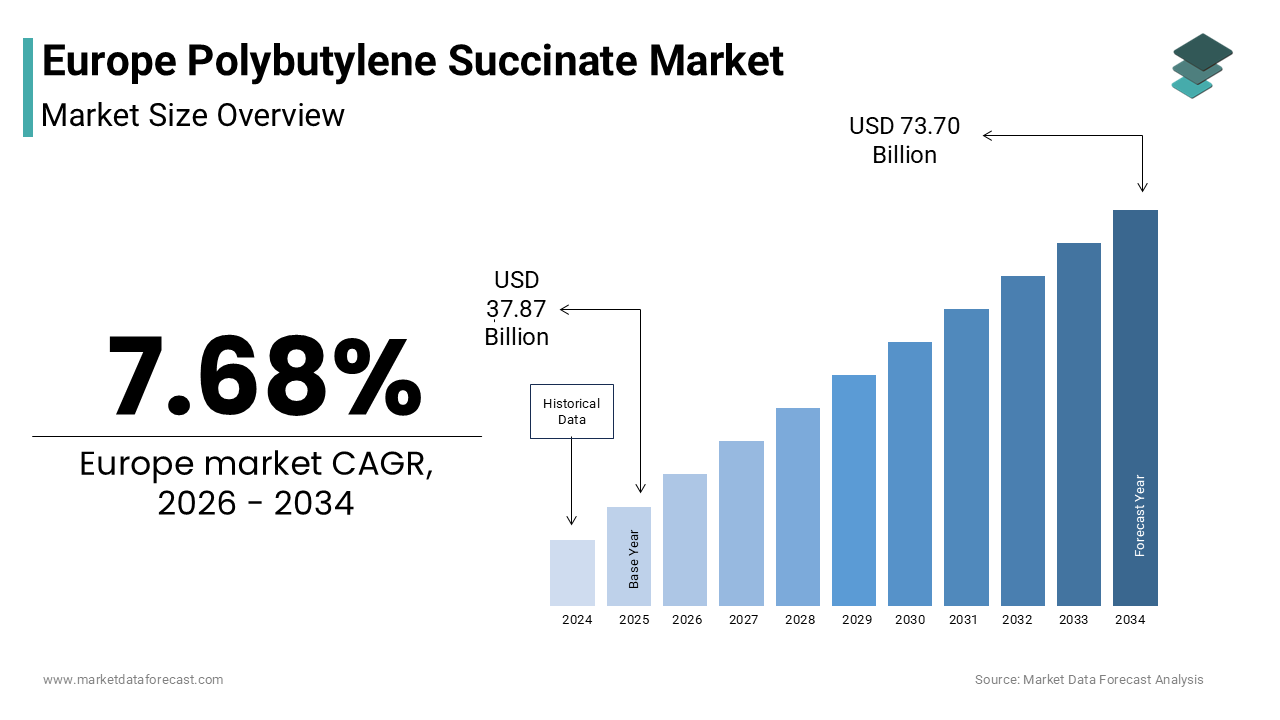
$37.87 BnMarket Estimate, 2026
$40.78 BnMarket Forecast, 2034
$73.70 BnCAGR, 2026–2034
7.68%Europe Polybutylene Succinate Market Report Summary
The Europe polybutylene succinate market was valued at USD 37.87 billion in 2025, is estimated to reach USD 40.78 billion in 2026, and is projected to reach USD 73.70 billion by 2034, growing at a CAGR of 7.68% during the forecast period from 2026 to 2034. The growth of the Europe polybutylene succinate market is driven by stringent regulatory measures targeting single-use plastics, increasing corporate sustainability commitments, and expanding innovation in biodegradable polymer chemistry. Rising demand for compostable packaging, agricultural biodegradable films, and consumer goods materials aligned with circular economy goals is further accelerating market adoption. Moreover, advancements in PBS blends, the development of bio-based monomers, and government support for biodegradable agricultural solutions are broadening the application scope across Europe.
Key Market Trends
-
Rising regulatory pressure from the EU Single-Use Plastics Directive and extended producer responsibility frameworks promoting compostable polymer adoption.
-
Increasing corporate sustainability pledges and packaging transformation initiatives among major consumer goods companies.
-
Growing integration of PBS in agricultural applications such as mulch films and plant pots to reduce soil plastic contamination.
-
Strong innovation momentum in PBS copolymers and polymer blends is improving thermal resistance, flexibility, and barrier performance.
-
Expansion of bio-based feedstock production and fermentation technologies supporting decarbonized PBS manufacturing.
Segmental Insights
-
Based on type, the conventional PBS segment held a significant share of the Europe polybutylene succinate market in 2024 due to established production infrastructure, cost advantages, and stable feedstock availability compared to bio-based alternatives.
-
Based on process, the trans-esterification segment was the largest contributor to the Europe polybutylene succinate market in 2024 owing to compatibility with existing polyester production lines and improved control over polymer characteristics.
-
Based on end-user products, the mulch film segment accounted for 36.3% of the Europe polybutylene succinate market share in 2024. The segment’s leadership is attributed to strict agricultural plastic regulations and growing adoption of soil-biodegradable films supported by subsidy programs across multiple European countries.
Regional Insights
The Europe polybutylene succinate market is witnessing steady growth across key countries supported by regulatory mandates, composting infrastructure expansion, and agricultural demand for biodegradable materials.
-
Germany was the largest contributor, accounting for 22.3% of the Europe polybutylene succinate market share in 2024, driven by its advanced chemical manufacturing ecosystem, strong composting capacity, and progressive packaging legislation.
-
France demonstrates robust growth supported by anti-waste laws, mandatory biowaste collection programs, and nationwide adoption of compostable packaging formats.
-
Italy is emerging as a high-growth market owing to extensive agricultural use of biodegradable films, financial incentives through eco-contribution schemes, and strong domestic biopolymer innovation.
-
The Netherlands plays a strategic role as a research and development hub with advanced waste management systems and bio-monomer production capabilities.
-
Spain is witnessing increasing adoption driven by agricultural demand, expanding composting infrastructure, and regional funding programs supporting biodegradable material deployment.
Competitive Landscape
The Europe polybutylene succinate market is characterized by participation from large chemical producers, specialized biopolymer innovators, and bio-based feedstock suppliers competing through sustainability performance, certification compliance, and application-focused innovation. Market players are prioritizing the development of certified compostable formulations, partnerships across agricultural and packaging ecosystems, and investments in renewable monomer supply chains to strengthen competitiveness. Collaboration with waste management stakeholders and participation in EU-funded research initiatives are further shaping the competitive environment. Prominent players in the Europe polybutylene succinate market include BASF SE, Succinity GmbH, Novamont S.p.A., Reverdia, TotalEnergies Corbion, and Biome Bioplastics Ltd.
 Download Free Sample Report
Europe Polybutylene Succinate Market Size
The Europe polybutylene succinate market size was valued at USD 37.87 billion in 2025 and is anticipated to reach USD 40.78 billion in 2026 from USD 73.70 billion by 2034, growing at a CAGR of 7.68% during the forecast period from 2026 to 2034.
The polybutylene succinate is the production and application of a biodegradable aliphatic polyester derived from renewable or fossil-based succinic acid and 1,4-butanediol, engineered for use in packaging agriculture consumer goods and biomedical sectors. PBS is valued for its compostability mechanical strength and thermal stability properties that align with the European Union’s circular economy and single-use plastics directives. Unlike conventional plastics, PBS degrades under industrial composting conditions within 90 to 180 days without releasing microplastics. Its adoption is driven by regulatory pressure corporate sustainability commitments and innovation in bio-based polymer chemistry. According to the European Environment Agency, over 25 million metric tons of plastic waste were generated in the EU in 2023 with less than 30% effectively recycled, intensifying demand for certified compostable alternatives. As per the European Bioplastics Association, more than 60% of new bio-based polymer pilot plants launched in Europe since 2022 include PBS or its copolymers such as PBSA. The emergence of green public procurement mandates evolving waste infrastructure and material science advances positions PBS, as a strategic enabler of Europe’s transition toward non-persistent plastic solutions.
MARKET DRIVERS
EU Single-Use Plastics Directive and Extended Producer Responsibility Mandates
The European Union’s regulatory framework, compelling brands and packaging producers to replace conventional plastics with certified compostable alternatives is majorly propelling the growth of Europe polybutylene succinate market. According to the European Commission Directive EU 2019, 904 bans specific single-use plastic items and mandates that food containers and cups placed on the market after 2025 must be made from at least 50% compostable materials in certain member states. Similarly, Italy’s CONAI system imposes lower eco-contributions for packaging made from certified biodegradable polymers, creating direct financial incentives. As per the European Environment Agency 14 EU countries now enforce mandatory separate collection of biowaste by 2024, expanding the infrastructure needed for PBS composting. These policies transform PBS from a niche material into a compliance necessity for food service packaging agricultural films and retail bags, driving consistent industrial demand across Western and Southern Europe.
Corporate Net Zero Commitments and Sustainable Packaging Pledges
Leading European consumer goods companies are accelerating PBS adoption through voluntary sustainability initiatives aligned with Science Based Targets and the European Green Deal. The corporate net zero commitments and sustainable packaging pledges is additionally elevating the growth of Europe polybutylene succinate market. According to the Ellen MacArthur Foundation, over 70% of major EU food and beverage brands, including Nestle, Unilever and Danone have committed to 100% reusable or compostable packaging by 2025. PBS is increasingly selected for fresh produce trays compostable coffee capsules and biodegradable mulch films due to its balance of rigidity heat resistance and end-of-life compatibility. Carrefour launched PBS-based fruit containers across its French stores achieving full industrial compostability certification. Similarly, Syngenta adopted PBS mulch films in its European vegetable seed operations reducing plastic residue in farmland. This private sector momentum complements regulatory drivers creating a dual engine of market expansion beyond legislative minimums.
MARKET RESTRAINTS
Limited Industrial Composting Infrastructure Across Member States
The effective end-of-life management of polybutylene succinate remains constrained by inadequate composting capacity is impeding the growth of Europe polybutylene succinate market. According to the study, only 12 member states operate sufficient industrial composting facilities to process certified compostable plastics at scale, with Eastern and Southern Europe particularly underserved. Germany and the Netherlands lead with over 300 facilities each, but countries like Greece, Romania, and Bulgaria, have fewer than 15 combined. As per Eurostat, only 18% of municipal biowaste in the EU was treated in certified composting plants in 2023, meaning most PBS products end up in landfills or incinerators where their biodegradability offers no advantage. This infrastructure gap undermines the environmental value proposition and discourages brand investment. Additionally inconsistent labeling and consumer confusion about “compostable” versus “biodegradable” lead to contamination of recycling streams, prompting some municipalities to ban all bioplastics from organic waste bins.
High Production Costs and Feedstock Price Volatility
The polybutylene succinate remains significantly more expensive than conventional polyolefins, with prices ranging from 3.50 to 5.00 euros per kilogram compared to 1.20 euros for polyethylene. This factor is also one of the factors hampering the growth of Europe polybutylene succinate market. According to the European Chemical Industry Council, PBS production costs are heavily influenced by succinic acid pricing, which fluctuated by 28% in 2023 due to energy-intensive fermentation processes and competition for bio-based feedstocks like glucose. Most commercial PBS still relies on fossil-derived 1,4-butanediol, subject to petrochemical market swings. Although bio-succinic acid capacity is expanding companies like Reverdia and Succinity operate pilot plants in the Netherlands and Germany scale remains limited. As per the nova-Institute, European PBS output in 2023 used fully bio-based monomers due to cost and supply constraints.
MARKET OPPORTUNITIES
Integration into Agricultural and Horticultural Applications
The agricultural sector presents a high-impact opportunity for polybutylene succinate through biodegradable mulch films plant pots and seedling trays that eliminate post-harvest plastic recovery. The integration into agricultural and horticultural applications is creating new opportunities for the growth of Europe polybutylene succinate market. According to the European Commission, over 75,000 tons of conventional plastic mulch are used annually in EU agriculture, with less than 30% recovered due to soil contamination. The EU’s Farm to Fork Strategy explicitly encourages biodegradable alternatives under controlled conditions. In 2024, BASF and Novamont launched PBS-based mulch films in Spain and Italy that degrade in soil within 12 months without toxic residues, validated by the Italian Institute for Agricultural Biology. France’s Ecophyto Plan provides subsidies covering 40% of the cost difference between conventional and certified biodegradable films. This application avoids composting infrastructure limitations by enabling in-field degradation, unlocking scalable rural adoption.
Development of PBS Blends and Copolymers for Enhanced Performance
Innovation in polymer blending is expanding polybutylene succinate’s utility into demanding applications like flexible packaging hot-fill containers and 3D printing filaments. The development of PBS blends and copolymers for enhanced performance is substantially to leverage new opportunities for the growth of Europe polybutylene succinate market. Researchers across Europe are combining PBS with polylactic acid starch or polybutylene adipate terephthalate to improve barrier properties flexibility and processability. Similarly, Covestro and RWTH Aachen University created a PBS-TPU copolymer for durable compostable cutlery that withstands 90°C temperatures.
MARKET CHALLENGES
Lack of Harmonized Standards and Certification Confusion
The absence of unified EU-wide standards for biodegradability claims, fragmentation and consumer mistrust is one of the challenges for the growth of Europe polybutylene succinate market. While EN 13432 governs industrial compostability, national schemes like Germany’s DIN-Geprüft and Belgium’s Vinçotte OK Compost use varying test durations and disintegration thresholds. According to the European Consumer Organisation, 62% of Europeans cannot distinguish between “home compostable” “industrial compostable” and “oxo-degradable” labels, leading to improper disposal. Some countries like Austria restrict the use of the term “biodegradable” altogether to prevent greenwashing. Additionally, the EU’s upcoming Ecodesign for Sustainable Products Regulation will require digital product passports detailing end-of-life pathways with a complex requirement for multi-layer PBS packaging. As per the European Committee for Standardization, efforts to harmonize soil biodegradation testing for agricultural films remain stalled due to scientific disagreements over degradation metrics.
Competition from Established and Emerging Biopolymers
The intense competition from both mature biopolymers like polylactic acid and next-generation alternatives such as polyhydroxyalkanoates, which offer superior properties or lower costs, which is additionally to inhibit the growth of Europe polybutylene succinate market. According to the European Bioplastics Association, PLA accounted for 45% of the EU bioplastics market in 2023 due to its rigidity clarity and established production scale, while PHA though nascent is gaining traction for marine biodegradability. PBS’s slower crystallization rate and higher moisture sensitivity make it less suitable for high-speed thermoforming than PLA. Meanwhile, PHA producers like RWDC Industries are scaling European production with backing from the European Investment Bank, targeting single-use applications with faster degradation profiles. Without significant performance differentiation or cost reduction PBS risks becoming a niche player despite its balanced property profile. Strategic partnerships and application-specific innovation are essential to carve out defensible market segments against these converging alternatives.
REPORT COVERAGE
| REPORT METRIC | DETAILS |
| Market Size Available | 2025 to 2034 |
| Base Year | 2025 |
| Forecast Period | 2026 to 2034 |
| CAGR | 7.68% |
| Segments Covered | By Type, Process, End-User, End User Products, Manufacturing Process and Region |
| Various Analyses Covered | Regional & Country Level Analysis, Segment-Level Analysis, DROC, PESTLE Analysis, Porter’s Five Forces Analysis, Competitive Landscape, Analyst Overview on Investment Opportunities |
| Countries Covered | UK, France, Spain, Germany, Italy, Russia, Sweden, Denmark, Switzerland, the Netherlands, Turkey, the Czech Republic, and the Rest of Europe. |
| Market Leaders Profiled | BASF SE, Succinity GmbH, Novamont S.p.A., Reverdia, TotalEnergies Corbion, and Biome Bioplastics Ltd. |
SEGMENTAL ANALYSIS
By Type Insights
The conventional segment was accounted in holding a significant share of the Europe PBS market in 2024 due to established production infrastructure lower costs and consistent supply compared to bio-based alternatives. According to the European Chemical Industry Council, current PBS capacity in Europe relies on petrochemical-derived succinic acid and 1,4-butanediol sourced from integrated crackers in Germany and Belgium. These facilities benefit from economies of scale and stable feedstock pipelines that bio-based routes have yet to match. The nova-Institute reports that conventional PBS costs 30 to 40% less than fully bio-based variants, making it the default choice for price-sensitive applications like agricultural films and basic packaging. Additionally, performance consistency is higher in fossil-based grades due to uniform monomer purity, a factor for industrial converters using high-speed extrusion lines. As per the European Bioplastics Association, most commercial PBS products, even those marketed as “biodegradable” still use conventional chemistry because certification standards like EN 13432 focus on end-of-life behavior rather than feedstock origin.
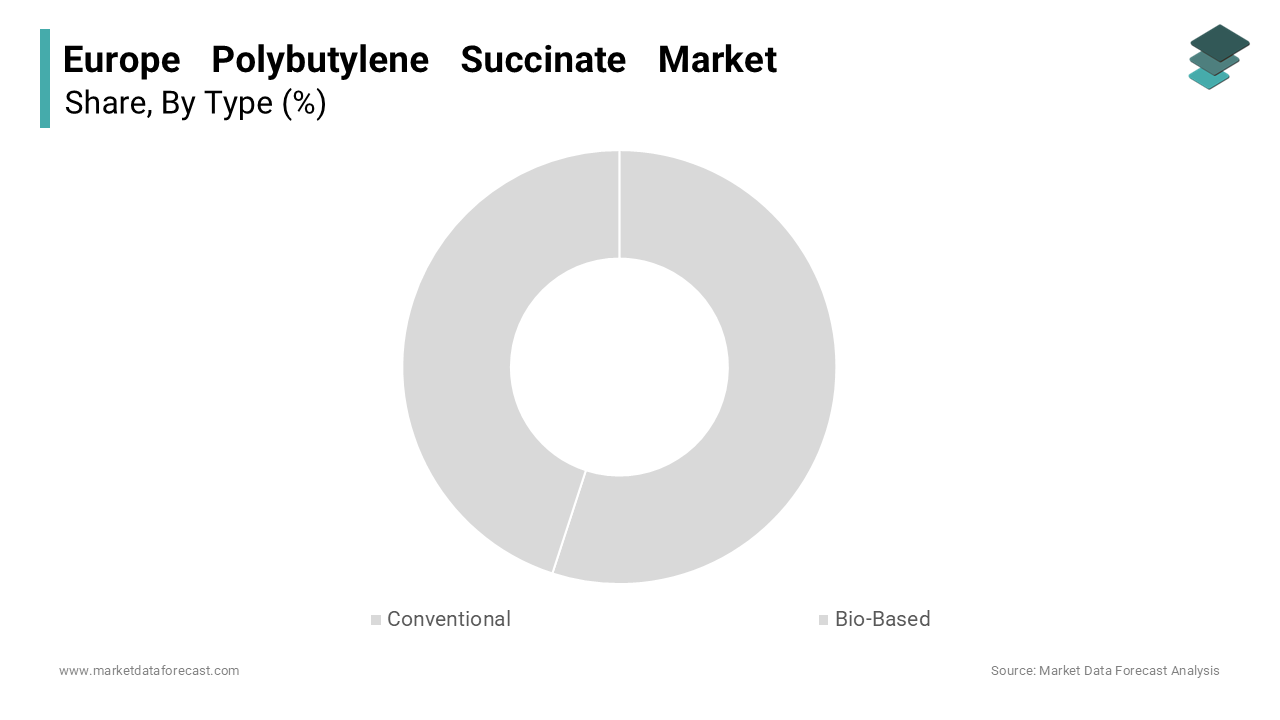
The bio-based segment is projected to expand at a CAGR of 18.4% throughout the forecast period with the corporate net zero commitments EU Green Public Procurement criteria and advancing fermentation technology for renewable succinic acid. According to the European Commission’s Circular Economy Action Plan, public tenders for packaging and disposable items now require minimum bio-based content thresholds, with France and Italy mandating 30% by 2025. Companies like Reverdia with a joint venture between DSM and Roquette operate demonstration plants in the Netherlands producing bio-succinic acid from glucose with a 40% lower carbon footprint than fossil routes as verified by TUV Rheinland. Additionally, the scale bio-monomer production under its Bio-Based Industries Joint Undertaking. As per the nova-Institute pilot-scale, bio-PBS achieved price parity within 15% of conventional grades in 2024, narrowing the adoption gap. This emergence of policy innovation and cost reduction positions bio-based PBS as the strategic growth vector for a decarbonized plastics future.
By Process Insights
The trans-esterification segment was the largest by capturing a significant share of the Europe polybutylene succinate market in 2024 due to its compatibility with existing polyester production infrastructure and superior control over molecular weight distribution. According to the European Polymer Federation, this method using dimethyl succinate and 1,4-butanediol enables precise tuning of PBS viscosity and crystallinity critical for film and fiber applications. Major chemical producers like BASF and INEOS operate repurposed PET lines in Germany and Belgium that efficiently produce PBS via trans-esterification without major capital investment. The Fraunhofer Institute for Environmental Safety and Energy Technology notes that this route yields polymers with lower residual monomer content (<0.5%) compared to direct esterification by enhancing biodegradation consistency under EN 13432 testing. Additionally, the process operates at lower temperatures (180–220°C) reducing energy consumption by alternative methods.
The direct esterification segment is likely to grow at a fastest CAGR of 15.2% throughout the forecast period. This method reacting succinic acid directly with 1,4-butanediol eliminates methanol byproduct generation and aligns with green chemistry principles favored under the EU Chemicals Strategy for Sustainability. According to the European Institute of Innovation and Technology, pilot plants using direct esterification reduced solvent use by 90% and cut water consumption by 60% compared to trans-esterification. Startups like Succinity in Germany and BioAmber (now part of GC Innovation America) have optimized catalyst systems that achieve high conversion rates at atmospheric pressure lowering capital intensity. The European Patent Office recorded a 35% annual increase in direct esterification patents between 2022 and 2024 reflecting strong R&D momentum. Furthermore, this route is better suited for integrating bio-based succinic acid from fermentation broth without purification steps. These environmental and efficiency advantages position it as the next-generation process for scalable sustainable PBS production.
By End User Products Insights
The mulch film segment was accounted in holding 36.3% of the Europe polybutylene succinate market share in 2024 with the stringent agricultural plastic regulations and the urgent need to eliminate soil contamination from conventional polyethylene films. According to the European Commission, over 75,000 metric tons of plastic mulch are used annually in EU agriculture with recovery rates below 30% due to soil adhesion and fragmentation. The EU’s Farm to Fork Strategy explicitly promotes certified biodegradable alternatives that degrade in soil without leaving microplastics. Countries like France, Italy, and Spain lead adoption, France’s Ecophyto III plan provides subsidies covering up to 40% of the cost difference for EN 17033 certified films. The Italian Institute for Agricultural Biology validated that PBS-based mulch films fully biodegrade within 12 months under Mediterranean conditions without phytotoxicity. This regulatory-enforced transition from persistent to functional biodegradability ensures mulch film remains the cornerstone application for PBS in Europe.
The coffee capsules segment is expected to grow at a fastest CAGR of 21.3% throughout the forecast period owing to the consumer backlash against aluminum and polypropylene capsules and brand commitments to compostable single-serve formats. According to the European Coffee Federation, over 18 billion coffee capsules were consumed in the EU in 2023 with compostable options growing at triple the rate of conventional types. PBS is uniquely suited for this application due to its heat resistance (withstanding 90°C brewing), rigidity for machine compatibility, and full industrial compostability under EN 13432. Nestle expanded its compostable Nespresso line across Germany and France using PBS blends developed with NatureWorks. Similarly, Lavazza launched PBS-based capsules certified by TUV Austria for OK Compost INDUSTRIAL.
REGIONAL ANALYSIS
Germany Polybutylene Succinate Market Analysis
Germany was the largest contributor of the Europe polybutylene succinate market by holding 22.3% of share in 2024 with its advanced chemical industry robust composting infrastructure and strict packaging regulations. According to the German Environment Agency, over 300 industrial composting facilities operate nationwide enabling effective end-of-life management for PBS products. The country hosts major polymer producers like BASF and Covestro, which have developed PBS formulations for packaging and agricultural films. The German Packaging Act mandates that all single-use food containers be compostable by 2025, a rule accelerating PBS adoption in catering and retail. Additionally, the Federal Ministry of Food and Agriculture funds field trials for biodegradable mulch films with PBS showing 98% degradation in 12 months. As per the nova-Institute, Germany accounts for 40% of EU PBS pilot plant capacity focused on bio-based monomers. This combination of industrial capability regulatory leadership and waste infrastructure solidifies Germany’s position as the regional innovation and adoption hub.
France Polybutylene Succinate Market Analysis
France polybutylene succinate market growth is likely to grow with the aggressive anti-waste legislation strong agricultural demand and centralized composting mandates. According to ADEME, France’s ecological agency over 120 certified composting sites accept bioplastics under the mandatory separate biowaste collection law enacted in 2024. The Anti-Waste Law for a Circular Economy bans non-compostable disposable tableware and requires all fruit and vegetable trays in supermarkets to be industrially compostable by 2025, directly benefiting PBS. Companies like Carrefour and Sodexo have rolled out PBS-based food service items across national operations.
Italy Polybutylene Succinate Market Analysis
Italy polybutylene succinate market growth is driven by its large agricultural sector progressive regional bioplastic policies and in compostable packaging innovation. According to ISPRA, Italy’s environmental protection agency over 80 industrial composters accept certified bioplastics with Lombardy and Emilia-Romagna leading collection rates. The CONAI system imposes lower eco-contributions for packaging made from EN 13432 certified materials creating direct financial incentives for PBS use. Italy is Europe’s largest user of agricultural mulch films with over 25,000 tons deployed annually, now transitioning to PBS under the National Recovery and Resilience Plan. Leading companies like Novamont and FaterSMART have developed PBS-based hygiene products and mulch films validated by the Italian Institute for Agricultural Biology. This blend of rural necessity urban policy and industrial expertise ensures Italy remains a high-growth market for functional biodegradable applications.
Netherlands Polybutylene Succinate Market Analysis
The Netherlands polybutylene succinate market growth is driven by its role as a bioplastics R&D hub circular economy and port logistics advantage. According to the Dutch Ministry of Infrastructure and Water Management, the country recycles or composts 65% of its municipal waste with dedicated streams for certified bioplastics. The Netherlands hosts key bio-monomer producers like Corbion and Avantium, which supply succinic acid and butanediol for PBS synthesis. Companies like Danone and Unilever, use Dutch-developed PBS for yogurt cups and detergent pods distributed across Europe.
Spain Polybutylene Succinate Market Analysis
Spain polybutylene succinate market growth is likely to be propelled with its extensive agricultural sector rising composting capacity and EU-funded sustainability transitions. According to the Spanish Ministry for Ecological Transition, over 50 industrial composting plants now accept certified biodegradable plastics following the 2023 Royal Decree on Packaging. The country is Europe’s second-largest user of agricultural mulch films after Italy with over 20,000 tons applied annually in horticulture, increasingly shifting to PBS under the National Circular Economy Strategy. Regions like Andalusia and Murcia offer grants covering 30% of the cost for biodegradable films to combat plastic pollution in sensitive ecosystems. Leading retailers, such as Mercadona have introduced PBS-based produce trays in southern distribution centers.
COMPETITIVE LANDSCAPE
The Europe polybutylene succinate market features a mix of large chemical conglomerates specialized biopolymer producers and upstream bio-monomer suppliers competing on sustainability performance and application expertise. Competition is less about price and more about certification compliance end-of-life validation and tailored solutions for agriculture packaging and consumer goods. The market remains niche but highly strategic with barriers including high production costs limited composting infrastructure and competition from PLA and PHA. Differentiation hinges on proving real-world biodegradability in soil or compost without microplastic residue. Regulatory tailwinds from the EU Green Deal and national anti-waste laws create opportunities but require significant investment in R&D and ecosystem collaboration.
KEY MARKET PLAYERS
Some of the companies that are playing a dominating role in the Europe polybutylene succinate market include
- BASF SE
- Succinity GmbH
- Novamont S.p.A.
- Reverdia
- TotalEnergies Corbion
- Biome Bioplastics Ltd.
Top Players in the Market
BASF SE
BASF SE is a pivotal player in the Europe polybutylene succinate market through its ecoflex and ecovio biopolymer portfolios, which include PBS and PBSA copolymers tailored for packaging agricultural films and compostable consumer goods. The company leverages its integrated Verbund chemical production network in Ludwigshafen Germany to ensure stable supply of succinic acid and 1,4-butanediol monomers. BASF actively collaborates with European composting associations and certification bodies to validate end-of-life performance under EN 13432 and OK Compost standards. In recent years it expanded its PBS offerings for coffee capsules and mulch films in partnership with major food and agricultural brands. Its ChemCycling program also explores chemical recycling pathways for mixed bioplastic waste enhancing circularity. These initiatives position BASF as a science-driven enabler of Europe’s transition to functional biodegradable plastics.
Novamont S.p.A.
Novamont is an Italy based pioneer in biodegradable polymers with a strong presence in the European PBS market through its proprietary Mater-Bi technology, which incorporates PBS into high performance blends for agriculture packaging and hygiene applications. The company operates fully integrated biorefineries in Italy using renewable feedstocks and holds over 1,600 patents in biopolymer formulation. Novamont works closely with Italian and EU policymakers to shape standards for soil biodegradability and compostability. Recently, it launched PBS-based mulch films certified under EN 17033 and partnered with Lavazza on compostable coffee capsules distributed across Southern Europe.
Corbion N.V.
Corbion is a Netherlands headquartered global leader in lactic acid and bio-based building blocks that supplies high purity bio-succinic acid for PBS production across Europe. While not a direct PBS producer Corbion enables the bio-based segment by providing renewable monomers to polymer manufacturers seeking to reduce fossil carbon content. The company operates a state of the art fermentation facility in Thailand with European distribution hubs in the Netherlands and Germany ensuring reliable supply. Corbion actively participates in EU-funded consortia like Circular Bio-based Europe to develop next generation PBS from non-food biomass. It launched a traceable bio-succinic acid grade certified under ISCC PLUS supporting brand claims for circularity.
Top Strategies Used by the Key Market Participants
Key players in the Europe polybutylene succinate market focus on developing certified compostable and soil biodegradable formulations that meet EN 13432 EN 17033 and OK Compost standards to align with EU regulatory mandates. They invest in bio-based monomer production and partnerships to reduce reliance on fossil feedstocks and enhance carbon footprint credentials. Companies collaborate with agricultural cooperatives food brands and waste management authorities to create closed loop ecosystems for PBS products. Strategic participation in EU-funded research programs accelerates innovation in PBS blends copolymers and processing technologies. Additionally, firms engage in policy advocacy and standardization efforts to harmonize biodegradability claims and expand industrial composting infrastructure across member states.
MARKET SEGMENTATION
This research report on the Europe Polybutylene Succinate Market has been segmented and sub-segmented based on the following categories.
By Type
- Conventional
- Bio-Based
By Process
- Trans-Esterification
- Direct Esterification
By End User
- Packaging
- Agriculture
- Textile
- Consumer Goods
- Electronics & Electrical
- Automotive
- Others
By End User Products
- Mulch Film
- Packaging Film
- Bags
- Flushable Hygiene Products
- Fishing Nets
- Coffee Capsules
- Wood Plastic Composites
By Manufacturing Process
- Extrusion
- Injection Molding
- Blow Molding
- Thermoforming
- Film Blowing
- Fiber Spinning
By Country
- UK
- France
- Spain
- Germany
- Italy
- Russia
- Sweden
- Denmark
- Switzerland
- Netherlands
- Turkey
- Czech Republic
- Rest of Europe