- Product Description Description
- Table of Contents TOC
- List of Table & Figure LOT
- Get Free Sample PDF Sample PDF
Market Size, 2025
$4.37 MnMarket Estimate, 2026
$4.46 MnMarket Forecast, 2034
$5.25 MnCAGR, 2026–2034
2.07%Europe Polycarbonate Market Report Summary
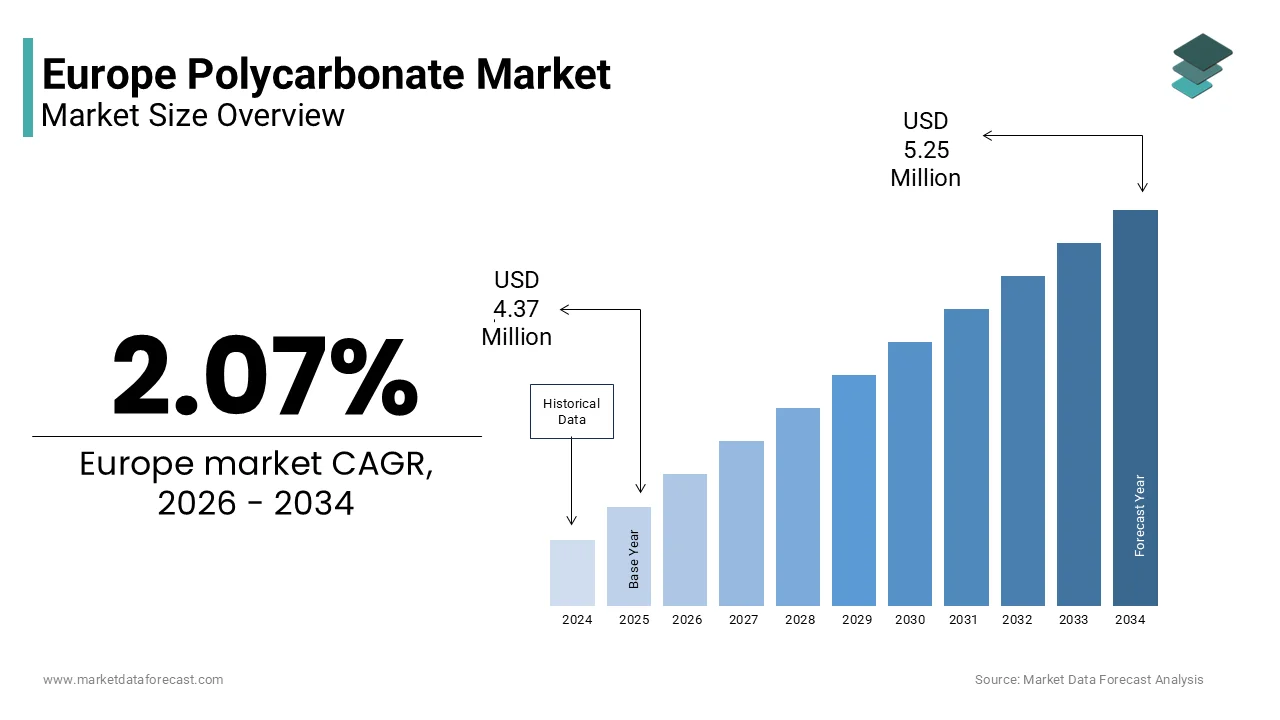
The Europe polycarbonate market was valued at USD 4.37 million in 2025, is estimated to reach USD 4.46 million in 2026, and is projected to reach USD 5.25 million by 2034, growing at a CAGR of 2.07% during the forecast period. Market growth is supported by steady demand from building and construction, automotive, and electrical applications, along with the material’s high impact resistance, transparency, and lightweight properties. Increasing use of polycarbonate as an alternative to glass and metal in construction and industrial applications, combined with rising focus on durable and energy efficient materials, is contributing to sustained market expansion across Europe.
Key Market Trends
-
Rising adoption of polycarbonate sheets in roofing, glazing, and facade applications due to strength and light transmission benefits.
-
Growing demand from the construction sector driven by renovation activities and infrastructure upgrades across Europe.
-
Increased preference for lightweight and high performance plastics in industrial and electrical applications.
-
Gradual shift toward recyclable and sustainable polycarbonate materials aligned with European environmental regulations.
-
Stable demand from automotive and consumer goods sectors supporting baseline market growth.
Segmental Insights
- Based on product form, the sheets segment dominated the Europe polycarbonate market by accounting for 44.9% of the regional market share in 2025. The segment’s leadership is attributed to widespread use of polycarbonate sheets in construction, signage, greenhouses, and protective glazing applications.
- By end user industry, the building and construction segment held a 28.4% share of the market in 2025. Growth in this segment is driven by demand for impact resistant, weather durable, and energy efficient materials in residential and commercial buildings.
Regional Insights
- Germany led the Europe polycarbonate market by holding 22.8% of the regional market share in 2025. The country’s dominance is supported by a strong manufacturing base, advanced construction sector, and high adoption of engineering plastics in industrial applications.
- Other Western European countries continue to contribute steadily, supported by infrastructure maintenance and industrial demand.
Competitive Landscape
The Europe polycarbonate market is moderately competitive, with key players focusing on material innovation, sustainability initiatives, and expanding application areas. Companies are emphasizing high quality grades, improved recyclability, and long term supply partnerships with construction and industrial customers. Prominent players operating in the market include Covestro AG, SABIC, LOTTE Chemical Corporation, Teijin Limited, Trinseo PLC, Idemitsu Kosan Co. Ltd., LG Chem Ltd., RTP Company Inc., CHIMEI Corporation, and Lone Star Chemical.
Europe Polycarbonate Market Size
The Europe polycarbonate market size was valued at USD 4.37 million in 2025 and is projected to reach USD 5.25 million by 2034 from USD 4.46 million in 2026, growing at a CAGR of 2.07%.
Polycarbonate are high performance thermoplastic polymers derived primarily from bisphenol A and phosgene or diphenyl carbonate. Known for exceptional impact resistance optical clarity and thermal stability polycarbonate is integral to sectors ranging from automotive glazing and electronic enclosures to medical devices and construction glazing. Unlike commodity plastics polycarbonate serves specialized engineering functions where safety durability and transparency are non-negotiable. According to the European Chemicals Agency, over 700,000 metric tons of polycarbonate were placed on the EU market in 2023 for conversion into finished goods. As per Eurostat, the EU construction sector consumed 18% of total engineering plastics output in 2024, with polycarbonate sheets increasingly replacing glass in skylights and sound barriers due to weight and safety advantages. Additionally, according to the European Environment Agency, over 45% of new electric vehicles registered in the EU in 2023 featured polycarbonate-based headlamp lenses and interior displays. These applications underscore polycarbonate’s role, not as a bulk material, but as a mission critical enabler of modern design, safety, and digital integration across Europe’s industrial and consumer landscape.
MARKET DRIVERS
Stringent Automotive Safety and Lightweighting Regulations Drive Material Substitution
European vehicle safety and emissions standards have made polycarbonate indispensable in automotive design, due to its dual ability to reduce weight and enhance occupant protection, which is significantly driving the growth of the Europe polycarbonate market. According to the European Commission Regulation EC No 661/2009, all new vehicle lighting systems must use impact resistant transparent materials that maintain optical performance under thermal stress, which is a requirement polycarbonate meets with superior margin. Furthermore, the EU’s CO₂ fleet targets mandate an average of 95 grams per kilometre by 2025, pushing manufacturers to adopt lightweight polymers. As per a 2024 study by the European Automobile Manufacturers Association, substituting glass with polycarbonate in panoramic roofs and glazing reduces vehicle mass by up to 50% per component. This weight saving translates directly into extended electric vehicle range; Volkswagen confirmed that its ID series gains 8 to 12 kilometres of range per 100 kilograms saved. Polycarbonate’s moldability also enables complex integrated designs, such as seamless sensor housings for ADAS cameras, which are now mandatory under the EU General Safety Regulation effective 2024. These regulatory and functional synergies ensure sustained demand beyond cyclical auto production trends.
Expansion of Energy Efficient Building Glazing Mandates Boosts Construction Applications
Europe’s building decarbonization agenda has catalysed adoption of polycarbonate in architectural glazing, through energy performance requirements, which is further boosting the expansion of the Europe polycarbonate market. As per the revised Energy Performance of Buildings Directive, EU member states must ensure all new buildings are nearly zero energy by 2030. Polycarbonate multiwall sheets offer thermal insulation values as low as 1.0 W per square meter per kelvin but at half the weight and with superior impact resistance. According to the European Construction Institute, over 35% of commercial skylight and façade projects in Germany, the Netherlands, and Sweden used polycarbonate panels in 2024, due to these advantages. Additionally, noise abatement regulations near airports and highways have increased demand for polycarbonate sound barriers as France’s Ministry of Ecological Transition documented a 28% rise in highway noise wall installations using polycarbonate between 2022 and 2024. The material’s UV stabilized grades also maintain light transmission above 88% over 10 years, per independent testing by the Fraunhofer Institute, making it ideal for daylighting strategies that reduce artificial lighting loads. This alignment with EU building sustainability goals transforms polycarbonate from a niche alternative into a mainstream specification.
MARKET RESTRAINTS
Regulatory Scrutiny Over Bisphenol A Impacts Consumer and Medical Applications
Concerns regarding bisphenol A, a key precursor in conventional polycarbonate production, have constrained its use in sensitive applications across Europe, which is impeding the Europe polycarbonate market growth. According to the European Food Safety Authority, the tolerable daily intake for BPA was reduced to 0.2 nanograms per kilogram of body weight in 2023, following endocrine disruption evidence. This has led to de facto bans in baby bottles, sippy cups, and food storage containers, as mandated under EU Regulation 10/2011. Consequently, the European Medical Devices Regulation now requires rigorous leaching assessments for any BPA containing polymer in prolonged contact with patients. As per a 2024 survey by the European Coordination Committee of the Radiological, Electromedical, and Healthcare Industries, 62% of hospitals in Germany and France have shifted to BPA free alternatives, like polysulfone or cyclic olefin copolymer, for IV connectors and dialysis cartridges. While BPA free polycarbonate grades exist, they carry a 20 to 30% cost premium, as noted by Plastics Europe, and face performance trade-offs in clarity and heat resistance. This regulatory headwind limits market expansion in high growth healthcare and food contact segments, despite polycarbonate’s mechanical advantages.
Volatility in Feedstock Pricing and Reliance on Fossil Based Inputs Constrains Cost Stability
Polycarbonate production in Europe remains heavily dependent on fossil derived feedstocks, primarily bisphenol A sourced from phenol and acetone, both linked to benzene from crude oil refining, which is also hindering the market expansion in Europe. According to the International Energy Agency, benzene prices fluctuated by over 45% in 2023, due to refinery outages and petrochemical demand swings. This volatility directly impacts polycarbonate resin costs, which rose by 18% on average in the EU between January and September 2023, as per the European Petrochemical Association. Unlike polyolefins, which benefit from naphtha cracking integration, polycarbonate producers operate on narrower margins with limited feedstock flexibility. Additionally, the EU Emissions Trading System increased compliance costs for aromatic plants. According to the European Commission, carbon allowance prices exceeded 85 euros per ton in 2024, raising production expenses for integrated sites in Belgium and Germany. These cost pressures are difficult to pass through in competitive sectors like electronics enclosures, where alternative materials such as ABS blends are gaining traction. Until bio based or chemical recycling routes achieve commercial scale, polycarbonate will remain exposed to hydrocarbon market turbulence, which is undermining pricing predictability.
MARKET OPPORTUNITIES
Growth of Circular Polycarbonate from Chemical Recycling Opens New Supply Channels
Advanced recycling technologies are creating a viable pathway for circular polycarbonate in Europe, which is aligning with the EU Plastics Strategy target of 10 million tons of recycled plastics use by 2025. According to the European Environment Agency, chemical depolymerization processes can recover bisphenol A and diphenyl carbonate from end-of-life polycarbonate waste with purity exceeding 99.5%, enabling true closed loop recycling. Companies like SABIC and Covestro have launched certified circular polycarbonate grades using feedstock from mixed plastic waste processed via pyrolysis or glycolysis. In 2024, the German Federal Ministry for Economic Affairs and Climate Action approved a 120 million euro grant for a polycarbonate specific recycling cluster in North Rhine Westphalia, capable of processing 30,000 metric tons annually. Furthermore, electronics manufacturers including Siemens and Philips now specify circular polycarbonate in compliance with the EU Ecodesign for Sustainable Products Regulation, which mandates recycled content disclosure from 2027. This emerging supply stream not only reduces reliance on virgin fossil inputs, but also meets corporate net zero commitments, creating premium demand for traceable circular grades.
Rising Adoption in Renewable Energy Infrastructure Creates Structural Demand
Polycarbonate is gaining critical roles in Europe’s clean energy transition, particularly in solar and battery storage systems where durability and transparency are essential, which is another prominent opportunity in the Europe polycarbonate market. According to SolarPower Europe, over 56 gigawatts of photovoltaic capacity was installed in the EU in 2023, with bifacial modules increasingly using polycarbonate backsheets for enhanced light reflection and hail resistance. Unlike glass backsheets, polycarbonate reduces module weight by 30%, facilitating installation on rooftops with lower load capacity, which is a key constraint in historic European cities, as noted by the European Urban Initiative. Additionally, polycarbonate enclosures are now standard in stationary battery energy storage systems deployed under the EU’s REPowerEU plan. The European Battery Alliance states that over 80% of new 100 kWh+ residential and commercial battery units use flame retardant polycarbonate housings rated UL94 V 0, due to stringent fire safety requirements in enclosed spaces. As per the Covestro’s 2024 material deployment data, a 42% year on year increase in polycarbonate orders from European energy storage integrators. This convergence of safety, performance, and lightweighting ensures polycarbonate becomes embedded in the physical infrastructure of decarbonization, beyond traditional consumer markets.
MARKET CHALLENGES
Limited Commercial Scale of Bio Based Polycarbonate Hampers Green Transition Claims
Despite growing pressure for sustainable polymers, truly bio-based polycarbonate remains absent from the European market due to unresolved technical and economic barriers, which is a key challenge to the growth of the Europe polycarbonate market. While laboratory routes using isosorbide or limonene derived monomers exist, they suffer from lower heat deflection temperatures and reduced optical clarity compared to BPA based grades. According to the European Bioplastics Association, less than 0.5% of engineering thermoplastics sold in the EU in 2024 were bio-based polycarbonate alternatives. This scarcity forces brands to rely on mass balance attribution rather than actual bio content when marketing “sustainable” products, which is a practice increasingly scrutinized under the EU Green Claims Directive. According to the European Consumer Organisation, 68% of consumers expect “bio based” labels to mean majority renewable carbon content, yet most polycarbonate products meeting this claim use fossil feedstocks with renewable attribution via bookkeeping. Without breakthroughs in bio monomer synthesis or catalytic efficiency, the industry cannot credibly position polycarbonate as a green material despite circular recycling advances, thereby risking reputational and regulatory exposure in eco conscious markets.
Fragmentation in End-of-Life Collection Systems Undermines Recycling Viability
Polycarbonate’s recyclability is compromised by inefficient and inconsistent post-consumer collection infrastructure across Europe, which is further challenging the Europe polycarbonate market growth. Unlike PET or HDPE, which benefit from harmonized deposit return or curbside schemes, polycarbonate waste is dispersed across complex waste streams including automotive, electronics, and construction debris. According to the European Waste Framework Directive, only 22% of post-industrial polycarbonate is currently collected separately for recycling, while post-consumer recovery is below 8%, as per data from the European Environment Agency. This low capture rate stems from lack of identification protocols; polycarbonate often lacks standardized resin codes or is laminated with other materials, making automated sorting at material recovery facilities unreliable. A 2024 study by the Fraunhofer Institute found that less than 15% of polycarbonate from end-of-life vehicles is recovered, due to integration into multi material assemblies. Without EU wide design for recycling guidelines, or extended producer responsibility schemes mandating take back for durable goods, polycarbonate will remain stranded in mixed waste streams, undermining circular economy ambitions and reinforcing reliance on virgin production despite technological recycling readiness.
REPORT COVERAGE
| REPORT METRIC | DETAILS |
| Market Size Available | 2025 to 2034 |
| Base Year | 2025 |
| Forecast Period | 2026 to 2034 |
| CAGR | 2.07% |
| Segments Covered | By Product Form, End User Industry, and Region |
| Various Analyses Covered | Global, Regional, & Country Level Analysis; Segment-Level Analysis; DROC, PESTLE Analysis; Porter’s Five Forces Analysis; Competitive Landscape; Analyst Overview of Investment Opportunities |
| Regions Covered | UK, France, Spain, Germany, Italy, Russia, Sweden, Denmark, Switzerland, Netherlands, Turkey, and the Czech Republic |
| Market Leaders Profiled | Covestro AG, SABIC (Saudi Arabian Oil Company), LOTTE Chemical Corporation (LOTTE Corp.), Teijin Limited, Trinseo PLC, Idemitsu Kosan Co., Ltd., LG Chem Ltd. (LG Corporation), RTP Company, Inc., CHIMEI Corporation, and Lone Star Chemical |
SEGMENTAL ANALYSIS
By Product Form Insights
The sheets segment dominated the market by accounting for 44.9% of the regional market share in 2025. The dominance of the sheets segment in this regional market is driven by its irreplaceable role in construction, automotive, and safety applications, where structural integrity, transparency, and impact resistance are critical. Polycarbonate sheets are the material of choice for glazing in modern European architecture, due to their superior thermal insulation and lightweight properties. As per the European Construction Institute, over 40% of new commercial skylights and atrium roofs installed in Germany, the Netherlands, and Sweden in 2024 used multiwall polycarbonate sheets, offering U values as low as 1.0 W per square meter per kelvin, which is comparable to double glazing, but at half the weight. The revised Energy Performance of Buildings Directive mandates that all new public buildings achieve nearly zero energy status by 2026, driving adoption of daylighting solutions that reduce artificial lighting demand. Additionally, polycarbonate’s Class B1 fire rating and self-extinguishing properties align with strict EU construction safety codes. As per the Fraunhofer Institute, buildings using polycarbonate glazing reduced HVAC loads by 12 to 18% in temperate climates, due to controlled solar heat gain. These performance attributes make sheets not just preferable, but often mandatory, in high performance building specifications.
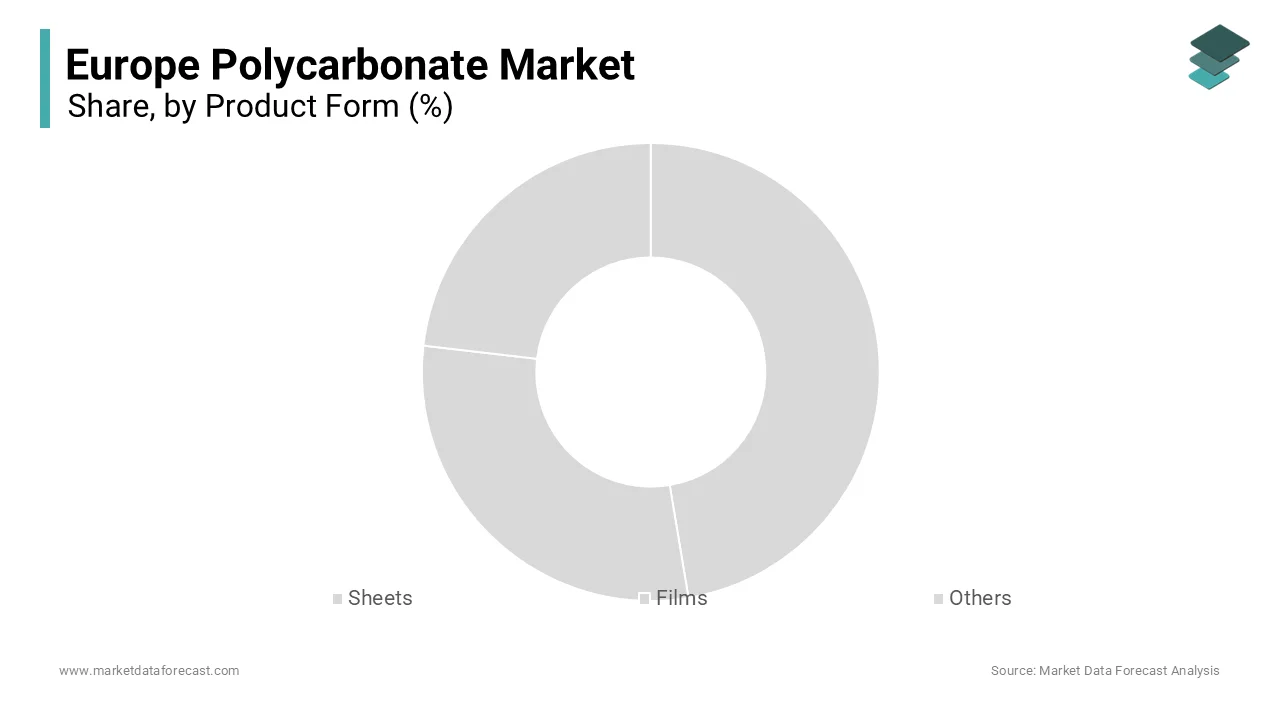
The films segment is a promising segment and is estimated to register a CAGR of 7.44% over the forecast period. Polycarbonate films are increasingly essential in next generation consumer electronics, due to their optical clarity, thermal stability, and dielectric properties. As per the European Electronics Industry Association, over 75% of OLED display backplanes in smartphones and tablets assembled in Europe now use 50-to-125-micron polycarbonate films as protective substrates. These films enable bendable screen designs while maintaining dimensional stability at temperatures up to 135 degrees Celsius, which is critical for high brightness displays. The rise of foldable devices, particularly in premium segments, has accelerated demand as Samsung Display reported a 38% year on year increase in polycarbonate film procurement from European converters in 2024. Additionally, the EU’s Ecodesign for Sustainable Products Regulation mandates longer product lifespans, which favors durable, scratch resistant films over conventional alternatives. This integration into high tech manufacturing cements films as a high growth vector.
By End User Industry Insights
The building and construction segment occupied 28.4% of the regional market share in 2025. The growth of the building and construction segment in the European market is attributed to the structural integration in energy efficient and resilient infrastructure. Polycarbonate sheets and panels are actively promoted in leading European green building frameworks, due to their contribution to daylighting, energy savings, and durability. As per the German Sustainable Building Council, over 60% of projects certified under the DGNB Gold standard in 2024 specified polycarbonate glazing for roofs and façades. Similarly, the French HQE certification awards points for materials that reduce embodied energy and enable natural lighting both strengths of polycarbonate. The material’s 30-year service life, with minimal maintenance, further supports lifecycle assessment credits. As per a 2024 study by the Royal Institute of British Architects, polycarbonate reduced lighting energy use by 22% in educational buildings across the UK and the Netherlands. This alignment with certification incentives transforms polycarbonate from a passive component into a strategic tool for developers pursuing sustainability credentials and public procurement contracts.
The electrical and electronics segment is the fastest growing end user industry and is expected to witness a CAGR of 8.12% over the forecast period owing to the surge in connected home appliances has intensified demand for flame retardant polycarbonate in enclosures, connectors, and sensor housings. According to the European Smart Home Market Monitor, over 58 million households in the EU owned at least three connected devices in 2024, with average device count rising to 8.2 per home. These devices require UL94 V 0 rated housings that resist ignition from internal circuitry—precisely the domain of polycarbonate. Bosch and Siemens now specify polycarbonate for over 90% of their smart thermostat and security camera casings, due to its dimensional stability and electrical insulation. The EU’s Radio Equipment Directive mandates strict flammability and electromagnetic compatibility standards, which polycarbonate meets without halogenated additives. This regulatory and functional synergy ensures deep integration into the expanding IoT hardware ecosystem.
REGIONAL ANALYSIS
Germany Polycarbonate Market Analysis
Germany dominated the polycarbonate market in Europe in 2025 by holding 22.8% of the regional market share. The dominating position of Germany in the Europe polycarbonate market is majorly driven by its advanced manufacturing base, stringent building codes, and leadership in automotive engineering. As per the German Engineering Federation, over 40% of the country’s engineering plastics consumption is directed toward automotive and machinery sectors, where polycarbonate’s impact resistance is critical. The Energiewende policy and revised EnEV building ordinance mandate high daylighting ratios in public buildings, leading to widespread use of multiwall sheets in schools, hospitals, and transport hubs. Additionally, Germany hosts Europe’s largest chemical industry cluster along the Rhine, with Covestro and BASF producing polycarbonate resin and compounds for global distribution. The Fraunhofer Institute reports that German R&D spending on polymer innovation exceeded 1.8 billion euros in 2024, with significant focus on flame retardant and circular grades. This ecosystem of regulation, industry, and innovation ensures Germany’s continued dominance.
France Polycarbonate Market Analysis
France captured 15.1% of the Europe polycarbonate market share in 2025. The growth of France in the Europe polycarbonate market is attributed to the urban infrastructure modernization and aerospace manufacturing. According to France’s Ministry of Ecological Transition, the government’s France 2030 investment plan allocated 2.4 billion euros for sustainable construction materials, including polycarbonate glazing for public buildings and noise barriers on the A10 and A6 motorways. Simultaneously, the aerospace sector centered in Toulouse uses high purity polycarbonate for cockpit canopies and interior panels in Airbus A320 and A350 programs. The French Civil Aviation Authority requires materials with FST certification, which polycarbonate meets through halogen free flame retardants. A 2024 study by IFP Energies Nouvelles found that polycarbonate use in French automotive lighting grew by 11%, due to new headlamp designs for electric vehicles. These diverse, high value applications sustain robust demand across industrial and public domains.
Italy Polycarbonate Market Analysis
Italy is estimated to witness a promising CAGR in the Europe polycarbonate market over the forecast period owing to the design-driven architecture and specialty automotive production. As per the Italian National Institute of Statistics, polycarbonate sheet consumption in high end retail and museum construction rose by 15% in 2024, due to demand for seamless curved glazing unattainable with glass. Italian luxury carmakers like Ferrari, Lamborghini, and Maserati specify optical grade polycarbonate for complex headlamp lenses and interior displays, where precision molding is essential. The Italian National Agency for New Technologies reports that over 60% of industrial polycarbonate purchases in 2024 were for medical device components, responding to EU MDR compliance deadlines. Additionally, Southern Italy’s greenhouse agriculture sector uses UV stabilized polycarbonate films for multiyear crop protection, which is a niche but stable application. This blend of aesthetic engineering and regulatory compliance creates a resilient and diversified demand base.
United Kingdom Polycarbonate Market Analysis
The United Kingdom is estimated to account for a notable share of the Europe polycarbonate market over the forecast period owing to the post Brexit regulatory alignment and digital infrastructure investment. According to the UK Department for Levelling Up, over 70% of new hospital and school projects under the Procurement Pipeline 2024 specify polycarbonate roofing for natural lighting and safety. The country’s departure from the EU has not relaxed material standards; the UKCA marking requires equivalent flammability and impact testing, ensuring continued polycarbonate use in electronics and transport. Additionally, the National Infrastructure Commission’s 2023 report prioritized data center expansion, with 12 new facilities approved in Greater London and Manchester, all using polycarbonate for server enclosures and fiber management. The British Plastics Federation notes that circular polycarbonate adoption rose by 22% in 2024, as brands comply with Extended Producer Responsibility fees. These systemic drivers ensure steady market evolution, despite macroeconomic uncertainty.
Netherlands Polycarbonate Market Analysis
The Netherlands is projected to witness a healthy CAGR in the Europe polycarbonate market during the forecast period. Netherlands serves as a logistics and innovation hub for sustainable polymer applications. As per the Dutch Ministry of Infrastructure, over 50% of new greenhouse projects in Westland use multiwall polycarbonate panels for thermal efficiency and hail resistance. Dutch architects also lead in circular construction; the Amsterdam Circular Strategy 2025 mandates 20% recycled content in all public building materials, prompting early adoption of chemically recycled polycarbonate from companies like SABIC. Additionally, the Port of Rotterdam’s industrial zone hosts major electronics assemblers, who use flame retardant films for smart meter and EV charger housings. Statistics Netherlands reports that polycarbonate exports from Dutch converters grew by 18% in 2024, driven by demand from Scandinavia and the Baltics. This combination of agricultural innovation, circular policy, and export orientation positions the Netherlands as a dynamic growth node.
COMPETITIVE LANDSCAPE
Competition in the Europe polycarbonate market is defined by technological differentiation regulatory foresight and sustainability integration rather than price alone. The market is dominated by a handful of multinational producers who compete on material performance consistency regulatory compliance and service depth. Barriers to entry are high due to capital intensive production stringent quality certifications and complex customer qualification processes especially in automotive and medical sectors. Competition increasingly centers on circularity with players vying to offer the highest verified recycled content without sacrificing optical or mechanical properties. Regional converters and compounders add further complexity by tailoring global resins to local application needs. However, the convergence of EU policies such as the Ecodesign for Sustainable Products Regulation and the Chemicals Strategy for Sustainability is raising the stakes forcing even established players to accelerate innovation in bio-based alternatives and closed loop recycling. As a result, the competitive landscape is shifting from product supply to integrated material stewardship where transparency traceability and lifecycle value determine market leadership.
KEY MARKET PLAYERS
Some of the notable key players in the European polycarbonate market are
- Covestro AG
- SABIC (Saudi Arabian Oil Company)
- LOTTE Chemical Corporation (LOTTE Corp.)
- Teijin Limited
- Trinseo PLC
- Idemitsu Kosan Co., Ltd.
- LG Chem Ltd. (LG Corporation)
- RTP Company, Inc.
- CHIMEI Corporation
- Lone Star Chemical
Top Players in the Market
- Covestro is a global leader in polycarbonate innovation with deep integration across the Europe polycarbonate market through its high performance Makrolon resins and specialty sheets. The company supplies optical grade and flame-retardant polycarbonate to automotive electronics and construction sectors across the continent. Covestro has strengthened its position by advancing circular solutions including the launch of its Makrolon RE line made from mass balanced recycled feedstock certified under ISCC Plus. The company also expanded its digital material selection platform to assist European designers in meeting EU sustainability and safety standards. Its investment in carbon neutral production at its Krefeld site aligns with the EU Green Deal reinforcing its role as a sustainability pioneer in engineering thermoplastics.
- SABIC plays a pivotal role in the Europe polycarbonate market through its Lexan portfolio which serves aerospace automotive and healthcare applications with high purity and regulatory compliant grades. The company contributes significantly to global circular economy efforts by scaling chemically recycled polycarbonate derived from post-consumer mixed plastics. In Europe SABIC has partnered with major automotive and electronics OEMs to integrate certified circular content into high value components. Recent actions include the qualification of its LNP ELCRES copolymer grades for 5G infrastructure and the expansion of its specialty compounding capacity in the Netherlands. These initiatives position SABIC at the intersection of performance sustainability and digital transformation.
- Trinseo is a key supplier of specialty polycarbonate and polycarbonate blends in Europe with a strong focus on electrical electronics and mobility applications. The company differentiates itself through tailored formulations that meet stringent flame retardancy and optical clarity requirements without halogenated additives. Trinseo has reinforced its market presence by launching its MAGNUM ABS and Luran polycarbonate blends optimized for electric vehicle battery enclosures and charging stations. It actively participates in EU regulatory dialogues on material sustainability and has implemented mass balance tracking for its recycled content offerings. The company’s technical service centers across Germany and Italy enable rapid co development with European customers enhancing responsiveness and innovation velocity.
Top Strategies Used by the Key Market Participants
Key players in the Europe polycarbonate market prioritize compliance with EU chemical and sustainability regulations by developing halogen free flame retardant and BPA free formulations. They invest in circular economy initiatives through chemical recycling partnerships and mass balance certified product lines. Companies enhance digital material selection tools to support designers in meeting Ecodesign and Green Public Procurement criteria. Strategic co development with automotive electronics and construction OEMs ensures early integration into next generation products. Additionally, they expand compounding and conversion capabilities within Europe to shorten supply chains and support just in time delivery for high value applications.
MARKET SEGMENTATION
This research report on the European polycarbonate market has been segmented and sub-segmented based on categories.
By Product Form
- Sheets
- Films
- Others
By End User Industry
- Aerospace
- Automotive
- Building and Construction
- Electrical and Electronics
- Industrial and Machinery
- Packaging
- Other End User Industries
By Country
- UK
- France
- Spain
- Germany
- Italy
- Russia
- Sweden
- Denmark
- Switzerland
- Netherlands
- Turkey
- Czech Republic
- Rest of Europe