- Product Description Description
- Table of Contents TOC
- List of Table & Figure LOT
- Get Free Sample PDF Sample PDF
Market Size, 2025
$11.85 BnMarket Estimate, 2026
$12.85 BnMarket Forecast, 2034
$24.52 BnCAGR, 2026–2034
8.41%Executive Summary: Europe Polyols Market
- Market Scope: Comprehensive regional market analysis covering polyol types, application sectors, end-use industries, country-level leadership frameworks, and sustainability metrics for the European polyols sector.
- Market Valuation: Valued at USD 11.85 billion (2025), estimated at USD 12.85 billion (2026), and projected to reach USD 24.52 billion by 2034, registering a robust CAGR of 8.41% (2026–2034).
- Primary Growth Drivers: Stringent environmental regulations promoting energy-efficient building insulation, automotive demand for lightweight components, bio-based polyol adoption, and healthcare/industrial filtration needs. Market challenges include raw material cost volatility and strict chemical regulations, while opportunities lie in polyester polyol coatings, CASE applications, and electronics segment expansion.
Key Market Segment Metrics (2026–2034)
| Category | Leading Segment Position | Fastest-Growing Segment |
|---|---|---|
| By Type / Application / End-Use | Polyether polyols segment (dominated in 2025 for flexible foams) & Flexible polyurethane foam (45.7% share) & Building and construction (35.4% share) | Polyester polyols segment (7.5% CAGR) & CASE segment (8.2% CAGR) & Electronics segment (highest CAGR of 9.5%) |
| By Region / Country | Germany (led market with 25.2% share in 2025 supported by manufacturing and green building initiatives) | United Kingdom (predicted to showcase prominent CAGR of 6.2% driven by infrastructure and sustainability mandates) |
Major Market Players & Market Structure
Market Structure: Highly competitive European chemical landscape centering on product diversification (bio-based polyols), strategic acquisitions for R&D enhancement, Eastern European network expansions, and sustainable resin technologies.
Key Companies: The Dow Chemical Company, BASF SE, Vertellus, Huntsman Corporation, Lanxess AG, Mitsui Chemicals Inc., Stepan Company, Koch Industries Inc., Tosoh Corporation, and Shell plc.
Europe Polyols Market Overview
The Europe polyols market size was valued at USD 11.85 billion in 2025 and is expected to reach USD 24.52 billion by 2034 from USD 12.85 billion in 2026, growing at a CAGR of 8.41% from 2026 to 2034.
The Europe polyols market is witnessing steady growth with the increasing demand for polyurethane-based products across various industries. This expansion is fueled by the growing adoption of polyols in applications such as flexible foams, rigid insulation panels, and coatings, adhesives, sealants, and elastomers (CASE). The presence of robust manufacturing base and strong emphasis on energy-efficient building materials in European countries is ascribed to bolster the growth of the market. Additionally, the European Insulation Manufacturers Association reports that over 60% of insulation materials in Europe now incorporate polyols. Innovations in bio-based polyols have further enhanced their appeal by positioning the market for continued growth.
MARKET DRIVERS
Rising Demand for Energy-Efficient Building Materials
The increasing emphasis on energy efficiency in construction is a primary driver of the European polyols market. According to the European Commission, over 40% of Europe’s energy consumption is attributed to buildings by prompting stricter regulations for thermal insulation. According to the French Ministry of Ecology, rigid polyurethane foam is derived from polyols and is now mandated in new residential projects due to its superior insulation properties. This trend is further amplified by government incentives for green building certifications. As per the German Sustainable Building Council, over 70% of commercial buildings in Germany now use polyol-based insulation materials, reflecting their widespread acceptance. Companies like BASF have capitalized on this shift by introducing eco-friendly polyols tailored for construction applications.
Expanding Automotive Industry
The automotive industry’s reliance on lightweight materials is another significant driver. According to the European Automobile Manufacturers’ Association, over 30% of vehicles produced in Europe now incorporate polyurethane foams for seating, interiors, and insulation. For example, Italy’s automotive sector reported a 20% increase in polyol usage in 2023 with the production of electric vehicles requiring noise-reducing foams. As per the International Council on Clean Transportation, lightweight components reduce vehicle weight by up to 25% by improving fuel efficiency and reducing emissions. This dynamic has encouraged manufacturers to invest in advanced polyol formulations that is further propelling market growth.
MARKET RESTRAINTS
High Production Costs of Bio-Based Polyols
High production costs associated with bio-based polyols pose a significant restraint for the Europe polyols market. According to the European Bioplastics Association, producing bio-based alternatives can be up to 40% more expensive than traditional petroleum-derived polyols due to the specialized processes involved. This financial barrier limits accessibility for smaller manufacturers and budget-conscious consumers. For instance, Spanish startups faced challenges in scaling up bio-polyol production due to high raw material expenses, as reported by the Spanish Chemical Federation.
Stringent Environmental Regulations
Stringent environmental regulations also act as a restraint for the market. According to the European Environment Agency, compliance with emissions standards for polyol production facilities increased operational costs by 25% in 2023. For example, France’s recent legislation requiring detailed carbon footprint disclosures created additional financial burdens for manufacturers. Furthermore, varying regulations across member states complicate market entry strategies for multinational operators. These complexities hinder growth and force companies to allocate resources toward meeting compliance requirements.
MARKET OPPORTUNITIES
Adoption of Bio-Based Polyols
The growing adoption of bio-based polyols presents a significant opportunity for the Europe polyols market. The consumer interest in sustainable and renewable materials are propelling the growth of the market. For instance, Sweden introduced bio-polyols derived from vegetable oils in 2023 by targeting eco-conscious manufacturers. As per the European Green Deal, countries like Denmark offer tax incentives for companies using renewable feedstocks by encouraging investments in bio-based solutions. Additionally, rising awareness about carbon neutrality has boosted demand for low-impact polyols with this segment as a key growth driver.
Expansion into Emerging Markets
Emerging markets in Eastern Europe offer untapped opportunities for growth. According to the World Bank, countries like Poland and Romania are witnessing rapid industrialization, with manufacturing spending increasing by 15% annually. Polyol providers are capitalizing on this trend by establishing local operations by catering to automotive and construction sectors. For example, Hungary’s booming automotive industry attracted over €1 billion in investments in 2023, creating demand for lightweight polyol-based materials.
MARKET CHALLENGES
Supply Chain Disruptions for Raw Materials
Supply chain disruptions for raw materials pose a pressing challenge for the Europe polyols market. According to the European Logistics Association, shortages caused by geopolitical tensions delayed production schedules by up to six months in 2023. This issue is compounded by reliance on imports for critical feedstocks. As per the European Raw Materials Alliance, over 90% of propylene oxide used in polyol production is sourced from foreign markets by making the supply chain vulnerable to external shocks. For example, tariffs imposed on Chinese imports raised production costs for manufacturers by limiting their ability to meet growing demand.
Competition from Substitute Materials
Intense competition from substitute materials acts as another challenge. According to Deloitte, alternative insulation materials like fiberglass captured over 35% of the European market share in 2023 by reducing reliance on polyol-based foams. For instance, London-based builders increasingly prefer mineral wool for its perceived fire-resistant properties by limiting polyol demand. This shift is further amplified by affordability claims of substitutes.
REPORT COVERAGE
| REPORT METRIC | DETAILS |
| Market Size Available | 2025 to 2034 |
| Base Year | 2025 |
| Forecast Period | 2026 to 2034 |
| CAGR | 8.41% |
| Segments Covered | By Type, Application, End-Use Industry, and Region |
| Various Analyses Covered | Global, Regional, & Country Level Analysis; Segment-Level Analysis; DROC; PESTLE Analysis; Porter’s Five Forces Analysis; Competitive Landscape; Analyst Overview of Investment Opportunities |
| Regions Covered | UK, France, Spain, Germany, Italy, Russia, Sweden, Denmark, Switzerland, Netherlands, Turkey, Czech Republic, Rest of Europe |
| Market Leaders Profiled | The Dow Chemical Company, BASF SE, Vertellus, Huntsman Corporation, Lanxess AG, Mitsui Chemicals Inc., Stepan Company, Koch Industries Inc., Tosoh Corporation, Shell plc, and others. |
SEGMENTAL ANALYSIS
By Type Insights
The polyether polyols segment was the largest and the Europe polyols market with a dominant share in 2025 owing to their versatility and widespread use in flexible foams for bedding and furniture applications. According to the Italian Furniture Association, over 80% of upholstered furniture incorporates polyether polyols by reflecting their popularity. Advancements in polymer technology have further enhanced the segment’s growth. As per the European Polyurethane Foam Association, modern formulations now improve durability by 25% is boosting the market’s growth.
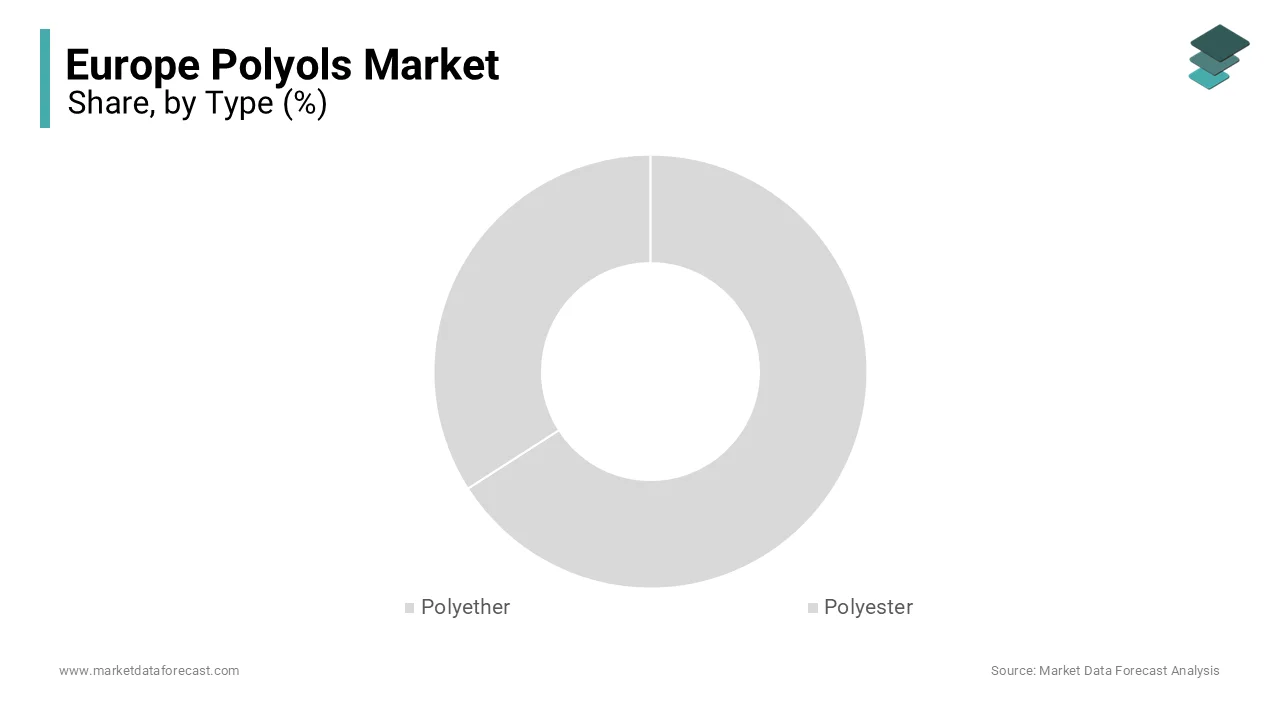
The polyester polyols segment is likely to experience a significant CAGR of 7.5% during the forecast period. This growth is fueled by their increasing use in rigid foams and coatings in the automotive and construction sectors. According to the German Automotive Federation, over 50% of car manufacturers now use polyester polyols for interior components by citing their resistance to heat and chemicals. Innovations in bio-based formulations have accelerated adoption. For instance, BASF introduced a renewable polyester polyol in 2023 is targeting sustainability-focused industries. These developments position polyester polyols as a key growth driver in the coming years.
By Application Insights
The flexible polyurethane foam dominated the European polyols market by capturing 45.7% of the share in 2025 due to the sector’s reliance on comfort-driven applications, such as mattresses, automotive seating, and furniture, where versatility is paramount. For instance, the Spanish Mattress Manufacturers’ Association reports that over 70% of mattresses produced in Spain incorporate flexible foams, reflecting their widespread adoption. Technological advancements have further bolstered the segment’s appeal. As per the European Foam Producers’ Association, modern foams now offer improved breathability and resilience by enhancing consumer satisfaction.
The coatings, adhesives, sealants, and elastomers (CASE) segment is lucratively growing with a CAGR of 8.2% in the coming years. This growth is driven by the increasing use of polyols in protective coatings and adhesives, particularly in the construction and electronics sectors. According to the Dutch Construction Federation, over 60% of building projects now use polyol-based sealants for weatherproofing. Innovations in formulation have accelerated adoption. For instance, Dow Chemical introduced UV-resistant polyols in 2023, targeting outdoor applications. These developments position CASE applications as a key growth driver in the coming years.
By End-Use Industry Insights
The building and construction dominated the Europe polyols market with an estimated share of 35.4% in 2025 due to the reliance on rigid foams for insulation, which aligns with Europe’s stringent energy efficiency regulations. For instance, the UK Insulation Board reports that over 80% of new residential projects incorporate polyol-based insulation panels. Advancements in fire-retardant formulations have further enhanced the segment’s appeal. As per the European Fire Safety Alliance, modern foams now comply with EN 13501 standards.
The electronics segment is likely to exhibit a CAGR of 9.5% during the forecast period. This growth is fueled by the increasing use of polyols in protective coatings and encapsulants, particularly for circuit boards and displays. According to the Swedish Electronics Association, over 50% of manufacturers now use polyol-based coatings to enhance product durability due to their technical advantages. Innovations in thermal management have accelerated adoption. For instance, Samsung partnered with a European supplier in 2023 to develop polyol-based encapsulants for smartphones by targeting heat dissipation.
REGIONAL ANALYSIS
Germany Polyols Market Insights
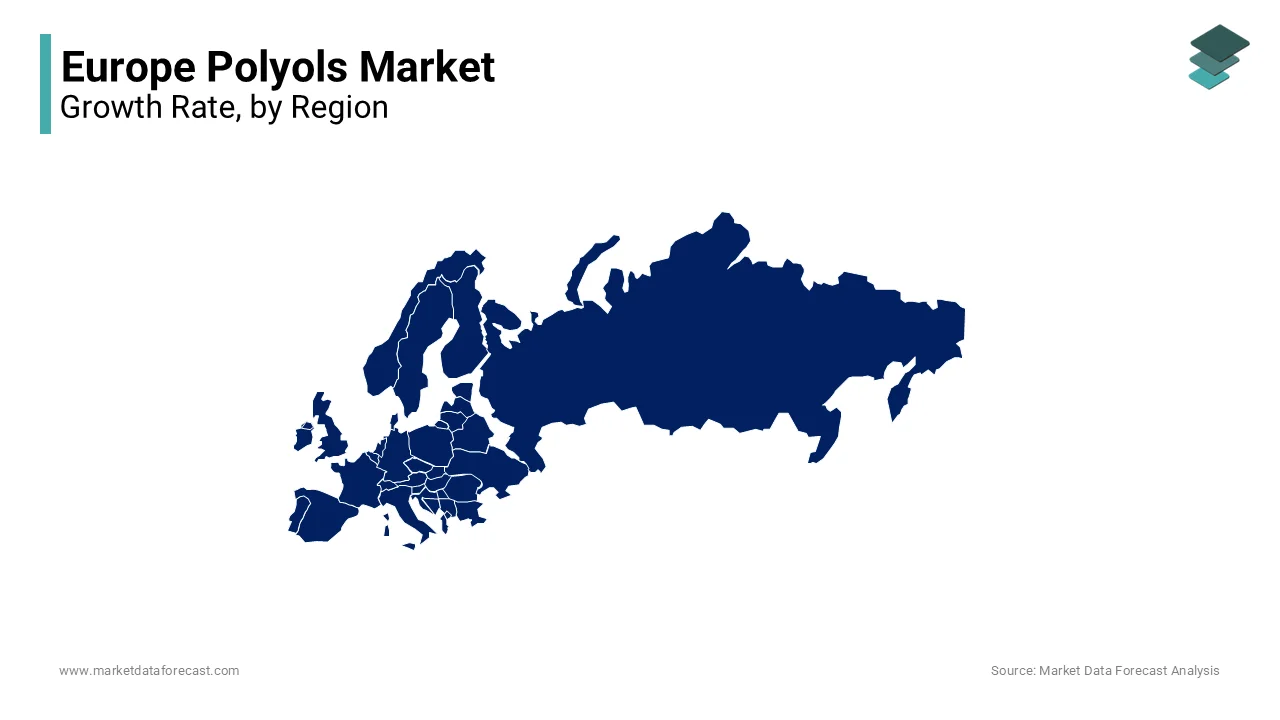
German positioned at top by occupying a share of 25.2% in 2025. This dominance is fueled by the country’s robust manufacturing base and strong emphasis on energy-efficient building materials. For instance, over 70% of insulation panels used in German construction projects incorporate polyols by reflecting their widespread adoption. A key factor propelling Germany’s growth is its leadership in innovation. According to the European Climate Action Network, German companies lead Europe in adopting green technologies, with over 60% of facilities powered by renewable energy sources. Additionally, government incentives for sustainable construction have encouraged investments in bio-based polyols.
The UK Polyols Market Insights
The United Kingdom is gaining traction over the growth rate with an projected CAGR of 6.2% during the forecast period. The growth is driven by its thriving construction sector, which accounts for nearly 10% of GDP. For example, London-based builders utilize polyol-based rigid foams to meet stringent insulation regulations. Another contributing factor is the rise of digital platforms.
France Polyols Market Insights
France captures approximately 15% of the market share, as per the French Ministry of Ecology. The country’s emphasis on environmental sustainability and energy efficiency makes it a hub for polyol-based insulation solutions. For instance, over 60% of new residential projects in France now mandate the use of rigid polyurethane foams, underscoring their critical role in reducing carbon emissions. Additionally, the French government’s tax incentives for renewable materials have accelerated innovation in bio-based polyols by positioning France as a leader in sustainable construction practices.
COMPETITIVE LANDSCAPE
Key Market Players
- The Dow Chemical Company, BASF SE, Vertellus, Huntsman Corporation, Lanxess AG, Mitsui Chemicals Inc., Stepan Company, Koch Industries Inc., Tosoh Corporation, and Shell plc are playing a dominant role in the European polyols market.
- The Europe polyols market is marked by intense competition, with established giants and emerging players vying for supremacy. According to the European Chemical Industry Council, the top five companies account for over 60% of total sales by reflecting the market’s oligopolistic structure. BASF, Covestro, and Dow dominate the landscape is leveraging their technological expertise and extensive distribution networks.
- Smaller players, however, are gaining traction through niche offerings, such as bio-based and specialty polyols. The rise of e-commerce platforms has leveled the playing field by enabling smaller brands to reach wider audiences. Price wars and promotional campaigns are common, particularly in the construction segment. Despite these challenges, innovation remains a key differentiator, with companies continuously introducing advanced solutions to meet evolving consumer demands.
TOP PLAYERS IN THE EUROPEAN POLYOLS MARKET
- BASF SE leads the European polyols market, contributing significantly to the global industry through its diverse portfolio of innovative products. According to the European Chemical Industry Council, BASF's focus on sustainability and advanced formulations will sustain its position in the marketplace. The company’s global reach extends to over 90 countries is making it a dominant player worldwide.
- Covestro AG ranks second, renowned for its expertise in producing high-performance polyols for rigid foams and CASE applications. The company’s strategic partnerships with end-users enhance its global footprint.
- Dow Inc. holds the third position, leveraging its strong brand presence and commitment to innovation. The focus on bio-based solutions is to substantially leverage the company’s productivity. Its contributions to the global market include tailored formulations for diverse applications, positioning it as a key player in the industry.
TOP STRATEGIES USED BY KEY MARKET PLAYERS
- Key players in the European polyols market employ diverse strategies to strengthen their positions. One prominent approach is product diversification is BASF launched a line of bio-based polyols in 2023 to cater to environmentally conscious consumers. Another strategy is geographic expansion, as Covestro AG opened new facilities in Eastern Europe to tap into emerging markets.
- Strategic collaborations also play a crucial role. In 2023, Dow Inc. partnered with leading electronics manufacturers to develop polyol-based encapsulants for smartphones, targeting heat dissipation. Additionally, companies like BASF are investing in consumer education campaigns to promote the benefits of bio-based polyols.
Europe Polyols Market News
- In January 2024, BASF SE launched a line of bio-based polyols. This initiative aimed to cater to environmentally conscious consumers and expand its product range.
- In March 2024, Covestro AG acquired a Czech chemical firm. This acquisition was intended to enhance its R&D capabilities and accelerate product innovation.
- In May 2024, Dow Inc. introduced a new range of UV-resistant polyols. This launch aimed to target outdoor applications across Europe.
In July 2024, Huntsman Corporation unveiled its first commercially available fire-retardant polyol foam. This initiative aimed to position the Netherlands as a global hub for advanced polyol technologies. - In September 2024, Wanhua Chemical partnered with a Swiss startup to develop recyclable polyols. This collaboration aimed to explore sustainable and scalable solutions for future applications.
MARKET SEGMENTATION
This research report on the Europe Polyols market is segmented and sub-segmented into the following categories.
By Type
- Polyether
- Polyester
By Application
- Flexible Foam
- Rigid Foam
- Coatings
- Adhesives & Sealants
- Elastomers
- Others
By End-Use Industry
- Building & Construction
- Furnishings
- Automotive
- Packaging
- Electronics
- Others
By Country
- UK
- France
- Spain
- Germany
- Italy
- Russia
- Sweden
- Denmark
- Switzerland
- Netherlands
- Turkey
- Czech Republic
- Rest of Europe