- Product Description Description
- Table of Contents TOC
- List of Table & Figure LOT
- Get Free Sample PDF Sample PDF
Europe Polyvinylpyrrolidone Market Size
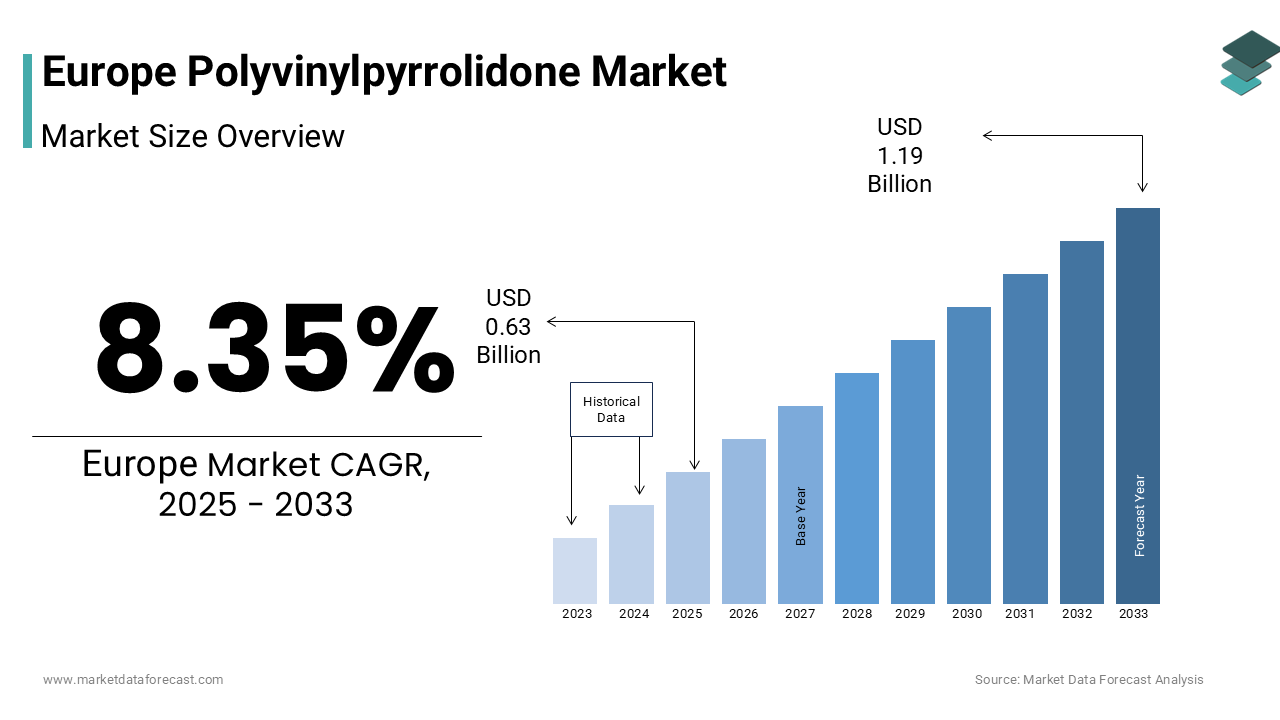
The global polyvinylpyrrolidone market size was valued at USD 0.58 billion in 2024 and is anticipated to reach USD 0.63 billion in 2025 from USD 1.19 billion by 2033, growing at a CAGR of 8.35% during the forecast period from 2025 to 2033.
Polyvinylpyrrolidone (PVP) is a water soluble synthetic polymer widely employed across pharmaceutical, cosmetic, food, and industrial applications due to its exceptional binding, film forming, and stabilizing properties. In Europe, PVP serves as a critical excipient in solid oral dosage formulations and is integral to antiseptic solutions such as povidone iodine. The substance also finds extensive use in personal care products as a hair fixative and in industrial processes like inkjet printing and adhesives. Regulatory acceptance under the European Pharmacopoeia and compliance with REACH legislation strengthen its legitimacy in high sensitivity applications. As per sources, a portion of the European Union’s pharmaceutical excipients are sourced internally or from trusted trade partners adhering to stringent quality norms, which creates a conducive environment for specialty polymers like PVP. The compound’s non toxic and biocompatible nature further solidifies its position in regulated sectors. Unlike commodity chemicals, PVP’s value stems from its functional versatility rather than volume, which aligns with Europe’s shift toward high performance specialty chemicals. This foundational role across multiple regulated industries defines the structural dynamics of the Europe polyvinylpyrrolidone market.
MARKET DRIVERS
Rising Demand for Advanced Pharmaceutical Formulations
The pharmaceutical industry in the region continues to evolve toward complex drug delivery systems, which propels the growth of the Europe polyvinylpyrrolidone market. PVP is essential in amorphous solid dispersions that enhance the bioavailability of poorly water soluble active pharmaceutical ingredients, a category that constitutes a portion of new chemical entities under development as per studies. This solubility challenge has driven formulators to adopt polymer based stabilization techniques where PVP K30 and related grades serve as matrix formers. Apart from these, the European Medicines Agency has approved oral solid dosage products that list PVP among their inactive ingredients, which reflects its entrenched role in modern pharmacopeia. The growing prevalence of chronic diseases further amplifies demand. Moreover, the expansion of generic drug manufacturing in Central and Eastern Europe, particularly in countries like Poland and Hungary, has intensified procurement of GMP compliant excipients. This convergence of formulation science, regulatory validation, and therapeutic need sustains robust demand for PVP across Europe’s pharmaceutical value chain.
Expanding Use in Personal Care and Cosmetic Applications
Polyvinylpyrrolidone has become indispensable in region’s personal care sector due to its film forming, styling, and stabilizing attributes, particularly in hair care and color cosmetic formulations, which drives the expansion of the Europe Polyvinylpyrrolidone market. PVP is a key ingredient in hair sprays, mousses, and gels, where it provides hold without stiffness or flaking, aligning with clean beauty trends that favor non greasy, residue free finishes. Furthermore, its compatibility with oxidative hair dyes enhances color longevity and uniformity, a critical factor given that a share of women in the EU aged 18 to 65 use permanent hair colorants at least quarterly. Regulatory clarity under the EU Cosmetic Regulation also supports PVP’s adoption, as it is listed among approved ingredients with no concentration restrictions for rinse off or leave on products. Innovations in sustainable formulations have further broadened its relevance. This regulatory endorsement, coupled with evolving aesthetic preferences and environmental considerations, cements PVP’s role in Europe’s dynamic cosmetics landscape.
MARKET RESTRAINTS
Stringent Environmental and Chemical Safety Regulations
Pressure from increasingly rigorous chemical safety and environmental regulations hinders the growth of the Europe polyvinylpyrrolidone market. Even though PVP is generally regarded as safe, its regulation by the REACH framework means that comprehensive data on its degradation, ecotoxicity, and environmental fate must still be provided. PVP's delayed biodegradation is a concern for regulators, who are questioning its classification, as it does not currently fall under the EU's persistent substance criteria. Besides, wastewater treatment plants across the EU report incomplete removal of synthetic polymers. These findings fuel policy discussions on extended producer responsibility and potential restrictions in rinse off cosmetic products. Consequently, manufacturers must invest in alternative polymer development or enhanced lifecycle assessments, increasing operational complexity and potentially limiting formulation flexibility in sensitive applications.
Volatility in Raw Material Sourcing and Pricing
The production of polyvinylpyrrolidone is intrinsically tied to the availability and cost stability of its primary monomer, N vinylpyrrolidone (NVP), whose synthesis depends on petrochemical feedstocks, impedes the expansion of the Europe polyvinylpyrrolidone market. Geopolitical disruptions and energy market fluctuations have introduced significant volatility into this supply chain. This directly impacts PVP manufacturers, as raw materials constitute a portion of total production costs. Furthermore, Europe’s limited domestic NVP production capacity forces reliance on imports from Asia, primarily China and South Korea, exposing the supply chain to logistical barriers and trade policy shifts. Such unpredictability complicates inventory planning for PVP producers and downstream formulators, particularly in just in time manufacturing environments common in pharmaceuticals. Consequently, pricing instability and supply insecurity act as structural restraints, which discourages long term contractual commitments and dampening investment in capacity expansion within the European PVP value chain.
MARKET OPPORTUNITIES
Growth in Biopharmaceutical and mRNA Vaccine Platforms
The emergence of advanced biopharmaceutical modalities, particularly mRNA based therapeutics and vaccines, offers new opportunities for the growth of the Europe polyvinylpyrrolidone market. PVP serves as a cryoprotectant and stabilizer in lyophilized mRNA formulations, preventing aggregation and maintaining structural integrity during freeze drying and storage. This role is critical given the thermal sensitivity of nucleic acid constructs. As per sources, many mRNA based products are currently in clinical trials across the EU, spanning oncology, infectious diseases, and rare genetic disorders. The infrastructure supporting this innovation is expanding rapidly. PVP’s compatibility with lipid nanoparticle systems, the primary delivery vehicle for mRNA, further enhances its relevance. The strategic pivot necessitates robust supply chains for high purity excipients, creating a niche but growing demand for pharma grade PVP. Unlike traditional small molecule drugs, biologics require stringent control over excipient quality, allowing premium grade PVP suppliers to command higher margins. Thus, the convergence of scientific innovation, public health policy, and manufacturing localization positions PVP as an enabler of Europe’s next generation therapeutic ambitions.
Adoption in Sustainable Agricultural Adjuvants
Polyvinylpyrrolidone is gaining traction in agricultural sector as a performance enhancing adjuvant in biopesticide and foliar nutrient formulations, which creates fresh prospects for the expansion of the Europe Polyvinylpyrrolidone market. PVP improves the spreading, sticking, and rainfastness of agrochemical sprays, thereby increasing active ingredient efficacy and reducing application frequency. Moreover, PVP’s water solubility and low ecotoxicity profile, classified as non hazardous to aquatic organisms under EU CLP Regulation, make it compliant with stringent environmental standards governing agricultural inputs. The expansion of organic farming has led to a heightened demand for effective, natural adjuvants. PVP’s dual functionality as both a stabilizer and delivery enhancer offers a compelling solution for formulators developing next generation sustainable crop protection products, opening a novel and policy aligned growth vector for the European PVP market.
MARKET CHALLENGES
Competition from Bio Based and Biodegradable Polymer Alternatives
Mounting burden from emerging bio based polymers that align more closely with the region’s circular economy and sustainability mandates challenges the growth of the Europe polyvinylpyrrolidone market. Polymers such as polyvinyl alcohol (PVA), pullulan, and modified starches are increasingly promoted as greener alternatives due to their enhanced biodegradability and renewable sourcing. According to sources, the production capacity for bio based specialty polymers in the EU grew, driven by policy incentives under the European Green Deal. In pharmaceutical applications, pullulan, a polysaccharide derived from fungal fermentation, has gained regulatory approval for use in fast dissolving films and is marketed as fully biodegradable, contrasting with PVP’s partial persistence. Similarly, in cosmetics, the European Commission’s 2023 restriction on intentionally added microplastics has heightened scrutiny of all synthetic polymers, regardless of solubility. Formulators are proactively reformulating products to avoid potential future bans, even though the water solubility of PVP exempts it from current microplastic definitions. This strategic shift is supported by consumer sentiment. Consequently, PVP suppliers face the dual challenge of defending their product’s safety record while competing against alternatives that carry stronger environmental narratives, potentially eroding market share in sustainability sensitive segments.
Fragmented Regulatory Classification Across EU Member States
Inconsistent national interpretations of chemical and product regulations inhibits the expansion of the Europe polyvinylpyrrolidone market. While REACH provides a harmonized framework, individual member states retain authority over certain classifications, particularly concerning environmental labeling and waste handling. This fragmentation is especially problematic in multi country product launches. Moreover, in pharmaceuticals, while the European Pharmacopoeia standardizes PVP quality, national competent authorities sometimes impose additional impurity thresholds. These discrepancies increase regulatory overhead, delay time to market, and inflate compliance costs, particularly for small and medium enterprises lacking dedicated regulatory affairs teams. A lack of regulatory standardization will continue to pose a structural problem for European PVP stakeholders.
REPORT COVERAGE
| REPORT METRIC | DETAILS |
| Market Size Available | 2024 to 2033 |
| Base Year | 2024 |
| Forecast Period | 2025 to 2033 |
| Segments Covered | By Form, Application and Region |
| Various Analyses Covered | Global, Regional & Country Level Analysis, Segment-Level Analysis, DROC, PESTLE Analysis, Porter’s Five Forces Analysis, Competitive Landscape, Analyst Overview of Investment Opportunities |
| Regions Covered | UK, France, Spain, Germany, Italy, Russia, Sweden, Denmark, Switzerland, the Netherlands, Turkey, the Czech Republic, and the Rest of Europe. |
| Market Leaders Profiled | BASF SE, Ashland Global Holdings Inc., Boai NKY Pharmaceuticals Ltd., Nippon Shokubai Co., Ltd., Merck KGaA, Hangzhou Motto Science & Technology Co., Ltd., JH Nanhang Life Sciences Co., Ltd., Glide Chem Pvt. Ltd., Shanghai Qifuqing Material Technology Co., Ltd., and Thermo Fisher Scientific Inc. |
SEGMENTAL ANALYSIS
By Form Insights
The powder form segment dominated the Europe polyvinylpyrrolidone market and accounted for substantial share in 2024. The dominance of the powder form segment is because of its superior stability, ease of handling, and compatibility with solid dosage pharmaceutical manufacturing the largest end use sector for PVP in Europe. Powder PVP exhibits extended shelf life under ambient storage conditions, a critical advantage for just in time supply chains prevalent in EU based generic drug production. Furthermore, its free flowing nature facilitates precise dosing in high speed tablet compression lines. Furthermore, powder form enables efficient transportation and reduced logistics costs. These operational, regulatory, and sustainability advantages collectively sustain the powder segment’s dominance across pharmaceutical, food, and industrial applications in Europe.
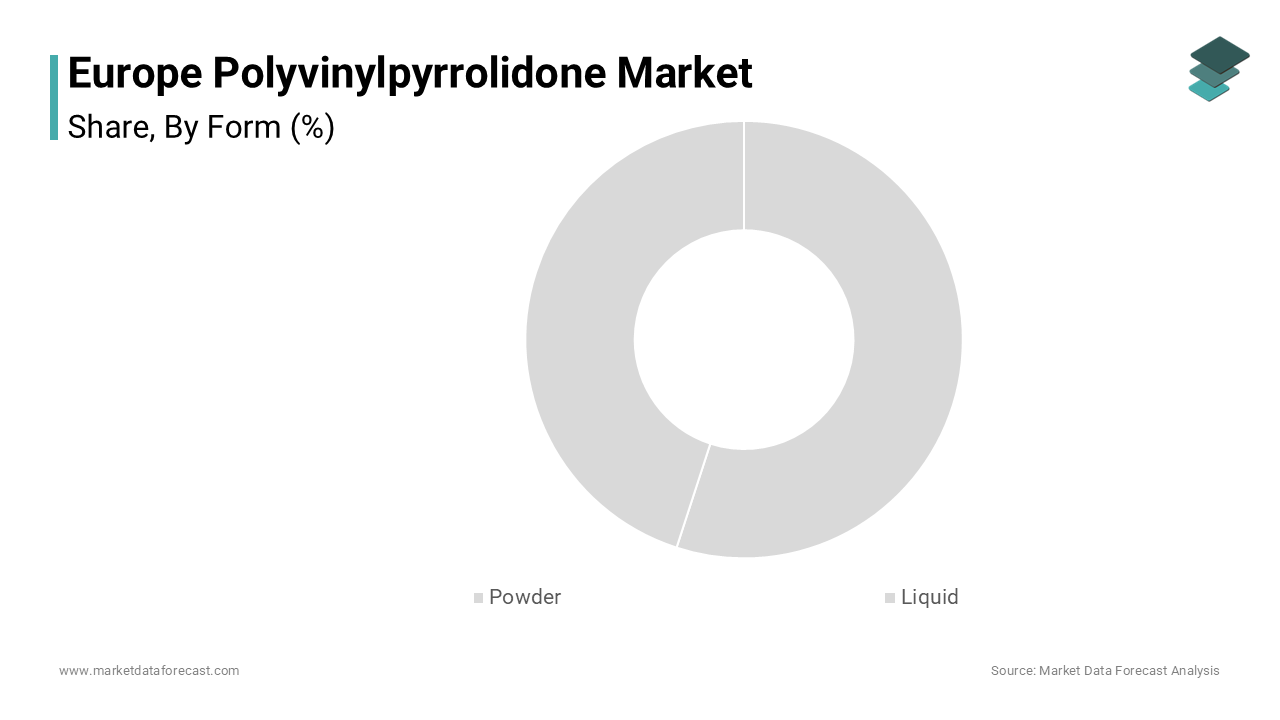
The liquid form segment is estimated to register the fastest CAGR of 6.8% between 2025 and 2033 due to rising demand in ready to use cosmetic formulations and industrial adhesives where immediate solubility and homogeneity are essential. Liquid PVP eliminates the dissolution step required in powder processing, reducing production time in hair styling gel manufacturing, according to research. In the adhesives sector, water based liquid PVP solutions are increasingly used in label and packaging bonding applications due to their rapid tack development and compatibility with automated filling lines. Moreover, the shift toward sustainable manufacturing has favored liquid concentrates that minimize dust exposure and improve workplace safety. Apart from these, innovations in stabilized aqueous PVP dispersions. These functional and ergonomic benefits position liquid PVP as a preferred format in high throughput, safety conscious, and formulation agile industries across Europe.
By Application Insights
The pharmaceutical application segment held the largest share of 52.5% of the Europe polyvinylpyrrolidone market. This superiority of pharmaceutical application segment is attributed to PVP’s irreplaceable role as a binder, disintegrant, and stabilizer in solid oral dosage forms, which constitute over 70 percent of all medicinal products authorized in the EU. Furthermore, the continent’s aging population intensifies reliance on chronic disease medications. Regulatory frameworks further entrench its use. Besides, the rise of contract development and manufacturing organizations in Eastern Europe has amplified bulk procurement of GMP grade PVP powder. These demographic, regulatory, and industrial dynamics solidify pharmaceuticals as the cornerstone of PVP consumption in Europe.
The food and beverage application segment is anticipated to witness the fastest CAGR of 7.2% from 2025 to 2033 owing to PVP’s function as a clarifying agent in wine and beer production, where it binds polyphenols to prevent haze formation without altering taste or aroma. Consumer demand for clean label beverages has further accelerated adoption. Moreover, PVP’s approval under Regulation (EC permits its use in alcoholic beverages, providing legal certainty for producers. Innovations in powdered beverage mixes, particularly protein and electrolyte formulations, also utilize PVP as a dispersant to prevent clumping. These converging trends in production efficiency, regulatory compliance, and consumer preference drive the segment’s rapid expansion.
SEGMENTAL ANALYSIS
Germany Polyvinylpyrrolidone Market Analysis
Germany was the prominent region in the Europe polyvinylpyrrolidone market and captured 22.5% share in 2024. The dominance of Germany is mainly driven by its world class pharmaceutical and chemical manufacturing infrastructure, home to global players like BASF and Merck KGaA, both of which produce and consume PVP at scale. Germany accounts for a portion of the EU’s total pharmaceutical output as per the Federal Statistical Office. The nation’s robust generics sector relies heavily on cost effective, high purity excipients like PVP. Furthermore, Germany’s stringent adherence to Good Manufacturing Practice and its prominence in green chemistry enhance the appeal of domestically produced PVP. The presence of advanced research institutions such as the Fraunhofer Institute further drives innovation in PVP based drug delivery systems. These industrial, regulatory, and scientific strengths ensure Germany’s continued dominance in the European PVP landscape.
France Polyvinylpyrrolidone Market Analysis
France was the second largest region in the Europe polyvinylpyrrolidone market. The growth of France is due to its integrated pharmaceutical and cosmetics industries, both of which are among the largest in the EU. France is the birthplace of major beauty conglomerates like L’Oréal and LVMH. PVP is extensively used in their hair care and makeup lines for film forming and pigment dispersion. Simultaneously, France’s public healthcare system drives high pharmaceutical consumption. Furthermore, the French Agency for Food, Environmental and Occupational Health and Safety maintains a transparent approval process for food and cosmetic additives, facilitating rapid formulation updates. This dual strength in beauty and health sectors, supported by proactive industrial policy, sustains France’s pivotal role in the PVP value chain.
The United Kingdom Polyvinylpyrrolidone Market Analysis
The United Kingdom is growing steadily in the Europe polyvinylpyrrolidone market. Despite Brexit, the UK remains a powerhouse in pharmaceutical research and specialty chemical formulation, hosting global headquarters of AstraZeneca and GSK. The country’s Medicines and Healthcare products Regulatory Agency approved active substances, many of which utilize PVP in solid dispersions to overcome solubility limitations. Post Brexit regulatory divergence has not hindered PVP use; the UK REACH regime retains identical classification for PVP as the EU, ensuring continuity. These scientific, regulatory, and commercial attributes preserve the UK’s strong market position.
Italy Polyvinylpyrrolidone Market Analysis
Italy is moving ahead steadfastly in the Europe polyvinylpyrrolidone market owing to its diversified chemical industry and robust food and beverage sector, particularly wine production. Italy is the world’s largest wine producer, generating millions of hectoliters, with PVP widely used for colloidal stabilization in white and rosé wines destined for export. Simultaneously, Italy’s pharmaceutical manufacturing base, concentrated in Lombardy and Emilia Romagna, produces billions of dosage units annually, which relies on PVP for tablet binding and granulation. The Italian cosmetics industry, known for niche perfumery and skincare, also contributes through PVP based fixatives in hair sprays and setting lotions. Government support through the National Recovery and Resilience Plan has allocated funds to modernize pharmaceutical production facilities, enhancing excipient demand. Besides, Italy’s aging population drives chronic medication use, strengthening pharmaceutical consumption. This blend of agri food excellence and pharmaceutical tradition underpins Italy’s sustained relevance in the PVP market.
Spain Polyvinylpyrrolidone Market Analysis
Spain is likely to grow in the Europe polyvinylpyrrolidone market due to its expanding generic pharmaceutical sector and growing personal care manufacturing. Spain is the EU’s fourth largest producer of generic medicines, with output increasing. This growth is supported by national cost containment policies that prioritize affordable therapeutics, directly boosting demand for economical excipients like PVP. The country’s wine industry also utilizes PVP for clarification, especially in cava and young white wines. Public investment in biotechnology hubs such as the Barcelona Science Park further stimulates innovation in advanced drug formulations. These industrial dynamics, combined with strategic geographic access to North Africa and Latin America, support Spain’s role as a key PVP consumer in Southern Europe.
COMPETITIVE LANDSCAPE
The Europe polyvinylpyrrolidone market features moderate competition characterized by a mix of multinational chemical giants and specialized regional producers. The competitive landscape is shaped by stringent regulatory requirements, high entry barriers in pharmaceutical applications, and the need for consistent product quality. Leading companies differentiate themselves through technical service capabilities, regulatory expertise, and application specific innovation rather than price alone. While global players dominate high purity segments, niche suppliers compete effectively in industrial and cosmetic grades by offering customized solutions. The market exhibits low threat of new entrants due to capital intensity and complex compliance obligations. Competitive intensity is further influenced by raw material volatility and the growing demand for sustainable alternatives, prompting incumbents to invest in bio based derivatives and circular production models. Overall, competition remains focused on value addition, reliability, and regulatory alignment.
KEY MARKET PLAYERS
A few of the major companies in the europe polyvinylpyrrolidone market include
- BASF SE
- Ashlad Global Holdings Inc.
- Boai NKY Pharmaceuticals Ltd.
- Nippon Shokubai Co., Ltd
- Merck KGaA
- Hangzhou Motto Science & Technology Co., Ltd.
- JH Nanhang Life Sciences Co., Ltd.
- Glide Chem Pvt. Ltd.
- Shanghai Qifuqing Material Technology Co., Ltd.
- Thermo Fisher Scientific Inc.
Top Players in the Europe Polyvinylpyrrolidone Market
BASF SE
BASF SE is a leading global chemical company with a significant presence in the Europe polyvinylpyrrolidone market through its extensive portfolio of specialty polymers. The company supplies high purity PVP grades for pharmaceutical, cosmetic, and industrial applications across the continent. BASF has supported its position by investing in sustainable production technologies at its Ludwigshafen facility, aligning with EU green chemistry initiatives. In recent years, the company has expanded its regulatory support services to assist customers with REACH and pharmacopeial compliance, enhancing its value proposition in highly regulated sectors. Its integrated Verbund system ensures consistent quality and supply reliability, making it a preferred partner for multinational formulators seeking secure excipient sourcing within Europe.
Ashland Global Holdings Inc
Ashland Global Holdings Inc plays a pivotal role in the Europe polyvinylpyrrolidone market through its specialty ingredients division, offering branded PVP solutions under the Plasdone and PVP Kollidon lines. The company focuses on high performance applications in pharmaceuticals and personal care, leveraging deep formulation expertise. Ashland has strengthened its European footprint by upgrading its manufacturing site in Belgium to meet increasing demand for GMP compliant excipients. Recent initiatives include launching digital formulation tools that help customers optimize PVP usage in solid dispersions and hair care systems. The company also collaborates closely with European regulatory bodies to ensure its products meet evolving safety and environmental standards, supporting trust among regional clients.
Merck KGaA
Merck KGaA operates as a key supplier of pharmaceutical grade polyvinylpyrrolidone in Europe under its SAFC and Sigma Aldrich brands. The company caters primarily to the biopharmaceutical and generics sectors, providing PVP with stringent quality controls and full traceability. Merck has enhanced its market position by expanding cold chain logistics capabilities to support PVP use in temperature sensitive mRNA vaccine formulations. It also invests heavily in application research at its Darmstadt innovation center, developing next generation PVP derivatives for advanced drug delivery. Besides, the company actively participates in European Pharmacopoeia expert groups, contributing to monograph updates and ensuring its products remain aligned with regulatory expectations across the region.
Top Strategies Used by the Key Market Participants
Key players in the Europe polyvinylpyrrolidone market employ several strategic approaches to maintain competitiveness and expand their influence. They prioritize vertical integration to secure raw material supply and ensure production consistency. Investment in regulatory compliance infrastructure enables seamless adherence to REACH, pharmacopeial, and cosmetic regulations across diverse EU member states. Companies also focus on application specific product development, tailoring PVP grades for mRNA stabilization, clean label cosmetics, and sustainable adhesives. Strategic collaborations with academic institutions and contract manufacturers accelerate innovation in high growth segments. Furthermore, digitalization of technical support services enhances customer formulation efficiency. Sustainability initiatives, including solvent reduction and energy efficient synthesis, align with the European Green Deal and strengthen brand credibility among environmentally conscious buyers.
MARKET SEGMENTATION
This research report on the europe polyvinylpyrrolidone market has been segmented based on the following categories.
By Form
- Powder
- Liquid
By Application
- Pharmaceutical
- Food and Beverage
- Cosmetics Adhesives
- Other Applications
By Country
- UK
- France
- Spain
- Germany
- Italy
- Russia
- Sweden
- Denmark
- Switzerland
- Netherlands
- Turkey
- Czech Republic
- Rest of Europe