- Product Description Description
- Table of Contents TOC
- List of Table & Figure LOT
- Get Free Sample PDF Sample PDF
Market Size, 2025
$32.33 BnMarket Estimate, 2026
$35.02 BnMarket Forecast, 2034
$66.32 BnCAGR, 2026–2034
8.31%Europe POS Terminals Market Size
The Europe POS terminals market was worth USD 32.33 billion in 2025. The Europe market is estimated to reach USD 66.32 billion by 2034 from USD 35.02 billion in 2026, rising at a CAGR of 8.31% from 2026 to 2034.
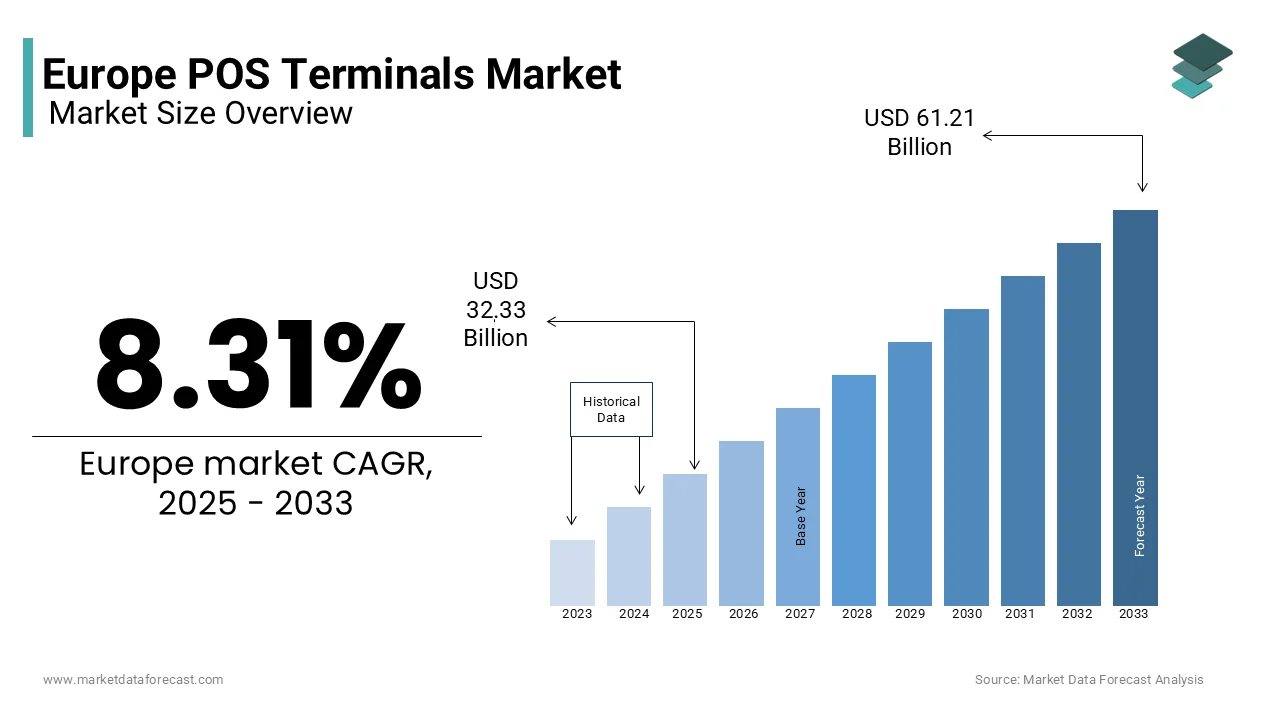
The POS terminals are electronic payment processing devices deployed across retail, hospitality, transportation, and healthcare sectors to facilitate secure and efficient transaction execution. These systems range from traditional countertop terminals to mobile and cloud-based solutions. The Payment Services Directive 2 (PSD2) and strong EMV compliance have driven standardization and security enhancements across terminal deployments. The integration of POS systems with inventory management, customer loyalty programs, and e-receipts has transformed them from mere transaction tools into strategic business intelligence platforms, reinforcing their centrality in modern retail ecosystems.
MARKET DRIVERS
Accelerated Shift Toward Cashless and Contactless Payments
The wide adoption of cashless transaction habits is a major driving factor for the growth of Europe POS Terminals Market. The total number of contactless transactions reached 23.2 billion in the second half of 2023. According to Sveriges Riksbank and Danmarks Nationalbank, in countries like Sweden and Denmark, cash usage in retail has declined to less than 10% of total transactions by compelling merchants to adopt reliable digital payment infrastructure. In Germany, 73% of consumers had to change their preferred payment method (cash) during the pandemic, with 48% trying contactless. Italy is described as one of the most advanced contactless countries, with nearly 44% of Italian respondents stating they had tried contactless due to the pandemic. The EU’s Digital Single Market strategy promotes interoperable payment systems by encouraging cross-border compatibility of POS terminals. This behavioral and regulatory momentum ensures sustained demand for modern, secure, and user-friendly terminals across small, medium, and large enterprises.
Expansion of Small and Medium-Sized Enterprises (SMEs) in the Digital Economy
The presence of millions of enterprises and the expansion of SMEs are other prominent factors escalating the growth of the Europe POS Terminals Market. As per Eurostat, SMEs accounted for 49% of private-sector employment in 2023, with increasing digitalization across markets, pop-up stores, and delivery services. Many of these businesses, especially in food trucks, independent retail, and freelance services, require affordable, portable POS systems that support card-on-file, QR payments, and real-time sales tracking. According to the European Commission’s SME Digitalization Scoreboard, the number of micro-businesses using digital payment terminals rose between 2020 and 2023. Companies like SumUp, iZettle (acquired by PayPal), and Adyen have expanded their footprint by offering low-cost, SIM-enabled terminals with plug-and-play functionality.
MARKET RESTRAINTS
Fragmented Regulatory and Interoperability Standards Across Countries
The lack of fully harmonized payment regulations and technical standards across member states is significantly restraining the Europe POS Terminals Market growth. While PSD2 mandates open banking and strong customer authentication (SCA), national interpretations and implementation timelines vary by complicating terminal certification and software updates. The tax compliance requirements, such as mandatory electronic cash register logging in Germany (GoBD) and Austria’s Fiscalization Act, require hardware-level adaptations by increasing deployment costs.
High Upfront Costs and Maintenance Burden for Legacy Systems
Many small retailers and independent operators in Europe continue to rely on outdated POS infrastructure because the high cost of upgrading to modern, compliant systems is hindering the growth of the Europe POS Terminals Market. Replacing these systems involves not only hardware expenses, which may range from €300 to €1,200 per unit, but also integration with accounting software, staff training, and potential downtime. The ongoing maintenance, software licensing, and subscription fees for cloud-based services add to the financial burden. The European Association of Craft, Small and Medium-Sized Enterprises (UEAPME) reported that half of the microbusinesses cite cost as the primary reason for delaying digital payment adoption. This economic constraint limits market penetration in rural and low-income regions by slowing the transition to a fully digital transaction ecosystem.
MARKET OPPORTUNITIES
Integration of POS Terminals with AI-Powered Business Analytics
The integration of artificial intelligence to deliver actionable business insights beyond transaction processing is creating a major opportunity for the growth of the Europe POS Terminals Market. Modern POS systems are evolving into intelligent platforms capable of analyzing sales patterns by forecasting inventory needs and personalizing customer engagement. As per a 2023 study by Capgemini Research Institute, more than half of mid-sized retailers in Germany and the Netherlands now use AI-enhanced POS data to optimize pricing and promotions. Companies like Shopify and Lightspeed offer terminals linked to dashboards that track customer lifetime value, peak traffic hours, and product performance. The European Commission’s Data Act, set to take effect in 2025, will further enable SMEs to leverage their transaction data for competitive advantage.
Rise of Mobile-First and Cloud-Based POS Ecosystems
The proliferation of mobile-first and cloud-managed POS solutions presents a major growth avenue, particularly for agile and non-traditional retail environments is acting as another emerging opportunity for the Europe POS Terminals Market growth. According to the recent GSMA Mobile Economy Europe 2025 report, as of 2024, 88% of the population in Europe subscribed to a mobile service, with mobile internet adoption at 79%. Cloud-based platforms like Square, SumUp, and Zettle allow merchants to manage sales, issue invoices, and access capital from a single app by reducing dependency on fixed infrastructure. The mobile POS systems offer real-time synchronization, remote updates, and scalable subscription models, making them ideal for seasonal and temporary operations.
MARKET CHALLENGES
Cybersecurity Threats and Data Privacy Compliance Risks
The increasing sophistication of cyberattacks targeting POS systems poses a significant challenge to the Europe POS terminals Market. The 2023 IOCTA covered online fraud schemes and payment system threats, confirming that fraud against payment systems is often driven by the theft of personal and financial information. A German retailer, Metro AG, experienced an attack in 2022 that led to widespread IT outages. This attack did affect payment systems, POS systems, and checkout systems across its stores. Compliance with the General Data Protection Regulation (GDPR) requires that all payment data be encrypted and stored securely, but many SMEs lack the technical expertise to maintain PCI DSS certification. The risk of reputational damage and regulatory fines up to 4% of annual turnover under GDPR is creating hesitation among merchants to adopt new digital payment technologies without robust vendor-backed security guarantees.
Rapid Technological Obsolescence and Vendor Lock-In
The fast pace of innovation in POS technology is creating a challenge of premature obsolescence and dependency on proprietary ecosystems, which is limiting the growth of the Europe POS Terminals Market. Many modern terminals are designed to work exclusively with specific software platforms or payment processors by limiting interoperability and creating vendor lock-in. The average lifecycle of a POS terminal has decreased from eight to four years due to evolving security standards and consumer expectations for faster, multi-modal payments. According to a 2023 report by the European Digital SME Alliance, half of the small businesses expressed concern about investing in systems that may become incompatible within a few years. This uncertainty discourages long-term adoption and forces vendors to shift toward subscription-based models by raising sustainability questions for budget-constrained operators across the region.
REPORT COVERAGE
| REPORT METRIC | DETAILS |
| Market Size Available | 2025 to 2034 |
| Base Year | 2025 |
| Forecast Period | 2026 to 2034 |
| CAGR | 8.31% |
| Segments Covered | By Component, Type, End-user Industries, and Country |
|
Various Analyses Covered | Regional & Country Level Analysis, Segment-Level Analysis, DROC, PESTLE Analysis, Porter’s Five Forces Analysis, Competitive Landscape, Analyst Overview on Investment Opportunities |
| Countries Covered | UK, France, Spain, Germany, Italy, Russia, Sweden, Denmark, Switzerland, Netherlands, Turkey, Czech Republic, and the Rest of Europe |
|
Market Leaders Profiled | Ingenico Group (Worldline), NEC Corporation, NCR Corporation, Izettle UK (PayPal), and Verifone Inc. |
SEGMENTAL ANALYSIS
By Component Insights
The hardware segment dominated the market and held 55% of the Europe POS terminals market share in 2024, owing to its essential role of physical devices like card readers and self-service kiosks in facilitating transactions. According to the European Central Bank, contactless hardware systems accounted for over 70% of all payment devices in 2022, driven by consumer demand for fast and secure payments. This segment's importance lies in its foundational role, as software and services depend on reliable hardware. However, high costs and rapid obsolescence challenge growth.
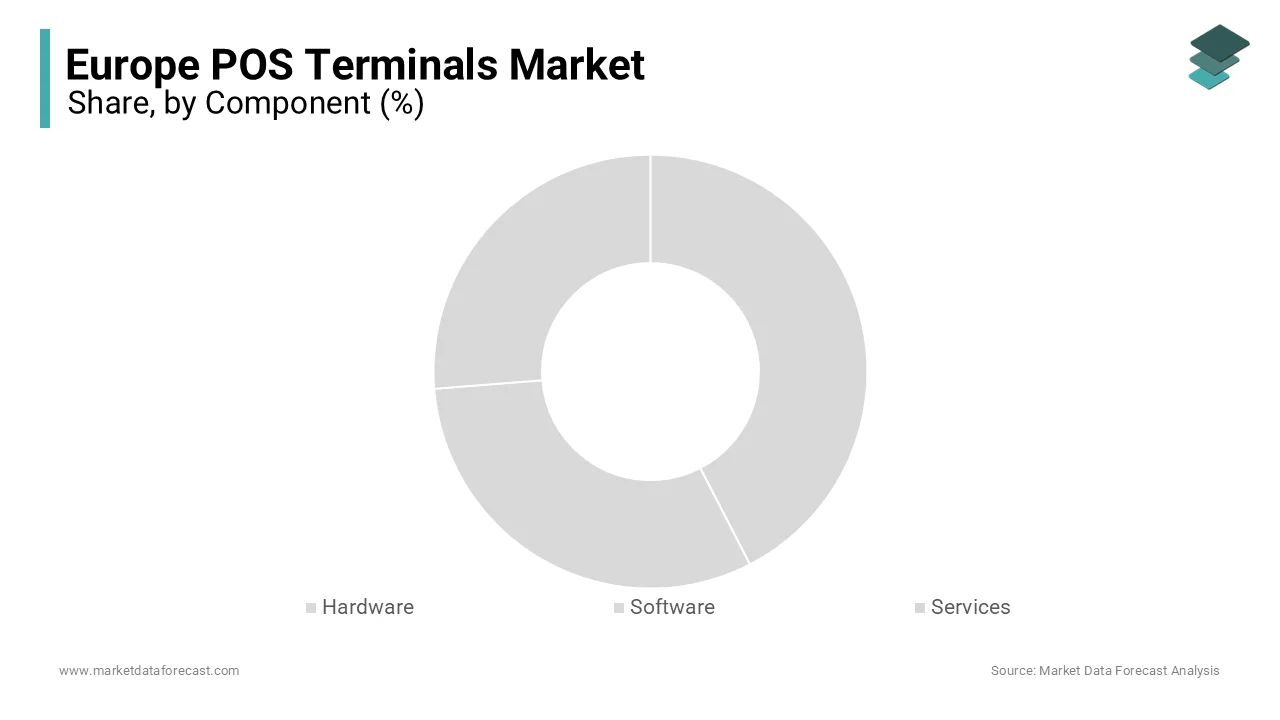
The software segment is likely to experience a CAGR of 18.1% from 2026 to 2034, with the adoption of cloud-based solutions, with the European Investment Bank reporting a 25% annual rise in businesses integrating AI-driven analytics. Software’s scalability and ability to enhance customer experience make it critical for modern POS systems. This segment’s rapid expansion is due to its transformative role in streamlining operations and boosting profitability across industries.
By Type Insights
The Fixed Point-of-Sale Systems segment led the Europe POS Terminals Market by occupying 52.3% share in 2024. The entrenched presence in established retail, supermarket, and pharmacy environments, where transaction volume and reliability are escalating the segment growth. Fixed terminals offer robust integration with inventory management, barcode scanners, and cash drawers, making them essential for high-throughput operations. According to Eurostat, the number of POS terminals in the EU-27 reached approximately 21.7 million in 2024. Germany and France are among the countries with the highest retail trade turnover and significant numbers of retail outlets. According to the European Commission, most of the large retailers comply with EMV and PCI DSS standards through fixed terminals by ensuring secure, auditable transactions. The tax compliance mandates in countries like Italy and Austria require certified fiscal registers, which are predominantly implemented via fixed systems by reinforcing their continued dominance in regulated, high-volume environments.
The Mobile/Portable Point-of-Sale Systems segment is projected to expand at a CAGR of 14.7% from 2026 to 2034 in the Europe POS Terminals Market. The rise of non-traditional retail formats, which includes pop-up stores, street vendors, delivery services, and event-based commerce. These systems leverage smartphone connectivity, cloud-based software, and Bluetooth card readers by enabling low-cost entry into digital payments. SumUp and iZettle report that over a million microbusinesses in Europe now use portable terminals, with average setup costs. The European Commission’s SME Strategy actively promotes mobile payment access to formalize informal trade, while 5G network expansion enhances real-time transaction processing.
By End-user Industries Insights
The Retail sector segment dominated the Europe POS Terminals by capturing an estimated 45.3% share in 2024. The sector’s vast network of physical stores, hypermarkets, and specialty shops, requiring reliable, high-volume transaction processing, is primarily enhancing the segment growth. According to Eurostat statistics, the retail trade sector had approximately 5.8 million enterprises across the EU in 2022. This was part of a larger distributive trade sector of 5.8 million enterprises, making it one of the largest enterprise populations in the EU business economy. The shift toward unified commerce has accelerated the deployment of smart terminals that sync online and in-store data, with most of the mid-sized retailers in Germany and the Netherlands adopting cloud-connected POS platforms by 2023. The EU’s anti-tax evasion directives have mandated electronic transaction logging in all formal retail outlets, driving the replacement of legacy cash registers with compliant POS systems. This regulatory and operational imperative ensures retail remains the primary driver of terminal procurement and innovation.
The Hospitality sector is projected to grow at a CAGR of 13.9% from 2026 to 2034 in the Europe POS Terminals Market. The post-pandemic revival of tourism and dining-out culture is coupled with the need for faster, contactless service, is propelling the segment growth. As per Eurostat, overnight stays in EU hotels and short-term rentals reached 2.9 billion in 2023, nearing pre-pandemic levels, with restaurants and cafes reporting an increase in card-based transactions. Modern hospitality POS systems now integrate tableside ordering, kitchen display systems, and direct payment processing by reducing wait times and improving customer experience. Cloud-based platforms like Lightspeed and Shopify POS enable real-time analytics and staff management, while compliance with PSD2 and GDPR ensures secure data handling.
COUNTRY-LEVEL ANALYSIS
Germany POS Terminals Market Insights
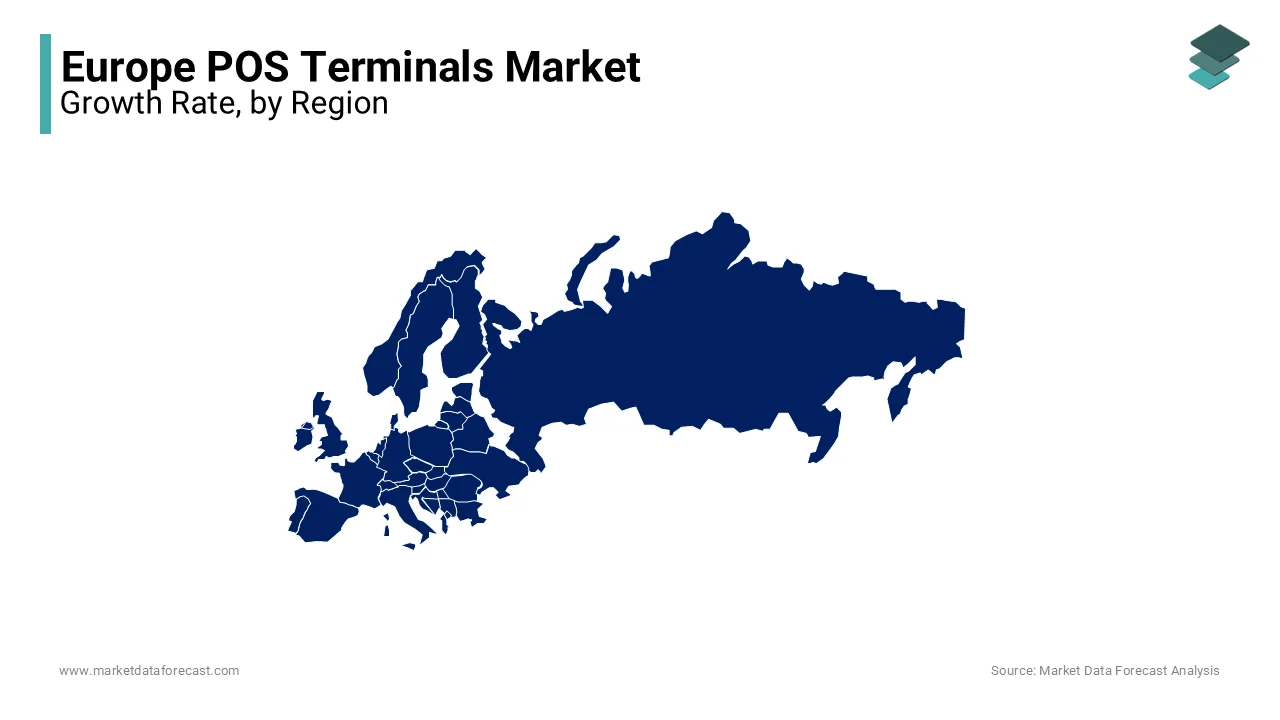
Germany dominated the Europe POS Terminals Market by capturing 22.6% share in 2024. The country serves as a technological and regulatory benchmark for payment infrastructure, with a highly formalized retail and service economy demanding advanced, compliant systems. German businesses operate under the GoBD (Grundsätze zur ordnungsmäßigen Führung und Aufbewahrung von Büchern, Aufzeichnungen und Unterlagen in elektronischer Form) and Kassenbonpflicht (fiscal receipt requirement) is mandating tamper-proof electronic cash registers and secure transaction logging. The country hosts leading terminal providers such as DATEV and TSE-certified vendors, and major retailers like Aldi and Lidl utilize integrated POS networks across thousands of stores. Germany’s strong industrial base supports innovation in secure payment hardware, with Fraunhofer Institute collaborating on encryption technologies. This blend of regulatory rigor, enterprise density, and technical expertise enhance the Germany’s prominence in the regional POS ecosystem.
United Kingdom POS Terminals Market Insights
United Kingdom held the significant value in Europe POS Terminals Market by capturing 18.7% share in 2024, which is shaped by a mature digital economy and high consumer reliance on card and contactless payments. Despite Brexit, the UK remains a hub for fintech innovation, with companies like SumUp, Zettle, and Barclaycard driving POS adoption across SMEs. Contactless payments made up to 60% of all British card payments. While a significant majority, this is lower than the 82% stated in the user query. According to the Bank of England, the average UK consumer makes over 250 non-cash transactions annually is creating sustained demand for reliable terminal infrastructure. The hospitality sector’s rapid rebound post-pandemic has accelerated mobile POS deployment in pubs, cafes, and food markets. With London serving as a European fintech epicenter, the UK continues to lead in payment innovation and terminal modernization.
France POS Terminals Market Insights
France POS Terminals Market is distinguished by strong government-led digitalization and fiscalization efforts. As per the French Ministry of Economy and Finance, over 1.3 million SMEs upgraded their systems by 2023 to comply with the law. France also leads in mobile POS adoption among artisans, street vendors, and farmers’ markets, which is supported by government-backed digital inclusion programs. Companies like Ogone (Adyen) and Payline have expanded their services to independent operators which is offering plug-and-play solutions. With high consumer trust in digital payments and continued public investment in SME digitization, France is a pivotal market for both fixed and mobile terminal innovation.
Italy POS Terminals Market Insights
Italy POS Terminals Market is characterized by a mix of advanced urban commerce and lagging rural digitization. As per the sources, over millions of electronic invoicing-compliant POS systems were installed by 2023 which is linked to the national tax platform (Sistema di Interscambio). However, a 2023 report by Confcommercio revealed that 38% of small shops in Southern Italy still rely on outdated or non-fiscalized terminals. The retail and hospitality sectors are leading modernization, with Milan and Rome adopting cloud-based systems at rates comparable to Northern Europe. The rise of fintech startups like Nexi and Satispay is accelerating mobile payment integration. While fragmentation persists, Italy’s regulatory push and growing digital awareness are creating a fertile environment for next-generation POS deployment.
Netherlands POS Terminals Market Insights
Netherlands POS Terminals Market stands out for its highly cashless society and advanced fintech infrastructure. According to Statistics Netherlands (CBS), contactless payments dominate, with over 95% of adults using debit cards regularly. The country’s dense urban centers and high concentration of SMEs over 1.2 million, per Eurostat have created strong demand for scalable, cloud-managed POS solutions. Amsterdam serves as a European hub for payment innovation, hosting global players like Adyen and Mollie, which integrate terminals with e-commerce and subscription billing. The Dutch government supports digital entrepreneurship through the Digital Economy Agenda, promoting secure, interoperable payment systems. With widespread 5G coverage and a culture of technological adoption, the Netherlands is a model for seamless, integrated POS deployment across retail, hospitality, and mobile commerce.
COMPETITIVE LANDSCAPE
The competition in the Europe POS terminals market is shaped by a dynamic interplay of technological innovation, regulatory compliance, and shifting consumer behavior. Established players like Ingenico and Verifone dominate through advanced hardware and deep integration with financial networks, while disruptors such as SumUp and Adyen challenge traditional models with mobile-first, low-cost solutions tailored for SMEs. The market is fragmented across segments, with specialized vendors targeting retail, hospitality, and micro-enterprises. Differentiation increasingly hinges on software capabilities, which includes cloud management, AI-driven analytics, and omnichannel functionality. Regulatory mandates like PSD2 and national fiscalization laws create high barriers to entry by favoring companies with certified, secure systems. The rise of open banking and embedded finance is intensifying collaboration between terminal providers and fintechs, which is blurring traditional boundaries.
KEY MARKET PLAYERS
The major players in the Europe pos terminals market include
- Ingenico Group (Worldline)
- NEC Corporation
- NCR Corporation
- Izettle UK (Paypal)
- Verifone Inc.
TOP LEADING PLAYERS IN THE MARKET
- Ingenico, now fully integrated into Worldline has dominated the Europe POS Terminals Market which is renowned for its secure, scalable, and EMV-compliant payment solutions. The company has pioneered next-generation terminals supporting contactless, mobile, and e-commerce payments is widely adopted across retail, hospitality, and transportation sectors. Its devices are certified under the EU’s stringent SCD (Secure Crypto Device) standards and integrated with major acquirers and banks. In the Asia Pacific region, Ingenico has maintained a strong presence through localized partnerships with banks in India, Australia, and Southeast Asia which is offering tailored payment solutions for diverse regulatory environments. In 2023, the company launched a new cloud-managed terminal series in various countries which are optimized for high-speed transaction processing and cybersecurity resilience. Recent investments in AI-driven fraud detection and sustainable hardware design such as energy-efficient processors and recyclable casings escalate its commitment to innovation and environmental responsibility across global markets.
- Verifone plays a significant role in shaping the Europe POS Terminals Market with its advanced payment platforms that combine hardware security, cloud connectivity, and omnichannel integration. The company’s MX and VX series terminals are widely deployed in supermarkets, fuel stations, and public transit systems, which is supporting contactless, QR, and mobile wallet transactions in compliance with PSD2 and GDPR. Verifone collaborates closely with European payment processors and fintechs to ensure seamless integration with local banking infrastructures. In the European market, the company has strengthened its footprint by expanding its service network across the region while launching region-specific solutions for micro-merchants and digital kiosks. Its focus on open-platform systems and cybersecurity certifications positions it as a key enabler of digital commerce transformation across both European and high-growth Asian markets.
- SumUp has emerged as a transformative player in the Europe POS Terminals Market by democratizing access to digital payments for microbusinesses and informal vendors. Headquartered in Berlin, the company offers affordable, no-contract mobile card readers and cloud-based POS software by enabling small retailers, food trucks, and freelancers to accept secure card and contactless payments. Its plug-and-play terminals connect via smartphone apps is eliminating the need for fixed lines or complex installations.
TOP STRATEGIES USED BY THE KEY MARKET PARTICIPANTS
Key players in the Europe POS terminals market employ multifaceted strategies to consolidate their influence and respond to evolving merchant needs. A primary focus is on platformization, where terminals are transformed into intelligent business hubs integrating payments, inventory, customer relationship management, and analytics. Companies invest heavily in cloud-based architectures to enable remote updates, real-time monitoring, and scalability for SMEs. Cybersecurity remains a priority, with vendors incorporating hardware security modules (HSMs), tokenization, and PCI-PTS 6.x compliance to meet EU regulatory demands. Strategic partnerships with banks, fintechs, and e-commerce platforms enhance ecosystem integration and distribution reach. The firms are advancing sustainability by designing energy-efficient devices and using recyclable materials. Expansion into mobile-first and vertical-specific solutions such as hospitality or healthcare is allowing differentiation in a competitive landscape increasingly driven by agility, compliance and total cost of ownership.
RECENT MARKET DEVELOPMENTS
- In July 2025, SumUp introduced a new Android-based all-in-one POS tablet called “SumUp Terminal” in the UK and Netherlands by combining payment processing, inventory tracking, and employee management in a single device by targeting independent cafes and boutique stores to expand its footprint in the Europe POS Terminals Market.
- In November 2023, Verifone launched a cloud-based terminal management system in Italy and Spain, allowing merchants and payment service providers to remotely monitor, update, and troubleshoot thousands of devices by improving operational efficiency and service reliability in the Europe POS Terminals Market.
MARKET SEGMENTATION
This research report on the Europe POS Terminals market is segmented and sub-segmented into the following categories.
By Component
- Hardware
- Software
- Services
By Type
- Fixed Point-of-Sale Terminals
- Mobile/Portable Point-of-Sale Terminals
By End-user Industries
- Entertainment
- Hospitality
- Healthcare
- Retail
- Other End-user Industries
By Country
- UK
- France
- Spain
- Germany
- Italy
- Russia
- Sweden
- Denmark
- Switzerland
- Netherlands
- Turkey
- Czech Republic
- Rest of Europe