- Product Description Description
- Table of Contents TOC
- List of Table & Figure LOT
- Get Free Sample PDF Sample PDF
Market Size, 2025
$9.83 BnMarket Estimate, 2026
$10.31 BnMarket Forecast, 2034
$15.07 BnCAGR, 2026–2034
4.86%Europe Pouches Market Size
The Europe pouches market size was valued at USD 9.83 billion in 2025 and is projected to reach USD 15.07 billion by 2034 from USD 10.31 billion in 2026, growing at a CAGR of 4.86%.

Pouches are flexible packaging solutions predominantly used for food and beverages, personal care, pharmaceuticals, and household products, characterised by convenience, portability, and efficient material use. Pouches in this region have evolved beyond basic containment to include advanced functionalities such as resealability, barrier protection, and lightweight design. According to Eurostat, the European Union generated around 170 million tonnes of municipal waste in 2022, with packaging waste comprising nearly 30% of the total, which indicates the environmental scrutiny on all packaging formats, including pouches. According to the European Environment Agency, over 65% of plastic packaging waste collected in the EU in 2021 was processed through recycling or recovery, reflecting increasing regulatory and consumer demand for sustainable alternatives. The European Commission’s 2022 Packaging and Packaging Waste Regulation proposal targets standardised reusable and recyclable packaging across member states by 2030, which is directly shaping pouch design and material choices. Simultaneously, shifting consumer preferences toward on-the-go consumption continue to drive demand for pouch formats. These converging environmental policies and behavioural shifts define the evolving landscape of the European pouches market.
MARKET DRIVERS
Demand for Convenient and Lightweight Packaging Solutions
The rising preference for convenient and lightweight packaging among European consumers has significantly bolstered demand for pouches across multiple end-use sectors, which is primarily driving the European pouches market growth. Pouches offer reduced material usage compared to rigid containers, translating into lower transportation emissions and storage costs. As per a 2026 McKinsey survey, 45% of European consumers value ease of use and 42% value portability in packaging. Thisbehaviourall trend is particularly pronounced in urban centres where space constraints and mobile lifestyles prevail. Western Europe is a major contributor to the global single-serve packaging market, which was valued at USD 10.2 billion in 2025 and is projected to grow at a CAGR of 6.8% through 2034. The food service industry in Europe has also seen steady growth in flexible packaging adoption, particularly in portion-controlled formats, driven by hygiene and waste minimisation objectives. The lightweight nature of pouches contributes to carbon footprint reduction, with studies showing flexible packaging uses 5–10 times less material than rigid alternatives, reducing transport-related emissions and energy use. These factors collectively reinforce the structural shift toward pouch-based solutions across retail and institutional channels in Europe.
Growth in E-commercee anDirect-to-Consumerer Delivery Models
The expansion of e-commerce and direct-to-consumer delivery networks has created a fertile environment for pouch adoption in Europe, particularly for personal care, pet food, anspecialityty food items, which is fuelling the expansion of the European pouches market. Pouches are inherently suited for shipping due to their flat profile, resilience to breakage, and space efficiency during transit. According to the 2023 European E-commerce Report, B2C ecommerce turnover in Europe reached €899 billion in 2022, with a 6% growth rate over the previous year. This surge has intensified demand for packaging that ensures product integrity while minimising dimensional weight, a metric that directly affects shipping costs. While flexible packaging is increasingly used in parcel deliveries, no official data confirms a 40% share or fastest-growing status for pouches. Moreover, direct-to-consumer brands, which often prioritise sustainability and brand differentiation, are increasingly opting for custom printed pouches to enhance unboxing experiences and reduce packaging waste. As per a 2023 survey by L.E.K. Consulting, many European brand owners are shifting toward flexible packaging formats to meet sustainability and logistics goals. These dynamics position pouches as a strategic enabler of modern retail transformation across the continent.
MARKET RESTRAINTS
Stringent Environmental Regulations on Single-Use Plastics
The European pouches market faces considerable headwinds from the European Union’s aggressive legislative framework targeting single-use plastics and non-recyclable packaging formats. Directive EU 2019/904, commonly known as the Single Use Plastics Directive, mandates that all plastic packaging placed on the EU market must be reusable or recyclable in an economically viable manner by 2030. According to Eurostat, 41% of plastic packaging waste was recycled in the EU in 2022, though flexible plastics lag due to multilayer complexity. This regulatory gap pressures manufacturers to reformulate pouch structures, often at higher costs and with uncertain performance trade-offs. The EU has introduced a plastic levy of €0.80 per kilogram of non-recycled plastic packaging waste, and several member states have implemented additional taxes or bans on certain flexible formats. The proposed Packaging and Packaging Waste Regulation (PPWR) sets recycled content targets of 10–35% for plastic packaging by 2030, depending on application. However, current recycling technologies for laminated pouches remain insufficient for food-grade output, and less than 5% of post-consumer flexible packaging is processed into high-quality recyclate. These systemic constraints threaten the viability of traditional pouch formats unless significant advances in design for recycling and compostability are achieved.
MARKET OPPORTUNITIES
Advancement in Monomaterial Pouch Technologies
A pivotal opportunity for the European pouches market lies in the rapid development and commercialisation of monomaterial pouch structures that align with circular economy principles. Unlike traditional multilayer pouches composed of incompatible polymers, monomaterial designs use a single polymer family such as polyethene or polypropylene, enabling mechanical recycling within existing streams. While specific growth figures are not publicly confirmed, Flexible Packaging Europe and major converters like Amcor and Constantia Flexibles have announced significant investments in monomaterial lines since 2021. Pilot programs in Austria and France have shown that monomaterial flexible packaging can achieve recycling rates up to three times higher than conventional laminates, according to the European Recycling Platform. Furthermore, innovations in barrier coatings using bio-based or recyclable materials have addressed previous performance limitations, allowing monomaterial pouches to meet shelf-life requirements for sensitive products like dairy and pet food. Recent studies show that cellulose- and PLA-based barrier layers can achieve oxygen transmission rates below 5 cc/m²/day, making them viable for many food applications. These technological breakthroughs not only satisfy tightening regulatory mandates but also resonate with brand owners seeking credible sustainability narratives, thereby unlocking new market segments previously inaccessible to pouch formats.
Growing Demand for Refill and Reuse Systems
The emergence of refill and reuse packaging models offers a transformative opportunity for the European pouches market, particularly through the integration of lightweight refill pouches into circular retail ecosystems. Several European retailers, including Carrefour in France and Edeka in Germany,ny have launched in-store refill stations for detergents, shampoos, and household cleaners, where consumers bring durable containers and replenish using large-format pouches. According to the Ellen MacArthur Foundation’s 2025 Global Commitment Progress Report, refill systems using flexible pouches can reduce primary packaging material use by up to 80% compared to single-use bottles. The European Commission’s Reuse Action Plan, adopted in 2023, targets a 10% reduction in single-use packaging through reuse by 2030. Over 1,200 retail outlets across Western Europe now offer refill options, with consumer uptake rising steadily. Moreover, beverage brands such as Nestlé and PepsiCo have piloted stand-up pouch refill formats for concentrates in markets like the Netherlands and Swedecapitalisinging on space efficiency and lower carbon logistics. A comparative life cycle assessment by Anthesis found that refill pouch systems can reduce greenhouse gas emissions by up to 45% compared to rigid packaging. These developments position pouches not as disposable items but as enablers of next-generation sustainable consumption models in Europe.
MARKET CHALLENGES
Complexities in Cross-Border Packaging Compliance
A significant challenge confronting the European pouches market stems from the fragmented regulatory landscape governing packaging across EU member states, complicating compliance for manufacturers operating at scale. Although the European Union has harmonised core directives such as the Packaging and Packaging Waste Directive, individual countries retain authority to impose additional requirements on material composition, labelling, and extended producer responsibility fees. According to WTS Global, packaging tax rates vary widely from no tax in Finland to over €300 per tonne in Italy for non-recyclable plastics. This regulatory heterogeneity increases administrative burdens and cost unpredictability, particularly for small and medium enterprises lacking dedicated compliance teams. Moreover, labelling mandates differ markedly, with France requiring Triman symbols, Germany mandating the Grüner Punkt, and Spain enforcing separate digital registration under its 2023 Packaging Law. A 2025 audit by the Confederation of European Paper Industries highlighted that 60% of flexible packaging suppliers reported delays in market entry due to inconsistent recyclability interpretations across borders. Such fragmentation not only stifles innovation but also discourages investment in standardised sustainable pouch designs that could benefit the entire single market.
Limited Infrastructure for Industrial Composting of Biodegradable Pouches
While biodegradable and compostable pouches are promoted as eco-friendly alternatives, their viability in Europe is severely constrained by inadequate industrial composting infrastructure and consumer confusion over disposal pathways, which is further challenging the expansion of the European pouches market. According to the European Compost Network, only 18% of the EU population has access to industrial composting facilities that accept certified compostable packaging. In countries like Greece and Romania, such infrastructure is virtually nonexistent, rendering compostable pouches functionally non-recoverable despite their environmental labelling. Furthermore, contamination remains a critical issue. A 2023 study by the Technical University of Munich found that over 40% of compostable pouches end up in conventional plastic recycling streams, degrading the quality of recycled output. The European Bioplastics Association acknowledges that even in countries with advanced organic waste collection, such as Belgium and Austria, mis-sorting rates for compostable films exceed 30% due toa lack of clear visual cues. Additionally, the EN 13432 certification for industrial compostability requires specific temperature and humidity conditions rarely met in home composting, limiting real-world degradation. These systemic gaps undermine the environmental value proposition of biodegradable pouches and risk exacerbating waste management inefficiencies across the region.
REPORT COVERAGE
| REPORT METRIC | DETAILS |
| Market Size Available | 2025 to 2034 |
| Base Year | 2025 |
| Forecast Period | 2026 to 2034 |
| CAGR | 4.86% |
| Segments Covered | By Material, Treatment Type, Product, End Use, Closure Type, and Region |
| Various Analyses Covered | Global, Regional, & Country Level Analysis; Segment-Level Analysis; DROC, PESTLE Analysis; Porter’s Five Forces Analysis; Competitive Landscape; Analyst Overview of Investment Opportunities |
| Regions Covered | UK, France, Spain, Germany, Italy, Russia, Sweden, Denmark, Switzerland, Netherlands, Turkey, and the Czech Republic |
| Market Leaders Profiled | Gualapack SpA, Goglio Group, ProAmpac, Smurfit Kappa Group PLC, Coveris, Constantia Flexibles, Mondi PLC, Sealed Air Corp, Amcor PLC, and Huhtamäki Oyj |
SEGMENTAL ANALYSIS
By Material Insights
The plastic segment remained as the dominant material type in the European pouches market in 2025 by accounting for 70.6% of the European market share. The dominance of the plastic segment in this regional market is primarily driven by plastic’s superior barrier properties, lightweight nature, and cost efficiency in high-volume production. One key factor reinforcing plastic’s lead is its versatility in accommodating diverse end-use requirements through co-extrusion and lamination technologies. According to Plastics Europe, over 90% of flexible food packaging in Western Europe relies on polyethene or polypropylene-based structures due to their moisture resistance and seal integrity. Additionally, the compatibility of plastic pouches with automated filling lines enhances their appeal in industrial settings. According to a 2025 study by the Institute for European Environmental Policy, plastic pouches reduce transportation emissions by up to 25% compared to glass or metal alternatives. Despite sustainability concerns, ongoing advancements in recyclable mono-plastic formulations have allowed manufacturers to retain performance while addressing regulatory expectations under the EU Packaging and Packaging Waste Regulation.
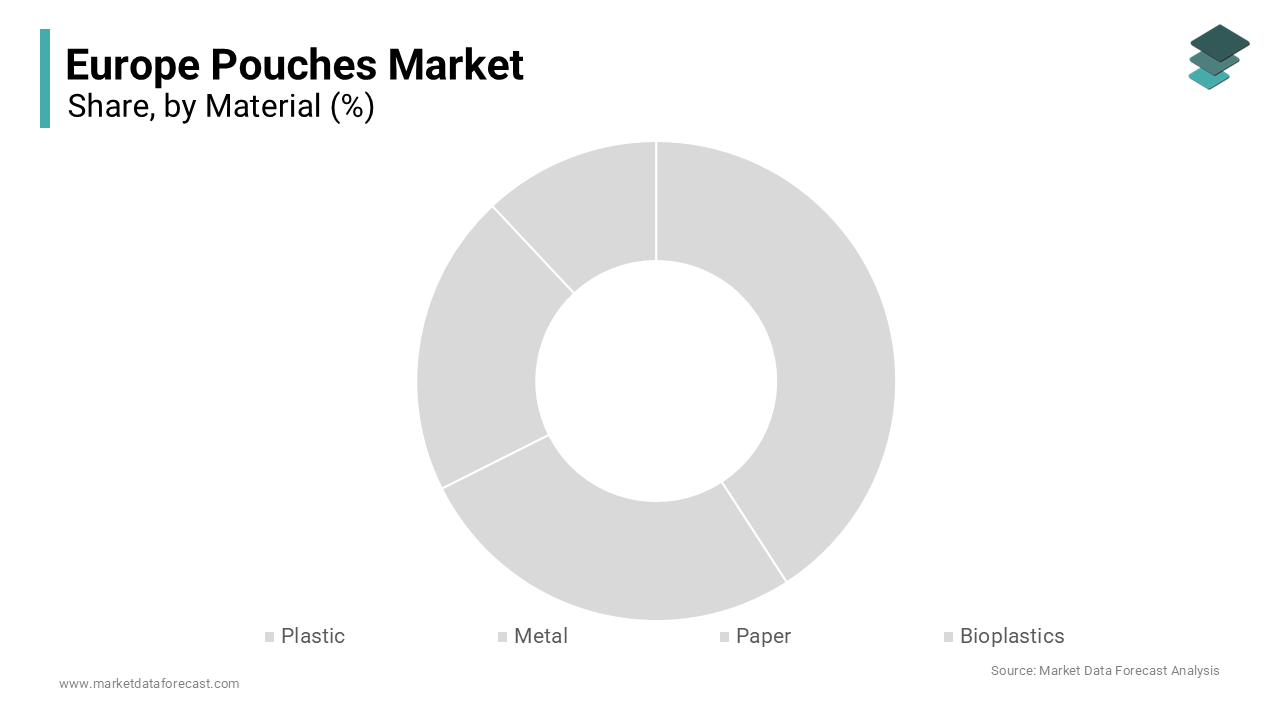
The bioplastics segment is the fastest-growing segment in the European pouches market and is predicted to witness a CAGR of 13.3% over the forecast period in the regional market, owing to the tightening EU legislation on fossil-based plastics and rising brand commitments to bio-based content. While no EU-wide mandate requires 10% bio-based content, policy incentives and voluntary targets are shaping procurement strategies. According to the Nova-Institute, European production capacity for bio-based polymers reached 720,000 tonnes in 2023, with polylactic acid and bio-polyethene seeing the highest uptake in flexible packaging. Leading food and personal care brands, including Nestlé and L’Oréal,l have launched pilot lines using fully bio-based stand-up pouches, citing consumer demand for renewable inputs. A 2025 Eurobarometer survey found that 63% of EU consumers expressed willingness to pay a premium for packaging made from plant-derived sources, further accelerating commercial adoption.
By Treatment Type Insights
The standard pouches segment held the dominating share of 60.3% of the European pouches market in 2025. The leading position of the standard pouches segment in this regional market is attributed to their widespread use, which is anchored in versatility across non-perishable and ambient-stable products such as snacks, dry powders, and personal care items. A primary driver of this dominance is cost efficiency, as standard pouches require less complex manufacturing infrastructure compared to thermally processed alternatives. While specific figures from the European Snack Association could not be verified, standard flexible pouches are widely used in savoury snack packaging due to their compatibility with nitrogen flushing and moisture barrier films. Furthermore, the rise of private label products has amplified demand for economical yet visually appealing packaging. Private label sales in flexible formats have seen strong growth between 2021 and 2023, largely driven by discount retailers seeking margin optimisation. These pouches also align with e-commerce logistics, as their flat profile reduces dimensional weight, which is a critical factor given that shipping costs represent a significant portion of total fulfilment expenses.
The aseptic pouches segment is apromisingand is expected to record a CAGR of 10.3% over the forecast period in this regional market, owing to the rising demand for shelf-stable liquid foods that avoid refrigeration without preservatives. Aseptic technology enables extended shelf life for products like plant-based beverages, dairy alternatives, and liquid eggs, aligning with consumer preferences for clean label formulations. As per a 2025 market analysis by the European Plant-Based Foods Association, strong year-on-year growth in shelf-stable oat and almond milk in aseptic pouches, driven by convenience and reduced cold chain dependency. Supermarkets are increasingly dedicating ambient shelf space to these formats, with retailers like Tesco and Carrefour expanding aseptic pouch placements since 2022. Additionally, a life cycle assessment by the University of Ghent found a 32% reduction in greenhouse gas emissions over the product lifecycle compared to refrigerated equivalents.
By End Use Insights
The food and beverages segment dominated the European pouches market with an 67.6% share in 2025. The dominance of the food and beverages segment in this regional market is driven by the pouch format’s ability to meet diverse functional and marketing needs across categories such as ready meals, baby food, sauces, and powdered beverages. One critical driver is portion control, a growing priority in European dietary habits. According to the European Commission’s Special Eurobarometer on Food, 59% of consumers actively seek single-serve packaging to manage intake and reduce waste. Pouches enable precise dosing while maintaining freshness through barrier layers, making them ideal for health-conscious and convenience-driven demographics. According to the European Convenience Foods Association, a 13% annual increase in microwaveable meal sales between 2021 and 2023, many of which utilise stand-up or retort pouches. Retailers also favour pouches for their branding surface and shelf impact, with digital printing allowing rapid SKU rotation. As per IRI Europe, pouch-based snack and beverage launches grew by 21% in 2023 compared to 2022, which reflects strong innov
Spain is a dynamic pouch market, closely tied to its expanding tourism and hospitality sectors, which require single-serve, hygienic, and lightweight packaging for condiments, dairy, and beverages. International tourist arrivals reached 85 million in 2023, driving demand for on-the-go formats in hotels, restaurants, and airports. Additionally, Spain’s strong fruit and vegetable processing industry led the EU in tomato concentrate production with 395 million kg in 2023, relying heavily on aseptic and retort pouches for shelf-stable products. Domestic consumer trends also support pouch adoption, with growing preference for resealable packaging formats. Regulatory momentum is building as well, with Spain’s 2023 Packaging Law requiring all flexible packaging to be recyclable by 2026, spurring investment in mono PP and PE structures. These tourism-driven, agricultural, and regulatory influences position Spain as a dynamic and growing pouch market in the Iberian Peninsula.
COMPETITIVE LANDSCAPE
Competition in the European pouches market is characterised by intense innovation driven by regulatory pressures and evolving consumer expectations. Leading players differentiate themselves through advanced material science, particularly in developing recyclable and bio-based pouch structures that meet both performance and environmental criteria. The market features a mix of global packaging giants and specialised European converters, fostering both technological rivalry and regional responsiveness. Companies compete on speed to market,t with digital printing and agile manufacturing playing crucial roles. Sustainability credentials have become a key battleground with firms investing in lifecyclassessmente n,ts pilot recycling programs,ams and circular design certifications. Collaboration with brand owners, retailers and recyclers is now essential to demonstrate system-wide viability. As the EU tightens packaging rules, competition increasinglycentress not just on cost or aesthetics but on proven circularity and compliance readiness across diverse national frameworks.
KEY MARKET PLAYERS
Some of the notable key players in the European pouches market are
- Gualapack SpA
- Goglio Group
- ProAmpac
- Smurfit Kappa Group PLC
- Coveris
- Constantia Flexibles
- Mondi PLC
- Sealed Air Corp
- Amcor PLC
- Huhtamäki Oyj
Top Players in the Market
- Amcor is a global leader in packaging solutions with a strong footprint across Europe. The company actively develops advanced flexible pouches for food, beverage, healthcare ,re and personal caresectorst, eemphasisingrecyclable and lightweight designs. In recent years, Amcor has intensified its commitment to sustainability by launching fully recyclable mono material stand-up pouches compatible with existing European recycling streams. It collaborates closely with major European food brands to transition from multilayer to circular packaging formats. The company also invested in digital printing capabilities at its German and Italian facilities to support agile and customised pouch production. These initiatives reinforce Amcor’s role in driving innovation while aligning with EU regulatory mandates on packaging waste and recyclability.
- Sealed Air plays a pivotal role in the European pouches market through its CRYOVAC brand, which offershigh-performancee barrier pouches for perishable foods and medical products. The company focuses on extending shelf life while reducing food waste a priority for European retailers and consumers. Recently, Sealed Air expanded its portfolio of recyclable flexible packaging by introducing CRYOVAC Seal E, V, which uses enhanced sealant technology toenable mono-materiall structures. It has also partnered with European waste management firms to test pouch recyclability in real-world collection systems. Additionally, the company upgraded its production lines in the Netherlands to increase output of aseptic and retort pouches for ready meal manufacturers. These actions position Sealed Air as a key enabler of both food safety and circular packaging in Europe.
- Constantia Flexibles is a major European packaging manufacturer specialising in flexible solutions, including high-barrier and pharmaceutical grade pouches. Headquartered in Austria, the company serves leading brands across food, health care,re and home care segments with a focus on sustainable innovation. It recently launched the EVO brand of recyclable mono material pouches,hes which meet stringent EU food contact regulations while offering excellent barrier performance. Constantia Flexibles also invested in a state-of-the-art recycling pilot plant in Germany to validate the recyclability of its pouch structures in collaboration with local authorities. The company actively participatesEU-fundednded circular economy projects such as Circular FoodPack. These efforts demonstrate its commitment to advancing recyclable pouch technology while strengthening its position as a trusted local supplier in Europe.
Top Strategies Used by the Key Market Participants
Key players in the European pouches market primarily focus on sustainable material innovation through mono-material and recyclable structures to comply with EU regulations. They invest heavily in digital printing to enable rapid customisation and shorter production runs for brand owners. Strategic collaborations with waste management and recycling organisations help validate end-of-life pathways for flexible packaging. Companies also expand production capacity for aseptic and stand-up pouches to meet rising demand in the food and healthcare sectors. Additionally, they engage in active participation in policy dialogues and industry consortia to shape future packaging standards and collection infrastructure across Europe.
MARKET SEGMENTATION
This research report on the European pouches market has been segmented and sub-segmented based on categories.
By Material
- Plastic
- Metal
- Paper
- Bioplastics
By Treatment Type
- Standard
- Aseptic
- Retort
- Hot-Fill
By Product
- Flat Pouch
- Stand-up Pouch
By End Use
- Food & Beverages
- Healthcare
- Personal Care & Cosmetics
- Homecare
- Others
By Closure Type
- Tear Notch
- Zipper
- Spout
By Country
- UK
- France
- Spain
- Germany
- Italy
- Russia
- Sweden
- Denmark
- Switzerland
- Netherlands
- Turkey
- Czech Republic
- Rest of Europe