- Product Description Description
- Table of Contents TOC
- List of Table & Figure LOT
- Get Free Sample PDF Sample PDF
Market Size, 2025
$1.20 BnMarket Estimate, 2026
$1.25 BnMarket Forecast, 2034
$1.74 BnCAGR, 2026–2034
4.19%Europe Poultry Processing Equipment Market Size, Growth, Trends & Forecast (2026–2034)
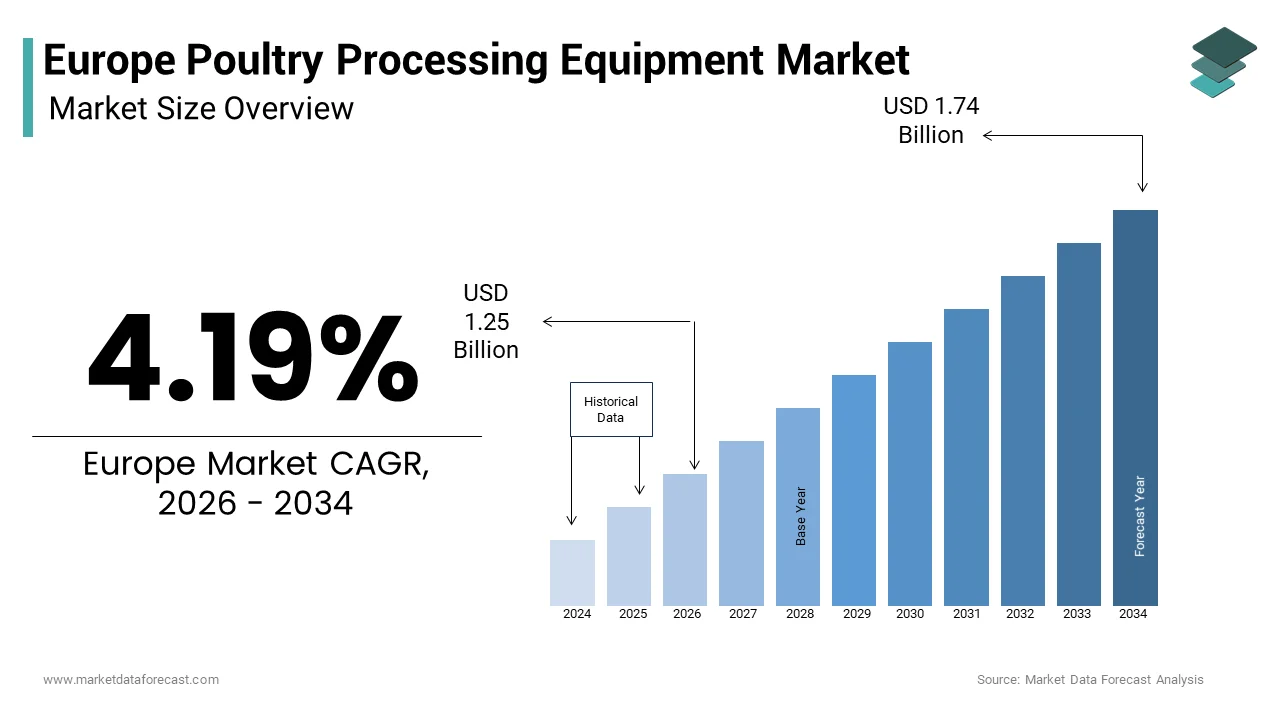
The European poultry processing equipment market size was valued at USD 1.20 billion in 2025, is anticipated to reach USD 1.25 billion in 2026, and is projected to expand up to USD 1.74 billion by 2034, registering a compound annual growth rate (CAGR) of 4.19% over the forecast period from 2026 to 2034. Propelled by strict food safety regulations, rising consumer demand for convenience and value-added poultry products, and accelerated integration of Industry 4.0 predictive maintenance technologies, the market is undergoing steady structural modernization.
Key Executive Metrics (At-a-Glance)
- 2025 Base Valuation: USD 1.20 Billion
- 2026 Current Valuation: USD 1.25 Billion
- 2034 Forecast Valuation: USD 1.74 Billion
- Compound Annual Growth Rate (CAGR): 4.19% (2026–2034)
- Dominant Equipment Segment: Evisceration (Largest Share) & Deboning & Skinning (Fastest-Growing at 9.7% CAGR)
- Dominant Poultry Segment: Chicken (Largest Share) & Duck (Fastest-Growing at 7.3% CAGR)
- Dominant Geographic Region: Germany, France, and the United Kingdom
Core Market Drivers & Restraints
- Drivers: Stringent EU food safety and traceability legislation (Regulation EC No 2160/2003), shifting consumer preference toward pre-cut ready-to-cook meat items, and the adoption of water-efficient/sustainable processing solutions.
- Restraints & Challenges: High initial capital outlays and extended payback periods for fully automated lines, evolving animal welfare requirements (such as the upcoming live shackling ban by 2027), and acute regional labor shortages.
Europe Poultry Processing Equipment Market Segmentation Breakdown
| Segment Category | Largest Segment | Fastest-Growing Segment |
|---|---|---|
| By Equipment Type | Evisceration | Deboning & Skinning (9.7% CAGR) |
| By Poultry Type | Chicken | Duck (7.3% CAGR) |
| By Country | Germany & France | United Kingdom & Spain |
Major Industry Players Profiled
Key European and global market participants include Marel, Baader Food Processing Machinery, Meyn, GEA Food Solutions, Bayle SA, John Bean Technologies Corporation, Key Technology Inc, Prime Equipment Group Inc, CTB Inc, and Cargill Inc.
Europe Poultry Processing Equipment Market Size
The European poultry processing equipment market size was valued at USD 1.20 billion in 2025 and is anticipated to reach USD 1.25 billion in 2026 to reach USD 1.74 billion by 2034, growing at a CAGR of 4.19% during the forecast period from 2026 to 2034.
The Poultry Processing Equipment is specialized machinery and integrated systems designed for the efficient slaughtering, eviscerating, cutting, chilling, and packaging of poultry, including chicken, turkey, and ducks in compliance with stringent food safety ,animal wel,f, and hygiene standards. These systems range from automated live bird handling and stunning units to precision portioning, ng traceability-enabled packaging lines. As per the European Commission, poultry accounts for nearly 38% of total meat consumption in the EU, reflecting sustained consumer preference for lean and affordable protein sources. Concurrently, regulatory frameworks such as the EU Animal Welfare Strategy 2021–2027 and the Farm to Fork initiative mandate higher welfare standards and reduced environmental impact, which necessitate technological upgrades in processing infrastructure.
MARKET DRIVERS
Stringent Food Safety and Traceability Regulations Mandating Technological Upgrades
European poultry processors face mounting pressure to comply with comprehensive food safety legislation that directly drives investment in advanced processing equipment. Therising investment int advanced processing equipment is majorly propelling the growth of the Europe poultry processing equipment market. In response, Regulation EC No 2160 2003 and its subsequent amendments require mandatory pathogen reduction controls throughout the production chain. This regulatory landscape compels processors to adopt automated evisceration systems with leak-proof designs, high-pressure carcass washers, and inline microbial detection sensors. Furthermore, the EU Digital Product Passport initiative under the Circular Economy Action Plan will soon require end-to-end digital traceability from farm to retail, which necessitates equipment embedded with RFID or QR code integration capabilities. These mandates transform compliance from a cost center into a catalyst for capital expenditure on next-generation processing lines that ensure both safety and regulatory alignment across the European single market.
Rising Consumer Demand for Convenience and Value-Added Poultry Products
The shift in European consumer behavior toward ready-to-cook and portion-controlled poultry items is additionally accelerating the growth of the Europe Poultry Processing Equipment Market. According to the European Consumer Organisation, over 68% of households in Western Europe purchased pre-cut or marinated poultry products in 2023. As per Eurostat, sales of value-added meat products grew by 9.4% year on year in the EU, with poultry leading this segment due to its versatility and perceived health benefits. This trend necessitates high precision cutting, ng debon, in, and portioning systems capable of producing consistent fillets, tenders, and boneless thighs at scale. Equipment manufacturers are responding with vision-guided robotic arms and AI-powered portioning machines that minimize yield loss while maintaining product integrity. Processors in countries like Germany, France, and the Netherlands are retrofitting legacy lines with modular automation to meet retailer specifications for uniformity and shelf life.
MARKET RESTRAINTS
High Capital Investment and Long Payback Periods for Advanced Systems
The substantial upfront costs and extended return on investment timelines are solely hampering the growth of the Europe poultry processing equipment market. A fully automated poultry processing line capable of handling 10000 birds per hour requires an initial capital outlay of between 8 million and 12 million euros, depending on integration depth and technology sophistication. As per the German Agricultural Society, small and medium-sized processors, which constitute over 60 % of EU poultry facilities,e, often lack access to affordable financing for such large-scale upgrades. Moreover, the payback period for these systems typically exceeds five years due to moderate throughput volumes and competitive meat pricing pressures. This financial barrier is particularly acute in Eastern and Southern Europe, where average facility sizes are smaller and profit margins thinner. Many processors opt for incremental upgrades s second-hand equipment, which compromises efficiency and compliance. The absence of EU-wide subsidy programs specifically targeting processing automation further limits modernization.
Stringent Animal Welfare Standards Increasing Operational Complexity
Evolving animal welfare regulations are imposing new technical and procedural demands on poultry processing that complicate equipment design and operation, which is limiting the growth of the Europe poultry processing equipment market. According to the European Union Directive, 98 58 EC and the updated guidelines from the European Food Safety Authority, all poultry must be handled in ways that minimize stress and injury during lairage and shackling. The upcoming ban on live shackling for chickens by 2027 will require processors to implement controlled atmosphere stunning systems, which involve significant reconfiguration of existing lines. Furthermore, the EU Animal Welfare Strategy 2021–2027 mandates individual bird tracking and welfare outcome assessments, which necessitate integration of sensors and data analytics into processing machinery.
MARKET OPPORTUNITIES
Integration of Industry 4.0 and Predictive Maintenance Technologies
The integration of poultry processing with Industry 4.0 principles is creating new opportunities for the growth of the Europe poultry processing equipment market. According to the European Association of Poultry Processors, over 45% of large-scale facilities in Germany have initiated digital transformation projects focused on equipment connectivity and data utilization. Modern poultry processing lines are now being equipped with IoT-enabled motors, conveyors, and cutters that feed operational data into centralized dashboards. This enables processors to anticipate component failure, optimize cleaning cycles,les and adjust throughput based on real-time demand signals. Equipment suppliers are capitalizing on this shift by offering modular smart kits that retrofit legacy machines with sensors and cloud analytics. Furthermore, the EU’s Horizon Europe program provides co-funding fordigitalization projectss agri-food processing, which lowers adoption barriers. This synergy between regulatory efficiency goals and digital innovation is creating a high-value niche for intelligent processing equipment across Europe.
Expansion of Sustainable and Water-Efficient Processing Solutions
The growing environmental regulations and corporate sustainability commitments that minimize water, energ,y and waste are also expected to enhance the growth of the Europe poultry processing equipment market. This has spurred innovation in enclosed-loop chilling systems, dry cleanitechnologyi, and air chilling alternatives that reduce water use by up to 70% compared to traditional immersion chilling. Equipment manufacturers are responding with integrated water recovery units, ozone-based sanitation systems, and heat recovery exchangers that capture thermal energy from scalding and chilling processes. Companies like Marel and Meyn have launched eco-certified lines that meet ISO 14046 water footprint standards. Additionally, major retailers such as Carrefour and Tesco now require suppliers to disclose water and carbon metricswhich further incentivizes green equipment adoption. This regulatory and commercial alignment positions sustainability not as a cost but as a competitive differentiator and a key growth vector for equipment providers.
MARKET CHALLENGES
Labor Shortages and Skills Gaps in Operating Advanced Equipment
The European poultry processing industry continues to grapple with acute labor shortages that impede the effective deployment of sophisticated equipment, which is ascribed to poses a challenge for the growth of the Europe poultry processing equipment market. According to the European Labour Authority, meat processing is among the top five sectors facing workforce deficit,,s with vacancy rates exceeding 22% in Germany,y Pola, nd and Spain in 2023. Vocational training programs in countries like France and Italy have not kept pace with technological advances, resulting in a mismatch between available labor and equipment complexity. This human capital gap forces processors to either delay automation or rely on external service providers, which increases operational costs and reduces responsiveness.
Fragmented Regulatory Landscape Across EU Member States
While the European Union provides an overarching food safety and animal welfare framework,,s significant regulatory fragmentation persists at the national le, which complicates equipment standardization and deployment. The fragmented regulatory landscape across EU member states is also hindering the growth of the Europe poultry processing equipment market. This regulatory heterogeneity increases compliance costs for equipment manufacturers who must customize solutions for each market and delays project timelines for processors seeking multi-country operations. Furthermore, countries like Norway and Switzerland, though aligned with EU standards,, rds operate under separate veterinary agreements, which add another layer of complexity. The absence of a unified EU technical passport for processing machinery forces companies to navigate a patchwork of inspection, approval, and documentation requirements.
REPORT COVERAGE
| REPORT METRIC | DETAILS |
| Market Size Available | 2025 to 2034 |
| Base Year | 2025 |
| Forecast Period | 2026 to 2034 |
| CAGR | 4.19% |
| Segments Covered | By Equipment, Poultry, and Region |
| Various Analyses Covered | Global, Regional, and Country-Level Analysis; Segment-Level Analysis; DROC; PESTLE Analysis; Porter’s Five Forces Analysis; Competitive Landscape; Analyst Overview of Investment Opportunities |
| Regions Covered | UK, France, Spain, Germany, Italy, Russia, Sweden, Denmark, Switzerland, Netherlands, Turkey, the Czech Republic, and the Rest of Europe |
| Market Leaders Profiled | Manitowoc, GEA Food Solutions, Brower Equipment, Bayle SA, Tool Works, Marelhf, CTB Inc, Key Technology Inc, John Bean Technologies Corporation, Prime Equipment Group Inc, Baader Food Processing Machinery, Cargill Inc., and Waltons Co. |
SEGMENTAL ANALYSIS
By Equipment Insights
The evisceration segment was the largest by accounting for a dominant share of the Europe poultry processing equipment market in 2025 due to its role in ensuring food safety, hygiene, and regulatory compliance during primary processing. According to the European Food Safety Authority, internal contamination from improper evisceration is a leading cause of microbial cross-contamination in poultry plants. This has driven widespread adoption of high-precision automated evisceration systems equipped with vision sensors and leak detection mechanisms. Modern lines from manufacturers like Marel and Linco integrate real-time feedback to adjust cutter pressure based on bird size, reducing yield loss and improving consistency.
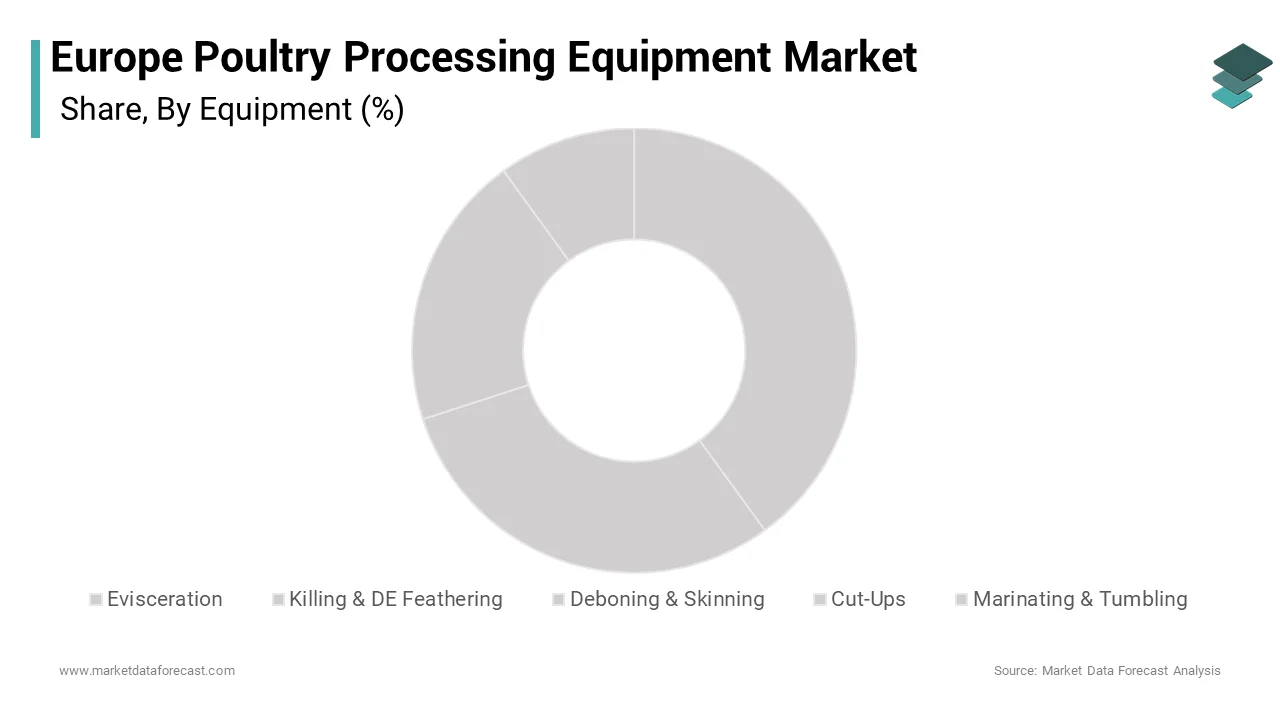
The deboning and skinning equipment segment is projected to grow with a CAGR of 9.7% from 2025 to 2033 owing to the surging consumer demand for boneless, skinless, and ready-to-cook poultry products across the region. As per Eurostat, retail sales of value-added poultry items grew by 11.2% year on year in the with boneless cuts accounting for the majority of this increase. Equipment from companies like Meyn and Baader can achieve yield recovery rates of up to 96% compared to 85% with manual methods. Additionally, the EU Farm to Fork Strategy’s emphasis on reducing food waste incentivizes precision deboning to minimize trim loss. National training initiatives in Germany and France are also addressing the labor shortage in manual deboning by promoting automation adoption.
By Poultry Insights
The chicken segment accounted for in holding a significant share of the Europe poultry processing equipment market in 2024 due to its position as the most consumed poultry species across the continent. The European Union produced 14.2 million metric tons of chicken meat in 2023, representing over 92% of total poultry output. This scale of production necessitates high-throughput processing lines capable of handling tens of thousands of birds per hour, ur which drives consistent demand for integrated chicken-specific equipment across all processing stages. Furthermore, the rise of fast food chains and ready meal manufacturers in countries like Germany and Spain has intensified demand for standardized chicken portions, snacks, which require specialized cutting and portioning machinery. Equipment manufacturers design modular systems specifically for broiler chicken,,s optimizing for uniform size and high line speeds. The sheer volu,, me economics and consumer centrality of chicken solidify its dominance in shaping equipmenspecificationio,, ns investment cycles, and technological innovation across Europe.
The duck processing segment is emerging with a significant CAGR of 7.3% from 2025 to 20,33, owing to the rising gourmet and ethnic food consumption, n particularly in urban centers of France, the UK, and the Netherlands. As per the UK Department for Environment, Food and Rural Affairs, imports of duck meat rose by 12 % year on year in 20,23, reflecting growing popularity in Asian and fusion cuisines. Manufacturers like Stork and Baader developed duck-specific lines featuring adjustable feather removal intensity and precision breast filleting tools. Additionally, premium pricing allows processors to justify higher equipment investments.
COUNTRY ANALYSIS
Germany Poultry Processing Equipment Market Analysis
Germany was the top performer in the European poultry processing equipment market by technological sophistication, large-scale integrated production, and stringent compliance standards. Germany hosts some of Europe’s most advanced processing facilities operated by companies like PHW Group and Plukon, which invest heavily in automation to meet labor shortages and retailer demands. As per the Federal Ministry of Food and Agriculture, German poultry plants have implemented Industry 4.0 solutions, including predictive maintenance and digital traceability. The country’s engineering prowess also supports a robust domestic equipment manufacturing base with firms like GHD Hartmann supplying high precision cut up supplying systems across the EU. Additionally, Germany’s central geographic location makes it a logistics hub for poultry distribution to neighboring countries, which further incentivizes throughput optimization.
France Poultry Processing Equipment Market
The French poultry processing equipment market held second position by its dual focus on industrial broiler production and premium specialty poultry, such as duck and Label Rouge chicken. According to FranceAgriMer, the country produced 1.9 million metric tons of poultry meat in 20,23, with duck alone accounting for over 180000 metric tons. This diversity necessitates a hybrid equipment ecosystem ranging from high-speed chicken lines to specialized duck processing systems with gentle handling features. Major processors like LDC and Doux have invested in modular equipment that can switch between standard and premium modes to optimize asset utilization. Furthermore, France’s strong culinary tradition drives demand for precise portioning and skinning capabilities, particularly for breast and leg cuts.
The United Kingdom Poultry Processing Equipment Market Analysis
The United Kingdom poultry processing equipment market growth is likely to be driven by high per capita consumption, vertically integrated supply chain, and aandpost-Brexit emphasis on domestic food security. As per the Department Environmentonment Food and Rural Affairs, poultry meat sold in the UK is produced domestically by integrated companies like 2 Sisters Food Group and MoyPark, which operate large-scale facilities requiring continuous equipment upgrades. The UK’s departure from the EU has intensified focus on traceability and biosecurity, ty leading to investments in closed-loop processing lines with integrated pathogen monitoring. Additionally, the rise of private-label ready meals has increased demand for automated cutting and marinating systems that deliver consistent portion sizes and marinade absorption. Labor shortages exacerbated by immigration policy changes have further accelerated the adoption of robotic deboning and packing solutions.
Spain's poultry processing equipment market growth is likely to grow with rising domestic consumption,n export orientation, and m of aging facilities. As per the Spanish Poultry Association, many processing plants were built before 2010 and are now undergoing phased upgrades to meet EU hygiene and animal welfare standards. This retrofitting wave is driving demand for modular evisceration and cut-upp systems that can be integrated into existing layouts without full line replacement. Additionally, Spain’s growing tourism and hospitality sector fuels demand for standardized portioned products, which requires investment in precision cutting and packaging equipment. Major processors like Coren and Aviatur have partnered with European equipment suppliers to implement lines that balance cost efficiency with compliance.
COMPETITIVE LANDSCAPE
The Europe poultry processing equipment market features a concentrated yet dynamic competitive landscape dominated by a handful of technologically advanced engineering firms primarily from the Netherlands,, ds Germany, and the Nordic region. Competition is not based on price but on precision,,n regulatory compliance, a nd total cost of ownership over the equipment lifecycle. Marel Baader and Meyn lead through differentiated strengths, where Marel leads in integrated-to-end Baader in high-yielding bottlenecking and Meyn in primary processing and animal welfare-aligned systems. However, competition remains intense in innovation with players racing to embed Industry 4.0 capabilities, w, recycling, and alternative stunning methods into their platforms. This environment fosters continuous advancement but demands sustained investment in both hardware and digital ecosystems to retain relevance in Europe’s highly regulated and sustainability-driven poultry sector.
KEY MARKET PLAYERS
A few of the market players in the europe poultry processing equipment market include
- Manitowoc
- Marel
- Meyn
- GEA Food Solutions
- Brower Equipment
- Bayle SA
- Tool Works
- Marelhf
- CTB Inc
- Key Technology Inc
- John Bean Technologies Corporation
- Prime Equipment Group Inc
- Baader Food Processing Machinery
- Cargill Inc.
- Waltons Co.
Top Players In The Market
- Marel is a global leader in advanced food processing systems with a dominant presence in the Europe poultry processing equipment market. Headquartered in Iceland but deeply integrated into the European industrial ecosystem,t,, he company supplies end solutions, including automated evisceration, on deboning and portioning lines to major processors across Germany, the Nether,d andnce. Marel has strengthened its position through continuous innovation in water-efficient chilling and vision-guided robotics. In recent years, the company has expanded its service network across Southern and Eastern Europe, offering predictive maintenance and digital twin simulations to optimize line performance.
- Baader is a German engineering powerhouse renowned for its high precision poultry processing equipment, particularly in deboning, skinning, and portioning. The company serves premium and industrial clients across Europe with machinery designed for maximum yield and minimal waste. Baader has reinforced its market standing by launching AI-enhanced deboning systems that adapt to bird anatomy in real-time, significantly improving meat recovery rates. The company has also deepened collaborations with poultry integrators in Spain and the UK to develop solutions for boneless, ready-to-cook products. Its recent investment in a digital training academy for technicians ensures skilled operation of its advanced system,,s addressing Europe’s labor shortage challenge while enhancing customer retention and system uptime.
- I, in the Netherlands-based subsidiary of CTInc..nc and part of Berkshire Hathaw, ay is a key innovator in primary poultry processing equipment across Europe. The company specializes in killing and cutting up systems that comply with the EU’s strictest animal welfare and food safety standards. Meyn has recently accelerated its focus on controlled atmosphere stunning and leak-proof evisceration to support the upcoming EU ban on live shackling. It has also introduced modular line designs that allow processors to scale capacity without full replacement.
Top Strategies Used By The Key Market Participants
Key players in the Europe poultry processing equipment market are pursuing multifaceted strategies to maintain a competitive advantage and drive growth. They are heavily investing in research and development to create water andenergy-efficientt systems that align with the EU Farm to Fork and Circular Economy Action Plan mandates. Companies are integrating artificial intelligence and machine vision into deboning and portioning equipment to maximize yield and reduce labor dependency. Strategic partnerships with large poultry integrators enable the development of customized solutions and real-world validation of new technologies. Expansion of after-sales service network,,s including remote diagnostics and technical training, addresses operational challenges in an era of skilled labor shortages. Additionally, firms are offering modular and retrofit solutions to help mid-sized processors upgrade legacy systems cost-effectively. Digitalization through IoT-enabled predictive maintenance and performance dashboards is becoming a standard value-added offering. These strategies collectively enhance customer loloyaltyegulatorcocomplianceece anlong-termrm market penetration across diverse European production environments.
MARKET SEGMENTATION
This research report on the Europe poultry processing equipment market is segmented and sub-segmented into the following categories.
By Equipment Type
- Evisceration
- Killing & DE Feathering
- Deboning & Skinning
- Cut-Ups
- Marinating & Tumbling
By Poultry Type
- Turkey
- Duck
- Chicken
By Country
- United Kingdom
- France
- Spain
- Germany
- Italy
- Russia
- Sweden
- Denmark
- Switzerland
- Netherlands
- Rest of Europe