- Product Description Description
- Table of Contents TOC
- List of Table & Figure LOT
- Get Free Sample PDF Sample PDF
Market Size, 2025
$1.83 BnMarket Estimate, 2026
$1.95 BnMarket Forecast, 2034
$3.26 BnCAGR, 2026–2034
6.62%Europe Power Management System Market Size
The European power management system market size was valued at USD 1.83 billion in 2025 and is projected to reach USD 3.26 billion by 2034 from USD 1.95 billion in 2026, growing at a CAGR of 6.62%.
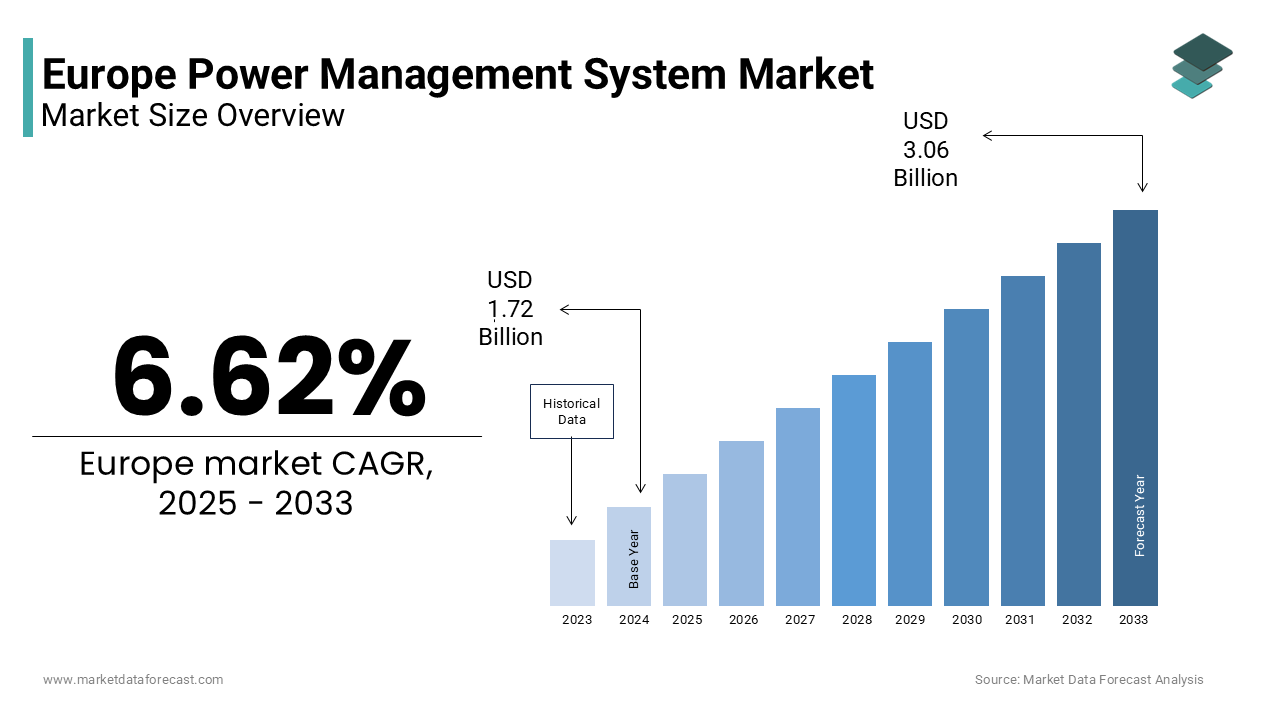
A power management system refers to an integrated suite of hardware and software solutions designed to monitor, control, optimise, and protect electrical energy flow across residential, commercial, industrial, and grid-scale infrastructure. These systems include energy meters, circuit protection devices, uninterruptible power supplies, smart switches, and advanced software platforms that enable real-time load balancing, predictive maintenance, and demand response. The deployment of such systems has become strategically vital as Europe accelerates its energy transition under the European Green Deal, which mandates a reduction in greenhouse gas emissions by 2030 and net zero by 2050. According to sources, buildings alone account for a portion of the EU’s total energy consumption, with inefficient power distribution contributing to significant losses. As per research, the share of renewable energy in the EU's gross final energy consumption has shown continuous and consistent growth over the past several years, although ongoing progress is needed to meet the ambitious future targets for the end of the decade. The expansion of variable renewable sources such as wind and solar energy is a major driver of this positive trend. Furthermore, the European Commission’s Energy Efficiency Directive requires all large enterprises to conduct mandatory energy audits every four years, driving adoption of granular monitoring systems. Coupled with rising electricity prices, these factors position power management systems not as auxiliary tools but as essential instruments for energy sovereignty, cost control, and grid stability across Europe.
MARKET DRIVERS
EU Energy Efficiency Mandates Accelerate Industrial and Commercial Adoption
Stringent regulatory requirements under the European Union’s Energy Efficiency Directive are a primary driver for the European power management system market. The directive mandates that all large enterprises conduct certified energy audits every four years and implement cost-effective efficiency measures. According to sources, the European Union's energy efficiency policies emphasise data monitoring and energy management systems as crucial tools for identifying significant energy savings opportunities across member states. In response, companies like Siemens and BASF have installed advanced power management platforms across their European facilities to track energy use by production line, enabling targeted optimisation. Official reports and industry analyses in Germany and across the EU indicate that implementing robust energy management systems in industrial settings consistently leads to substantial improvements in energy efficiency. Besides, revisions to the European Union's Energy Performance of Buildings Directive are driving a significant increase in the mandatory adoption of automated energy management and building automation control systems in commercial and non-residential properties. These legally binding frameworks transform power management from an operational choice into a compliance necessity, ensuring sustained demand across Europe’s energy-intensive sectors.
Integration of Distributed Renewable Energy Sources Demands Intelligent Grid Management
The rapid proliferation of decentralised renewable generation, particularly rooftop solar and on-site wind, is creating unprecedented complexity in Europe’s low and medium-voltage distribution networks, which necessitates advanced power management systems. This further contributes to the expansion of the European power management system market. According to sources, solar capacity in the region has experienced significant growth, largely driven by residential and commercial installations. This distributed generation introduces bidirectional power flows, voltage fluctuations and protection coordination challenges that legacy grids were not designed to handle. The increase in local renewable energy production has led to reports of grid congestion in several member states. In response, distribution system operators like Enedis in France and Tennet in the Netherlands are deploying smart power management systems with real-time voltage regulation, islanding detection and dynamic load shedding capabilities. Regulatory frameworks now mandate that distribution grid operators implement digital monitoring and control systems to support higher levels of renewable integration. Intelligent power management is crucial for grid resilience and the integration of renewable energy as Europe transitions to a decentralised energy system.
MARKET RESTRAINTS
High Upfront Investment and Fragmented ROI Justification Deter SME Uptake
The adoption of these advanced systems among the region’s small and medium enterprises remains constrained by significant capital costs and uncertain return on investment timelines, which in turn restricts the growth of the European power management system market. According to sources, the vast majority of European enterprises operate as small and medium-sized entities characterised by narrow profit margins and restricted capital for secondary expenditures. Implementing a full-scale industrial power management infrastructure requires a significant capital investment that often represents a substantial portion of an organisation's yearly earnings. High initial costs for energy monitoring and protection technologies contribute to widespread financial caution among smaller business owners. Moreover, energy savings alone often fail to justify the investment. There is a notable discrepancy between the rapid return on investment required by businesses for project approval and the actual time needed to realise cost savings through energy efficiency. The European Investment Bank provides green loans, but their adoption is minimal, a situation attributed to the challenging application processes and a general absence of internal energy expertise. Europe's extensive SME sector will not achieve its full market potential and will remain under-automated until modular, scalable, or subscription-based business models become more established.
Lack of Interoperability Standards Across Legacy and Modern Systems
The absence of universal communication protocols and data formats creates significant integration barriers between new power management systems and the region’s heterogeneous legacy electrical infrastructure, which hinders the expansion of the European power management systems market. Many industrial facilities still operate with decades-old switchgear motor controls and meters that lack digital interfaces or support only obsolete protocols like Modbus RTU. According to research, a notable portion of power devices installed in certain factories are not compatible with modern management platforms unless significant investment in gateways or replacements is made. This fragmentation increases engineering complexity and deployment time. A majority of machinery manufacturers in one assessment experienced project delays related to protocol differences during power system upgrades. Although initiatives like the EU’s SAREF ontology and IEC 61850 aim to standardise energy data models, adoption remains voluntary and inconsistent across vendors. Consequently, end users often lock into single supplier ecosystems to avoid integration risks, stifling innovation and competition. The complete potential for integrated power management across Europe’s ageing industrial base cannot be realised until the upcoming Ecodesign for Energy Related Products Regulation mandates interoperability requirements.
MARKET OPPORTUNITIES
Expansion of Data Centres Drives Demand for High-Density Power Management
The region's digital economy is fueling explosive growth in data centre construction, which provides new opportunities for the European power management system market. This growth creates a high-value niche for advanced power management systems that ensure uptime efficiency and thermal control. European data centre infrastructure is expanding through the commissioning of numerous hyperscale and edge facilities. The cumulative energy requirements of these facilities have reached a scale comparable to the residential consumption of an entire nation. Operational efficiency standards require advanced technical capabilities, including precise load balancing, seamless power switching, and predictive maintenance analytics. Regulatory mandates for energy monitoring and reporting are driving the integration of intelligent power distribution hardware and management software. Companies deploy AI-driven power management platforms in their Frankfurt and Amsterdam hubs that dynamically shift workloads based on grid carbon intensity and electricity pricing. Europe's intensifying reliance on digital infrastructure, driven by cloud computing, AI training, and data localisation regulations, ensures the digital sector remains a key growth area for high-reliability power management solutions.
Rise of Smart Building Initiatives Enables Holistic Energy Optimisation
The European Union’s push toward intelligent building ecosystems is unlocking integrated power management opportunities that extend beyond metering to encompass HVAC, lighting and occupancy systems. This offers fresh prospects for the European power management system market. Under the revised Energy Performance of Buildings Directive, all new public buildings in the EU must achieve zero-emission building (ZEB) status by 2028, and all other new buildings by 2030, with a focus on deep energy retrofits for the existing building stock over time. As per sources, the European Commission's Renovation Wave strategy encourages a significant increase in the annual energy renovation rate across the EU, emphasising deep renovation of public and private buildings to integrate smart technologies like power monitoring and advanced building management systems. In Sweden, the state-owned property company Akademiska Hus has implemented AI-powered energy management systems across numerous university campuses to dynamically adjust energy use, such as lighting and ventilation, based on real-time occupancy data and electricity grid signals. Similarly, the City of Paris, aligning with broader national and EU directives, requires large commercial buildings to install building automation and control systems to optimise energy performance and reduce emissions. These initiatives transform power management from a standalone electrical function into a core component of building intelligence, which enables demand response participation, grid services and carbon tracking. Europe's ongoing digitisation of its built environment, supported by favourable policies, creates a significant and scalable growth opportunity for integrated power management platforms.
MARKET CHALLENGES
Cybersecurity Vulnerabilities in Connected Power Infrastructure Pose Systemic Risks
The increasing connectivity of power management systems exposes the region’s critical energy infrastructure to escalating cybersecurity threats that affect trust and deployment, and thereby challenge the growth of the European power management system market. Integration with cloud platforms and grid operators transforms these systems into potential entry points for ransomware attacks, data theft, or remote manipulation. Energy sector organisations frequently experience attempted unauthorised access to industrial control systems, particularly targeting power management components. Phishing campaigns have successfully compromised building management systems, resulting in the temporary disruption of backup power coordination within healthcare facilities. Legislative frameworks now categorise power management vendors as essential entities, necessitating more rigorous security audits and formalised incident reporting. Heightened regulatory requirements contribute to increased operational costs and greater complexity in the design of power management systems. However, many legacy systems lack secure boot encryption or over-the-air update capabilities, making remediation difficult. Widespread adoption, particularly in sensitive fields like healthcare and defence, remains limited by cyber risks. This tempering effect will likely continue until hardware-based security and zero-trust architectures are standard.
Skilled Workforce Shortage Hinders Deployment and Maintenance of Advanced Systems
The region faces a serious gap in technicians and engineers capable of designing, installing, and maintaining modern power management systems, which creates a barrier to the European power management system market. The shift toward renewable energy sources requires a significant increase in the number of skilled workers. Current vocational training programs are not fully aligned with the necessary digital and energy-related skills. A substantial percentage of firms in the electrical services industry experience project delays, indicating a gap in appropriately trained staff who possess both traditional electrical skills and information technology knowledge. In some southern European countries, the availability of specialised college courses focusing on internet-enabled energy management systems is very limited. This deficit is acute in building retrofits, where electricians must configure cloud dashboards, cybersecurity settings and API integrations, tasks outside traditional curricula. The European Institute for Vocational Training has launched pilot programs, but scaling remains slow. Fully capitalising on intelligent power management requires coordinated investment in reskilling via the EU’s Pact for Skills initiative, because human expertise is essential for maximising the value of advanced systems.
REPORT COVERAGE
| REPORT METRIC | DETAILS |
| Market Size Available | 2025 to 2034 |
| Base Year | 2025 |
| Forecast Period | 2026 to 2034 |
| CAGR | 6.62% |
| Segments Covered | By Component, Application, End Use Industry, and Region |
| Various Analyses Covered | Global, Regional, & Country Level Analysis; Segment-Level Analysis; DROC, PESTLE Analysis; Porter’s Five Forces Analysis; Competitive Landscape; Analyst Overview of Investment Opportunities |
| Regions Covered | UK, France, Spain, Germany, Italy, Russia, Sweden, Denmark, Switzerland, Netherlands, Turkey, and the Czech Republic |
| Market Leaders Profiled | ABB Group, General Electric Company, Siemens AG, Eaton Corporation PLC, Schneider Electric SE, Emerson Electric Co., Mitsubishi Electric Corporation, Rockwell Automation, Inc., Honeywell International, Inc., and Fuji Electric Co., Ltd. |
SEGMENTAL ANALYSIS
By Application Insights
The power control and monitoring segment led the European power management system market by accounting for a 58.1% share in 2025. The leading position of the power control and monitoring segment is credited to its foundational role in enabling real-time visibility, predictive maintenance, and regulatory compliance across industrial, commercial, and grid infrastructure. A significant number of industrial facilities underwent mandatory energy audits, with most specifying submetering and voltage quality monitoring as critical upgrades. Factories using integrated power monitoring saw a reduction in unplanned outages. Similarly, data centres in one European country are deploying power quality analysers with high-resolution capabilities to meet new EU reporting mandates. The segment’s versatility, spanning from simple panel meters to AI-driven cloud platforms, ensures its centrality across Europe’s energy transition, where visibility precedes optimisation.

The load shedding and management segment is expected to exhibit a noteworthy CAGR of 17.9% from 2026 to 2034. The rapid expansion of the load shedding and management segment is driven by escalating grid instability caused by renewable intermittency and rising peak demand. Localised grid overloads during extreme summer heatwaves have necessitated the implementation of emergency load curtailment protocols. To avoid disruptive blackouts, industrial consumers and municipalities are adopting automated load shedding systems that selectively disconnect non-critical loads based on real-time grid signals. Grid operators are providing financial incentives to industrial facilities that commit to significant shedding capacities through digital control systems. Commercial buildings are being integrated into demand response programs using automated management platforms that allow for rapid reductions in consumption following grid alerts. Regulatory mandates are shifting demand-side flexibility from a reactive emergency measure to a strategic grid asset. The demand-side flexibility segment is emerging as a primary growth area within the energy sector.
By End Use Industry Insights
The IT and data centres segment held the majority share of 24.5% of the European power management system market in 2025. The prominence of the IT and data centre segment is attributed to the sector’s extreme sensitivity to power reliability, energy efficiency, and regulatory reporting. Energy consumption across European data centres accounts for a notable portion of the region's industrial electricity demand. Facility operations are maintaining low power usage effectiveness ratios to align with efficiency standards. Regulatory frameworks require large-scale facilities to maintain continuous energy monitoring systems. Reporting standards necessitate the regular submission of data regarding carbon intensity levels. Data centres are integrating advanced power management technologies to enable granular metering at the rack level. Companies like Equinix and Digital Realty deploy AI-driven platforms in their Frankfurt and Amsterdam hubs that dynamically shift workloads based on grid conditions. The integration of uninterruptible power supplies with heating, ventilation, and air conditioning systems allows for coordinated power control that lowers cooling energy requirements. The continued expansion of infrastructure alongside the increasing demands of artificial intelligence workloads establishes this sector as a primary driver of technical requirements within the regional power management landscape. Technological advancements in energy coordination are being utilised to manage the growing complexity and intensity of digital infrastructure operations.
The utilities segment is predicted to witness the highest CAGR of 19.4% from 2026 to 2034, owing to the urgent need to modernise ageing low-voltage distribution networks to accommodate decentralised renewables and electric vehicle charging loads. A regulatory framework encourages distribution system operators to adopt digital monitoring and automated control systems to manage the shift to bidirectional power flows. In one example, a French operator has deployed thousands of smart secondary substations equipped with capabilities for real-time voltage regulation and fault isolation to address the challenges posed by local renewable energy generation. In Germany, a grid operator integrated artificial intelligence into its power management platform, which improved efficiency and reduced strain on equipment during high-demand periods. Financial resources have been allocated at a regional level to support the ongoing enhancement of digital infrastructure within the grid network. Europe's shift towards decentralised energy is changing utilities from passive distributors to active orchestrators, which makes them the fastest-growing sector for smart power management systems.
REGIONAL ANALYSIS
Germany Power Management System Market Analysis
Germany dominated the European power management system market and captured a 20.3% share in 2025. The supremacy of the German market is driven by its energy-intensive manufacturing base and pioneering grid digitalisation efforts. The country is home to Europe’s highest concentration of automotive, chemical, and machinery plantsaccount for a portion of national electricity consumption, according to sources. Under the Energy Efficiency Act, all large industrial facilities must implement continuous power monitoring with data reported to the national registry. Simultaneously, sly Germany’s Energiewende policy has spurred massive investment in distribution grid automation. Companies like Siemens and ABB test next-generation power management platforms at the Energiepark Mainz innovation hub. Additionally, the government’s Industry 4 0 initiative subsidises power control retrofits for SMEs. This dual focus on industrial efficiency and grid resilience cements Germany’s position as Europe’s power management nucleus.
France Power Management System Market Analysis
France followed closely in the European power management system market and captured a share of 16.7% in 2025. The growth of the French market is propelled by its unique blend of nuclear baseload stability and aggressive digital grid modernisation. Nuclear energy remains a primary source of electricity for the national power supply. The electrical network experiences regional congestion due to the integration of distributed solar power and increased demand from electric vehicles in urban areas. The national transmission system operator has initiated a modernisation program focused on expanding digital infrastructure. This initiative involves deploying automated power management systems across various substations to optimise grid performance. Industrial adoption is equally robust. Under French regulations, specific facilities that exceed a significant energy consumption threshold are required to implement real-time energy monitoring and remote load control systems. A substantial majority of industrial chemical and refining sites within the country have successfully adopted these necessary monitoring and control measures. Additionally, data centre clusters in Paris and Marseille rely on ultra-precise power quality management to meet EU Data Act mandates. France’s systematic approach, combining centralised generation with decentralised intelligence, creates a balanced and scalable power management ecosystem unmatched in regulatory coherence.
United Kingdom Power Management System Market Analysis
The United Kingdom is also a key player in the European power management system market because of explosive data centre growth and strategic grid resilience investments. Despite Brexit, the UK aligns closely with EU energy efficiency standards and has intensified its own mandates under the Energy Security Strategy 2022. The data centre corridor connecting London and Slough experienced significant growth, with many large-scale facilities becoming operational. Each of these requires sophisticated power management systems to ensure continuous operation and energy efficiency. The National Grid ESO now operates a digital demand response platform that enrols industrial and commercial consumers in automated load shedding during peak events. The government introduced a plan to modernise power distribution infrastructure, allocating funds to enhance real-time monitoring and control capabilities across networks. Companies like National Grid and SSE partner with Schneider Electric to deploy AI-driven substation management across Scotland and Wales. This fusion of digital infrastructure policy and grid innovation ensures the UK remains a high-value market for intelligent power systems.
Italy Power Management System Market Analysis
Italy expanded gradually in the European power management system market owing to urgent industrial modernisation and southern grid reinforcement to manage solar overproduction. The Industry 4.0 initiative has provided significant financial incentives for the adoption of modern power management systems within small and medium enterprises. A large number of industrial sites have implemented real-time energy monitoring to meet national efficiency requirements. Simultaneously, southern regions of the country experience persistent grid limitations, leading to instances of electricity curtailment driven by peak solar generation periods. In response, the grid operator is installing modernised substations equipped with automated load management and voltage regulation capabilities. Additionally, data centre growth in Milan and Turin is accelerating the adoption of high-density power monitoring. Italy’s dual challenge, modernising legacy industry while integrating renewables, creates a resilient and policy-driven market for adaptive power management solutions.
Netherlands Power Management System Market Analysis
The Netherlands is anticipated to grow in the European power management system market from 2026 to 2034 due to its role as Europe’s digital gateway and leader in port electrification. Hyperscale data centres are concentrated in major regional hubs to support growing cloud demand, necessitating precise power quality management and emissions monitoring under national climate frameworks. The increasing energy consumption of these facilities is facilitating the implementation of advanced artificial intelligence platforms for power management. Major maritime ports are undergoing large-scale electrification of berths and cargo machinery, which requires comprehensive load management systems to maintain grid stability. Regional infrastructure initiatives are integrating real-time power controls across logistics operations and specialised storage facilities. Public funding is being directed toward smart grid infrastructure to support energy transitions within industrial clusters. This convergence of digital economy and sustainable logistics positions the Netherlands as a high-growth nexus for advanced power management systems in Europe.
COMPETITIVE LANDSCAPE
Competition in the European power management system market is defined by technical depth, regulatory alignment, and ecosystem integration rather than price alone. The landscape is dominated by a handful of multinational engineering firms that combine decades of electrical expertise with advanced digital capabilities. Success hinges on adherence to EU standards for cybersecurity energy reporting and grid interoperability—barriers that exclude generic vendors. Unlike commodity markets, ETS here differentiation arises from AI-driven analytics, predictive maintenance accuracy and millisecond-level load control. Utilities and large industries favour vendors with proven track records in mission-critical environments where failure is not an option. The market also rewards those who bridge operational technology and information technology through secure edge-to-cloud architectures. With the energy transition accelerating, competition intensifies around software intelligence rather than hardware alone. Only companies that harmonise engineering rigour with regulatory foresight and digital agility can sustain leadership in Europe’s complex and high-stakes power management ecosystem.
KEY MARKET PLAYERS
Some of the notable key players in the European power management system market are
- ABB Group
- General Electric Company
- Siemens AG
- Eaton Corporation PLC
- Schneider Electric SE
- Emerson Electric Co.
- Mitsubishi Electric Corporation
- Rockwell Automation, Inc.
- Honeywell International, Inc.
- Fuji Electric Co., Ltd.
Top Players in the Market
- Siemens AG is a German industrial technology leader with deep integration in the European power management system market through its Spectrum Power and Sentron portfolios. The company provides end-to-end solutions, from smart meters and protection relays to AI-driven grid control software, deployed across utilities, data centres, and heavy industry. Siemens contributes globally by developing IEC 61850-compliant systems that enable interoperability and cyber-secure grid automation. In recent years, it has strengthened its European position by launching the EnergyIP Advanced Metering Infrastructure platform tailored for EU data privacy and energy reporting mandates. It also partnered with TenneT and RTE on digital substation projects that integrate real-time load forecasting and renewable forecasting. These initiatives reinforce Siemens’ role as a strategic enabler of Europe’s energy transition and grid resilience.
- Schneider Electric is a French multinational and a pioneer in digital power management, offering integrated EcoStruxure platforms for buildings, data centres, and industrial facilities across Europe. The company’s solutions emphasise energy efficiency, predictive maintenance, and demand response, aligning closely with EU Green Deal objectives. Schneider contributes globally by championing open protocols like Modbus and BACnet to ensure system interoperability. It also collaborated with National Grid UK and Enel Italy on virtual power plant pilots that aggregate distributed flexibility. These actions position Schneider Electric as a key architect of Europe’s decentralised and intelligent energy future.
- ABB Ltd, headquartered in Switzerland, plays a critical role in the European power management system market through its Ability suite of digital solutions for utilities, marine, and industrial sectors. The company specialises in real-time power quality monitoring, automated load management, and substation automation that support grid stability amid rising renewable penetration. ABB contributes globally by developing secure edge computing devices that process data locally to reduce latency and enhance resilience. It also launched a cloud-based energy analytics platform compliant with EU Data Act reporting requirements. These innovations underscore ABB’s commitment to secure, scalable, and regulation-ready power management across Europe.
Top Strategies Used by the Key Market Participants
Key players in the European power management system market prioritise compliance with EU regulations such as the Energy Efficiency Directive, Data AActnd NIS2 cybersecurity requirements through certified hardware and secure cloud platforms. They develop interoperable systems using open standards like IEC 61850 and Modbus to ensure seamless integration with legacy infrastructure. Companies form strategic partnerships with transmission and distribution system operators to pilot AI-driven grid management and demand response solutions. They also offer modular, scalable platforms that cater to both large industrial users and small commercial facilities. Additionally, firms invest in edge computing and local data processing to enhance system resilience, reduce latency and meet GDPR data localisation expectations across the European Union.
MARKET SEGMENTATION
This research report on the European power management system market has been segmented and sub-segmented based on categories.
By Component
- Hardware
- Controllers
- Sensors
- Switches, Relays, & Gateways
- Others
- Software
- Supervisory Control & Data Acquisition (SCADA)
- Advanced Distribution Management Components (ADMS)
- Outage Management Component (OMS)
- Generation Management Components (GMS)
- Others
- Services
By Application
- Load Shedding & Management
- Power Control & Monitoring
- Generator Control
- Switching and Safety Management
- Power Simulator
- Energy Cost Accounting
- Data Historian
- Others
By End Use Industry
- Oil & Gas
- Marine
- Metal & Mining
- Chemical & Petrochemical
- IT & Data Centres
- Utilities
- Paper & Pulp
- Others
By Country
- UK
- France
- Spain
- Germany
- Italy
- Russia
- Sweden
- Denmark
- Switzerland
- Netherlands
- Turkey
- Czech Republic
- Rest of Europe