- Product Description Description
- Table of Contents TOC
- List of Table & Figure LOT
- Get Free Sample PDF Sample PDF
Market Size, 2025
$15.18 BnMarket Estimate, 2026
$16.06 BnMarket Forecast, 2034
$25.15 BnCAGR, 2026–2034
5.77%Executive Summary: Europe Pre-Harvest Equipment Market
- Market Scope: Comprehensive regional pre-harvest equipment market analysis covering primary/secondary tillage, planting, irrigation, plant protection, and fertilizing tools, alongside country-level regulatory frameworks and precision ag tech integration.
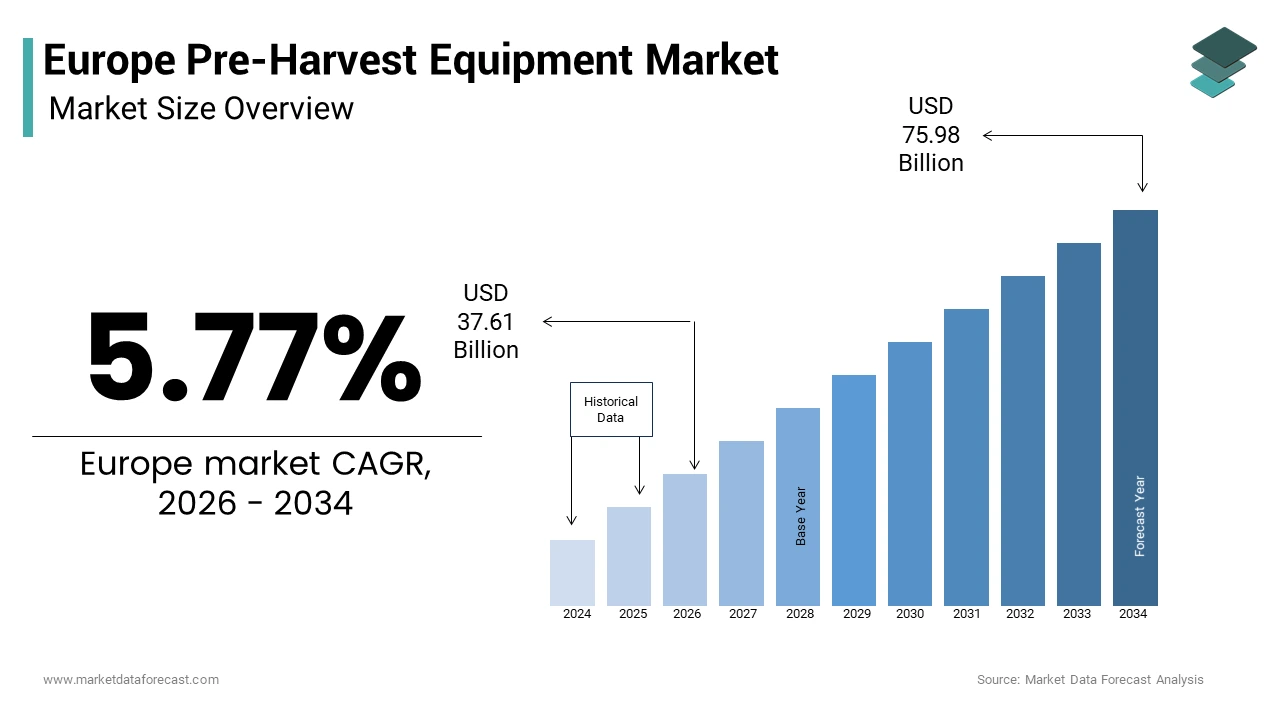
- Market Valuation: Valued at USD 15.18 billion (2025), estimated at USD 16.06 billion (2026), and projected to reach USD 25.15 billion by 2034, registering a solid CAGR of 5.77% (2026–2034).
- Primary Growth Drivers: Accelerated adoption of precision agriculture technologies driven by EU policy incentives and Farm to Fork objectives, persistent agricultural labor shortages intensifying demand for automation, and the rising need for climate-resilient water management solutions.
Key Market Segment Metrics (2026–2034)
| Category | Leading Segment (2025 Position) | Fastest-Growing Segment (2026–2034) |
|---|---|---|
| By Type | Planting Equipment (captured a 31.2% share in 2025, driven by precision sowing needs, conservation tillage, and EU eco-scheme compliance) | Irrigation Equipment (projected to witness the fastest CAGR of 7.9% due to intensifying water stress, precipitation deficits, and smart water management demands across Europe) |
| By Country | Germany (dominated the market with a 19.6% share in 2025, backed by advanced farm networks, strict regulations, and a robust domestic OEM base) | Southern and Eastern European Markets (experiencing rapid growth due to increasing mechanization demands, labor scarcity, and climate adaptation needs) |
Major Market Players & Market Structure
Market Structure: Highly competitive landscape characterized by global original equipment manufacturers (OEMs), regional specialists, and agritech startups. Differentiation centers on technological sophistication, regulatory alignment with EU environmental directives, electrification, autonomous capabilities, and data platforms that provide compliance-ready sustainability metrics.
Key Companies: Deere & Company, CNH Industrial (Case IH, New Holland), AGCO Corp (Fendt, Massey Ferguson), CLAAS KGaA mbH, Mahindra & Mahindra Ltd., Valmont Industries Inc., and Iseki & Company Ltd.
 Download Free Sample Report
Europe Pre-Harvest Equipment Market Size
The European pre-harvest equipment market was valued at USD 15.18 billion in 2025 and is anticipated to reach USD 16.06 billion in 2026 from USD 25.15 billion by 2034, growing at a CAGR of 5.77% from 2026 to 2034.
Current Introduction of the European Pre-Harvest Equipment Market
Pre-harvest equipment refers to the range of machinery, tools, and digital systems used to prepare fields and maintain crops throughout their growth cycle, ending just before the actual harvesting process begins. These tools range from conventional tractors and seed drills to advanced precision agriculture solutions such as GPS-guided implements, variable rate applicators, and drone-based scouting platforms. The sector is integral to ensuring yield optimization, resource efficiency,y and compliance with stringent EU environmental directives governing chemical usage and soil health. According to research, a substantial portion of the European Union’s land surface is used for agricultural production, with the majority of this farmland classified as cultivated arable land. Agricultural activities in Southern Europe are a dominant driver of freshwater consumption, making efficient water use and improved nutrient management essential to combat environmental water stress. Furthermore, the Common Agricultural Policy requires a significant portion of direct payments to be linked to eco-scheme adoption, providing strong financial incentives for farmers to adopt environmentally sustainable practices. This regulatory and ecological context positions pre-harvest equipment not merely as productivity enablers but as essential instruments for achieving the EU’s Farm to Fork and climate neutrality objectives.
MARKET DRIVERS
Accelerated Adoption of Precision Agriculture Technologies Driven by Policy Incentives
The integration of precision agriculture tools into pre-harvest workflows has surged across the region due to targeted policy support and economic necessity, which drives the growth of the pre-harvest equipment market. Digital transformation initiatives in Europe have directed substantial funding toward the adoption of automated, precision-focused technology on farms. The deployment of smart farming equipment is closely aligned with broader agricultural policies that prioritize environmental and climate-conscious practices. In specific European regions, a significant shift toward precision technology is evident, characterized by widespread adoption of tools for variable-rate applications. Public funding initiatives and financial incentives, such as tax credits for advanced guidance systems, have served as drivers for increasing automated technology adoption in specialized agricultural sectors. These technologies minimize input waste, enhance yield consistency, and generate digital field records required for eco scheme compliance. European agriculture is rapidly moving from optional, high-tech tools to necessary, automated systems, driven by shrinking labor pools and stricter regulations.
Labor Shortages Intensifying Demand for Mechanized and Automated Solutions
Persistent agricultural labor deficits across the continent are compelling farmers to replace manual and semi-manual pre-harvest tasks with mechanized alternatives, thereby fueling the expansion of the European pre-harvest equipment market. The agricultural labor force within the European Union has experienced a notable reduction, with more pronounced decreases observed in specific southern and eastern regions. Certain member states have seen significant decreases in the total number of individuals working on farms. Shortages in seasonal labor for horticultural harvesting have become more pronounced, with impacts extending to earlier field preparation roles. To address labor shortages, agricultural producers in the Netherlands are implementing autonomous technology for weed management. In Spain, the cultivation of olives is moving toward increased mechanization for canopy management and pruning due to a reduction in available, specialized labor. The livestock sector, particularly in Denmark, is incorporating automated, GPS-guided technology for field maintenance tasks to reduce the reliance on manual labor. This structural shift transforms pre-harvest equipment from mere efficiency tools into essential substitutes for vanishing human capital.
MARKET RESTRAINTS
High Initial Investment Costs Limiting Access for Smallholder Farmers
The upfront expense of advanced pre-harvest equipment remains a formidable barrier for the region’s vast network of small-scale farms, despite clear agronomic benefits, which impedes the growth of the European pre-harvest equipment market. The agricultural landscape is characterized by a high number of small-scale holdings occupying a disproportionately small share of the total cultivated land, which can present challenges for the economic stability of these smaller operations. The acquisition of advanced precision agriculture equipment, such as GPS-guided seeding tools, often requires substantial financial investment that can be challenging for smaller, independent producers to manage without external funding. The adoption of autonomous technology retrofits is constrained by high costs, limiting accessibility for many producers. Despite the availability of supporting funds, adoption of digital tools by smallholders is restricted by high administrative complexity, language limitations, and limited technical support. Consequently, many continue using outdated machinery that consumes more fuel, emits higher emissions, and applies inputs inefficiently. This disparity risks deepening a two-tier agricultural system where large consolidated farms achieve sustainability targets through technology while smallholders fall behind both economically and environmentally. Modern pre-harvest equipment will remain inaccessible to most European farmers until leasing, cooperative models, or simplified subsidies are scaled up.
Fragmented Regulatory Standards Across Member States Complicating Equipment Deployment
The absence of harmonized technical and environmental regulations for pre-harvest machinery across European Union member states creates significant compliance burdens for manufacturers and end users alike, which in turn constrains the expansion of the European pre-harvest equipment market. National interpretations of noise, emission, and chemical application standards diverge widely, despite the EU Machinery Directive providing a baseline safety framework. Variations in national regulations regarding spray technology standards, such as drift reduction or mapping protocols, can necessitate specialized adjustments for equipment, which may increase validation time and costs. The process of obtaining country-specific certifications for agricultural machinery involves significant time, potentially delaying product availability and increasing expenses. Regulatory differences between neighboring regions can complicate operational requirements, leading to the need for multiple, distinct equipment setups to ensure compliance. Such inconsistencies undermine the Single Market principle and discourage cross-border equipment sharing or rental, a key strategy for cost reduction among smallholders. The rollout of innovative pre-harvest technologies across Europe will remain flawed and uneven unless initiatives like the Green Deal’s Sustainable Products Policy achieve greater regulatory harmony.
MARKET OPPORTUNITIES
Expansion of Shared Equipment Cooperatives and Digital Rental Platforms
The rise of collaborative ownership models is providing access to advanced pre-harvest machinery for farmers who cannot justify individual purchases, creating new opportunities for the European pre-harvest equipment market. Agricultural machinery cooperatives are increasing in number and prevalence across various European regions, facilitating shared access to advanced technologies like precision seeders and soil sensors among a large member base. Digital platforms allow for the real-time scheduling and utilization of autonomous agricultural tools, shifting the operational model from ownership to usage-based billing. Participating in these cooperative models allows farmers to significantly lower their machinery expenditures while simultaneously raising the annual utilization rates of the equipment. These shared machinery initiatives offer substantial financial benefits, particularly for farming operations in regions with lower average incomes. Integrating payment structures that coincide with harvest cycles has led to a notable rise in the utilization of GPS-guided farming equipment within these cooperative frameworks. Critically, these platforms often bundle training and maintenance, lowering technical barriers. Supported by CAP rural development funds that now explicitly finance “shared means of production,” this trend transforms pre-harvest equipment from a fixed asset into a flexible service,e accelerating technology diffusion without requiring balance sheet expansion.
Integration of Carbon Farming Metrics into Equipment Performance Monitoring
Pre-harvest equipment is increasingly leveraged as a data collection node in emerging carbon farming frameworks, transforming machinery into climate accountability tools, which exhibits potential prospects for the European pre-harvest equipment market. Agricultural initiatives are increasingly requiring farmers to document specific changes in soil management, energy consumption, and input usage to participate in sustainability programs. Modern machinery technologies enable automated tracking of agricultural activities, which facilitates the generation of documentation for carbon credit programs. Verified reductions in carbon emissions, derived from data captured by connected equipment, are being used to provide financial compensation to producers. Certifying bodies are requiring the quantification of emission reductions, with a reliance on integrated sensors for data accuracy. This connection between machine-tracked data and environmental performance is creating economic incentives for producers that are separate from crop yield revenue. Farms utilizing monitored systems can generate additional income through carbon payments and environmental premiums. The EU’s emerging carbon removal rules are turning pre-harvest tools into valuable financial assets for the green transition.
MARKET CHALLENGES
Supply Chain Disruptions for Critical Components Delaying Equipment Delivery
Geopolitical instability and logistical barriers have severely impacted the timely availability of pre-harvest machinery across the region. This hinders the growth of the European pre-harvest equipment market due to dependencies on global semiconductor and specialty steel markets. Agricultural equipment manufacturing heavily depends on specialized microcontrollers for advanced machinery, with a significant reliance on imports for these components. Disruptions in maritime shipping routes have significantly increased lead times for essential electronic and hydraulic components. Supply chain delays have resulted in major manufacturers struggling to deliver equipment in time for critical seasonal planting windows. Logistical constraints in receiving specialized machinery have caused delays for farmers in achieving optimal planting schedules. Localized production of specialized materials, such as wear-resistant steel, is experiencing constraints due to manufacturing cost pressures. These disruptions not only inflate costs through expedited freight but also erode trust in just-in-time procurement models, forcing farmers to order equipment a full season in advance. The resilience of the pre-harvest equipment supply chain remains vulnerable to external shocks until the EU boosts local production and diversifies its supply base.
Skills Gap in Operating and Maintaining Advanced Digital Implements
The rapid digitization of pre-harvest equipment has outpaced the availability of technically proficient personnel capable of operating and servicing these complex systems, which acts as a major obstacle for the European pre-harvest equipment market. Agricultural machinery service centers in multiple European regions are experiencing a shortage of technicians skilled in advanced electronics, software management, and digital integration for modern machinery. A significant portion of agricultural operators are delaying or abandoning the adoption of automated guidance and precision tools, driven by concerns regarding potential technical failures during critical, time-sensitive field tasks. Formal education and vocational training systems are not consistently incorporating comprehensive precision agriculture curricula across all member states, resulting in a gap between workforce skills and industry needs. The aging profile of farm ownership in the region correlates with agenerally low level of confidence in utilizing advanced, tablet-based digital interfaces for machine control. The rapid pace of digitalization in agriculture has outpaced the development of supporting infrastructure, technical education, and service capabilities, creating a bottleneck for technological adoption. Consequently, expensive equipment sits underutilized or reverts to manual mode n, negating efficiency and sustainability gains. The potential of advanced pre-harvest technology across Europe will remain untapped unless we invest in upskilling, mobile support, and user-friendly interfaces.
REPORT COVERAGE
| REPORT METRIC | DETAILS |
| Market Size Available | 2025 to 2034 |
| Base Year | 2025 |
| Forecast Period | 2026 to 2034 |
| CAGR | 5.77% |
| Segments Covered | By Type, And By Region |
| Various Analyses Covered | Global, Regional, and Country-Level Analysis; Segment-Level Analysis; DROC; PESTLE Analysis; Porter’s Five Forces Analysis; Competitive Landscape; Analyst Overview of Investment Opportunities |
| Regions Covered | UK, France, Spain, Germany, Italy, Russia, Sweden, Denmark, Switzerland, Netherlands, Turkey, the Czech Republic, and the Rest of Europe |
| Market Leaders Profiled | Deere & Company (U.S.), CNH Global (The Netherlands), and AGCO Corp (U.S.) |
SEGMENTAL ANALYSIS
By Type Insights
The planting equipment segment led the Europe pre-harvest equipment market by capturing a 31.2% share in 2025. The leading position of the planting equipment segment is attributed to the critical role of precision sowing in achieving optimal crop establishment, yield consistency,cy and compliance with EU agroecological standards. This segment is also helped by the widespread shift toward conservation tillage systems, ems which require advanced planting tools capable of operating in high residue conditions without soil inversion. Reduced tillage practices are becoming the standard in key Western European agricultural nations, prompting farmers to adopt advanced seeding technology, such as heavy-duty seed drills with precision depth capabilities, to manage residue and soil structure. Additionally, the Common Agricultural Policy’s eco scheme mandates for crop diversification and cover cropping have increased demand for multi-crop crop planters that can switch between cereals,, legume,s, and oilseeds within a single pass. Research by German federal agricultural authorities confirms that utilizing GPS-guided, high-precision air seeders substantially boosts planting efficiency, resulting in less seed waste and more consistent, uniform crop germination compared to conventional broadcasting. Furthermore, rising labor costs have made manual sowing economically unviable even on mid-sized farms. Due to sharply increasing costs for seasonal agricultural labor in Poland, even mid-sized farms are shifting towards automated and mechanized seeding systems to ensure economic viability and production efficiency. These converging agronomic, economic,c and regulatory forces cement planting equipment as the cornerstone of modern European pre-harvest operations.
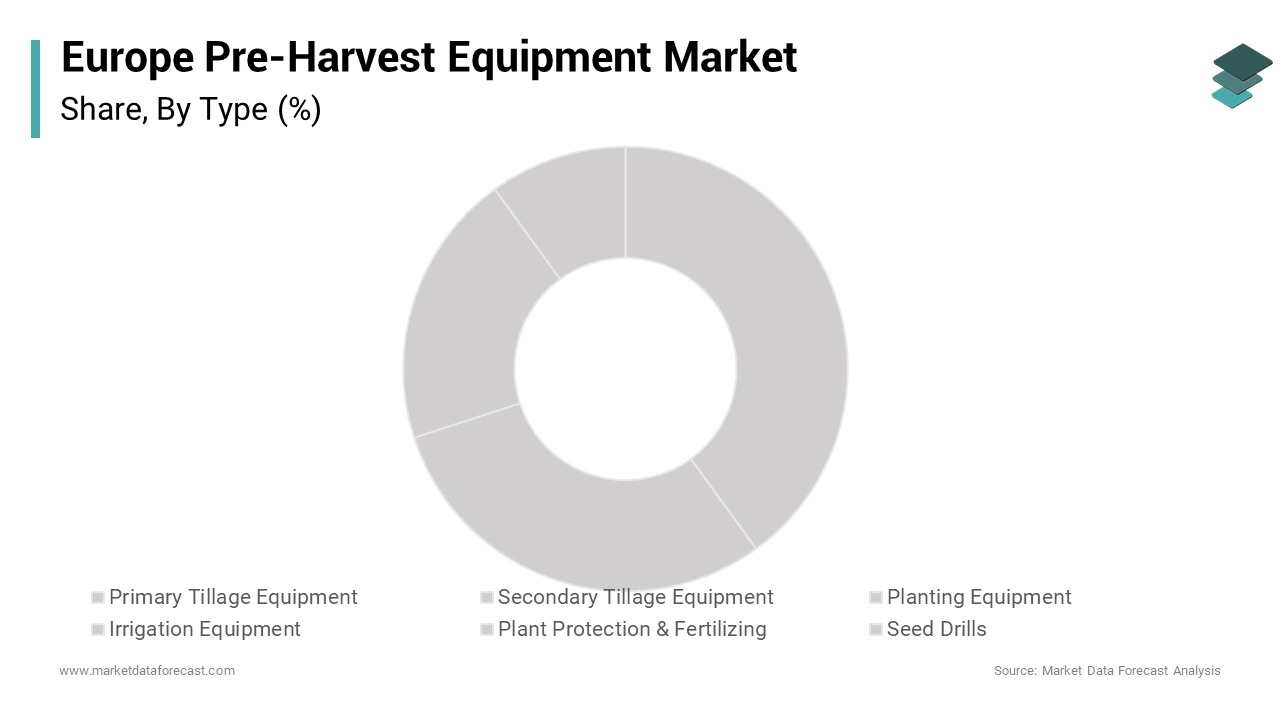
The irrigation equipment segment is anticipated to witness the fastest CAGR of 7.9% between 2026 and 2034 due to intensifying water stress across Southern and Central Europe, pe where climate change has disrupted traditional rainfall reliability. Significant, record-level precipitation deficits have created challenging conditions for rainfed agriculture in parts of Southern Europe. Persistent dry conditions have prompted a notable shift toward the adoption of water-efficient irrigation technologies, particularly in tree crop cultivation. National authorities are increasingly investing in and subsidizing automated irrigation systems to improve water-use efficiency and modernize infrastructure. This transition represents a broader, long-term effort to enhance agricultural resilience against increasing water scarcity by optimizing water management. Technological integration further fuels growth. Smart irrigation controllers using real-time evapotranspiration data from the European Space Agency’s Sentinel satellites now enable sub-field level scheduling, minimizing both waste and energy use. Hence, this segment goes beyond historical reliance on Mediterranean climates into temperate zones previously considered low risk.
COUNTRY LEVEL ANALYSIS
Germany Pre-Harvest Equipment Market Analysis
Germany dominated the European pre-harvest equipment market by holding a 19.6% share in 2025. The supremacy of the German market is credited to a dense network of technologically advanced farms, stringent environmental regulation,,s and a robust domestic machinery manufacturing base,ase including global OEMs like Claas and Amazone. Many German crop producers have integrated satellite-guided systems into their regular planting and nutrient management routines. The transition toward precision agriculture is influenced by national strategies aimed at tracking and refining the application of crop protection products. A notable shift has occurred where precise digital documentation is becoming a standard operational requirement for land management. Governmental financial support plays a role in making advanced field technologies more accessible to a wider range of farm sizes. Investment patterns suggest a focus on modernizing infrastructure through the adoption of automated data transmission and adjustable application tools. Additionally, Germany’s Energiewende policy has accelerated the electrification of field equipment with pilot programs testing battery-powered seeders and autonomous electric tractors in Lower Saxony and Bavaria. The presence of world-class research institutions such as the Thünen Institute ensures continuous innovation in soil health monitoring and carbon sequestration-compatible implements. This synergy of regulation, industry R&D, and public funding creates an ecosystem where pre-harvest equipment is not merely a tool but a regulated component of national climate and food security strategy.
France Pre-Harvest Equipment Market Analysis
France was the second largest country in the European pre-harvest equipment market by accounting for a 16.3% share in 2025. The growth of the French market is fuelled by its diverse agricultural landscape, from cereal plains in Picardy to vineyards in Bordeaux, each demanding specialized pre-harvest solutions. A key driver is the national plan, which targets fifteen percent organic farmland by 20, 30, necessitating mechanical weeding tools, inter-row cultivators, rs and precision seeders that avoid synthetic inputs. The agricultural sector is experiencing a transition toward organic practices, leading to a higher demand for equipment that does not rely on traditional chemical applications. Governmental support for agricultural modernization has targeted improved water management systems in response to recurring dry conditions. Investment in specialized irrigation, such as drip and micro-sprinkler systems, has increased significantly in specific regions. Cooperative sharing models for high-end planting and spraying machinery are well-established and widely utilized by producers. This model democratizes access while ensuring optimal utilization. Supported by strong vocational training in agricultural mechanics,s France maintains a skilled technician base that minimizes downtime, further enhancing equipment ROI and adoption confidence across farm sizes.
Italy Pre-Harvest Equipment Market Analysis
Italy continues to be a major player in the European pre-harvest equipment market due to fragmentation,y et paradoxically high mechanization due to labor scarcity and terrain challenges. Agricultural areas in high-altitude and steep-slope locations are increasingly utilizing specialized, compact equipment designed to navigate challenging terrains. The adoption of advanced, slope-adapted machinery is driven by initiatives supporting the modernization of agricultural practices and the integration of precision technology. Technological advancements, including precision planting and fertility management tools, are seeing higher adoption rates due to initiatives that make these investments more accessible. Growers in specific regions are adopting GPS-enabled precision planting technology to address environmental concerns related to nutrient management. The shift towards smarter farming technologies is influenced by efforts to reduce environmental impacts, such as nutrient runoff, while maintaining agricultural productivity. Moreover, Italy’s specialty crop sectors, olives, es grapes, and tomatoes, demand ultra-precise pre-harvest setups. Vineyard owners increasingly adopt electrostatic sprayers that cut pesticide drift. Thus, Italy’s market thrives not on scale but on tailored innovation addressing micro-regional agronomic and regulatory pressures.
Spain Pre-Harvest Equipment Market Analysis
Spain experienced a consistent growth in the European pre-harvest equipment market. Water scarcity defines the agricultural reality. Significant portions of the country face considerable water stress, leading to a focus on improved pre-harvest irrigation methods. The nation has adopted widespread drip irrigation systems, surpassing other European counterparts in implementation. Investments are shifting toward integrating soil moisture sensors and automated fertigation systems to align nutrient application with specific crop growth stages, resulting in reduced fertilizer usage in orchards. Large-scale cereal operations are utilizing wider planting equipment to increase efficiency during shorter, weather-affected planting seasons. Public funding is directed towards supporting the modernization of agricultural techniques, with a focus on water-saving, pre-harvest technologies. Faced with recurring droughts, Spanish farmers treat equipment not asa capital expense but as survival infrastructure, driving consistent demand despite economic headwinds.
Netherlands Pre-Harvest Equipment Market Analysis
The Netherlands is likely to expand in the European pre-harvest equipment market from 2026 to 2034. Despite its small land area, the country exerts disproportionate influence through technological intensity and export-oriented horticulture. Dutch agricultural producers are increasingly integrating automated planting and variable rate fertilization technologies within both field and greenhouse settings to improve efficiency. The widespread adoption of these technologies is supported by data from, and integration with, satellite imagery and aerial drone imaging. A national transition toward more sustainable and closed-loop production systems is driving a significant, policy-driven reduction in the application of synthetic nutrients. To comply with environmental goals, farming operations are adopting sensor-based technology that adjusts fertilizer application in real time based on on-the-go analysis of plant health. Observational trials indicate that these precision application systems can sustain crop production levels while reducing overall synthetic fertilizer inputs. Moreover, the Netherlands serves as a testbed for next-generation equipment. Companies like Vervaet and Kverneland pilot autonomous electric seeders in Zeeland’s clay soils before global rollout. The country’s dense network of machinery dealers and rapid service response minimizes downtime and builds user confidence. Thus, the Dutch market thrives on extreme efficiency, regulatory foresight, and its role as Europe’s innovation proving ground for sustainable pre-harvest solutions.
COMPETITIVE LANDSCAPE
Competition in the European Pre-Harvest Equipment Market is intense, characterized by a mix of global OEMs, regional specialists, and emerging agritech startups. Incumbents differentiate through technological sophistication, regulatory alignment andafter-saless service networks rather than price alone. The market is shaped by stringent EU environmental directives, particularly the Farm to Fork Strategyy which mandates reduced chemical and fertilizer use, driving demand for precision planting and low disturbance tillage systems. Large manufacturers leverage economies of scale to offer integrated hardware and software solutions, while niche players focus on specialized segments like organic mechanical weeding or slope-adapted machinery. Barriers to entry remain high due to certification complexity, R&D costs, ts and established dealer relationships. However, ver collaboration is common with OEMs acquiring sensor and AI startups to accelerate digital transformation. As climate resilience becomes central to agricultural policy,licy competition increasingly revolves around who can deliver verifiable sustainability outcomes through pre-harvest innovation.
KEY MARKET PLAYERSEuropeanurope pre-harvest equipment market is
- Deere & Company (U.S.)
- CLAAS KGaA mbH
- CNH Global (The Netherlands)
- AGCO Corp (U.S.)
- Mahindra & Mahindra Ltd (India)
- Valmont Industries Inc.(U.S.)
- Iseki & Company Ltd(Japan),
- Deere & Company
Top Players In The Market
- CNH Industrial is a global leader in agricultural machinery with a strong presence in the European pre-harvest equipment market through its Case IH and New Holland brands. The company offers a comprehensive portfolio, including precision seeders, tillage implements, and smart irrigation solutions,s tailored to diverse European farming systems. It also expanded its digital farming platform to include carbon footprint tracking aligned with EU eco scheme requirements. These initiatives reinforce its role as a technology enabler supporting sustainable intensification not only in Europe but across North and South American markets where its pre-harvest systems are widely deployed.
- AGCO plays a pivotal role in the European pre-harvest equipment sector through its Fendt, Massey Ferguson,, and Challenger brands, known forhigh-efficiencyy planting and soil preparation machinery. The company focuses on precision agriculture integration, offering variable rate seeders and sensor-guided sprayers compatible with EU regulatory standards. It also partnered with European research institutes to validate reduced tillage protocols that enhance soil carbon sequestration. AGCO strengthens its international presence by utilizing sustainable, efficient, and automated technologies tailored to specific regional agronomic challenges.
- CLAAS is a leading European manufacturer deeply embedded in the pre-harvest equipment landscape with advanced seed drills, planters,s and soil cultivation systems renowned for durability and precision. Headquartered in Germany, the company serves both large-scale cereal farms and specialized horticultural operations across the continent. It also enhanced its telematics suite to provide real-time field data compliant with national digital farming registries. CLAAS is driving climate-smart agriculture by merging mechanical expertise with digital connectivity, expanding from Europe into Eastern European and Middle Eastern markets, and looking to implement EU-aligned, sustainable farming practices.
Top Strategies Used By The Key Market Participants
Key players in the Europe Pre-Harvest Equipment Market focus on integrating precision technologies such as GPS guidance and variable rate application to meet sustainability regulations. They developregion-specificc equipment variants for diverse agroclimatic zones, including mountainous and Mediterranean terrains. Companies invest heavily in electrification and autonomous capabilities to reduce emissions and labor dependency. Strategic partnerships with research institutions ensure scientific validation of conservation tillage and carbon farming protocols. Additionally, they expand digital platforms to provide farmers withcompliance-readyy data for EU eco schemes and carbon credit programs.
MARKET SEGMENTATION
This research report on the European pre-harvest Equipment Market is segmented and sub-segmented into the following categories.
By Type
- Primary Tillage Equipment
- Secondary Tillage Equipment
- Planting Equipment
- Irrigation Equipment
- Plant Protection & Fertilizing
- Seed Drills
- Planters
- Air Seeders
- Others
By Country
- UK
- France
- Spain
- Germany
- Italy
- Russia
- Sweden
- Denmark
- Switzerland
- Netherlands
- Turkey
- Czech Republic
- Rest of Europe