- Product Description Description
- Table of Contents TOC
- List of Table & Figure LOT
- Get Free Sample PDF Sample PDF
Market Size, 2025
$3.62 BnMarket Estimate, 2026
$4.10 BnMarket Forecast, 2034
$11.05 BnCAGR, 2026–2034
13.20%Executive Summary: Europe Precision Farming Market
- Market Scope: Regional analysis of the European precision farming market covering key offerings, technologies, diverse application areas, and extensive country breakdowns across the UK, France, Spain, Germany, Italy, Russia, Sweden, Denmark, Switzerland, Netherlands, Turkey, the Czech Republic, and the Rest of Europe.
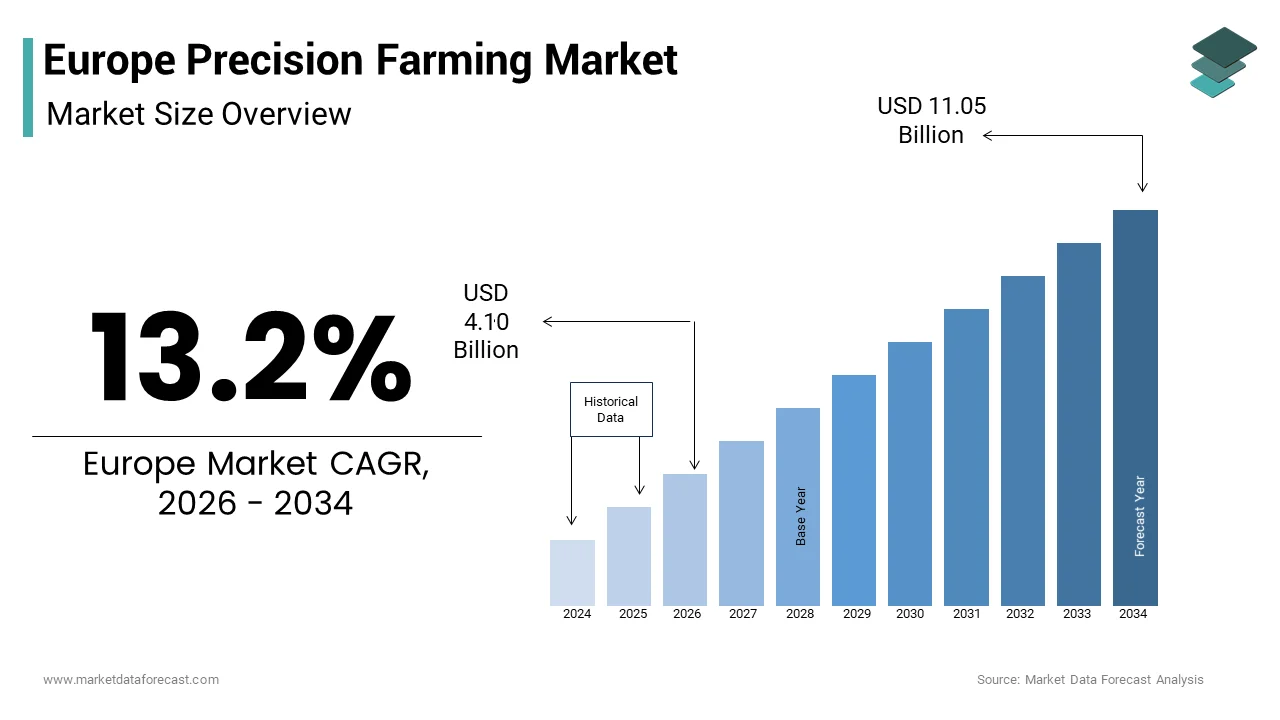
- Market Valuation: Valued at USD 3.62 billion (2025), estimated at USD 4.10 billion (2026), and projected to reach USD 11.05 billion by 2034, registering a strong CAGR of 13.20% (2026–2034).
- Primary Growth Drivers: EU Green Deal and Farm to Fork Strategy mandates compelling precision adoption, and rapidly escalating input costs (fertilizers, fuel, chemicals) intensifying the need for strict resource optimization.
Key Market Segment Metrics (2026–2034)
| Category | Leading Segment / Position | Fastest-Growing Segment / Scope |
|---|---|---|
| By Offering | Hardware (accounted for 47.6% of the market share, driven by GPS receivers, yield monitors, soil sensors, and automated guidance systems) | Software (projected to grow at a fastest CAGR of 12.4%, propelled by cloud-based management platforms and AI-driven compliance reporting) |
| By Technology | Guidance Systems (largest segment with 38.2% share, valued for immediate returns through overlap reduction and fuel savings) | Remote Sensing (forecasted at a 13.7% CAGR, driven by high-resolution satellite/drone imagery and AI analytics) |
| By Application | Yield Monitoring (held 24.8% share, serving as the cornerstone for spatial productivity analysis and subsidy compliance) | Irrigation Management (projected to grow at the fastest CAGR of 14.1%, propelled by intensifying water scarcity and policy mandates) |
| By Country | Germany (market leader with 18.3% share in 2024, anchored by advanced machinery, digital infrastructure, and strong subsidies) | France & Spain (expanding rapidly via large-scale cereal optimization, viticulture tracking, and national water efficiency strategies) |
Major Market Players & Competitive Landscape
Market Structure: A dynamic landscape featuring global agri-tech giants, European machinery manufacturers, and agile regional startups competing intensely on regulatory compliance, data interoperability, and localized agronomic relevance.
Key Companies: John Deere, Trimble Inc., BASF Digital Farming (xarvio), AGCO Corporation, Raven Industries, Monsanto Company, DuPont, Agjunction Inc., Precision Planting Inc., SST Development Group, and Dickey-John Corporation.
Europe Precision Farming Market Size
The Europe precision farming market was valued at USD 3.62 billion in 2025 and is anticipated to reach USD 4.10 billion in 2026 to reach USD 11.05 billion by 2034, growing at a CAGR of 13.20% during the forecast period from 2026 to 2034.
Precision Farming is a technology-driven agricultural practices that optimize input use, enhances productivity, and minimizes environmental impact through data-centric decision-making. Core components include GPS-guided machinery, variable rate application systems, soil and crop sensors drone drone-based monitoring, and farm management software.
According to Eurostat, 68% of EU farms are smaller than 5 hectares, with a structural complexity that precision tools must accommodate through scalable and modular solutions. As per the European Environment Agency, agriculture accounts for 10.3% of the EU’s total greenhouse gas emissions, with nitrogen fertilizer overuse contributing significantly to nitrous oxide release. The European Commission’s Farm to Fork Strategy mandates a 20% reduction in fertilizer use and 50% cut in pesticide risk by 2030, making precision farming not optional but a regulatory imperative.
MARKET DRIVERS
EU Green Deal and Farm to Fork Strategy Mandate Precision Adoption
The European Union’s binding sustainability targets under the Farm to Fork Strategy are a primary factor for the growth of Europe's precision farming market. As per the European Commission, the strategy requires a 20% reduction in nutrient losses and a 50% decrease in chemical pesticide use by 2030 without compromising food security. These objectives are unattainable through blanket application methods and necessitate field-specific data and variable rate technologies. The EU’s Common Agricultural Policy now links 35% of direct payments to eco scheme compliance, including digital record keeping and precision input mapping. In Germany, for instance, the Federal Ministry of Food and Agriculture reported that over 12000 farms enrolled in digital eco schemes in 2024 using soil sensors and satellite imagery to validate reduced nitrogen applications. Similarly, France’s Ecophyto Plan II mandates digital traceability for pesticide use, with non-compliant farms facing subsidy penalties. These regulatory levers transform precision farming from a productivity enhancer into a compliance necessity.
Rising Input Costs Intensify Need for Resource Optimization
The escalating prices of fertilizers, fuel, and crop protection chemicals are another attribute propelling the growth of the Europe precision farming market. According to the Food and Agriculture Organization of the United Nations, fertilizer prices in the EU surged by 142% between 2021 and 2023, driven by energy market volatility and supply chain disruptions. A 2024 study by Wageningen University demonstrated that Dutch arable farms using real-time soil nitrogen sensors lowered synthetic fertilizer expenditure by 210 euros per hectare without yield loss. Similarly, the German Farmers Association reported that 63% of large cereal farms adopted auto steer and section control on sprayers in 2023 to counter rising herbicide costs. These technologies not only preserve margins but also enhance resilience against future price shocks.
MARKET RESTRAINTS
High Initial Investment Deters Small and Medium-Scale Farmers
The upfront capital requirements that disproportionately affect Europe’s fragmented farm structure are degrading the growth of Europe's precision farming market. According to Eurostat, 78% of EU agricultural holdings are smaller than 10 hectares with limited access to credit and risk capital. Public subsidies often fail to bridge this gap, while the Common Agricultural Policy allocates funds for digitalization. Only 28% of eligible smallholders accessed these grants in 2023 due to complex application procedures and co-financing demands. In Southern and Eastern Europe, where average farm incomes are 40% below the EU median, the barrier is even steeper. Romania’s National Institute of Statistics found that less than 9% of farms under 20 hectares used any form of precision technology in 2024.
Data Fragmentation and Lack of Interoperability Hamper System Integration
The severe data silos due to incompatible software platforms and proprietary hardware protocols are additionally hampering the growth othe f the Europe farming market. As per the report, over 60 different farm management information systems operate across the EU, with fewer than 20% adhering to the AgroAPI or ISO 11783 interoperability standards. This fragmentation forces farmers to manually transfer data between machinery brands and software tools, undermining real-time decision-making. European farmers abandoned or scaled back precision investments due to integration difficulties. Moreover, the absence of a unified data governance framework creates uncertainty around ownership and reuse, while the EU Data Act establishes general principles and lacks agriculture-specific provisions on sensor data generated on private land. Consequently, equipment manufacturers prioritize closed ecosystems to lock in customers rather than open collaboration.
MARKET OPPORTUNITIES
Expansion of Satellite-Based Monitoring and AI-Driven Advisory Services
The integration of high-resolution satellite imagery and artificial intelligence is unlocking scalable precision farming solutions for diverse European conditions, which is solely posing new opportunities for the growth of the precision farming market. As per the European Space Agency, the Copernicus Sentinel constellation now delivers free multispectral imagery at 10-meter resolution every 5 days, ys near-real-time crop health assessment across the continent. Startups like France’s TerraNIS and Germany’s EFP have developed AI algorithms that translate this data into actionable nitrogen or irrigation prescriptions without requiring farm sensors. The European Innovation Council funded 14 sucagri-tech ventures in 2024 with grants exceeding 60 million euros to validate models across cereal vineyard and horticultural systems. These cloud-based services reduce hardware dependence, making precision accessible to smallholders, where a pilot in Spain demonstrated that olive growers using satellite advisories reduced water use by 22% while maintaining oil yield. Furthermore, the EU’s Digital Europe Programme is establishing agricultural data spaces to securely share anonymized field data, accelerating AI training and regional model accuracy. This shift from hardware-intensive e todata-intensivee precision lowers entry barriers and supports policy goals of equitable digital access.
Integration of Precision Livestock Farming in Dairy and Poultry Sectors
Rapid extension beyond crops into livestock management, driven by animal welfare regulations and efficiency demands, is also expected to enhance the growth of the Europe precision farming market. In response, dairy farms are adopting wearable sensors that monitor rumination activity, body temperature, and milk conductivity to flag health anomalies 48 hours before clinical symptoms appear. Similarly, automated poultry barns in France and Poland now employ computer vision to track bird movement, feed intake, ke and featheconditionti,, on enabling real-time welfare adjustments. The European Commission’s Animal Welfare Strategy 2023 2027 explicitly encourages these technologies as alternatives to routine interventions.
MARKET CHALLENGES
Digital Literacy Gaps Among the Aging Farming Population Limit Technology Utilization
The demographic profile of its agricultural workforce is likely to challenge the growth of the Europe precision farming market. According to Eurostat, 57% of EU farm managers are aged 55 or older, with limited exposure to digital tools during their formative years. A 2024 study by the Joint Research Centre found that only 29% of farmers over 60 felt confident in tablet-based farm management software, even when hardware was provided. This skills deficit leads to underutilization, where German agricultural extension services observed that 44% GPS-guided tractors on farms managed by seniors operated in manual mode due to interface complexity.
Inconsistent Rural Broadband Coverage Impedes Real-Time Data Connectivity
Reliable high-speed internet deployment in non-urban agricultural zones is also inhibiting the growth of the Europe precision farming market. According to the European Commission’s Digital Economy and Society Index, only 58% of rural households had access to fixed broadband with speeds of at least 100 Mbps in 2024, compared to 92% in cities. In countries like Romania, Bulgaria, and Greece, over 40% of farmland lies in areas with no 4G or limited LTE coverage as mapped by the Body of European Regulators for Electronic Communications. This connectivity gap prevents real-time data transmission from drones, soil sensors,ors and autonomous machines, disrupting time-sensitive decisions such as irrigation or pest control. While the EU’s Rural Broadband Initiative has allocated 4.2 billion euros under the Connecting Europe Facility, ty only 31% of targeted zones achieved full deployment by the end of 2024 due to terrain challenges and low return on investment for telecom operators.
REPORT COVERAGE
| REPORT METRIC | DETAILS |
| Market Size Available | 2025 to 2034 |
| Base Year | 2025 |
| Forecast Period | 2026 to 2034 |
| CAGR | 13.2% |
| Segments Covered | By Offering, Technology, Applications, And Region |
| Various Analyses Covered | Global, Regional, and Country Level Analysis; Segment-Level Analysis; DROC; PESTLE Analysis; Porter’s Five Forces Analysis; Competitive Landscape; Analyst Overview of Investment Opportunities |
| Regions Covered | UK, France, Spain, Germany, Italy, Russia, Sweden, Denmark, Switzerland, Netherlands, Turkey, the Czech Republic,c, and the Rest of Europe |
| Market Leaders Profiled | Raven Industries, Deere & Company, AGCO Corporation, Trimble Navigation Ltd, Monsanto Company, DuPont, Agjunction, Inc., PrecisionPlanting Inc., SST Development Group, and Dickey-John Corporation. |
SEGMENTAL ANALYSIS
By Offering Insights
The hardware segments accounted in holding 47.6% of the Europe Precision Farming Market share in 20,2, with the foundational role of physical equipment such as GPS receivers, yield monitors, soil sensors, and automated guidance systemsenabling data-driven farming. The European Commission’s Common Agricultural Policy links 25% of direct payments to digital record keeping, which necessitates on-farm hardware deployment. In Germany, over 82% of tractors sold in 202include factory-installed auto-steer systems as reported by the German Agricultural Society. Similarly, France’s Ecophyto II plan mandates digital tracking of pesticide applications requiring sprayers equipped with flow meters and section control. Additionally, rising input costs have accelerated upta,ke with the Food and Agriculture Organizatinotingted that EU fertilizer prices remained 95% above 2020 levels in early,025,, making variable rate applicators economically compelling. These regulatory and economic imperatives ensure sustained hardware investment across arable and specialty crop sectors.
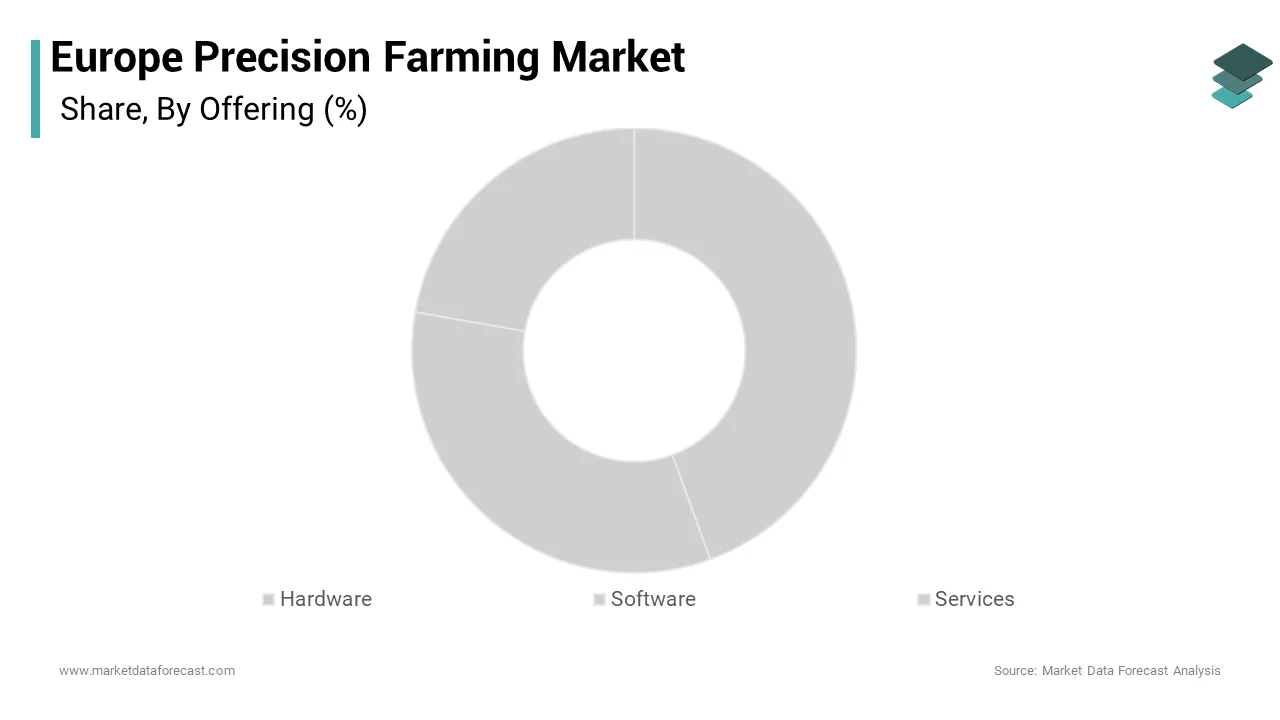
The software segmenexpectedeemed to grow at a fastest CAGR of 12.4% from 2025 to 2033 with the shift from standalone tools to integrated farm management platforms. As per the European Commission’s Digital Agriculture Report 2024, over 60% of new precision farming contracts now include cloud-based software suites that unify field data, machine, nd compliance reporting. The EU’s Farm to Fork Strategy requires digital proof of reduced input use, and this has catalyzed demand for software that auto-generates audit trails for subsidies. Startups like Denmark’s AgroIntelli and Spain’s Agrosmart have developed AIAI-powered dashboards that translate satellite and sensor data into prescription maps without manual interpretation. The European Innovation Council allocated 78 million euros in 2024 to scale such platforms across diverse agro-ecological zones. Furthermore, interoperability initiatives like the EU-funded SmartAgriHubs project are establishing common data standards enabling seamless data flow between machinery brands and software vendors. This transition from hardware-centric to intelligence-centric farming is redefining value creation and accelerating software adoption even among smallholders through subscription models.
By Technology Insights
The guidance systems segment was the largest by accounting for 38.2% of the Europe precision farming market share in 20,2withom immediate returfuelerlr, and overlap reduction during field operations. Auto steer systems reduce pass overlap by up to 12% according to trials conducted by Wageningen University, saving an average of 18 liters of diesel per hectare annually. Additionally, guidance systems serve as the entry point for digital farming; once installed, farmers often add yield monitors or variable rate controllers, creating a technology adoption cascade. National training programs in France and Italy have further lowered barriers by offering subsidized installation and operator certification, ensuring effective utilization beyond mere ownership.
The remote sensing segment is likely to witness an anticipated CAGR of 13.7% from 2025 to 2033, with the proliferation of high-resolution satellite and drone imagery combined with AI analytics. As per the European Space Agency, the Copernicus Sentinel constellation delivers free multispectral data at a 10-meter resolution every 5 days, continent-wide crop monitoring without farm sensors. In 2024, the European Innovation Council funded 11 remote sensing agri tech ventures with grants exceeding 50 million euros to develop disease prediction models for cereals and vineyards. France’s TerraNIS platform now processes over 2 million hectares of EU farmland monthly, generating nitrogen and irrigation advisories validated by INRAE field trials. Drone adoption is also surging; the European Union Aviation Safety Agency issued over 18000 agricultural drone operator licenses in 2024, a 40% increase year on year. This accessibility,, ty combined with declining imagery costs, senses the fastest evolving precision farming technology.
By Application Insights
The yield monitoring segment held 24.8% of the Europprecision on Farming Market share in 20,24 with its role as the cornerstone of precision agriculture, enabling spatial analysis of productivity drivers. Combine harvesters equipped with mass flow sensors and GPS log yield variability intervals, creating baseline maps for future input zoning. Furthermore, the EU’s Green Deal requires evidence of sustainable yield maintenance during input reduction, making yield maps essential for subsidy compliance. This dual value proposition on economic optimization and regulatory proof ensures that yield monitoring remains the most widely adopted precision application across diverse EU cropping systems.
The irrigation management segment is projected to witness the fastest CAGR of 14.1% during the forecast period, with the intensifying water scarcity and policy mandates. According to the European Environment Agency, EU river basins faced water stress in summer 20,24 with agricultural use of freshwater abstraction in Southern Europe. The EU’s Water Reuse Regulation now permits treated wastewater for irrigation but requires real-time monitoring of soil moisture and crop evapotranspiration to prevent overuse. Spain’s Ministry of Agriculture reported that over 120000 hectares of olive and almond orchards adopted soil moisture sensor networks in 2024 under the National Irrigation Modernization Plan. Similarly, Italy’s Po River Basin Authority mandates digital irrigation logs for all farms drawing surface water. Startups like Switzerland’s Aquascope offer AI-driven irrigation scheduling that reduces water use by 27% in tomato trials, as validated by ETH Zurich.
COUNTRY ANALYSIS
Germany Precision Farming Market Analysis
Germany was the top performer of the Europe Precision Farming Market with 18.3% of share in 20,,24 with its advanced agricultural machinery se,ct, or strong digital infrastructure anpolicy-drivenen adoption. According to the Federal Ministry of Food and Agriculture, over 70% of arable farms use at least one precision technology, with GPS guidance and yield monitoring most prevalent. The national Digital Farming Strategy allocates 300 million euros annually for farm digitalization, including subsidies covering 40% of hardware costs for smallholders. Germany also hosts Europe’s largest cluster of agri-tech developers in regions like Lower Saxony and Bavaria, supported by Fraunhofer Institute research in AI and robotics. The mandatory documentation of fertilizer and pesticide use under the Fertilizer Ordinance further drives the uptake of integrated farm management software.
France's precision farming market was positioned next by occupying 17.8% of the share in 20,24, with its strength rooted large-scale cereal and viticulture sectors that benefit from spatially variable management. As per FranceAgriMer, over 1.2 million hectares of wheat and barley fields were managed with satellite-based nitrogen prescriptions in 2024 under the Ecophyto II national plan. The country operates one of Europe’s most advanced agricultural data ecosystems through the APESA platform, which aggregates anonymized machinery and yield data to support public policy and private advisory services. Additionally, the government’s France 2030 investment plan allocated 220 million euros to scale AI-driven crop models for climate resilience.
United Kingdom Precision Farming Market Analysis
The United Kingdom Precision Farming Market growth is propelled by post-Brexit agricultural reform and climate adaptation needs. According to the Department for Environment, Food and Rural Affairs, over 55% of English farms now use some form of precision technology, with satellite imagery and soil sensors most common in arable regions like East Anglia. The Environmental Land Management Scheme replaces EU subsidies with payments for ecosystem services, requiring digital verification of reduced inputs and enhanced soil health. Additionally, the UK’s Agri Tech Centre launched 14 regional innovation hubs in 20,24, offering subsidized access to drone fleets and AI analytics for small and medium farms.
Spain's precision farming market analysiswith its dynamics shaped by water scarcity and export-oriented horticulture. As per the Spanish Ministry of Agriculture, over 1.5 million hectares of olive orchards and vineyards now use soil moisture probes and satellite evapotranspiration data to comply with the National Water Efficiency Strategy. Additionally, Spain is a leader in solar-powered field sensors, reducing energy costs in off-grid areas.
COMPETITIVE LANDSCAPE
The Europe precision Farming Market features a dynamic mix of global agri-tech giants, European machinery manufacturers, and agile regional startups. Competition centers on regulatory compliance,eata interoperability, and localized agronomic relevance rather than hardware performance alone. Incumbents leverage established dealer networks and decades of field validation to maintain trust, while newer entrants differentiate through AI-driven analytics and satellite-based scalability. The stringent requirements of the EU Green Deal create both barriers and opportunities, favoring players who can demonstrate measurable reductions in fertilizers and phosphorus fertilizers and water across member states' country-specific strategies for policy alignment and farmer engagement.
KEY MARKET PLAYERS
Some of the major players in the Precision Farming market are
- Raven Industries
- John Deere
- BASF Digital Farming (xarvio)
- Trimble Inc
- Deere & Company
- AGCO Corporation
- Trimble Navigation Ltd
- Monsanto Company
- Dupont
- Agjunction, Inc.
- Precision Planting, Inc.
- SST Development Group
- Dickey-John Corporation.
Top Players In The Market
- John Deere is a leading force in the Europe Precision Farming Mark et offering an integrated ecosystem of GPS-guided machinery, variable rate applicators, and the Operations Center software platform. The company leverages its strong dealer network acrossGermanys,, to provide end-to-end digital farming support. In recent years, John Deere has deepened its European presence by establishing a data innovation hub in Germany focused on AI-driven agronomic models compliant with EU data governance standards. These initiatives reinforce its global leadership while addressing Europe’s regulatory emphasis on sustainability and input reduction.
- Trimble Inc. plays a pivotal role in the Europe Precision Farming Market through its advanced guidance system,,s field mapping tools, and Connected Farm software suite. The company has cultivated strong partnerships with European machinery manufacturers to embed its GNSS and telematics solutions into tractors and implements. It also introduced a new cloud-based irrigation management module tailored for Southern European vineyards and olive groves, integrating Copernicus satellite data with on-field soil moisture readings. These actions position Trimble as a critical enabler of scalable precision agriculture aligned with regional environmental policies.
- BASF Digital Farming operates under the xarvio brand and is a key contributor to the Europe precision Farming Market by delivering science-based digital crop protection and nutrition solutions. Its SCOUTING and FIELD MANAGER platforms use AI and satellite imagery to provide field-specific disease and nutrient recommendations. The company also partnered with European research institutes to validate its models under diverse EUagro-ecological conditions, ensuring regulatory and scientific credibility. These collaborations enhance trust and adoption among risk-averse smallholders while supporting BASF’s global mission of sustainable crop production.
Top Strategies Used by the Key Market Participants
Key players in the Europe Precision Farming Market prioritize regulatory alignment by ensuring their technologies support the EU Green Deal and Farm to Fork compliance through verifiable input reduction. They invest in localized agronomic models trained on European soil and climate data to enhance decision accuracy. Strategic partnerships with national agricultural advisory bodies and cooperatives facilitate scalable deployment and trust building among smallholders. Companies also emphasize data sovereignty by designing systems compliant with GDPR and the EU Data Act to address farmers' concerns about ownership and usage. Additionally, the hadoptopt module modulasubscription-basedpricinpricing pricing gg to pricing pricing pricing lower entry barriers for fragmented European farm structures while maintaining recurring revenue streams.
MARKET SEGMENTATION
This research report on the European precision farming market is segmented and sub-segmented into the following categories.
By Offering
- Hardware
- Automation and control systems
- and Sensing and Monitoring Devices
- Software
- Web-based and cloud-based software
- Services
By Technology
- Guidance systems
- Variable rate technology
- remote sensing
By Application
- Yield Monitoring
- Field Mapping
- Crop Scouting
- Weather Tracking & Forecasting
- Irrigation Management
- Inventory Management
- Farm Labor Management
- Financial Management
By Country
- UK
- France
- Spain
- Germany
- Italy
- Russia
- Sweden
- Denmark
- Switzerland
- Netherlands
- Turkey
- Czech Republic
- Rest of Europe