- Product Description Description
- Table of Contents TOC
- List of Table & Figure LOT
- Get Free Sample PDF Sample PDF
Europe Precision Fermentation Market Size
The europe precision fermentation market size was valued at USD 0.98 billion in 2024 and is anticipated to reach USD 1.35 billion in 2025 from USD 17.93 billion by 2033, growing at a CAGR of 38.12% during the forecast period from 2025 to 2033.
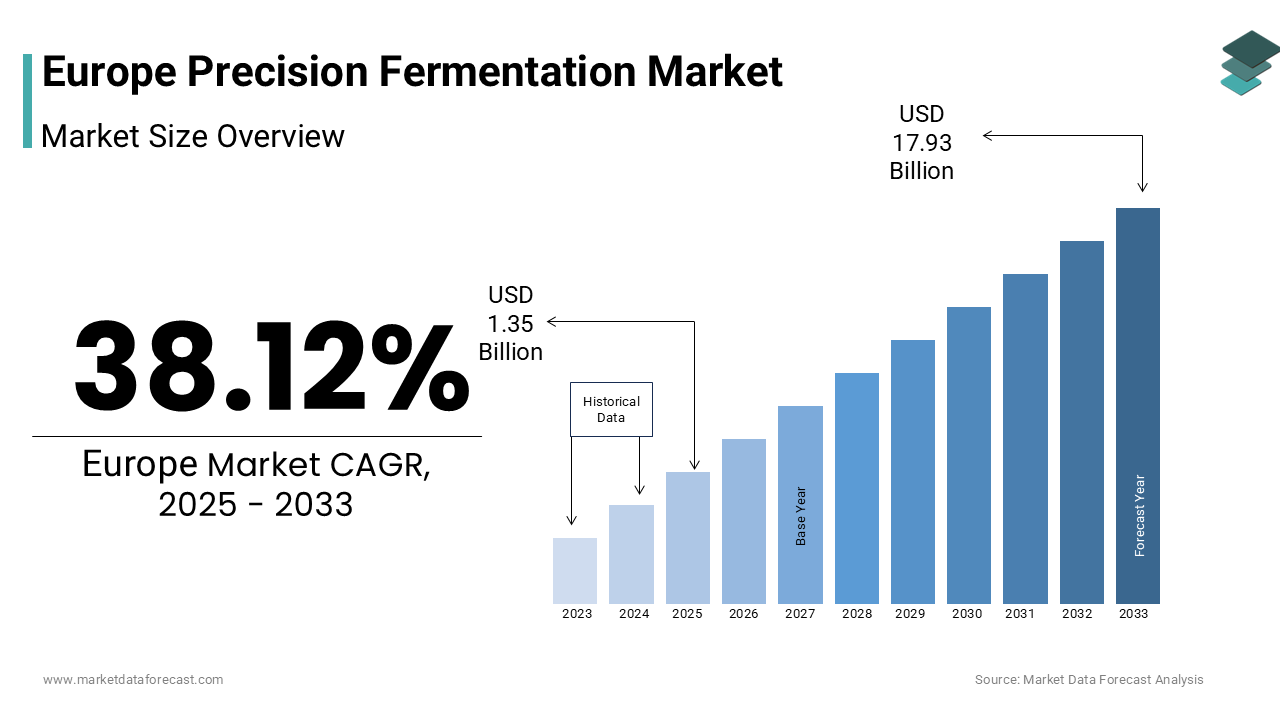
Precision fermentation is the controlled microbial synthesis of specific proteins, enzymes or bioactive compounds using genetically engineered microorganisms such as yeast or bacteria. This biotechnological approach enables the sustainable production of dairy proteins, egg whites, collagen, and other high-value ingredients without reliance on animal agriculture. Europe’s regulatory clarity around novel foods and strong institutional support for alternative protein innovation have positioned the region as a strategic hub for precision fermentation. According to the European Commission, over 130 novel food applications were submitted between 2018 and 2023. The European Food Safety Authority has evaluated more than 25 precision-fermentation-derived products for safety by the end of 2024. Consumer sentiment is shifting rapidly with a 2024 Eurobarometer survey showing that 41 % of Europeans are willing to try foods made with fermentation-derived proteins. Academic and industrial collaboration is accelerating, with Horizon Europe allocating approximately €220 million to cellular-agriculture and fermentation-related research for the 2021-2027 period. This scientific and regulatory momentum indicates Europe’s emerging leadership in redefining food and ingredient systems through precision fermentation.
MARKET DRIVERS
Growing Consumer Demand for Sustainable and Animal-Free Protein Sources
European consumers are increasingly rejecting conventional animal agriculture due to its environmental and ethical implications, thereby accelerating demand for precision fermentation derived alternatives, which is majorly propelling the growth of the European precision fermentation market. According to the European Environment Agency, the livestock sector is part of the agriculture-related emissions in the European Union and agriculture accounted for about 12% of total greenhouse gas emissions in 2021 in the EU. According to the European Commission’s Farm to Fork Strategy, there is a clear aim to reduce the environmental footprint of food production, which is indirectly supporting alternative protein technologies. As per a survey by the European Consumer Organisation, among respondents aged 18 to 35 a majority expressed a preference for animal-free dairy products if they matched conventional counterparts in taste and price. Producing one kilogram of bovine milk protein requires significantly more land and emits substantially more carbon-dioxide-equivalent greenhouse gases than a precision-fermentation-derived counterpart, as indicated by a life-cycle assessment from the Technical University of Munich. Regulatory support further amplifies this demand. The European Food Safety Authority’s streamlined novel-food pathway for microbial proteins has cut approval timelines by a large margin since 2022. These converging factors are collectively driving market uptake of precision-fermentation technologies across Western and Northern Europe.
Robust Public and Private Investment in Alternative Protein Innovation
The unprecedented levels of coordinated funding from both public institutions and private investors that create fertile ground for scalable commercialization is further boosting the European precision fermentation market expansion. Since 2020, the European Investment Bank has channelled significant funding into food-tech ventures. National governments are also stepping up: France’s national strategy for alternative proteins committed substantial funding through 2025, which is earmarking a large share for fermentation infrastructure. Meanwhile, Germany’s federal Ministry of Food and Agriculture allocated meaningful funds in 2023 to support pilot-scale bioreactor facilities focused on non-GMO and engineered strains alike. On the private side, venture-capital inflows into European precision-fermentation startups have risen markedly according to data from AgFunder Europe with companies like Formo and Solar Foods securing substantial Series B funding rounds, which is enabling construction of industrial-scale production units in Germany and Finland. These investments are not just financial but strategic, often coupled with university partnerships and access to EU innovation grants. This dual engine of public policy and private risk capital is rapidly closing the gap between laboratory proof-of-concept and market-ready products, thereby reinforcing Europe’s emerging leadership in fermentation-derived food ingredients.
MARKET RESTRAINTS
Stringent and Fragmented Regulatory Approval Processes Across Member States
Despite harmonized novel food legislation under EU Regulation 2015/2283, precision fermentation derived ingredients encounter significant delays and inconsistencies in national implementation, which is restraining the regional market expansion. While the European Food Safety Authority provides a central scientific assessment, final authorisation requires endorsement by the European Commission and Member States, which in practice currently takes an average of about 2.56 years (≈ 31 months) from submission to opinion for novel-food applications. More critically, after approval individual countries impose divergent labelling, traceability and retail restrictions. For instance, national frameworks vary considerably in how fermentation-derived analogues are defined and labelled. This fragmentation complicates pan-European product launches and increases compliance costs. Regulatory heterogeneity adds a meaningful cost burden to market entry for many startups developing novel foods. The absence of clear EU-wide guidelines on containment of genetically-modified microorganisms used in industrial fermentation has also triggered precautionary delays in certain Member States. Until a truly unified and accelerated pathway is operationalised, regulatory fragmentation remains a structural restraint on the scalability and investment appeal of Europe’s precision-fermentation sector.
High Capital Expenditure and Limited Access to Industrial-Scale Fermentation Infrastructure
The commercial viability of precision fermentation in Europe is significantly constrained by the scarcity of large-scale fermentation facilities and the prohibitive cost of building new ones, which is further hampering the growth of the European market. Constructing a 100,000-litre stainless steel bioreactor facility compliant with EU Good Manufacturing Practices requires an initial investment of €120 to €180 million. Start-ups make up over 75% of Europe’s precision-fermentation companies. Unlike the United States, where contract development and manufacturing organisations offer ready access to multi-100,000-litre capacity, Europe has fewer than 10 dedicated food-grade fermentation sites capable of supporting commercial volumes. Most existing bioreactors are repurposed from pharmaceutical or bio-fuel production, which leads to sub-optimal yields and cross-contamination risks. Over 60% of food-fermentation start-ups report delays of 18 months or more in securing pilot-scale capacity. Furthermore, energy costs compound the issue. Running a 50,000-litre bioreactor continuously consumes approximately 15 GWh annually, which is incurring energy bills exceeding €2 million in Germany alone. Without coordinated public–private infrastructure initiatives or shared manufacturing hubs, the European precision-fermentation market will struggle to achieve the economies of scale necessary for price parity with conventional ingredients.
MARKET OPPORTUNITIES
Expansion into High-Value Non-Food Applications Such as Cosmeceuticals and Biomaterials
The European precision fermentation market is unlocking substantial growth potential beyond food by targeting premium non-food sectors where purity, functionality, and sustainability command price premiums. The European cosmetics market is valued at over €100 billion. Bio-identical molecules such as squalane, hyaluronic acid and collagen produced via fermentation are increasingly replacing animal- or petrochemical-derived actives. Unlike traditional extraction methods, precision fermentation yields molecules with zero batch variability and full traceability, which is compliant with the EU Cosmetics Regulation 1223/2009. Companies based in Austria and France are already commercialising fermentation-derived cosmetic ingredients with very high purity levels as verified by independent testing. In parallel, the biomaterials sector offers emerging opportunities. Bio-based polymers derived from microbial fermentation have potential to replace a meaningful share of conventional plastics in applications such as medical and packaging uses. Regulatory tailwinds also support this diversification. Guidance from the European Chemicals Agency (ECHA) explicitly classifies fermentation-derived molecules produced without toxic solvents as inherently safer under REACH, thereby accelerating registration timelines and reducing data requirements. By strategically pivoting toward cosmeceuticals and advanced biomaterials, European precision fermentation firms can achieve higher margins, reduce exposure to volatile food-commodity pricing, and leverage existing biomanufacturing assets more efficiently and thereby de-risking their overall business models.
Strategic Integration with Circular Bioeconomy and Waste Valorization Frameworks
Precision fermentation in Europe is gaining momentum through its alignment with the EU’s circular bioeconomy strategy, which promotes the conversion of organic waste streams into high-value biochemicals and is considered as a promising opportunity for the regional market. The European Union generates a large amount of food and beverage-processing residues annually. These residues are rich in sugars, cellulose and glycerol and are increasingly being used as low-cost feedstocks for microbial fermentation, which is significantly lowering raw-material expenses and carbon intensity. For example, the Finland-based company Solar Foods utilises side streams from the forestry industry to produce protein via gas fermentation, which according to company data has a carbon footprint of around 0.4 kg CO₂-equivalent per kilogram of protein. The Netherlands-based company DSM has partnered with local dairy cooperatives to convert whey permeate into fermentation media for vitamin B₂ production, which is reducing media costs substantially as reported in its sustainability update. The European Bioeconomy Strategy 2030 explicitly prioritises such industrial symbiosis with significant Horizon Europe funding allocated to “waste-to-molecule” fermentation projects. This integration not only enhances economic viability but also qualifies companies for green subsidies under the EU Taxonomy for Sustainable Activities. By anchoring precision fermentation within regional waste-valorisation ecosystems, European innovators are building resilient, localised and policy-favoured supply chains that transcend the limitations of traditional feed-stock dependency.
MARKET CHALLENGES
Persistent Consumer Skepticism Toward Genetically Engineered Microorganisms
Despite scientific consensus on safety, a significant segment of European consumers remains wary of products derived from genetically engineered microbes, which is one of the biggest challenges to the growth of the European precision fermentation market. The 2024 European Commission’s Eurobarometer survey on biotechnology found that a significant portion of EU citizens oppose the use of gene editing in food production. Public skepticism stems from decades of debate around GMOs, which has shaped a cultural narrative equating genetic modification with corporate control and unnaturalness. Although precision fermentation does not involve genetically modified organisms in the final product. According to a consumer-perception study by the University of Copenhagen, only a minority of respondents could correctly identify that no GMOs are present in the final food item. This knowledge gap leads to avoidance behaviours with a substantial share of surveyed consumers saying they would avoid a product labelled as “made using engineered yeast” even if it were more sustainable. Retailers are sensitive to consumer sentiment and have delayed roll-outs of precision fermentation dairy alternatives citing uncertain customer readiness. Until public communication strategies effectively disentangle the process from the product and rebuild trust through transparency, this cultural resistance will continue to limit mainstream adoption and depress investor confidence in consumer-facing fermentation applications.
Intellectual Property Fragmentation and Strain on Innovation Ecosystems
The mounting pressure from overlapping and conflicting intellectual property claims that hinder collaborative innovation and increase litigation risk is further inhibiting the expansion of the regional market. Unlike in the United States, where patent law provides clearer guidelines on synthetic biology and gene sequences, the European Patent Office (EPO) applies a more restrictive interpretation under Directive 98/44/EC on the legal protection of biotechnological inventions that excludes essentially biological processes from patentability. According to one legal review, the directive and associated European Patent Convention provisions specify that microorganisms and products thereof may be patentable, but “essentially biological processes for the production of plants or animals” are excluded. This ambiguity has led many firms to engage in defensive patenting. For example, some observers describe dense patent “thickets” in synthetic biology. Many of these patents reportedly cover foundational tools such as promoter sequences, host strains and purification methods, which is creating a dense thicket that startups must navigate. According to a study, companies operating in Europe often face “freedom-to-operate” uncertainties when building on biotechnological inventions. Moreover, university spin-outs often face licensing issues because national research‐funding rules mandate broad access rather than exclusive licenses, which is a contrast to the U.S. framework under Bayh‑Dole Act. The resulting innovation friction discourages cross-border R&D partnerships and deters early-stage investors wary of IP entanglements. Without harmonised EU-wide standards for biotech patent eligibility and streamlined licensing pathways, intellectual-property fragmentation will continue to stifle the collaborative spirit essential for scaling Europe’s precision-fermentation ambitions.
REPORT COVERAGE
| REPORT METRIC | DETAILS |
| Market Size Available | 2024 to 2033 |
| Base Year | 2024 |
| Forecast Period | 2025 to 2033 |
| Segments Covered | By Microbe Type, Ingredient, Application, Industry and Region |
| Various Analyses Covered | Global, Regional & Country Level Analysis, Segment-Level Analysis, DROC, PESTLE Analysis, Porter’s Five Forces Analysis, Competitive Landscape, Analyst Overview on Investment Opportunities |
| Regions Covered | United Kingdom, France, Spain, Germany, Italy, Russia, Sweden, Denmark, Switzerland, the Netherlands, Turkey, and the Czech Republic. |
| Market Leaders Profiled | Perfect Day, Geltor, Solar Biotech, Imagindairy, Formo (Legendairy Foods), Remilk, Motif FoodWorks, Melt&Marble, New Culture, Mycorena, ADM, DSM-Firmenich, Chi Foods, Wilk Technologies, and Those Vegan Cowboys. |
SEGMENTAL ANALYSIS
By Microbe Type Insights
The yeast segment captured 59.5% of the regional market share in 2024. The dominance of the yeast segment in the European market is attributed to its well-established genetic tractability, scalability in industrial bioreactors, and regulatory familiarity across European food and pharmaceutical frameworks. Established industrial infrastructure and GRAS status are anticipated to drive the leading position of the yeast segment in the European market during the forecast period. Saccharomyces cerevisiae has benefited from decades of use in food and beverage fermentation and is recognised under the European Food Safety Authority (EFSA) “Qualified Presumption of Safety” (QPS) framework for food and feed uses. The strain’s eukaryotic protein-folding machinery also enables accurate post-translational modifications, which is critical when producing functional dairy proteins like β-lactoglobulin. Companies such as Formo and Remilk rely exclusively on yeast-based platforms to replicate casein and whey proteins. Additionally, substantial funding through Horizon Europe has supported yeast-centric fermentation projects since 2021, which is reinforcing institutional confidence in the platform. This convergence of regulatory acceptance, existing bioprocessing compatibility and functional fidelity are likely to contribute to the domination of the yeast segment in the European precision fermentation market.
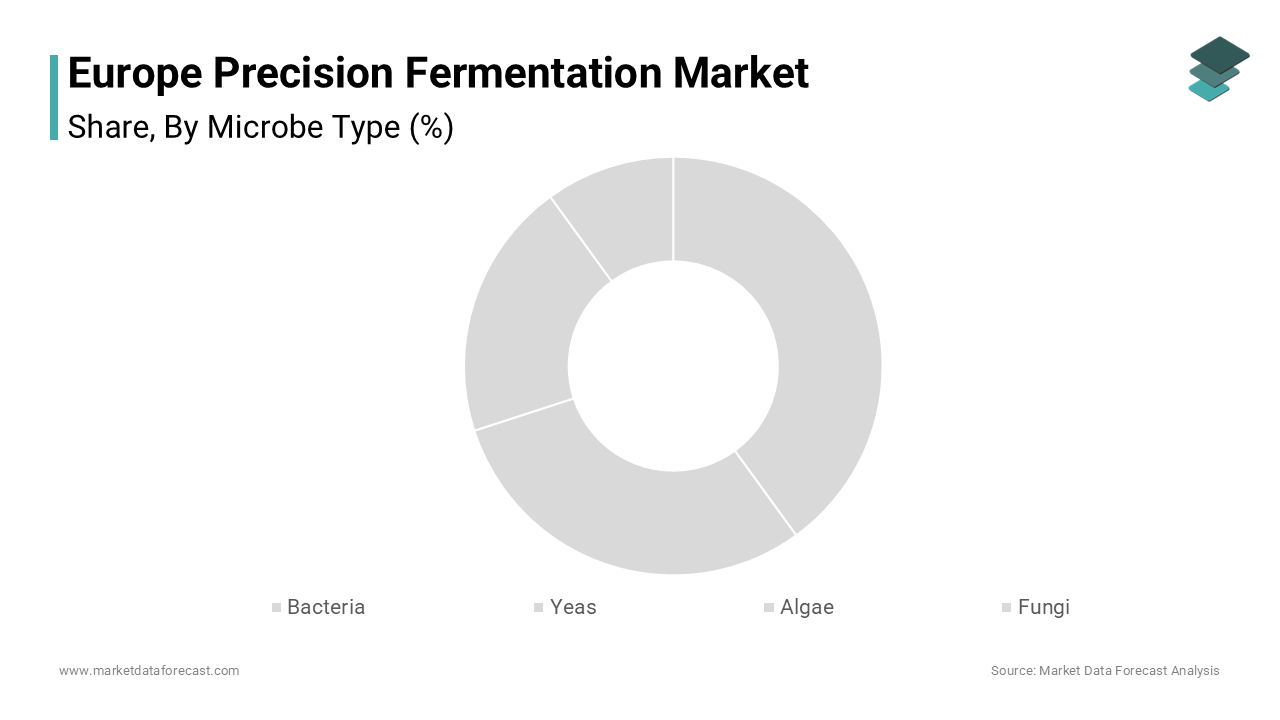
The algae segment is anticipated to register the fastest CAGR of 29.8% over the forecast period in the European market. While currently small in absolute volume, the growth of the algae segment is propelled by dual demand from nutraceuticals and sustainable biomaterials, coupled with advances in photobioreactor and heterotrophic fermentation hybrid systems. Expanding role in Omega 3 and antioxidant production is fuelling the expansion of the algae segment in the European market. European consumers are increasingly driving demand for algae-derived docosahexaenoic acid (DHA) as a vegetarian alternative to fish oil. Retail sales of algal omega-3 supplements have seen strong year-on-year growth across Europe. Regulatory approvals are accelerating this trend. New algal strains for novel-food use have been authorised in recent years. Precision fermentation enhances consistency and purity, eliminating ocean-derived contaminants such as mercury. Producers are now using heterotrophic algae in stainless-steel bioreactors to achieve high DHA concentrations for medical-nutrition applications. At the same time, the growing aging population of Europe supports sustained demand for cognitive-health ingredients is further driving the growth of the algae segment in the European market.
By Ingredient Insights
The whey and casein protein segments together constituted the dominant share of the European market in 2024. The overwhelming focus on dairy proteins reflects Europe’s cultural and industrial entrenchment in dairy consumption and its strategic pivot toward animal free dairy without compromising functionality. Regulatory and sensory alignment with conventional dairy is further propelling the growth of the whey and casein protein segments in the European market. Precision fermentation derived whey and casein are molecularly identical to their bovine counterparts, which is enabling seamless replication of melt, stretch and gelling properties essential in cheese and yogurt. This exact match has accelerated regulatory acceptance. The European Food Safety Authority cleared the first animal-free beta-lactoglobulin for use in 2022. Germany’s REWE supermarket chain launched a precision-fermentation mozzarella prototype in Q4 2024, which is citing sensory equivalence in internal trials. Moreover, European consumer research shows a rising interest in dairy alternatives if taste and texture matched conventional products. Given that Europe consumes many millions of tonnes of cheese annually, even a 5 % substitution by fermentation-derived dairy proteins represents a multi-billion-euro opportunity. This functional fidelity and ethical and environmental storytelling are further contributing to the dominating the whey and casein segments in the European market.
The collagen protein segment is estimated to witness the highest CAGR of 30.7% over the forecast period in the European precision fermentation market during the forecast period owing to the booming demand in beauty from within and medical aesthetics, where bio identical human collagen offers superior biocompatibility over animal sourced variants. The growing demand for clean label anti-aging solutions in beauty sector is also contributing to the growth of the collagen protein segment in the regional market. European consumers are increasingly rejecting bovine and porcine collagen due to religious, ethical, and prion-related safety concerns. Precision fermentation delivers type I and III human collagen with 99.9% sequence accuracy, which is enabling dermal fillers and topical serums with enhanced bioavailability. Clinical validation further supports adoption. As per a 2025 double-blind study published in the Journal of the European Academy of Dermatology, topical application of microbial collagen increased skin elasticity by 21 % over 12 weeks, which is outperforming marine collagen by 8 percentage points.
By Application Insights
The dairy alternatives segment occupied the major share of 53.5% of the European market in 2024. The growth of the dairy alternatives segment is rooted in Europe’s deep dairy heritage, high per capita consumption, and the technical feasibility of replicating dairy functionality through precision fermentation. Cultural entrenchment of dairy products creates high substitution potential and further boost the expansion of the dairy alternatives segment in the European market. Europeans consume a substantial amount of dairy products every year, with total annual milk production in the European Commission (EU) region estimated around 155 million tonnes per year. Unlike plant-based dairy alternatives that often suffer from off flavours and poor meltability, precision fermentation proteins replicate the exact molecular structure of casein and whey. According to a 2024 consumer trial by NielsenIQ across five European countries, 73% of participants rated fermentation-derived mozzarella as “indistinguishable” from dairy in blind taste tests. Major dairies like Arla Foods and Müller Group are actively exploring blends, which is recognising that full replacement is not necessary to achieve sustainability targets. Even a 10 % market penetration in cheese alone would equate to over 200 000 tonnes of precision-fermentation protein annually demonstrating why dairy alternatives command the lion’s share of applications.
The skincare and haircare products segment is predicted to grow at the fastest CAGR of 36.6% over the forecast period in the European precision fermentation market due to the cosmetics industry’s pivot toward bio identical, traceable, and sustainable actives that meet strict EU safety and environmental standards.The EU Cosmetics Regulation (EC) No 1223/2009 mandates full traceability of cosmetic products throughout the supply chain. According to the regulation, cosmetic products must be linked to a “responsible person” and the product-information file must be readily accessible to competent authorities. The regulation also bans sale within the EU of cosmetic products tested on animals, including both finished products and ingredients. That regulatory framework thus supports routes such as precision fermentation, which provide animal-free high-performance actives like squalane, hyaluronic acid and keratin without relying on animal testing or endangered-species sources. Independent market-data from Ecovia Intelligence reports that the global natural & organic cosmetics market is forecast to approach USD 14 billion in 2024.
REGIONAL ANALYSIS
Germany Precision Fermentation Market Analysis
Germany dominated the precision fermentation market in Europe in 2024 with a share of 25.5%. The dominating position of Germany in the European market is driven by its world class biotech infrastructure, aggressive industrial decarbonization policies, and dense network of food and chemical manufacturers. Over 40 precision-fermentation startups operate in Germany, including Formo and Magellan Life Science. Germany has received substantial public funding in this space. According to a review, German alternative protein funding has been rising strongly, with around €134 million invested in 2024 alone in alternative proteins, of which a large share went to fermentation-based companies. The Fraunhofer‑Gesellschaft supports pilot plants and infrastructure for microbial protein production, leveraging Germany’s existing chemical and pharma industrial base (e.g., BASF and Merck KGaA) to provide high-purity fermentation expertise. German consumers also display strong sustainability interest: a survey by GfK SE found that 81% of German consumers perceived their lifestyle as very or somewhat environmentally friendly. This combined ecosystem of capital, talent, policy and demand underpins Germany’s emerging role as a key European hub for precision fermentation.
France Precision Fermentation Market Analysis
France captured the second largest share of the European market in 2024. The growth of the French market is attributed to its state led protein transition strategy and strong dairy industry engagement. The French National Strategy for Alternative Proteins that was launched in 2022 supports domestic sovereignty in protein supply and aims to scale up infrastructure for next generation ingredients. France’s large cheese-producing industry and export segment create strong incentives for dairy-free innovation. Public research institutions such as INRAE are advancing fermentation technologies and microbial protein production, which is consistent with France’s cautious stance on genetic engineering. According to the Good Food Institute’s 2025 consumer survey, about 50 % of French consumers are open to precision-fermentation-derived foods. France also hosts major food-tech clusters, including the accelerator Station F, which nurtures startups focused on fermentation-based ingredients. This blend of agricultural heritage, public investment, and culinary culture positions France as a pivotal growth engine.
Netherlands Precision Fermentation Market Analysis
The Netherlands is expected to command a prominent share of the European market over the forecast period owing to its unparalleled agri food logistics network and world leading research in microbial biotechnology. The Wageningen University & Research in the Netherlands is ranked #1 worldwide in the field of Agriculture & Forestry. The country hosts more than 25 fermentation startups, including Fooditive and Upstream Foods. The Dutch government’s Protein Transition Implementation Agenda is committed to alternative-protein scale up by 2027, including specific support for shared fermentation facilities within the Food Valley ecosystem. Leveraging the Port of Rotterdam, companies gain low-cost access to global feedstocks, reducing input costs by up to 18 % (per a 2024 analysis). The Netherlands also leads in regulatory sandboxing: the Dutch Nutrition Centre approved the first precision-fermentation dairy product for public sale in 2024 under a novel-food fast track. With ~70 % of European food-ingredients transiting through Dutch distribution centres, the country offers unmatched go-to-market speed — reinforcing its position as Europe’s precision-fermentation anchor.
Switzerland Precision Fermentation Market Analysis
Switzerland held a considerable share of the European precision fermentation market in 2024. Despite its small population, the market in Switzerland is majorly driven by its world class biopharmaceutical sector and premium consumer base. Swiss precision fermentation firms like Bloom Biorenewables and Geltor benefit from decades of expertise in GMP-compliant protein production, with many startups founded by former Novartis or Roche scientists. The Swiss Federal Office of Public Health (FOPH) authorises novel foods, including those approved in the EU, under a streamlined process. Switzerland’s cosmetics industry and is home to premium brands like La Prairie demands ultra-pure actives, creating a ready market for fermentation-derived collagen and elastin. In 2023, Switzerland ranked third in Europe for per-capita cosmetics consumption at about €233 per person. Additionally, Switzerland’s regulatory and infrastructural environment and its premium consumer market combine to make it a disproportionate force in high-value precision fermentation applications.
Denmark Precision Fermentation Market Analysis
Denmark is projected to hold a notable share of the European precision fermentation market during the forecast period due to its integration of fermentation into national circular economy frameworks. The Danish Technological Institute operates a pilot facility converting agricultural by-products into higher-value proteins. Denmark’s 2023 Bioeconomy Strategy mandates increased valorisation of food-industry side streams by 2030. The country’s low-carbon electricity mix (with over 80 % renewables) provides a competitive energy cost base. This supportive infrastructure, along with strong consumer trust in novel food technologies, positions Denmark as a model for sustainable scale-up in precision fermentation.
COMPETITIVE LANDSCAPE
The Europe precision fermentation market features a dynamic and rapidly evolving competitive landscape characterized by a mix of agile startups strong academic institutions and strategic alliances with legacy food and chemical companies. Unlike other regions dominated by a few large corporations Europe’s ecosystem is highly fragmented with innovation emerging from diverse national hubs including Germany the Netherlands Switzerland and Finland. Competition is primarily driven by technological differentiation in strain engineering downstream processing and feedstock flexibility rather than price. Startups compete fiercely for public funding venture capital and pilot scale fermentation capacity which remains limited. Regulatory navigation capability is a key competitive lever as companies that secure early novel food approvals gain significant first mover advantage. While collaboration is common through industry consortia and EU funded projects intellectual property disputes over foundational biotech tools are beginning to surface adding complexity to the competitive environment.
KEY MARKET PLAYERS
Some of the companies that are playing a dominating role in the Europe Precision Fermentation Market include
- Perfect Day, Inc.
- Geltor, Inc.
- Solar Biotech
- Imagindairy Ltd.
- Formo (Legendairy Foods GmbH)
- Remilk Ltd.
- Motif FoodWorks
- Melt&Marble
- New Culture
- Mycorena AB
- ADM (Precision fermentation division)
- DSM-Firmenich
- Chi Foods
- Wilk Technologies
- Those Vegan Cowboys
Top Players in the Market
Formo
Formo is a Germany based food technology company focused on producing real dairy proteins through precision fermentation without the use of animals. The company specializes in casein and whey proteins that are molecularly identical to those found in cow’s milk enabling authentic taste and functionality in cheese and yogurt applications. In 2024 Formo inaugurated Europe’s largest precision fermentation pilot facility in Berlin with support from the German Federal Ministry of Food and Agriculture. The company has also secured regulatory clearance from the European Food Safety Authority for its animal free casein and is actively collaborating with traditional dairies to integrate its proteins into existing production lines. Formo’s work demonstrates a scalable pathway for decarbonizing Europe’s dairy sector while preserving culinary heritage.
Solar Foods
Solar Foods is a Finnish innovator that leverages gas fermentation to produce protein from carbon dioxide hydrogen and electricity. Although initially focused on space and remote food applications the company has pivoted to supply high purity protein ingredients for food and cosmetics across Europe. In 2024 Solar Foods received final investment decision approval for its commercial scale Solein production facility in Vantaa Finland with operations expected to begin in 2026. The company has partnered with the European Space Agency and several EU funded circular economy initiatives to validate its carbon negative production model. Solar Foods’ unique feedstock independence from agricultural sugars positions it as a key player in climate resilient food systems and expands the geographic viability of precision fermentation beyond traditional biotech hubs.
Bloom Biorenewables
Bloom Biorenewables is a Swiss startup that engineers microbes to produce high value cosmetic and textile ingredients through precision fermentation. The company’s flagship products include bio identical collagen and bio based alternatives to petrochemical dyes. In 2024 Bloom completed a 35 million euro Series A funding round led by European climate tech investors and expanded its GMP compliant pilot plant in Lausanne. It has formed strategic supply agreements with two major European luxury beauty brands for 2025 product launches. By targeting premium non food applications Bloom avoids direct competition in crowded food ingredient spaces and leverages Switzerland’s strong regulatory and scientific ecosystem to accelerate commercialization. The company exemplifies how European fermentation firms are diversifying into high margin verticals to de risk their business models.
Top Strategies Used by Key Market Participants
Key players in the Europe precision fermentation market are actively pursuing strategic collaborations with traditional food and cosmetics manufacturers to enable seamless integration of microbial ingredients into established product lines. Companies are investing heavily in pilot and commercial scale fermentation infrastructure supported by both public grants and private capital to overcome scale up barriers. Regulatory engagement is a core strategy with firms proactively submitting novel food dossiers and participating in EU policy dialogues to shape favorable approval pathways. Many are also diversifying into high margin non food applications such as cosmeceuticals and biomaterials to reduce dependence on volatile food markets. Additionally players are prioritizing circular feedstock integration by utilizing agricultural or industrial side streams to lower input costs and enhance sustainability credentials aligning with the European Green Deal.
MARKET SEGMENTATION
The research report on the Europe Precision Fermentation Market has been segmented and sub-segmented based on categories.
By Microbe Type
- Bacteria
- Yeas
- Algae
- Fungi
By Ingredient
- Egg Protein
- Heme Protein
- Collagen Protein
- Whey and Casein Protein
- Enzymes
- Others
By Application
- Meat and Seafood
- Dairy Alternatives
- Egg Alternative
- Processed Food and Beverages
- Skincare and Haircare Products
- Others
By Industry
- Food and Beverages
- Cosmetics
- Pharmaceuticals
By Country
- UK
- France
- Spain
- Germany
- Italy
- Russia
- Sweden
- Denmark
- Switzerland
- Netherlands
- Turkey
- Czech Republic
- Rest of Europe