- Product Description Description
- Table of Contents TOC
- List of Table & Figure LOT
- Get Free Sample PDF Sample PDF
Market Size, 2025
$9.33 BnMarket Estimate, 2026
$9.55 BnMarket Forecast, 2034
$11.51 BnCAGR, 2026–2034
2.36%Europe Predictive Analytics Market Report Summary
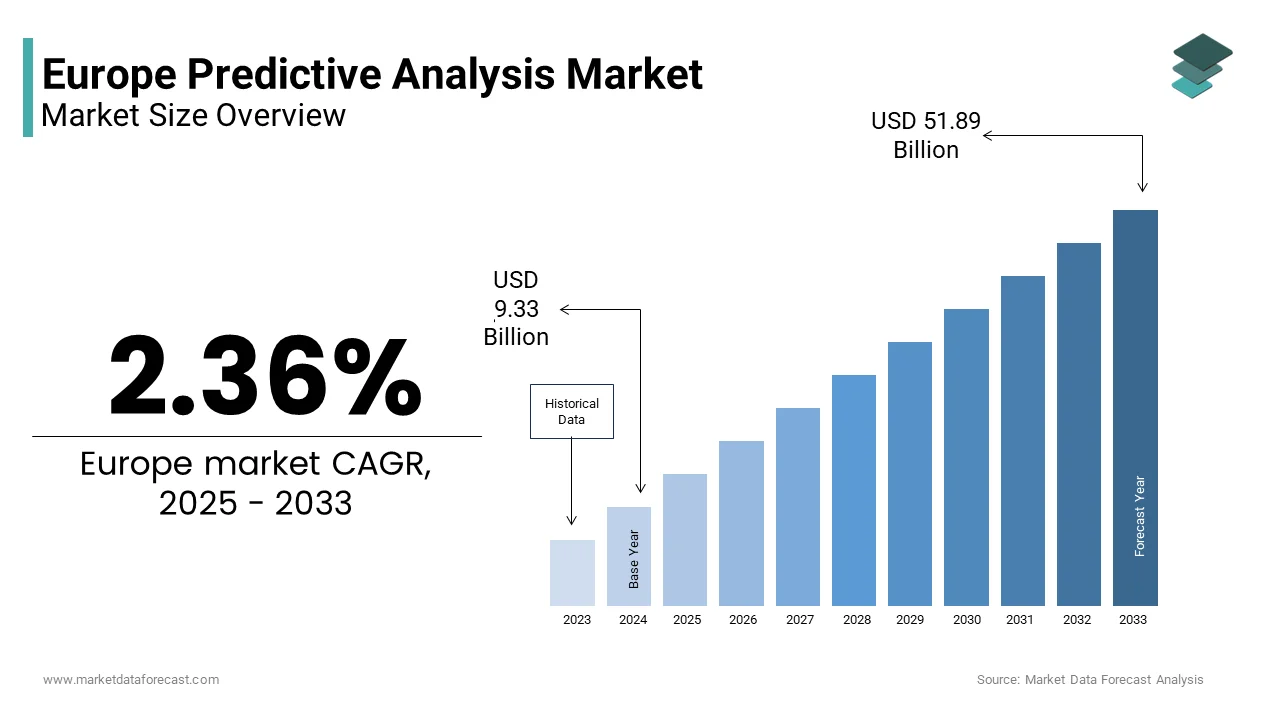
The Europe predictive analytics market was valued at USD 9.33 billion in 2025, is estimated to reach USD 9.55 billion in 2026, and is projected to expand to USD 11.51 billion by 2034, growing at a CAGR of 2.36% during the forecast period from 2026 to 2034. Market growth is driven by accelerating digital transformation across enterprises, rising adoption of data-driven decision-making, and increasing use of advanced analytics for operational efficiency, risk mitigation, and strategic planning. The growing integration of artificial intelligence (AI), machine learning (ML), and big data analytics across industries such as manufacturing, BFSI, logistics, and public services is further strengthening market momentum across Europe.
Key Market Trends
- Increasing adoption of predictive analytics for operations management, demand forecasting, and process optimization.
- Strong preference for on-premise deployment models, driven by data security, regulatory compliance, and legacy IT infrastructure.
- Rising use of AI-driven analytics platforms to support automation, predictive maintenance, and real-time decision intelligence.
- Growing demand from large enterprises for scalable analytics solutions that integrate with ERP, CRM, and supply chain systems.
- Expansion of predictive analytics in public sector modernization, defense, and national AI strategies across Europe.
Segmental Insights
- By deployment model, the on-premise segment held the largest share of the Europe predictive analytics market in 2025, supported by strict data governance requirements, cybersecurity concerns, and enterprise control over sensitive datasets.
- By application, the operations management segment dominated the market in 2025, driven by the need to enhance efficiency, reduce downtime, optimize resource allocation, and improve predictive maintenance across industries.
- By organization size, large enterprises accounted for the majority share of the market in 2025, owing to their higher data volumes, stronger IT budgets, and early adoption of advanced analytics technologies.
Regional Insights
- Germany led the Europe predictive analytics market with a 24.2% share in 2025, supported by strong industrial analytics adoption, Industry 4.0 initiatives, and advanced manufacturing ecosystems.
- The United Kingdom followed with a 17.3% share, driven by widespread analytics usage in finance, retail, and public services.
- France continues to grow steadily due to national initiatives focused on AI sovereignty, defense modernization, and public-sector digital transformation.
- The Netherlands benefits from strong adoption in logistics, agri-tech, and open data ecosystems.
- Sweden is expected to register healthy growth from 2025 to 2033, supported by advanced digital infrastructure and innovation-led enterprises.
Competitive Landscape
The Europe predictive analytics market is characterized by the presence of global technology leaders offering end-to-end analytics platforms, AI-enabled insights, and enterprise-grade data solutions. Companies are focusing on cloud-hybrid architectures, AI integration, industry-specific analytics models, and strategic partnerships to strengthen market presence.
Prominent players in the Europe predictive analytics market include Teradata Corporation, Fair Isaac Corporation, Oracle Corporation, IBM Corporation, Siemens AG, SAP SE, MicroStrategy Inc., Microsoft Corporation, General Electric Company, and SAS Institute, Inc.
Europe Predictive Analytics Market Size
The Europe predictive analytics market size was valued at USD 9.33 billion in 2025 and is anticipated to reach USD 9.55 billion in 2026 and USD 11.51 billion by 2034, growing at a CAGR of 2.36% during the forecast period from 2026 to 2034.
Predictive analytics are advanced data modeling techniques, including machine learning, statistical algorithms, and artificial intelligence, that analyze historical and real-time data to forecast future events, behaviors, and outcomes across sectors such as banking, healthcare, manufacturing, ing and public administration. Unlike descriptive analytics, which explains past performance, predictive analytics enables proactive decision-making by identifying patterns and probabilities before outcomes materialize. In a region defined by stringent data governance and a push for evidence-based policy, predictive analytics has evolved from a business intelligence tool into a strategic asset for operational resilience and regulatory compliance. According to sources, large enterprises in the European Union are increasingly focusing on implementing advanced data analytics and AI for applications such as predictive maintenance and customer churn analysis to improve efficiency and make informed decisions. As per research, there is a growing emphasis within the public sector on leveraging technology, including big data analytics and AI systems, for improved fraud detection and service optimization to protect public resources and increase efficiency. Furthermore, European banking supervision, led by the European Central Bank (ECB) through the SSM, requires significant credit institutions to have robust internal processes and data analysis capabilities for managing and monitoring credit risk and anti-money laundering (AML) activities. These institutional imperatives position predictive analytics as a cornerstone of Europe’s data-driven governance and industrial competitiveness.
MARKET DRIVERS
Regulatory Mandates for Proactive Risk Management in Financial Services
European financial institutions are compelled to adopt advanced data modeling techniques due to binding regulatory frameworks, which contribute to the growth of the Europe predictive analytics market. These frameworks require ffforward-looking riskssessment and fraud prevention. The Digital Operational Resilience Act mandates that all significant entities implement advanced monitoring systems capable of identifying anomalous transactions and cyber threats in real time. Many institutions have widely adopted predictive anti-money laundering systems that analyze behavioral patterns to flag suspicious activity with a reduced rate of false positives compared to traditional methods. Similarly, the European Insurance and Occupational Pensions Authority requires insurers to use predictive models for solvency stress testing under the Solvency II framework. Predictive credit risk models now cover a majority of retail loan portfolios, enabling dynamic provisioning and early default intervention. This regulatory cascade transforms predictive analytics from an optional efficiency tool into a non-negotiable compliance infrastructure across Europe’s financial ecosystem.
Industrial Digitalization and Predictive Maintenance Under the Twin Transition
The European Union’s dual green and digital transition strategy is another key driver of the Europe predictive analytics market. This has accelerated the deployment of predictive analytics in manufacturing, eneenergy and transport to optimize asset performance and reduce emissions. According to research, Large industrial firms across the European Union have increasingly implemented predictive maintenance systems to minimize unplanned downtime and extend equipment life. Predictive maintenance models utilized within various manufacturing facilities, including automotive plants, have demonstrated effectiveness in reducing machine failure rates and lowering overall maintenance costs. In energy, the European Network of Transmission System Operators for Electricity uses predictive load forecasting to balance renewable supply and demand across grids with a percentage of variable generation. This convergence of industrial polytechnic infrastructure and sustainability goals makes predictive analytics indispensable for Europe’s resilient and efficient industrial base.
MARKET RESTRAINTS
Strict Data Protection Rules Limiting Training Data Availability
The General Data Protection Regulation imposes stringent constraints on the collection, processing, poprocessingg and use of personal data for algorithmic training, which acts as a major obstacle to the Europe predictive analytics market growth. This directly limits the scope and accuracy of predictive models in customer-facing domains. Retailers and insurers often experience project delays when attempting to repurpose consumer data because of the complexities involved in securing valid consent. The regulation’s purpose limitation principle prohibits repurposing customer data collected for service delivery into model training without explicit opt-in, a barrier that fragments data pools and reduces model robustness. Predictive marketing initiatives are frequently modified or discontinued when data anonymization methods are deemed insufficient or a clear lawful basis for processing is absent. The legal requirement for providing explanations regarding automated decisions creates operational challenges for organizations using algorithmic models in credit evaluations and recruitment processes. These legal constraints create a tension between model performance and compliance, particularly for small and medium enterprises lacking dedicated data governance teams.
Shortage of Skilled Data Science and AI Talent
The region faces a serious deficit in professionals capable of designing, validating, vlidating, nd deploying predictive analytics solutions, which creates a disruption in adoption across public and private sectors, and thereby negatively impacts the expansion of the Europe predictive analytics market. According to multiple sources, the European Union is facing a significant deficit of specialized data professionals, ranging from machine learning experts to ethics specialists. Moreover, as per research, a majority of enterprises indicate that a deficiency in internal expertise serves as the main obstacle to expanding predictive analytics initiatives. The gap is particularly acute in Central and Eastern Europe, where academic curricula lag in advanced analytics. As per various studies, a limited number of higher education institutions provide academic programs specifically focused on applied predictive modeling. Public sector agencies are hardest hit. A small portion of national administrations have established certified teams dedicated to data science. This human capital shortfall forces organizations to rely on costly external consultants or limit predictive use to off-the-shelf software, which affects customization and strategic value.
MARKET OPPORTUNITIES
Integration into Public Health and Pandemic Preparedness Systems
The European Union’s strengthened focus on health security is providing a pathway for growth of the Europe predictive analytics market. These opportunities exist in areas such as disease surveillance, resource allocation, and clinical risk stratification. Several member states now use models to forecast surges in hospitalizations caused by influenza and respiratory viruses, according to research. A developing European health data initiative will help facilitate the use of predictive models across borders for understanding chronic disease progression and drug responses, as per studies. Predictive analytics were used to reduce errors when forecasting intensive care unit admissions during a notable respiratory virus wave in Germany and the Netherlands. Additionally, the Innovative Medicines Initiative funds projects using predictive biomarkers to identify patients at risk of treatment failure in oncology and autoimmune diseases. This institutionalization of predictive health intelligence transforms analytics from reactive support to proactive public health infrastructure.
Expansion in Sustainable Supply Chain and Circular Economy Forecasting
These advanced data modeling techniques are emerging as a key enabler of the region’s circular economy and green logistics ambitions by forecasting material flows, product lifespans, and reverse logistics demand, which in turn offers fresh opportunities for the expansion of the Europe predictive analytics market. Several pilot projects under a broad action plan use predictive models to estimate product returns at the end of their life cycles and optimize schedules for remanufacturing processes. In the retail sector, predictive demand sensing has reduced overstock situations and cut down on waste from unsold inventory across participating business chains. Logistics service providers deploy models for predicting routes and loads, which results in lower fuel consumption through dynamic dispatch optimization.BeBesidesregulations governing batteries require digital records that incorporate indicators of future health, necessitating analytical platforms to forecast remaining capacity and potential safety risks for second-life applications. This convergence of regulatory foresight and operational efficiency positions predictive analytics as a strategic lever for Europe’s resource-neutral economy.
MARKET CHALLENGES
Algorithmic Bias and Lack of Explainability Under the AI Act
The European Union’s Artificial Intelligence Act classifies predictive analytics systems used in hiring, credit scoring, credt scori,scoringd law enforcement as high risk requiring rigorous transparency and human oversight, which poses significant technical and compliance challenges. Consequently, this impedes the growth of the Europe predictive analytics market. According to sources, a notable number of predictive models across the human resources and financial services sectors did not pass initial evaluations related to bias, often due to issues with the representativeness of their training data or the lack of transparency in their design. The regulation mandates that high-risk systems provide clear explanations of algorithmic decisions, a requirement difficult to fulfill with complex ensemble or deep learning models. As per research, a majority of commercial predictive platforms do not currently provide outputs that can be easily interpreted or documented according to current standards. Additionally, the lack of standardized bias testing frameworks across member states creates inconsistent enforcement. Adoption of AI in regulated industries will be constrained by legal uncertainty and reputational risk until vendors embed explainable AI and fairness validation into core development workflows.
Fragmented Data Infrastructures and Interoperability Barriers
Predictive analytics deployment is hindered by fragmented national data systems,, incopatible forma,, ts and siloed sectoral databases that prevent holistic modelling, despite the vision of a single regional data industry, which limits the expansion of the Europe predictive analytics market. A minority of predictive initiatives within the public sector successfully achieve data integration across different agencies; this outcome appears related to inconsistent metadata systems and older technology infrastructures. The use of numerous clinical coding standards in national health record systems hinders the development of predictive models that could operate across a wider region for disease monitoring or evaluating treatment results. Similarly, industrial firms struggle to combine operational technology data from machinery with enterprise resource planning systems due to protocol mismatches. Businesses operating in multiple countries frequently encounter several distinct data governance frameworks, which adds complexity to cross-border operations. This fragmentation inflates integration costs, limits model generalizability, anddelays time to value, which affects Europe’s ambition for scalable data-driven intelligence.
REOPORT COVERAGE
| REPORT METRIC | DETAILS |
| Market Size Available | 2025 to 2034 |
| Base Year | 2025 |
| Forecast Period | 2026 to 2034 |
| CAGR | 2.36% |
| Segments Covered | By Deployment Mode, Application, Organization Size, Industry, By Region |
| Various Analyses Covered | Global, Regional & Country Level Analysis, Segment-Level Analysis, DROC, PESTLE Analysis, Porter’s Five Forces Analysis, Competitive Landscape, Analyst Overview of Investment Opportunities |
| Regions Covered | UK, France, Spain, Germany, Italy, Russia, Sweden, Denmark, Switzerland, Netherlands, Turkey, Czech Republic, & Rest of Europe |
| Market Leaders Profiled | Teradata Corporation, Fair Issac Corporation, Oracle Corporation, IBM Corporation, Siemens AG, SAP SE, Microstrategy Inc., Microsoft Corporation, General Electric Company, SAS Institute, Inc. |
SEGMENTAL ANALYSIS
By Deployment Model Insights
In 2024, the on-premise segment was the largest in the Europe predictive analytics market. Factors such as stringent data sovereignty requirements, regulatory compliance needs, and the operational criticality of analytics systems in financial servicservicesb lic administration, and d and defense have mainly contributed to the prominence of the on-premise segment. Significant credit institutions often manage their predictive models on-premises, a practice that helps them retain direct control over sensitive customer information and adhere to operational resilience guidelines. A similar trend is observed where certain critical infrastructure operators are expected to manage their predictive cybersecurity analytics using local infrastructure. Furthermore, public sector bodies are typically required to maintain institutional custody of data used for official statistics and policy modeling, which tends to favor on-premise solutions. Additionally, legacy integration with core banking and enterprise resource planning systems, still prevalent in large enterprises, further entrenches on-premises solutions. This combination of regulatory necessity control and system legacy ensures oon-premisesthe dominant deployment model for high-risk and high-compliance applications.
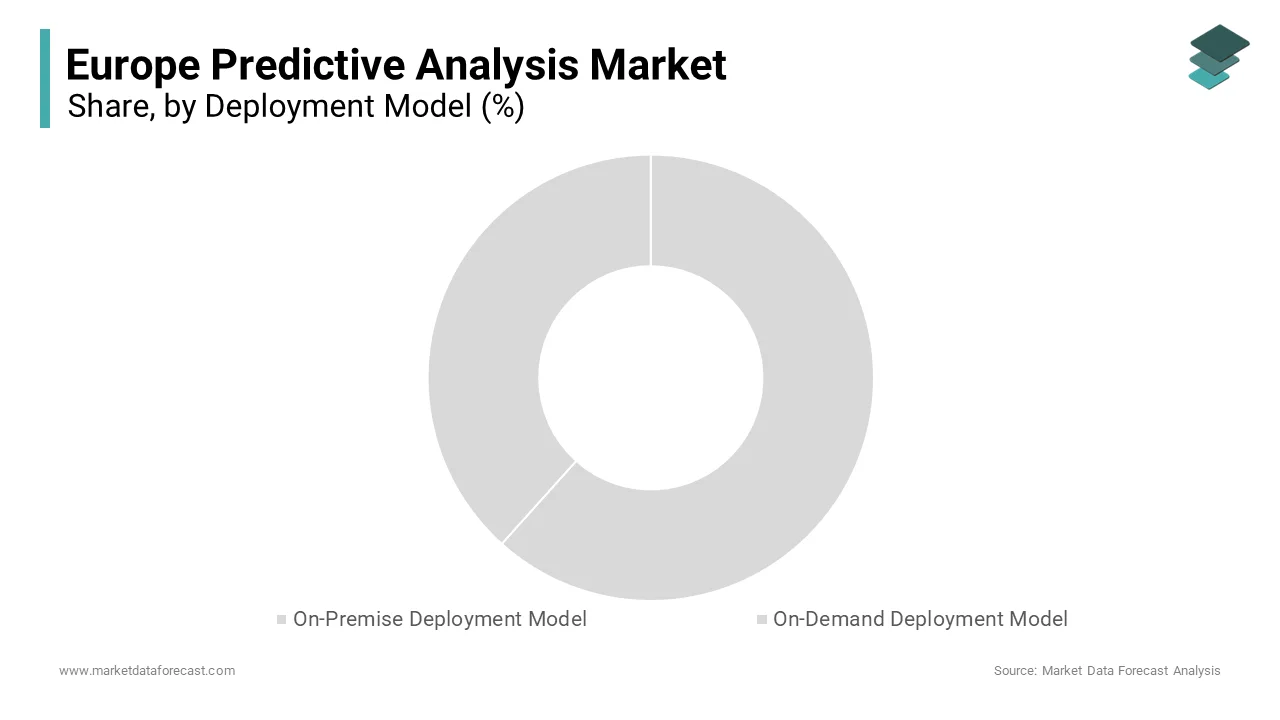
The on-demand segment is expected to exhibit a noteworthy CAGR of 24.6% from 2025 to 2033 due to the scalability, cost efficieefficiencyrapid innovation cycles offered by cloud platforms like Microsoft Azu, Google Cloud, AWS, which provide pre-built machine learning services and managed data lakes. Small and medium enterprises, lacking in-house data infrastructure, are leading adopters. Many buyers of predictive analytics technology have chosen cloud-based delivery methods. Cross-border research in the health data sector utilizes secure cloud environments for analysis. Predictive models can be applied to anonymized data directly within the cloud without relocating the original information. Efforts across the continent are working to establish legitimate sovereign cloud analytics. Providers are being certified to ensure they comply with data protection and interoperability standards. This convergence of accessibility compliance and innovation positions on demand as the high velocity growth engine for next generation predictive intelligence.
By Application Insights
The operations management segment held the majority share of the Europe predictive analytics market in 2025. Its vital role in optimizing manufacturing efficiency, energy use, and set reliability across industrial and utility sectors drives the leading position of the operations management segment. Predictive maintenance alone, enabled by sensor data and machine learning, reduces unplanned downtime and extends equipment life in a region prioritizing industrial resilience and decarbonization. In manufacturing and heavy machinery industries, the application of predictive methods in plant operations leads to significant reductions in equipment failure incidents and associated upkeep expenses. Within the energy sector, predictive modeling is a standard tool used to anticipate equipment strain, which helps maintain grid stability, especially in systems with high levels of renewable energy integration. Regulatory bodies in the aviation industry have incorporated mandatory requirements for the continuous monitoring of aircraft component health, leveraging predictive insights to improve safety protocols and optimize maintenance schedules. Across large industrial businesses, integrating predictive operations has become a widespread and vital part of broader digital strategies.
The supply chain management segment is predicted to witness the highest CAGR of 26.3% from 2025 to 2033, owingto post pandemic supply chain fragility, the European Union’s push for resilient and circular supply networknetworksthe need for real-time demand sensing in volatile markets. Predictive demand forecasting helps major retail chains lower overstock levels and decrease the volume of unsold inventory waste. Digital product passports for batteries incorporate predictive models to assess health and determine the timing for recycling or second-life applications. Logistics providers utilize predictive route optimization and dynamic dispatching to reduce fuel consumption. Predictive analytics are employed to anticipate material shortages and assist in securing strategic inputs for various industries. This alignment with resilience circularity and regulatory foresight positionsth suppl chain as the highest growth frontier for predictive intelligence.
By Organization Size Insights
The large enterprises dominated the Europe predictive analytics market in 2025. The dominance of the large enterprises segment is credited to its substantial data assets, regulatory obligations, and strategic investments in digital transformation. Large enterprises frequently utilize predictive models to enhance risk management, optimize operations, and refine customer analytics. Financial institutions contribute a substantial portion of investment in these technologies to meet regulatory requirements and strengthen operational resilience. Additionally, large manufacturers like SiemensSiemenSiemens, ch and others leverage predictive analytics across global supply chains and production networks with dedicated data science teams aenterprise-gradeade platforms. Major corporations are significantly more likely than small and medium-sized businesses to incorporate predictive analytics into their primary decision-making processes. This scale of investment data maturity and compliance necessity ensures large enterprises remain the market’s primary revenue and innovation engine.
The small and medium business enterprises segment is estimated to register the fastest CAGR of 28.1% from 2025 to 2033. The rapid expansion of the small and medium business enterprises segment is fueled by the democratization of predictive analytics through affordable cloud-based platforms, low-code tools, and industry-specific software as a service solutions. Platforms like Microsoft Power BI, Google Looker, and SAP Analytics Cloud now offer pre-built predictive templates for inventory forecasting, customer churn, and cash flow, which require data science expertise. Small and medium enterprises often adopt predictive analytics by utilizing embedded features already available within their existing accounting or customer relationship management platforms. Furthermore, regional digitalization vouchers are available in certain countries to help businesses offset a portion of the costs associated with acquiring analytics software. This accessibility regulatory support and ease of use are rapidly closing the analytics gap and transforming small and medium enterprises into agile, data-driven competitors.
COUNTRY ANALYSIS
Germany Predictive Analytics Market Analysis
Germany led the Europe predictive analytics market and held a 24.2% share in 2025. The growth of predictive analytics in Germany is driven by its advanced manufacturing base, stringent financial regulations, and leadership in industrial digitalization. The country’s Industrie 4.0 initiative has embedded predictive maintenance and quality control analytics in a portion of large factories. Additionally, the Federal Financial Supervisory Authority enforces strict use of predictive models for credit risk and fraud detection, mandating on-premises deployment for data sovereignty. A significant number of projects centered on predictive analytics were funded through a federal program this year. The presence of global leaders like SAP, Siemens, and Deutsche Bank further fuels demand for enterprise-grade solutions. This integration of industrial policy, financial compliance, and technological infrastructure cements Germany as the market’s analytical nucleus.
United Kingdom Predictive Analytics Market Analysis
The United Kingdom was the next prominent player in the Europe predictive analytics market and captured a share of 17.3% in 2025. The demand for predictive analytics in the UK is attributed to its world-class financial sector and advanced public service analytics. Despite Brexit, the UK aligns closely with European data standards and remains a hub for predictiveanti-moneyy laundering and credit scoring innovation. Major financial institutions have integrated machine learning frameworks into their systems to monitor transactions. Healthcare providers utilize predictive modeling to anticipate patient intake and manage facility resources. These technological implementations assist in streamlining operational efficiency and improving service delivery timelines. The Office for National Statistics also runs the Integrated Data Service,e enabling secure predictive research across government datasets. This dual engine of private sector sophistication and public sector data integration sustains the UK’high-valueue analytics ecosystem.
France Predictive Analytics Market Analysis
France grew steadily in the Europe predictive analytics market because of national strategies for AI sovereignty, defense mmodernization and public sector digital transformation. The French government's artificial intelligence plan has set aside substantial funding to create reliable forecasting tools for its defense, health, and power sectors. In the defense sector, a significant portion of the new intelligence platforms now employ predictive analysis methods to anticipate potential issues and streamline logistics. Regarding healthcare, a dedicated data platform facilitates secure, multi-institutional modeling for the effective management of chronic illnesses across a large pool of patient data. Additionally, the French Data Protection Authority, CNIL, has pioneered regulatory sandboxes for testing high-risk predictive models under the Artificial Intelligence Act. This blend of strategic autonomy, public data infrastructure,e and regulatory innovation positions France as a high compliance high control market.
Netherlands Predictive Analytics Market Analysis
The Netherlands is another key player in the Europe predictive analytics market due to its command in logistics, agri tech, and open data ecosystems. In agriculture, the Dutch Ministry of Agriculture supports predictive models for yield forecasting and disease detection across greenhouse clusters using satellite and sensor data. Companies like Philips and ASML deploy predictive maintenance in high-precision manufacturing to ensure equipment uptime. Additionally, the Netherlands hosts the European Open Data Portal and is a pilot country for the European Data Innovation Board, facilitating cross-sectoral analytics innovation. This concentration of trade sustainability and data openness makes the Netherlands a scalable testbed for real-world predictive solutions.
Sweden Predictive Analytics Market Analysis
Sweden is likely to expand in the Europe predictive analytics market from 2025 to 2033, owing to its leadership in predictive public health and green technology. An eHealth agency in Sweden operates a platform that forecasts hospital admissions and potential drug shortages using health records from a large number of citizens. Predictive load balancing approaches have led to reductions in the use of fossil fuels within district heating networks. Additionally, Swedish companies like Ericsson and Spotify pioneered early adoption of predictive customer analytics in telecommunications and digital media. An innovation agency in Sweden provides funding to numerous predictive analytics start-ups each year, with many of these new companies concentrating on solutions for climate and health-related fields. This culture of data for public good,d combined with private sector innovation, creates a high trust, high impact market per capita.
COMPETITIVE LANDSCAPE
The Europe predictive analytics market features intense competition among global cloud giants, European enterprise software leaders, and specialized AI innovators, each navigating a landscape defined by regulation, trust, nd sector specificity. Microsoft, SAP, and IBM dominate through integrated platforms that combine data management, machine learn, and governance—tailored to Europe’s high compliance expectations. Meanwhile, niche players focus on vertical applications such as predictive healthcare or sustainable supply chains where domain expertise outweighs scale. The market is increasingly bifurcated between on-premises solutions for regulated industries and cloud-based on-demand models for agile businesses. Competition is not merely technical but centered on data sovereignty, ethical AI, and alignment with the European Union’s digital sovereignty vision. Success requires not only algorithmic sophistication but also deep collaboration with public institutions,, ns adherence to evolving Astandastandardsand the ability to deliver transparent, auditable, le and human-centric predictive intelligence in a region that prioritizes rights over raw innovation.
KEY MARKET PLAYERS
A few of the market players in the Europe predictive analysis market are
- Teradata Corporation
- Fair Issac Corporation
- Oracle Corporation
- IBM Corporation
- Siemens AG
- SAP SE
- MicroStrategy Inc.
- Microsoft Corporation
- General Electric Company
- SAS Institute, Inc.
Top Players In The Market
- SAP SE is a European leader in enterprise predictive analytics through its SAP Analytics Cloud and embedded AI capabilities within the SAP Business Technology Platform. The company enables large enterprises across manufacturing, finance,ce and public sectors to deploy predictive models for supply chain optimization, predictive maintenance,,ce and financial risk forecasting. The company also expanded integration with SAP S/4HANA to deliver real-time predictive insights directly within operational workflows. These innovations reinforce SAP’s role as a trusted provider of sovereign,gn scalable and compliant analytics solutions for Europe’s digital industrial base and global enterprise clients.
- Microsoft Corporation plays a pivotal role in the Europe predictive analytics market through its Azure Machine Learning and Power Platform suite, which democratizes advanced analytics for both large enterprises and small and medium businesses. The company’s cloud infrastructure is certified under the EU Data Boundary and GAIA X framework,s ensuring data residency and compliance with the General Data Protection Regulation. Additionally, Microsoft partnered with national health agencies in France and Sweden to deploy predictive models for hospital capacity planning using secure enclaves. These actions strengthen Microsoft’s position as a foundational cloud and AI partner in Europe’s trusted data ecosystem.
- IBM Corporation contributes significantly to the Europe predictive analytics market through its Watsonx data and AI platf,orm which emphasizes gove,rned trustw,orthy and explainable artificial intelligence for regulated industries. The company’s predictive solutions are widely used in banking, healthcare,lthcare and public administration transparency and audit. The company also collaborated with German industrial firms to deploy predictive quality control systems in manufacturing that reduce defect rates by over thirty percent. By focusing on responsible AI and sector-specific compliance, IBM reinforces its reputation as a strategic partner for Europe’shigh-integrityy analytics needs.
Top Strategies Used By The Key Market Participants
Key players in the Europe predictive analytics market prioritize regulatory alignment by embedding explainability, fairness validvalidationd data provenance features to comply with the Artificial Intelligence Act and General Data Protection Regulation. They offer sovereign cloud deployment options with EU data residency guarantees through partnerships with GAIA X and national cloud providers. Companies invest in low-code generative AI tools to democratize predictive modeling for small and medium enterprises and citizen data scientists. Strategic collaborations with public sector agencies, financial reguregulatorsnd industrial consortia enabenable developmentdomain-specific solutions for health logistics and manufacturing. Additionally, vendors emphasize interoperability with European data spaces such as the European Health Data Space and energy data infrastructures to supportcross-borderr analytics within trusted governance frameworks.
MARKET SEGMENTATION
This research report on the Europe predictive analytics market is segmented and sub-segmented into the following categories.
By Deployment Model
- On-Premise Deployment Model
- On-Demand Deployment Model
By Application
- Supply Chain Management
- Network Management
- Operations Management
- Others
By Organization Size
- Large enterprises
- Small and medium-sized business enterprises
By Industry Type
- BFSI
- Information Technology and Media
- Telecom
- Healthcare
- Hospitality
- Retail
- Manufacturing
- Others
By Country
- UK
- France
- Spain
- Germany
- Italy
- Russia
- Sweden
- Denmark
- Switzerland
- Netherlands
- Turkey
- Czech Republic
- Rest of Europe