- Product Description Description
- Table of Contents TOC
- List of Table & Figure LOT
- Get Free Sample PDF Sample PDF
Market Size, 2025
$1.3 BnMarket Estimate, 2026
$1.38 BnMarket Forecast, 2034
$2.16 BnCAGR, 2026–2034
5.77%Executive Summary: Europe Prefilled Syringes Market
- Market Scope: Comprehensive regional prefilled syringes market analysis covering material segments, product types, distribution channels, country-level leadership frameworks, and technological advancements.
- Market Valuation: Valued at USD 1.30 billion (2025), estimated at USD 1.38 billion (2026), and projected to reach USD 2.16 billion by 2034, registering a robust CAGR of 5.77% (2026–2034).
- Primary Growth Drivers: Rising prevalence of chronic diseases requiring self-administration, robust pipeline of biologics and biosimilars necessitating advanced delivery systems, and integration of digital health platforms for smart injection monitoring. Key industry trends include a strategic shift toward home healthcare ecosystems, stringent EU mandates for safety-engineered devices to prevent needlestick injuries, and increasing adoption of polymer alternatives to mitigate glass supply chain vulnerabilities.
Key Market Segment Metrics (2026–2034)
| Category | Leading Segment (2025 Position) | Fastest-Growing Segment |
|---|---|---|
| By Material | Glass (remains the largest material segment due to regulatory acceptance) | Plastic prefilled syringes (projected to grow at a CAGR of 13.7%) |
| By Type | Conventional syringes (hold the prominent share by type) | Safety syringes (projected to register a CAGR of 15.2%) |
| By Distribution Channel | Hospitals (represent the largest distribution channel with 52.3% market share in 2025) | Mail-order pharmacies (likely to register a CAGR of 18.4%) |
| By Region / Country | Germany (leads the regional market with a 24.3% share in 2025) | United Kingdom (expected to register the fastest CAGR during the forecast period) |
Major Market Players & Market Structure
Market Structure: Highly competitive European prefilled syringes landscape featuring major industry leaders competing on advanced coating technologies, safety-integrated formats, expanded production networks, and specialized polymer solutions for biologic formulations.
Key Companies: Becton Dickinson and Company, Gerresheimer AG, SCHOTT AG, West Pharmaceutical Services, Inc., Ompi, Catalent, Inc., Weigao Group, Vetter Pharma International GmbH, Nipro Corporation, and MedPro Inc.
Europe Prefilled Syringes Market Size
The Europe Prefilled Syringes Market is projected to grow from USD 1.30 billion in 2025 to USD 1.38 billion in 2026 and reach USD 2.16 billion by 2034, registering a CAGR of 5.77% from 2026 to 2034.
The prefilled syringes are sterile single-use delivery systems preloaded with precise doses of injectable pharmaceuticals ranging from vaccines and biologics to chronic disease therapeutics. These devices integrate drug containment and administration into one unit, eliminating the need for vial reconstitution and reducing the risk of dosing errors or contamination. In Europe, their adoption is propelled by evolving healthcare models that prioritize patient safety, outpatient care, and self-administration for long-term conditions. According to the European Centre for Disease Prevention and Control, over 75 million Europeans manage chronic illnesses such as diabetes, rheumatoid arthritis, or multiple sclerosis, often requiring regular subcutaneous injections. National health systems across Germany, France, and the Nordic countries increasingly reimburse home-based injection therapies to alleviate hospital burdens. Furthermore, the European Medicines Agency has issued specific guidelines for container closure integrity and extractables testing for prefilled syringes used with sensitive biologics, reflecting their critical role in modern drug delivery infrastructure.
MAREKT DRIVERS
Rising Prevalence of Chronic Diseases Drives Demand for Self-Administration on Devices
The growing burden of chronic non-communicable diseases is elevating the demand to adopt self-administration devices, where patients increasingly manage treatment at home is solely fuelling the growth of the European prefilled syringes market. According to the World Health Organization Regional Office for Europe, many deaths in the EU are linked to chronic conditions, including diabetes, cancer, and autoimmune disorders, many of which require injectable biologics. For instance, the European Federation of Pharmaceutical Industries and Associations estimates that more than 3.2 million Europeans receive biologic therapies for rheumatoid arthritis, psoriasis, or inflammatory bowel disease, with administered subcutaneously via prefilled syringes. Countries like Sweden and the Netherlands have formalized home therapy pathways where nurses train patients to use prefilled devices, reducing clinic visits.
Expansion of Biologics and Biosimilars Portfolio Intensifies Need for Advanced Delivery Systems
The robust pipeline and commercialization of biologic and biosimilar drugs in Europe necessitate primary packaging solutions that ensure stability, sterility, and accurate dosing is another attribute prompting the growth of Europe's prefilled syringes market. As per the European Medicines Agency, over 80 new biologics were approved between 2020 and 2024, with monoclonal antibodies accounting for nearly half. These large-molecule drugs are highly sensitive to surface interaction, shear stress, and air-liquid interfaces, making traditional vial transfer risky. Prefilled syringes manufactured with coated glass or polymer barrels minimize protein adsorption and aggregation. Furthermore, the European Commission’s biosimilar uptake initiative actively promotes cost-effective alternatives with 15 biosimilars for monoclonal antibodies now marketed across the EU. These products overwhelmingly adopt prefilled syringes to match originator convenience and ensure patient adherence.
MARKET RESTRAINTS
Stringent Regulatory Requirements for Extractables and Leachables Increase Development Complexity
The European regulatory framework imposes rigorous analytical demands on prefilled syringes, particularly concerning extractables and leachables that can compromise drug safety or efficacy, which is hampering the growth of the European prefilled syringes market. As per the European Medicines Agency Guideline on Plastic Immediate Packaging Materials, manufacturers must conduct extensive simulation studies using worst-case conditions to identify potential interactions between the drug formulation and syringe components, including stopper,s barre, ls, and lubricants. Moreover, the EU Medical Devices Regulation indirectly affects combination products by requiring full traceability of device components.
High Material and Manufacturing Costs Limit Accessibility in Price-Sensitive Markets
The higher production expenses than traditional vials due to specialized materials, precision assembly, and sterility assurance protocols, which constrain their adoption in cost-conscious healthcare systems, are additionally hampering the growth of the European prefilled syringes market. According to the European Industrial Pharmacy Consortium, the average cost of a coated glass prefilled syringe with a staked needle ranges from 1.80 to 3.20 euros compared to 0.25 euros for a standard Type I glass vial. Polymer alternatives like cyclic olefin copolymer reduce breakage risk but cost up to 40% more than glass. These differentials become critical in public procurement, where price often outweighs convenience. In Spain, for example, tenders for insulin analogs awarded 92% of volume to vial formats in 2024 due to budget constraints.
MARKET OPPORTUNITIES
Integration with Digital Health Platforms Enables Smart Injection Monitoring
The integration of prefilled syringes with digital health technologies to enhance treatment adherence and real-world data collection is significantly posing new opportunities for the growth of the European prefilled syringes market. European pharmaceutical companies are increasingly embedding sensors or pairing syringes with companion apps that record injection time, dose confirmation, and even physiological responses. Novo Nordisk’s partnership with digital health firm Gocap enabled Bluetooth-enabled caps for its prefilled insulin pens, now used by over 200,000 patients in Germany and the UK. Furthermore, the EU’s Digital Europe Programme allocated 120 million euros in 2024 to support interoperable injection monitoring tools under its chronic disease management pillar.
Growth of Home Healthcare Ecosystems Fuels Demand for User-Friendly Delivery Formats
The shift toward decentralized care models is designed for patient or caregiver use outside clinical settings, which is another attribute enhancing the growth of the European prefilled syringes market. According to the Organisation for Economic Co-operation and Development, home healthcare expenditure in the EU grew by 9.4% annually from 2020 to 2024, with injectable therapies constituting a major service line. National initiatives such as France’s Plan Ma Santé 2022 and Germany’s Home Therapy Directive now cover nurse-led training for self-injection of biologics, enabling over 1.5 million patients to receive treatment at home. This transition requires delivery devices that prioritize ease of use, safety, and psychological comfort. Features like needle shielding, automatic injection, and ergonomic grips have become standard in new prefilled designs. Additionally, community pharmacies across the Netherlands and Denmark now offer prefilled syringe dispensing and disposal services integrated into chronic care pathways.
MARKET CHALLENGES
Supply Chain Vulnerabilities for Specialty Glass Create Production Bottlenecks
The reliance on a narrow global supply base of high-quality borosilicate glass tubing, with the primary material, is one of the restraining factors for the growth of the European prefilled syringes market. According to the European Medicines Agency, over 90% of glass prefilled syringes used in the EU depend on tubing sourced from just three international suppliers, two of which are outside Europe. As per the European Association of Pharmaceutical Full Line Suppliers, lead times for glass syringes extended from 12 weeks to over 30 weeks in 2022, causing temporary shortages for critical drugs, including epinephrine and certain oncology biologics.
Inconsistent Reimbursement Policies Across Member States Hinder Market Harmonization
The fragmented reimbursement frameworks that treat delivery devices as cost adders rather than value enablers are additionally hindering the growth of the European prefilled syringe market. According to the European Network for Health Technology Assessment, only eight EU countries conduct formal health technology assessments that account for administration benefits such as reduced dosing errors or nursing time when evaluating prefilled formats. This disconnect persists despite EU-level guidance from the Pharmaceutical Forum advocating for holistic value assessment.
REPORT COVERAGE
| REPORT METRIC | DETAILS |
| Market Size Available | 2025 to 2034 |
| Base Year | 2025 |
| Forecast Period | 2026 to 2034 |
| Segments Covered | By Material, Type, Design, Application, Distribution Channel, and Region. |
| Various Analyses Covered | Global, Regional, and Country-Level Analysis, Segment-Level Analysis, Drivers, Restraints, Opportunities, Challenges; PESTLE Analysis; Porter’s Five Forces Analysis, Competitive Landscape, Analyst Overview of Investment Opportunities |
| Countries Covered | UK, France, Spain, Germany, Italy, Russia, Sweden, Denmark, Switzerland, Netherlands, Turkey, Czech Republic, Rest of Europe |
| Market Leaders Profiled | Becton Dickinson and Company, Gerresheimer AG, SCHOTT AG, West Pharmaceutical Services, Inc., Ompi, Catalent, Inc., Weigao Group, Vetter Pharma International GmbH, Nipro Corporation, MedPro Inc. |
SEGMENTAL ANALYSIS
By Material Insights
The glass segment was accounted in holding a prominent share of the European prefilled syringes market in 2025 to the established regulatory acceptance and superior barrier properties of Type I borosilicate glass, which protects sensitive biologics from moisture,e oxy, gen, and leachables. As per the European Directorate for the Quality of Medicines, over 95% of marketing authorizations for injectable biologics in the EU specify glass primary containers due to extensive historical compatibility data. Glass syringes have been used for decades in hospital and home settings with a well-documented safety profile. According to the Paul Ehrlich Institute in Germany, glass containers exhibit negligible levels of extractables even when in contact with high pH monoclonal antibody formulations for extended periods. Additionally, major European pharmaceutical manufacturers such as Roche and Sanofi maintain legacy filling lines optimized for glass, reducing the incentive to re-validate for alternative materials.
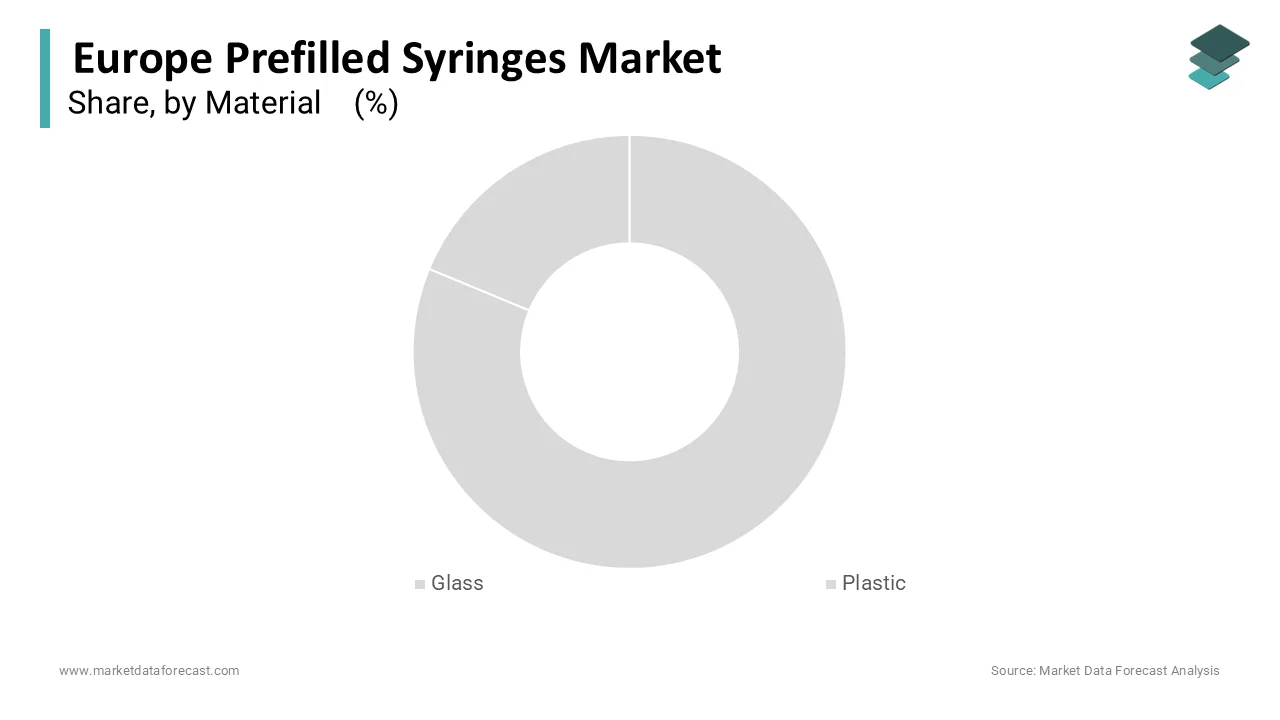
The plastic prefilled syringes segment is expected to grow with an expected CAGR of 13.7% from 2025 to 2033, owing to the rising demand for flexible and lightweight delivery systems, especially in home care and emergency settings. Cyclic olefin copolymer and polymer blends now offer barrier properties approaching those of glass while eliminating risks of glass particulates and needlestick injuries from shattered barrels. Companies like Gerresheimer and Stevanato Group have also secured European Medicines Agency scientific advice for polymer platforms supporting high-concentration biologics, further accelerating regulatory confidence and commercial adoption.
By Type Insghts
The conventional segment was accounted for in holding a prominent share of the European prefilled syringes market in 2025, from widespread use in chronic disease management, where patients are trained in standard injection techniques, and cost remains a key consideration for public payers. According to the European Federation of Pharmaceutical Industries and Associations, originator biologics launched before 2020 used conventional designs due to simpler regulatory pathways and lower development costs. Many home therapy systems are engineered to accept standard dimension syringes, enabling modular device strategies. In Germany and France, national health insurers reimburse drugs and devices separately, often favoring lower-cost conventional formats unless safety features are clinically mandated. Additionally, in hospital settings where healthcare professionals administer injections, the perceived need for active safety mechanisms is reduced. This institutional inertia, combined with established manufacturing infrastructure, ensures conventional syringes remain the default choice for a broad range of therapies from insulin to fertility hormones.
The safety segment is expected to register a CAGR of 15.2% from 2025 to 2033, with stringent EU mandates to prevent needlestick injuries, which affect over 1 million healthcare workers annually, as documented by the European Agency for Safety and Health at Work. Directive 2010/32/EU requires all member states to implement measures eliminating sharps injuries, including the use of safety-engineered devices. As per the German Statutory Accident Insurance, over 85% of public hospitals in Germany now procure only safety-integrated syringes for parenteral administration.
By Distribution Channel Insights
The hospitals segment was the largest by holding 52.3% of the European prefilled syringes market share in 2025, with the high volume of acute and chronic injectable therapies administered in inpatient and outpatient departments, including oncology, immunology, and emergency care. National and regional hospital purchasing groups negotiate bulk contracts that favor standardized formats with proven sterility and traceability. These institutions also serve as early adopters for new biologics, which are initially launched in hospital settings before transitioning to home care. Additionally, hospitals maintain strict cold chain and inventory management systems that align with the storage requirements of prefilled syringes containing temperature-sensitive formulations.
The mail order pharmacies segment is likely to register a CAGR of 18.4% throughout the forecast period with the integration of home-based care models, digital prescriptions, and direct-to-patient logistics. National e-prescription systems enable seamless routing of biologic therapies to licensed mail order providers, such as Apotheka and DocMorris, who specialize in temperature-controlled shipping and patient training kits. The second catalyst is payer efficiency. Additionally, these pharmacies integrate adherence support through SMS reminders and video tutorials, significantly improving treatment continuity.
COUNTRY LEVEL ANALYSIS
Germany Prefilled Syringes Market Analysis
Germany was the top performer in the European prefilled syringes market by accounting for 24.3% the market in 2025, with a high prevalence of chronic disease, a robust biopharmaceutical industry, and advanced home care reimbursement frameworks. The country also hosts major pharmaceutical manufacturers and device developers, including Boehringer Ingelheim and Schott Pharma, which drive local innovation in primary packaging. Regulatory clarity further supports market stability as the Paul Ehrlich Institute maintains expedited evaluation pathways for combination products with established container closure systems. Additionally, Germany’s nursing care insurance scheme reimburses home injection training, creating a sustainable ecosystem for patient-centric delivery. These structural factors ensure Germany remains the strategic anchor for prefilled syringe adoption and development across Europe.
France Prefilled Syringes Market Analysis
France's prefilled syringes market growth is likely to be driven by the aggressive biosimilar uptake policies and strong institutional support for home-based therapies. France’s Transparency Committee mandates that all new biologics and biosimilars demonstrate delivery convenience as part of their added therapeutic value assessment, effectively incentivizing prefilled formats. Over 1.2 million French patients now self-inject biologics for conditions like psoriasis and Crohn’s disease, supported by the national “Hospital at Home” program, which provides nurse-led training and home delivery. The French Medicines Agency also enforces strict needlestick injury prevention protocols requiring safety-engineered devices in all public health facilities. Additionally, France’s centralized procurement system through UNOCAM negotiates volume-based pricing for prefilled syringes, ensuring broad access across public and private clinics.
United Kingdom Prefilled Syringes Market Analysis
The United Kingdom's prefilled syringes market growth is likely to register the fastest CAGR during the forecast period, from a well-established home care infrastructure and proactive adoption of digital health tools. The NHS Long Term Plan explicitly promotes self-administration of injectables to reduce outpatient burden, with over 900,000 patients enrolled in home therapy programs for rheumatoid arthritis, multiple sclerosis, and diabetes as of 2024. The National Institute for Health and Care Excellence recommends prefilled syringes as first-line delivery for all new biologics due to reduced error rates and nursing dependency. Furthermore, the UK’s Medicines and Healthcare products Regulatory Agency has streamlined combination product reviews, enabling faster market access for novel drug-device systems. Post-Brexit regulatory autonomy has also allowed accelerated adoption of polymer prefilled platforms not yet widely approved in the EU.
Italy Prefilled Syringes Market Analysis
Italy's prefilled syringes market growth is likely to grow with a large aging population and high incidence of autoimmune disorders requiring long-term injectable therapy. Over 3.5 million Italians suffer from rheumatoid arthritis or psoriasis, and national guidelines mandate biologic treatment escalation when conventional therapy fails. Additionally, Italy has one of Europe’s highest rates of home nursing, with over 420,000 patients receiving weekly injections at home as documented by Istituto Superiore di Sanità. This ecosystem creates consistent demand for user-friendly prefilled syringes with safety features. Italian pharmaceutical companies like Chiesi Farmaceutici are also investing in local filling capabilities for both glass and polymer formats, enhancing supply chain resilience and supporting domestic innovation in advanced delivery systems.
Spain Prefilled Syringes Market Analysis
Spain's prefilled syringes market growth is likely to grow with the expanding biosimilar adoption and growing home care initiatives in chronic inflammatory diseases. Spain has approved 22 adalimumab biosimilars as of 2024, the highest in Europe, and nearly all are marketed in prefilled syringes to match originator convenience. As per the Ministry of Health, over 850,000 Spanish patients now manage their conditions via home injections supported by regional telehealth platforms that monitor adherence. Additionally, Spain’s warm climate increases the need for stable primary packaging, with glass syringes preferred for their thermal resistance during summer transport. Recent investments in cold chain logistics by pharmacy cooperatives like COFAS have further enabled reliable home delivery.
TOP LEADING PLAYERS IN THE MARKET
- Gerresheimer AG is a Germany-based global leader in pharmaceutical packaging and drug delivery systems with a strong footprint in the European prefilled syringes market. The company supplies both glass and polymer syringes to major biopharmaceutical firms and has pioneered cyclic olefin polymer platforms that address breakage and extractables concerns. In Europe, Gerresheimer leverages its regulatory expertise and local manufacturing sites in Germany, Italy, and Switzerland to ensure supply chain resilience. It also launched a new coated glass syringe with reduced silicone oil migration, specifically designed for high-concentration monoclonal antibodies. These actions reinforce its role as a strategic partner in Europe’s transition toward advanced and patient-centric delivery solutions.
- Schott AG is a German specialty glass technology company and a key enabler of the European prefilled syringes market through its high-quality borosilicate glass tubing and ready-to-fill syringes. The company supplies the majority of European pharmaceutical fill and finish facilities and plays a critical role in ensuring container integrity for sensitive biologics. Schott has invested heavily in expanding its European production network, including a new facility in Switzerland dedicated to syringes with enhanced surface coatings. Schott also collaborates with device integrators to support combination product development. These initiatives solidify its position as a foundational materials provider in Europe’shigh-integrityy drug delivery ecosystem.
- Stevanato Group is an Italian multinational offering integrated capabilities in glass forming, secondary packaging, and visual inspection systems for prefilled syringes. The company has deepened its presence in Europe by supplying syringes to both originator and biosimilar manufacturers with a focus on high precision and sterility assurance. Its proprietary EZ fill platform enables pharmaceutical companies to outsource finished syringe production while maintaining full regulatory control. In 2023, Stevanato inaugurated a new syringe production line in Piombino, Italy, dedicated to safety-integrated formats with passive needleshielding. The company also partnered with a leading Nordic biotech firm to co-develop a polymer syringe for a novel GLP-1 agonist. These strategic moves highlight its commitment to innovation, scalability, and compliance with evolving European safety and sustainability standards.
TOP STRATEGIES USED BY THE KEY MARKET PARTICIPANTS
Key players in the European Prefilled Syringes Market focus on vertical integration by combining primary packaging manufacturing with drug filling and inspection services to offer end-to-end solutions. Companies invest in advanced material science to develop low-interaction glass coatings and break-resistant polymers that meet stringent biologic compatibility requirements. Strategic collaborations with pharmaceutical firms enable co-development of drug-device combinations aligned with regulatory and patient needs. Expansion of European production capacity ensures supply chain security amid global logistics volatility. Firms also prioritize compliance with EU safety directives by integrating passive or active needle protection mechanisms into syringe designs. Additionally, manufacturers engage in early dialogue with the European Medicines Agency to secure scientific advice on novel container closure systems, accelerating market access and reinforcing trust among regulators and payers.
COMPETITIVE LANDSCAPE
The Europe Prefilled Syringes Market features a competitive landscape defined by technological sophistication, regulatory compliance, and strategic alignment with pharmaceutical innovation. Competition is dominated by established European packaging specialists who leverage local manufacturing regulatory familiarity and longstanding relationships with biopharma clients. While global players participate in the market favors firms with regional production facilities due to stringent supply chain expectations and preference for reduced transport emissions. Differentiation centers on material performance, safety integration, and compatibility with withigh-concentrationon or viscous formulations rather than price. Regulatory complexity, particularly around extractables and leachables, and container closure integrity, creates high entry barriers limiting disruption from low-cost manufacturers. The rise of biosimilars and home-based therapies has intensified demand for both conventional and safety syringes, prompting continuous innovation in user experience and sterility assurance. Companies increasingly compete on ecosystem value, offering everything from coated glass barrels to ready-to-fill syringes with full traceability.
KEY MARKET PLAYERS
The key market players that dominate the europe prefilled syringes market are analysed in this report.
- Becton Dickinson and Company
- Gerresheimer AG
- SCHOTT AG
- West Pharmaceutical Services, Inc.
- Ompi,
- Catalent, Inc.
- Weigao Group
- Vetter Pharma International GmbH
- Nipro Corporation
- MedPro Inc.
MARKET SEGMENTATION
This research report on the europe prefilled syringes market has been segmented and sub-segmented into the following categories.
By Material
-
Glass
- Plastic
By Type
- Conventional
- Safety
By Design
- Single-Chamber
- Dual-Chamber
By Application
- Vaccines
- Monoclonal Antibodies
By Distribution Channel
- Hospitals
- Ambulatory Surgical Centres
- Mail-Order Pharmacies
By Country
- UK
- France
- Spain
- Germany
- Italy
- Russia
- Sweden
- Denmark
- Switzerland
- Netherlands
- Turkey
- Czech Republic
- Rest of Europe