- Product Description Description
- Table of Contents TOC
- List of Table & Figure LOT
- Get Free Sample PDF Sample PDF
Market Size, 2025
$4.02 BnMarket Estimate, 2026
$4.15 BnMarket Forecast, 2034
$5.36 BnCAGR, 2026–2034
3.25%Europe Pressure Sensitive Adhesives Market Size
The Europe pressure sensitive adhesives market size was valued at USD 4.02 billion in 2025 and is projected to reach USD 5.36 billion by 2034 from USD 4.15 billion in 2026, growing at a CAGR of 3.25%.
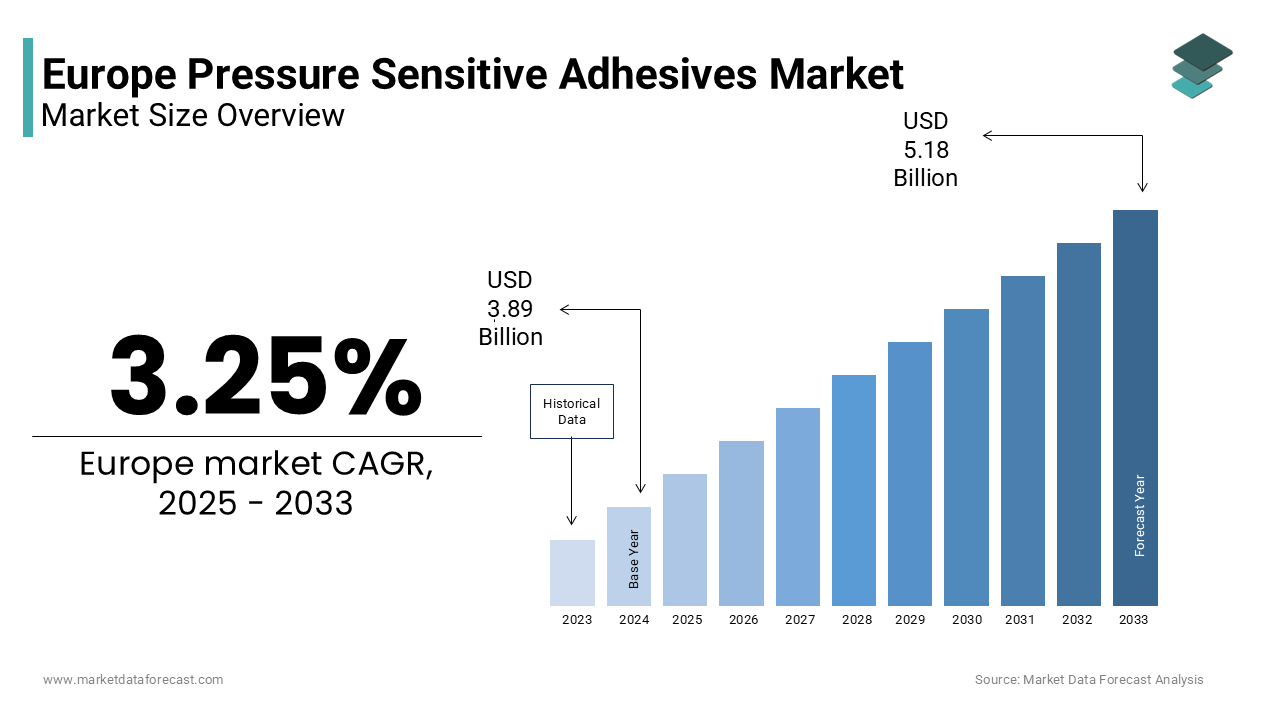
Pressure sensitive adhesives are formulations designed to bond instantly upon light pressure without the need for solvents heat or chemical activation. These adhesives are integral to tapes labels graphics films and medical dressings across industrial consumer and healthcare applications throughout European Union and European Free Trade Association nations. Their performance hinges on viscoelastic properties enabling permanent or removable adhesion under ambient conditions. According to sources, the use of pressure-sensitive technology for labeling and sealing solutions in the EU packaging market continues to be a significant trend, driven by ongoing innovations and the diverse needs of various packaging applications. Furthermore, the European Commission’s Circular Economy Action Plan has intensified scrutiny on the recyclability of packaging, including the compatibility of adhesives with material recovery processes, to ensure all packaging placed on the EU market is recyclable by 2030. Concurrently, demographic shifts toward an older population in the WHO European Region continue to exert influence on healthcare needs, which drives an increasing demand for specialized medical applications such as gentle skin adhesives. These regulatory demographic and functional imperatives define the operational landscape for pressure sensitive adhesives beyond mere commercial metrics.
MARKET DRIVERS
Expansion of E Commerce and Sustainable Packaging Requirements
The rapid growth of online retail across Europe has fundamentally reshaped packaging dynamics, which accelerates the growth of the Europe pressure sensitive adhesives market. This creates sustained demand for high performance pressure sensitive adhesives in shipping labels and tamper evident seals. E-commerce activity and the volume of parcels delivered have experienced significant growth across the European Union in recent years, though the pace has stabilized since the pandemic peak. Importantly, the recently adopted European Union Packaging and Packaging Waste Regulation requires that all packaging be designed for recyclability by 2030, accelerating the development of innovative, recycling-compatible adhesive technologies. Research, including studies by the Fraunhofer Institute, emphasizes that conventional adhesives can interfere significantly with the paper recycling process, creating an industry-wide need for improved adhesive materials that delaminate cleanly or disperse in water. In response, major adhesive producers have introduced bio-based acrylics and modified rubber resins that maintain bond integrity during transit yet release cleanly in pulping processes. Retailers specify adhesives meeting CEFLEX recyclability protocols for all supplier packaging. This convergence of logistics volume and circular economy enforcement establishes a dual demand vector for next generation pressure sensitive adhesives across the European supply chain.
Rising Demand for Advanced Medical Wearables and Skin Friendly Adhesives
The region's aging population and shift toward decentralized healthcare are accelerating adoption of wearable diagnostic and drug delivery devices, which further fuels the expansion of the Europe pressure sensitive adhesives market. These devices depend on biocompatible pressure sensitive adhesives for secure yet gentle skin attachment. The number of individuals managing long-term health issues is expected to increase, which could raise the demand for various treatment methods like those applied through the skin. This anticipated rise suggests a growing need for corresponding medical device technologies. Separately, specific guidelines for the safety of materials in medical products mandate that any adhesive used on the skin must be tested for potential biological reactions, including skin irritation and sensitivity. These assessments are necessary to ensure the materials used in device construction are safe for patient contact. In response companies have developed silicone and polyurethane based adhesives with modulated peel strength and moisture vapor transmission rates. Besides, the European Wound Management Association emphasizes the need for low trauma adhesives in geriatric care where fragile skin is prone to medical adhesive related injuries. These clinical imperatives are causing investment in hypoallergenic breathable adhesive platforms specifically engineered for long term epidermal contact across Northern and Western European healthcare systems.
MARKET RESTRAINTS
Stringent Chemical Restrictions Under REACH and Ecolabel Frameworks
The regional regulatory frameworks impose significant formulation constraints on the Europe pressure sensitive adhesives market. This is due to the Registration Evaluation Authorisation and Restriction of Chemicals legislation and EU Ecolabel criteria which limit the use of certain monomers plasticizers and tackifiers. Compliance requires extensive substance substitution testing which increases development cycles several months, according to research. Moreover, environmental criteria for certain adhesive tapes have been established. These criteria place limitations on the amount of specific chemical compounds that can be included in the product formulation. In addition, the thresholds set by these criteria are stringent enough to make many conventional solvent-based systems unsuitable for this environmental certification. A significant majority of relevant adhesive products available through retail channels were consequently reformulated or removed to align with the new criteria. This indicates a clear shift within the product category toward compliance with environmental guidelines. These restrictions disproportionately affect small and medium enterprises lacking in house regulatory expertise thereby concentrating innovation among a few large players. Environmental safety policies often increase technical and financial hurdles, which limits the variety of adhesive formulations and delays the release of new solutions.
MARKET OPPORTUNITIES
Adoption of Lightweight Materials in Automotive and Aerospace Sectors
The European transportation industry has an aggressive lightweighting agenda to meet CO2 emission targets, which creates new opportunities for the growth of the Europe pressure sensitive adhesives market. This is fostering a structural reliance on pressure sensitive adhesives for bonding dissimilar materials such as composites, aluminum, and high-strength steels. According to various studies, the automotive industry is continuously working on reducing vehicle weight using lightweight materials to meet increasingly stringent EU CO2 emissions regulations. Adhesives enable multi material integration where mechanical fasteners would induce stress concentrations or galvanic corrosion. Airbus and the aerospace industry are increasingly incorporating composite materials and advanced adhesive bonding methods to build lighter and more fuel-efficient aircraft structures. The adoption of composite materials and adhesive bonding techniques in aircraft manufacturing results in substantial weight savings compared to traditional metal structures, improving fuel efficiency and performance. These applications demand adhesives with high shear strength thermal stability and durability under extreme humidity cycling. Research and development efforts, including those by institutions like the German Aerospace Center (DLR), are focused on developing advanced adhesive formulations with enhanced temperature resistance for demanding aerospace applications. Electric vehicle production and registrations in the European Union have been increasing significantly in recent years, despite some fluctuations in annual growth rates. This performance driven substitution of mechanical joining methods establishes pressure sensitive adhesives as enablers of Europe’s decarbonized mobility future.
MARKET CHALLENGES
Volatility in Petrochemical Feedstock Pricing and Supply Chain Fragmentation
Persistent cost instability degrades the growth of the Europe pressure sensitive adhesives market. This is due to its dependence on petroleum derived raw materials including acrylic acid butadiene and styrene whose pricing remains subject to global energy market fluctuations and regional refining capacity constraints. As per research, crude oil price fluctuations contribute to general volatility in acrylic acid spot prices across Europe. Reports from industry bodies indicate that a portion of European solvent-based adhesive feedstock capacity has been idled in recent years. This supply contraction forces adhesive formulators to source intermediates from outside the EU primarily from the Middle East and Asia introducing logistical complexity and quality variance. Economic analyses indicate varying input cost pass-through delays within the broader chemicals sector. Furthermore, the EU's Carbon Border Adjustment Mechanism (CBAM) is transitioning to full implementation in 2026 will impose tariffs on imported hydrocarbon based chemicals further distorting cost structures. These intertwined feedstock insecurity and policy driven trade barriers create unpredictable input economics that hinder long term formulation planning and pricing stability.
Complexity in End of Life Management and Recycling Contamination
These adhesives present significant challenges in post-consumer waste streams by impeding material separation and degrading recyclate quality, particularly in paper and flexible packaging circuits, which holds back the expansion of the Europe pressure sensitive adhesives market. Adhesive residues present challenges in paper recycling, contributing to operational downtime through screen clogging and deposit formation in deinking processes. The presence of adhesive contamination can reduce the overall yield of recovered fiber material. In flexible plastic packaging, multilayer structures bonded with certain permanent adhesives are largely incompatible with current mechanical recycling infrastructure. A small portion of adhesive-laminated films is effectively processed today within existing systems. Currently, the number of commercial depolymerization plants capable of accepting adhesive-laden waste streams is limited, even as chemical recycling methods show future potential. Consequently, brand owners face conflicting demands between secure labeling and circular compliance forcing adhesive developers into reactive reformulation cycles. This systemic incompatibility between adhesion performance and recyclability remains a structural bottleneck in Europe’s transition to a true circular materials economy.
REPORT COVERAGE
| REPORT METRIC | DETAILS |
| Market Size Available | 2025 to 2034 |
| Base Year | 2025 |
| Forecast Period | 2026 to 2034 |
| CAGR | 3.25% |
| Segments Covered | By Resin Type, Technology, Application, End Use Industry, and Region |
| Various Analyses Covered | Global, Regional, & Country Level Analysis; Segment-Level Analysis; DROC, PESTLE Analysis; Porter’s Five Forces Analysis; Competitive Landscape; Analyst Overview of Investment Opportunities |
| Regions Covered | UK, France, Spain, Germany, Italy, Russia, Sweden, Denmark, Switzerland, Netherlands, Turkey, and the Czech Republic |
| Market Leaders Profiled | 3M Company, Henkel AG & Co. KGaA, H.B. Fuller Company, Avery Dennison Corporation, Sika AG, Arkema S.A., Dow Inc., Tesa SE, Ashland Global Holdings Inc., and Lohmann GmbH & Co. KG |
SEGMENTAL ANALYSIS
By Resin Type Insights
The acrylic-based resins segment led the Europe pressure-sensitive adhesives market because of its exceptional balance of clarity, UV resistance, oxidation stability, and adhesion performance across diverse substrates. Their solvent free and water based variants align with stringent European environmental regulations promoting low volatile organic compound formulations. According to research, most recent approvals for pressure sensitive adhesives are based on acrylic technology. The automotive sector particularly relies on high performance acrylics for interior trim bonding and exterior emblem attachment due to their durability under thermal cycling. New passenger vehicles widely incorporate acrylic adhesives for various non-structural bonding applications. Besides, the medical device industry favors acrylics for wound care and wearable sensor applications because they meet ISO 10993 biocompatibility standards without requiring additional additives. Acrylic formulations demonstrate strong retention of initial peel strength following accelerated weathering procedures. These technical and compliance advantages secure acrylics’ dominance across industrial consumer and healthcare domains.

The silicone resins segment is expected to exhibit a noteworthy CAGR of 8.4% from 2026 to 2034 due to escalating demand in high reliability medical and electronics applications. Silicones offer unmatched biocompatibility thermal stability and conformability on low energy surfaces making them ideal for sensitive skin contact and extreme environment bonding. The use of silicone adhesives in advanced wound care is increasing, with many new products designed to ensure gentle removal, which is particularly beneficial for sensitive skin types. The European market for continuous glucose monitors (CGMs) is significant, and these devices consistently rely on skin-safe silicone adhesive patches. These patches are formulated to provide extended, reliable adhesion despite challenges like patient movement and exposure to moisture. Furthermore, In the electronics sector, miniaturized sensors and flexible circuits increasingly incorporate silicone pressure sensitive films. These materials are valued for their ability to manage thermal stress and isolate strain effectively. These performance attributes in mission critical sectors ensure sustained growth despite higher raw material costs.
By Application Insights
The labels segment held the leading share of the Europe pressure sensitive adhesives market in 2025. The leading position of the labels segment is credited to ubiquitous use in food beverage, pharmaceutical, and logistics sectors where instant adhesion and legibility are non-negotiable. EU regulations, like the Food Information Regulation (FIR), mandate robust traceability for food products (not all packaged goods) to ensure safety and consumer information, requiring data flow from farm to fork. The sheer volume of food and consumer goods in the EU market demands significant traceability systems, but specific, all-encompassing annual figures from the EC for labeled units are elusive and likely exaggerated. Food safety mandates further dictate adhesive inertness to prevent chemical migration. The rise of smart packaging has amplified demand for adhesives compatible with RFID inlays and conductive inks. The premium beverage region in Western Europe is seeing increased use of interactive labels, which creates a need for specific adhesive properties like dielectric stability and minimal outgassing. The upcoming EU Digital Product Passport initiative will require durable data carriers, necessitating adhesives that can resist moisture abrasion and temperature variations for reliable performance. Retail compliance programs from major chains like Carrefour and Aldi further enforce strict label retention standards during cold chain distribution. These regulatory commercial and technological imperatives cement labels as the cornerstone application for pressure sensitive adhesives.
The graphics segment is predicted to witness the highest CAGR of 7.9% over the forecast period owing to urban branding mandates digital printing expansion and architectural film adoption. Municipalities across the EU are implementing visual identity programs requiring durable exterior signage and vehicle wraps that withstand five to seven years of UV exposure and thermal cycling. A shift is observable in the public transport sector across several European nations regarding how they manage the appearance of their vehicles. Many public transport providers in Germany, France, and the Netherlands have updated the exterior branding of a substantial portion of their fleets. The rise of short run digital printing has democratized custom graphics. Architecturally the renovation wave under the EU Renovation Wave Strategy drives demand for energy saving window films and decorative surface coverings. Solar control window film is being utilized in commercial and public buildings as a method to manage internal temperatures and reduce energy consumption. The application of window film, covering a significant area across various structures, which emphasizes its increased adoption in modern architecture and building management practices. Advancements in adhesive technology mean that many installations now feature easily removable applications. This adhesive innovation helps facilitate the straightforward recycling of the glass when the film is eventually removed or updated. These aesthetic functional and policy driven trends create robust growth independent of traditional industrial cycles.
By End User Industry Insights
The packaging segment dominated the Europe pressure sensitive adhesives market by capturing a substantial share in 2025, as adhesives are indispensable for labeling, sealing, and tamper-evident closure systems across food, consumer goods, and pharmaceutical containers. A significant amount of all packaging placed on the EU market utilizes pressure sensitive label attachment. The food sector alone accounts for hundreds of billions of labeled units annually. New regulations will require that all labels used must be compatible with standard recycling processes in the coming years. This mandate is accelerating the adoption of cleanly debonding acrylic adhesives in the industry. Adhesive contamination has historically been a major cause of inefficiency within paper recycling streams. Innovative debonding formulations are now showing promising results in reducing this specific type of contamination during processing trials. Additionally, the pharmaceutical sector enforces strict adhesive inertness under EU GMP Annex 1 with the European Medicines Agency requiring migration testing for all primary packaging adhesives. Retailer sustainability scorecards from Lidl and Tesco now penalize suppliers using non-compliant adhesives thereby enforcing supply chain adoption. These regulatory commercial and operational dependencies make packaging the most consistent and volumetrically significant end user sector.
The medical end user segment is estimated to register the fastest CAGR of 9.1% from 2026 to 2034. The rapid growth of the medical end user segment is propelled by aging demographics technological innovation and regulatory standardization. Over time, a significant number of people in Europe will require ongoing management for chronic health issues, a need that is frequently addressed using diagnostic wearables and methods like transdermal patches. The European Union's regulations have standardized the requirements for material safety, encouraging the use of approved silicone and acrylic materials across different applications. There has been an increase in the number of approvals for adhesive-based delivery systems used for conditions like diabetes, which rely on skin-friendly adhesives designed to provide reliable and long-lasting adhesion for up to a week. Besides, hospital acquired pressure injuries have prompted adoption of low trauma adhesives in wound care. These clinical policy and demographic forces create a high value resilient growth corridor insulated from economic volatility.
REGIONAL ANALYSIS
Germany Pressure Sensitive Adhesives Market Analysis
Germany was the top performer in the Europe pressure sensitive adhesives market by capturing a 24.5% share in 2025. The demand for these adhesives in Germany is driven by its advanced manufacturing base, stringent regulatory environment, and leadership in automotive and medical device production. The country hosts several adhesive formulation facilities including global innovation centers for Henkel and tesa SE which drive next generation product development. According to research, the sector invested substantial amount in R and D for sustainable adhesives in 2025 focusing on bio-based monomers and water borne systems. The automotive industry remains a major consumer. Furthermore, the Federal Institute for Risk Assessment enforces rigorous migration testing for food contact adhesives setting de facto EU standards. The national packaging law VerpackG mandates deposit return systems that require high integrity label adhesion during wet handling further reinforcing demand. These industrial regulatory and innovation dynamics position Germany as the undisputed technical and commercial nucleus of the European adhesive landscape.
France Pressure Sensitive Adhesives Market Analysis
France followed closely in the Europe pressure sensitive adhesives market by accounting for a 15.1% share in 2025. The growth of the French market is credited to a strong packaging sector aerospace manufacturing and progressive medical device adoption particularly in chronic care solutions. Airbus headquartered in Toulouse utilizes pressure sensitive adhesives extensively in interior cabin assembly. There is a notable increase in the use of medical devices within home environments, particularly for conditions such as diabetes and cardiovascular issues, which often rely on skin-safe adhesives. Regulations promoting a circular economy require that product packaging be designed for recyclability, which encourages the development of advanced adhesive technologies that allow for easier separation of materials. Retail giants enforce strict supplier compliance through their Eco Rating system which includes adhesive recyclability as a scoring criterion. These intersecting industrial health and policy currents sustain France’s robust market trajectory.
United Kingdom Pressure Sensitive Adhesives Market Analysis
The United Kingdom maintains a noteworthy position in the European market due to resilience in pharmaceutical labelling, advanced wound care, and post Brexit regulatory divergence that has spurred local formulation capabilities. Regulatory standards necessitate that all drug packaging labels maintain stable adhesion over time, which increases the need for high-quality adhesives. The pharmaceutical industry is a significant market that requires a large volume of labels that meet these compliance standards. Primary wound dressings are now required to use gentle adhesives as part of an effort to minimize skin injuries for elderly patients. Domestic producers of adhesives are increasing their use of bio-based resins, a shift influenced by economic factors and concerns about supply chain stability. Tax policies related to plastic packaging with low recycled content encourage the use of sustainable label systems and adhesives that can be easily removed for recycling. These regulatory and industrial adaptations ensure the UK remains a significant and self reliant market despite geopolitical shifts.
Italy Pressure Sensitive Adhesives Market Analysis
Italy witnessed consistent growth in the Europe pressure sensitive adhesives market owing to luxury packaging, fashion labeling, and small-scale industrial manufacturing, which requires high aesthetic and performance adhesives. The country maintains a strong production volume of premium product labels designed for the cosmetics, wine, and fashion industries, where high visual quality and durability are essential attributes. Specialist adhesive converters in the region focus on the production of very thin transparent films which serve brand protection purposes. The market has experienced growth in the sales of materials designed to combat counterfeiting. A regional medical device manufacturing area produces wound care items daily, all of which incorporate skin-friendly adhesives that meet relevant compliance standards. Funds have been dedicated through a national plan to facilitate the modernization of manufacturing processes within small and medium enterprises, which includes the integration of automated adhesive application systems. The Italian Competition Authority enforces strict labeling accuracy rules under the Consumer Code further driving demand for high fidelity bonding solutions. These niche high value applications sustain Italy’s specialized and innovation oriented adhesive ecosystem.
Netherlands Pressure Sensitive Adhesives Market Analysis
The Netherlands is likely to expand in the Europe pressure sensitive adhesives market from 2026 to 2034 due to its role as a European logistics hub, advanced horticulture packaging, and leadership in circular economy innovation. The large port handles a significant volume of consumer goods, each needing shipping labels that perform well in high humidity conditions. High paper recycling rates in municipalities create a need for brands to use adhesives that separate cleanly from paper during the recycling process to ensure material purity. Moreover, a collaborative industry program provides funding for pilot projects centered on developing water-dispersible acrylic adhesives, and these are being adopted by major corporations. The significant use of labels within the horticulture sector, on items like plant pots and trays, requires the labels to have specific features like resistance to ultraviolet light and the ability to be compostable. The Rijkswaterstaat infrastructure agency mandates adhesive bonded safety signage on all national highways that must withstand North Sea saline exposure. These logistical environmental and infrastructural demands position the Netherlands as a testbed for next generation sustainable adhesive adoption.
COMPETITIVE LANDSCAPE
Competition in the Europe pressure sensitive adhesives market is characterized by a dual dynamic wherein global giants leverage scale and regulatory expertise while specialized regional players differentiate through niche performance or sustainability credentials. The market is highly innovation driven with companies racing to align adhesive chemistries with the European Green Deal’s circular economy mandates particularly in packaging and medical sectors. Regulatory compliance acts as a key barrier to entry with REACH EU Ecolabel and Medical Device Regulation certifications requiring significant technical and financial investment. Simultaneously demand for high reliability adhesives in automotive lightweighting and wearable healthcare fosters collaboration between material suppliers and end users. Price competition remains muted as value is increasingly defined by formulation purity debonding behavior and compatibility with recycling infrastructure rather than cost alone. This environment favors established players with integrated R and D supply chains and deep regulatory engagement while pressuring smaller firms to specialize or consolidate. The result is a consolidated yet technologically vibrant landscape where sustainability and performance intersect as primary competitive levers.
KEY MARKET PLAYERS
Some of the notable key players in the European pressure sensitive adhesives market are
- 3M Company
- Henkel AG & Co. KGaA
- H.B. Fuller Company
- Avery Dennison Corporation
- Sika AG
- Arkema S.A.
- Dow Inc.
- Tesa SE
- Ashland Global Holdings Inc.
- Lohmann GmbH & Co. KG
TOP PLAYERS IN THE MARKET
- Henkel AG and Co KGaA headquartered in Germany is a global leader in adhesive technologies with a commanding presence in the Europe pressure sensitive adhesives market through its LOCTITE and Technomelt brands. The company supplies high performance acrylic and hybrid formulations to automotive electronics and medical sectors across the continent. The company also enhanced its Düsseldorf innovation center to accelerate development of recyclable labeling adhesives aligned with the EU Packaging and Packaging Waste Regulation. These initiatives reinforce Henkel’s commitment to sustainable innovation while supporting customers in meeting circular economy mandates without compromising bond performance in demanding industrial applications.
- 3M Company maintains a robust footprint in the Europe pressure sensitive adhesives market through its advanced tape and film technologies serving medical transportation and commercial graphics sectors. The company’s acrylic and silicone based platforms are engineered for extreme durability and skin compatibility meeting stringent EU Medical Device Regulation requirements. Additionally the company introduced a new series of low migration adhesives for food contact labeling certified under EU 10 2011 standards. These strategic investments position 3M at the intersection of regulatory compliance and high value performance driving adoption in mission critical European applications.
- Avery Dennison Corporation plays a pivotal role in the Europe pressure sensitive adhesives market as a leading provider of labeling materials and functional tapes for packaging logistics and retail. The company’s European operations focus on sustainable adhesive solutions including cleanly debonding acrylics that enable paper and plastic recyclability. The company also partnered with major fashion and beverage brands to implement digital watermarked labels compatible with HolyGrail 2.0 sorting systems. These actions align with EU circular economy directives and solidify Avery Dennison’s position as an enabler of recyclable packaging infrastructure through adhesive innovation.
TOP STRATEGIES USED BY THE KEY MARKET PLAYERS
Key participants in the Europe pressure sensitive adhesives market prioritize the development of sustainable formulations including bio based water borne and cleanly debonding chemistries to comply with EU environmental regulations. They invest heavily in application specific innovation such as skin friendly adhesives for medical wearables and low migration systems for food packaging. Strategic expansion of regional R and D centers enables rapid response to evolving regulatory standards like the EU Medical Device Regulation and Packaging and Packaging Waste Directive. Companies also forge partnerships with brand owners and recyclers to co develop circular adhesive solutions integrated into digital recycling ecosystems. Additionally they enhance production capabilities for high purity silicone and hybrid acrylic resins to serve advanced electronics and automotive lightweighting demands across Europe.
MARKET SEGMENTATION
This research report on the European pressure sensitive adhesives market has been segmented and sub-segmented based on categories.
By Resin Type
- Acrylics
- Silicones
- Elastomers
- Other Resins
By Technology
- Water-based
- Solvent-based
- Hot Melt
- Radiation
By Application
- Tapes
- Labels
- Graphics
- Other Applications
By End User Industry
- Packaging
- Woodworking and Joinery
- Medical
- Commercial Graphics
- Transportation
- Others
By Country
- UK
- France
- Spain
- Germany
- Italy
- Russia
- Sweden
- Denmark
- Switzerland
- Netherlands
- Turkey
- Czech Republic
- Rest of Europe