Europe Pressure Vessel Market Size, Share, Trends, & Growth Forecast Report By Vessel Type (Boilers, Reactors, Separators, Others), Construction Type, Application, End-User and Country (UK, France, Spain, Germany, Italy, Russia, Sweden, Denmark, Switzerland, Netherlands, Turkey, Czech Republic and Rest of Europe), Industry Analysis From 2026 to 2034
Market Size, 2025
$17.82 BnMarket Estimate, 2026
$18.46 BnMarket Forecast, 2034
$24.45 BnCAGR, 2026–2034
3.56%Europe Pressure Vessel Market Report Summary
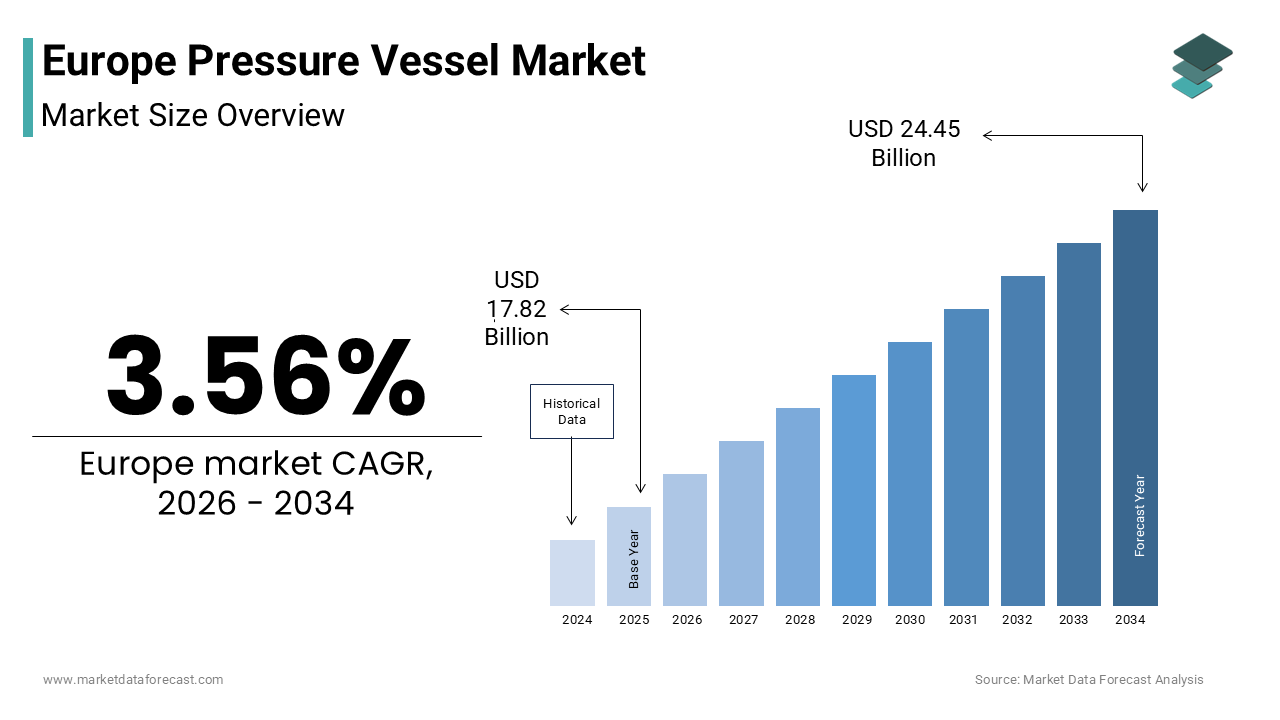
The Europe pressure vessel market was valued at USD 17.82 billion in 2025, is projected to reach USD 18.46 billion in 2026, and is expected to grow to USD 24.45 billion by 2034, expanding at a CAGR of 3.56% during the forecast period from 2026 to 2034. The growth of the Europe pressure vessel market is driven by industrial decarbonization initiatives, hydrogen infrastructure expansion, and modernization of aging industrial plants under stringent regulatory frameworks such as the EU Pressure Equipment Directive (2014/68/EU). Pressure vessels play a critical role in sectors including chemicals, power generation, food processing, and pharmaceuticals, where safe containment of pressurized gases and liquids is essential. Increasing adoption of carbon capture technologies, green hydrogen storage systems, and digitally monitored smart vessels is reshaping the technological landscape of the Europe pressure vessel market.
Key Market Trends
-
Growing demand for high-pressure vessels designed for hydrogen storage, CCUS applications, and renewable energy infrastructure.
-
Increasing adoption of digital twins and predictive maintenance systems embedded within pressure equipment.
-
Rising modernization of legacy industrial facilities to comply with updated safety and emission standards.
-
Expansion of composite Type IV vessels driven by hydrogen mobility and lightweight storage requirements.
-
Strong integration of advanced metallurgy and corrosion-resistant materials for emerging industrial processes.
Segmental Insights
-
Based on vessel type, the reactors segment held 38.2% of the Europe pressure vessel market share in 2024, supported by strong demand from chemical processing, pharmaceutical manufacturing, and hydrogen-related applications.
-
The separators segment is projected to grow at a CAGR of 9.1%, driven by increasing deployment in carbon capture, biogas upgrading, and offshore oil and gas operations.
-
Based on construction type, Type I all-metal pressure vessels dominated the Europe pressure vessel market, owing to their regulatory acceptance, cost efficiency, and widespread industrial usage.
-
The Type IV vessels segment is anticipated to grow at the fastest rate due to rising adoption in hydrogen refueling infrastructure and mobility applications.
-
Based on end user, the chemicals and petrochemicals sector accounted for 41.2% of the Europe pressure vessel market share in 2024, driven by stringent safety requirements and large-scale reactor deployment.
Regional Insights
The Europe pressure vessel market demonstrates strong regional concentration in countries with advanced industrial manufacturing and energy transition initiatives.
-
Germany led the Europe pressure vessel market with a 26.3% share in 2024, supported by its extensive chemical industry, hydrogen strategy investments, and robust inspection infrastructure.
-
France maintains a strong position due to nuclear energy dominance and state-backed hydrogen expansion programs.
-
Italy is witnessing steady growth driven by petrochemical processing and emerging hydrogen logistics projects.
-
The Netherlands benefits from large-scale CCUS and chemical processing hubs around the Port of Rotterdam.
-
The United Kingdom is expanding through offshore energy infrastructure and carbon capture initiatives such as the Humber Cluster.
Competitive Landscape
The Europe pressure vessel market is moderately fragmented, with a mix of global engineering conglomerates and specialized regional fabricators competing under strict regulatory oversight. Market leaders focus on advanced engineering capabilities, compliance with the Pressure Equipment Directive, and expansion into hydrogen and carbon capture projects. Major companies operating in the Europe pressure vessel market include Babcock & Wilcox Enterprises, Mitsubishi Heavy Industries, Doosan Heavy Industries & Construction, Linde Plc, General Electric (GE), Siemens AG, IHI Corporation, Larsen & Toubro Limited, Bharat Heavy Electricals Limited (BHEL), Samuel Pressure Vessel Group, Alloy Products Corp., Abbott & Co (Newark) Ltd., GEA Group Aktiengesellschaft, Halvorsen Company, and Hitachi Zosen Corporation.
Europe Pressure Vessel Market Size
The Europe pressure vessel market size was valued at USD 17.82 billion in 2025 and is anticipated to reach USD 18.46 billion in 2026 from USD 24.45 billion by 2034, growing at a CAGR of 3.56% during the forecast period from 2026 to 2034.
The pressure vessels are engineered containers designed to safely hold gases or liquids at pressures significantly different from ambient conditions, chemical processing, pharmaceuticals, and food production. Governed by the European Union’s Pressure Equipment Directive (2014/68/EU), these systems must comply with stringent safety, material integrity, and conformity assessment protocols before deployment. The directive classifies vessels based on volume, pressure, and fluid group, mandating CE marking and third-party inspection for higher risk categories. According to the European Commission, over 120,000 industrial facilities across the EU operate under this regulatory framework, relying on pressure vessels for essential processes such as steam generation, hydrogen storage, and sterile bioreactor operations. As per Eurostat, the industrial sector accounts for 23 % of total final energy consumption in the EU, much of which involves pressurized thermal or chemical systems. Furthermore, the European Environment Agency notes that industrial decarbonization efforts in hard to abate sectors like steel and chemicals are accelerating demand for high integrity vessels capable of handling green hydrogen and carbon capture media. This regulatory rigor combined with industrial transformation defines the technical and strategic contours of the Europe pressure vessel market.
MARKET DRIVERS
Industrial Decarbonization and Green Hydrogen Infrastructure Expansion
The urgent push toward industrial decarbonization is engineered for green hydrogen storage and transport. The industrial decarbonization and green hydrogen infrastructure expansion is propelling the growth of Europe pressure vessel market. As part of the European Green Deal, the EU aims to install 40 gigawatts of renewable hydrogen electrolyzers by 2030, requiring thousands of high pressure vessels rated for 350 to 700 bar operation. According to the European Clean Hydrogen Alliance, over 500 hydrogen valley projects are currently in development across member states, each necessitating arrays of stationary and mobile pressure vessels for compression, storage, and refueling. Germany’s National Hydrogen Strategy alone forecasts the need for more than 10 000 new high pressure tanks by 2030 in industrial clusters like the Ruhr region. Similarly, France’s Hydrogen Plan allocates 7 billion euros through 2030 to scale low carbon hydrogen, directly stimulating demand for ASME and PED compliant vessels. These applications demand specialized materials such as chromium molybdenum steel and Type IV composite liners to withstand cyclic loading and hydrogen embrittlement.
Stringent Regulatory Compliance and Safety Modernization in Aging Industrial Plants
The aging industrial infrastructure is undergoing extensive safety-driven modernization, fueling replacement demand for certified pressure vessels that meet current Pressure Equipment Directive standards. The stringent regulatory compliance and safety modernization in aging industrial plants is escalating the growth of Europe pressure vessel market. Many chemical and power generation facilities operating since the 1970s and 1980s rely on legacy vessels built under obsolete national codes, now deemed non-compliant with harmonized EU safety thresholds. According to the European Federation of Chemical Engineers, approximately 38 % of pressure equipment in Western Europe exceeds 30 years of service life, increasing risks of fatigue failure and leakage. Regulatory enforcement has intensified, as per the German Technical Inspection Association (TUV), over 12,000 non-compliant vessels were decommissioned across Germany alone between 2021 and 2023 following mandatory reassessments. Similar, audits are underway in Italy and the Netherlands under national notified body oversight. The European Industrial Emissions Directive further mandates Best Available Techniques upgrades, compelling operators to retrofit or replace outdated systems. This regulatory push is amplified by insurance requirements, Lloyd’s of London now ties premium rates to PED compliance status for high-risk installations. Consequently, plant operators are investing in new vessels with integrated monitoring sensors and digital documentation by aligning operational safety with EU legal mandates and risk mitigation protocols.
MARKET RESTRAINTS
High Capital and Certification Costs for Advanced Material Vessels
The escalating cost of manufacturing pressure vessels from advanced materials for hydrogen and cryogenic applications is hampering the growth of Europe pressure vessel market. Vessels designed for green hydrogen storage often require expensive alloys such as SA 387 Grade 22 or carbon fiber reinforced composites to resist hydrogen embrittlement and maintain structural integrity under extreme cyclic pressures. According to the European Materials Handling Federation, the raw material cost for a single 500 bar hydrogen storage vessel can exceed 85,000 euros, nearly triple that of conventional carbon steel units. As per the European Commission’s Joint Research Centre, small and medium enterprises in Southern and Eastern Europe frequently delay vessel upgrades due to these financial barriers, opting instead for extended use of grandfathered equipment. Additionally, the limited number of EU notified bodies specializing in high-risk fluid groups, where the Italian Ministry of Economic Development reported a six month average wait time for conformity assessments in 2024. These economic and procedural hurdles disproportionately affect smaller industrial players, slowing the adoption of next generation pressure containment systems.
Fragmented Supply Chain and Skilled Labor Shortages in Fabrication
The shortage of certified welders and pressure vessel fabricators production capacity and delays project execution, particularly for custom engineered units is hampering the growth of Europe pressure vessel market. The European Federation for Welding Joining and Cutting estimates that over 40 % of qualified pressure vessel welders in Germany and France will retire by 2030, with insufficient apprenticeship pipelines to replace them. This scarcity is exacerbated by the rigorous EN ISO 9606 certification required for welding pressure-retaining components, a process that takes 18 to 24 months to complete. As per the Confederation of European Paper Industries, lead times for bespoke reactors in the pulp and chemical sectors have increased from 6 to 11 months since 2022 due to fabrication. Moreover, the supply chain for specialty steels remains fragmented, only three EU-based mills ArcelorMittal in Luxembourg, Tata Steel in the Netherlands, and Outokumpu in Finland produce PED compliant chromium molybdenum plates at scale, creating dependency and price volatility. Without coordinated investment in human capital and material sovereignty, the pressure vessel market faces structural constraints that limit responsiveness to surging clean energy and industrial demand.
MARKET OPPORTUNITIES
Integration of Digital Twins and Predictive Maintenance Systems
The incorporation of digital twin technology and real time structural health monitoring by enabling predictive maintenance and lifecycle optimization is setting up new opportunities for the growth of Europe pressure vessel market. Modern vessels are increasingly embedded with fiber optic strain sensors, acoustic emission detectors, and IoT enabled pressure transducers that feed data into cloud based analytics platforms. The European Commission’s Horizon Europe program has allocated 28 million euros to the “SafeVessel” initiative, which develops AI driven models to simulate fatigue crack propagation under variable load conditions. Companies like Siemens Energy and Endress+Hauser now offer integrated condition monitoring packages compliant with the EU’s Cybersecurity Act, ensuring data integrity and remote diagnostics. These smart vessels not only enhance operational safety but also support compliance with the EU Taxonomy for Sustainable Activities by documenting asset longevity and emission avoidance. As Industry 4.0 standards mature, digitally enabled pressure equipment is poised to become the norm, unlocking new service revenue streams and redefining value beyond hardware delivery.
Expansion of Carbon Capture Utilization and Storage Infrastructure
The rapid deployment of carbon capture utilization and storage (CCUS) projects for high pressure vessels capable of handling supercritical CO₂, which is additionally leveraging the growth of Europe pressure vessel market. Under the EU’s Net Zero Industry Act, member states aim to capture 50 million tonnes of CO₂ annually by 2030, requiring extensive networks of compression units, buffer tanks, and transport cylinders rated for 150 bar and above. According to the Global CCS Institute, Europe hosts 41 operational or planned CCUS facilities as of 2024, with major hubs in Norway’s Northern Lights project, the Port of Rotterdam, and the Humber Cluster in the UK. Each facility requires dozens of PED Category IV vessels constructed from low temperature carbon steel to prevent brittle fracture during CO₂ phase transitions. The European Pipeline Assessment Group reports that over 200 kilometers of CO₂ pipeline infrastructure are under construction, all dependent on certified pressure containment systems. Furthermore, the European Chemical Society emphasizes that CO₂ utilization in synthetic fuels and concrete curing adds downstream vessel requirements. With the EU Emissions Trading System carbon prices exceeding 80 euros per tonne, industrial emitters are accelerating CCUS adoption, positioning pressure vessel manufacturers as critical enablers of Europe’s carbon management ecosystem.
Inconsistent Interpretation of the Pressure Equipment Directive Across Member States
The divergent national interpretations of the Pressure Equipment Directive create compliance uncertainty and increase administrative burdens for manufacturers operating. The inconsistent interpretation of the pressure equipment directive across member states is a challenge for the growth of Europe pressure vessel market. While the directive establishes common safety principles, individual notified bodies in Germany France and Italy apply varying criteria for risk classification, material approval, and conformity assessment procedures. According to the European Committee for Standardization, a vessel classified as Category III in Spain may be deemed Category IV in Sweden due to differences in fluid group interpretation, triggering additional testing and documentation. The European Commission’s 2023 Market Surveillance Report documented 147 cases of cross border disputes over PED compliance, delaying project approvals by up to nine months. Although, the EU’s NANDO database lists notified bodies, it does not standardize their technical judgments, leaving manufacturers to navigate a patchwork of expectations.
MARKET CHALLENGES
Material Substitution Risks and Hydrogen Embrittlement Uncertainties
The shift toward hydrogen and other novel process media introduces significant technical challenges related to material compatibility and long-term structural reliability in pressure vessels. Hydrogen embrittlement, where the loss of ductility in metals exposed to atomic hydrogen remains poorly quantified for many conventional alloys under real world cyclic loading conditions. According to the Joint Research Centre of the European Commission, existing test standards such as ISO 11114 4 do not fully replicate the synergistic effects of high-pressure temperature fluctuations and impurities found in green hydrogen streams. This knowledge gap forces engineers to adopt overly conservative design margins, increasing vessel weight and cost. Similarly, the use of captured CO₂ often containing trace oxygen sulfur compounds or moisture can accelerate corrosion in carbon steel vessels not specifically designed for such mixtures. The European Federation of Corrosion Engineers warns that premature failures could occur if material selection relies solely on historical hydrocarbon service data. While research initiatives like the EU’s HyStress project aim to develop new testing protocols, the absence of validated long term performance data deters risk averse industries from adopting next generation vessels.
REPORT COVERAGE
| REPORT METRIC | DETAILS |
| Market Size Available | 2025 to 2034 |
| Base Year | 2025 |
| Forecast Period | 2026 to 2034 |
| CAGR | 3.56% |
| Segments Covered | By Vessel Type, Construction Type, Application, End-User and Region |
| Various Analyses Covered | Regional & Country Level Analysis, Segment-Level Analysis, DROC, PESTLE Analysis, Porter’s Five Forces Analysis, Competitive Landscape, Analyst Overview on Investment Opportunities |
| Countries Covered | UK, France, Spain, Germany, Italy, Russia, Sweden, Denmark, Switzerland, the Netherlands, Turkey, the Czech Republic, and the Rest of Europe. |
| Market Leaders Profiled | Babcock & Wilcox Enterprises, Mitsubishi Heavy Industries, Doosan Heavy Industries & Construction, Linde Plc, General Electric (GE), Siemens AG, IHI Corporation, Larsen & Toubro Limited, Bharat Heavy Electricals Limited (BHEL), Samuel Pressure Vessel Group, Alloy Products Corp., Abbott & Co (Newark) Ltd., GEA Group Aktiengesellschaft, Halvorsen Company, and Hitachi Zosen Corporation. |
SEGMENTAL ANALYSIS
By Vessel Type Insights
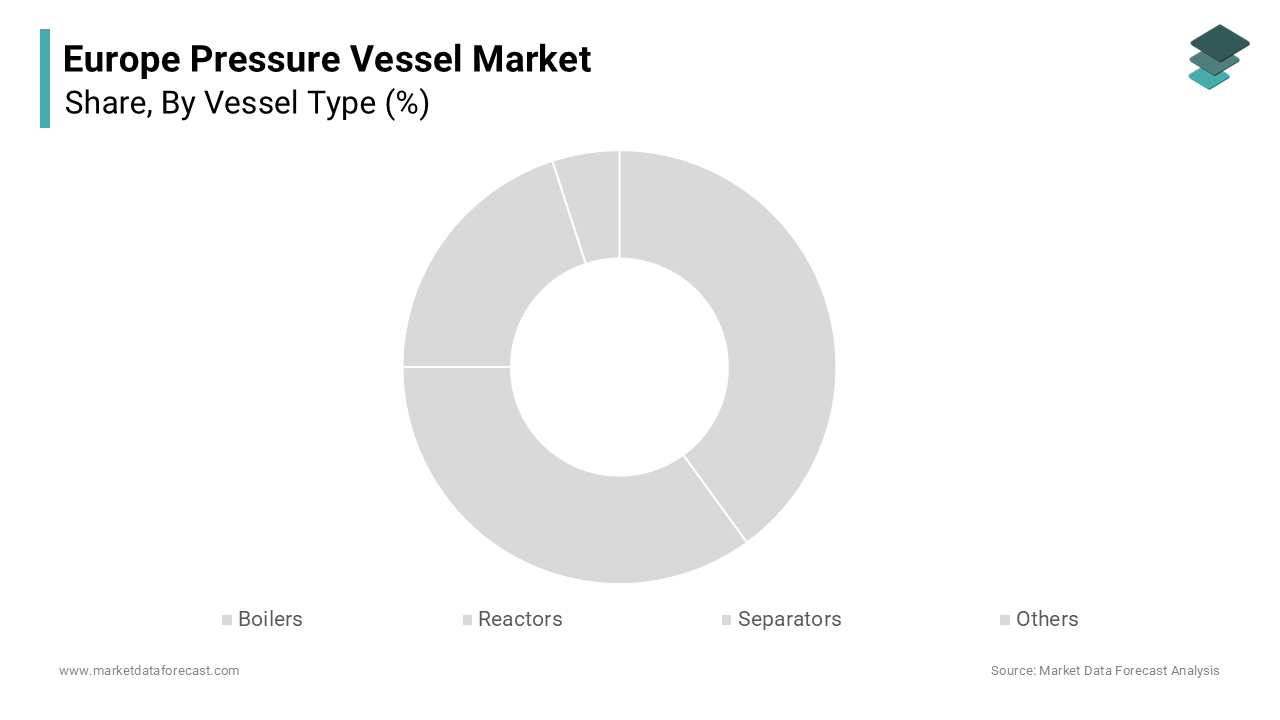
The reactors segment was the largest by holding 38.2% of the Europe pressure vessel market share in 2024 owing to their role in chemical synthesis, pharmaceutical production, and emerging green hydrogen electrolysis processes. In the European chemical industry, which contributes over 500 billion euros annually to GDP, reactors serve as the core units for catalytic reactions, polymerization, and hydrogenation under controlled temperature and pressure. Additionally, the EU’s Green Deal Industrial Plan mandates the retrofitting of conventional reactors for carbon capture integration and renewable feedstock compatibility. Germany’s Federal Ministry for Economic Affairs and Climate Action reports that over 1,200 chemical plants have initiated reactor modernization programs since 2022 to meet Best Available Techniques requirements.
The separators segment is projected to grow at a fastest CAGR of 9.1 % from 2025 to 2033 from the expanding need for phase separation in carbon capture, biogas upgrading, and offshore oil and gas operations. In CCUS projects, separators are essential for removing moisture and impurities from captured CO₂ streams before compression with a requirement under the EU’s CO₂ Quality Guidelines. According to the Global CCS Institute, Europe’s 41 active or planned carbon capture facilities each deploy 3 to 6 high pressure separators, creating consistent demand. Similarly, the European Biogas Association states that over 24,000 biogas plants operate across the EU, with 68% upgrading raw biogas to biomethane using pressurized water scrubbers or membrane separators. Offshore developments also contribute, Norway’s Equinor reported installing 14 new three phase separators on North Sea platforms in 2024 to enhance oil recovery efficiency.
By Construction Type Insights
The type I all metal pressure vessels segment was the largest by accounting for a dominant share of the Europe pressure vessel market in 2024, owing to their proven reliability, cost efficiency, and broad regulatory acceptance across industrial applications. Constructed entirely from carbon or low alloy steel, these vessels are the standard choice for steam boilers, chemical reactors, and heat exchangers operating below 300 bar. Their prevalence is reinforced by established manufacturing infrastructure; as per the European Steel Association, over 90 % of EU pressure vessel fabricators are optimized for rolled and welded steel construction by ensuring short lead times and competitive pricing. Regulatory frameworks further entrench Type I usage, where the Pressure Equipment Directive includes extensive material specifications for P355GH and P265GH steels, streamlining certification. Germany’s TUV Rheinland reports that 85 % of PED conformity assessments in 2024 involved Type I designs due to predictable failure modes and decades of operational data. In sectors like power generation and fertilizers, where process media are well understood and corrosion manageable, Type I vessels offer the optimal balance of safety performance and capital efficiency, sustaining their market primacy despite advances in composite alternatives.
The type IV pressure vessels segment is anticipated to grow at fastest CAGR of 14.3% throughout the forecast period with the urgent need for lightweight, high strength containers for hydrogen mobility and stationary storage. Unlike metal vessels, Type IV units reduce weight by up to 70 % while maintaining 700 bar capacity, a critical advantage for fuel cell trucks and refueling stations. According to the European Hydrogen Backbone initiative, over 28,000 hydrogen refueling stations will require Type IV tanks by 2030 to meet EU mobility targets. Regulatory progress has accelerated adoption; in 2023 the European Committee for Standardization published EN 17902 specifically for Type IV hydrogen cylinders, enabling CE marking under the Pressure Equipment Directive. Companies like NPROXX and Luxfer Gas Cylinders have expanded European production, with a new facility in the Netherlands shipping 12,000 units in 2024.
By End User Segment Analysis
The chemicals and petrochemicals sector was accounted in holding 41.2% of the Europe pressure vessel market share in 2024. The growth of the segment is driven by the industry’s reliance on high integrity containment systems for reactive and hazardous processes. The sector’s stringent safety culture shaped by the Seveso III Directive, mandates regular vessel replacement and real time monitoring, ensuring steady demand. Germany’s Ludwigshafen BASF complex alone operates more than 3,500 pressure vessels, many undergoing 10-year lifecycle renewals. Additionally, the EU’s REACH regulation drives substitution of legacy processes with closed system technologies, increasing vessel count per plant. The European Fertilizer Manufacturers Association notes that 92 % of ammonia production uses high pressure Haber Bosch reactors rated above 150 bar, requiring specialized alloy construction.
The power sector is projected to expand at a CAGR of 10.7% from 2025 to 2033 with the resurgence of nuclear energy and the scaling of thermal energy storage for grid stability. France’s government plans to construct six new EPR2 nuclear reactors by 2035, each requiring over 200 ASME Section III compliant pressure vessels for primary and secondary loops. Simultaneously, concentrated solar power and molten salt storage projects, such as those in Spain’s Extremadura region deploy high temperature vessels rated for 565°C and 30 bar to store thermal energy. According to the European Commission’s Strategic Energy Technology Plan, 12 gigawatts of long duration storage will be deployed by 2030, heavily reliant on pressurized containment. Hydrogen co firing in gas turbines also demands new buffer vessels, where Siemens Energy installed 18 such units in German power plants in 2024.
REGIONAL ANALYSIS
Germany Pressure Vessel Market Analysis
Germany was the largest contributor of the Europe pressure vessel market by holding 26.3% of share in 2024 with its world leading chemical engineering sector and aggressive industrial decarbonization agenda. Home to BASF Covestro and Bayer the country operates the highest density of high hazard industrial sites in Europe, all governed by strict TUV inspection regimes under the Seveso Directive. The National Hydrogen Strategy further amplifies demand, the Ministry for Economic Affairs allocated 9 billion euros through 2027 for hydrogen infrastructure including 300 new high pressure storage vessels at industrial clusters like Leuna and Marl. Germany’s skilled fabrication base supported by dual vocational training ensures rapid delivery of custom reactors and separators.
France Pressure Vessel Market Analysis
France pressure vessel market was ranked second by holding 19.2% of share in 2024 with the nuclear energy dominance and state led industrial strategy. The country derives nearly 65% of its electricity from 56 nuclear reactors managed by EDF, each requiring hundreds of high integrity pressure vessels for coolant systems and steam generators. According to the French Nuclear Safety Authority, over 120,000 pressure retaining components are under active surveillance across the fleet, with life extension programs driving replacement cycles. Beyond nuclear France’s “France 2030” investment plan allocates 1.9 billion euros to green hydrogen, spurring demand for Type IV vessels at projects like the Normandy Hydrogen Hub. The chemical sector also contributes significantly, Arkema and TotalEnergies operate large-scale fluoropolymer and bio based chemical plants requiring corrosion resistant reactors.
Italy Pressure Vessel Market Analysis
Italy pressure vessel market growth is likely to grow with its robust petrochemical heritage and Mediterranean energy corridor role. The Priolo Gargallo and Brindisi industrial zones host Eni Versalis and other major operators running high pressure steam crackers and ammonia synthesis units. Italy is also emerging as a hydrogen logistics hub, where the Snam-operated Adriatic Hydrogen Corridor will require 85 new buffer and transport vessels by 2027. The country’s strong SME fabricator network centered in Emilia Romagna specializes in stainless steel and duplex alloy vessels for food pharma and specialty chemicals.
Netherlands Pressure Vessel Market Analysis
The Netherlands pressure vessel market growth is steadily growing with the Europe’s energy and chemical gateway through the Port of Rotterdam. Home to Shell LyondellBasell and Dow the port hosts over 40 major chemical and refining complexes, all dependent on high pressure separation and reaction systems. According to the Dutch Ministry of Economic Affairs, the Porthos carbon capture project alone will install 22 high pressure CO₂ separators and 12 injection vessels by 2026, setting a continental benchmark. The Netherlands is also pioneering hydrogen infrastructure, where the HyStock terminal in Vlissingen will store 30,000 tonnes of green hydrogen in cryogenic pressure vessels. Strict environmental permitting under the Dutch Environmental Management Act ensures continuous vessel upgrades.
UK Pressure Vessel Market Analysis
The United Kingdom pressure vessel market growth is expected to have prominent opportunities with the offshore oil and gas legacy and emerging carbon management. The North Sea remains a critical hydrocarbon basin, with over 300 active platforms requiring separators and glycol dehydration vessels. Simultaneously, the UK leads in CCUS deployment, where the Acorn and Viking projects will utilize over 60 high pressure CO₂ vessels by 2027. The Humber Cluster’s Zero Carbon Humber initiative includes 24 new amine absorber and flash drum vessels for biomass with carbon capture. Post Brexit the UK adopted its own Pressure Equipment Regulations mirroring EU standards, ensuring continuity.
COMPETITIVE LANDSCAPE
The competition in the Europe pressure vessel market is characterized by a mix of large industrial conglomerates specialized engineering firms and regional fabricators operating under stringent regulatory oversight. Dominant players like ThyssenKrupp and Linde Engineering leverage global scale technical expertise and integrated project delivery to secure complex high value contracts in chemicals energy and hydrogen sectors. Meanwhile mid-sized European manufacturers differentiate through niche capabilities in materials such as duplex steel or Hastelloy and rapid turnaround for replacement vessels in aging plants. The market is highly fragmented below the top tier with hundreds of certified workshops competing on price and proximity particularly in Southern and Eastern Europe. Regulatory compliance acts as both a barrier and a differentiator as only firms with robust quality management systems can navigate the Pressure Equipment Directive’s conformity assessment routes. Innovation is increasingly focused on sustainability including lightweight composites for hydrogen and modular designs for carbon capture.
KEY MARKET PLAYERS
Some of the companies that are playing a dominating role in the Europe Pressure Vessel Market include
- Babcock & Wilcox Enterprises
- Mitsubishi Heavy Industries
- Doosan Heavy Industries & Construction
- Linde Plc
- General Electric (GE)
- Siemens AG
- IHI Corporation
- Larsen & Toubro Limited
- Bharat Heavy Electricals Limited (BHEL)
- Samuel Pressure Vessel Group
- Alloy Products Corp.
- Abbott & Co (Newark) Ltd.
- GEA Group Aktiengesellschaft
- Halvorsen Company
- Hitachi Zosen Corporation
Top Players in the Europe Pressure Vessel Market
ThyssenKrupp AG
ThyssenKrupp AG is a leading engineering and industrial solutions provider in the Europe pressure vessel market with deep expertise in high integrity reactors separators and hydrogen storage systems. The company serves major chemical energy and petrochemical clients across Germany France and the Netherlands through its Industrial Solutions division. ThyssenKrupp has reinforced its position by investing in advanced manufacturing facilities compliant with the EU Pressure Equipment Directive and ASME standards. In recent years, the company has expanded its portfolio to include electrolyzer balance of plant vessels for green hydrogen projects and carbon capture absorption columns. It also launched a digital twin platform for predictive maintenance of pressure equipment enhancing lifecycle value for industrial operators across Europe.
Linde Engineering
Linde Engineering plays a pivotal role in the Europe pressure vessel market by designing and supplying custom engineered vessels for cryogenic air separation hydrogen liquefaction and carbon capture applications. As part of the Linde Group, the company leverages global engineering standards while maintaining localized fabrication partnerships across Italy, Spain, and the UK. Linde Engineering has strengthened its European footprint by delivering integrated CCUS modules that include high pressure CO₂ separators and buffer tanks compliant with EN 13445. The company recently commissioned a state-of-the-art testing facility in Pullach Germany to validate vessel performance under extreme cyclic loading conditions supporting next generation clean energy infrastructure deployment.
Sulzer Ltd
Sulzer Ltd contributes significantly to the Europe pressure vessel market through its Chemtech division which specializes in separation columns heat exchangers and reactor internals for refining and chemical processing. Headquartered in Switzerland the company integrates advanced metallurgy and computational fluid dynamics to optimize vessel efficiency and durability. Sulzer has enhanced its competitive stance by developing modular pressure vessel skids for biorefineries and e fuel plants enabling faster deployment across EU member states. The company partnered with European notified bodies to streamline PED certification for vessels using novel duplex stainless steels further accelerating project timelines for clients in the circular chemistry sector.
Top Strategies Used by the Key Market Participants
Key players in the Europe pressure vessel market pursue several strategic priorities to maintain competitiveness and address evolving industrial demands. Vertical integration enables control over design fabrication and after sales service ensuring compliance with the Pressure Equipment Directive and timely project execution. Diversification into clean energy segments such as hydrogen carbon capture and biorefining allows companies to align with EU decarbonization mandates and access public funding. Investment in digitalization including digital twins remote monitoring and predictive maintenance enhances asset reliability and creates recurring service revenue. Strategic partnerships with notified bodies and material suppliers streamline certification and secure access to specialty alloys.
MARKET SEGMENTATION
This research report on the Europe Pressure Vessel Market has been segmented and sub-segmented based on the following categories.
By Vessel Type
- Boilers
- Reactors
- Separators
- Others
By Construction Type
- Type I
- Type 2
- Type 3
- Type 4
By Application
- Storage
- Processing
By End-User
- Power
- Oil & Gas
- Chemicals & Petrochemicals
- Fertilizers
- Others
By Country
- UK
- France
- Spain
- Germany
- Italy
- Russia
- Sweden
- Denmark
- Switzerland
- Netherlands
- Turkey
- Czech Republic
- Rest of Europe
Access the study in MULTIPLE FORMATS
Purchase options starting from
$ 2000
Didn’t find what you’re looking for?
TALK TO OUR ANALYST TEAM
Need something within your budget?
NO WORRIES! WE GOT YOU COVERED!
Call us on: +1 888 702 9696 (U.S Toll Free)
Write to us: sales@marketdataforecast.com