- Product Description Description
- Table of Contents TOC
- List of Table & Figure LOT
- Get Free Sample PDF Sample PDF
Europe Printed Electronics Market Report Summary
The Europe printed electronics market was valued at USD 3.96 billion in 2024, is estimated to reach USD 4.86 billion in 2025, and is projected to reach USD 25.56 billion by 2033, growing at a CAGR of 23.07% during the forecast period from 2025 to 2033. The growth of the Europe printed electronics market is driven by rapid adoption of flexible, lightweight, and low-cost electronic components across packaging, healthcare, automotive, and industrial IoT applications. Increasing implementation of EU traceability regulations, rising demand for smart packaging, and advancements in functional inks and substrates are further accelerating market growth. Moreover, the expansion of printed biosensors, organic photovoltaics, flexible displays, and item-level intelligence technologies is broadening the application scope of printed electronics across Europe.
Key Market Trends
- Growing deployment of smart packaging solutions driven by EU traceability mandates, digital product passports, and circular economy regulations.
- Rising adoption of printed biosensors and flexible electrodes in wearable healthcare and remote patient monitoring devices.
- Increasing investment in biodegradable and compostable electronic components to align with Europe’s sustainability and e-waste reduction goals.
- Expansion of printed electronics in smart buildings, including organic photovoltaics, electrochromic windows, and intelligent HVAC sensors.
- Advancements in functional inks such as silver, carbon, and emerging copper formulations—supporting high-performance and eco-friendly device manufacturing.
Segmental Insights
- Based on technology, the screen-printing segment was the largest and held a significant share of the Europe printed electronics market in 2024. The segment’s dominance is attributed to its proven reliability, cost efficiency, and suitability for high-viscosity conductive inks used in membrane switches, heaters, and photovoltaic components across industrial and automotive applications.
- Based on technology, inkjet printing is projected to record the fastest growth over the forecast period, driven by demand for high-resolution digital patterning, rapid prototyping, and customizable biosensors used in medical diagnostics and smart wearables.
- Based on material, the ink segment dominated the Europe printed electronics market in 2024. The strong performance of this segment is linked to increasing use of conductive inks—especially silver nanoparticle formulations in RFID antennas, flexible circuits, and smart labels requiring high electrical performance and regulatory compliance.
Regional Insights
The Europe printed electronics market is witnessing steady expansion across major economies, supported by strong R&D infrastructure, policy-driven innovation, and increasing adoption of smart and sustainable electronic systems.
- Germany was the largest contributor, accounting for 25.7% of the market share in 2024, driven by strong automotive, industrial automation, and smart packaging ecosystems supported by extensive pilot production lines.
- United Kingdom continues to perform well due to leadership in biomedical wearables, flexible sensors, and next-generation IoT technologies, supported by advanced research centers and open-access pilot facilities.
- France is emerging as a strong player supported by smart packaging applications, food traceability regulations, and growing adoption of printed sensors in aerospace and satellite systems.
- Netherlands demonstrates solid growth driven by collaborative innovation hubs like the Holst Centre and TNO enabling advancements in organic photodiodes, health patches, and RFID technologies.
- Sweden is expanding rapidly with strong focus on biodegradable electronics, printed medical devices, and indoor organic solar harvesting aligned with the region’s sustainability priorities.
Competitive Landscape
The Europe printed electronics market is characterized by the presence of specialized material suppliers, technological innovators, and vertically integrated solution providers. Leading companies are focusing on developing sustainable inks, flexible substrates, and high-volume roll-to-roll manufacturing processes to meet regulatory requirements and growing industrial demand. Companies are also expanding strategic partnerships across healthcare, aerospace, retail packaging, and automotive sectors to accelerate deployment of printed sensors, RFID, and smart labeling technologies. Prominent players in the Europe printed electronics market include BASF SE, Thin Film Electronics ASA, PolyIC GmbH, Ynvisible Interactive Inc., NovaCentrix, Enfucell, PragmatIC Semiconductor, Molex LLC, Ceradrop (MGI Group), and DuPont de Nemours, Inc.
Europe Printed Electronics Market Size
The europe printed electronics market size was valued at USD 3.96 billion in 2024 and is anticipated to reach USD 4.86 billion in 2025 from USD 25.56 billion by 2033, growing at a CAGR of 23.07% during the forecast period from 2025 to 2033.
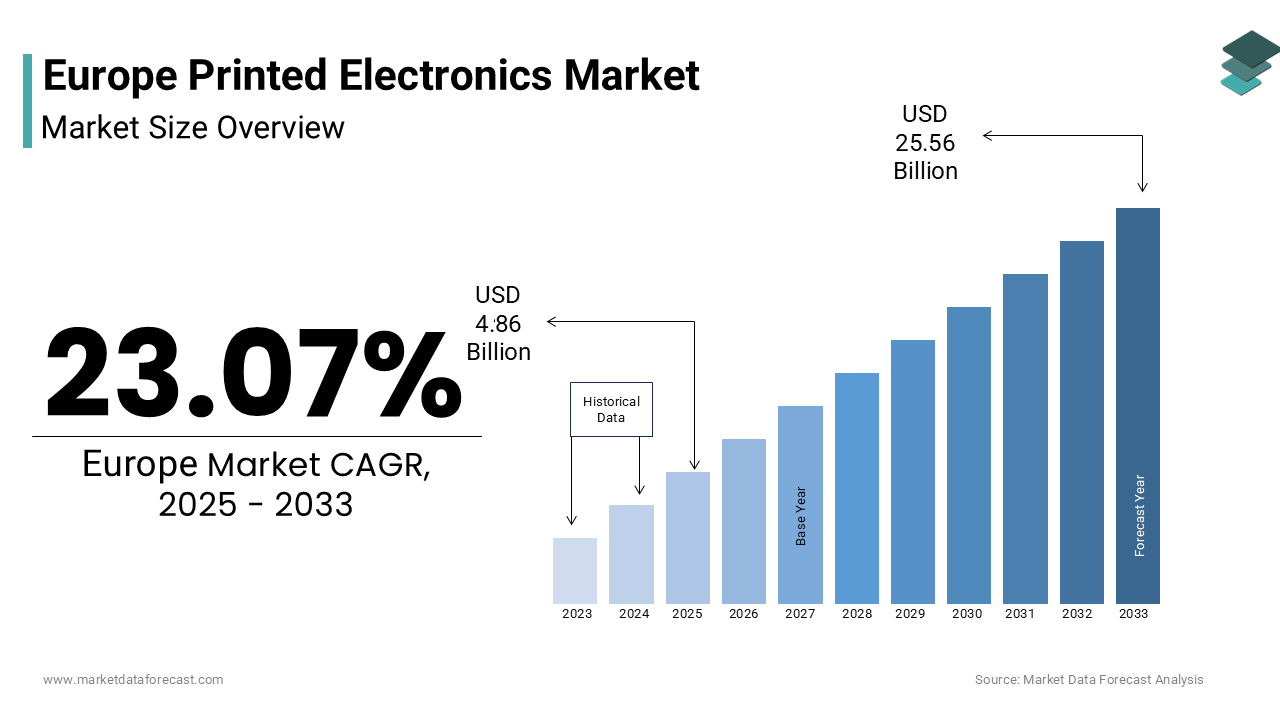
Printed electronics refers to the fabrication of electronic devices and circuits using additive printing techniques, such as inkjet screen flexographic and gravure, on flexible substrates like plastic paper or foil. In Europe this technology enables lightweight low cost and scalable production of sensors displays antennas and smart packaging components that support digital transformation across healthcare consumer goods and industrial IoT. Unlike conventional silicon-based electronics printed electronics leverages functional inks containing conductive semiconducting or dielectric materials to create devices that are thin conformable and often disposable. According to sources, numerous pilot and industrial scale production lines for printed electronics are operational across Europe, supporting initiatives in electronic components and systems. A significant majority of European packaging manufacturers are engaging in smart labeling trials, particularly influenced by requirements for traceability. Printed sensors are being utilized for applications such as satellite thermal monitoring, demonstrating the technology's effectiveness in high performance environments. This blend of industrial policy environmental regulation and cross sector innovation defines the unique trajectory of the Europe printed electronics market.
MARKET DRIVERS
EU Regulatory Push for Smart Packaging and Traceability
The European Union’s binding requirements for product traceability and circularity are boosting the growth of the Europe printed electronics market. These are accelerating adoption of printed electronics in packaging and labeling. The Digital Product Passport under a specific regulation requires certain products sold in the EU to include machine-readable digital IDs containing information about material composition, carbon footprint, and repairability. Integrating these digital IDs into items often involves using low-cost RFID tags or printed barcodes, with one common production method being roll-to-roll printing. Companies are already deploying printed NFC and QR code labels at scale for pharmaceutical and food applications. Brands in the food sector use smart labels as part of a strategy related to product authenticity and waste reduction goals. Packaging rules require items to be digitally identifiable to help with automated sorting in recycling facilities, a process that can use printed conductive markers. These regulatory imperatives transform printed electronics from a novelty into a compliance necessity across fast moving consumer goods.
Growth in Wearable Medical Devices and Remote Patient Monitoring
The expansion of home based and wearable healthcare technologies is driving demand for flexible printed sensors and electrodes across the region, which propels the expansion of the Europe printed electronics market. According to research, a notable number of individuals are now using connected health devices to manage ongoing health conditions, such as diabetes, heart issues, and breathing disorders. Printed electronics enables the mass production of ultra-thin disposable biosensors such as ECG electrodes glucose test strips and temperature patches that are comfortable cost effective and biocompatible. Funding priorities are increasingly supporting digital health infrastructure, with a particular focus on remote patient monitoring to help manage the demands on healthcare systems. Companies have commercialized printed photoplethysmography sensors that monitor blood oxygen and heart rate using organic photodiodes. Advancements in sensor technology, specifically the use of flexible, printed biosensors, appear to offer a potential for reducing patient monitoring expenses compared to more traditional options. The sustained growth in scalable and affordable medical electronics is driven by the aging population across Europe.
MARKET RESTRAINTS
Performance Limitations Compared to Conventional Silicon Electronics
Inherent performance constraints of organic and printed materials relative to traditional silicon semiconductors are a major restraint in the Europe printed electronics market. Printed transistors generally exhibit significantly lower electron mobilities compared to those made from crystalline silicon. This limits switching speed power handling and operational lifetime, making printed electronics unsuitable for high frequency data processing or high-power applications. The technology is only suitable for basic applications like RFID tags and simple displays, and cannot be used in complex devices such as smartphones or industrial controllers. Furthermore, environmental stability remains a concern as oxygen and moisture degrade organic semiconductors requiring costly encapsulation. These technical ceilings confine printed electronics to low complexity applications despite advances in conductive inks and barrier films hindering broader industrial substitution and investment.
Fragmented Manufacturing Infrastructure and Scale Limitations
Lack of standardized high volume manufacturing infrastructure capable of consistent yield and quality at commercial scale hinders the expansion of the Europe printed electronics market. Unlike Asia where dedicated gigafactories produce billions of RFID tags annually European production remains fragmented across pilot lines and small scale converters. A limited number of relevant facilities are operating at high production speeds. The majority of facilities operate at lower speeds. Operating speed is a key factor in achieving cost-competitive production. This fragmentation increases per unit costs and deters brand owners from large scale adoption. Additionally the absence of harmonized ink and substrate specifications across converters complicates supply chain reliability. Europe must consolidate its production capacity and create open access pilot lines with industrial throughput to achieve the economies of scale required for mainstream market penetration.
MARKET OPPORTUNITIES
Integration into Smart Building and Energy Efficient Systems
Embedding printed electronics into building materials for energy management and occupant comfort creates new opportunities for the growth of the Europe printed electronics market. Future building regulations across Europe mandate that new constructions achieve nearly zero energy standards, integrating advanced systems for managing lighting, heating, and ventilation. Printed organic photovoltaics and electrochromic windows can generate or modulate energy dynamically while printed temperature and occupancy sensors enable granular HVAC optimization. A significant portion of existing buildings in the EU are expected to undergo energy-efficient renovations, driving the demand for adaptable, cost-effective electronic components. Advancements in materials science include the development of flexible solar films that can be easily applied to various surfaces like building facades or rooftops. These applications align with EU decarbonization goals while leveraging the lightweight and aesthetic advantages of printed electronics in architectural contexts.
Adoption in Sustainable and Biodegradable Electronics
The region’s command in circular economy policy is fostering innovation in biodegradable and compostable printed electronics that minimize e-waste and provide fresh prospects for the Europe printed electronics market. The EU Strategy for Plastics in a Circular Economy and the upcoming Right to Repair Directive incentivize transient electronics that safely degrade after use. Compostable materials have been developed using cellulose-based substrates and water-soluble conductive inks. These specific materials are capable of decomposing in industrial composting environments. Electronic waste generation is a considerable concern. Packaging and disposable sensors form a notable and expanding part of the waste stream. Startups are commercializing printed biosensors and biofuel cells using chitosan and cellulose that leave no toxic residue. This alignment with EU sustainability mandates positions printed electronics as a key enabler of green digitalization.
MARKET CHALLENGES
Lack of Standardized Testing and Certification Protocols
The absence of harmonized reliability and safety standards for printed components challenges the growth of the Europe printed electronics market. Unlike conventional electronics governed by IEC and ISO norms printed devices, especially those used in medical or food contact applications, lack universally accepted test methodologies for lifetime performance biocompatibility and environmental resistance. Current regulation for the shelf life of printed biosensors in smart packaging is not harmonized across the EU. There is an absence of a unified standard for migration limits of ink components in smart packaging applications within Europe. This regulatory gap forces manufacturers to navigate inconsistent national requirements delaying market entry and increasing compliance costs. The adoption of printed electronics in regulated sectors will remain fragmented and risk-averse until the EU establishes clear certification pathways under the CE marking framework.
Supply Chain Vulnerability for Specialty Functional Inks
There are material supply risks due to its reliance on imported specialty inks containing silver nanowires conductive polymers and rare earth dopants, which challenges the expansion of the Europe printed electronics market. A notable share of high performance conductive inks used in European production are sourced from the United States South Korea and Japan, according to sources. Silver, a key component in most conductive inks, is classified as a critical raw material by the European Commission due to supply concentration and price volatility. Copper and carbon alternatives are being explored in research, but they have not yet matched the conductivity and oxidation stability of existing materials. Domestic European ink producers like Agfa and Coatema remain dependent on imported nanoparticle dispersions limiting supply security. The EU's printed electronics sector remains vulnerable to worldwide material shortages until it boosts local nanomaterial production through programs like the IPCEI for microelectronics.
REPORT COVERAGE
| REPORT METRIC | DETAILS |
| Market Size Available | 2024 to 2033 |
| Base Year | 2024 |
| Forecast Period | 2025 to 2033 |
| Segments Covered | By Technology, Material, Application, End-User & Region |
| Various Analyses Covered | Global, Regional & Country Level Analysis, Segment-Level Analysis, Drivers, Restraints, Opportunities, Challenges, PESTLE Analysis, Porter's Five Forces Analysis, Competitive Landscape, Analyst Overview on Investment Opportunities |
| Regions Covered | United Kingdom, France, Spain, Germany, Italy, Russia, Sweden, Denmark, Switzerland, the Netherlands, Turkey, and the Czech Republic. |
| Key Market Players | BASF SE, Thin Film Electronics ASA, PolyIC GmbH, Ynvisible Interactive Inc., NovaCentrix, Enfucell, PragmatIC Semiconductor, Molex LLC, Ceradrop (MGI Group), and DuPont de Nemours, Inc.. |
SEGMENTAL ANALYSIS
By Technology Insights
The screen-printing segment led the Europe printed electronics market and captured a 38.6% share in 2024. The dominance of the screen-printing segment is credited to its maturity reliability and suitability for high viscosity conductive inks used in thick film applications such as membrane switches heating elements and photovoltaic electrodes. The technology offers excellent layer thickness control making it ideal for resistive heaters in automotive rear windows and touch sensors in industrial control panels. Besides, screen printing requires lower capital investment than high precision inkjet or gravure systems enabling widespread adoption among small and medium converters across Southern and Eastern Europe. Its compatibility with a broad range of substrates including glass PET and textiles further cements its role in diverse applications from smart packaging to wearable electronics. This combination of technical robustness cost efficiency and industrial familiarity ensures screen printing remains the backbone of European printed electronics manufacturing.
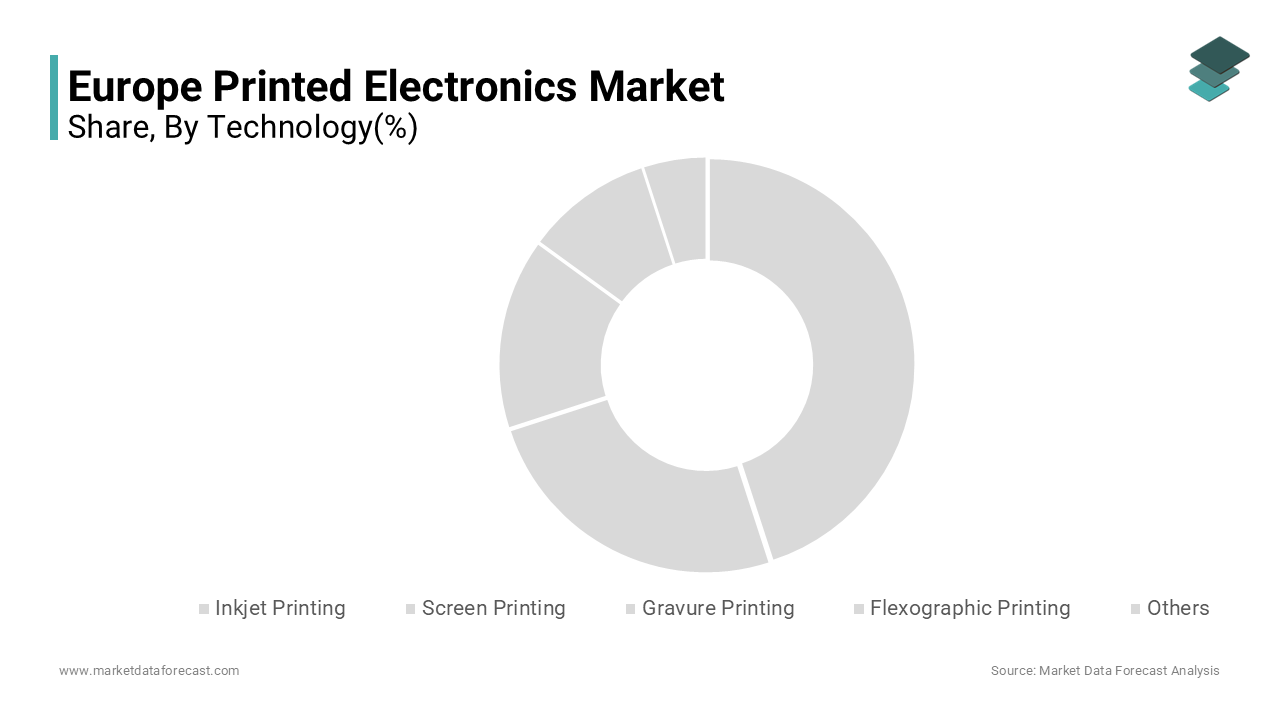
The inkjet printing segment is estimated to register the fastest CAGR of 18.4% from 2025 to 2033 due to its unmatched flexibility in digital patterning low material waste and compatibility with emerging applications requiring high resolution and customization. Unlike analog methods inkjet enables rapid prototyping and just in time production without physical masks, a critical advantage for medical diagnostics and personalized wearables. A majority of new disposable biosensor designs are utilizing inkjet printing for electrode deposition. The use of inkjet printing provides precision in depositing picoliter droplets of biocompatible inks. Furthermore, inkjet is the only technology capable of multi material printing on non planar surfaces enabling conformal electronics for aerospace and automotive interiors. Organizations have successfully demonstrated inkjet-printed RFID antennas with very fine line widths. These inkjet-printed antennas can achieve results comparable to traditional etched copper methods. Supported by EU funding under the Horizon Europe Smart Systems program inkjet is transitioning from lab scale to industrial roll to roll integration making it the most dynamic enabler of next generation printed electronics.
By Material Insights
The ink segment dominated the Europe printed electronics market and captured a share of 58.7% in 2024. The prominence of the ink segment is attributed to the high value and performance criticality of functional inks which determine electrical conductivity optical properties and environmental stability of printed devices. Conductive silver inks constitute a significant portion of the material segment used for printing. Key applications for these inks include RFID antennas, touch sensors, and flexible circuits. There is a substantial volume of RFID tags produced, which largely utilize silver nanoparticle inks. The use of silver-based conductive inks is a well-established and advancing technology in the field of printed and flexible electronics. The shift toward sustainability is also driving innovation in copper and carbon-based inks with companies launching oxidation resistant formulations that cut material costs. Additionally, regulatory pressure under REACH is accelerating the phase out of toxic solvents in favor of water based and UV curable systems. The entry of printed electronics into sensitive areas like healthcare and food safety makes ink purity and biocompatibility mandatory requirements, significantly heightening the commercial and technical importance of advanced ink formulations over basic substrates.
The substrate segment is anticipated to witness the fastest CAGR of 14.2% from 2025 to 2033 owing to the demand for flexible biodegradable and high-performance base materials that enable novel applications in wearables smart packaging and building integration. Traditional PET and PEN films are being supplemented by cellulose-based bioplastics polylactic acid and even paper substrates that align with the EU’s Circular Economy Action Plan. Some new trials for smart labels are exploring the use of compostable materials in response to emerging product information requirements. Certain films designed for organic solar power applications incorporate a specific coated bio-based material to help achieve durability for outdoor use. Specialized materials are required for applications in high-temperature environments, such as those found within certain cabin sensor components in the aerospace industry. National initiatives are subsidizing pilot lines for sustainable substrates. This convergence of regulatory environmental and performance demands positions substrate innovation as the most rapidly evolving frontier in printed electronics materials.
By End user Insights
The retail and packaging segment was the largest segment in the Europe printed electronics market and occupied a 32.7% share in 2024. The prominence of the retail and packaging segment is driven by Europe’s aggressive regulatory push for product traceability anti-counterfeiting and waste reduction. A requirement for a digital product passport is being introduced for certain products sold within the EU. This regulation impacts product categories such as electronics, textiles, and batteries. The system requires products to have machine-readable identifiers. Identifiers are a common method for accessing product information. Smart labels are widely used on various types of goods in the region. Companies operate high speed roll to roll lines producing temperature indicating time temperature integrators and NFC enabled tamper evident labels. The Farm to Fork strategy further mandates real time freshness monitoring for perishables driving adoption of printed biosensors in meat and dairy packaging. This regulatory and commercial imperative transforms printed electronics from a premium feature into a standard compliance component across fast moving consumer goods.
The healthcare segment is likely to experience the fastest CAGR of 21.6% over the forecast period. The rapid expansion of the healthcare segment is propelled by the convergence of aging demographics digital health policy and demand for low cost disposable diagnostics. Printed electronics enables mass production of single use ECG electrodes glucose test strips and wound infection sensors using biocompatible inks on flexible substrates. Companies like ISORG France and Plastic Electronic Sweden have commercialized printed photoplethysmography patches that continuously monitor heart rate and blood oxygen with medical grade accuracy. With the EU Medical Devices Regulation now fully enforced printed diagnostics must meet stringent CE certification spurring investment in GMP compliant manufacturing. This alignment of clinical need regulatory support and scalable technology establishes healthcare as the most dynamic growth vector in the European market.
REGIONAL ANALYSIS
Germany Printed Electronics Market Analysis
Germany outperformed other regions in the Europe printed electronics market and captured a 25.7% share in 2024. The dominance of the German market is driven by deep integration with automotive industrial automation and smart packaging sectors. Most German vehicles incorporate screen printed heating elements and touch interfaces. The country hosts leading producers like Agfa and Coatema which supply conductive inks and printing systems to converters across Europe. Additionally, the Fraunhofer network operates seven pilot lines for printed biosensors organic photovoltaics and RFID enabling rapid industrial transfer. This combination of manufacturing scale policy support and R&D infrastructure establishes Germany as the continent’s most comprehensive and application driven printed electronics hub.
United Kingdom Printed Electronics Market Analysis
The United Kingdom was the next prominent region in the Europe printed electronics market and accounted for a 15.6% share in 2024. The growth of the UK market is propelled by world class research translation particularly in biomedical and wearable electronics. Companies operate open access pilot lines that support SMEs in scaling printed OLEDs and RFID. Despite Brexit the UK remains tightly linked to EU medical device standards facilitating market access. This focus on high value flexible and transient electronics positions the UK as Europe’s innovation gateway for next generation printed medical and IoT applications.
France Printed Electronics Market Analysis
France is growing steadily in the Europe printed electronics market. The country excels in smart packaging and eco designed printed electronics driven by national circular economy laws and food safety mandates. Companies like Thales and ISORG produce NFC enabled labels and printed optical sensors for pharmaceutical and wine traceability, sectors critical to the French economy. France’s Tech4Nature program has funded startups developing compostable substrates and water-based inks with VTT and CEA-Liten providing technical validation. Additionally, the French Space Agency uses printed thermal sensors in satellite systems demonstrating high reliability. This blend of regulatory foresight agricultural heritage and green tech ambition makes France a leader in sustainable and traceable printed electronics.
Netherlands Printed Electronics Market Analysis
The Netherlands is moderately growing in the Europe printed electronics market. Its uniqueness lies in a collaborative open innovation model centered on the Holst Centre and TNO which operate shared pilot lines accessible to European SMEs and multinationals alike. These facilities have enabled breakthroughs in printed organic photodiodes RFID and health patches now commercialized by companies. The Port of Rotterdam uses printed temperature and humidity sensors in logistics containers ensuring cold chain integrity for pharmaceuticals. Furthermore, the Netherlands hosts Europe’s largest concentration of flexible electronics startups supported by accelerators. This ecosystem approach, combining public infrastructure private investment and cross border collaboration, makes the Netherlands a vital testing ground for scalable printed electronics.
Sweden Printed Electronics Market Analysis
Sweden is anticipated to grow in the Europe printed electronics market from 2025 to 2033 due to leadership in printed medical devices and sustainable materials aligned with its fossil free industrial strategy. Companies like Plastic Electronic and Epishine produce biocompatible biosensors and indoor organic solar cells used in healthcare and building automation. Additionally, the KTH Royal Institute of Technology leads EU projects on printed biofuel cells for self-powered diagnostics. This fusion of healthcare innovation circular design and clean energy ensures Sweden’s outsized influence in ethical and sustainable printed electronics
COMPETITVE LANDSCAPE
Competition in the Europe printed electronics market is characterized by a dual focus on technological differentiation and regulatory alignment rather than price. The landscape includes specialty chemical companies industrial integrators and agile startups each competing on material performance application expertise and sustainability credentials. Unlike mass electronics markets where scale dominates Europe’s ecosystem rewards innovation in biocompatible inks compostable substrates and secure printed circuits for regulated sectors. Large players like Agfa and Thales leverage decades of materials science and certification experience while startups such as PragmatIC disrupt with novel architectures like flexible microchips. Public funding through Horizon Europe and national innovation agencies reduces R&D risk enabling rapid prototyping and pilot deployment. Fragmentation remains a challenge as production is dispersed across small scale converters but open innovation models and shared pilot lines foster collaboration. Ultimately the market favors those who combine scientific rigor with regulatory foresight and environmental responsibility ensuring only the most adaptive and purpose driven players achieve long term impact.
KEY MARKET PLAYERS
- BASF SE
- Thin Film Electronics ASA
- PolyIC GmbH
- Ynvisible Interactive Inc.
- NovaCentrix
- Enfucell
- PragmatIC Semiconductor
- Molex LLC
- Ceradrop (MGI Group)
- DuPont de Nemours, Inc.
Top Players in the Market
Agfa-Gevaert
Agfa Gevaert is a Belgian multinational and a leading European developer of functional inks and materials for printed electronics with global reach in RFID biosensors and smart packaging. The company supplies silver and carbon-based conductive inks compatible with inkjet screen and flexographic printing to converters across Europe Asia and North America. Agfa contributes to the global market by enabling low-cost high performance printed circuits for medical diagnostics and logistics tracking. It also expanded its pilot production line in Mortsel Belgium to support GMP compliant manufacturing of printed biosensors for medical device partners. These actions reinforce its role as an enabler of eco friendly and regulated printed electronics applications worldwide.
Thales Group
Thales Group a French technology leader plays a pivotal role in the Europe printed electronics market through its development of secure NFC and RFID solutions for defense aerospace and traceable packaging. The company integrates printed antennas and sensors into identity documents pharmaceutical packaging and aircraft monitoring systems used across Europe and globally. Thales contributes internationally by combining printed electronics with cryptographic security to prevent counterfeiting and ensure supply chain integrity. It also partnered with CEA Leti to develop printed temperature sensors for satellite thermal management. These innovations position Thales at the intersection of security sustainability and high reliability printed electronics.
PragmatIC Semiconductor
PragmatIC Semiconductor a United Kingdom based innovator specializes in ultra low cost flexible integrated circuits using printed electronics technology. The company’s FlexICs are deployed in smart packaging retail authentication and IoT applications across Europe and North America enabling intelligence at the item level without silicon constraints. PragmatIC contributes to the global market by offering a scalable alternative to conventional chips for high volume disposable use cases. It also launched a new design platform allowing brand owners to customize circuits without semiconductor expertise. These advancements accelerate the adoption of intelligent packaging and position PragmatIC as a pioneer in democratizing embedded intelligence through printed semiconductors.
Top Strategies Used by the Key Market Participants
Key players in the Europe printed electronics market focus on developing sustainable and biodegradable functional inks and substrates to align with EU circular economy regulations. They invest in open access pilot lines and collaborative R&D with research institutes to accelerate industrial scale up. Companies pursue vertical integration by controlling ink formulation substrate engineering and printing process optimization to ensure performance consistency. Strategic partnerships with brand owners healthcare providers and aerospace firms embed printed electronics into regulated high value applications. Geographic concentration in innovation clusters such as Eindhoven Cambridge and Dresden enables access to talent infrastructure and public funding reinforcing Europe’s leadership in ethical and application driven printed electronics.
MARKET SEGMENTATION
This research report on the europe printed electronics market has been segmented and sub–segmented into the following categories.
By Technology
- Inkjet Printing
- Screen Printing
- Gravure Printing
- Flexographic Printing
- Others (3D Printing, Offset Printing, etc.)
By Material
- Ink
- Substrate
By Application
- Displays
- Photovoltaic
- Lighting
- RFID
- Others (Printed Batteries)
By End-user
- Healthcare
- Aerospace & Defense
- Automotive & Transportation
- Consumer Electronics
- Construction & Architecture
- Retail & Packaging
- Others (Food & Beverages)
By Country
- UK
- France
- Spain
- Germany
- Italy
- Russia
- Sweden
- Denmark
- Switzerland
- Netherlands
- Turkey
- Czech Republic
- Rest of Europe