- Product Description Description
- Table of Contents TOC
- List of Table & Figure LOT
- Get Free Sample PDF Sample PDF
Market Size, 2025
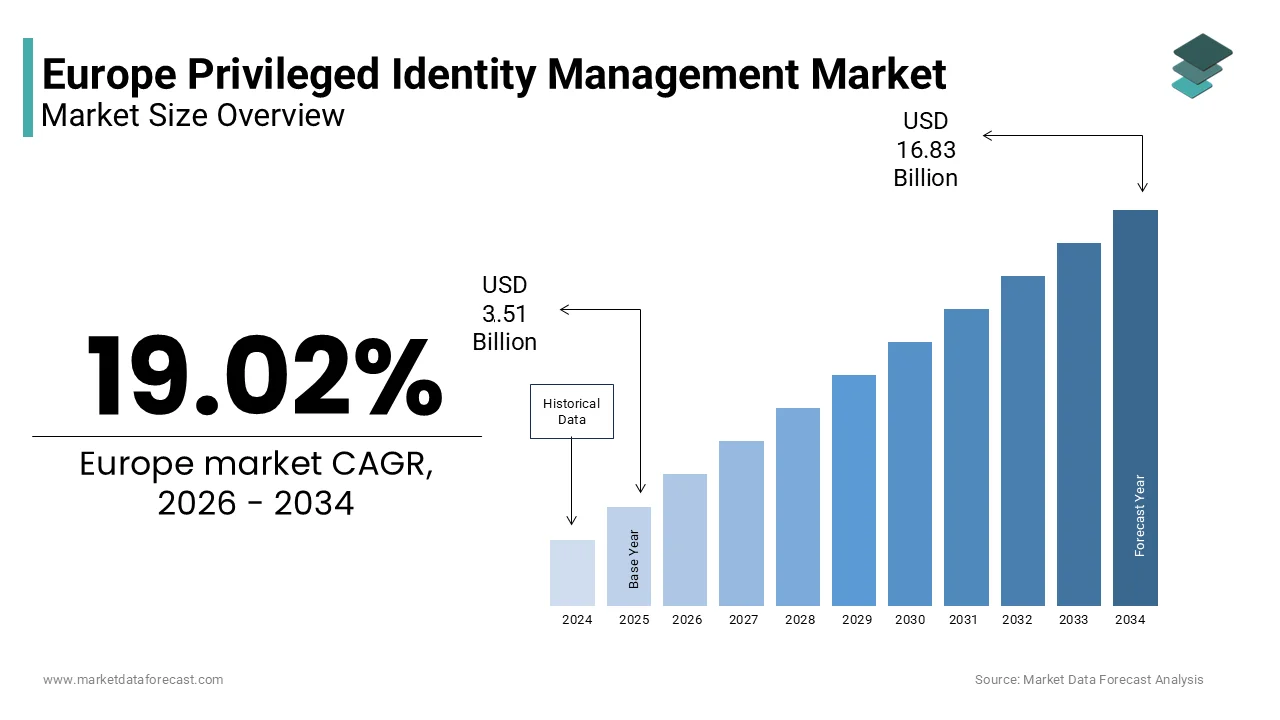
$3.51 BnMarket Estimate, 2026
$4.18 BnMarket Forecast, 2034
$16.83 BnCAGR, 2026–2034
19.02%Europe Privileged Identity Management Market Report Summary
The Europe privileged identity management market was valued at USD 3.51 billion in 2025, is estimated to reach USD 4.18 billion in 2026, and is projected to reach USD 16.83 billion by 2034, growing at a CAGR of 19.02% during the forecast period. The growth of the Europe privileged identity management market is driven by the increasing frequency of cyber threats, rising demand for advanced identity security solutions, and the growing adoption of digital transformation initiatives across enterprises. Organizations are increasingly implementing privileged identity management solutions to secure sensitive systems, control administrative access, and ensure compliance with stringent data protection regulations. The expansion of cloud computing, remote workforce models, and the need to protect critical digital infrastructure are further accelerating the adoption of privileged identity management solutions across Europe.
Key Market Trends
- Rising adoption of identity and access management solutions to protect sensitive corporate systems and critical digital infrastructure.
- Increasing implementation of zero trust security frameworks that emphasize strict access control and identity verification.
- Growing integration of artificial intelligence and automation in privileged access monitoring and threat detection systems.
- Expansion of hybrid and multi cloud environments creating higher demand for advanced identity governance and access control tools.
- Increasing regulatory requirements related to data security, compliance, and risk management across European industries.
Segmental Insights
- Based on deployment type, the hybrid deployment model segment dominated the Europe privileged identity management market in 2025. Organizations increasingly prefer hybrid deployments because they provide flexibility, scalability, and enhanced control by combining on premises infrastructure with cloud based security solutions.
- Based on application, the access management segment led the Europe privileged identity management market in 2025. The segment’s dominance is attributed to the growing need for secure management of administrative privileges and monitoring of user access to critical enterprise systems.
- Based on end user, the banking, financial services, and insurance segment was the largest segment in the Europe privileged identity management market in 2025. Financial institutions require strong identity governance and privileged access controls to protect sensitive financial data, prevent cyberattacks, and comply with strict regulatory frameworks.
- Based on component, the services segment is expected to register a significant CAGR of 19.8% during the forecast period. The increasing demand for consulting, integration, and managed security services to implement and maintain identity management solutions is supporting the rapid growth of this segment.
Regional Insights
- The Europe privileged identity management market is experiencing strong growth across several countries due to increasing cybersecurity threats and the rapid adoption of digital technologies.
- Germany accounted for the largest share of the Europe privileged identity management market and held 24.8% of the regional market share in 2025. The country’s strong enterprise IT infrastructure, high cybersecurity awareness, and increasing investments in advanced identity security solutions are major factors supporting market expansion.
- Other European countries are also witnessing growing adoption of privileged identity management solutions driven by regulatory compliance requirements, increasing cyber risk, and expanding digital transformation initiatives across industries.
Competitive Landscape
The Europe privileged identity management market is highly competitive with the presence of global cybersecurity solution providers and specialized identity management vendors. Companies are focusing on developing advanced identity governance platforms, integrating artificial intelligence driven security capabilities, and expanding cloud compatible security solutions. Strategic partnerships, product innovation, and expansion of cybersecurity services are helping market participants strengthen their presence in the European privileged identity management market. Prominent players in the Europe privileged identity management market include CyberArk Software Ltd., BeyondTrust Corporation, ThycoticCentrify (DelineA), Microsoft Corporation, IBM Corporation, Oracle Corporation, Broadcom Inc., One Identity LLC, ARCON, and Wallix Group.
Europe Privileged Identity Management Market Size
The Europe privileged identity management market size was valued at USD 3.51 billion in 2025 and is projected to reach USD 16.83 billion by 2034 from USD 4.18 billion in 2026, growing at a CAGR of 19.02 %.
Current Market Definition and Operational Landscape
Conceptual Framework and Security Context
Privileged identity management enables organisations to authenticate authorise and audit privileged accounts across hybrid environments while maintaining compliance with stringent regulatory mandates. The operational necessity for such controls intensifies as European enterprises navigate an increasingly complex threat ecosystem where identity based attacks represent a predominant intrusion vector. According to the European Union Agency for Cybersecurity nearly four thousand nine hundred curated security incidents were analysed within a single recent annual cycle underscoring the persistent exposure of digital assets. As per Eurostat more than half of European enterprises now utilise paid cloud computing services which inherently expands the privileged access surface requiring sophisticated governance. The convergence of regulatory pressure digital transformation and sophisticated threat actors establishes privileged identity management as an indispensable component of enterprise security architecture across the European continent. This discipline transcends traditional access control by incorporating continuous verification behavioural analytics and just in time privilege elevation to mitigate insider threats and external compromise attempts.
MARKET DRIVERS
Escalating Cyber Threat Sophisticacy Demands Advanced Access Governance
Identity-centric attack methodologies are proliferating across European digital infrastructure, which acts as a major accelerator for the Europe privileged identity management market. This trend compels organisations to adopt robust privileged identity management frameworks. European organizations are currently facing a record-breaking pace of ransomware attacks and large-scale data breaches, with threat actors increasingly utilizing compromised credentials and Initial Access Brokers to infiltrate corporate networks. Privileged accounts represent high value targets for adversaries because they enable lateral movement and unrestricted data access once compromised. Identity has become the primary entry point for cyberattacks, with the vast majority of these incidents relying on the exploitation of user passwords through large-scale automated guessing techniques. European financial services healthcare and public sector entities face heightened exposure due to the sensitivity of their data assets and the regulatory consequences of breach events. While the majority of reported cyber incidents in Europe are currently characterized by high-volume service disruptions, traditional methods like credential theft continue to serve as the critical starting point for more damaging and long-term network compromises. Organisations therefore prioritise privileged identity management solutions that deliver session monitoring credential vaulting and behavioural anomaly detection to counter these evolving threats. The integration of zero trust principles further amplifies demand for continuous privileged access verification rather than static permission models.
Regulatory Compliance Imperatives Accelerate Privileged Access Adoption
The region is governed by strict data protection and cybersecurity regulations, which in turn propels the expansion of the Europe privileged identity management market. These rules make the deployment of privileged identity management an absolute necessity. Data protection authorities across Europe are increasingly aggressive in their enforcement actions, leading to a steady rise in both the volume and the monetary value of penalties issued to organizations that fail to protect user privacy. Privileged accounts pose significant compliance risk because unmonitored access to personal data can trigger mandatory breach notifications and substantial penalties. As per the Cyber Resilience Act manufacturers and service providers must implement secure development practices that include rigorous privileged access controls throughout product lifecycles. The Network and Information Security Directive 2 further obliges essential and important entities to adopt technical measures that safeguard system integrity including privileged session recording and access approval workflows. European financial institutions additionally prepare for Digital Operational Resilience Act enforcement which requires comprehensive testing of identity and access management controls under stress scenarios. Organisations therefore invest in privileged identity management platforms that provide audit ready reporting automated policy enforcement and real time alerting to satisfy regulatory examiners. The convergence of multiple regulatory frameworks creates a compounding effect where privileged access governance becomes a central pillar of enterprise risk management rather than an optional security enhancement.
MARKET RESTRAINTS
Complex Integration Requirements Impede Deployment Velocity
European enterprises typically operate within a heterogeneous technology landscape, which restricts the growth of the Europe privileged identity management market. This complexity introduces significant friction when implementing privileged identity management solutions. Cybersecurity investment across Europe is rising steadily as businesses prioritize resilience and regulatory compliance while managing the security risks inherent in older, non-modernized internal systems. Many organisations operate hybrid environments combining on premises mainframes legacy applications and contemporary cloud platforms each requiring distinct privileged access handling methodologies. As per Eurostat only fifty two point seven four percent of EU enterprises adopted paid cloud services in 2025 indicating substantial variation in digital maturity that complicates standardised privileged access policies. Privileged identity management deployments often necessitate custom connectors agent based monitoring and directory service integrations that extend implementation timelines and increase total cost of ownership. The scarcity of cybersecurity professionals with expertise in privileged access architecture further delays project execution as organisations compete for limited talent pools. According to European Commission data only sixty percent of EU citizens aged sixteen to seventy four possessed basic digital skills in 2025 constraining the availability of personnel capable of managing sophisticated identity governance platforms. These integration complexities discourage small and medium enterprises from pursuing comprehensive privileged identity management strategies despite recognised security benefits.
Budgetary Constraints Limit Investment in Advanced Access Controls
Financial pressures across European business sectors restrict the allocation of resources toward privileged identity management initiatives particularly among small and medium enterprises, which further hampers the expansion of the Europe privileged identity management market. : Most European business leaders acknowledge the necessity of expanding their cyber defenses, yet a significant portion of organizations still lack the actual funding required to address their specific security vulnerabilities.
Privileged identity management solutions represent significant capital expenditure requiring licensing fees professional services and ongoing maintenance costs that strain limited IT budgets. European technology investment is reaching record levels, with a major portion of these funds being directed specifically toward strengthening digital security and sovereignty rather than just general infrastructure updates. Economic uncertainty inflationary pressures and supply chain disruptions compel chief financial officers to prioritise immediate operational needs over strategic security investments. The return on investment for privileged identity management remains difficult to quantify in monetary terms which disadvantages these solutions during budget allocation discussions. According to ENISA median information security spending doubled to one million euros in 2023 yet this figure masks substantial disparity between large enterprises and smaller organisations that lack equivalent financial capacity. Consequently many European entities adopt fragmented or manual privileged access processes that expose them to preventable security incidents while deferring comprehensive platform adoption.
MARKET OPPORTUNITIES
Cloud Native Architecture Expansion Creates New Governance Opportunities
The accelerating migration of European workloads to cloud environments generates substantial demand for cloud aware privileged identity management capabilities. This acceleration is expected to boost the growth of the Europe privileged identity management market. While cloud computing is now utilized by more than half of the European business landscape, the technology is nearly universal among major corporations, driving a disproportionate demand for cloud-specific security tools in that segment. Cloud platforms introduce dynamic ephemeral resources and distributed identity stores that traditional on premises privileged access tools cannot effectively govern. Northern European countries continue to outpace the rest of the continent in cloud integration, serving as early adopters for sophisticated identity and access governance strategies. Privileged identity management vendors that offer native integration with major cloud providers enable organisations to enforce consistent access policies regardless of workload location. The emergence of serverless computing container orchestration and infrastructure as code further amplifies the need for just in time privilege elevation and automated credential rotation. According to research, Finland Sweden Norway and Denmark lead European cloud adoption with rates exceeding seventy percent creating early mover advantages for privileged access solutions tailored to these markets. Organisations that implement cloud native privileged identity management gain operational agility while maintaining security posture during digital transformation initiatives.
Artificial Intelligence Integration Enables Proactive Threat Mitigation
The incorporation of artificial intelligence and machine learning into privileged identity management platforms unlocks predictive security capabilities, which provide potential prospects for the expansion of the Europe privileged identity management market. These advanced tools specifically address the evolving European threat landscapes. According to CrowdStrike European threat actors are accelerating intrusion speed and employing novel techniques that overwhelm traditional rule based access controls. AI driven privileged identity management solutions analyse behavioural patterns to detect anomalous privileged session activity such as unusual access times geographic locations or command sequences that may indicate compromise. As per ENISA threat groups increasingly reuse tools and collaborate across boundaries requiring adaptive defence mechanisms that learn from emerging attack patterns. Machine learning models can identify privilege creep by monitoring permission accumulation over time and recommending least privilege adjustments to reduce attack surface. The European Union Artificial Intelligence Act establishes a regulatory framework that encourages trustworthy AI deployment in cybersecurity applications providing legal clarity for vendors developing intelligent privileged access features. According to Digital Europe policy initiatives digital transformation goals include strengthening cybersecurity resilience which aligns with AI enhanced privileged identity management adoption. Organisations that leverage artificial intelligence within privileged access governance achieve faster threat detection reduced false positives and automated response capabilities that strengthen overall security posture.
MARKET CHALLENGES
Skills Shortage Constrains Effective Privileged Access Operations
The persistent deficit of cybersecurity professionals across the region impedes the growth of the Europe privileged identity management market. This affects the effective deployment and management of privileged identity management systems. According to European Commission data only sixty percent of EU citizens aged sixteen to seventy four possessed at least basic digital skills in 2025 falling short of the eighty percent target established for 2030. Privileged identity management requires specialised expertise in identity protocols access policy design and security analytics that remains scarce in the European labour market. European enterprises are facing a significant disconnect between the technical requirements of modern cybersecurity roles and the actual qualifications of the available workforce, creating systemic vulnerabilities in how sensitive data and system access are managed. The complexity of modern privileged identity management platforms demands continuous training and certification that many organisations cannot sustain given resource limitations. The pool of high-level technical experts in the European Union remains dangerously small, leaving a critical gap in the personnel available to operate and maintain the complex security platforms necessary for national and corporate defense. This talent shortage forces security teams to prioritise reactive incident response over proactive privileged access optimisation increasing organisational vulnerability. The competition for qualified personnel between public and private sectors further exacerbates recruitment challenges particularly in critical infrastructure domains where privileged access management carries heightened importance.
Evolving Regulatory Fragmentation Complicates Compliance Strategies
Cybersecurity regulations across European jurisdictions are proliferating, often overlapping and conflicting, which limits the expansion of the Europe privileged identity management market. This growth creates significant operational complexity for implementing privileged identity management. According to the Cyber Resilience Act compliance deadlines for vulnerability reporting and secure development practices vary by product category creating uncertainty for vendors and adopters. As per the European Data Protection Board GDPR enforcement approaches differ among national authorities leading to inconsistent interpretation of privileged access requirements for personal data protection. The Network and Information Security Directive 2 establishes baseline security obligations yet member states retain discretion in implementation details that affect privileged identity management specifications. According to CyberArrow analysis European organisations must navigate multiple compliance frameworks including GDPR PCI DSS and sector specific mandates that each impose distinct privileged access controls. This regulatory fragmentation increases the cost and complexity of privileged identity management deployments particularly for multinational enterprises operating across multiple European markets. The absence of harmonised technical standards for privileged session recording access approval workflows and audit reporting forces organisations to customise solutions for each jurisdiction. According to TUV Sud guidance new cybersecurity requirements for wireless devices under the Radio Equipment Directive introduce additional compliance layers that intersect with privileged access governance. These regulatory complexities delay deployment timelines and increase the risk of non compliance despite substantial security investments.
REPORT COVERAGE
| REPORT METRIC | DETAILS |
| Market Size Available | 2025 to 2034 |
| Base Year | 2025 |
| Forecast Period | 2026 to 2034 |
| CAGR | 19.02% |
| Segments Covered | By Deployment Type, Application, End User, Component, and Region |
| Various Analyses Covered | Global, Regional, & Country Level Analysis; Segment-Level Analysis; DROC, PESTLE Analysis; Porter’s Five Forces Analysis; Competitive Landscape; Analyst Overview of Investment Opportunities |
| Regions Covered | UK, France, Spain, Germany, Italy, Russia, Sweden, Denmark, Switzerland, Netherlands, Turkey, and the Czech Republic |
| Market Leaders Profiled | CyberArk Software Ltd., BeyondTrust Corporation, ThycoticCentrify (DelineA), Microsoft Corporation, IBM Corporation, Oracle Corporation, Broadcom Inc., One Identity LLC, ARCON, and Wallix Group |
SEGMENTAL ANALYSIS
By Deployment Type Insights
The hybrid deployment model segment dominated the Europe privileged identity management market in 2025. The dominance of the segment is driven by organisations striving to balance legacy infrastructure security with cloud agility, and the transitional nature of European enterprise IT landscapes where complete migration to the cloud remains a multi year endeavour. A primary factor sustaining hybrid dominance is the extensive presence of on premises mainframes and legacy applications that cannot be immediately migrated to cloud environments. Large-scale European enterprises are maintaining older, specialized computer systems for their most critical operations, which necessitates a security approach focused on controlling high-level access within their own physical data centres. Most major European companies now use a combination of cloud and traditional on-site technology, creating a complex environment that demands a single, coordinated way to manage user permissions across all platforms. The complexity of maintaining consistent security policies across disparate environments drives the demand for hybrid solutions that offer a single pane of glass for visibility. Organisations face significant risks if privileged credentials for on premises systems are managed separately from cloud assets creating security silos that attackers exploit. Consequently vendors focus heavily on hybrid architectures that support agent based monitoring for local servers alongside API driven integration for cloud platforms. This approach allows businesses to protect critical assets regardless of location without forcing a disruptive rip and replace strategy. The need to comply with data sovereignty laws in countries like Germany and France further reinforces the retention of on premises components within a broader hybrid framework. Stringent data residency regulations across the European Union compel many organisations to retain sensitive privileged identity data within national borders while leveraging cloud scalability for other functions. According to the European Data Protection Board interpretations of GDPR often require that personally identifiable information and critical access logs remain stored within specific jurisdictions to ensure legal compliance. : New European laws require technology providers to prove they have total control over how their products handle security information, which is forcing many companies to carefully evaluate whether standard cloud services meet these strict new transparency and safety rules. Hybrid privileged identity management solutions enable organisations to keep credential vaults and audit logs on local servers while utilizing cloud resources for analytics and threat intelligence sharing. This architectural flexibility satisfies regulatory auditors who demand proof of data localization while still allowing companies to benefit from cloud innovation. The Network and Information Security Directive 2 further mandates that operators of essential services maintain robust incident response capabilities which are often easier to guarantee with local infrastructure components. Consequently the hybrid model emerges as the pragmatic choice for regulated industries such as healthcare and government where the penalty for non compliance far outweighs the operational convenience of a fully cloud native approach.
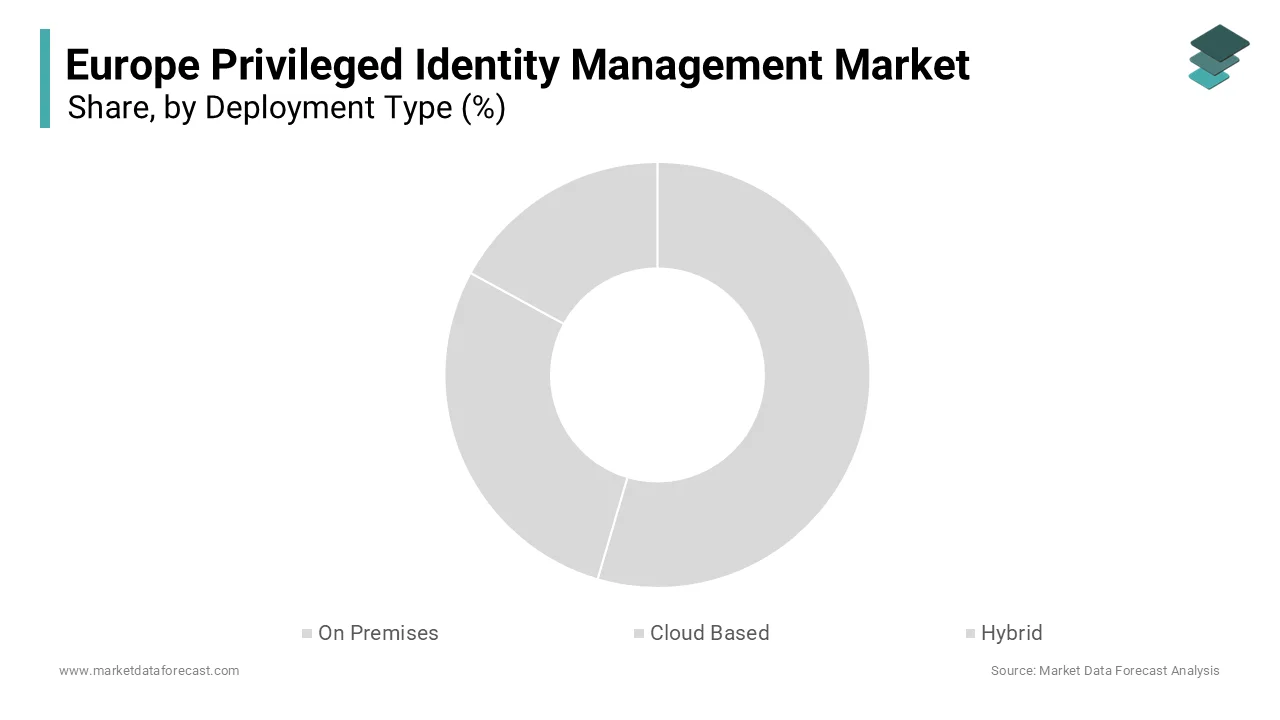
The cloud based deployment segment is likely to experience the fastest CAGR of 18.5% from 2026 to 2034 due to rapid digital transformation and the shift toward remote work models. The aggressive migration of European workloads to public and private cloud environments serves as the key factor for the exponential growth of cloud native privileged identity management solutions. According to Eurostat the percentage of EU enterprises using cloud computing services has risen steadily with large enterprises leading the charge in adopting infrastructure as a service and platform as a service models. As per the European Commission digital decade targets member states are pushing for widespread adoption of advanced digital technologies which inherently increases the surface area requiring cloud specific access controls. Traditional on premises tools lack the elasticity and API connectivity required to manage ephemeral cloud resources such as containers and serverless functions that spin up and down dynamically. Cloud based privileged identity management platforms offer immediate scalability and seamless integration with major hyperscalers like AWS Azure and Google Cloud which are expanding their European data center footprints. Organisations recognize that managing cloud privileges through legacy methods creates dangerous blind spots where unauthorized access can go undetected. The speed of deployment for cloud solutions also appeals to IT leaders who need to secure new environments rapidly without the lengthy procurement and installation cycles associated with hardware based systems. This urgency to secure cloud first strategies propels the cloud segment ahead of all other deployment types in terms of growth velocity. The permanent shift toward hybrid and remote work arrangements across Europe has fundamentally altered access patterns necessitating cloud delivered privileged identity management capabilities. According to Eurofound data a significant portion of the European workforce now operates remotely at least part of the time requiring secure access to corporate resources from diverse locations and devices. As per Microsoft Security reports identity based attacks targeting remote users have surged prompting organisations to adopt cloud based solutions that provide secure access without relying on traditional network perimeters. Cloud based privileged identity management enables employees to request and receive just in time access credentials from anywhere in the world while maintaining rigorous authentication standards such as multi factor authentication and behavioral biometrics. The ability to centrally manage privileges for a dispersed workforce without installing complex client software on every endpoint makes cloud solutions highly attractive to modern enterprises. Furthermore cloud platforms facilitate easier collaboration between geographically distributed IT teams who need shared visibility into privileged activities. The cost efficiency of subscription based cloud models also lowers the barrier to entry for small and medium enterprises that previously could not afford sophisticated on premises infrastructure. These factors combine to make cloud deployment the fastest expanding segment in the European market landscape.
By Application Insights
The access management segment led the Europe privileged identity management market in 2025. The leading position of the segment is attributed to the universal requirement to control who can access what resources and under which conditions. It serves as the foundational layer for securing elevated privileges across diverse IT environments. The widespread implementation of zero trust security frameworks across European enterprises acts as a major driver for the supremacy of access management solutions. According to ENISA zero trust has become a strategic priority for European cybersecurity with organisations moving away from implicit trust models to continuous verification of every access request. As per the European Union Agency for Cybersecurity guidelines zero trust principles mandate strict identity verification for every person and device trying to access resources regardless of whether they are sitting within or outside of the network perimeter. Access management modules within privileged identity management suites provide the critical enforcement mechanisms for these policies by ensuring that only authenticated and authorized users gain entry to sensitive systems. The granularity of control offered by modern access management tools allows organisations to implement least privilege principles effectively thereby reducing the attack surface available to potential intruders. European regulators increasingly view robust access management as a baseline requirement for compliance with directives such as NIS2 which explicitly calls for strict access control measures. The ability to enforce context aware policies based on user role device health and location makes access management indispensable for protecting critical infrastructure. Consequently organisations prioritize investment in this application area to establish a solid security foundation before layering on more advanced governance or session monitoring capabilities. The rising prevalence of insider threats whether malicious or accidental compels European organisations to prioritize robust access management as their first line of defense. According to Verizon data breach investigations a significant proportion of security incidents in Europe involve internal actors who misuse their existing access privileges to exfiltrate data or disrupt operations. As per Ponemon Institute research the cost of insider threats has risen sharply prompting boards of directors to demand stricter controls over how privileged accounts are assigned and utilized. Access management solutions address this challenge by enforcing strict segregation of duties and ensuring that no single individual possesses excessive power that could be abused. These systems enable dynamic adjustment of access rights based on real time risk assessments revoking permissions immediately if suspicious behavior is detected. The psychological deterrent effect of knowing that access is tightly monitored and restricted also reduces the likelihood of intentional misconduct by employees. Furthermore access management helps mitigate accidental breaches by preventing well meaning staff from accessing systems they are not trained to handle thereby reducing configuration errors and system outages. The critical nature of controlling initial entry points ensures that access management remains the largest and most heavily invested application segment in the European privileged identity management market.
The privileged session management segment is on the rise and is expected to be the fastest growing segment in the market by witnessing a CAGR of 21.3% during the forecast period owing to the need for granular visibility and forensic capabilities into administrative activities. The increasing demand for detailed forensic evidence following security incidents fuels the rapid expansion of privileged session management solutions across Europe. Privileged session management tools capture every keystroke mouse click and command executed during an administrative session providing an undeniable record of actions taken. This level of detail is crucial for determining the root cause of breaches and holding individuals accountable for policy violations. Legal teams and compliance officers rely on these recordings to defend against regulatory fines and to satisfy insurance requirements related to cyber liability. The ability to search and index session content using optical character recognition further enhances the utility of these tools for rapid incident response. As European courts and regulators raise the bar for evidence quality organisations are rushing to deploy session management capabilities that were previously considered optional. This regulatory pressure combined with the need for operational transparency drives the exceptional growth rate of this application segment. The evolution of privileged session management from passive recording to active real time intervention represents a key factor accelerating its adoption in the European market. Advanced privileged session management platforms now incorporate artificial intelligence to detect anomalous behavior patterns such as unusual file transfers or unauthorized configuration changes during a live session. When such anomalies are identified the system can automatically terminate the connection or step up authentication requirements to verify the user identity. This proactive stance transforms session management from a mere compliance tool into a critical component of active defense strategies. European security operations centers value this capability because it reduces the mean time to respond and limits the blast radius of compromised accounts. The integration of these real time controls with existing security orchestration platforms further amplifies their effectiveness making privileged session management a high priority investment for forward looking organisations seeking to stay ahead of sophisticated adversaries.
By End User Insights
The Banking Financial Services and Insurance segment was the largest segment in the Europe privileged identity management market in 2025. The BFSI sector's supremacy is mainly propelled by a dense web of financial regulations that mandate rigorous control over privileged access to customer data and transaction systems. Non compliance with these regulations can result in massive fines loss of banking licenses and irreparable reputational damage which motivates banks to invest heavily in top tier privileged identity management solutions. The necessity to segregate duties between developers testers and production administrators is strictly enforced to prevent fraud and errors in financial reporting. Furthermore the General Data Protection Regulation imposes heavy penalties for mishandling personal financial data making robust access governance a legal imperative rather than a technical choice. Financial institutions also face pressure from international standards such as PCI DSS which require tight control over cardholder data environments. These overlapping regulatory requirements create a non negotiable demand for sophisticated privileged identity management tools that can provide the necessary audit trails and enforcement mechanisms to satisfy examiners and stakeholders alike. The status of the BFSI sector as the most lucrative target for cybercriminals drives unprecedented investment in privileged identity protection across Europe. Privileged identities serve as the master keys to these crown jewels making them the primary objective for advanced persistent threats and organized crime syndicates. Banks recognize that traditional perimeter defenses are insufficient against attackers who have already gained a foothold inside the network via phishing or third party vulnerabilities. Consequently they deploy layered privileged identity management strategies that include behavioral analytics to detect subtle signs of account compromise. The fear of systemic risk where the failure of one major bank could destabilize the entire financial ecosystem further justifies the high levels of spending in this sector. This constant arms race between defenders and attackers ensures that the BFSI segment remains the largest consumer of privileged identity management technologies in Europe.
By Component Insights
The services component segment is expected to exhibit a noteworthy CAGR of 19.8% over the forecast period. The acute scarcity of skilled cybersecurity professionals in Europe forces organisations to rely heavily on external service providers for privileged identity management implementation and management. The talent deficit makes it nearly impossible for many companies to successfully deploy and optimize complex privileged identity management platforms using only internal resources. Managed security service providers fill this void by offering specialized teams that possess deep knowledge of various vendor solutions and best practices. These providers handle everything from initial assessment and design to ongoing monitoring and incident response allowing clients to focus on their core business activities. The complexity of integrating privileged identity management with existing directories cloud environments and legacy systems further increases the reliance on professional services. Organisations recognize that a poorly configured system can create more risks than it solves making expert guidance essential. As the threat landscape evolves the need for continuous tuning and updates to privileged access policies ensures a steady demand for advisory and managed services driving rapid growth in this component segment. The growing complexity of hybrid and multi cloud environments necessitates specialized professional services to ensure cohesive privileged identity management across disparate platforms. Service providers offer the strategic insight needed to design architectures that bridge these silos and enforce consistent security postures regardless of where resources reside. They assist in developing tailored playbooks for incident response that account for the unique characteristics of each environment involved. The frequent introduction of new cloud services and DevOps tools adds another layer of complexity that requires ongoing consultation to maintain security efficacy. Organisations increasingly view these services as a strategic partnership rather than a one time transaction ensuring that their privileged identity management posture evolves in lockstep with their IT infrastructure. This dependency on external expertise to manage complexity acts as a powerful engine for the rapid expansion of the services component in the European market.
REGIONAL ANALYSIS
Germany Privileged Identity Management Market Analysis
Germany outperformed other countries in the Europe privileged identity management market and accounted for a 24.8% share in 2025. The dominance of the German market is attributed to its robust industrial base and stringent data protection culture. The country's position is supported by its status as the largest economy in Europe with a high concentration of automotive manufacturing and engineering firms that are prime targets for intellectual property theft. The implementation of the IT Security Act 2.0 has further mandated that operators of critical infrastructure adopt state of the art security measures including sophisticated privileged identity management systems. German organisations are known for their meticulous approach to compliance and risk management often exceeding minimum regulatory requirements to ensure absolute data integrity. The strong presence of global technology vendors and a mature ecosystem of local cybersecurity firms provide ample support for deployment and innovation. Furthermore the cultural emphasis on privacy and data protection aligns perfectly with the core value proposition of privileged identity management solutions. These factors combine to make Germany the most significant and influential market for privileged identity management technologies in the European region.
United Kingdom Privileged Identity Management Market Analysis
The United Kingdom was the next prominent country in the Europe privileged identity management market and captured a 17.9% share in 2025 because of a highly developed financial services sector and proactive government security initiatives. The UK market is knowns for its early adoption of zero trust architectures and its role as a global hub for fintech innovation which demands cutting edge access controls. The departure from the European Union has led to the development of distinct regulatory frameworks such as the UK GDPR and the Product Security and Telecommunications Infrastructure Act which impose rigorous security obligations on businesses. London's status as a leading global financial center means that banks and insurance companies headquartered there set high standards for privileged access governance that ripple through the entire sector. The presence of a vibrant startup ecosystem focused on cybersecurity also drives innovation and competition among solution providers. Additionally the UK's strong academic institutions produce a steady stream of cybersecurity talent although shortages persist driving demand for managed services. These dynamics ensure that the UK remains a pivotal and high growth market for privileged identity management solutions in Europe.
France Privileged Identity Management Market Analysis
France holds a significant position in the Europe privileged identity management market due to strong state led cybersecurity initiatives and a thriving digital economy. The French market is uniquely influenced by the government's aggressive push for technological sovereignty and the protection of national interests against foreign cyber threats. The France 2030 investment plan allocates substantial funds to bolstering cybersecurity capabilities and fostering the growth of domestic security champions who develop innovative privileged identity management solutions. French organisations particularly in the energy aerospace and defense sectors are highly sensitive to espionage risks and therefore prioritize advanced access controls to safeguard sensitive information. The General Directorate for Enterprise supports the development of trusted cloud offerings which integrate seamlessly with privileged identity management frameworks to ensure data remains under French jurisdiction. Furthermore the cultural emphasis on centralized control and regulation facilitates the rapid dissemination of security best practices across industries. These strategic priorities position France as a key growth engine and a critical market for privileged identity management vendors operating in Europe.
Italy Privileged Identity Management Market Analysis
Italy is moving ahead steadfastly in the Europe privileged identity management market owing to the modernization of its public administration and the digital transformation of its manufacturing sector. The Italian market sees a surge in cybersecurity investments following several high profile ransomware attacks that exposed vulnerabilities in critical infrastructure and healthcare systems. The Next Generation EU recovery funds have provided a significant boost to Italy's digital infrastructure projects enabling public sector bodies to upgrade their legacy security systems with modern privileged identity management platforms. The banking sector in Italy is also undergoing consolidation and digitalization leading to increased demand for integrated access control solutions that can manage merged IT environments efficiently. Italian regulators are becoming more assertive in enforcing GDPR compliance resulting in higher awareness of the risks associated with unmanaged privileged accounts. The growing recognition of cybersecurity as a strategic enabler rather than a cost center is shifting budget allocations toward advanced security technologies. These trends indicate a maturing market with substantial potential for future growth in privileged identity management adoption.
Netherlands Privileged Identity Management Market Analysis
The Netherlands is anticipated to grow in the Europe privileged identity management market from 2026 to 2034 by leveraging its status as a major digital gateway and logistics hub for the continent. The Dutch market is distinguished by its exceptionally high internet penetration rates and the presence of numerous multinational corporations that use the country as their European headquarters. The Dutch government actively promotes public private partnerships to enhance national cybersecurity resilience encouraging the sharing of threat intelligence and best practices among industry players. Rotterdam and Amsterdam serve as critical logistics nodes where the convergence of operational technology and information technology creates unique challenges for privileged access management that drive specialized solution adoption. The Netherlands also benefits from a highly skilled workforce and a supportive regulatory environment that fosters innovation in cybersecurity technologies. The presence of major data centers and cloud regions operated by hyperscalers further concentrates the need for robust privileged identity management to protect vast amounts of transiting data. These factors combine to make the Netherlands a disproportionately influential and dynamic market for privileged identity management solutions relative to its population size.
COMPETITIVE LANDSCAPE
The competition in the Europe privileged identity management market is intensely fierce characterized by a dynamic mix of established global giants and agile specialized vendors vying for dominance in a rapidly evolving landscape. Market participants constantly differentiate themselves through technological innovation particularly in areas such as zero trust architecture integration and artificial intelligence driven anomaly detection to stay ahead of sophisticated cyber threats. The presence of stringent regulatory requirements across European nations forces companies to continuously adapt their offerings to ensure full compliance which serves as a significant barrier to entry for smaller or less resourced competitors. Large corporations leverage their extensive partner networks and brand reputation to secure long term contracts with major financial institutions and government entities while niche players focus on specific industry verticals or unique technical capabilities to carve out profitable segments. Price competition remains moderate as buyers prioritize security efficacy and compliance assurance over cost savings given the catastrophic potential of privileged access breaches. The market witnesses frequent mergers and acquisitions as larger entities seek to absorb innovative startups to enhance their feature sets and expand their geographic footprint within the diverse European region.
KEY MARKET PLAYERS
Some of the notable key players in the Europe privileged identity management market are
- CyberArk Software Ltd.
- BeyondTrust Corporation
- ThycoticCentrify (DelineA)
- Microsoft Corporation
- IBM Corporation
- Oracle Corporation
- Broadcom Inc.
- One Identity LLC
- ARCON
- Wallix Group
Top Players in the Market
- CyberArk stands as a preeminent global leader specializing exclusively in privileged access security with a profound impact on the European cybersecurity landscape. The company provides a comprehensive suite of solutions that secure identities across hybrid cloud environments and on premises infrastructure for thousands of enterprises. Recently CyberArk has intensified its focus on cloud native security by launching advanced just in time access capabilities tailored for Kubernetes and serverless architectures popular among European tech firms. The organization actively collaborates with European regulatory bodies to ensure its platforms meet stringent compliance standards such as GDPR and NIS2. Their continuous investment in artificial intelligence driven threat detection enables real time response to compromised credentials which is critical for protecting European financial and government sectors. CyberArk maintains a robust partner ecosystem across Europe to facilitate localized deployment and support ensuring customers receive expert guidance during complex digital transformations.
- BeyondTrust operates as a major force in the global privileged identity management sector delivering unified platforms that integrate password management session monitoring and endpoint privilege escalation controls. The company serves a vast array of European organizations by offering scalable solutions that address the unique challenges of mixed IT environments found across the continent. In recent developments BeyondTrust has expanded its cloud service offerings to include seamless integration with major European data centers ensuring data sovereignty and low latency performance for local clients. They have also enhanced their remote support capabilities to accommodate the persistent hybrid work models adopted by European businesses post pandemic. The firm frequently engages in strategic partnerships with European managed security service providers to extend its reach into the small and medium enterprise segment. BeyondTrust prioritizes research and development to incorporate behavioral analytics into its core products enabling proactive identification of insider threats and anomalous privileged activities within European networks.
- Delinea has emerged as a significant innovator in the privileged identity management domain following the merger of Thycotic and Centrify to create a powerful combined entity with extensive global reach. The company focuses on delivering secretless secrets management and flexible deployment options that resonate strongly with European enterprises seeking agility without compromising security. Delinea recently introduced rapid deployment tools specifically designed to accelerate time to value for European customers facing urgent compliance deadlines under new regulations. Their commitment to open standards and API first architecture allows for easy integration with diverse European legacy systems and modern cloud platforms alike. The organization actively participates in European cybersecurity forums to share threat intelligence and best practices fostering a collaborative defense posture against evolving cyber threats. Delinea continues to expand its local presence by hiring regional experts and establishing dedicated support centers to ensure high quality service delivery across multiple European languages and time zones.
Top Strategies Used by Key Market Participants
Key players in the Europe privileged identity management market primarily employ aggressive acquisition strategies to consolidate technologies and eliminate competition while rapidly expanding their product portfolios. Companies frequently invest heavily in research and development to integrate artificial intelligence and machine learning capabilities that enable predictive threat detection and automated response mechanisms. Strategic partnerships with major cloud service providers and local European system integrators allow vendors to embed their solutions deeply into existing customer infrastructure and ensure seamless deployment. Vendors also focus on achieving rigorous compliance certifications to align with stringent European regulations such as GDPR and NIS2 thereby building trust with regulated industries. Another prevalent strategy involves transitioning from perpetual licensing to subscription based cloud models which lowers entry barriers for small and medium enterprises and ensures recurring revenue streams. Furthermore leading firms actively engage in extensive customer education programs and workshops to demonstrate the tangible value of privileged access governance and accelerate adoption rates across diverse verticals.
MARKET SEGMENTATION
This research report on the European privileged identity management market has been segmented and sub-segmented based on categories.
By Deployment Type
- On Premises
- Cloud Based
- Hybrid
By Application
- Access Management
- Identity Governance
- Credential Management
- Privileged Session Management
By End User
- BFSI
- Government
- Healthcare
- IT and Telecom
- Retail
By Component
- Solutions
- Services
By Country
- UK
- France
- Spain
- Germany
- Italy
- Russia
- Sweden
- Denmark
- Switzerland
- Netherlands
- Turkey
- Czech Republic
- Rest of Europe