- Product Description Description
- Table of Contents TOC
- List of Table & Figure LOT
- Get Free Sample PDF Sample PDF
Market Size, 2025
$1.02 BnMarket Estimate, 2026
$1.09 BnMarket Forecast, 2034
$1.85 BnCAGR, 2026–2034
6.87%Europe Property Management Software Market Size, Growth, Trends & Forecast (2026–2034)
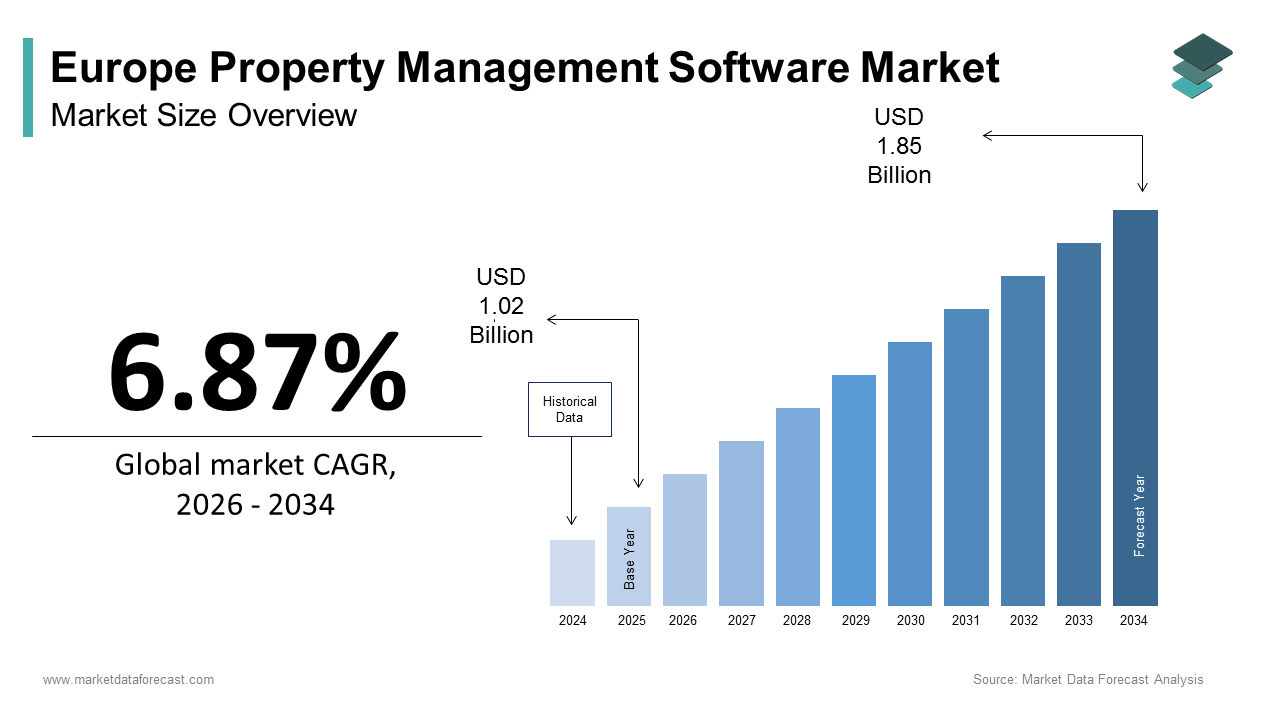
The Europe property management software market size was calculated to be USD 1.02 billion in 2025, reached USD 1.09 billion in 2026, and is anticipated to be worth USD 1.85 billion by 2034, growing at a compound annual growth rate (CAGR) of 6.87% during the forecast period from 2026 to 2034. Driven by the institutionalization of build-to-rent portfolios, EU energy performance mandates, and strict data compliance requirements, the market continues to expand across residential and commercial sectors.
Key Executive Metrics (At-a-Glance)
- 2025 Base Valuation: USD 1.02 Billion
- 2026 Current Valuation: USD 1.09 Billion
- 2034 Forecast Valuation: USD 1.85 Billion
- Compound Annual Growth Rate (CAGR): 6.87% (2026–2034)
- Dominant Regional Market: United Kingdom (holding a 23.3% market share in 2025 due to a highly professionalized private rental sector and early digitization)
- Key Growth Segments: Commercial applications, cloud deployment, housing associations, and the UK and German markets
Core Market Drivers & Growth Triggers
- Build-to-Rent Investment: Rapid institutionalization of Europe’s rental housing sector creating systematic demand for enterprise-grade platform automation.
- Energy & Compliance Mandates: European regulatory frameworks compelling property operators to digitize energy tracking, tenant data management, and audit trails.
Primary Market Restraints & Challenges
- Regulatory Fragmentation: Divergent housing laws, rent controls, and tenant rights across European member states complicating unified software deployment.
- Adoption & Sovereignty Barriers: Low digital literacy among independent landlords alongside strict EEA data hosting and GDPR sovereignty requirements.
Europe Property Management Software Market Segmentation Breakdown
| Segment Category | Largest Segment / Leader | Fastest-Growing Segment |
|---|---|---|
| By Application | Residential (Captured 60.6% share in 2025, driven by private rental scale and build-to-rent institutional portfolios) | Commercial (Estimated at a 10.4% CAGR due to EU Energy Performance of Buildings Directive carbon tracking needs) |
| By Deployment Type | Cloud-based (Commanded 74.4% share in 2025 via low upfront costs, subscription scalability, and remote access) | Cloud-based (Continues to outpace on-premise solutions due to lower total cost of ownership and auto-updates) |
| By End User | Property Managers & Agents (Occupied 48.6% share in 2025, maximizing operational efficiency per full-time employee) | Housing Associations (Predicted at a 12.5% CAGR driven by public funding conditions and mandatory digital performance reporting) |
| By Region | United Kingdom (Held 23.3% market share in 2025, anchored by high agency software adoption and build-to-rent scale) | Spain / France (Expanding rapidly through tourist rental formalization, digital lease mandates, and public social housing updates) |
Major Industry Players Profiled
Key corporations shaping the Europe property management software market include Yardi, AppFolio, MRI Software, Entrata, Oracle, and Buildium.
Europe Property Management Software Market Size
The Europe property management software market size was calculated to be USD 1.02 billion in 2025 and is anticipated to be worth USD 1.85 billion by 2034, growing from USD 1.09 billion in 2026 at a CAGR of 6.87% during the forecast period.
Property management software includes digital platforms designed to streamline the operational, administrative, and financial workflows of residential, commercial, and mixed-use real estate portfolios across the European Union and select non-EU countries. These solutions integrate functions such as lease tracking, rent collection, maintenance coordination, tenant communication, and compliance management within unified cloud-based environments. Unlike generic business software, property management systems are tailored to address region-specific regulatory frameworks, including rent control laws, energy performance certificate requirements, and GDPR compliant data handling. According to Eurostat, about 68% of people in the EU lived in owner-occupied homes in 2024, while around 32% lived in rented accommodation, which is a fragmented landscape that creates demand for scalable digital oversight. As per the European Commission’s Digital Economy and Society Index, 68% of small and medium enterprises in the EU now use cloud-based tools for core operations. Independent landlords have been slower to adopt purpose-built property software, which highlights an adoption gap that reflects both opportunity and complexity in a market shaped by housing policy, digital infrastructure, and evolving tenant expectations.
MARKET DRIVERS
Proliferation of Build to Rent and Institutional Residential Investment Drives Platform Adoption
The rapid institutionalization of Europe’s rental housing sector has created structural demand for enterprise-grade property management software, which is primarily driving the European property management software market growth. According to the European Public Real Estate Association, over 120000 new build-to-rent units were completed across the EU in 2023, with Germany, the UK, and the Netherlands accounting for 68% of volume. These professionally managed portfolios require integrated systems to handle high tenant turnover, utility billing, preventive maintenance, and regulatory reporting at scale. Unlike individual landlords, institutional operators such as Vonovia and Akelius manage tens of thousands of units, where manual processes are economically unviable. As per a 2024 study by Savills Europe, most new build-to-rent developments now include property management software as part of their operational budget from day one. According to the European Rental Housing Observatory, institutional landlords achieve higher occupancy rates through data-driven leasing and tenant retention strategies enabled by these platforms. This shift from fragmented amateur management to professionalized asset operation is transforming software from a convenience into a core infrastructure requirement.
EU Mandates for Energy Performance and Tenant Data Transparency Accelerate Compliance Integration
European regulatory frameworks increasingly compel property operators to digitize energy and tenant data management, which is creating embedded demand for compliant software and fuelling the European market growth. According to the revised Energy Performance of Buildings Directive, all rental properties must achieve a minimum energy rating of E by 2030 and D by 2033, with digital energy passports becoming mandatory for new leases. As per the European Environment Agency, over 35% of EU residential buildings currently fall below these thresholds, necessitating systematic tracking of retrofit progress and utility consumption. According to the General Data Protection Regulation, strict rules on tenant data handling apply, with fines reaching up to 4% of global turnover for violations. As per a 2024 survey by the European Landlords Federation, 61% of property managers cite compliance risk as their primary motivation for adopting software with automated audit trails and certificate expiry alerts. Platforms that embed templates for national energy declarations, rent cap calculations, and GDPR consent workflows reduce legal exposure while standardizing operations across jurisdictions, a critical advantage in a fragmented regulatory landscape.
MARKET RESTRAINTS
Fragmentation of Housing Regulations Across Member States Hinders Standardized Solutions
The absence of harmonized property laws across Europe complicates the development and deployment of unified software platforms, which is hampering the growth of the European property management software market. According to the European Commission’s Country Fiches on Housing Policy, rental regulations governing security deposits, rent increases, and eviction procedures vary significantly, even between neighbouring countries. For example, Germany enforces Mietpreisbremse rent caps in hundreds of municipalities, while Sweden applies nationwide rent negotiation boards, and France mandates energy diagnostics for every lease renewal. As per a 2024 analysis by the European Real Estate Software Alliance, vendors supporting five or more EU countries spend significantly more on compliance engineering than those focused on a single market. Consequently, many solutions remain regionally siloed or require extensive customization, which deters small landlords seeking affordable off-the-shelf tools. Until the EU advances greater policy convergence, software interoperability and scalability will remain constrained by legal fragmentation.
Low Digital Literacy Among Small and Independent Landlords Limits Mass Adoption
Despite clear operational benefits, a significant segment of Europe’s rental market remains resistant to digital transformation due to demographic and skill barriers. According to Eurostat, a majority of private rental units in Southern and Eastern Europe are owned by individuals aged 55 or older, with limited experience in cloud-based applications. As per the European Digital Skills Dashboard, only 42% of adults over 55 in countries like Italy, Romania, and Greece possess basic digital competencies, such as managing online accounts or uploading documents. This gap is exacerbated by language limitations, as most property software is available only in English, German, or French, excluding non-dominant language speakers. As per a 2024 study by the European Tenants Union, many small landlords in Greece and Portugal still use paper ledgers or spreadsheets, citing complexity, cost, and fear of data breaches as primary concerns. Without simplified interfaces, multilingual support, and offline onboarding assistance, this large but fragmented user base will continue to operate outside digital ecosystems, limiting market penetration beyond institutional segments.
MARKET OPPORTUNITIES
Integration with Proptech Ecosystems Enables End-to-End Tenant Lifecycle Management
The convergence of property management software with adjacent proptech services is unlocking new value through seamless tenant journey orchestration. According to the European PropTech Association, over 450 proptech startups in Europe now offer specialized services in tenant screening, utility switching, insurance, and smart home integration. Leading property platforms are responding by opening application programming interfaces that connect with verified third-party providers, creating unified workflows. For example, a landlord using compliant software can automatically initiate an energy switch referral upon lease signing or trigger a home insurance quote based on property type. As per a 2024 pilot by HousingAnywhere in the Netherlands, integrated onboarding reduced tenant setup time by 62%, while increasing ancillary revenue per lease by 28 euros. Furthermore, according to the European Commission’s Digital Markets Act, interoperability is promoted, which may soon mandate data portability between platforms, enhancing competition and innovation. This ecosystem approach transforms property software from a back-office tool into a revenue-generating tenant engagement hub.
Expansion of Social and Affordable Housing Digitization Programs Creates Public Sector Demand
European governments are actively digitizing public and social housing operations to improve transparency, efficiency, and tenant service delivery, which is another promising opportunity in the European property management software market. According to the European Investment Bank, over 4.2 billion euros were allocated in 2023 to modernize social housing infrastructure across Poland, Portugal, and Greece, with digital management systems as a core component. In France, the ANAH agency now requires all subsidized rehabilitation projects to implement software that tracks occupancy, eligibility, maintenance requests, and energy performance. Similarly, Germany’s KfW funding guidelines for social landlords mandate digital rent accounting and barrier-free tenant portals. As per a 2024 evaluation by the OECD, municipalities using integrated property platforms reduced maintenance response times by 34% and rental arrears by 22%. These public investments not only create direct procurement opportunities but also establish benchmarks that influence private sector expectations. According to Eurostat, social housing accounts for over 15% of total EU dwellings, and this digitization wave represents a stable and growing demand vector insulated from commercial real estate cycles.
MARKET CHALLENGES
Data Sovereignty and Cross-Border Hosting Constraints Increase Operational Complexity
European data protection laws impose strict requirements on where and how tenant and property data can be stored, processed, and transferred, which is creating technical and legal hurdles for the European property management software market. According to the European Data Protection Board, any personal data related to EU residents must be hosted on servers located within the European Economic Area, unless adequate safeguards are in place. This limits the use of global cloud infrastructure from non-compliant providers, and increases costs for vendors relying on U.S.-based platforms. As per a 2024 survey by the European Cloud Partnership, 58% of property software companies incurred additional expenses to migrate databases to EU-based data centers, such as those operated by OVHcloud or Deutsche Telekom. Moreover, according to the Schrems II ruling, standard contractual clauses for many transatlantic data flows were invalidated, forcing vendors to implement supplementary measures such as encryption and pseudonymization. These compliance burdens disproportionately affect small and mid-sized software firms with limited legal resources, delaying feature development and market entry, particularly in cross-border portfolios.
Resistance to Recurring Subscription Models in Price-Sensitive Markets Suppresses Revenue Growth
Despite the shift toward software as a service, many European property owners remain averse to ongoing subscription fees, preferring one-time purchases or ad hoc payments, which further challenges the European property management software market expansion. According to the European Landlords Federation, over 65% of independent landlords in Southern and Eastern Europe operate on thin margins, with average net rental yields below 3%, making monthly software costs hard to justify. As per a 2024 pricing analysis by the European Real Estate Software Alliance, while 80% of German and Dutch landlords accept subscriptions under 15 euros per month, only 28% of Spanish and Romanian counterparts do so. This forces vendors to offer fragmented pricing tiers or hybrid models that reduce profitability and complicate support. Additionally, the perception that property management is a “set and forget” task discourages continuous engagement. Without compelling proof of return on investment, such as documented rent collection improvements or reduced vacancy periods, many small operators revert to free tools or manual methods. This behavioral inertia constrains revenue predictability and slows innovation investment in regions with the greatest digitization potential.
REPORT COVERAGE
| REPORT METRIC | DETAILS |
| Market Size Available | 2025 to 2034 |
| Base Year | 2025 |
| Forecast Period | 2026 to 2034 |
| CAGR | 6.87% |
| Segments Covered | By Application, Deployment Type, End User, And Region |
| Various Analyses Covered | Global, Regional & Country Level Analysis; Segment-Level Analysis; DROC, PESTLE Analysis; Porter’s Five Forces Analysis; Competitive Landscape; Analyst Overview of Investment Opportunities |
| Regions Covered | UK, France, Spain, Germany, Italy, Russia, Sweden, Denmark, Switzerland, Netherlands, Turkey, and the Czech Republic |
| Market Leaders Profiled | Yardi, AppFolio, MRI Software, Entrata, Oracle |
SEGMENTAL ANALYSIS
By Application Insights
The residential segment accounted for 60.6% of the European market share in 2025. The dominance of the residential segment in the European property management software market is rooted in the scale of Europe’s private rental sector and regulatory pressures on individual and institutional landlords. The rapid growth of professionally managed residential portfolios has created systematic demand for scalable software solutions. According to the European Public Real Estate Association, over 135000 build-to-rent units were delivered across the EU in 2024, with Germany, the UK, and the Netherlands accounting for 72% of completions. These institutional landlords manage thousands of units, requiring automation for lease administration, rent collection, maintenance dispatch, and tenant communication. As per a 2024 Savills Europe report, 94% of new build-to-rent operators implement cloud-based property management platforms before tenant occupancy, to ensure operational efficiency and compliance. Unlike fragmented private landlords, these entities treat software as essential infrastructure, not optional overhead, driving consistent and high-value adoption across the residential segment.
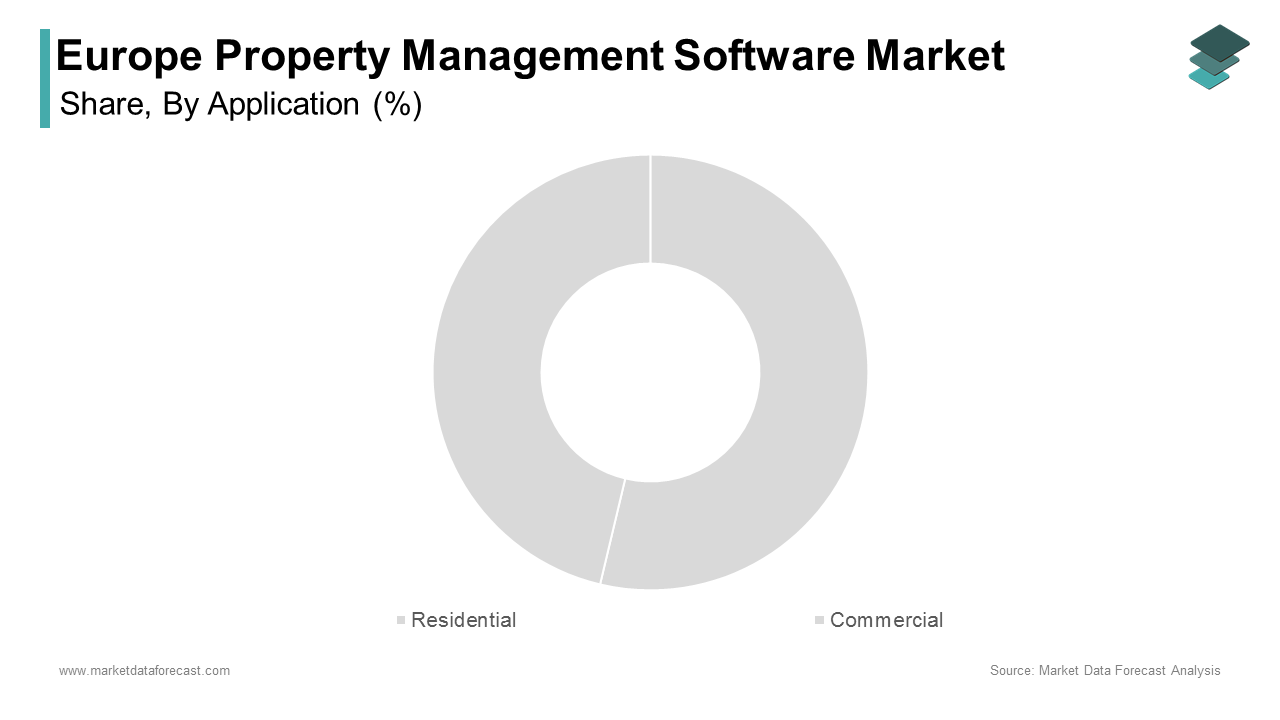
The commercial segment is the fastest-growing and is estimated to grow at a CAGR of 10.4% over the forecast period. The EU’s Energy Performance of Buildings Directive now requires all commercial properties to achieve a minimum energy rating of C by 2030, and B by 2033. According to the European Environment Agency, over 60% of office and retail buildings currently fall below this threshold, necessitating real-time tracking of consumption, retrofit progress, and certificate validity. As per a 2024 study by the Urban Land Institute Europe, 78% of commercial real estate firms in Germany and the Netherlands now require software platforms that auto-calculate carbon intensity per square meter and benchmark against EU Taxonomy criteria. This regulatory imperative is driving rapid digitization in a historically slower-adoption segment.
By Deployment Type Insights
The cloud segment commanded the highest share of 74.4% of the regional market in 2025. The growth of the cloud segment in the European market can be attributed to the cost, accessibility, and compliance advantages. Cloud solutions eliminate upfront hardware investment and reduce IT staffing needs, making them accessible to housing associations and independent landlords. According to Eurostat, over 67% of property management firms in the EU employ fewer than 10 people and operate on annual software budgets under 5000 euros. Cloud platforms offer subscription models as low as 10 euros per unit per month, with automatic updates and backups. As per a 2024 European Landlords Federation survey, cloud adopters reduced total cost of ownership by 41% over three years compared to on-premises alternatives. The ability to scale up or down based on portfolio size is particularly valuable in volatile markets like Spain and Italy, where landlord churn remains high due to regulatory uncertainty.
By End User Insights
The property managers and agents segment occupied for 48.6% of the regional market share in 2025. Their centrality in the rental ecosystem drives consistent software demand. Property managers operate on tight margins, where time savings directly impact profitability. According to the European Real Estate Federation, the average agency manages 180 residential units per full-time employee, with fee structures typically 8 to 10% of monthly rent. As per a 2024 benchmark study by the UK Property Ombudsman, agencies using integrated platforms handled 35% more properties per agent, while maintaining service quality. This productivity gain is essential in competitive markets like Spain and Portugal, where agency fees have declined by 12% since 2020 due to online listing platforms.
The housing associations segment is the fastest-growing and is predicted to register a CAGR of 12.5% over the forecast period. Public funding for social housing is increasingly conditional on digital management capabilities. According to the European Investment Bank, 3.8 billion euros in 2023 social housing loans required the implementation of software that tracks occupancy, eligibility, maintenance KPIs, and energy performance. In the Netherlands, the Woningwet law mandates housing associations to publish annual digital service reports, including response times and tenant satisfaction. As per a 2024 evaluation by the Dutch Housing Authority, associations using certified platforms scored 28% higher on public performance rankings, which directly affects subsidy eligibility. This policy linkage transforms software into a strategic asset for institutional survival.
REGIONAL ANALYSIS
United Kingdom Property Management Software Market Analysis
The United Kingdom led the property management software market in Europe in 2025 by holding 23.3% of the regional market share. The dominance of the UK in the European market is driven by its highly professionalized private rental sector and early regulatory digitization. As per the UK Ministry of Housing, over 4.7 million private rental properties are managed by licensed agents, who must comply with the Tenant Fees Act and Right to Rent checks. According to the Property Ombudsman’s 2024 Technology Survey, 91% of agencies use cloud platforms, making software adoption nearly universal. Additionally, the UK’s build-to-rent sector accounts for over 250000 operational units, with operators like Greystar and Quintain mandating integrated software for resident services and utility billing. As per the UK Digital Identity Trust Framework, seamless tenant verification is now enabled through certified apps. This mature ecosystem of regulation, innovation, and scale ensures continued leadership.
Germany Property Management Software Market Analysis
Germany commanded the second-largest share of the European property management software market in 2025 due to the strict rent control laws and a vast institutional landlord base. According to the German Federal Statistical Office, over 55% of households rent their homes, with 12 million units managed by professional entities like Vonovia and Deutsche Wohnen. As per the Mietpreisbremse law, rent increases are capped in 314 cities, requiring meticulous historical tracking, a task only feasible through software. According to a 2024 study by the German Tenants Association, 88% of landlords in Berlin and Munich use digital platforms to calculate permissible rents and generate compliant lease addenda. As per Germany’s new Building Energy Act, digital energy passports will be mandatory for all rentals by 2025, accelerating integration of ESG modules. The combination of regulatory density, institutional scale, and energy transition creates a high-intensity software environment unmatched in continental Europe.
France Property Management Software Market Analysis
France is predicted to grow at a promising CAGR in the European property management software market over the forecast period, owing to the centralized digital mandates and social housing modernization. As per the French Ministry of Housing, the Alur and Elan laws require digital lease registration, energy diagnostics, and rent transparency for every transaction. According to the government’s DossierFacile platform, 2.1 million landlords used the system in 2024, integrating with commercial software to validate tenant applications. As per Action Logement, 1.2 billion euros were allocated in 2023 to upgrade management systems for France’s 4.8 million social housing units. According to a 2024 report by the French Housing Federation, 76% of social landlords now use certified platforms to track occupancy, eligibility, and prevent fraud. This dual pressure from private compliance and public investment ensures robust and diversified demand across the rental spectrum.
Netherlands Property Management Software Market Analysis
The Netherlands is anticipated to account for a notable share of the Europe property management software market during the forecast period. The Netherlands serves as a testbed for integrated digital ecosystems. According to the Dutch Ministry of the Interior, over 75% of rental properties are managed by professional entities, in a market where housing associations control 32% of stock. As per the country’s Digital Government Act, all public services must offer API based integrations, enabling property software to connect with municipal registration BRP data, tax systems, and utility providers. A 2024 pilot in Amsterdam allowed landlords to auto-verify tenant income and deposit registration through a single digital gateway. According to the Dutch Competition Authority, strict data portability rules allow tenants to switch landlords without losing rental history, a feature only cloud platforms support. This regulatory foresight creates a seamless and competitive digital rental market, driving advanced software adoption.
Spain Property Management Software Market Analysis
Spain is predicted to register a healthy CAGR in the European property management software market over the forecast period. Spain is experiencing the fastest per capita growth due to regulatory catch-up and tourism rental formalization. According to Spain’s Ministry of Transport, over 220000 tourist apartments must now register with regional databases and submit monthly occupancy reports under the 2023 Real Decreto Ley 25 2023. As per a 2024 study by the Spanish Property Registry, 68% of new property management software signups in 2024 came from vacation rental hosts in Barcelona, Madrid, and the Balearics. According to the government’s Plan Estatal de Vivienda, subsidies are offered to landlords who digitize rent collection and maintenance for long-term rentals. With over 23 million rental contracts in force, this dual formalization wave is transforming Spain from a laggard into a high-growth digital rental market.
COMPETITION OVERVIEW
Competition in the Europe property management software market is characterized by a dual dynamic of regulatory specialization and user experience differentiation. Large global vendors compete on compliance depth, scalability, and integration with institutional workflows, while local and mid-tier players focus on affordability, language support, and simplicity for small landlords. The market is highly fragmented due to divergent national housing laws, which prevent any single platform from achieving universal dominance. However, this fragmentation also raises barriers to entry as new entrants must navigate complex legal requirements across multiple jurisdictions. Competition is intensifying around ESG functionality with vendors racing to embed energy tracking, carbon calculation, and retrofit planning tools to meet EU mandates. At the same time, user retention hinges on mobile engagement, tenant portals, and automated workflows that reduce manual effort. Unlike commodity software, success here depends on contextual intelligence, legal foresight, and ecosystem connectivity, making the competitive landscape both technically demanding and regionally nuanced.
KEY MARKET PLAYERS
A few major players of the Europe property management software market include
- Yardi
- AppFolio
- MRI Software
- Entrata
- Oracle
Top Strategies Used by the Key Market Participants
Key players in the Europe property management software market prioritize deep regulatory localization by embedding country-specific rent control, energy compliance, and data protection rules directly into their platforms. They invest in EU-based cloud infrastructure to ensure GDPR and NIS2 compliance while enabling integration with national digital identity and payment systems. Companies expand mobile capabilities to support field operations and tenant self-service in response to labor shortages and rising service expectations. Strategic partnerships with utility providers, insurance firms, and smart home vendors create bundled service ecosystems that increase customer stickiness. Additionally, they offer tiered pricing and simplified onboarding to attract small landlords while maintaining enterprise-grade features for institutional clients, thereby capturing both ends of the market spectrum.
Leading Players in the Market
- MRI Software is a globally recognized provider of real estate technology with a strong footprint in the Europe property management software market. The company serves institutional landlords, housing associations, and commercial real estate firms with integrated platforms for residential and mixed-use portfolios. MRI has strengthened its European position through strategic localization, including GDPR compliant data hosting, energy performance certificate modules for EU markets, and multilingual tenant portals. Recent actions include the expansion of its London-based innovation lab focused on AI-driven rent optimization and predictive maintenance. The company also deepened integrations with national payment systems such as SEPA and iDEAL, enabling seamless rent collection across the Eurozone and reinforcing its role as a comprehensive operational backbone for professional property operators.
- Yardi Systems delivers end-to-end property management and investment management solutions with significant adoption across Europe’s institutional real estate sector. The company supports large build-to-rent operators, housing associations, and commercial landlords with platforms that comply with regional regulations, including German rent caps, French energy diagnostics, and UK Right to Rent checks. Yardi has reinforced its market presence by establishing EU-based data centers in Frankfurt and Amsterdam to ensure full GDPR and NIS2 compliance. It also launched Yardi Energy IQ in 2024, a module that auto-calculates carbon intensity per asset aligned with EU Taxonomy requirements. These investments in regulatory alignment and sustainability analytics position Yardi as a strategic partner for institutional clients navigating Europe’s complex compliance landscape.
- Buildium is a prominent cloud-based property management software provider catering primarily to small and mid-sized landlords and property managers across Europe. The company differentiates itself through intuitive user interfaces, multilingual support, and affordable subscription models tailored for independent operators. Buildium has strengthened its European presence by launching localized versions in German,y France, and Spain, featuring country-specific lease templates, rent control logic, and tax reporting. In 2024, the company introduced a mobile-first tenant app with digital lease signing and maintenance request tracking to address labor shortages and improve tenant satisfaction. Its focus on user experience and regulatory relevance enables it to capture the fragmented but sizable segment of non-institutional landlords who are increasingly mandated to digitize operations under national housing laws.
MARKET SEGMENTATION
This research report on the Europe property management software market has been segmented and sub-segmented based on application, deployment type, end user, and region.
By Application
- Residential
- Commercial
- Industrial Property Management
By Deployment Type
- Cloud-based
- On-premise
By End User
- Property Managers
- Housing Associations
- Real Estate Companies
- Individual Landlords
By Region
- UK
- Germany
- France
- Italy
- Spain
- Rest of Europe