- Product Description Description
- Table of Contents TOC
- List of Table & Figure LOT
- Get Free Sample PDF Sample PDF
Market Size, 2025
$12.82 BnMarket Estimate, 2026
$15.22 BnMarket Forecast, 2034
$60.18 BnCAGR, 2026–2034
18.75%Europe Proptech Market Report Summary
The Europe proptech market was valued at USD 12.82 billion in 2025, is estimated to reach USD 15.22 billion in 2026, and is projected to reach USD 60.18 billion by 2034, growing at a CAGR of 18.75% during the forecast period from 2026 to 2034. The growth of the Europe proptech market is driven by the European Union’s Green Deal and Renovation Wave initiatives, increasing demand for energy-efficient and digitally enabled buildings, and the rapid adoption of AI, IoT, and data analytics across the real estate value chain. Rising requirements for energy performance monitoring, tenant experience optimization, and regulatory compliance are accelerating the deployment of proptech solutions across residential, commercial, and industrial properties. Moreover, the emergence of real estate tokenization, digital twins, and smart building platforms is transforming property investment, management, and transactions across Europe.
Key Market Trends
- Strong adoption of digital energy management and monitoring platforms driven by EU decarbonization and renovation mandates.
- Rising integration of IoT sensors, AI-driven analytics, and smart building systems across residential and commercial properties.
- Growing use of tenant experience platforms and space utilization tools due to hybrid and flexible work models.
- Increasing interest in blockchain-enabled real estate tokenization and fractional property ownership.
- Expansion of proptech adoption in social and affordable housing through publicly funded modernization programs.
Segmental Insights
- Based on property type, the residential segment was the largest and held a significant share of the Europe proptech market in 2024. The segment’s dominance is attributed to Europe’s aging housing stock, mandatory energy renovation requirements, and rising adoption of smart home and energy monitoring solutions across private and social housing.
- Based on the solution, the software segment led the Europe proptech market in 2024, supported by the scalability of cloud-based platforms used for property management, energy compliance reporting, ESG tracking, and tenant engagement. The services segment is projected to grow at the fastest rate during the forecast period due to increasing demand for system integration, data migration, and managed analytics services for legacy real estate portfolios.
- Based on end user, property owners and developers accounted for the largest share of the market in 2024, driven by their responsibility for regulatory compliance, asset performance optimization, and tenant satisfaction across large portfolios.
Regional Insights
The Europe proptech market is witnessing strong growth across major economies, supported by regulatory mandates, digital infrastructure, and sustainability goals.
- Germany was the largest contributor, accounting for 21.2% of the Europe proptech market share in 2024, driven by stringent building energy regulations and widespread adoption of digital monitoring systems.
- The United Kingdom continues to perform strongly, supported by hybrid work adoption, tenant experience platforms, and government-backed digital construction initiatives.
- France is emerging as a key growth market due to centralized digital housing policies, large-scale public housing modernization, and strict commercial energy reduction mandates.
- The Netherlands and Sweden are also gaining traction, supported by smart building standards, logistics sector digitization, and advanced tenant engagement models.
Competitive Landscape
The Europe proptech market is characterized by the presence of established digital real estate platforms and innovative regional startups focusing on energy optimization, tenant experience, and compliance-driven solutions. Leading players are emphasizing regulatory alignment, retrofit compatibility, data privacy, and ESG integration while expanding their cloud-based and AI-enabled offerings. Strategic partnerships with public housing authorities, facility managers, and energy providers are strengthening market penetration. Prominent players in the Europe proptech market include Rightmove plc, Zoopla, Idealista, Seloger Group, JLL Technologies, Savills plc, IMMOFINANZ AG, Casavo, Habyt, and Goodlord
Europe Proptech Market Size
The europe proptech market size was valued at USD 10.79 billion in 2024 and is anticipated to reach USD 12.82 billion in 2025 from USD 50.70 billion by 2033, growing at a CAGR of 18.75% during the forecast period from 2025 to 2033.
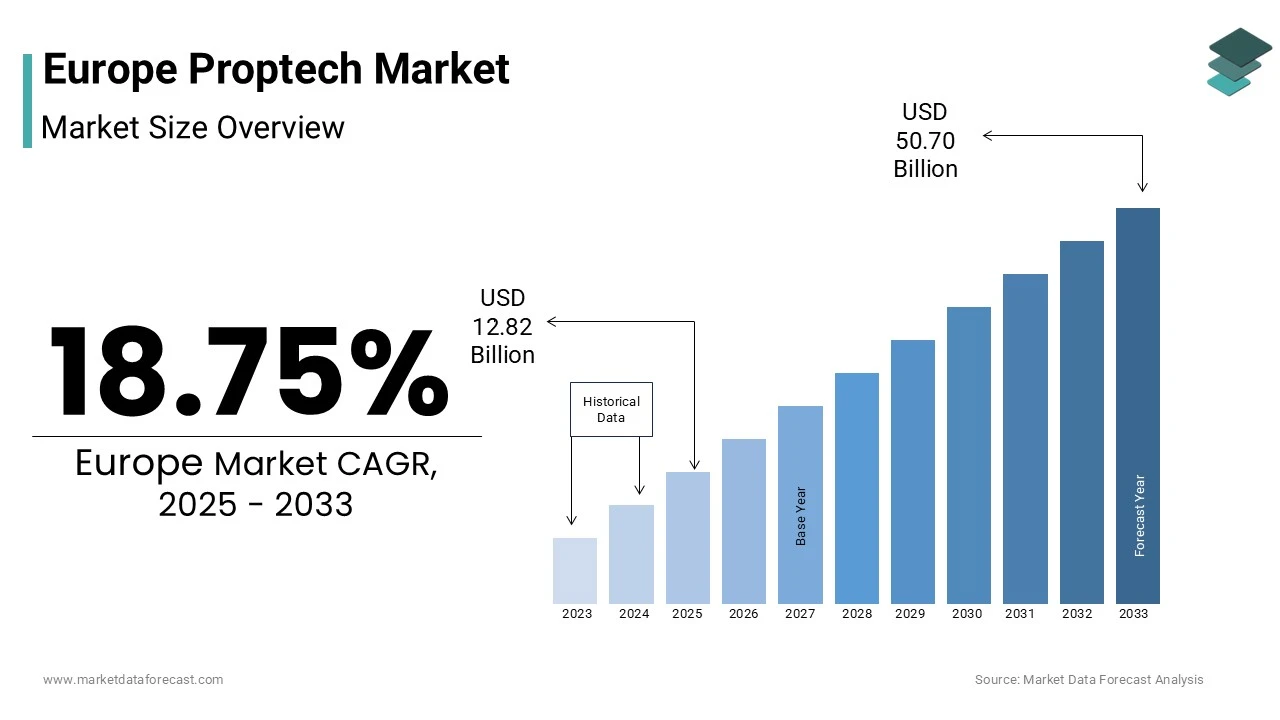
Proptech is the integration of digital technologies ranging from artificial intelligence and blockchain to Internet of Things sensors and data analytics into the real estate value chain to enhance the efficiency sustainability and user experience of property development investment management and transactions. According to the European Commission, over 35 million buildings in the EU require deep energy renovation by 2030 to meet Fit for 55 emissions goals with digital tools essential for audit prioritization and performance monitoring. As per Eurostat, 70% of Europe’s building stock was constructed before 1980 lacking modern energy and data infrastructure creating immense retrofit potential for smart building solutions. In this context, proptech transcends operational optimization to become a strategic enabler of decarbonization digital sovereignty and adaptive real estate across the European Union.
MARKET DRIVERS
EU Green Deal and Building Renovation Wave Drive Smart Retrofit Demand
The European Union’s legally binding climate agenda, the Renovation Wave Strategy and Energy Performance of Buildings Directive for proptech adoption by mandating digital monitoring and energy optimization, across the built environment. The EU green deal and building renovation wave drive smart retrofit demand is propelling the growth of Europe proptech market. The Renovation Wave targets a doubling of annual energy renovation rates to 3% by 2030, covering 35 million buildings, each requiring digital energy audits smart metering and automated control systems to verify savings. According to the European Environment Agency, over 75% of EU buildings are energy inefficient with heating alone accounting for 64% of residential final energy use making digital retrofits non optional. In Germany, the Building Energy Act now requires all non-residential buildings over 1000 square meters to install smart energy management systems by 2025. Similarly, France’s Tertiary Decree mandates a 60% reduction in energy consumption for large commercial properties by 2030 relative to 2010 levels enforced through continuous digital monitoring. Proptech platforms like BuildingIQ and Metrikus provide AI driven optimization that reduces HVAC energy use by 25 to 40% as confirmed by pilot data from EU-funded projects. This regulatory imperative transforms proptech from a value add to a compliance necessity fueling sustained demand for building operating systems across Europe’s vast retrofit pipeline.
Rise of Hybrid Work and Tenant Experience Expectations Reshape Commercial Real Estate
The structural shift toward flexible and hybrid work models has fundamentally altered occupant expectations in commercial real estate, driving demand for proptech solutions that enhance space utilization tenant engagement and operational agility. The rise of hybrid work and tenant experience expectations is eventually propelling the growth of Europe proptech market. According to Eurostat, over 38% of EU office workers now work remotely at least two days per week with a trend that has reduced average desk occupancy to 45% in major cities, as reported by JLL Europe. This underutilization forces landlords to adopt smart occupancy sensors desk booking apps and dynamic space management platforms to maximize asset efficiency. In London, 68% of Grade A office buildings implemented tenant experience apps in 2023 offering integrated services like meeting room booking access control and maintenance requests as per the British Council for Offices. Similarly, in Amsterdam the city’s “Circular Buildings Program” requires all new commercial developments to include data platforms that track space usage and user satisfaction in real time. Tenants now evaluate buildings not just on location but on digital amenities.
MARKET RESTRAINTS
Fragmented National Real Estate Regulations Hinder Scalable Solutions
The absence of harmonized property laws digital standards and data sharing frameworks creates significant barriers to pan European proptech deployment, which is declining the growth of Europe proptech market. While the EU provides high level directives on energy efficiency and data protection national implementation varies widely in France notarial deeds must be processed through state appointed notaries, whereas Germany allows private digital conveyancing platforms. In Spain, digital cadastral data is publicly available while in Italy it remains fragmented across regional offices. This fragmentation forces proptech companies to develop country specific workflows increasing development costs by 30 to 50%, as confirmed by PropTech Europe’s 2023 industry survey. Furthermore, data sovereignty laws under GDPR restrict cross border transfer of tenant or building performance data even within the same company, which is requiring localized cloud infrastructure.
Legacy Property Management Systems Resist Digital Integration
Many European real estate portfolios in public housing and institutional ownership operate on decades old property management software that lacks modern APIs open data standards or cloud connectivity, which is creating formidable integration challenges for proptech solutions. The legacy property management systems resist digital integration is also prompting the growth of Europe proptech market. According to the European Real Estate Society, over 65% of social housing providers in Italy Spain and Poland still rely on custom built on premises systems developed before 2005 with minimal interoperability capabilities. In Germany, the Federal Office for Building and Regional Planning reports that only 28% of public building operators can integrate IoT sensor data into centralized dashboards due to incompatible legacy infrastructure. This technical debt forces proptech vendors to build costly middleware or manual data bridges extending implementation timelines by 6 to 12 months and increasing failure risk. A 2023 pilot by the City of Helsinki revealed that migrating energy data from its 1990s facility management system required 14 months of manual reformatting before AI optimization could begin.
MAKRET OPPORTUNITIES
Integration of Proptech in EU Affordable Housing Modernization Programs
The European Union’s commitment to social equity and housing affordability is unlocking a major opportunity for proptech through dedicated funding streams that mandate digital monitoring and tenant engagement tools in public housing retrofits. The integration of proptech in EU affordable housing modernization programs is creating new opportunities for the growth of Europe proptech market. The Affordable Housing Initiative is part of the New European Bauhaus allocates 5 billion euros to modernize 200000 social housing units across 100 lighthouse projects by 2025 with digital twin and energy management systems as required components. According to the study, over 45000 social dwellings in Greece and Portugal received smart thermostats occupancy sensors and tenant apps in 2023, under this program reducing heating costs by 35% on average. In the Netherlands, the Social Housing Decarbonization Fund mandates that all retrofitted units include digital platforms enabling residents to monitor consumption report issues and access community services, improving both efficiency and quality of life. Proptech companies like Muvon and Buteeo have developed low-cost modular kits specifically for social housing that comply with EU data protection and accessibility standards.
Expansion of Real Estate Tokenization Under EU Digital Finance Framework
The European Commission’s Markets in Crypto Assets Regulation and Digital Finance Strategy are creating a regulated pathway for real estate tokenization by enabling fractional ownership liquidity and new investment models through blockchain technology. The expansion of real estate tokenization under EU digital finance framework is additionally to fuel the growth of Europe proptech market. As per the European Securities and Markets Authority, the MiCA framework provides legal clarity for security token offerings linked to physical assets including commercial and residential properties. In 2023, Luxembourg’s financial regulator approved the first EU compliant real estate tokenization platform allowing investors to purchase shares in Berlin office buildings with as little as 100 euros. Similarly, Sweden’s Lansforsakringar launched a blockchain based platform for fractional vacation home ownership compliant with Swedish property law and EU investor protection rules. The tokenized real estate could unlock 150 billion euros in illiquid assets by 2030 by enabling micro investments and automated compliance. Proptech firms like Brickblock and Exporo are building end to end platforms that integrate property valuation smart contracts and regulatory reporting bridging traditional real estate with decentralized finance.
MARKET CHALLENGES
Persistent Shortage of Proptech Skilled Professionals Constrains Implementation
The deficit of professionals who combine real estate domain knowledge with digital technology expertise in proptech deployment and optimization, across public and private sectors, which is one of the challenges for the growth of Europe proptech market. The European Real Estate Society notes that fewer than 15% of university real estate programs in 2023 included modules on data analytics IoT integration or building operating systems. This gap leads to extended project timelines, industry data from Germany shows that 58% of proptech implementations in commercial real estate exceed initial schedules by six months or more due to lack of in-house skills for configuration and change management. In public housing agencies, where budgets are tight the problem is acute Spain’s Ministry of Transport reported that 70% of regional housing authorities rely on external consultants for basic smart meter data interpretation.
Data Privacy and Cybersecurity Risks Undermine Tenant and Investor Trust
The proliferation of sensors cameras and user tracking systems in smart buildings raises significant concerns about data privacy and cyber vulnerability, which is threatening both regulatory compliance and social acceptance of proptech solutions. Under the General Data Protection Regulation, the collection of occupancy patterns movement data or utility usage from tenants requires explicit consent and purpose limitation rules often overlooked in rushed deployments. According to the European Data Protection Supervisor, over 40 proptech related complaints were filed in 2023 concerning opaque data practices in tenant apps and energy monitoring platforms. Simultaneously, cybersecurity threats are escalating Europol documented a 52% increase in ransomware attacks on building management systems in 2023 with hackers targeting HVAC and access control networks to extort property managers. The Dutch National Cyber Security Centre issued alerts after several Dutch office buildings suffered operational shutdowns due to compromised IoT devices. These incidents erode trust, 62% of EU tenants now express reluctance to share usage data, as per the European Consumer Organisation hindering the data density needed for AI optimization.
REPORT COVERAGE
| REPORT METRIC | DETAILS |
| Market Size Available | 2024 to 2033 |
| Base Year | 2024 |
| Forecast Period | 2025 to 2033 |
| CAGR | 18.75% |
| Segments Covered | By Property Type, Solution, Deployment, End-use, Technology and Region. |
| Various Analyses Covered | Global, Regional & Country Level Analysis, Segment-Level Analysis, DROC, PESTLE Analysis, Porter’s Five Forces Analysis, Competitive Landscape, Analyst Overview of Investment Opportunities |
| Regions Covered | United Kingdom, France, Spain, Germany, Italy, Russia, Sweden, Denmark, Switzerland, the Netherlands, Turkey, and the Czech Republic |
| Market Leaders Profiled | Rightmove plc, Zoopla, Idealista, Seloger Group, JLL Technologies, Savills plc, IMMOFINANZ AG, Casavo, Habyt, and Goodlord. |
SEGMENTAL ANALYSIS
By Property Type Insights
The residential segment was accounted in holding 38.2% of the Europe proptech market share in 2024 from Europe’s vast housing stock, urgent renovation mandates, and growing tenant demand for smart home functionality within both private and social housing sectors. The EU Renovation Wave Strategy, which targets deep energy retrofits for 35 million buildings by 2030 with residential units representing over 70% of this total. According to the European Commission, 85% of Europe’s 240 million residential buildings were constructed before 2000 with minimal energy efficiency, necessitating digital interventions like smart thermostats occupancy sensors and AI driven energy dashboards. In Germany, the Building Energy Act mandates that all residential buildings undergoing major renovation install digital energy monitoring systems by 2025. Similarly, France’s MaPrimeRenov scheme subsidized smart home kits in over 800000 dwellings between 2021 and 2023 to optimize heating based on occupancy and weather forecasts. These regulatory pushes transform proptech from optional convenience to compliance requirement across millions of homes. The rise of proptech in social and affordable housing as a tool for equity and resource management is also fuelling the growth of segment. In the Netherlands, housing associations like Ymere use digital platforms to enable tenants to report maintenance issues track energy use and access community services, all compliant with GDPR and accessibility standards.
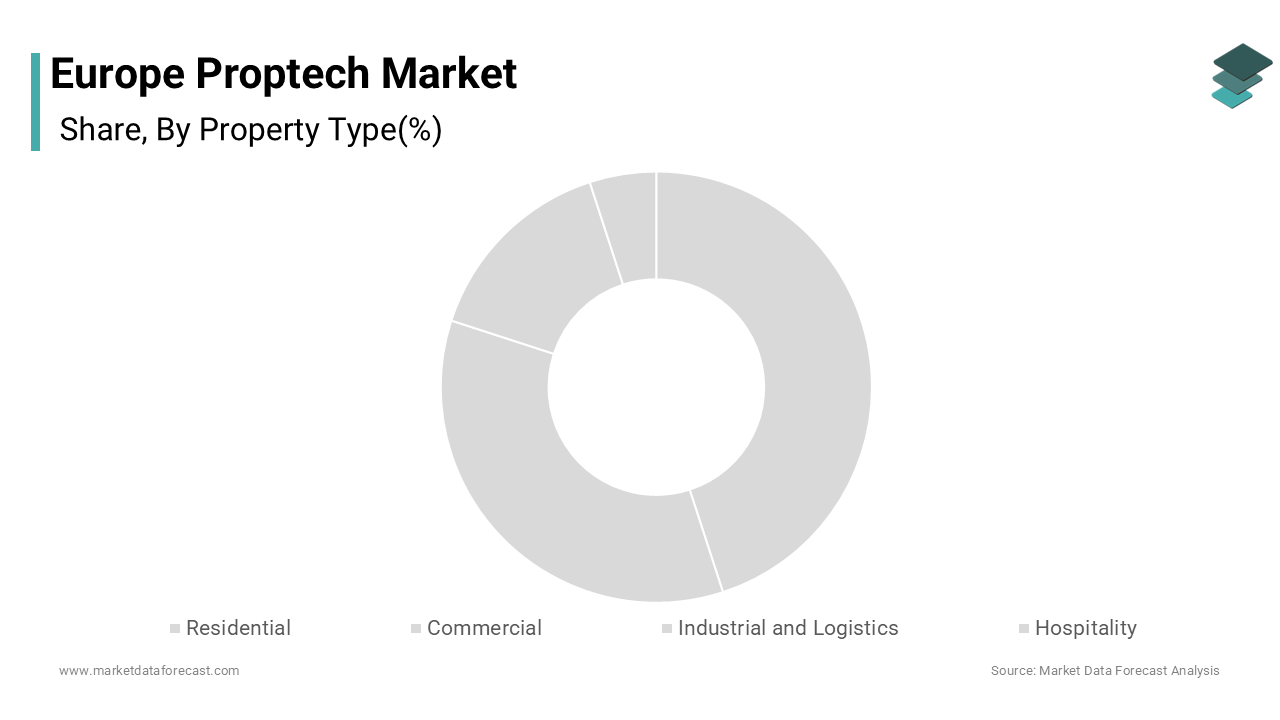
The industrial and logistics property segment is projected to expand at a CAGR of 15.7% from 2025 to 2033 with the structural shift in logistics driven by online retail, requiring high velocity fulfillment centers with real time inventory visibility and predictive maintenance. Proptech platforms, now integrate IoT sensors with warehouse management systems to monitor temperature humidity and structural stress in cold chain and high value storage facilities. The EU’s Corporate Sustainability Reporting Directive, which requires large logistics operators to disclose Scope 1 and 2 emissions from owned facilities. Companies like DHL and DB Schenker, now deploy AI powered building operating systems across their European warehouse portfolios to track and reduce energy intensity in real time. In Sweden, the Environmental Protection Agency mandates that all new industrial buildings over 5000 square meters achieve at least BREEAM Very Good certification driving adoption of smart metering and renewable energy integration.
By Solution Insights
The software segment was accounted in holding a dominant share of the Europe proptech market share in 2024 owing to the scalability regulatory alignment and automation capabilities of cloud-based platforms that manage everything from property listings to building operations. The regulatory push for digital energy and occupancy monitoring under the Energy Performance of Buildings Directive. Software platforms enable landlords to comply with mandatory reporting by aggregating data from smart meters sensors and utility bills into auditable dashboards. According to the German Property Federation, over 78% of commercial property owners in Germany, now use software like Metrikus or Cogito to automate energy performance certificates and track renovation progress. Similarly, in France the Tertiary Decree requires large buildings to submit annual energy data driving widespread adoption of compliance software that auto calculates reductions against 2010 baselines. These platforms reduce manual reporting costs by up to 60% as confirmed by pilot data from EU-funded projects. The integration of software into end to end real estate workflows from transaction to asset management is likely to fuel the growth of the segment. Cloud based property management systems like Yardi and MRI Software, now offer modules for lease administration tenant experience predictive maintenance and ESG reporting in a single interface. The shift to subscription based SaaS models also lowers entry barriers for SMEs by allowing even small landlords to access enterprise grade tools.
The services segment is likely to witness a fastest CAGR of 13.2% from 2025 to 2033 owing to the technical challenge of retrofitting legacy portfolios with modern digital systems. This forces them to rely on external proptech service providers for data migration system configuration and change management. Service firms bridge the gap between technology and real estate operations by translating regulatory requirements into functional workflows. The demand for actionable insights from building data is also elevating the growth of Europe proptech market. Companies like BuildingIQ and Metrikus, now offer managed analytics services where AI models are continuously tuned by human engineers to reduce HVAC energy use by 25 to 40%. In Sweden, the Environmental Protection Agency confirms that buildings using managed optimization services achieve energy savings 1.8 times higher than those using software alone.
By End User Insights
The property owners and developers segment was accounted in holding 46.3% of the Europe proptech market share in 2024 with their direct accountability for regulatory compliance asset performance and tenant satisfaction across large portfolios. Property owners of commercial and residential buildings are legally required to monitor energy use reduce consumption and disclose performance tasks impossible to fulfill at scale without proptech. Similarly, in France, the Tertiary Decree mandates that owners of large non-residential buildings reduce energy use by 60% by 2030 by driving adoption of AI powered optimization platforms. The pressure to optimize occupancy and retention in a competitive leasing environment is also driving the growth of segment. According to JLL Europe, office vacancy rates in major cities rose to 6.8% in 2 023 due to hybrid work, compelling owners to invest in tenant experience apps flexible space platforms and predictive maintenance to differentiate their assets.
The facility managers end user segment is projected to expand at a CAGR of 14.9% during the forecast period owing to the operational complexity of modern buildings and the delegation of digital transformation from asset owners to specialized operators. The technical burden of managing integrated building systems, HVAC lighting access control and energy monitoring, all of which generate terabytes of data requiring real time coordination. According to the association, over 68% of facility management contracts in Western Europe, now include digital performance KPIs such as energy intensity reduction and maintenance response time for execution and reporting. The shift to performance based contracts further incentivizes investment in data driven tools. The EU’s focus on public building efficiency national governments increasingly outsource facility management of schools hospitals and administrative offices to private operators under energy performance contracts. In France, the public sector awarded over 1200 such contracts in 2023 requiring facility managers to guarantee 30% energy savings using digital monitoring and optimization.
By Technology Insights
The IoT and smart sensor networks segment was the largest by holding 41.2% of the Europe proptech market share in 2024 with their foundational role in capturing real time building data required for energy optimization occupancy management and predictive maintenance. Smart meters occupancy sensors CO2 detectors and temperature probes generate the granular data needed to verify renovation savings and comply with reporting obligations. According to the European Environment Agency, over 12 million buildings in the EU were equipped with IoT energy monitoring systems in 2023 up from 4 million in 2020. In Germany, the Building Energy Act requires all non-residential buildings over 1000 square meters to install such systems by 2025. The operational efficiency gains in commercial and industrial settings is also to leverage the growth of segment. IoT networks enable real time space utilization tracking in hybrid work environments, where desk occupancy averages 45%, as per JLL Europe. In logistics, facilities sensors monitor temperature humidity and structural integrity for cold chain and high value storage.
The AI and big data analytics technology segment is projected to expand at a CAGR of 18.3% during the forecast period with the need to transform raw building data into actionable intelligence for energy optimization risk prediction and tenant personalization. The regulatory requirement for predictive energy management under EU decarbonization policies is also elevating the growth of segment. AI algorithms analyze historical weather occupancy and utility data to optimize HVAC schedules in real time, thereby reducing energy use by 25 to 40%. In Sweden, the Environmental Protection Agency mandates that all new commercial buildings over 2000 square meters use AI driven energy models to achieve BREEAM certification. Companies like BuildingIQ and Metrikus, now offer cloud based AI engines that continuously learn from building behavior to improve savings over time by making human oversight redundant for routine adjustments. The rise of predictive maintenance and risk analytics in aging building stock is also to enhance the growth of segment. In Germany, the Federal Office for Building and Regional Planning reports that public housing agencies using AI analytics reduced emergency repair costs. Similarly, in insurance AI platforms assess fire flood and subsidence risk from property data enabling dynamic premium pricing.
REGIONAL ANALYSIS
Germany Proptech Market Analysis
Germany was accounted in holding 21.2% of the Europe proptech market share in 2024 with the stringent building energy regulations dense commercial real estate sector and advanced industrial base. The Building Energy Act mandates digital energy monitoring for all large buildings by 2025 and deep retrofits for 180000 properties annually, thereby creating immense demand for IoT sensors AI optimization and compliance software. Germany, also hosts Europe’s largest logistics hub with over 6000 new warehouse projects in 2023 requiring smart facility management systems. Companies like Metrikus and Deloitte Real Estate have developed localized proptech platforms that integrate with national energy databases and certification schemes.
United Kingdom Proptech Market Analysis
The United Kingdom proptech market growth is likely to grow with its mature commercial real estate market hybrid work adaptation and supportive regulatory sandbox for real estate innovation. According to the British Council for Offices, over 68% of Grade A office buildings in London implemented tenant experience apps and smart occupancy systems in 2023 to combat rising vacancy rates. The UK’s Digital Built Britain program has invested over 2 billion pounds in digital construction and asset management accelerating BIM and digital twin adoption across public infrastructure. The UK maintains alignment with EU data standards through the UK GDPR and actively participates in international proptech alliances. London’s status as a global fintech hub also fosters innovation in real estate finance, including blockchain based property transactions and ESG analytics.
France Proptech Market Analysis
France proptech market growth is likely to driven with its centralized digital strategy ambitious public housing modernization and in sustainable building certification. According to France’s Ministry of Ecological Transition, over 800000 residential units received smart home kits under the MaPrimeRénov scheme between 2021 and 2023 while the Tertiary Decree mandates 60% energy reduction for large commercial buildings by 2030 that enforced through continuous digital monitoring. The country’s Affordable Housing Initiative has retrofitted 45000 social dwellings with tenant apps and consumption trackers. Furthermore, France mandates BREEAM or HQE certification for all public buildings driving adoption of AI powered energy modeling and IoT integration.
Netherlands Proptech Market Analysis
The Netherlands proptech market growth is expected to grow due to its logistics leadership circular building policies and progressive tenant engagement models. According to the Dutch Association of Warehouse Developers, 85% of new distribution centers commissioned in 2023 included digital twin models and automated energy systems to meet EU supply chain transparency and decarbonization goals. In residential real estate, the government’s Green Deal for Sustainable Construction mandates that all new homes include smart energy management as standard covering over 80000 units annually. Amsterdam’s “Circular Buildings Program” requires real time space and user satisfaction tracking in all commercial developments.
Sweden Proptech Market Analysis
Sweden proptech market is propelled with its near cashless society digital public services and strong environmental governance. The country’s public housing sector is managing over 2.5 million units, uses digital platforms to enable tenant self-service energy tracking and predictive maintenance. Sweden’s dominance in renewable energy integration, also fosters innovation in proptech that coordinates building loads with district heating and solar generation.
COMPETITIVE LANDSCAPE
Competition in the Europe proptech market is characterized by a dynamic interplay between global enterprise platforms European specialists and public sector innovators. Large vendors like Yardi and MRI Software dominate with integrated suites for institutional owners while agile European startups such as Metrikus and Muvon capture niche segments in energy optimization and social housing through deep regulatory and cultural alignment. Differentiation hinges on retrofit compatibility data sovereignty and measurable impact rather than feature checklists alone. Public procurement increasingly favors solutions that demonstrate social value tenant inclusion and circular design alongside energy savings.
KEY MARKET PLAYERS
Some of the companies that are playing a dominating role in the Europe Proptech Market include
- Rightmove plc
- Zoopla
- Idealista
- Seloger Group
- JLL Technologies
- Savills plc
- IMMOFINANZ AG
- Casavo
- Habyt
- Goodlord
Top Players in the Europe Proptech Market
Yardi Systems
Yardi Systems is a global leader in property management and investment software with deep integration, across Europe’s residential commercial and industrial real estate sectors. The company offers end to end platforms for accounting leasing energy management and ESG reporting that comply with EU regulatory frameworks, including the Energy Performance of Buildings Directive and CSRD. Yardi enhanced its European data infrastructure by expanding its GDPR compliant cloud centers in Frankfurt and Amsterdam to support real time energy analytics and tenant experience applications. The company also launched Yardi Energy Europe with a specialized module that automates EU energy certificate generation and tracks renovation progress against national baselines.
Metrikus
Metrikus is a London based proptech innovator specializing in AI powered building optimization for energy efficiency and space utilization, across Europe’s commercial and public real estate. The company’s platform integrates IoT sensor data with machine learning to deliver predictive maintenance HVAC optimization and occupancy insights without requiring full building system overhauls. Metrikus expanded its partnership with the UK’s Carbon Trust to certify its AI models for compliance with EU Taxonomy and BREEAM standards. The company also launched its Social Value Dashboard enabling social housing providers to measure tenant well-being and resource equity by aligning with the EU’s Affordable Housing Initiative.
Muvon
Muvon is a Dutch proptech company transforming social and affordable housing through resident centric digital platforms that combine energy monitoring maintenance coordination and community engagement. Headquartered in Amsterdam the company works closely with European housing associations to deploy low-cost modular kits that comply with GDPR accessibility standards and national energy reporting requirements. Muvon integrated real time utility data with behavioral nudges to reduce heating consumption in pilot projects, across the Netherlands and Portugal funded. The company also launched its Tenant Voice module allowing residents to co design service improvements and report issues through voice or text in 12 EU languages.
Top Strategies Used by the Key Market Participants
Key players in the Europe proptech market prioritize regulatory alignment by embedding EU energy ESG and data privacy requirements directly into software architecture to ensure automated compliance. They invest in retrofit compatible solutions that integrate with legacy building systems through open APIs and modular IoT to reduce implementation barriers. Companies form strategic partnerships with public housing agencies energy providers and certification bodies to co develop solutions for social equity and decarbonization. They emphasize data transparency and tenant consent by designing privacy by default platforms that give users control over their building data. Additionally they offer managed services and performance-based contracts to guarantee energy savings occupancy optimization and maintenance outcomes shifting from product sales to value based partnerships across Europe’s evolving real estate ecosystem.
MARKET SEGMENTATION
This research report on the Europe Proptech Market has been segmented and sub–segmented into the following categories.
By Property Type
- Residential
- Commercial
- Industrial and Logistics
- Hospitality
By Solution
- Software
- Services
By Deployment
- Cloud
- On-Premise
- Hybrid
By End-User
- Property Owners and Developers
- Real-Estate Agents and Brokerages
- Facility Managers
- Housing Associations and REITs
By Technology
- IoT and Smart-Sensor Networks
- AI / Big-Data Analytics
- AR / VR and Digital Twins
- Blockchain and DLT
By Country
- UK
- France
- Spain
- Germany
- Italy
- Russia
- Sweden
- Denmark
- Switzerland
- Netherlands
- Turkey
- Czech Republic
- Rest of Europe