Europe Propylene Glycol Market Size, Share, Trends & Growth Forecast Report – Segmented By Grade (Industrial, Food and Beverage, Pharmaceutical), Application, End User Industry, and Country (UK, France, Spain, Germany, Italy, Russia, Sweden, Denmark, Switzerland, Netherlands, Turkey, Czech Republic & Rest of Europe), Industry Analysis From 2026 to 2034
Market Size, 2025
$1.04 BnMarket Estimate, 2026
$1.10 BnMarket Forecast, 2034
$1.75 BnCAGR, 2026–2034
5.97%Executive Summary: Europe Propylene Glycol Market
- Market Scope: European regional market analysis covering grade variations, application sectors, end-user verticals, sustainability trends, and country-level leadership frameworks.
- Market Valuation: Valued at USD 1.04 billion (2025), estimated at USD 1.10 billion (2026), and projected to reach USD 1.75 billion by 2034, growing at a CAGR of 5.97% (2026–2034).
- Primary Growth Drivers: High regional demand driven by pharmaceutical applications (propylene glycol present in >60% of liquid oral and parenteral drug formulations approved between 2020 and 2023, supported by EU pharma production growing 6.4% and biologic drugs up 9.2% in 2023) and regulatory compliance (EU imports of ~43,487 metric tons and >100,000 metric tons registered under REACH). Sustainability initiatives are also accelerating growth, with renewable propylene glycol expanding 34% and bio-based production offering up to an 85% lower carbon footprint than fossil alternatives.
Key Market Segment Metrics (2026–2034)
| Category | Leading Segment (2025 Position) | Fastest-Growing Segment |
|---|---|---|
| By Grade / Application | Industrial Grade (holds significant market share); Chemical Intermediates dominated applications with 42.3% share in 2025 | Pharmaceutical Grade (projected to grow at an 8.9% CAGR) / Antifreeze and Deicer Agents (forecasted to expand at a 9.4% CAGR) |
| By End User | Food and Beverages (accounted for 28.3% of the market in 2025) | Pharmaceuticals (projected to grow at an 8.7% CAGR) |
| By Region / Country | Germany (led Europe with 22.3% market share in 2025), followed by France (16.3%; imported >12,000 metric tons of pharma-grade propylene glycol in 2023) | — |
Major Market Players & Market Structure
Market Structure: Highly competitive chemical and petrochemical manufacturing landscape featuring eight major profiled market leaders competing on bio-based production routes, high-purity regulatory compliance, sustainability certifications, and supply-chain resilience.
Key Companies: Adeka Corp, INEOS, Shell PLC, Archer-Daniels Midland Co., LyondellBasell Industries, Huntsman Corp., Dow Inc., and BASF SE.
Europe Propylene Glycol Market Size
The Europe propylene glycol market size was valued at USD 1.04 billion in 2025 and is projected to reach USD 1.75 billion by 2034 from USD 1.10 billion in 2026, growing at a CAGR of 5.97%.
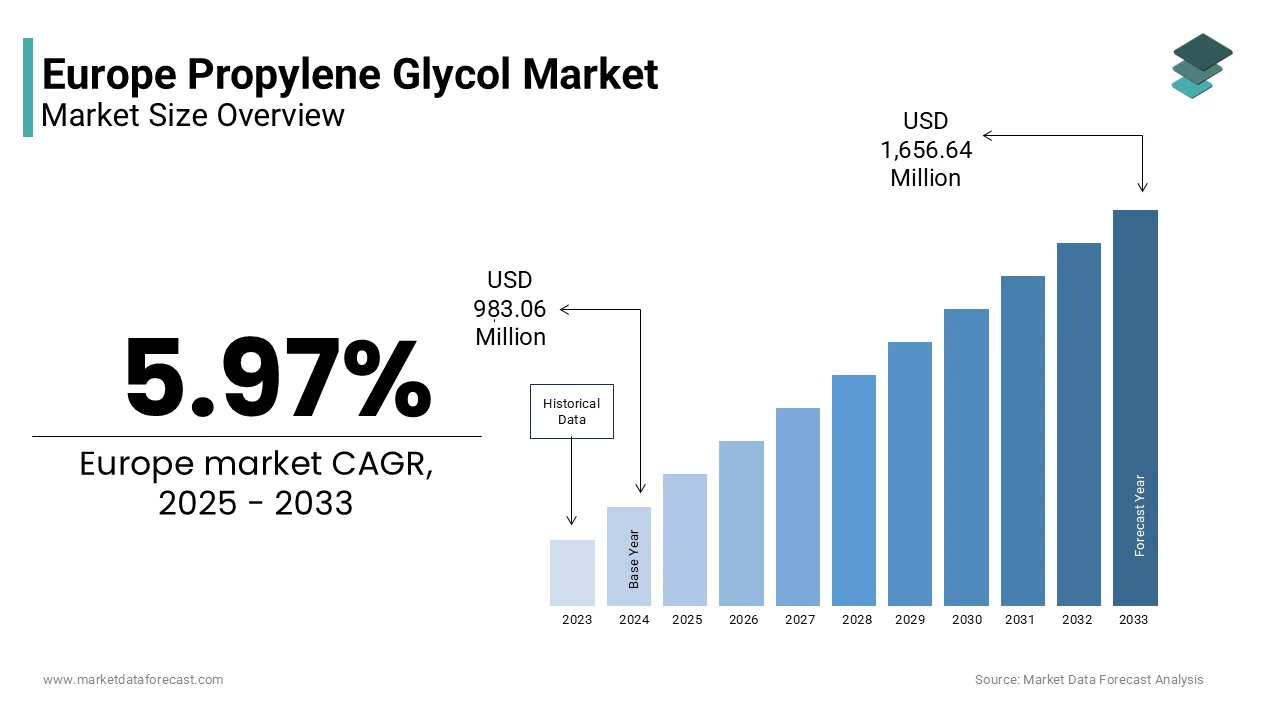
Propylene glycol is a versatile organic compound widely used as a solvent,, humectant, and chemical intermediate across pharmaceutical,,s fo,,od cosmetics and industrial applications due to its low toxici,,ty high solvency and hygroscopic properties. According to the European Chemicals Agency,, over 100000 metric tons of propylene glycol were registered under REACH in 202,,3 reflecting its extensive use in consumer and industrial formulations. As per Eurostat,, the European Union imported approximately 43,487 metric tons of propylene glycol in 20,23 primarily from the United States and Saudi Arab,,ia to supplement domestic production capacity.
MARKET DRIVERS
Rising Demand for Pharmaceutical and Vaccine Formulations
The expanding use of propylene glycol in pharmaceuticals and biologics is prompting the growth of the European propylene glycol market. According to the European Medicines Agency, propylene glycol is present in more than 60% of liquid oral and parenteral drug formulations approved between 2020 and 2023 due to its ability to solubilise active ingredient,stabiliseze protein structures and enhance bioavailability. The rollout of mRNA vaccines during the pandemic further cemented its role as a key component in lipid nanoparticle delivery systems,, with each dose of certain vaccines containing up to 10 milligrams of pharmaceutical-grade propylene glycol. Additionally, the European Federation of Pharmaceutical Industries and Associations states that pharmaceutical production in the EU grew by 6.4% in 2023,, driven byageingg populations and increased biologic drug approva,,ls which inherently require higher excipient volumes.
Growth in Bio-Based Personal Care and Cosmetic Products
The strong consumer preference for sustainable and non-toxic personal care products for bio-based propylene glycol in cosmetics is additionally to further elevate the growth of the Europe propylene market. According to the European Commission’s Eco Innovation Observatory, over 68% of new cosmetic launches in the EU in 2023 featured bio-based or naturally derived claim,,s with propylene glycol sourced from renewable feedstocks increasingly specified as a replacement for petrochemical variants. The European Cosmetic Regulation mandates full ingredient disclosure and restricts substances of concern, which has led formulators to adopt certified renewable propylene glycol that meets COSMOS and Ecocert standards. L’Oréal Unilever and Beiersdorf have all committed to sourcing 100% renewable carbon in their formulations by 2030 under the Together for Sustainability initiative. In 20,,23 Dow and BASF expanded their bio-based propylene glycol supply agreements with major EU cosmetic brand,,s leveraging glycerol from biodiesel byproducts. This alignment between regulatory transparency, consumer ethics and corporate sustainability commitments is transforming propylene glycol from a commodity into a differentiated green ingredient.
MARKET RESTRAINTS
Stringent Regulatory Classification Under REACH and CLP
Propylene glycol faces increasing regulatory scrutiny in Europe despite its generally recognised safety due to evolving hazard communication requirements under the Classificati,,on Labelling and Packaging regulation. The stringent regulatory classification under REACH and CLP is impeding the growth of the Europe propylene glycol market. According to the European Chemicals Agenc,y certain grades of propylene glycol are now subject tharmoniseded classification for eye irritation and specific target organ toxicity following repeated exposu,,re which necessitates updated safety data sheets anlabellinggng for industrial users. As per the European Commission’s 2023 update to Annexee VI of the CLP regulatio,,n manufacturers must now include precautionary statements on containers used in cleaning and de-icing applicatio,,ns even though the substance remains approved for food and pharmaceutical use. This dual regulatory status creates compliance complexity for multi-sector suppliers who must manage separate inventory streams and documentation protocols. Furthermore, the upcoming restriction proposal on skin sensitisers under REACH may indirectly affect derivative compounds used in fragrances where propylene glycol acts as a carrier.
Volatility in Propylene Feedstock Availability and Pricing
The fluctuations in propylene supply,, which is primarily derived as a co-product of steam cracking and fluid catalytic cracking processes,, are additionally hampering the growth othe ofofEuropeanpe propylene glycol market. According to the International Energy Agency, European refinery utilisation rates averaged 81% in 2023,, down from 87% in 2022 due to energy cost pressures and strategic run cuts,, which reduced propylene co-production by an estimated 9% year on year. As per Platts propylene spot prices in Northwest Europe swung from 890 euros per metric ton in January 2023 to 1320 euros per metric ton in October,, following unplanned outages at crackers in Germany and Belgium. Since propylene accounts for nearly 70% of the raw material cost in conventional propylene glycol synthesis, these swings directly impact producer margins and downstream pricing stability. The European Olefins and Aromatics Association notes that Europe imported 1.2 million metric tons of propylene in 202,3 mostly from the United States and the Middle Eas,t to offset domestic shortfalls.
MARKET OPPORTUNITIES
Expansion of Renewable Propylene Glycol Production Capacity
The scaling ofbio-basedd production using sustainable feedstocks, such as crude glycerol from biodiesel or sugar fermentati,on is creating new opportunities for the growth Europe'sope propylene glycol market. According to the European Bioplastics Associati,on renewable propylene glycol production in the EU grew by 34% in 2023 with three nenew commercial-scalelants commissioned in the Netherlands,, ds Sweden and Spain. Thesefacilities utilisee proprietary catalytic processes to convert waste glycerol into USP and technical grade propylene glycol with up to 85% lower carbon footprint compared to fossil-based routes as verified by the Joint Research Centre’s life cycle assessment database. Major downstream use,, rs including Ne,stl, é DSM anAkzoNobelo b,el havsigned long-termrm supply agreements for this material to meet corporate net zero targets under the Science Based Targets initiative. As per the EU Renewable Energy Directive reca,,st the usebio-basedased chemicals in industrial applications qualifies for inclusion in national renewable energy share calculatio,, nincentivisingng adoption.
Adoption in Next Generation De-Icing Fluids for Aviation
The aviation sector’s shift toward environmentally compliant de-icing fluids is creating new opportunities for the growth othe f Europe propylene glycol market. According to the European Union Aviation Safety Agency, over 19 million aircraft movements occurred at EU airports in 2023 generating demand for more than 180 million litres of Type I and Type II Ide-icingng fluids. HiHistoricallyly ethylene glycol dominated this segment,, but its high aquatic toxicity has led to strict effluent limits under the EU Urban Wastewater Treatment Directive. As per the European Environment Agency, 14 major European airports,, ts including Frankfurt,, rt Schiphol and Charles de Gau,, have transitioned entirely tpropylglycol-baseded fluids due to their lower environmental impact and biodegradability within 28 days. In 2023, the German Federal Environment Agency mandated that all airports with over 50000 annual movements must recover and treat 95% de-icing runoff which furthfurthersylene glycol’s easier wastewater handling. The Thiregulatory-drivenen substitution is creating a stable industrial demand stream insulated from consumer market fluctuations.
MARKET CHALLENGES
Competition from Glycerol and Other Humectants in Formulations
Propylene glycol faces mounting substitution pressure in food and cosmetic applications from alternative humectants such as glycerol sorbitol and erythritol which are perceived as more natural by European consumers. The growing competition is one of the biggeschallengese for thEuropeanpe propylene glycol market. According to the European Food Information Council, over 52% of EU consumers in a 2023 survey expressed a preference for ingredient-labelled asplant-deriveded” orkitchen-friendlyly, leading brands to reformulate products to exclude synthetic-sounding components, including propylene glycol. SSimilarly, in personal care t,he European Cosmetic Ingredient Database shows a 119-year-on-yearncrease in glycerol registrations compared to a 4% rise for propylene glycol. Although propylene glycol offers superior antimicrobial and solvent properties its chemical nomenclature hinders marketing despite regulatory safety assurances. As per Mintel,, over 220 cosmetic product launches in Europe in 2023 explicitly advertised “propylene glycol free” as a selling point. Thiconsumer-drivenen repositioning erodes demand ihigh-marginin segments and forces producers to invest in education and rebranding.
Carbon Intensity of Conventional Production Routes
The conventional production of propylene glycol via hydrolysis of propylene oxide derived from fossil fuels carries a significant carbon footprint that conflicts with Europe’s decarbonization mandates, which is also a factor declining the growth of the market. According to the European Environment Agency, the average cradle to gate greenhouse gas emission fopetrochemical-baseded propylene glycol is 2.8 kilograms of carbon dioxide equivalent per kilogram of produ,,ct which exceeds the 2.0 threshold set by the EU Product Environmental Footprint method for preferred chemicals. Carbon Border Adjustment Mechanism proposal set to phase in from 20,,26 imported propylene glycol may face carbon costs if produced in jurisdictions without equivalent climate policies. Furthermore, the EU’s Corporate Sustainability Reporting Directive requires large companies to disclose scope three emissio,,ns which has prompted formulators like Henkel and Reckitt to audit their glycol suppliers.
REPORT COVERAGE
| REPORT METRIC | DETAILS |
| Market Size Available | 2025 to 2034 |
| Base Year | 2025 |
| Forecast Period | 2026 to 2034 |
| CAGR | 5.97% |
| Segments Covered | By Grade, Application, End User Industry, and Region |
| Various Analyses Covered | Global, Regional, & Country Level Analysis; Segment-Level Analysis; DROC, PESTLE Analysis; Porter’s Five Forces Analysis; Competitive Landscape; Analyst Overview of Investment Opportunities |
| Regions Covered | UK, France, Spain, Germany, Italy, Russia, Sweden, Denmark, Switzerland, Netherlands, Turkey, and the Czech Republic |
| Market Leaders Profiled | Adeka Corp, INEOS, Shell PLC, Archer-Daniels Midland Co, LyondellBasell Industries NV Class A, Huntsman Corp, Dow Inc, and BASF SE |
SEGMENTAL ANALYSIS
By Grade Insights
The industrial grade segment accounted in holding a significant share of the European propylene glycol market in 20,24,, with its extensive use in chemical synthesis,, sis heat transfer fluids, and unsaturated polyester resins. According to the European Chemical Industry Council, over 2,10,000 metric tonof industrial-gradeee propylene glycol were consumed in 2023 for the production of liquid detdetergentsasticiserszers and alkyd resins. Additionally, the European Union Aviation Safety Agency mandates the use opropylene glycol-basedded de-icing fluids at major airports due to lower aquatic toxicity compared to ethylene glycol,,ol with 14 airports fully transitioning bbythe ynof d 2023. Industrial users also benefit from less stringent purity requirement,s whicis cost-effectiveve production from conventional petrochemical routes. This broad applicability across manufacturing, constructio,,oand transportation sectors ensures industrial grade remains the backbone of European demand.
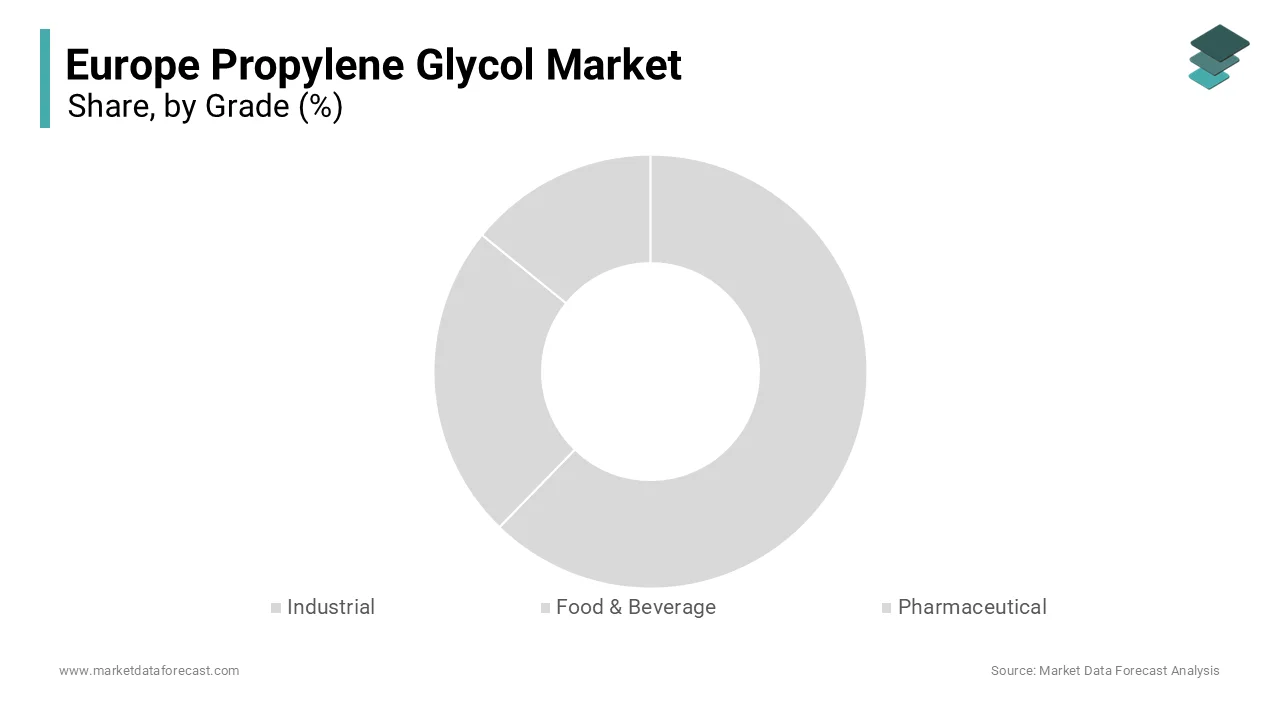
The pharmaceutical grade segment is anticipated to witness a CAGR of 8.9% from 2026 to 2034. This acceleration stems from its irreplaceable role as a solvent and andstabiliserr in injectable biologics,cs oliquidsiqui,ds and topical formulations. According to the European Medicines Agency, over 3700 medicinal products authorised in the EU as of 2023 list propylene glycol as asana excipient,nt including monoclonal antibodi,es mRNA vaccines and pediatric syrups. The European Federation of Pharmaceutical Industries and Associations states that biologic drug production in the EU grew by 9.2% in 2023 with each batch requiring high purity USP grade glycol to maintain protein conformation and sterility. Furthermore, the European Pharmacopoeia updated its monograph in 2023 to tighten limits on residual aldehydes and peroxides reinforcing demand for ultra refined grades.
By Application Insights
The chemical intermediates segment held 42.3% of the Europe propylene glycol market share in 2025. Propylene glycol serves as a foundational building block for synthesizing a wide array of derivatives including propylene glycol ethers dipropylene glycol and polyurethane polyols. According to the European Chemical Industry Council, over 180000 metric tons of propylene glycol were used in 2023 to produce glycol ethers which are essential in semiconductor cleaning formulations and low VOC industrial coatings. Additionally, the European Polyurethane Association reports that flexible foam production for automotive seating and furniture utilized 48000 metric tons of polyol derived from propylene glycol in 2023. These derivatives benefit from regulatory tailwinds as they replace more hazardous solvents under the EU’s REACH authorization list. The integration of propylene glycol into high value chemical chains ensures its continued centrality in Europe’s specialty chemical ecosystem.
The antifreeze and deicer agent segment is projected to witness a fastest CAGR of 9.4% from 2026 to 2034 with stringent environmental regulations phasing out ethylene glycol in aviation and ground transportation applications. The European Environment Agency confirms that 14 major EU airports including Frankfurt Schiphol and Oslo have implemented closed loop collection systems that favor propylene glycol’s easier wastewater treatment. In road transport, the European Automobile Manufacturers Association states that 68% of new electric vehicle coolant formulations launched in 2023 use propylene glycol to prevent battery thermal runaway while meeting EU End of Life Vehicle Directive requirements.
By End User Industry Insights
The food and beverages industry segment held 28.3% of the Europe propylene glycol market share in 2025 with the compound’s regulatory approval as food additive E1520 and its functional versatility in flavor delivery moisture retention and texture stabilization. According to the European Food Safety Authority, propylene glycol is permitted in flavored beverages bakery fillings and confectionery at concentrations up to 10000 milligrams per kilogram. In the beverage sector, 23 billion liters of ready to drink flavored waters and soft drinks were produced in Europe in 2023 with propylene glycol enabling consistent flavor dispersion. Additionally, industrial bakers used an estimated 9500 metric tons of food grade glycol in 2023 to extend shelf life in gluten free and low sugar products. This deep integration into Europe’s processed food infrastructure ensures sustained demand despite clean label pressures.
The pharmaceuticals end user segment is expected to grow at a fastest CAGR of 8.7% from 2026 to 2034 with Europe’s robust biopharmaceutical manufacturing base and rising demand for complex drug delivery systems. According to the European Medicines Agency, 212 new active substances were approved in the EU in 2023 with 64% requiring propylene glycol as a co solvent or stabilizer in liquid formulations. In vaccine production, the European Centre for Disease Prevention and Control confirms that mRNA platform technologies, which dominated pandemic and seasonal flu vaccine development use propylene glycol in lipid nanoparticle suspensions. Furthermore, the EU’s Beating Cancer Plan launched in 2023 is accelerating oncology drug approvals many of which are orally administered liquids dependent on glycol for solubility.
REGIONAL ANALYSIS
Germany Market Analysis
Germany was the top performer in the Europe propylene glycol market by capturing 22.3% of share in 2025. The country’s market growth is driven by its diversified industrial base spanning pharmaceuticals automotive chemicals and food processing. According to the Federal Statistical Office, Germany produced 58000 metric tons of pharmaceutical preparations in 2023 many of which used propylene glycol as an excipient. Additionally, Germany hosts major food and beverage multinationals such as Dr Oetker and Radeberger Group which utilize food grade glycol in flavor systems and stabilizers. The country’s strict implementation of REACH and Green Deal policies also drives demand for bio-based variants with BASF and Evonik investing in renewable glycol pilot lines.
France Market Analysis
France was positioned second in the Europe propylene glycol market with 16.3% of share in 2025 by its strong pharmaceutical cosmetics and aviation sectors. According to the French National Agency for Medicines and Health Products Safety, over 12000 metric tons of pharmaceutical grade propylene glycol were imported in 2023 to support vaccine and biologic production at Sanofi and Servier facilities. In aviation, the French Civil Aviation Authority confirms that Charles de Gaulle and Orly airports fully transitioned to propylene glycol de-icing fluids in 2022 reducing effluent toxicity by over 60%. Additionally, France’s food industry consumed 8200 metric tons of food grade glycol in 2023 for flavorings and bakery applications as reported by FranceAgriMer. Government incentives under the France 2030 investment plan are also supporting bio based glycol production from sugar beet feedstocks.
United Kingdom Market Analysis
The United Kingdom propylene glycol market is lucratively to have significant growth opportunities in coming years with its world class pharmaceutical sector and stringent environmental policies. According to the UK Medicines and Healthcare products Regulatory Agency, over 950 new drug applications included propylene glycol in formulations in 2023 with major production hubs in Liverpool and Cambridge. In food the Food Standards Agency, permits glycol as E1520 and notes its use in over 4000 approved flavorings. Post Brexit the UK has aligned its chemical regulations with EU REACH through the UK REACH framework maintaining consistent demand patterns. Additionally, the UK’s Net Zero Strategy promotes bio based glycol for green chemistry. This regulatory continuity and scientific excellence sustain the UK’s market position.
Italy Market Analysis
Italy propylene glycol market growth is likely to grow steadily with its food processing fashion cosmetics and industrial manufacturing sectors. According to the Italian Medicines Agency, pharmaceutical production consumed 6800 metric tons of high purity glycol in 2023 for oral and topical medicines. Cosmetics giant L’Oréal Italia and niche perfumers in Milan utilize glycol as a carrier in 85% of liquid fragrances as per the Italian Cosmetic Association. Additionally, Italy’s 42 commercial airports are transitioning to eco-friendly de icing fluids under ENAC mandates.
Spain Market Analysis
Spain propylene glycol market growth is propelled by its expanding food and beverage sector renewable energy infrastructure and tourism linked aviation activity. According to Spain’s Agency for Medicines and Health Products pharmaceutical manufacturers consumed 5400 metric tons of USP grade glycol in 2023 for generic and biologic production. Aena the national airport operator reports that Spanish airports used 3.9 million liters of propylene glycol de-icing fluid in the 2022 2023 season with Madrid and Barcelona leading adoption.
COMPETITIVE LANDSCAPE
KEY MARKET PLAYERS
Some of the notable key players in the Europe propylene glycol market are
- Adeka Corp
- INEOS
- Shell PLC
- Archer-Daniels Midland Co
- LyondellBasell Industries NV Class A
- Huntsman Corp
- Dow Inc
- BASF SE
TOP STRATEGIES USED BY THE KEY MARKET PLAYERS
Key players in the Europe propylene glycol market are prioritizing the development and commercialization of bio based and circular alternatives to meet stringent EU sustainability mandates. Companies are investing in advanced purification technologies to ensure compliance with pharmacopoeial and food safety standards across multiple grades. Strategic partnerships with downstream formulators in cosmetics pharmaceuticals and aviation de-icing are being formed to co-develop tailored solutions. Logistics and distribution networks are being optimized through regional hub expansions to guarantee supply resilience. Engagement in policy dialogues via industry associations helps shape favorable regulatory pathways for renewable chemicals. Digital traceability systems are being deployed to provide mass balance certification and lifecycle data required under the Corporate Sustainability Reporting Directive. These strategies collectively aim to differentiate offerings beyond commodity pricing and embed sustainability into core value propositions.
COMPETITION OVERVIEW
Competition in the Europe propylene glycol market is shaped by a mix of global chemical giants regional producers and emerging bio based innovators operating under one of the world’s most rigorous regulatory regimes. While traditional players like Dow BASF and LyondellBasell dominate through integrated production and multi grade portfolios niche suppliers are gaining ground by offering certified renewable glycol from glycerol or tall oil feedstocks. The absence of significant import barriers allows global producers to compete directly yet EU chemical regulations such as REACH CLP and the Green Deal create de facto entry thresholds favoring companies with robust compliance infrastructure. Differentiation is increasingly driven by sustainability credentials with customers demanding ISCC PLUS or mass balance certified products. Price competition remains moderate as quality purity and regulatory documentation heavily influence purchasing decisions particularly in pharmaceuticals and food. Mergers and collaborations are rare but technical service partnerships and formulation support are common as suppliers seek to embed themselves in customer value chains.
TOP PLAYERS IN THE MARKET
- Dow Inc is a global leader in propylene glycol production with a strong presence in Europe through its integrated manufacturing and distribution network. The company supplies industrial food grade and pharmaceutical grade propylene glycol to a wide range of sectors including cosmetics food processing and pharmaceuticals across Germany France and the Netherlands. This initiative aligns with the EU’s Circular Economy Action Plan and supports customer sustainability targets. Dow also enhanced its logistics infrastructure at the Terneuzen site in the Netherlands to ensure reliable delivery across the continent. These strategic moves reinforce Dow’s commitment to innovation and environmental stewardship in the European market.
- BASF SE is a major European chemical producer with significant capabilities in propylene glycol synthesis and downstream derivative manufacturing. Headquartered in Germany the company serves end users in pharmaceuticals personal care and industrial applications across the EU with high purity grades compliant with European Pharmacopoeia and food safety standards. In early 2025 BASF inaugurated a new purification unit at its Ludwigshafen complex to increase output of USP and food grade propylene glycol. The company also partnered with a French cosmetic formulator to develop low carbon glycol formulations certified under the COSMOS standard. Furthermore, BASF actively participates in the European Chemical Industry Council’s sustainability working groups to shape regulatory frameworks for bio-based chemicals. These initiatives underscore BASF’s integrated approach to quality compliance and green chemistry leadership in Europe.
- LyondellBasell is a key global supplier of propylene glycol with substantial supply commitments to European customers in the automotive food and chemical sectors. The company leverages its world scale propylene oxide assets to produce high quality glycol distributed through terminals in Rotterdam and Antwerp. This product meets ISCC PLUS standards and targets customers seeking to reduce carbon footprints without reformulating. The company also strengthened its technical service team in Milan and Warsaw to support industrial users in adopting glycol-based formulations compliant with EU REACH and CLP regulations. These actions demonstrate LyondellBasell’s focus on sustainability regulatory alignment and customer proximity in the European market.
MARKET SEGMENTATION
This research report on the Europe propylene glycol market has been segmented and sub-segmented based on categories.
By Grade
- Industrial
- Food & Beverage
- Pharmaceutical
By Application
- Flavoring Agent
- Antifreeze and Deicer Agent
- Unsaturated Polyester Resins
- Chemical Intermediates
- Other Applications (Antioxidants, Household Care, etc.)
By End User Industry
- Transportation
- Building and Construction
- Food and Beverages
- Personal Care
- Pharmaceuticals
- Other End User Industries (Electronics, Paints and Coatings, etc.)
By Country
- UK
- France
- Spain
- Germany
- Italy
- Russia
- Sweden
- Denmark
- Switzerland
- Netherlands
- Turkey
- Czech Republic
- Rest of Europe
Frequently Asked Questions
1. What is propylene glycol and why is it widely used in Europe?
Propylene glycol is a synthetic organic compound used as a solvent, humectant, antifreeze agent, and chemical intermediate across various European industries due to its safety profile and versatility.
2. What is driving the growth of the propylene glycol market in Europe?
Growth is mainly driven by increasing demand from the food & beverage, pharmaceuticals, cosmetics, automotive, and construction sectors, along with rising production of unsaturated polyester resins.
3. Which grade of propylene glycol is most in demand in Europe?
Industrial-grade propylene glycol currently dominates due to its extensive use in antifreeze, deicing solutions, and resins.
4. What applications use propylene glycol the most in Europe?
Major applications include antifreeze & deicer agents, unsaturated polyester resins, chemical intermediates, flavoring agents, and household care products.
5. Which end-user industries are the largest consumers of propylene glycol in Europe?
Key industries include transportation, building & construction, food & beverages, personal care, and pharmaceuticals.
6. Which countries in Europe contribute significantly to market demand?
Germany, the United Kingdom, France, Italy, and the Netherlands are major contributors due to strong industrial and manufacturing bases.
7. How is the automotive sector influencing propylene glycol consumption in Europe?
The automotive sector boosts demand for antifreeze, de-icing fluids, lubricants, and coolant systems that heavily rely on propylene glycol.
8. Is bio-based propylene glycol gaining popularity in Europe?
Yes, demand for sustainable and bio-based chemicals is rising, pushing manufacturers to offer eco-friendly propylene glycol derived from renewable sources.
9. Who are the major companies operating in the Europe Propylene Glycol Market?
Key players include BASF SE, Dow Inc., INEOS, LyondellBasell, Huntsman Corporation, and ADM.
10. How is the personal care industry contributing to market growth?
Propylene glycol is widely used as a moisturizer, stabilizer, and solvent in skincare, haircare, and cosmetic formulations, increasing its demand.
Related Reports
Access the study in MULTIPLE FORMATS
Purchase options starting from
$ 2000
Didn’t find what you’re looking for?
TALK TO OUR ANALYST TEAM
Need something within your budget?
NO WORRIES! WE GOT YOU COVERED!
Call us on: +1 888 702 9696 (U.S Toll Free)
Write to us: sales@marketdataforecast.com