- Product Description Description
- Table of Contents TOC
- List of Table & Figure LOT
- Get Free Sample PDF Sample PDF
Market Size, 2025
$64.13 BnMarket Estimate, 2026
$66.15 BnMarket Forecast, 2034
$84.78 BnCAGR, 2026–2034
3.15%Executive Summary: Europe Ready-Mix Concrete Market
- Market Scope: Comprehensive regional ready-mix concrete market analysis covering end-user industries, product types, European country coverage, and sustainable construction technology trends.
- Market Valuation: Valued at USD 64.13 billion (2025), estimated at USD 66.15 billion (2026), and projected to reach USD 84.78 billion by 2034, registering a stable CAGR of 3.15% (2026–2034).
- Primary Growth Drivers: Accelerated public infrastructure investment under the EU’s Recovery and Resilience Facility, rising residential construction driven by housing shortages, and increasing demand for sustainable construction materials aligned with the EU Green Deal. Key industry trends include the adoption of low-carbon concrete, digital batching technologies, IoT-enabled quality monitoring, and blockchain-based traceability. Growth remains constrained by stringent carbon pricing under the EU ETS, fragmented recycled aggregate regulations, and volatile energy costs.
Key Market Segment Metrics (2026–2034)
| Category | Leading Segment (2025 Position) | Fastest-Growing Segment |
|---|---|---|
| By End User Industry | Infrastructure development and residential construction sectors | Sustainable urban redevelopment and green infrastructure projects |
| By Product Type | Standard ready-mix concrete formulations and conventional mixes | Low-carbon concrete, supplementary cementitious materials, and alternative binders |
| By Region / Country | Major European construction markets (UK, Germany, France, Italy, and Spain) | Central and Eastern European infrastructure corridors |
Major Market Players & Market Structure
Market Structure: Highly competitive European ready-mix concrete landscape featuring major global building materials producers and regional suppliers competing on decarbonization technologies, digital batching integration, and circular economy compliance.
Key Companies: Heidelberg Materials AG, LafargeHolcim Ltd., CRH plc, CEMEX S.A.B. de C.V., Vicat Group, Buzzi Unicem SpA, Holcim Ltd., Breedon Group plc, Eurovia (Vinci Group), Titan Cement Company S.A., Schwenk Zement KG, Aggregate Industries (Saint-Gobain), BASF SE (Construction Chemicals), Italcementi S.p.A., EFRIMIX (Regional Producers Group), Dalmia Bharat Group, Ambuja Cements Ltd., Elkem ASA (Concrete Additives), and MBCC Group.
Europe Ready Mix Concrete Market Size
The Europe Ready Mix Concrete Market is projected to grow from USD 64.13 billion in 2025 to USD 66.15 billion in 2026 and reach USD 84.78 billion by 2034, registering a CAGR of 3.15% from 2026 to 2034.
Ready mix concrete refers to a precisely engineered blend of cement, aggregates, es wa, and chemical admixtures produced in a centralized batching plant and delivered in a plastic state to construction sites via transit mixers. In Europe, this material has become the cornerstone of modern urban development due to its consistent quality control and reduced on-site labor requirements. The market operates within a complex regulatory and environmental framework that increasingly prioritizes decarbonization and circularity in construction. On the other hand, according to Eurostat, final construction output in the European Union experienced a general contraction in 2024 due to macroeconomic challenges and market uncertainty, following a period of strong growth between 2021 and 2023. Apart from these, the European Environment Agency emphasizes the substantial contribution of the global buildings and construction sector to overall energy consumption and carbon dioxide emissions, emphasizing the need for low-carbon material adoption across the European Union. The European Union has approved the Net Zero Industry Act (NZIA), which aims to boost the domestic manufacturing capacity of clean technologies and set carbon storage targets, rather than mandating specific recycled content percentages for public works. These structural shifts are redefining the ready mix concrete landscape toward performance-verified sustainable solutions that align with the EU’s Green Deal objectives.
MARKET DRIVERS
Accelerated Public Infrastructure Investment Under the EU Recovery and Resilience Facility
The European Union’s Recovery and Resilience Facility has emerged as a key driver of the European ready-mix concrete market. This is due to large-scale public infrastructure modernization. The initiative requires member states to allocate a portion of national recovery plans to climate-related objectives, including sustainable construction. Funding for transport, energy, and social housing projects increasingly relies on the use of ready-mix concrete for essential construction elements such as foundations, structural components, and pavement systems. Government commitments in some regions to infrastructure improvements, including railway modernization and road upkeep, create a continuing need for concrete materials. Efforts to renovate public buildings, which involve seismic strengthening and thermal upgrades, commonly specify ready-mix concrete as a key construction material. These state-led programs not only provide volume stability but also enforce technical specifications that favor certified low-carbon mixes, thus reshaping procurement norms across the region.
Urban Regeneration and Housing Shortages Driving Residential Construction
Persistent housing deficits in major European metropolitan areas are fueling residential construction activity and consequently the expansion of the European ready-mix concrete market. The European Investment Bank and the European Commission point out a substantial gap between housing supply and demand across the EU, emphasizing the need for significant expansion of affordable and sustainable housing to meet diverse demographic needs. The EIB has a Housing Action Plan to help finance more affordable homes. Cities are implementing urban densification strategies that replace low-rise obsolete structures with mid to high-rise apartment complexes where ready-mix concrete is the primary structural material. Furthermore, municipal zoning reforms in the Netherlands and Austria now mandate mixed-use developments that combine housing, retail, and mobility hubs, all of which require high-strength concrete with precise slump and setting time control. This convergence of demographic pressure, policy reform, and urban planning is creating sustained demand for reliable, ready-mix supply chains.
MARKET RESTRAINTS
Stringent Carbon Pricing and Emissions Trading System Compliance Costs
The European Union’s Emissions Trading System imposes significant financial and operational pressures on ready mix concrete producers through escalating carbon pricing mechanisms, which in turn restricts the growth of the European ready mix concrete market. Ready mix plants that source conventional Portland cement face increased material expenses with no proportional uplift in selling price due to competitive tendering practices. The EU ETS coverage now includes indirect emissions from electricity used in batching and mixing operations, further broadening liability. According to research, cement production contributes a portion of the EU’s industrial carbon dioxide emissions, making it a focal point for regulatory scrutiny. Proposed reforms under the Carbon Border Adjustment Mechanism may also disadvantage non-EU cement imports, thereby limiting cost mitigation options. These dynamics compel producers to invest in carbon capture infrastructure or switch to alternative binders, which entail substantial capital outlays and technical recalibration without immediate return on investment.
Fragmented Regulatory Standards for Recycled Aggregates Across Member States
The inconsistent adoption of technical standards for construction and demolition waste-derived aggregates across the regional countries constrains the expansion of the European ready-mix concrete market. This hampers the large-scale integration of recycled content in ready-mix concrete. The EU established an ambitious C&D waste recovery goal for 2020, and while many member states met or exceeded this, performance still varies. The harmonization of technical standards for using recycled aggregates in concrete remains an ongoing challenge across the EU, with differing national regulations acting as a barrier to wider adoption. The use of recycled aggregates in structural concrete is becoming more common as research demonstrates technical viability and specific countries update their building codes to permit their use at certain incorporation ratios. This regulatory fragmentation increases compliance complexity for multinational ready mix suppliers and discourages investment in regional recycling infrastructure. Moreover, the lack of certified supply chains for high-quality recycled aggregates limits consistent batch reproducibility, a critical requirement for prestressed high-performance concrete used in bridges and parking structures.
MARKET OPPORTUNITIES
Scaling Low-Carbon Concrete Through Alternative Binders and SCMs
The transition toward low-carbon ready mix concrete offers a significant opportunity for the European ready mix concrete market. This is done through the adoption of supplementary cementitious materials and novel binders that reduce clinker dependency. Ground granulated blast furnace slag, fly ash, and calcined clay are increasingly validated for use in structural applications under revised European standards. The European cement industry is increasingly incorporating alternative materials in its products due to regulatory incentives and client sustainability mandates. Major infrastructure projects, such as the Grand Paris Express metro expansion, are increasingly using low-carbon concrete and considering global warming potential limits in procurement. Besides, the European Institute of Innovation and Technology and related bodies are allocating significant funding to support the piloting and development of innovative carbon capture and utilization technologies within the construction sector. These innovations not only lower embodied carbon but also enhance long-term durability against sulfate and chloride ingress, making them attractive for marine and wastewater applications.
Digital Integration and Smart Batching for Efficiency and Traceability
The deployment of digital technologies in ready mix operations provides a potential opportunity to enhance resource efficiency, reduce waste, and meet stringent environmental reporting requirements, which is expected to drive the growth of the European ready mix concrete market. Advanced batching software IoT IoT-enabled drum sensors, and real-time slump monitoring systems allow producers to optimize water-cement ratios and admixture dosages with millimeter precision. Furthermore, blockchain-based material passports are being piloted in the Netherlands and Sweden to track the carbon footprint and recycled content of each concrete delivery, aligning with the EU’s Level(s) sustainability assessment framework. These digital tools also facilitate compliance. By transforming concrete from a commodity into a data-rich engineered product, this digital shift strengthens value propositions beyond price and supports premium positioning for sustainable mixes.
MARKET CHALLENGES
Volatility in Energy and Raw Material Input Costs
Persistent profitability pressure due to extreme volatility in energy and raw material prices, particularly natural gas, which powers cement kilns and batching plant operations, is challenging the growth of the European ready-mix concrete market. Aggregates, another key input, have also seen price inflation with transport restrictions and quarry permitting delays contributing to regional shortages. These input fluctuations are difficult to pass on to clients due to fixed price public tenders and competitive private bidding. Consequently, margins remain compressed, particularly for small and medium-sized batchers lacking hedging instruments or vertical integration. This financial instability discourages investment in emission reduction technologies and constrains capacity expansion despite growing construction demand.
Limited Skilled Labor and Logistics Bottlenecks in Urban Centers
The acute labor shortages and urban logistics constraints threaten delivery reliability and project timelines, which obstruct the expansion of the European concrete market. Moreover, municipal regulations in cities like Paris, London, and Copenhagen have imposed strict time windows for heavy vehicle access to reduce noise and emissions. As per sources, average permitted delivery windows in major European cities narrowed to a few hours per day in 2024, down from those in 2020. This compression increases the risk of concrete setting in transit, particularly for long-haul jobs requiring extended workability. Moreover, congestion charges, low-emission zones, and pedestrianization schemes add operational complexity and cost. Service quality will remain poor, and large projects will falter in high-demand city areas unless we plan coordinated logistics and invest in tech like autonomous or night deliveries.
REPORT COVERAGE
| REPORT METRIC | DETAILS |
| Market Size Available | 2025 to 2034 |
| Base Year | 2025 |
| Forecast Period | 2026 to 2034 |
| Segments Covered | By End User Industry, Product Type, and Region. |
| Various Analyses Covered | Global, Regional, and Country-Level Analysis, Segment-Level Analysis, Drivers, Restraints, Opportunities, Challenges; PESTLE Analysis; Porter’s Five Forces Analysis, Competitive Landscape, Analyst Overview of Investment Opportunities |
| Countries Covered | UK, France, Spain, Germany, Italy, Russia, Sweden, Denmark, Switzerland, Netherlands, Turkey, Czech Republic, Rest of Europe |
| Market Leaders Profiled | Heidelberg Materials AG, LafargeHolcim Ltd., CRH plc, CEMEX S.A.B. de C.V., Vicat Group, Buzzi Unicem SpA, Holcim Ltd., Breedon Group plc, Eurovia (Vinci Group), Titan Cement Company S.A., Schwenk Zement KG, Aggregate Industries (Saint-Gobain), BASF SE (Construction Chemicals), Italcementi S.p.A., EFRIMIX (Regional Producers Group), Dalmia Bharat Group, Ambuja Cements Ltd., Elkem ASA (Concrete Additives), MBCC Group (formerly BASF Construction Chemicals), Tarmac (Ireland/UK) |
SEGMENTAL ANALYSIS
By End User Industry Insights
The infrastructure segment dominated the European ready-mix concrete market by capturing a 34.1% share in 2025. The dominance of the infrastructure segment is attributed to sustained public investment in transportation networks, renewable energy projects aligned with the European Green Deal, and the continent-wide modernization of rail systems under the EU’s Sustainable and Smart Mobility Strategy, which mandates s increase high high-speed rail traffic by 2030. The European Union is actively engaged in a sustained effort to modernize and expand its railway networks, with a clear focus on increasing the proportion of electrified lines to meet climate and transport efficiency goals. Germany is undertaking a comprehensive, large-scale modernization and expansion of its national rail system to improve reliability, increase capacity, and integrate timetabling through its "Deutschlandtakt" program. An additional growth factor is the expansion of renewable energy infrastructure, particularly offshore wind and grid interconnectors, which rely heavily on mass concrete foundations and substations. Europe is continuing to expand its wind energy capacity significantly, with a strong focus on both onshore and offshore projects to meet increasing electricity demands and climate targets, though current installation rates need to accelerate to meet long-term EU goals. The EU’s Net Zero Industry Act further fast-tracks permitting for clean energy projects, reducing approval timelines and accelerating concrete demand in coastal regions such as the North Sea and Baltic corridors.
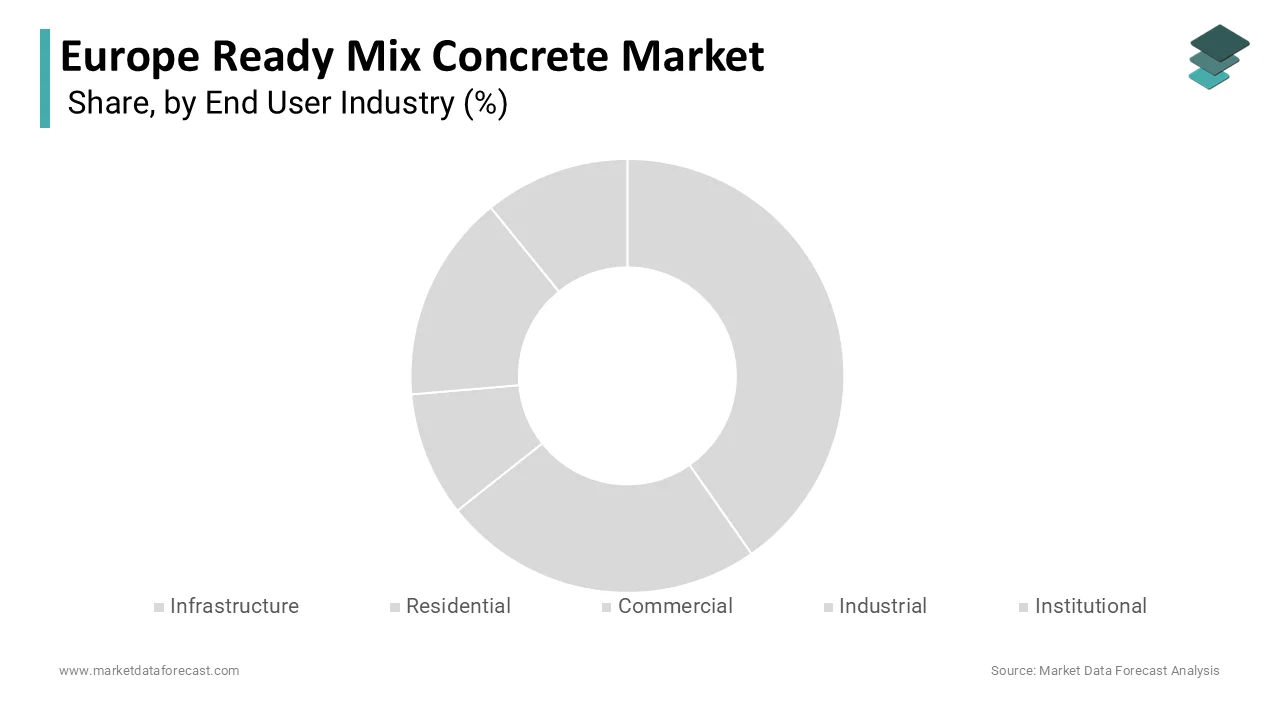
The institutional segment is likely to experience the fastest CAGR of 5.2% from 2025 to 2033. The rapid expansion of the institutional segment is fuelledby large-scale public commitments to renovate aging educational and healthcare facilities under climate-resilient design principles, and the European Investment Bank’s allocation of significant funds for hospital and university retrofits, with a portion earmarked for structural reinforcement and low-carbon concrete systems. Many public hospitals in Southern and Eastern Europe were built using older construction methods and materials. These buildings often do not meet contemporary standards for seismic resilience and energy efficiency. Meeting current building codes may require extensive renovation, such as completely rebuilding the external structure. The required modern construction techniques often involve using durable materials like high-strength concrete further key driver is the EU’s Skills Agenda, which mandates the construction of a notable number of new vocational training centers by 2027 to address labor market gaps. These projects prioritize durability, fire resistance, and thermal mass, all inherent advantages of concrete construction. This regulatory and investment convergence positions institutional construction as a high-growth niche despite its historically modest volume.
By Product Type Insights
The transit or truck mix concrete segment led the European ready mix concrete market and accounted for a substantial share in 2025. The supremacy of the transit or truck mix concrete segment is credited to unmatched flexibility in delivery scheduling, adaptability to variable site conditions across diverse project scales, and its suitability for fragmented urban constructio. Just-in-timee delivery mitigates storage constraints and waste. The system allows real-time adjustment of slump and set time through admixture injection during transit, a critical advantage for projects with unpredictable pour sequences or weather disruptions. The widespread availability of modern fleet infrastructure equipped with GPS tracking and drum rotation monitoring also drives the growth of this segment. Moreover, the digital integration supports compliance with low-emission zone requirements in cities where vehicles must meet Euro VI standards. Furthermore, the absence of intermediate handling minimizes aggregate segregation, ensuring consistent strength development, particularly in high-performance mixes used in precast elements and post-tensioned slabs. These operational and quality control benefits solidify transit mix as the default choice for contractors across the region.
The central or batch mix segment is on the rise and is expected to be the fastest-growing segment in the market by witnessing a CAGR of 4.8% from 2025 to 2033. The swift expansion of the central or batch mix segment is propelled by the rising demand for ultra-high-performance and specialized concrete formulations that require precisely controlled laboratory-like batching conditions unattainable in transit mixers. An additional growth driver is the construction of nuclear and hydrogen infrastructure, where concrete must meet exacting standards for radiation shielding or hydrogen embrittlement resistance. A further key enabler is the EU’s push for circular construction, which mandates consistent incorporation of recycled aggregates and supplementary cementitious materials. Major public tenders require third-party verified batch records for every pour, a condition only feasible with fixed plant operations. Apart from these, central plants located near urban recycling hubs can directly integrate construction waste streams, reducing transport emissions and raw material costs. This alignment with regulatory precision, sustainability, and performance requirements positions central batch mix as the preferred solution for technically demanding and compliance-intensive projects.
COUNTRY LEVEL ANALYSIS
Germany Ready Mix Concrete Market Analysis
Germany outperformed other countries in the European ready mix concrete market and accounted for a 21.4% share in 2025 because of its dual role as an industrial powerhouse and a pioneer in green infrastructure policy. Germany is executing the most ambitious rail modernization program in Europe, with thousands of construction sites active under the Deutschlandtakt initiative, according to sources. The energy transition includes the development of infrastructure that requires durable construction materials. New grid substations and hydrogen pipeline corridors are among the types of infrastructure being built. These projects utilize a specific type of ready-mix concrete known for its high strength and properties resistant to chloride diffusion. Also, there is a reported increase in the use of certified low-carbon concrete blends in many new public buildings. These specific concrete blends often contain supplementary cementitious materials, such as slag or fly ash. Strong domestic cement and admixture industries ensurereliableble supply of consistent raw materials, while stringent Abfallverordnung regulations drive closed-loop recycling of returned concrete. This ecosystem of policy demand and industrial capability sustains Germany’s dominant position.
France Ready Mix Concrete Market Analysis
France was the next prominent player in the European ready-mix concrete market by capturing a share of 16.5% in 2025, with aggressive urban renewal and nuclear infrastructure investment. The country is undergoing a historic transformation of its housing stock under the MaPrimeRénov scheme, which funded a substantial number of residential retrofits. These projects frequently involve structural concrete interventions such as facade stabilization and foundation underpinning. Concurrently, France is advancing its nuclear reindustrialization plan with many new EPR2 reactor sites approved for construction, each requiring significant cubic meters of radiation shielding concrete. Public works are required to use concrete that has an environmental declaration verified through a specific framework, ensuring transparency in the embodied carbon of the material. This supports a general move toward environmentally conscious construction practices. A major metro expansion project currently consumes substantial amounts of ready-mix concrete as part of its ongoing construction phases. This high level of activity helps maintain a consistent demand for concrete in the local construction market.
United Kingdom Ready Mix Concrete Market Analysis
The United Kingdom grew steadily in the European ready-mix concrete market due to its focus on decarbonized construction and post-pandemic infrastructure stimulus. Funding has been allocated to support transport and clean energy projects, including a major high-speed rail line and improvements to offshore wind ports. Construction output has experienced growth, primarily driven by significant civil engineering activity, which heavily utilizes concrete materials. A new standard for construction materials has been introduced, which allows for the use of concrete with lower environmental impact without negatively affecting its structural strength. Furthermore, the UK’s National Planning Policy Framework now requires major developments to demonstrate whole-life carbon assessment, accelerating the adoption of calcined clay and carbon-cured mixes. The clustering of concrete plants around major ports also supports efficient delivery to large-scale coastal infrastructure sites, enhancing logistical resilience.
Italy Ready Mix Concrete Market Analysis
Italy is another key player in the European ready-mix concrete market. It exhibits strong demand from seismic retrofitting and tourism-related construction. Following the 2016 Central Italy earthquakes, ongoing efforts coordinated by the Italian Civil Protection Department focused on assessing and improving the seismic resilience of the nation's vulnerable public building stock through the implementation of the National Seismic Prevention Plan, which encourages and funds structural improvements and retrofitting interventions rather than mandating universal upgrades. These interventions utilize fiber-reinforced ready-mix concrete with enhanced ductility, now standard in seismic zones. Italy's booming tourism post-pandemic is spurring significant hotel/airport expansion, especially in coastal/historic areas, driving demand for durable, salt-resistant concrete. Concurrently, the National Recovery & Resilience Plan (PNRR) funds sustainable construction and major transport links like the Brenner viaducts, boosting concrete use, which emphasizes a national push for resilient infrastructure to support tourism and modernize transport networks. Local producers benefit from abundant pozzolanic volcanic ash deposits near Napless, which serve as natural supplementary cementitious material, reducing clinker content without performance trade-offs.
Spain Ready Mix Concrete Market Analysis
Spain is anticipated to grow in the European ready-mix concrete market from 2025 to 2033 due to renewable energy deployment and social housing initiatives. The country led the EU in solar photovoltaic installations in 2024 with notable gigawatts added, according to sources, necessitating thousands of concrete inverter foundations and access roads across arid regions like Extremadura and Andalusia. Concurrently, the Spanish government is significantly increasing its commitment to public housing, aiming to expand the public housing stock to align with European averages through various programs and substantial multi-year investment in both new construction and rehabilitation. The strategy involves modernizing construction methods to build housing more quickly and affordably. Spain’s extensive coastline and frequent drought conditions further drive demand for low-permeability concrete in desalination plants and coastal defenses, reinforcing the material’s strategic role in national resilience planning.
COMPETITIVE LANDSCAPE
Competition in the European ready mix concrete market is shaped by a dual imperative of performance reliability and environmental compliance, driven by stringent EU climate policies and evolving public procurement standards. The landscape features a mix of multinational building materials giants and regional specialists, where differentiation hinges on technical innovation, sustainability credentials, and logistical agility. The market is increasingly polarized, with high-volume infrastructure tenders favoring certified sustainable suppliers and residential segments remaining price sensitive. Regulatory pressure, particularly under the EU Emissions Trading System and the Energy Performance of Buildings Directive, is compressing margins for conventional producers and accelerating consolidation. Simultaneously, digital tools for real-time quality control and carbon tracking are raising the bar for operational transparency. This environment rewards integrated players with robust supply chains,, environmental governance, and the ability to co-engineer solutions with architects and contractors, fostering a competitive dynamic that prioritizes value over volume.
KEY MARKET PLAYERS
Some of the companies that are playing a dominating role in the europe ready mix concrete market include
- Heidelberg Materials AG
- LafargeHolcim Ltd.
- CRH plc
- CEMEX S.A.B. de C.V.
- Vicat Group
- Buzzi Unicem SpA
- Holcim Ltd.
- Breedon Group plc
- Eurovia (Vinci Group)
- Titan Cement Company S.A.
- Schwenk Zement KG
- Aggregate Industries (Saint-Gobain)
- BASF SE (Construction Chemicals)
- Italcementi S.p.A.
- EFRIMIX (Regional Producers Group)
- Dalmia Bharat Group
- Ambuja Cements Ltd.
- Elkem ASA (Concrete Additives)
- MBCC Group (formerly BASF Construction Chemicals)
- Tarmac (Ireland/UK)
TOP LEADING PLAYERS IN THE MARKET
- Heidelberg Materials is a leading German building materials company with extensive ready-mix concrete operations across multiple European countries. The company supplies high-performance and low-carbon concrete solutions for major infrastructure projects, including rail networks, renewable energy installations, and urban developments. It also commissioned Europe’s first full-scale carbon capture plant at its Brevik cement facility in Norway, reinforcing its leadership in sustainable construction materials and strengthening its value proposition across the EEuropean ready-mix concretemarket.
- CRH plc, headquartered in Ireland, operates one of the most diversified building materials portfolios in Europe with a strong ready mix concrete presence in the United Kingdom, France, Germany, and the Netherlands. The company focuses on circular economy principles by integrating recycled aggregates and industrial byproducts into its concrete formulations. It also expanded digital batching capabilities at many plants, enabling real-time carbon tracking per cubic meter. These initiatives enhance CRH’s alignment with EU sustainability mandates and deepen its integration into green public procurement frameworks.
- LafargeHolcim rebranded as Holcim Group maintains a significant footprint in the Europe ready mix concrete market through localized production networks and innovation hubs in Switzerland France and Poland. The company emphasizes engineered solutions such as self compacting concrete for complex urban projects and low carbon mixes for public infrastructure. It also partnered with the European Investment Bank to finance decarbonization retrofits at 18 batching plants. These moves solidify Holcim’s role as a technology driven supplier supporting Europe’s transition to climate resilient construction.
TOP STRATEGIES USED BY THE KEY MARKET PARTICIPANTS
Key players in the Europe ready mix concrete market are prioritizing decarbonization through the development and commercialization of low carbon concrete formulations that incorporate alternative binders recycled aggregates and carbon capture technologies. They are investing heavily in digitalization by deploying IoT enabled batching systems real time delivery tracking and carbon accounting software to enhance operational efficiency and meet regulatory reporting requirements. Strategic partnerships with public agencies, research institutions ns and technology providers accelerate the validation and adoption of sustainable mixes. Companies are also expanding localized production footprints near urban centers and major infrastructure corridors to reduce transport emissions and improve service reliability. Finally, they are aligning product certifications with EU environmental frameworks such as the Level(s) assessment tool and Environmental Product Declarations to gain preferential access to public tenders.
MARKET SEGMENTATION
This research reportsthat europe ready-mix concrete market is segmented and sub-segmented into the following categories.
By End User Industry
- Infrastructure
- Residential
- Commercial
- Industrial
- Institutional
- Others
By Product Type
- Transit / Truck Mix Concrete
- Central / Batch Mix Concrete
By Country
- Germany
- France
- United Kingdom
- Italy
- Spain
- Rest of Europe